

Wonders of the World,
Trials of the Soul,
and Revelations of the Spirit
GA 129
19 August 1911, Munich
Translate the original German text into any language:
Versions Available:
Zweiter Vortrag
Second Lecture
[ 1 ] Es wurde von mir gestern versucht, eine Vorstellung davon zu geben, wie im alten Griechenland gedacht worden ist über den Zusammenhang der menschlichen Seele mit unserer Erdenentwikkelung, und zwei Gesichtspunkte wurden besonders hervorgehoben. Hervorgehoben wurde, daß man im griechischen Bewußtsein eine Empfindung davon hatte, daß die Menschenseele in uralten Zeiten mit hellseherischen Fähigkeiten begabt war. Als die Regentin, so sagte ich, jener Kräfte, welche da aus dem Kosmos in die Menschenseele hereinspielten, wurde angesehen Persephone, die Tochter der Demeter; dagegen wurde zum Ausdrucke gebracht alles das, was man die intellektuelle Kultur der Menschheit nennen kann, in jener Strömung, die angeknüpft wurde an die Namen Odysseus, Menelaos, Agamemnon. Es wurde die Empfindung erregt, daß für diese Kultur das fortwährende Opfer notwendig ist, so daß die besten Gefühle, die besten Empfindungen, welche die Menschenseele entwickeln kann, wenn auf sie die intellektuelle Kultur wirkt, sozusagen einem gewissen religiösen Priestertum geopfert werden. Dieser Gedanke ist uns repräsentiert in der Opferung der Iphigenia. Aus solchem Gesichtspunkte können wir eine Empfindung davon erhalten, wie im alten Griechentum noch durchaus die Überlieferung rege war und teilweise das unmittelbare Wissen von dem, was wir jetzt wiederum anstreben durch unsere Geisteswissenschaft. Wir weisen darauf hin, daß in uralten Zeiten die Menschenseele hellseherisches Vermögen hatte. In der «Geheimwissenschaft» können Sie es lesen, wie in der alten Atlantis die Menschenseelen hineinsahen in die geistige Welt und ihnen die Weltenkräfte wirklich erschienen in Form von Gestalten, so daß man dazumal nicht bloß von abstrakten Kräften sprach, sondern von wesenhaften Gestalten. Und ein Bewußtsein von solchem Wesenhaften ist eben zurückgeblieben in einer Gestalt wie Persephone. Langsam ringen wir uns durch die Geisteswissenschaft wiederum dazu hinauf, von unseren neueren Gesichtspunkten aus dieselbe lebende Wesenhaftigkeit in der geistigen Welt zu erkennen, die in uralten Zeiten den Menschen wohlbekannt war und die im alten Griechentum hineingeheimnißt worden ist in die Mythologie, in die Ausgestaltung der göttlichen Wesenheiten. Und je tiefer man sich einläßt auf so etwas, wie es zum Beispiel die griechische Götterlehre ist, eine desto größere Verehrung, Bewunderung erhält man für die tiefe Weltenweisheit, die in dieser Götterlehre verborgen ist. Ich möchte Sie, um gewissermaßen eine Vorstellung davon hervorzurufen, wie tief weisheitsvoll diese ganze Götterlehre der Griechen im Zusammenhange uns erscheinen kann, nur auf eines aufmerksam machen. Ich habe gestern erwähnt, daß auf zwei Strömungen hingewiesen wird durch die griechische Mythologie, auf jene Strömung, die anknüpft als intellektuelle Kultur an Menelaos, Agamemnon und Odysseus und die sich so schön repräsentiert in der Opferung der Iphigenia, und ich habe gezeigt, wie die andere Strömung an die Namen Persephone und Demeter, die Mutter der Persephone, anknüpft. Nun muß jeder, der über die Welt nachdenkt, sich selbstverständlich sagen: Solche Strömungen verlaufen nicht unabhängig voneinander, sie müssen, trotzdem sie uns als getrennte Strömungen erscheinen, einen inneren Zusammenhang haben, sie müssen irgendwo sich berühren. — Wie drückt diese tiefe Weisheit von der Berührung der Demeterströmung und der Agamemnonströmung die griechische Götterlehre aus?
[ 1 ] Yesterday I attempted to give an idea of how people in ancient Greece thought about the connection between the human soul and the development of our Earth, and two points of view were particularly emphasized. It was emphasized that in the Greek consciousness there was a sense that in ancient times the human soul was endowed with clairvoyant abilities. As I said, Persephone, the daughter of Demeter, was regarded as the ruler of those forces that flowed from the cosmos into the human soul; in contrast, everything that can be called the intellectual culture of humanity found expression in that current associated with the names of Odysseus, Menelaus, and Agamemnon. The feeling was aroused that for this culture, a continual sacrifice is necessary, so that the finest feelings, the finest sensibilities that the human soul can develop when influenced by intellectual culture, are, so to speak, sacrificed to a certain religious priesthood. This idea is represented to us in the sacrifice of Iphigenia. From such a perspective, we can gain a sense of how, in ancient Greece, the tradition was still very much alive and, in part, the direct knowledge of what we are now striving for through our spiritual science. We point out that in ancient times the human soul possessed clairvoyant powers. In *The Secret Science*, you can read how, in ancient Atlantis, human souls looked into the spiritual world and the world forces truly appeared to them in the form of beings, so that in those days one spoke not merely of abstract forces, but of substantial beings. And a consciousness of such substantiality has indeed been preserved in a figure such as Persephone. Slowly, through spiritual science, we are once again striving to recognize, from our modern perspectives, the same living essence in the spiritual world that was well known to people in ancient times and that was enshrined in ancient Greek mythology and in the depiction of divine beings. And the deeper one engages with something such as, for example, the Greek pantheon, the greater the reverence and admiration one feels for the profound wisdom of the world hidden within this pantheon. To give you, so to speak, an idea of how profoundly wise this entire Greek pantheon can appear to us in its context, I would like to draw your attention to just one thing. I mentioned yesterday that Greek mythology points to two currents: the current that, as intellectual culture, connects to Menelaus, Agamemnon, and Odysseus, and which is so beautifully represented in the sacrifice of Iphigenia; and I have shown how the other current is linked to the names of Persephone and Demeter, the mother of Persephone. Now, anyone who reflects on the world must of course say to themselves: Such currents do not run independently of one another; although they appear to us as separate currents, they must have an inner connection; they must touch one another somewhere. — How does Greek mythology express this profound wisdom regarding the intersection of the Demeter current and the Agamemnon current?
[ 2 ] Nun, wir wissen heute über einen solchen Zusammenhang kaum mehr zu sagen in Gemäßheit unserer modernen Wissenschaft als irgendwelche abstrakte Ideen. Die griechische Götterlehre und Heroenlehre drückt sich aber so aus: sie führt das Geschlecht des Agamemnon auf einen Repräsentanten menschlicher Seelenkräfte zurück, den wir etwa bezeichnen können mit Tantalos. Wir wissen, daß dieser Tantalos der griechischen Sage gemäß seinen eigenen Sohn in frevelhafter Weise den Göttern zur Speise dargereicht hat. Wir wissen, daß die Götter das auch erkannt haben, daß nur eine der Göttinnen ein Schulterblatt genossen hat, und diese Göttin war Demeter. So daß also hier durch diesen merkwürdigen symbolistischen Zug des Genießens des Schulterblattes vom Sohne des Tantalos durch Demeter angedeutet werden diese beiden Strömungen. Diese beiden Strömungen haben etwas miteinander zu tun. Und Demeterkräfte fließen in die ganze moderne Kultur ein, die anknüpft an die Namen Agamemnon, Menelaos, Odysseus. So gibt es für jeden Zug in der griechischen Mythologie ein Äquivalent in dem, was wir als neuere Geistesweisheit wieder entdecken, und es ist nicht unnötig, auch ab und zu auf solche tiefen bedeutsamen Züge hinzuweisen, denn daran erkennt man, wie die Art, in der der Mensch die äußeren Naturwunder anschaut, sich wandelt im Laufe der Zeit.
[ 2 ] Well, in light of modern science, we can say little more about such a connection today than we can about any abstract ideas. Greek mythology, however, expresses it this way: it traces the lineage of Agamemnon back to a representative of human spiritual powers, whom we might call Tantalus. We know that, according to Greek legend, this Tantalus wickedly offered his own son as food to the gods. We know that the gods recognized this as well, that only one of the goddesses partook of a shoulder blade, and that goddess was Demeter. Thus, through this remarkable symbolic act of Demeter’s partaking of the shoulder blade of Tantalus’s son, these two currents are indicated. These two currents are related to one another. And Demeteric forces flow into the whole of modern culture, which ties in with the names Agamemnon, Menelaus, and Odysseus. Thus, for every motif in Greek mythology there is an equivalent in what we are rediscovering as modern spiritual wisdom, and it is not unnecessary to point out such profound and significant motifs from time to time, for in them one recognizes how the way in which human beings view the wonders of nature changes over the course of time.
[ 3 ] Unsere Naturwissenschaft ist stolz auf ihre Auslegung der Natur. Oh, wie wenig hat sie Grund, stolz zu sein in Anbetracht des Umstandes, daß die Griechen zwar in den Gestaltungen ihrer Götter die tiefe Naturmacht als Regentin der Naturwunder ausgedrückt haben, aber in diesen Gestaltungen eine viel tiefere Naturweisheit verraten haben, als heute irgendeine Wissenschaft auch nur ahnt, und die erst wieder geahnt werden wird, wenn man die Geisteswissenschaft eindringen wird lassen in unsere Kultur. So gibt es bedeutsame Anregungen auch für unsere Erkenntnisse, wie wir sie uns im Laufe der Jahre angeeignet haben, wenn wir sie gewissermaßen zum Vergleiche stellen mit der tiefsinnigen griechischen Götterlehre.
[ 3 ] Our natural sciences take pride in their interpretation of nature. Oh, how little reason it has to be proud, considering that while the Greeks expressed the profound power of nature as the ruler of natural wonders in the forms of their gods, they revealed in these forms a much deeper wisdom of nature than any science today even suspects, and which will only be sensed again when spiritual science is allowed to penetrate our culture. Thus, there are also significant insights for our own knowledge—as we have acquired it over the years—when we, so to speak, compare it with the profound Greek theology of the gods.
[ 4 ] Ein Zug des Mysteriums von Eleusis weist uns auf ein bedeutsames Naturwunder hin. Was geschieht denn eigentlich als die Grundtatsache des Mysteriums von Eleusis? Persephone, die Repräsentantin der alten hellseherischen Kräfte der Menschenseele, wird von Pluto, dem Gotte der Unterwelt, geraubt. Und lebendig wird Ihnen die ganze wunderbare Handlung, wie sie in der Neuschöpfung des Mysteriums von Eleusis in der Plutoszene vor uns steht, noch vor Augen sein, insbesondere dadurch, daß unser lieber Herr Jürgas, der schon mehrere Jahre sich hingebungsvoll unserem Unternehmen gewidmet hat, diesen Pluto vor Sie in einer so ausgezeichneten Weise hingestellt hat. Was bedeutet es nun, wenn wir das, was die griechische Mythologie und das Mysterium von Eleusis zum Ausdrucke bringt, auf die Natur des Menschen selber anwenden? Was ist denn geschehen im Sinne unserer Geisteswissenschaft mit der alten hellseherischen Fähigkeit der Menschenseele? Ja, wir können sagen, dieser Raub der Persephone hat sich eben vollzogen seit den ältesten Zeiten bis in unsere Zeiten herein; die alte hellseherische Kultur ist verschwunden. Aber in Wahrheit verschwindet nichts in der Welt, in Wahrheit verwandeln sich die Dinge nur.
[ 4 ] One aspect of the Eleusinian Mysteries points to a significant natural wonder. What, then, is the fundamental event at the heart of the Eleusinian Mysteries? Persephone, the embodiment of the ancient clairvoyant powers of the human soul, is abducted by Pluto, the god of the underworld. And the entire marvelous drama, as it stands before us in the Pluto scene of the new production of the Eleusinian Mysteries, will surely still be vivid in your minds, especially because our dear Mr. Jürgas, who has devoted himself to our enterprise for several years now, has portrayed this Pluto for you in such an excellent manner. What does it mean, then, when we apply what Greek mythology and the Eleusinian Mystery express to the nature of the human being itself? What, then, has happened—in the sense of our spiritual science—to the ancient clairvoyant capacity of the human soul? Yes, we can say that this abduction of Persephone has been taking place from the earliest times right up to our own; the ancient clairvoyant culture has disappeared. But in truth, nothing in the world disappears; in truth, things merely transform.
[ 5 ] Wohin ist denn Persephone gekommen? Was macht sie als die Regentin der alten hellseherischen Kräfte heute in der menschlichen Natur? Sie werden aus den ersten Ausführungen eines Buches, das in einigen Tagen hier zu haben sein wird und das im wesentlichen meine letzten Kopenhagener Vorträge wiedergibt, entnehmen können, daß der ganze Umfang der menschlichen Seele weit größer ist als das, was die menschliche Seele durch ihren Intellekt, durch ihren Verstand weiß. Es gibt etwas, was man ein weiteres, ein umfänglicheres Seelenleben nennen könnte, ein unterbewußtes Seelenleben, das in uns wirkt, das aber bei der Mehrzahl der heutigen Menschen eben nicht ins Bewußtsein herauftritt. Es ist besser, es unterbewußtes als unbewußtes Seelenleben zu nennen. In dieses unterbewußte Seelenleben, in das, was in dem Menschen wirkt heute, ohne daß er mit seinem Bewußtsein sich verständige, intellektuelle Rechenschaft gäbe, da ist Persephone, da sind die alten hellseherischen Kräfte hinuntergezogen. Während sie in den uralten Zeiten in der Menschenseele so wirkten, daß diese Seele hellseherisch in geistige Welten hineinschauen konnte, wirken diese Kräfte heute in den Untergründen der menschlichen Seele, in den Seelentiefen, wirken mit bei der Ausbildung und Formung unseres Ich, machen dieses Ich immer fester und fester. Haben sie sich also in uralten Zeiten der Tätigkeit gewidmet, dem Menschen hellseherische Kräfte zu geben, so widmen sie sich heute der Festigung, der Konsolidierung unseres Ich, sie sind also wirklich in eine menschliche Seelenunterwelt hinuntergezogen, diese Persephonekräfte, sie sind umschlungen von dem, was in den Tiefen der menschlichen Seele ruht; sie sind geraubt in einer gewissen Beziehung von den Tiefen der menschlichen Seele. Und so hat sich im Laufe des geschichtlichen Werdens der Menschheit dieser Raub der Persephone vollzogen durch jene Kräfte der Menschenseele, die tief in ihren Untergründen sitzen und äußerlich in der Natur repräsentiert werden durch Pluto. Dieser Pluto beherrscht im Sinne der griechischen Götterlehre das Unterirdische der Erde. Aber der Grieche war sich bewußt, daß dieselben Kräfte, die in den Tiefen der Erde wirken, auch in den Tiefen der menschlichen Seele wirken. Wie Persephone von Pluto geraubt wird, so wurde im Laufe des Menschenwerdens das alte hellseherische Vermögen durch den Pluto im eigenen Seeleninnern geraubt. Nun ist Persephone die Tochter der Demeter, und wir werden dadurch auf die Anschauung geführt, daß wir in Demeter eine noch ältere Regentin sowohl der äußeren Naturkräfte wie auch der Kräfte der menschlichen Seele zu sehen haben. Ich habe schon gestern darauf aufmerksam gemacht, daß Demeter eine Gestalt der griechischen Götterlehre ist, die uns hinweist auf jene hellsichtige Anschauung der alten Atlantis — denn da ist sie wirklich zu finden -, die zu dem ältesten Weisheitsgut der atlantischen Menschheit gehört. Wenn der atlantische Mensch hineinschaute in die geistige Welt, sah er diese Demeter, sie begegnete ihm wirklich. Und was sagte sich der atlantische Mensch, wenn ihm aus der wirbelnden, sich gestaltenden, formenden geistigen Welt heraus diese Urmutter der menschlichen Seele und der fruchtbaren Naturkräfte erschien? Nicht mit Bewußtsein, aber gleichsam im Unbewußten sagte er sich: Ich habe nichts dazu getan, nicht irgendeine innere Entwickelung durchgemacht - wie die späteren Zeiten es tun werden -, um hineinzuschauen in die geistige Welt. Dieselben natürlichen Kräfte, die mir meine Augen, mein Gehirn, meinen Organismus geben, die in mir wirken, geben mir auch die hellseherische Kraft. Wie ich atme, so habe ich ein Hellsehen. -— Und wie der Mensch nicht durch besondere Entwickelung sein Atmen ausbildet, so bildete er damals nicht die hellseherischen Kräfte aus, sondern sie wurden ihm durch Naturgewalten, durch göttliche Wesenheiten gegeben. Der Mensch war sich bewußt, wenn er sein Auge da draußen in der Welt, in den Umkreis des Daseins ergehen ließ und zugleich mit dem Sinnlichen das Geistige sah: Ich nehme in mich die Stoffe der Umwelt auf aus dem Pflanzenreich, das damals noch anders war, ich nehme alles auf, was draußen wächst, ich nehme damit aber auch die Kräfte auf, welche da draußen wirken. Oh, der Mensch der damaligen Zeit war nicht so beschränkt, zu glauben, daß das, was er als seine Nahrung gleichsam aufnahm, nur äußerliche Stoffe, nur Dinge seien, die man mit der Chemie untersucht, sondern er wußte, daß er die innere Konfiguration der Kräfte, die da in all den Stoffen wirken, aufnahm, und daß in diesen Kräften das steckte, was ihn zusammensetzte, was seinen Leib wiederum aufbaute. So sagte sich ein solcher Mensch: Da draußen in der Natur wirken Kräfte; sie ziehen durch die Nahrung, durch die Atmung in mich ein. Was sie draußen sind, wird regiert von der großen Demeter. — Aber die große Demeter schickt die Kräfte in die menschliche Seele hinein. Da werden sie verarbeitet — sagen wir es mit einem groben Ausdruck — mit der Verdauung, die geistig war, und werden umgestaltet zum hellsichtigen Vermögen. In dem Menschen, in der menschlichen Organisation, wird durch die Kräfte, die Demeter als fruchtende Göttin in aller Umgebung wirkt, das hellseherische Vermögen geboren, das repräsentiert ist durch Persephone. So fühlte sich der Mensch hineingestellt in die Naturwunder; er fühlte in sich das hellseherische Vermögen geboren werden als die Geburt der Persephone und fühlte, daß er diese Geburt der Demeter verdankt, die dieselben Kräfte ausgebreitet draußen im weiten All entwickelt, die dann im Menschen zur hellseherischen Kraft sich entfalten.
[ 5 ] Where, then, has Persephone gone? What does she do today in human nature as the ruler of the ancient clairvoyant powers? You will be able to gather from the opening remarks of a book that will be available here in a few days—and which essentially reproduces my recent lectures in Copenhagen—that the entire scope of the human soul is far greater than what the human soul knows through its intellect, through its reason. There is something that could be called a further, more extensive soul life, a subconscious soul life that works within us, but which, for the majority of people today, simply does not rise into consciousness. It is better to call it a subconscious rather than an unconscious soul life. In this subconscious soul life—in that which works within the human being today without their conscious mind providing a rational, intellectual account of it—there is Persephone; there the ancient clairvoyant powers have descended. Whereas in ancient times they worked in the human soul in such a way that this soul could look into spiritual worlds clairvoyantly, today these forces work in the depths of the human soul, in the depths of the soul; they contribute to the development and formation of our ego, making this ego ever stronger and stronger. So while in ancient times they devoted themselves to the task of giving human beings clairvoyant powers, today they devote themselves to the strengthening, the consolidation of our ego; these Persephone forces have thus truly descended into a human soul underworld; they are entwined with what lies in the depths of the human soul; in a certain sense, they have been stolen from the depths of the human soul. And so, in the course of humanity’s historical development, this abduction of Persephone has taken place through those forces of the human soul that lie deep in its underworld and are represented externally in nature by Pluto. In the Greek pantheon, this Pluto rules the underworld of the Earth. But the Greeks were aware that the same forces that work in the depths of the Earth also work in the depths of the human soul. Just as Persephone is abducted by Pluto, so, in the course of human evolution, the ancient clairvoyant faculty was abducted by the Pluto within our own souls. Now Persephone is the daughter of Demeter, and this leads us to the insight that in Demeter we must see an even older ruler of both the outer forces of nature and the forces of the human soul. I already pointed out yesterday that Demeter is a figure in Greek mythology who points us toward that clairvoyant vision of ancient Atlantis—for that is where she is truly to be found—which belongs to the oldest treasure of wisdom of Atlantean humanity. When the Atlantean looked into the spiritual world, he saw this Demeter; she truly appeared to him. And what did the Atlantean say to himself when, out of the swirling, taking shape, forming spiritual world, this primal mother of the human soul and the fruitful forces of nature appeared to him? Not with consciousness, but as it were in the unconscious, he said to himself: I have done nothing to achieve this, nor have I undergone any inner development—as later times will do—in order to look into the spiritual world. The same natural forces that give me my eyes, my brain, my organism, and that work within me, also give me the power of clairvoyance. Just as I breathe, so do I possess clairvoyance. — And just as human beings do not develop their breathing through special training, so too did they not develop their clairvoyant powers back then; rather, they were given to them by the forces of nature, by divine beings. Human beings were aware, when they let their eyes roam out into the world, into the sphere of existence, and saw the spiritual alongside the physical: I take into myself the substances of the environment from the plant kingdom, which was different back then; I take in everything that grows out there; but in doing so, I also take in the forces that are at work out there. Oh, the human being of that time was not so limited as to believe that what he took in as his nourishment, so to speak, were merely external substances, merely things to be examined by chemistry; rather, he knew that he was taking in the inner configuration of the forces at work in all those substances, and that within these forces lay what constituted him, what in turn built up his body. So such a person would say to themselves: Out there in nature, forces are at work; they enter into me through food, through breathing. What they are out there is governed by the great Demeter. — But the great Demeter sends the forces into the human soul. There they are processed—to put it crudely—through a spiritual digestion, and are transformed into the clairvoyant faculty. In the human being, in the human organism, the clairvoyant faculty—represented by Persephone—is born through the forces that Demeter, as the goddess of fruitfulness, works in the entire environment. Thus did the human being feel placed within the wonders of nature; he felt the clairvoyant faculty being born within him as the birth of Persephone, and felt that he owed this birth to Demeter, who develops the very same forces out there in the vast cosmos that then unfold within the human being as the clairvoyant power.
[ 6 ] So blickte der alte Mensch hinauf zur großen Demeter, und so hatte man im alten Griechenland noch ein Bewußtsein des Hinaufblickens zu dieser großen Demeter. Sie haben aber daraus schon gesehen, daß sich der menschliche Organismus, die ganze Leibesorganisation seit jenen alten Zeiten geändert hat. Unser heutiger Leib, wie er in seinen Muskeln und Knochen organisiert ist, ist wesentlich dichter, in sich konsolidierter, als es der Leib jener Menschen war, die noch Persephone in sich gebären konnten, die noch das alte hellseherische Vermögen hatten. Und weil dieser Leib, weil unsere Organisation dichter geworden ist, kann sie auch sozusagen die hellseherischen Kräfte im Unterirdischen der Seele festhalten. Von dem Dichterwerden des menschlichen Leibes rührt das Gefangennehmen der hellseherischen Kräfte im Innern der Menschennatur her. Und indem man noch im alten Griechenlande fühlt, daß der alte, sagen wir symbolisch, weiche menschliche Leib in sich selber dichter wird, nimmt er die Kräfte auf, die im Innern der Erde wirksam sind, während er früher mehr von den Kräften beherrscht war, die den Luftkreis in Anspruch nahmen und dadurch ihn weicher machten. Und immer wirksamer und wirksamer auf den menschlichen Leib wird das, was im Unterirdischen der Erde wirkt, was von Pluto regiert wird, so daß wir sagen können: Im Innern des Menschen wurde Pluto immer wirksamer, verdichtete den menschlichen Leib und raubte dadurch Persephone. — Diese Verdichtung der menschlichen Organisation ging bis in den physischen Leib, denn ganz anders schaute selbst in den ersten nachatlantischen Zeiten die menschliche Organisation aus als die heutige. Nur ein kurzsichtiger Blick kann glauben, daß die Menschen immer so gestaltet waren wie heute. Das habe ich öfter erwähnt.
[ 6 ] Thus the ancient human looked up to the great Demeter, and thus in ancient Greece there was still an awareness of looking up to this great Demeter. But you have already seen from this that the human organism, the entire physical constitution, has changed since those ancient times. Our present-day body, as it is organized in its muscles and bones, is essentially denser, more consolidated within itself, than was the body of those people who could still give birth to Persephone within themselves, who still possessed the ancient clairvoyant powers. And because this body, because our constitution has become denser, it can also, so to speak, hold fast to the clairvoyant powers in the subterranean depths of the soul. The imprisonment of the clairvoyant powers within human nature stems from the densification of the human body. And as one still senses in ancient Greece that the old, let us say symbolically, soft human body is becoming denser within itself, it absorbs the forces active within the Earth, whereas earlier it was more dominated by the forces that occupied the air sphere and thereby made it softer. And what acts in the underworld of the Earth, what is ruled by Pluto, becomes ever more and more effective upon the human body, so that we can say: Within the human being, Pluto became ever more effective, densified the human body, and thereby stole Persephone. — This densification of the human constitution extended into the physical body, for even in the earliest post-Atlantean times, the human constitution looked quite different from what it does today. Only a short-sighted view can believe that human beings have always been constituted as they are today. I have mentioned this on several occasions.
[ 7 ] So sehen wir wirklich unter den Naturwundern des Menschen selber diesen Raub der Persephone und dieses Verhältnis des Menschen zur Demeter ausgedrückt. Auch darin sehen wir in der griechischen Mythologie das Bewußtsein herrschen, daß der Mensch ein Mikrokosmos, ein Ausdruck des Makrokosmos, der großen Welt ist. Wie Demeter draußen wirkt in den gewaltigen Kräften alles dessen, was aus der Erde heraus fruchtet, so wirkt im Innern das, was von Demeter kommt. Wie im Innern der Erde und nicht an der Oberfläche die Kräfte wirksam sind, die der Grieche repräsentiert sein läßt durch Pluto, so wirkt in der eigenen menschlichen Organisation der Pluto. Man muß recht sehr von dem, was heute üblich ist, von dem, was heute zu unseren Lebensgewohnheiten und Sitten gehört, den Blick abwenden können, wenn man ein Verständnis haben will für die ganz anders geartete Denkweise selbst noch der Griechen, Sehen Sie, der heutige Mensch - das ist selbstverständlich nicht eine Kritik der Sitten der Gegenwart, sondern ein Hinweis, wie es eben ist - sieht, wenn er Gesetze haben will, auf seine Regierungen, auf seine Parlamente. Davon kommen ihm die Gesetze her, und er würde sich heute zunächst wahrscheinlich für einen Toren halten, wenn er die Anschauung entwickeln sollte, daß durch die Köpfe derjenigen Menschen, die in den Parlamenten wirken, Weltenkräfte aus dem Kosmos durchgehen, daß da auch göttliche Kräfte walten. Wir wollen diese Frage nicht weiter berühren, sie würde grotesk für den heutigen Menschen klingen. So war es in denjenigen Zeiten nicht, welche den geschichtlichen, das heißt von der Geschichte beschriebenen Zeiten vorangingen, auch nicht im alten Griechenland. In jenen Urzeiten gab es eine Vorstellung - so wunderbar, so grandios zugleich, daß der heutige Mensch sie kaum mehr recht für richtig halten kann.
[ 7 ] Thus, among the wonders of nature, we truly see the abduction of Persephone and the relationship between humanity and Demeter expressed. Here, too, we see the prevailing awareness in Greek mythology that humanity is a microcosm, an expression of the macrocosm, the greater world. Just as Demeter works outwardly through the mighty forces of all that bears fruit from the earth, so does that which comes from Demeter work inwardly. Just as the forces that the Greeks had Pluto represent are at work within the earth and not on the surface, so does Pluto work within the human organism itself. One must be able to turn one’s gaze away quite significantly from what is customary today, from what is part of our present-day habits and customs, if one wishes to understand the very different way of thinking even of the ancient Greeks. You see, modern man—this is, of course, not a criticism of present-day customs, but an indication of how things simply are —looks, when he wants laws, to his governments, to his parliaments. That is where his laws come from, and he would probably consider himself a fool today if he were to develop the view that cosmic forces pass through the minds of those people who work in parliaments, that divine forces are also at work there. We do not wish to dwell further on this question; it would sound grotesque to people today. It was not so in those times that preceded the historical, that is, the times described by history, nor even in ancient Greece. In those primeval times there was a conception—so wondrous, so grandiose at the same time, that people today can hardly regard it as true anymore.
[ 8 ] Nehmen Sie alles das, was ich Ihnen gesagt habe über die griechische Götterentwickelung, da haben wir den Hinweis darauf, wie Demeter in alten Zeiten wirkte, wie sie ihre in den Pflanzen wirkenden Kräfte hereinschickte in die menschliche Natur und ihr Kind geboren werden ließ in der menschlichen Natur. Das hat sie in alten Zeiten getan. In ähnlicher Weise haben in alten Zeiten andere Götter gewirkt. Mit den Naturkräften und Naturwundern zugleich wirkten sie. Wie wirkten sie denn? Nun, der Mensch aß, atmete, und er wußte: Es ist die große Demeter, die in die Luft hinein, die in die Pflanzen die Kräfte gibt, die er in sich aufnimmt. Es ist Demeter, die ihm sein hellseherisches Bewußtsein gibt, die ihm aber auch das gibt, wodurch er weiß, wie er sich zu verhalten hat in der Welt. Es gab damals nicht Gesetze im späteren Sinne, es gab nicht äußerlich ausgedrückte Gebote, sondern indem der Mensch hellseherisch war, ging ihm auch hellseherisch auf, was er zu tun hatte, was das Richtige, was das Gute ist. So erblickte er in ältesten Zeiten in der Demeter, die ihm seine Nahrung reichte, auch die Weltenmacht, die Naturmacht, die, indem die Nahrungsmittel in ihn einzogen, ihm die Kräfte so umgestaltete, daß sie ihm seine Sitten, seine Handelnsregeln gab. Und es sagte sich der ältere Mensch: Ich blicke hinauf zur großen Demeter. Wenn ich dieses oder jenes vollbringe in der Welt, so vollbringe ich es dadurch, daß in mein Gehirn hineingeschickt werden die Kräfte, die draußen in der Pflanzenwelt sind. - Sie war eine selbstverständliche, nicht ins Bewußtsein heraufleuchtende, aber die Seele antreibende Gesetzgeberin, die Demeter der alten Zeit. Und so war es auch mit anderen Göttern. Indem sie den Menschen ernährten, ihn atmen ließen, die Impulse zum Gehen und Stehen anregten, gaben sie ihm zugleich die Impulse für Moral und alles äußere Verhalten. Indem die Götter jene Formen annahmen, von denen wir für die späteren Zeiten gesprochen haben, sagen wir, daß Demeter den Verlust ihres Kindes Persephone in der menschlichen Natur sah, den Raub durch die dichtere Körperlichkeit, so daß jetzt diese hellseherischen Kräfte nur mehr verwendet werden zur groben Ernährung der Körperlichkeit - indem Demeter sozusagen sich zurückzog von jener unmittelbaren moralischen Gesetzgebung der alten Zeit, was tat sie da? Sie stiftete ein Mysterium und gab von da aus in der neuen Gesetzgebung den Ersatz für die alte Gesetzgebung, die durch die Naturkräfte wirkte. So zogen sich die Götter von den Naturkräften zurück und in die Mysterien hinein und gaben den Menschen, die nicht mehr durch eine in ihnen wirkende Natur die Moral hatten, die moralischen Anweisungen.
[ 8 ] Take everything I have told you about the development of the Greek gods; there we find an indication of how Demeter worked in ancient times, how she sent her powers—which were active in the plants—into human nature and caused her child to be born within human nature. That is what she did in ancient times. In a similar way, other gods worked in ancient times. They worked in conjunction with the forces of nature and natural wonders. How did they work? Well, the human being ate, breathed, and knew: It is the great Demeter who gives the forces into the air and into the plants, which he takes in. It is Demeter who gives him his clairvoyant consciousness, but who also gives him the insight through which he knows how to conduct himself in the world. There were no laws in the later sense back then; there were no externally expressed commandments, but because human beings were clairvoyant, it also dawned on them clairvoyantly what they had to do, what is right, what is good. Thus, in the most ancient times, he saw in Demeter, who provided him with his food, also the power of the world, the power of nature, which, as the food entered him, transformed his forces in such a way that it gave him his customs, his rules of conduct. And the ancient human being said to himself: I look up to the great Demeter. When I accomplish this or that in the world, I accomplish it because the forces that exist out there in the plant world are sent into my brain. - She was a self-evident lawgiver, not one who shone into consciousness but who drove the soul—the Demeter of ancient times. And so it was with other gods as well. By nourishing humanity, allowing it to breathe, and stimulating the impulses to walk and stand, they simultaneously gave humanity the impulses for morality and all outward behavior. By assuming those forms of which we have spoken in connection with later times—that is, by seeing the loss of her child Persephone in human nature, the abduction by denser physicality, so that now these clairvoyant powers are used only for the coarse nourishment of the physical body—by withdrawing, so to speak, from that direct moral law-giving of ancient times, what did Demeter do? She instituted a mystery and, from there, provided in the new legislation a substitute for the old legislation that operated through the forces of nature. Thus the gods withdrew from the forces of nature and entered into the mysteries, and gave moral instructions to human beings who no longer possessed morality through a nature working within them.
[ 9 ] So dachte das alte Griechentum: In alten Zeiten haben zugleich mit den Naturkräften die Götter dem Menschen die Moral gegeben. Dann haben sich die Naturkräfte mehr zurückgezogen. Dafür gaben später die Götter durch ihre Boten in den Mysterien in abstrakterer Form die Moralgesetze. - Indem der Mensch der Natur entfremdet wurde, brauchte er eine abstraktere, intellektuellere Moral, deshalb sahen die alten Griechen auf ihre Mysterien hin, aus denen ihnen die Anweisungen kamen für ihr moralisches Leben, und sie sahen in diesen Mysterien die Wirksamkeit der Götter in ihren Moralanweisungen, wie sie früher sie gesehen hatten in den Naturkräften. Deshalb schrieben die ältesten Zeiten des Griechentums die Moralgesetze denselben Göttern zu, die auch den Naturkräften in den ältesten Zeiten zugrunde gelegen haben. Und nicht auf ein Parlament wiesen die Griechen hin, wenn sie auf den Ursprung ihrer ältesten Gesetze hinweisen wollten, sondern auf die Götter, die zu den Menschen heruntergestiegen sind und in den Mysterien den Menschen die Gesetze gegeben haben, die in der menschlichen Moral weiterleben.
[ 9 ] This was the thinking of ancient Greece: In ancient times, the gods bestowed morality upon humanity alongside the forces of nature. Later, the forces of nature receded somewhat. In their place, the gods later imparted moral laws in a more abstract form through their messengers in the mysteries. - As humans became estranged from nature, they needed a more abstract, intellectual morality; therefore, the ancient Greeks looked to their mysteries, from which they received instructions for their moral lives, and they saw in these mysteries the active presence of the gods in their moral instructions, just as they had previously seen it in the forces of nature. That is why the earliest periods of Greek civilization attributed the moral laws to the very same gods who had also been the foundation of the forces of nature in the earliest times. And when the Greeks wished to point to the origin of their oldest laws, they did not point to a parliament, but to the gods who had descended to humanity and, in the mysteries, had given humanity the laws that live on in human morality.
[ 10 ] Aber was ist mit jener ursprünglichen Demeterkraft selber geschehen, als der Menschenleib dichter geworden ist, sich verändert hat? Nun, wenn ich einen groben Vergleich gebrauchen darf: Sie wissen alle, daß man mit dem Eis nicht dasselbe machen kann wie mit dem Wasser, weil das Eis eine andere Form des Wassers ist. So kann man auch mit dem dichteren Menschenleib nicht dasselbe machen, was man einstmals aus den Naturkräften heraus mit dem feineren Leibe hat machen können. Mit diesem hat die Demeter bewirken können, daß sie ihm die geistigen Kräfte, die in den Naturmitteln lagen, einflößte und dadurch die hellseherischen Kräfte entwickelte. Was ist mit den Demeterkräften geschehen dadurch, daß der menschliche Leib dichter geworden ist oder mythologisch im Sinne der Griechen gesprochen - daß Persephone von Pluto geraubt worden ist? Diese Demeterkräfte mußten sich auch von der menschlichen Leibesorganisation zurückziehen, mußten weniger wirksam werden; der Mensch mußte sozusagen entfernt werden von der unmittelbaren Einwirkung der Demeter, er wurde anderen Kräften unterworfen, Kräften, auf welche ich auch schon gestern hingewiesen habe. Was macht den dichteren menschlichen Leib sozusagen frisch und gesund? So wie den alten menschlichen Leib in uralten Zeiten frisch und gesund gemacht hat die Demeter, so macht den neuen Leib frisch und gesund Eros, das heißt das, was in den Naturkräften durch Eros repräsentiert wird. Und wenn nicht Eros auf ihn wirkte, sondern wenn Demeter fortgewirkt hätte, würde dieser menschliche Leib durch das ganze Leben hindurch welk und runzelig sein. Die Demeterkräfte liegen nicht in den frischen, pausbackigen und rotwangigen Menschenleibern heute, sondern liegen dann im Menschenleib, wenn er die Eroskräfte aus sich ausmerzt. Das tut er, wenn er älter wird, wenn er welk und runzelig wird. Denken Sie, dieser tiefe Zug ist im Mysterium von Eleusis vorhanden. Demeter erscheint Ihnen nach dem Raub der Persephone entblößt der ursprünglichen Kräfte; sie ist verwandelt durch Hekate, verwandelt so, daß sie nun die Welkheit bewirkenden Kräfte trägt. Und mit dem Raub der Persephone sehen wir in der Tat das Zurückziehen der Demeter von der unmittelbaren menschlichen Leibesorganisation auch im geschichtlichen Werden der Menschheit sich vollziehen. Oh, diese alten Naturwunder, sie drücken sich in den alten Göttergestalten in herrlicher Weise aus. Wenn mit dem Altern des Menschen sich Eros von ihm zurückzieht, dann beginnt wieder der Einfluß der Demeter auf die menschliche Leibesorganisation. Dann kann Demeter in gewisser Beziehung wiederum in die menschliche Leibesorganisation hinein, dann tritt, was Repräsentant der fruchtenden Keuschheit ist, gegenüber der Erosorganisation in den Vordergrund. Und auf ein tiefes Mysterium, auf ein ganz gewaltiges Mysterium im Werden des Menschen werden wir hingewiesen, wenn wir das Altern des Menschen - die Umwandlung der Eroskräfte in die Demeterkräfte - in diesem Sinne verfolgen. Solche tiefen Dinge wurden hineingeheimnißt in das eleusinische Drama. So tief ist dieses eleusinische Drama, daß ganz gewiß jemand mit der gewöhnlichen heutigen äußeren Bildung alles das, was ich eben gesagt habe, als Phantasterei ansehen würde. Aber nicht dasjenige, was jetzt gesagt worden ist, ist Phantasterei, sondern was die materialistische Kultur über diese Dinge sagt: das ist die richtige Träumerei, ist der wahre Aberglaube.
[ 10 ] But what happened to that original Demeter force itself when the human body became denser and changed? Well, if I may use a rough comparison: You all know that you cannot do the same thing with ice as you can with water, because ice is a different form of water. In the same way, you cannot do the same thing with the denser human body that you were once able to do with the finer body through the forces of nature. Through this, Demeter was able to instill in the human body the spiritual powers that lay within the natural elements, thereby developing clairvoyant powers. What happened to the Demeter forces as a result of the human body becoming denser—or, to speak in the mythological sense of the Greeks, as a result of Persephone being abducted by Pluto? These Demeter forces also had to withdraw from the human bodily organization, had to become less effective; humanity had to be removed, so to speak, from the direct influence of Demeter; it was subjected to other forces, forces to which I also referred yesterday. What makes the denser human body, so to speak, fresh and healthy? Just as Demeter made the ancient human body fresh and healthy in primeval times, so Eros makes the new body fresh and healthy—that is, that which is represented by Eros in the forces of nature. And if Eros had not acted upon it, but if Demeter had continued to act, this human body would be withered and wrinkled throughout its entire life. The forces of Demeter do not reside in the fresh, chubby-cheeked, and rosy-cheeked human bodies of today, but rather reside in the human body when it expels the forces of Eros from within itself. It does this as it grows older, as it becomes withered and wrinkled. Consider that this profound aspect is present in the Eleusinian Mystery. After the abduction of Persephone, Demeter appears to you stripped of her original powers; she is transformed by Hecate, transformed in such a way that she now bears the forces that cause withering. And with the abduction of Persephone, we indeed see the withdrawal of Demeter from the immediate human physical constitution unfolding even in the historical development of humanity. Oh, these ancient wonders of nature—they express themselves in the ancient divine figures in a magnificent way. When, with the aging of the human being, Eros withdraws from him, then the influence of Demeter upon the human physical constitution begins anew. Then Demeter can, in a certain sense, enter once more into the human physical constitution; then that which represents fruitful chastity comes to the fore in contrast to the Eros constitution. And we are pointed toward a profound mystery, a truly immense mystery in the development of the human being, when we trace human aging—the transformation of the Eros forces into the Demeter forces—in this sense. Such profound things were enshrined in the Eleusinian drama. So profound is this Eleusinian drama that someone with today’s ordinary, superficial education would certainly regard everything I have just said as fantasy. But it is not what has just been said that is fantasy, but rather what materialistic culture says about these things: that is the true fantasy, the true superstition.
[ 11 ] Was hat sich denn in der menschlichen Natur eigentlich geändert im Laufe der Zeiten seit der alten Atlantis bis in unsere Zeiten herein? Das, worin eingehüllt ist die eigentliche Wesenheit des Menschen, hat sich geändert. Sie ist eingehüllt in seine drei Leibeshüllen, in den physischen Leib, Ätherleib und astralischen Leib, so daß unsere innerste Ich-Wesenheit eben in diesen drei Leibeshüllen steckt. Diese drei Leibeshüllen sind sämtlich anders geworden im Laufe der Entwickelung von der alten atlantischen Zeit bis heute. Und wir fragen jetzt: Was ist denn eigentlich der treibende Faktor, der da gewirkt, der diese Leibeshüllen anders gemacht hat? - Wir müssen diesen treibenden, diesen impulsierenden Faktor, das, was da gewirkt hat zum Anderswerden der Hüllen, vorzugsweise im menschlichen Ätherleib suchen. Der menschliche Ätherleib ist das Kraftende, das eigentlich Wirksame. Er hat den physischen Leib dichter gemacht, hat auch den astralischen Leib umgeändert. Denn diese drei Leiber sind nicht so, daß sie wie, sagen wir, Fruchtschalen, wie Zwiebelschalen äußerlich nebeneinander liegen, sondern ihre Kräfte durchdringen sich gegenseitig, sind in lebendiger Wechselwirkung. Und die wichtigste wirkende Hülle ist in dieser Umwandlung, in diesem geschichtlichen Werden des Menschen, der Ätherleib. Wir wollen uns symbolisch, schematisch einmal die drei Leiber des Menschen aufzeichnen. Ich zeichne einfach als drei untereinanderliegende Schichten den physischen, den ätherischen und den astralischen Leib.
[ 11 ] What, then, has actually changed in human nature over the course of time, from ancient Atlantis down to the present day? That which envelops the actual essence of the human being has changed. It is enveloped in the three physical bodies—the physical body, the etheric body, and the astral body—so that our innermost I-essence is contained within these three physical bodies. These three physical bodies have all changed in the course of development from the ancient Atlantean era to the present day. And we now ask: What, then, is the driving factor that has been at work here, that has transformed these physical bodies? — We must seek this driving, this impelling factor—that which has caused the bodies to change—primarily in the human etheric body. The human etheric body is the active, the truly effective force. It has made the physical body denser and has also transformed the astral body. For these three bodies do not lie side by side externally like, say, fruit peels or onion skins, but their forces interpenetrate one another and are in living interaction. And the most important active sheath in this transformation, in this historical development of the human being, is the etheric body. Let us once symbolically, schematically, depict the three bodies of the human being. I will simply draw the physical, the etheric, and the astral bodies as three layers lying one beneath the other.
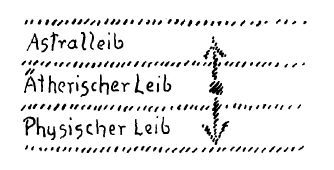
[ 12 ] Wir müssen nun die eigentlichen Kräfte, die da wirksam sind, vor allen Dingen die Eros- und Demeterkräfte, in dem Ätherleibe suchen. Sie werden vom Ätherleib hinaufgeschickt in den astralischen Leib und hinuntergeschickt in den physischen Leib, so daß der Ätherleib sowohl den Astralleib wie auch den physischen Leib beeinflußt. Den physischen Leib macht der Ätherleib in dieser Zeit vorzugsweise dichter, in sich konsolidierter, den astralischen Leib gestaltet er so um, daß er nicht mehr hellseherische Kräfte entwikkelt, sondern nur die intellektualistischen Kräfte der Menschennatur. Dadurch, daß der Mensch in dieser Weise umgestaltet wurde, daß er von seinem Ätherleibe aus alle drei Leiber umgestaltet erhielt, dadurch wurde in diesen drei Leibern im Laufe der Zeiten selbst Wichtigstes und Wesentlichstes verändert. Ganz umgestaltet wurden diese drei Leiber. Es war eben ein atlantischer Leib, selbst noch ein nachatlantischer Leib der ersten Perioden anders, als ein Leib heute ist. Es waren alle Verhältnisse und Lebensbedingungen anders. Das alles hat sich umgestaltet.
[ 12 ] We must now look for the actual forces at work here—above all, the forces of Eros and Demeter—in the etheric body. They are sent upward from the etheric body into the astral body and downward into the physical body, so that the etheric body influences both the astral body and the physical body. At this time, the etheric body primarily makes the physical body denser and more consolidated within itself; it reshapes the astral body so that it no longer develops clairvoyant powers, but only the intellectual powers of human nature. Because the human being was transformed in this way—receiving a transformation of all three bodies from his etheric body—the most important and essential aspects of these three bodies were altered over the course of time. These three bodies were completely transformed. An Atlantean body—and even a post-Atlantean body from the earliest periods—was different from a body today. All circumstances and living conditions were different. All of that has been transformed.
[ 13 ] Wenn wir zunächst den Physischen Leib betrachten in seinem lebendigen Werden von den ältesten Zeiten bis heute, so müssen wir sagen: Dadurch, daß der physische Leib dichter geworden ist, ist er mehr unterworfen worden den äußeren Einflüssen der physischen Umgebung. Während der alte, weiche physische Leib mehr den geistigen Bedingungen des Daseins in alten Zeiten unterworfen war, ist er in den neueren Zeiten durch seine Dichtigkeit den äußeren physischen Bedingungen des physischen Planes unterworfen worden. Dadurch sind gewisse Eigenschaften dieses physischen Leibes, die früher in solcher Form gar nicht vorhanden waren, erhöht worden, namentlich ist im physischen Leib anders geworden, was man die Krankheitsbedingungen nennt. Das, was man Erkrankung, was man Gesundheit des physischen Leibes des Menschen nennt, unterlag in alten Zeiten ganz anderen Ursachen. Da war alles das, was menschliche Gesundheit ist, mit den geistigen Verhältnissen der geistigen Welt in einem unmittelbaren Zusammenhang. Heute ist der physische Leib des Menschen mit den äußeren physischen Verhältnissen und Bedingungen im Zusammenhang und dadurch von den physischen Verhältnissen und Bedingungen abhängig. Und wir haben heute die Gesundheitsbedingungen mehr in den äußeren physischen Verhältnissen zu suchen. Der Mensch ist also mit seiner innersten Wesensnatur dadurch, daß Pluto - im Sinne der griechischen Mythologie gesprochen -— die Persephone geraubt hat, in die Untergründe der menschlichen Natur hinuntergeholt hat, den äußeren Bedingungen in bezug auf die Krankheits- und Gesundheitsverhältnisse unterworfen worden. Das ist das eine, was mit der Menschheitsorganisation vor sich gegangen ist.
[ 13 ] If we first consider the physical body in its living development from the earliest times to the present day, we must say: Because the physical body has become denser, it has become more subject to the external influences of the physical environment. While the old, soft physical body was more subject to the spiritual conditions of existence in ancient times, in more recent times it has, due to its density, become subject to the external physical conditions of the physical plane. As a result, certain characteristics of this physical body—which did not exist in this form at all in the past—have been heightened; specifically, what are called the conditions of illness have changed in the physical body. What is called illness and what is called health in the human physical body was subject to entirely different causes in ancient times. Back then, everything that constitutes human health was in direct connection with the spiritual conditions of the spiritual world. Today, the human physical body is connected to external physical conditions and circumstances and is therefore dependent on them. And today we must look for the conditions of health more in the external physical conditions. Thus, through the fact that Pluto—speaking in the sense of Greek mythology—abducted Persephone and brought her down into the underworld of human nature, human beings have been subjected to external conditions regarding matters of illness and health. This is one aspect of what has transpired within the organization of humanity.
[ 14 ] Das zweite bezieht sich auf den menschlichen Ätherleib selber. In ihm liegen zwar die Kräfte der Umgestaltung, aber er hat sich selber auch verändert. Dieser Ätherleib war in uralten Zeiten so organisiert, daß der Mensch nicht in derselben Weise die Welt erkannt hat, wie er sie heute erkennt, sondern wenn er hineinschaute in die geistige Welt durch das alte Persephone-Hellsehen, dann sah er in dieser geistigen Welt Bilder der geistigen Wesenheiten selber. Eine Bilderwelt sah der Mensch um sich. Diese Bilder werden zwar hervorgerufen durch die Kräfte des astralischen Leibes, aber der astralische Leib könnte sie, wenn er auf sich angewiesen wäre, nicht sehen. Der astralische Leib nimmt nicht Bilder wahr, wenn er allein auf sich angewiesen ist. Gerade sowenig wie ein Mensch sich selber sieht, wenn er, von keinem Spiegel gehindert, vorwärts geht, ebensowenig würde der astralische Leib die von ihm erzeugten Bilder wahrnehmen, wenn nicht die Tätigkeit des astralischen Leibes in der menschlichen Natur gleichsam zurückgeworfen würde durch den Ätherleib. So bringt der Ätherleib die vom astralischen Leib hervorgerufenen Bilder zum Anschauen, zum Wahrnehmen. Das, was der Mensch wahrnimmt von dem, was in seinem eigenen astralischen Leib vorgeht, ist das, was ihm sein Ätherleib spiegelt. Würden wir diese Spiegelung aller unserer astralischen inneren Vorgänge durch den Ätherleib nicht haben, so würde zwar alles das in uns sein, was der astralische Leib bewirkt, aber der Mensch würde es nicht anschauen, nicht wahrnehmen können. Daher ist das gesamte Weltbild, das sich der Mensch machen kann, der gesamte Inhalt seines Bewußtseins eine Spiegelung aus dem Ätherleibe. Und vom Ätherleibe hängt es ab, ob der Mensch überhaupt etwas weiß von der Welt. Es hing dieses ab vom Ätherleib in der alten hellseherischen Zeit, und auch heute hängt alles Wissen von der Welt von der Spiegelung der astralen Tätigkeit im menschlichen Ätherleibe ab.
[ 14 ] The second refers to the human etheric body itself. Although the forces of transformation lie within it, it has also undergone a transformation itself. In ancient times, this etheric body was organized in such a way that human beings did not perceive the world in the same way they do today; rather, when they looked into the spiritual world through the ancient Persephone clairvoyance, they saw images of the spiritual beings themselves in that spiritual world. Human beings saw a world of images around them. Although these images are brought about by the forces of the astral body, the astral body could not see them if it were left to its own devices. The astral body does not perceive images when it is left to its own devices. Just as a person does not see himself when he walks forward unimpeded by a mirror, so too would the astral body not perceive the images it generates unless the activity of the astral body in human nature were, as it were, reflected back by the etheric body. Thus the etheric body brings the images evoked by the astral body into view, into perception. What a person perceives of what is taking place in their own astral body is what their etheric body reflects back to them. If we did not have this reflection of all our inner astral processes through the etheric body, then everything that the astral body brings about would indeed be within us, but the person would not be able to see it or perceive it. Therefore, the entire worldview that a person can form, the entire content of their consciousness, is a reflection from the etheric body. And it depends on the etheric body whether a person knows anything at all about the world. This depended on the etheric body in the ancient clairvoyant era, and even today all knowledge of the world depends on the reflection of astral activity in the human etheric body.
[ 15 ] Was liegt also in den Kräften dieses Ätherleibes? In den Kräften dieses Ätherleibes liegt die Tatsache, daß wir durch sie den Schlüssel haben zur Erkenntnis der Welt. Sonst würde alles das, was die Welt in unserem astralischen Leib bewirkt, nicht die Pforte aufschließen zur Erkenntnis der Welt. Der Schlüssel zur WeltErkenntnis liegt im Ätherleib. Und auch alles das liegt in unserem Ätherleib, von dem wir so sprechen können, wie an einigen wichtigen Stellen der beiden Rosenkreuzerdramen gesprochen ist. Da ist gesprochen von den Gedankenlabyrinthen, von den Fäden, die unsere Welt-Erkenntnis spinnen muß. Wir lernen ja die Welt nicht dadurch erkennen, daß wir einfach auf sie hinschauen, sondern indem wir entweder wie im alten Hellsehen von Bild zu Bild gehen oder indem wir in der neueren intellektuellen Kultur von Gedanke zu Gedanke gehen eben wie durch das Gedankenlabyrinth. Auch dieser Zusammenhang wird durch die Kräfte des Ätherleibes bewirkt. Das hat sich also geändert, was wir den Schlüssel und was wir die Fäden nennen können, die zwischen den einzelnen Gebilden unseres Bewußtseins sich ausbreiten, wenn wir zur Welt-Erkenntnis gelangen. So sehen wir, was an den Kräften des Ätherleibes baut und was sich ändern muß an diesen Kräften des Ätherleibes.
[ 15 ] What, then, lies in the powers of this etheric body? In the powers of this etheric body lies the fact that through them we possess the key to understanding the world. Otherwise, everything that the world brings about in our astral body would not open the door to understanding the world. The key to understanding the world lies in the etheric body. And everything of which we can speak in the manner described in certain key passages of the two Rosicrucian dramas also lies within our etheric body. There is spoken of the labyrinths of thought, of the threads that our understanding of the world must weave. After all, we do not come to know the world by simply looking at it, but either by moving from image to image, as in the old clairvoyance, or by moving from thought to thought in the newer intellectual culture, just as through the labyrinth of thoughts. This connection, too, is brought about by the forces of the etheric body. Thus, what we might call the key and the threads that spread out between the individual structures of our consciousness as we attain knowledge of the world has changed. In this way, we see what builds upon the forces of the etheric body and what must change in these forces of the etheric body.
[ 16 ] Betrachten wir das dritte, den Astralleib selber. Der Astralleib ist Ja, wie gesagt, das Element in uns, in welches die Welt hereinwirkt und in welchem gestaltet werden die Kräfte und Fähigkeiten, die dann durch den Ätherleib gespiegelt werden. Im Astralleib wird die Erkenntnis entzündet, zum Bewußtsein gebracht wird sie durch den Ätherleib. Entzündet wird ein Gedanke, ein Bild im Astralleib; sie sind dadurch in uns, daß wir einen Astralleib haben. Es wird uns dieses Bild, dieser Gedanke bewußt dadurch, daß wir einen Ätherleib haben. Sie wären in uns, auch wenn wir keinen Ätherleib hätten, aber wir wüßten nichts davon. Die Fackel der Erkenntnis wird entzündet im Astralleib, gespiegelt als bewußte Erkenntnis des Menschen wird diese Fackel der Erkenntnis im menschlichen Ätherleib. So können wir sagen: Im menschlichen Astralleib wird die Fackel der Erkenntnis entzündet, und diese Fackel der Erkenntnis ändert sich wiederum im Laufe des geschichtlichen Werdens der Menschheit, so daß in alten Zeiten der Mensch die hellseherische Bilder-Erkenntnis hatte und heute die intellektuelle VerstandesErkenntnis. So haben sich die Kräfte des Astralleibes geändert.
[ 16 ] Let us consider the third, the astral body itself. The astral body is, as I said, the element within us into which the world acts and in which the forces and abilities are formed that are then reflected through the etheric body. In the astral body, insight is kindled; it is brought to consciousness through the etheric body. A thought or an image is kindled in the astral body; they are within us because we have an astral body. We become aware of this image, this thought, because we have an etheric body. They would be within us even if we had no etheric body, but we would know nothing of them. The torch of knowledge is kindled in the astral body; reflected as the human being’s conscious knowledge, this torch of knowledge becomes the human etheric body. Thus we can say: In the human astral body the torch of knowledge is kindled, and this torch of knowledge in turn changes in the course of humanity’s historical development, so that in ancient times human beings had clairvoyant, pictorial knowledge, and today they have intellectual, rational knowledge. Thus the powers of the astral body have changed.
[ 17 ] Während also der Mensch dieses geschichtliche Werden durchmachte, waren Kräfte in der menschlichen Natur, welche das ganze Verhältnis der Demeter zu den Menschen änderten. Aus dem alten, dünnen menschlichen Leib, aus dem alten, hellseherische Fähigkeiten entwickelnden Astralleib wurde sozusagen die Demeter ausgetrieben. Eros wirkte ein. Dafür wurden die — wie ich Ihnen heute gezeigt habe — andersgearteten erosfreien Kräfte der menschlichen Natur mehr der Demeter unterstellt. Es wirkte also eine Kraft des Werdens in drei Arten auf die menschliche Natur während dieser Zeit von der alten atlantischen Zeit bis heute; eine dreifache Natur des Werdens, des Umgestaltens, des Umformens, eine dreifache Art der Metamorphose, vom Ätherleibe ausgehend auf den physischen Leib, auf den Ätherleib selber, auf den Astralleib gehend. Diese Kraft des Werdens und der Umgestaltung, sie war in der menschlichen Natur und ist in uns. Sie ändert uns von der Jugend ins Alter um, indem sie die Eroskräfte in die Demeterkräfte überführt. Es ist in unserer Organisation dieses dreifache Werden, das im physischen Leibe die anderen Krankheits- und Gesundheitsbedingungen bewirkt, das im Ätherleibe die andere Spiegelung der Erkenntnis veranlaßt und das umändert die Fackel der Erkenntnis im Astralleibe.
[ 17 ] So as humanity underwent this historical development, forces within human nature were at work that altered the entire relationship between Demeter and humankind. Demeter was, so to speak, driven out of the old, frail human body and out of the old astral body, which had been developing clairvoyant abilities. Eros came into play. In its place, the forces of human nature that are—as I have shown you today—of a different kind and free from Eros became more subject to Demeter. Thus, a force of becoming acted upon human nature in three ways during this period from the ancient Atlantean era to the present day; a threefold nature of becoming, of transformation, of reshaping, a threefold kind of metamorphosis, proceeding from the etheric body to the physical body, to the etheric body itself, and to the astral body. This force of becoming and transformation was present in human nature and is within us. It transforms us from youth to old age by converting the forces of Eros into the forces of Demeter. It is this threefold becoming within our constitution that brings about the different conditions of illness and health in the physical body, that gives rise to the different reflection of knowledge in the etheric body, and that transforms the torch of knowledge in the astral body.
[ 18 ] Wie wunderbar ist es, daß uns aus der alten griechischen Götterlehre entgegenleuchtet der Repräsentant dieser Werdekräfte der menschlichen Natur, die in uns allen wirken, die unseren Astralleib umgestalten, die deshalb auch die Natur der Demeter umgestalten, jene Kräfte, die im menschlichen Ätherleibe sind und auf den physischen Leib und auf sich selber und auf den Astralleib wirken. Sie sind repräsentiert in der dreifachen Hekate. Was wir also heute ausdrücken dadurch, daß wir sagen: vom Ätherleibe gehen umgestaltende Kräfte in dreifacher Art aus, das drückte der Grieche aus, indem er von der dreifachen Hekate sprach. Ein Naturwunder der menschlichen Organisation in ihrem Werden ist in dieser dreifachen Hekate ausgesprochen. In ungeheure Weisheit blicken wir da hinein. Und Sie können noch heute in Rom dieses Bild der dreifachen Hekate sehen. Diese dreifach geteilte Hekate wird so dargestellt: die eine Organisation der Hekate, die sich bezieht auf die Krankheits- und Gesundheitsbedingungen, wird mit dem Symbolum des Dolches und der Schlange ausgestattet, welch letztere ja auch dem Äskulap beigegeben wird als dem Repräsentanten der Gesundheitskunde. Der Dolch repräsentiert die äußeren Einflüsse, die äußeren zerstörenden Einflüsse auf den menschlichen Organismus. Indem man der dreifachen Hekate in der einen ihrer Gestaltungen den Dolch und die Schlange beigegeben hat, wies man darauf hin, daß man jene Kräfte meinte, die den physischen Leib in bezug auf sein Werden beeinflußten. Das zweite Bild der Hekate mußte dann hinweisen darauf, daß sich im Ätherleibe geändert hat der Schlüssel zur Erkenntnis der Welt. Und welches Symbol hat das zweite Bild der dreifachen Hekate? Den Schlüssel und einen Bund Stricke als Symbolum für das Gedankenlabyrinth. Und die dritte Hekate hat die Fackel als die Fackel der Erkenntnis, wie sie sich im Astralleibe bildet. Und nun fühlen wir, mit welcher ungeheueren materialistischen Aberglaubensform man heute in unserem materialistischen Zeitalter vor dieser tiefsinnigen Gestalt der alten Zeit steht und wie sich diese Dinge beleben werden, wenn der Mensch wiederum wissen wird, was eigentlich gemeint wird mit solch einer grandiosen, tiefsinnigen Symbolik wie die der dreifachen Hekate. Das alte Griechenland wird neu erstehen in seinen Gedanken, wenn die mit Geisteswissenschaft gesättigte Menschenseele sich vor ein solches Bildwerk stellen wird und in dieser Menschenseele aufströmen wird all das Wissen von der geistigen Natur des Menschen, das hineingeheimnißt ist in eine solche Gestalt. Diese Dinge braucht man nicht in einem abstrakten Sinne zu nehmen. Wir können sie natürlich nur aussprechen, indem wir sie sozusagen in abstrakte Gedanken kleiden. Das alles kann aber für uns lebendige Empfindung und lebendiges Gefühl werden, wenn wir uns durchdringen mit dem Bewußtsein, daß auch die Hekate nur die Art und Weise ihrer Wirksamkeit geändert hat, daß sie aber auch heute in uns ist und in jedem einzelnen von uns wirkt.
[ 18 ] How wonderful it is that the ancient Greek pantheon shines upon us with the representative of these formative forces of human nature, which are at work within us all, which transform our astral body, and which therefore also transform the nature of Demeter—those forces that are within the human etheric body and act upon the physical body, upon themselves, and upon the astral body. They are represented in the triple Hecate. So what we express today by saying that transforming forces of a threefold nature emanate from the etheric body, the Greeks expressed by speaking of the triple Hecate. A natural wonder of the human organism in its becoming is expressed in this triple Hecate. We gaze into it with immense wisdom. And you can still see this image of the triple Hecate in Rome today. This threefold Hecate is depicted as follows: one aspect of Hecate, which relates to conditions of illness and health, is represented by the symbols of the dagger and the snake—the latter of which is also associated with Aesculapius as the representative of the science of health. The dagger represents the external influences, the external destructive influences on the human organism. By assigning the dagger and the snake to the triple Hecate in one of her forms, it was indicated that one was referring to those forces that influenced the physical body in relation to its becoming. The second image of Hecate was then meant to indicate that the key to knowledge of the world has changed within the etheric body. And what symbol does the second image of the triple Hecate bear? The key and a bundle of ropes as a symbol of the labyrinth of thought. And the third Hecate holds the torch as the torch of knowledge, as it forms within the astral body. And now we sense the immense form of materialistic superstition with which we stand today, in our materialistic age, before this profound figure of ancient times, and how these things will come to life when humanity once again knows what is actually meant by such magnificent, profound symbolism as that of the triple Hecate. Ancient Greece will rise anew in its thoughts when the human soul, imbued with spiritual science, stands before such a work of art, and all the knowledge of the spiritual nature of the human being—which is enshrined in such a figure—will well up within that human soul. These things need not be taken in an abstract sense. Of course, we can only express them by, so to speak, clothing them in abstract thoughts. But all of this can become a living sensation and a living feeling for us if we imbue ourselves with the awareness that Hecate, too, has merely changed the manner of her activity, but that she is also within us today and works in each and every one of us.
[ 19 ] Der alte Grieche sagte: Nicht nur die ganze Menschheit in ihrem Werden, sondern auch der einzelne Mensch untersteht, indem seine Leibesform umgestaltet wird, indem er seinem physischen Leibe, Ätherleibe und Astralleibe nach umgeändert wird, den Kräften der Hekate. Hekate wirkt in ihm in dreifacher Art. — Aber das, was dazumal im Bilde der Hekate der menschlichen Seele vermittelt worden ist, kann auch heute wieder vermittelt werden. Der moderne Bekenner der Geisteswissenschaft, der nicht mehr in solcher bildlichen Form spricht, wie drückt er sich aus? Er sagt: Im Laufe der menschlichen Einzelentwickelung von der Geburt bis zur Reife werden im menschlichen Werden die drei Glieder der menschlichen Leibeshülle umgeändert: in den ersten sieben Jahren die physische, in den zweiten sieben Jahren die ätherische, in den dritten sieben Jahren die astralische. - Die Kräfte, die Sie beschrieben finden, ohne daß dies Bild gebraucht ist, in meiner kleinen Schrift über «Die Erziehung des Kindes», die Kräfte, die da wirken in der menschlichen Organisation in dreifacher Weise, es sind die Hekate-Kräfte. Und indem Ihnen beschrieben wird heute von der Geisteswissenschaft, daß der Mensch bis zum Zahnwechsel vorzugsweise seinen physischen Leib ausbildet, wird darauf hingewiesen, daß die eine Form der Hekate in ihm wirkt. Da wird in moderner Form gesagt, was der Grieche meint, wenn er den einen Teil der Hekate mit Dolch und Schlange hinstellt. Und mit Schlüssel und Strickbund wird der zweite Teil der Umwandlung hingestellt, wo der Ätherleib aus sich selbst wirkt in den zweiten sieben Jahren. Und die dritten sieben Jahre werden hingestellt, als im Astralleib selber ganz vor sich gehend, mit dem Symbol der Fackel. So habe ich Ihnen im Grunde genommen in moderner Form längst das gesagt, was die Hekate-Weisheit der alten Griechen war, was im Bilde der Hekate in den alten Mysterien der Griechen ausgedrückt worden ist.
[ 19 ] The ancient Greeks said: Not only all of humanity in its development, but also the individual human being is subject to the forces of Hecate as his physical form is transformed, as he is reshaped in his physical, etheric, and astral bodies. Hecate works within him in threefold ways. — But what was once conveyed to the human soul through the image of Hecate can also be conveyed again today. How does the modern adherent of spiritual science, who no longer speaks in such pictorial terms, express himself? He says: In the course of the individual human development from birth to maturity, the three members of the human physical body are transformed: the physical body in the first seven years, the etheric body in the second seven years, and the astral body in the third seven years. - The forces you will find described—without the need for this image—in my short treatise on “The Education of the Child,” the forces that act in the human organism in threefold ways, are the Hecate forces. And when spiritual science describes to you today that, up until the change of teeth, the human being primarily develops his physical body, it points out that one form of Hecate is at work within him. There, in a modern form, is stated what the Greek meant when he depicted one part of Hecate with a dagger and a snake. And with a key and a bundle of ropes, the second part of the transformation is depicted, where the etheric body acts from within itself during the second seven years. And the third seven years are depicted as taking place entirely within the astral body itself, with the symbol of the torch. So, in essence, I have long since told you in a modern form what the Hecate wisdom of the ancient Greeks was, what was expressed in the image of Hecate in the ancient mysteries of the Greeks.
[ 20 ] Das aber ist auch der Sinn unseres Werdens der europäischen Kultur. Schauen wir zurück in die alten Zeiten des Griechentums, dann treten uns in den Überlieferungen der griechischen Mystik, der griechischen Mythologie auch die gewaltigen Bilder entgegen, die hingestellt wurden vor die zu Unterrichtenden, um in der Seele zu erwecken die Erkenntnis, die damals notwendig für den Menschen war. Das Bild der dreifachen Hekate weckte - nicht in der heutigen Form — die Wissenschaft auf, die wir aufnehmen, wenn wir die Lehre von der dreifachen Umwandlung von der Geburt bis etwa zum zwanzigsten Jahre ins Auge fassen. Und wenn wir solche Lehren ins Auge fassen, dann folgen wir getreulich dem Gange, den die menschliche Kultur nehmen muß. Die alte hellseherische Form mußte untertauchen in das Reich des Pluto in der menschlichen Seele, und eine Weile, von der alten sokratischen Zeit bis in unsere Gegenwart herein, mußte gewissermaßen eine Epoche des Nichtwissens herrschen in bezug auf alle diese Verhältnisse. Die Menschen mußten ihr Ich konsolidieren, ihre Egoität ausbilden. Da blieb unter der Oberfläche der menschlichen Seele das alte, durch die grandiosen Bilder angeregte Wissen der Griechen. Da war es gleichsam unter dem Schutte der intellektuellen Kultur begraben. Jetzt taucht es wieder auf aus einer dunklen Geistestiefe. In der Geisteswissenschaft taucht aus dem modernen Leben wiederum das herauf, was da untergetaucht ist in tiefere Gründe der menschlichen Seele. Wir fangen heute wiederum an auf die Art, die ich beschrieben habe in der «Erziehung des Kindes», die dreifache Hekate in einer mehr abstrakten Form zu erkennen. Dadurch aber wird die menschliche Seele wiederum vorbereitet zu einem künftigen, trotz der Intellektualität uns in Aussicht stehenden Hellsehen. Und die Vorbereitung für dieses künftige Hellsehen der Menschheit, das ist unsere Geisteswissenschaft. Oh, jene dreifache Hekate, von der die Griechen gesprochen haben, jene Demeter und Persephone und die andern Gestalten alle, die damals nicht solche Abstraktionen waren, wie die abergläubischen Gelehrten heute träumen, sondern lebendige Gestalten des griechischen Sehertums, alle diese Gestalten werden wieder erscheinen vor dem hellseherischen Blick, der in der Zukunft für die Menschheit immer mehr und mehr herunterdringen wird aus den geistigen Welten. Und die Kraft, welche in die Menschenseelen eindringt, um sie wieder hinaufzuführen, oder ich könnte auch sagen, um zu ihr herunterzuführen die hellseherischen Kräfte, ist diejenige, welche zunächst für die Erkenntnis der Menschen als bewußter Gedanke vorbereitet worden ist in der alten Jahve-Kultur und dann ihre volle Ausgestaltung gewonnen hat durch das Erscheinen der Christus-Wesenheit, die von den Menschen immer mehr und mehr erkannt werden wird. Und indem gesagt wird innerhalb unserer wahren Geisteswissenschaft, daß schon in diesem 20. Jahrhundert beginnt jenes hellseherische Hinaufschauen der Menschen zu dem seit dem Mysterium von Golgatha mit der Erde vereinten Christus, wird zu gleicher Zeit gesagt, daß dies Ereignis des wiederkommenden Christus selbstverständlich nicht in einem physischen Leibe, sondern für das ätherische _ Anschauen wie bei Paulus vor Damaskus eintreten wird. In dieser Christus-Kraft sind alle Impulse der menschlichen Natur gegeben, diese wiederum hinaufzuführen und sie zugleich anschauen zu lassen alles das, was zum Beispiel auch von griechischen Göttergestalten hinuntergetaucht ist in die unterbewußten Seelengründe.
[ 20 ] But this is also the meaning of the development of European culture. If we look back to the ancient times of Greek civilization, we encounter in the traditions of Greek mysticism and Greek mythology the powerful images that were presented to students in order to awaken in the soul the insight that was necessary for people at that time. The image of the threefold Hecate awakened—not in its present form—the knowledge we take in when we consider the teaching of the threefold transformation from birth to about the age of twenty. And when we consider such teachings, we faithfully follow the course that human culture must take. The old clairvoyant form had to sink into the realm of Pluto within the human soul, and for a time, from the old Socratic era right up to the present day, an epoch of ignorance had to prevail, so to speak, with regard to all these conditions. Human beings had to consolidate their “I,” to develop their ego. There, beneath the surface of the human soul, remained the ancient knowledge of the Greeks, inspired by those magnificent images. There it lay, as it were, buried beneath the rubble of intellectual culture. Now it is emerging once more from a dark depth of the spirit. In spiritual science, that which had sunk into the deeper recesses of the human soul is rising again from modern life. Today we are once again beginning to recognize the triple Hecate in a more abstract form, in the manner I described in *The Education of the Child*. Through this, however, the human soul is once again being prepared for a future clairvoyance that lies in prospect for us, despite intellectualism. And the preparation for this future clairvoyance of humanity—that is our spiritual science. Oh, that triple Hecate of whom the Greeks spoke, that Demeter and Persephone and all the other figures, who were not, back then, mere abstractions as the superstitious scholars of today imagine, but living figures of Greek seership, all these figures will appear again before the clairvoyant gaze that will descend more and more from the spiritual worlds for humanity in the future. And the power that penetrates human souls to lead them upward again—or I might also say, to bring down to them the clairvoyant powers—is the one that was first prepared for human knowledge as a conscious thought in the ancient Yahweh culture and then attained its full form through the appearance of the Christ Being, who will be recognized by humanity more and more. And while it is said within our true spiritual science that already in this 20th century that clairvoyant looking upward of human beings toward the Christ—who has been united with the Earth since the Mystery of Golgotha—begins, it is said at the same time that this event of the returning Christ will, of course, not occur in a physical body, but for the etheric beholding, as with Paul on the road to Damascus. In this Christ-force are contained all the impulses of human nature, to lift it up once more and at the same time allow it to behold all that has, for example, also descended from Greek deities into the subconscious depths of the soul.
[ 21 ] Das wird in die Zukunft hinein das größte Ereignis der menschlichen Seelenentwickelung sein, jenes Ereignis, auf das die Geisteswissenschaft vorbereiten muß, damit die menschlichen Seelen fähig werden, jenes ätherische Anschauen zu gewinnen. Und in den nächsten dreitausend Jahren wird das immer mehr und mehr menschliche Seelen ergreifen, und die nächsten dreitausend Jahre werden im wesentlichen gewidmet sein dem Aufflammen der Kräfte der menschlichen Seele, die die Ätherwunder der Natur um sich herum gewahr werden kann. In unserem Jahrhundert wird es beginnen, daß einzelne aus ihrer Ätherseele heraus den wiederkommenden Christus erblicken, und immer mehr und mehr Menschen werden es sein durch die nächsten drei Jahrtausende. Und dann wird sich erfüllen, was die wahre orientalische Tradition ist, die mit allem wahren Okkultismus übereinstimmt, daß mit Ablauf dieser dreitausend Jahre in einer ebenso verständlichen Form für die menschliche Seele spricht der zu der Menschheit herabsteigende Maitreya Buddha, der dann diese Christus-Natur dem Menschen vermitteln wird. Das ist das, was die orientalische Mystik bewahrt, daß dreitausend Jahre etwa nach unserer Zeit der Maitreya Buddha erscheinen wird. Was die abendländische Kultur beizutragen hat, ist, daß jene Welt-Individualität, wie Sie es in dem Mysterium «Die Prüfung der Seele» wieder betont finden, nur einmal im physischen Leibe erschienen ist, daß diese immer sichtbarer für das ätherische Anschauen der Menschen sein wird. Dadurch wird sie der Menschenseele etwas Vertrautes werden. Und mit so hinreißenden Worten, wie vor zwei Jahrtausenden der Buddha gesprochen hat von dem, was damals den besten Menschenseelen seiner Zeit das Natürliche war, so wird der Maitreya Buddha überall verkündigen können das, was heute noch nicht möglich ist, öffentlich auszusprechen, was sich aber vollziehen wird in dem ätherischen Anschauen des Christus. Das ist das größte Ereignis des 20. Jahrhunderts, dieses Hinaufentwickeln der menschlichen Natur zu dem, was wir die Wiederbringung des Paulus-Ereignisses nennen können. Dazumal kam es nur über den einzelnen, über Paulus, in der Schauung von Damaskus. Es wird in der Zukunft für die gesamte Menschheit kommen nach und nach, von unserem Jahrhundert angefangen.
[ 21 ] This will be the greatest event in the future development of the human soul—the event for which spiritual science must prepare, so that human souls may become capable of attaining that etheric vision. And over the next three thousand years, this will increasingly take hold of human souls, and the next three thousand years will essentially be devoted to the awakening of the powers of the human soul, which will be able to perceive the etheric wonders of nature all around it. In our century, it will begin that individuals will behold the returning Christ from within their etheric soul, and there will be more and more people doing so over the next three millennia. And then what the true Eastern tradition holds—which is in harmony with all true occultism—will be fulfilled: that at the end of these three thousand years, the Maitreya Buddha, descending to humanity, will speak to the human soul in a form equally comprehensible to it, and will then impart this Christ-nature to humankind. This is what Eastern mysticism preserves: that some three thousand years after our time, the Maitreya Buddha will appear. What Western culture has to contribute is that this World Individuality—as you find it emphasized once again in the Mystery Play “The Trial of the Soul”—has appeared only once in a physical body, and that it will become ever more visible to the etheric gaze of human beings. Through this, it will become something familiar to the human soul. And with words as captivating as those spoken by the Buddha two millennia ago about what was then natural to the finest human souls of his time, the Maitreya Buddha will be able to proclaim everywhere what is not yet possible to speak of publicly today, but which will take place in the etheric vision of the Christ. This is the greatest event of the 20th century: this ascent of human nature to what we might call the re-enactment of the Paul event. Back then, it came only through the individual, through Paul, in the vision on the road to Damascus. In the future, it will come gradually to all of humanity, beginning in our century.
[ 22 ] Derjenige, der da glaubt an den Fortschritt der menschlichen Natur, der da glaubt, daß die menschliche Seele immer höhere und höhere Kräfte entwickeln wird, der weiß, daß es notwendig für die in die tiefsten Tiefen des physischen Planes heruntergestiegene Menschenseele war, daß der Christus auch in einem physischen Leibe einmal erschien. Das war notwendig, weil damals die menschliche Seele nur die Gottheit in einem Leibe sehen konnte, der für physische Augen, für physische Organe sichtbar war. Dadurch aber, daß dieses Ereignis eintrat, daß die alte Jahve-Kultur‘ dieses Ereignis vorbereitet hat und es dann eingetreten ist, dadurch wird die menschliche Seele zu immer höheren Fähigkeiten geführt, und die Erhöhung dieser Fähigkeiten drückt sich dadurch aus, daß nun die Menschen lernen werden, auch dann den Christus zu schauen, wenn er nicht mehr in einem physischen Leibe unter ihnen wandelt, sondern wenn er so sich zeigt, wie er jetzt auch unter uns ist seit dem Mysterium von Golgatha, allerdings nur für hellsichtige Augen sichtbar. Der Christus ist da, ist mit dem Ätherleibe der Erde vereinigt. Das, worauf es ankommt, ist, daß die menschliche Seele sich heraufentwickelt, um ihn zu schauen. Darin liegt der große Fortschritt der Entwickelung der menschlichen Seele, und wer da an den Fortschritt der menschlichen Seele glaubt, wer glaubt, daß Geisteswissenschaft einen Zweck hat und eine Mission in bezug auf den Fortschritt der menschlichen Seele, der wird verstehen, daß die Kräfte der menschlichen Seele immer höhere werden müssen und daß es ein Stehenbleiben bedeuten würde, wenn die menschliche Seele in unserer Zeit den Christus in derselben physischen Form sehen müßte, in der sie ihn einstmals sah. Wer also glaubt an den Fortschritt und wer an Zweck und Mission der Geisteswissenschaft glaubt, der weiß: Eine grandiose Bedeutung liegt in dieser alten Rosenkreuzerformel von dem GottesSohnes-Wesen, das nur einmal in einem physischen Leibe sich verkörpert hat, das schon von unserem Jahrhundert ab - nach den Prophezeiungen und nach unseren Erkenntnissen — wiederum den menschlichen Seelen als ätherisches Wesen mehr und mehr sichtbar sein wird. Wer an den Fortschritt des menschlichen Werdens glaubt, der glaubt an dieses Wiederkehren des Christus, der da schaubar wird für die ätherischen Fähigkeiten des Menschen. Wer da nicht glauben will an den Fortschritt, der möge glauben daran, daß die menschlichen Seelenkräfte stehenbleiben und auch in unserer Zeit nötig haben, den Christus in derselben Gestalt zu sehen wie damals, als die Menschheit heruntergestiegen war in tiefste Gründe der Materie, der möge glauben an eine Wiederkehr eines Christus in einem physischen Leibe.
[ 22 ] Anyone who believes in the progress of human nature, who believes that the human soul will develop ever higher and higher powers, knows that it was necessary for the human soul—which had descended into the deepest depths of the physical plane—that Christ should also appear once in a physical body. This was necessary because, at that time, the human soul could only perceive the Godhead in a body that was visible to physical eyes and physical organs. But because this event occurred—because the ancient ‘Yahweh culture’ prepared the way for it and it then took place— the human soul is led to ever higher capacities, and the elevation of these capacities is expressed in the fact that people will now learn to behold the Christ even when he no longer walks among them in a physical body, but when he reveals himself as he has been among us since the Mystery of Golgotha—though visible only to clairvoyant eyes. Christ is here, united with the etheric body of the Earth. What matters is that the human soul develops itself to the point of being able to see him. In this lies the great progress of the development of the human soul, and whoever believes in the progress of the human soul, whoever believes that spiritual science has a purpose and a mission regarding the progress of the human soul, will understand that the powers of the human soul must become ever higher, and that it would mean stagnation if the human soul in our time were to see the Christ in the same physical form in which it once saw him. Whoever, therefore, believes in progress and in the purpose and mission of spiritual science knows this: there lies a profound significance in this ancient Rosicrucian formula concerning the Being of the Son of God, who incarnated in a physical body only once, and who—beginning with our own century, according to the prophecies and our insights—will once again become increasingly visible to human souls as an ethereal being. Whoever believes in the progress of human development believes in this return of the Christ, who will then become visible to the etheric faculties of human beings. Whoever does not wish to believe in this progress may believe that the powers of the human soul remain static and still require, even in our time, to see Christ in the same form as when humanity had descended into the deepest depths of matter; let such a person believe in the return of a Christ in a physical body.