Esoteric Christianity and the
Spiritual Guidance of Humanity
GA 130
1 October 1911, Basel
Translated by Steiner Online Library
6. The Etherization of the Blood. The Intervention of the Etheric Christ in Earth's Evolution
[ 1 ] Although self-knowledge has been demanded of the human soul throughout the ages, in all periods when people have sought knowledge—whether mystically, realistically, or in any other way—this self-knowledge of the human soul is by no means as easy as quite a few, even among theosophists, still imagine it to be. And the difficulties of human self-knowledge are something that the theosophist should constantly bring to mind, because, on the other hand, this self-knowledge is absolutely essential if we are to attain a truly dignified goal in our existence in the world—a truly dignified way of being and acting.
[ 2 ] Today, let us first consider the question of why self-knowledge must be so difficult for human beings. After all, human beings are quite complex creatures, and when we speak, for example, of the human soul or the inner life of a human being, we certainly do not want to imagine this soul life, this inner life, as simple and elementary from the outset; rather, we want to have the patience and perseverance to delve ever deeper, so that we may gradually and truly penetrate this marvelous structure, this wonderful organization of the divine-spiritual world forces, as which the human being can appear. Two things may strike us about the life of the human soul before we penetrate into the nature of cognition.
[ 3 ] Just as a magnet has a north pole and a south pole, and just as light and darkness appear in the external world as the primary shades of light, so too does the soul have two—one might say, two poles—of its existence. These two poles can become apparent to us when we observe human beings in two situations, two states of life. One such situation in life would apply to the soul’s life, for example, when we see a person—let’s say—standing on the street, completely lost in the contemplation of a beautiful, sublime, striking natural phenomenon. We see how he does not move a hand, does not move a leg, how he hardly takes his eyes off the natural phenomenon or the object that catches his attention and which he is observing, and we perceive that he is busy forming images within himself of what he sees before his eyes. We say: He is absorbed in contemplation; he is imagining his surroundings. That would be the one situation we wish to consider. Another situation would be the following: A person is walking down the street and feels insulted or hurt by another person. Without much thought, his anger and irritation take hold of him, and as an outburst of his anger, he does this: He strikes the one who insulted him or something similar. Here we perceive a manifestation of those forces that arise from anger and irritation. We perceive impulses of the will here, and we can quite well imagine that not many thoughts or ideas preceded this impulse, that the person in question might not have swung the blow, that he would have prevented the outburst of anger if he had thought things through carefully. We have set before us two extreme actions: one that manifests entirely as an image, in which the conscious will is completely shut out, and the other in which the life of the imagination is shut out and where the person immediately proceeds to the expression of a volitional impulse. These are the two things that represent for us the two extreme poles of the human soul. The impulsive nature of the will is one pole; the will-less surrender to contemplation, imagination, and thinking, while the will remains silent, is the other pole. Thus, we have set out the facts in a completely exoteric manner, purely through observation of external life.
[ 4 ] We can now delve a little deeper, and we then enter those spheres where we can only fully find our way if we draw on occult research. Another polarity confronts us there: the polarity of waking and sleeping. We know, of course, what sleep and waking signify in an occult context. According to the fundamental concepts of our theosophical knowledge, we know that in waking life the four members—the physical, etheric, and astral bodies and the I—are organically interwoven and interact with one another; whereas in sleep, the physical and etheric bodies lie in bed, while the astral body and the I are, as it were, poured out into the entire vast world that immediately adjoins our physical existence. We could also approach these facts in a different way. We could, for instance, ask ourselves how it actually stands with the perception of the world of life, with imagination and thought, and with the will and its impulses during waking and sleeping?
[ 5 ] Now, if we look more deeply, it becomes clear that, in a certain sense, human beings are actually always asleep in their present physical existence. They simply sleep differently at night than they do during the day. You can already visualize this purely from an external perspective, since you know that during the day one can awaken occultly, become clairvoyant, and look into the spiritual world. The ordinary physical body is asleep in relation to this perspective, and one can say that it is an awakening when a person learns to use their spiritual senses. And with regard to nighttime sleep, it is clear that the human being is asleep. So that one can say: Ordinary sleep is a sleep in relation to the outer physical world; daytime consciousness is currently a sleep in relation to the spiritual world.
[ 6 ] We can view these facts in yet another way. If we look more deeply, we realize that, in the ordinary waking state of physical life, human beings generally have very little control over their will. The will is something that largely eludes us in daily life. If you were to observe closely what we call human will, you would see how little control a person has over their will impulses during the course of daily life. Consider how little of what you do from morning to night truly arises from your own thinking and imagination, from a personal, individual decision. You cannot, when someone knocks on the door and you say: “Come in!”—you cannot call this a true decision of your own thinking and will. You cannot possibly say, when you are hungry and sit down to eat, that this is a decision of your will, for it is prompted by your organism, by your condition. Now try to hold your daily life before your eyes, and you will see how little the will is directly influenced by the human center. What is the cause of this? Occultism teaches this, showing that, in terms of the will, a person is indeed asleep during the day—that is, they do not live within their volitional impulses at all. We can arrive at ever better and better concepts and ideas, become more moral or more refined people, if you will, but in terms of the will, we can do absolutely nothing. If we harbor better thoughts, we can indirectly influence the will, but as far as life is concerned, we can do absolutely nothing directly regarding the will, for our will is only indirectly influenced by our daily life—indirectly through sleep. You do not think when you sleep; you have no ideas: it is the act of imagining and thinking that passes into sleep. The will, on the other hand, is awake and permeates our organism from the outside, enlivening it. That is why we feel strengthened in the morning, because what enters our organism is of a volitional nature. That we do not perceive this work of the will, that we know nothing of it, may seem quite plausible to us when we consider that our imagination sleeps when we sleep. Therefore, let us first offer a suggestion for further reflection, for further meditation. You will see that the further you advance in self-knowledge, the more you will find this statement to be true: A person sleeps in relation to their will when they are awake, and they sleep in relation to their imagination when they are asleep. By day the will sleeps; by night the life of the imagination sleeps.
[ 7 ] If a person does not realize that the will does not sleep at night, it is because that person knows how to stay awake only in the realm of the imagination. The will does not sleep at night, but rather acts there as in its true fiery element, working on the body to restore what has been consumed during the day.
[ 8 ] There are thus two poles within the human being: the impulses of the will and the life of observation or imagination, and people relate to these two poles in completely opposite ways. But these are only two poles. The entire life of the soul lies in various nuances between these two poles, and we will now approach this life of the soul a little more closely by attempting to relate this life of the soul—the microcosmic life of the soul—to what we recognize as the higher worlds. From what has been said, we have seen that one pole of our soul life is the life of imagination.
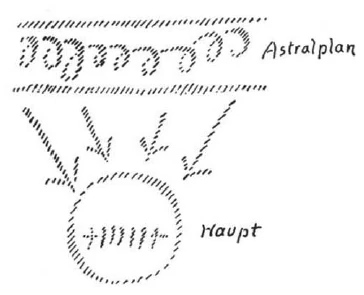
[ 9 ] This inner life of imagination is something that appears unreal to the outward, materialistically minded person. Isn’t it true that we often hear people say: “Oh, ideas and thoughts are just ideas and thoughts!” People want to point out that when you pick up a piece of bread or meat, that is a reality, whereas a thought is just a thought. People believe that thoughts cannot be eaten, and therefore they are not real, not actual—they are “only” thoughts. But why are they only thoughts? For the reason that what humans call their thoughts relates to what thoughts actually are in the same way that a shadow relates to the thing itself. If you have a flower there and you look at its shadow, the shadow points to the flower, to reality. It is the same with thoughts. Human thinking is the shadow of ideas and beings that exist in a higher world: in what is called the astral plane. And you actually imagine thinking correctly when you picture here—though this is not entirely accurate, but rather a schematic representation—the human head. Within this head are the thoughts, which I will represent here with lines. But we imagine these thoughts within the head as living beings—here on the astral plane. There, the most diverse beings are at work; it is teeming with ideas and actions that cast their shadows into the human being, and these processes are reflected in the human head as thinking. It is a correct conception if you imagine: From your head, currents are constantly flowing into the astral plane, and these are the shadows that convey the life of thought within your head. (See diagram on page 93.)
[ 10 ] In addition to what we might call the life of thought, there is another kind of life for the human soul. In everyday life—this isn’t entirely accurate, but I say it so that one can grasp the concept from the perspective of everyday life—we distinguish between the life of thought and the life of feeling. Among feelings, we distinguish between those of approval—sympathetic feelings—and those of disapproval—unsympathetic feelings. The former arise in connection with acts of justice and benevolence; antipathy arises in connection with acts of malice and injustice. This is already more than mere imagination; it is something else. We also form mental images of things that are indifferent to us. But these emotional experiences of sympathy and antipathy we have only toward the beautiful and the good, or the bad and the ugly. Just as everything that takes place within a human being as thoughts points to the astral plane, so everything connected with sympathy and antipathy points to what we call the lower Devachan. And in the same way, I could now extend the lines that I previously drew as far as the astral world in these concepts, all the way up into the Devachan or the heavenly world. Within us, particularly in our hearts, processes from the heavenly world or Devachan unfold as feelings of sympathy and antipathy toward the beautiful and the ugly, the good and the bad or evil, so that we carry within our souls what we might call our sensibilities toward the moral-aesthetic world—the reflections of the lower Devachan, the heavenly world.
[ 11 ] There is also a third aspect of human inner life that we must clearly distinguish from a mere preference for benevolent actions. There is a difference between standing by and observing a beautiful, benevolent act and taking pleasure in it, and actually putting one’s will into action to perform a benevolent act oneself. I would like to call the pleasure derived from good, beautiful acts and the displeasure derived from evil, ugly acts the aesthetic element, whereas that which drives a person to act well is the moral element. The moral stands higher than the merely aesthetic; mere pleasure or displeasure stands lower than the feeling of being compelled to do good or evil. To the extent that our soul feels driven, to the extent that it feels the moral impulses, these impulses are the shadow images of the higher Devachan, the upper heavenly world.
[ 12 ] We can quite well imagine that these three successive levels of soul activity—the purely intellectual aspects of thinking, imagining, and contemplating; the aesthetic aspect of liking and disliking; and the moral aspect in the impulses toward good and evil—that these three distinct experiences of the soul experience of the human soul are microcosmic images of what, in the great world outside in the macrocosm, overlaps in the three worlds: the astral world, which is reflected as the world of thought, the intellectual world; the Devachanic world, which is shadowed as the aesthetic world of pleasure and displeasure; the higher Devachanic world, which is reflected as morality.
| Thoughts: | Shadow images of beings from the astral plane | (Waking) |
| Sympathy and Antipathy: | Shadow images of beings of the lower Devachan | (Dreaming) |
| Moral impulses: | Shadow images of beings of the higher Devachan | (Sleeping) |
[ 13 ] If we connect what we have just said with what was previously said about the two poles of the human soul, we must perceive the intellectual as one pole—the pole that primarily governs waking life, when we are awake in relation to our intellectual life. During the day, a person is awake in relation to their intellect; during sleep, they are awake in relation to their will. But because they are then asleep in relation to their intellect, they are not aware of what they are doing with their will. Yet what we call moral principles and impulses indirectly influence the will. And indeed, human beings need the life of sleep so that what they take in through their thought life in the form of moral impulses can truly come into effective action. It is true: as human beings are today in ordinary life, they are only capable of carrying out what is right on the intellectual plane; they are less capable on the moral plane: there we are dependent on being helped from the macrocosm.
[ 14 ] What lies within us can take us a step further in intellectual terms, but when it comes to becoming morally better, we need the gods to come to our aid. That is why we sink into sleep, so that we may immerse ourselves in the divine will, where we are not present with our powerless intellect and where divine powers transform what we take in as moral principles into the power of the will, where they instill into our will that which we can otherwise only take in through our thoughts.
[ 15 ] Between these two poles—the pole of the will, which is awake at night, and the pole of the intellect, which is awake by day—lies the aesthetic circle, which is always present in human beings. For by day, human beings are not fully awake. Only the most sober, most philistine people are always awake when they are awake. People must, in essence, also dream a little during the day; they must be able to dream a little while awake, must be able to surrender themselves to art, poetry, or other life activities that are not directed solely toward the crude reality. Those who surrender themselves in this way create a bond that can have a very refreshing and invigorating effect on their entire existence. Surrendering to such thoughts is, in a sense, what penetrates waking life like a dream. And in sleep, as you know, dreaming is introduced there; it is the real dreams that permeate the rest of consciousness during sleep. This is something that all people need who do not wish to lead merely a sober, dry, unhealthy daily life. And dreaming comes at night anyway; there is no need to justify it. This is the middle ground that lies between the two poles: night-time and day-time dreaming, which allows one to live in the imagination.
[ 16 ] Thus, here too we have a threefold aspect within the soul: the intellectual aspect, through which we are truly awake and carry within us the shadow images of the astral plane when we give ourselves over to our thoughts during the day, so that the most fruitful ideas of everyday life and the great inventions emerge. And during sleep, when we dream, when these dreams enter our sleep-life, then the images of the lower heavenly world or of Devachan are reflected within us. And when we then work in sleep and imprint morality upon our will—we cannot perceive this directly, but we can perceive its effects—then, when we are able to instill this influence of the divine-spiritual powers into our thinking during the night, the impulses we perceive there are the reflections from the upper Devachan, the upper heavenly world. These are the moral impulses and feelings that live within us and cause us to say: Ultimately, human life is justified only by the fact that we place our thoughts in the service of the good and the beautiful and allow our intellectual activity to be permeated by the true, genuine lifeblood of divine-spiritual life, to be permeated by moral impulses.
[ 17 ] What we describe as the human soul life—first through an external, exoteric perspective, then through a somewhat more mystical view of life—arises from deeper occult research. And there we see, in the processes that clairvoyance can also perceive in human beings, what we have just described in more external terms. When a person stands before us today in the waking state and the clairvoyant eye observes them, it becomes apparent that certain rays of light are constantly flowing from the heart to the head. If we were to draw this schematically, we would have to depict the heart region here, with currents continuously flowing toward the brain and circulating within the head around the organ described in anatomy as the pineal gland. Like rays of light, they rise from the heart to the head and flow around the pineal gland. These currents arise because human blood, which is a physical substance, a material, is continually dissolving into ethereal substance, so that in the region of the heart a continuous transition of the blood into fine ethereal substance takes place, and this flows upward toward the head and shimmers around the pineal gland. This process, the etherization of the blood, is constantly evident in the waking human being. But it is different in the sleeping human being. Here, if we were to observe the brain region here and the heart region there, the occult observer would perceive a continuous flow coming in from the outside, and also flowing backward into the heart. These currents, however, which in the sleeping person flow in from outside—from outer space, from the macrocosm—into the interior of what lies there in bed as the physical and etheric body, present, when examined, something truly remarkable. These rays are quite different from person to person. Sleeping people are quite different from one another, and if people who are still a bit vain were always aware of how badly they betray themselves to the occult gaze when they fall asleep in public gatherings, they would prevent it, because it has a telltale effect.
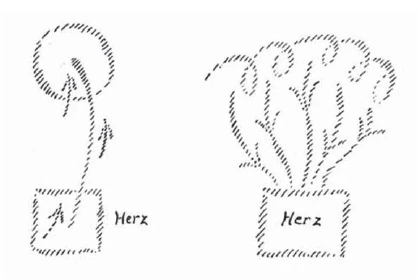
[ 18 ] In fact, moral qualities are revealed to a high degree in the unique character of what flows into a person during sleep, so that a person with low moral standards experiences a completely different flow than a person with high standards. It is of no use to pretend otherwise during the day. One cannot pretend in the presence of the higher world powers. The fact is that in a person who has even the slightest inclination toward less-than-moral principles, brownish-red and all manner of other reddish-brownish rays continually flow in. And lilac-violet rays appear in those who have high moral ideals. At the moment of waking or falling asleep, a kind of struggle takes place in the region of the pineal gland between what flows from above downward and what flows from below upward. The intellectual element flows from below upward in the form of light effects in the waking person, and that which is essentially of a moral-aesthetic nature flows from above downward. And at the moment of waking and falling asleep, the upward and downward currents meet, and one can then judge whether someone is particularly clever but has base principles—in which case a fierce struggle takes place near the pineal gland—or whether they have good principles and their intellectuality flows toward one: Then a calm spreading of a shimmering light appears around the pineal gland. At the moment of waking or falling asleep, it is, as it were, embedded in a small sea of light. And in the fact that a calm glow surrounds the pineal gland at the moment of waking and falling asleep, moral nobility is revealed. Thus, a person’s moral character is reflected within them. And this gentle glow often extends far into the region of the heart. Thus, two currents manifest within the human being: one from the macrocosm, the other microcosmic.
[ 19 ] We would only fully grasp the full significance of how these two currents converge within the human being if, on the one hand, we consider what has previously been said—in more external terms—about the life of the soul, as it manifests itself in its threefold polarity of the intellectual, the aesthetic, and the moral, which flows from the brain to the heart, from the brain to the heart; on the other hand, however, we grasp the full significance of what has been said when we now bring the corresponding phenomenon in the macrocosm before our eyes. This corresponding phenomenon can be described today as it has been established precisely through the most meticulous occult research of recent years, undertaken in the spiritual investigations of individual true, genuine Rosicrucians. Accordingly, this macrocosmic aspect must be described in relation to the microcosmic. And there it becomes apparent—you will come ever closer to understanding this—that something similar to what has just been said about the microcosm also takes place in the macrocosm.
[ 20 ] Just as a continuous transformation of blood into etheric substance takes place in the region of the human heart, so a similar process occurs in the macrocosm. We understand this when we turn our gaze to the Mystery of Golgotha and to that moment when the blood of Christ Jesus flowed from the wounds. This blood must not be regarded merely as a chemical substance; rather, through all that has been described as the nature of Jesus of Nazareth, it is something quite special. And as it flowed out and poured into the earth, our earth was given a substance which, by uniting with the earth, constituted an event of the utmost significance for all subsequent ages of the earth—an event that could occur only once. What happened to this blood in the ages that followed? Nothing other than what otherwise happens in the human heart. This blood underwent a process of etherization in the course of Earth’s evolution. And just as our blood flows upward from the heart as ether, so has the etherized blood of Christ Jesus lived in the Earth’s ether since the Mystery of Golgotha. The Earth’s etheric body is permeated by what has become of the blood that flowed on Golgotha; and that is important. Had what happened through Christ Jesus not taken place, then only what has been described above would be the case for human beings on Earth. But since the Mystery of Golgotha, there has been a continuous possibility that the effect of the etheric blood of Christ flows along with these currents from below to above.
[ 21 ] Because the etheric blood of Jesus of Nazareth is present in the Earth’s etheric body, the etheric human blood flowing from the heart to the brain from the heart to the brain, so that not only does what has been described earlier come together in the human being, but the actual human blood flow and the blood flow of Christ Jesus also come together. But a connection between these two currents can only come about if the human being brings the right understanding to what is contained in the Christ impulse. Otherwise, no connection can be established; otherwise, the two currents repel one another, colliding and then scattering apart just as they had collided. We can only acquire understanding if, in every age of Earth’s development, we appropriate this understanding in a way that is suited to that age. In the time when Christ Jesus lived on Earth, those who came to his forerunner John and were baptized through the formula expressed in the Gospel were able to meet the impending event with the right understanding. They received baptism to transform sin—that is, the karma of their past lives that had come to an end—and to recognize that the most important impulse of Earth’s evolution would now descend into a physical body. But human development continues, and for our present time it is important that people learn to realize that they must take in theosophical knowledge and gradually kindle what flows from the heart to the brain in such a way that it fosters an understanding of theosophy. The result will be that they can receive what begins to take effect from the twentieth century onward: This is the etheric Christ, in contrast to the physical Christ of Palestine.
[ 22 ] For we have now reached the point where the etheric Christ intervenes in earthly life and first becomes visible to a small number of people, as in a natural form of clairvoyance. Then, over the next three thousand years, he will become visible to more and more people. This must come to pass; it is a natural phenomenon. That it will come is just as certain as the advent of electricity in the nineteenth century. It is true that a certain number of people will see the etheric Christ and experience a Damascus moment. But the crucial point will be that people learn to recognize the moment when Christ approaches them. Only a few decades will pass, and for people—especially those in their youth—this will come to pass—it is already being prepared everywhere: a person goes here or there, and experiences this or that. If only they had truly sharpened their vision through engagement with theosophy, they might already notice that suddenly someone is there, coming to help, to draw their attention to this or that: that the Christ is standing before them—but they believe some physical human being is there. Yet they will realize it is a supersensible being because it vanishes immediately. Many a person will experience, when sitting quietly in their room with a heavy heart, burdened by sorrow, and not knowing what to do, that the door opens: the ethereal Christ will appear and speak words of comfort to them. Christ will become a living bringer of comfort for humanity! It may still seem grotesque today, but it is nevertheless true that sometimes, when people sit together, at a loss, and even when large crowds gather and wait: they will then see the ethereal Christ! There he will be in person, offering counsel, and speaking his word even into gatherings. We are certainly moving toward these times. This is the positive aspect, the element that will intervene as a positive, uplifting force in the development of humanity.
[ 23 ] Not a word should be spoken against the great cultural advances of our time; they are necessary for the salvation and liberation of humanity. But take all the external progress you can in mastering the forces of nature—it is not even comparable, as something small and insignificant, to what is given to the person who will experience the awakening in their soul through Christ, who is now intervening in human culture and its affairs. What will then grow within people as a result are unifying, positive forces. Christ brings uplifting forces into human culture.
[ 24 ] Yes, if we were to look at the early post-Atlantean era, we would see that people back then built their homes differently than they do today. They used all sorts of things that grew naturally, simply giving them a helping hand. They even built palaces this way, by giving nature a helping hand, intertwining branches and plants, and so on. Today, people have to build from the rubble. We create all of the external world’s culture from the products of destruction. And over the next few years, you will understand even better how various other aspects of our culture are products of destruction.
[ 25 ] Light is disintegrating within our post-Atlantean Earth process. Up until the time of Atlantis, the Earth process was one of progression; since then, it has been one of disintegration. What is light? It is disintegrating, and this disintegrating light is electricity. What we know as electricity is light that destroys itself within matter. And the chemical force that undergoes a transformation within Earth’s development is magnetism. And a third force will yet appear. And if electricity already seems miraculous to people today, this third force will influence civilization in an even more wondrous way. And the more we apply this force, the sooner the Earth will become a corpse, so that what is the spiritual essence of the Earth can carry its influence over to Jupiter. The forces must be applied to destroy the Earth, so that humanity may be freed from the Earth and so that the Earth’s body may fall away. As long as the Earth was in a process of development, this was not done, because only the decaying Earth can make use of the great cultural achievement of electricity. As strange as this may sound at present, it must be stated little by little. We must understand the process of development; through this, people will learn to evaluate our culture in the right way. We will thereby learn that it is necessary to destroy the Earth; otherwise, the spirit will not be set free. But we will also learn to appreciate the positive aspect: the penetration of spiritual forces into our earthly existence.
[ 26 ] Thus we can already see the great and tremendous progress in the fact that it was necessary for the Christ to walk for three years in a well-prepared human body so that He might become visible to the physical eyes. Through what took place during those three years, people have become ready to see the Christ who will walk about in the etheric body, who will intervene in earthly life just as truly and really as the physical Christ did during the time of the Palestinian reality. People will know—if they do not view such things with clouded senses—that they are dealing with the etheric body that will walk about within the physical world, but they will know that this is the only etheric body capable of acting in the physical world in the same way that a physical human body otherwise acts. It will differ from a physical body only in that it can, so to speak, be in two, three, indeed a hundred or a thousand places at the same time—something possible only for an etheric form, but not for a physical one. What is brought about by this progress of humanity is that the two poles I mentioned earlier—the intellectual and the moral pole—will increasingly become one, merging into a unity. This will happen because, over the course of the next millennia, people will increasingly learn to contemplate the etheric Christ in the world. They will also be increasingly permeated, even during the day, by the direct influence of the good in the spiritual worlds. Whereas now the will sleeps during the day and human beings can, in essence, act only indirectly through imagination, it will increasingly be the case over the course of the next millennia that, through what is working in from our own time—and which is presided over by the Christ—human activity can also be directly improved even in the waking state.
[ 27 ] Socrates’ dream that virtue can be taught will indeed come true. And more and more, the possibility will arise on earth that not only will our intellect be stimulated and inspired by these teachings, but that moral impulses will also be spread through them. Schopenhauer said: Preaching morality is easy; justifying morality is very difficult. — Why is that so? Because preaching does not actually spread morality. One can fully understand moral principles and yet fail to uphold them. For most people, the words of Christ apply: The spirit is willing, but the flesh is weak. — This changes as the moral fire radiates from this Christ-figure. Through this, however, it becomes increasingly evident on Earth that human beings recognize the necessity of morality and its impulses. And through this, humanity transforms the earth, insofar as people will increasingly feel that morality belongs to the earth. And in the future, only those people will be able to be immoral who receive help from the immoral, who are possessed by evil demons, by Ahrimanic and Asuric forces, and who seek this possession. This is the future state of the Earth: that there will be a sufficient number of people who will increasingly teach morality and at the same time provide a foundation for it; but also that those who, of their own free will, choose to do so, will surrender themselves to the evil forces and form an army of evil against the good people. No one will be forced to do this; it will be the free will of each individual.
[ 28 ] Then there will come a time upon the earth when what is—like so much else—actually contained only in the grand definitions of Eastern occultism and Eastern mysticism will come to pass, when this moral atmosphere will have intensified to a high degree. Eastern mysticism has been speaking of this time for many millennia. And since the appearance of the Buddha, it has spoken particularly strongly of that future state in which the Earth will be immersed in a moral etheric atmosphere. And as a great hope for the future, it has always stood before Oriental mysticism since the time of the ancient Rishis that this impulse will come to the Earth and that it will be an essential part of Vishva-Karman, or as Zarathustra said, of Ahura Mazdao. Thus it was already clear to that mysticism that this moral impulse, this moral atmosphere of the Earth, would emanate from the being we call the Christ, and it was upon him, the Christ, that this Eastern mysticism placed its hope.
[ 29 ] The tools of Eastern mysticism were not sufficient to imagine this, but they could imagine what would follow in the wake of this event. They could imagine that the pure Akashic beings, immersed in the fire and light of the sun, would come within five thousand years after the enlightenment of the great Buddha as the retinue of the One who cannot be recognized through Eastern mysticism alone. A wondrous vision indeed: something will come that will make it possible for the Sons of Light and Fire to walk about within the moral atmosphere of the Earth—not in physically embodied form, but as pure Akashic beings—through a purified moral atmosphere of the Earth. But then the Teacher will also be there, five thousand years after the enlightenment of Gautama Buddha, to teach people what wonderful beings these pure beings of fire and light are. This Teacher will be the Maitreya Buddha, who will appear three thousand years after our time and will be able to teach humanity the Christ impulse.
[ 30 ] Thus, Eastern mysticism unites with Western Christian knowledge to form a beautiful, wondrous unity. It is also made clear that the one who will appear as the Maitreya Buddha three thousand years after our era has repeatedly incarnated on Earth as the Bodhisattva, the successor to Gautama Buddha. One of his incarnations was that of Jeshu ben Pandira, who lived a hundred years before the beginning of our era. This being incarnated as Jeshu ben Pandira is the same one who will one day be the Maitreya Buddha and who appears again and again from century to century in a physical body—not yet as a Buddha himself, but as a Bodhisattva. Even in our age, the most significant teachings concerning the Christ-being and the Fire Sons of the Indians—the Agnishvattas—emanate from this one who will one day—not now, but one day—become the Maitreya Buddha.
[ 31 ] The characteristic by which one can recognize the one who will one day become the Maitreya Buddha is common to all true Eastern mysticism and Christian knowledge. One can recognize the one who will one day be the Maitreya Buddha—who, unlike the Sons of Fire, will appear in a physical body as a Bodhisattva—by the fact that he grows up in his youth in such a way that no one can guess what kind of individuality lies within him. It will always be the case that those who understand will only recognize in such a person, between the ages of thirty and thirty-three, that a Bodhisattva dwells within him. At that point, something like a transformation of the personality takes place. And the Maitreya Buddha himself will reveal himself to humanity precisely in the thirty-third year of his life. Just as Christ Jesus began his work in the thirtieth year of his life, so the Bodhisattvas, who will continue to proclaim the Christ, reveal themselves in the thirty-third year of their lives. And the Maitreya Buddha himself, who, as a transformed Bodhisattva, will proclaim the great mysteries of existence with grand, powerful words of which no conception can yet be given today—he will speak in a language that must first be created, for today no human being could find the words with which the Maitreya Buddha will one day speak to humanity. For this reason, it is not yet possible to speak to humanity in this way, because the physical instrument for it does not yet exist. The teachings of the Enlightened One will not merely be teachings, but they will flow into human lives as moral impulses. Such words cannot yet be uttered by a physical larynx. They can only exist in the spiritual worlds at present.
[ 32 ] Theosophy is the preparation for all that is to come in the future. Those who take human evolution seriously, who want the development of the soul not to stagnate but to continue in such a way that the Earth can truly become free in its spiritual aspect, that it can shed its coarser aspect like a corpse—for people could ruin the whole work— those who want the world’s work to succeed should acquire an understanding of spiritual life through what we today call Theosophy. Thus Theosophy becomes a duty; knowledge becomes something we feel, something toward which we have a responsibility. And if we feel this way and wish to learn, if we feel from these world mysteries that we want to be Theosophists, then we are feeling correctly. But then, too, Theosophy must not be for us something that merely satisfies our curiosity; rather, it must become something without which we cannot live. Only when that is the case do we feel in the true sense; only then do we live as living building blocks within that great edifice that is to be erected in the souls of human beings and that can spread out over humanity.
[ 33 ] Thus, Theosophy is an opening to the true phenomena of the world, as they will present themselves to the people of the future, to our own souls, whether we are still in the physical body or already between death and a new birth. This upheaval will affect us, whether we are still walking in the body or whether we will have shed the physical body. It is only that people must already here on Earth, in the physical body, acquire an understanding of these events if they are to be touched between death and new birth by what is happening there. For those who now acquire an understanding of the Christ while in the physical body, it makes no difference whether they will still be alive when the moment approaches to behold the Christ, or whether they will have already passed through the gate of death by then. But those who now reject an understanding of the Christ—if they have already passed through the gate of death by the time this event occurs—must wait until their next incarnation, for the foundation cannot be acquired between death and birth. But once the foundation has been acquired, it continues; then Christ is also visible between death and new birth. Thus, Theosophy becomes for us not only something we learn for physical life, but also something of value once we have laid down the physical body in death.
[ 34 ] This is what I wanted to share today to help you understand human nature and as a guide for answering certain questions. Self-knowledge is difficult because human beings are such complex beings. This complexity means that human beings are connected to all the higher worlds and beings. What is within us are shadows of the great world, and what constitutes our organization—our physical, etheric, and astral bodies and our ego, which together form our members—are worlds in themselves for the divine beings. What for us is the physical, etheric, and astral bodies and the ego is one world; the other world is the higher one, the heavenly world. For the divine-spiritual beings of the higher worlds, the members of the body are high divine-spiritual worlds. That is why the human being is something so complex, because he is a true mirror image of the spiritual world. This should lead him to an awareness of his human dignity. But from the realization that while we are indeed an image, we are still very far from what we are meant to be—through the detour of this realization—we acquire, alongside human dignity, the proper modesty and humility toward the macrocosm and its gods.
From the Q&A session following the lecture
Question: How should the phrase “speaking in tongues” be understood in the writings of the Apostle Paul?
[ 35 ] Answer: In the case of exceptional individuals, it can happen that not only is the phenomenon of speaking while awake present, but something enters into this speech that is otherwise only present in the consciousness of sleep. This is the phenomenon of which Paul speaks. Goethe discusses this from the same perspective. He wrote a very beautiful essay on this phenomenon.
Question: How can we understand Christ’s words of comfort?
[ 36 ] Answer: People will feel these words of comfort as if they were coming from their own hearts. It may even feel like hearing them physically.
Question: What are chemical forces and substances in relation to the spiritual world?
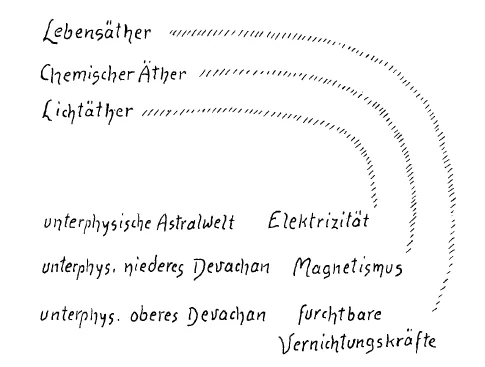
[ 37 ] Answer: There are a number of substances in the world that can be combined and separated. What we call chemistry is projected into the physical world from the world of Devachan, the harmony of the spheres. Thus, in the combination of two substances according to their atomic weights, we have a reflection of two tones of the harmony of the spheres. The chemical affinity of two substances in the physical world is a reflection from the world of the harmony of the spheres. The numerical ratios of chemistry are truly the expressions of the numerical ratios of the harmony of the spheres. The latter has become silent due to the densification of matter. If one were to actually bring the substances down to an ethereal dilution and be able to perceive the atomic numbers as an inner-forming principle, one would hear the harmony of the spheres. There is the physical world, the astral world, the lower Devachan, and the upper Devachan. If one now pushes a body even further down than the physical world, one enters the subphysical world, the subastral world, the lower or evil lower Devachan, and the lower or evil upper Devachan. The evil astral world is the realm of Lucifer, the evil lower Devachan is the realm of Ahriman, and the evil upper Devachan is the realm of the Asuras. If one pushes chemism even further down than the physical plane, into the evil lower Devachanic world, magnetism arises; and if one pushes the light into the sub-material, that is, one level deeper than the material world, electricity arises. If we push down what lives in the harmony of the spheres even further, down to the Asuras, then there is an even more terrible force that will no longer be able to be kept secret for long. One can only hope that when this force comes—which we must imagine to be far, far stronger than the most powerful electrical discharges, and which will certainly come—one can only hope that, before this force is given to humanity by an inventor, people will no longer have anything immoral about them!
Question: What is electricity?
[ 38 ] Answer: Electricity is light in a sub-material state. Here, light is compressed in the most intense way. Light must also be said to possess innerness; at every point, it is itself. Heat can expand in three directions of space; with light, we must speak of a fourth: it is expanded in four directions; it possesses inner essence as a fourth dimension.
Question: What happens to the earthly body?
[ 39 ] Answer: Our Moon, which orbits the Earth, is a remnant of the Moon’s development. Similarly, there will be a remnant of the Earth that will orbit Jupiter. Then the remnants will gradually dissolve into the general world ether. On Venus, there will be no remnant left. It first appears as pure heat, then becomes light, and finally returns to the spiritual world. For the Earth, the remnant becomes a corpse. But this is a path that human beings must not follow, as they would be subjected to terrible torments as a result. However, certain beings do accompany this corpse, as they will develop themselves to a higher level through this process. To the answer to the question
To answer your question:
| Reflected as Subphysical World | |
|---|---|
| the Astral World | the realm of Lucifer |
| lower Devachan | the realm of Ahriman |
| upper Devachan | the realm of the Asuras |