

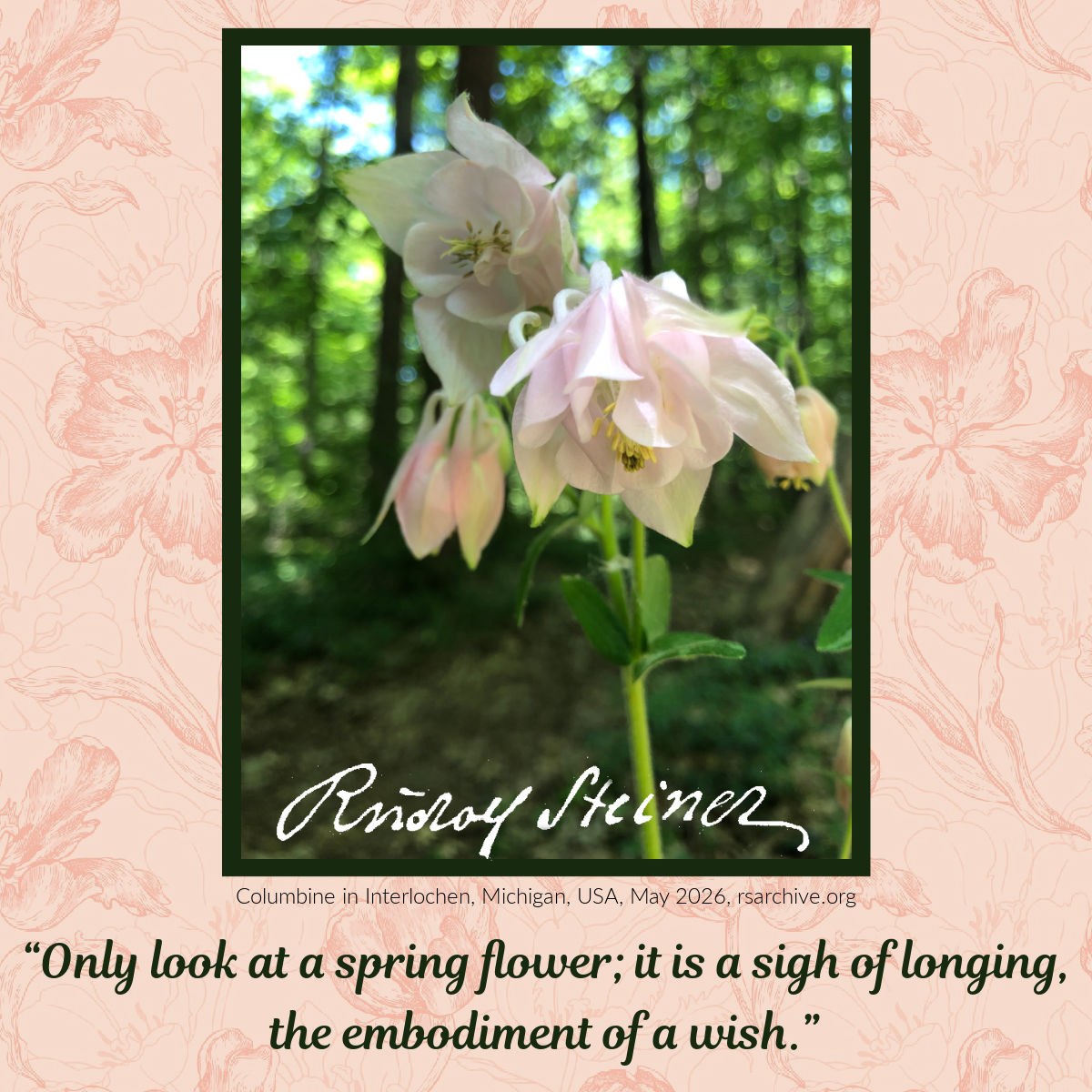
The Spring Flower
Physical natural laws, etheric natural laws, are the characters of a script which depicts the spiritual world. We only understand these things when we are able to conceive them as written characters from spiritual worlds.
"Let us look at the plant world. Truly this plant world possesses something which bewitches man in the most varied ways when he begins to contemplate the plant covering of the earth with the eye of the spirit. We go out into a meadow or a wood. We dig up, let us say, a plant with its root. If we regard what we have dug up with the eye of the spirit we find a wonderfully magical complex. The root shows itself as something of which we can say that it came into existence entirely in the sphere of the earthly. Yes, a plant root—the more so, the coarser it appears—is really something terribly earthly. It always reminds one—especially a root like a turnip, for instance—of a particularly well-fed alderman. O, yes, it is so; the root of a plant is extremely smug, and self-satisfied. It has absorbed the salts of the earth into itself, and feels a deep sense of gratification at having soaked up the earth. In the whole sphere of the earthly there exists no more absolute expression of satisfaction than such a turnip-root; it is the representative of root-nature.
On the other hand let us look at the blossom. When we observe the blossom with the eye of the spirit we only experience it as our own soul, when it cherishes the tenderest desires.
Only look at a spring flower; it is a sigh of longing, the embodiment of a wish. And something wonderful streams forth over the flower world which surrounds us, if only our soul-perception is delicate enough to be open to it. In spring we see the violet, maybe the daffodil, the lily-of-the-valley, or many little plants with yellow flowers, and we are seized by the feeling that these blossoming plants of spring would say to us: O Man, how pure and innocent can be the desires which you direct towards the spiritual! Spiritual desire-nature, desire-nature bathed, as it were, in piety, breathes from every blossom of spring.
And when the later flowers appear—let us at once take the other extreme, let us take the autumn crocus—can one behold the autumn crocus with soul-perception without having a slight feeling of shame? Does it not warn us that our desires can tend downwards, that our desires can be imbued with every kind of impurity? It is as though the autumn crocuses spoke to us from all sides, as if they would continually whisper to its: Consider the world of thy desires, O Man; how easily you can become a sinner!
Looked at thus, the plant-world is the mirror of human conscience in external nature. Nothing more poetical can be imagined than the thought of this voice of conscience coming forth from some point within us and being distributed over the myriad forms of the blossoming plants which speak to the soul, during the season of the year, in the most manifold ways. The plant-world reveals itself as the wide-spread mirror of conscience if we know how to look at it aright.
If we bear this in mind it becomes of special significance for us to look at the flowering plants and picture how the blossom is really a longing for the light-being of the universe, and how the form of the blossom grows upwards in order to enable the desires of the earth to stream towards this light-being of the universe, and how on the other hand the substantial root fetters the plant to the earth, how it is the root which continually wrests the plant away from its celestial desires, wishing to re-establish it in the substantiality of the earth."
Read more: Rudolf Steiner, Man as Symphony of the Creative Word, Part Four. The Secrets of the Human Organism, Lecture XI, GA 230, 10 November 1923, Dornach.