

From Jesus to Christ
GA 131
9 October 1911, Karlsruhe
Translated by Steiner Online Library
Fifth Lecture
[ 1 ] If you consider that our lectures have shown that the Christ impulse must be regarded as the most profound in the processes of human development, you will undoubtedly find it self-evident that some exertion of our mental faculties is necessary to understand the full significance and the entire scope of this Christ impulse. It is certainly a common misconception in the widest circles that whatever is the highest in the world must be comprehensible in the simplest possible way; and if someone were compelled to speak in complicated terms about the sources of existence, one would have to reject this for the very reason that the maxim must apply: truth must be simple. Ultimately, it is certainly simple. But if we wish to come to know the highest at a certain level, it is not difficult to see that we must first clear a path in order to comprehend the highest. And so we will again have to gather various elements together in order to find our way, from a certain point of view, into the full grandeur and significance of the Christ impulse.
[ 2 ] We need only open Paul’s letters and we will soon find that Paul—whom we know tried to incorporate precisely the transcendent aspect of the Christ-being into human development—that Paul, so to speak, drew upon the entire history of human development to arrive at the concept, the idea of the Christ. However, when we allow Paul’s letters to take effect upon us, we ultimately find ourselves faced with something that makes a most profound impression through its immense simplicity and the deep penetrating power of its words and sentences. But this is the case solely because Paul, through his own initiation, worked his way up to that simplicity which cannot be the starting point of the Truth, but rather the consequence, the goal of the Truth. If we now wish to penetrate what is ultimately expressed in Paul regarding the Christ-essence in wonderfully monumental yet simple words, we will have to approach, in our spiritual-scientific manner, an understanding of human nature, for the further development of which within the Earth the Christ-impulse has indeed come.
[ 3 ] Let us therefore consider what we already know about human nature, as it presents itself to the occult gaze! We divide human life into those two phases that we consider in relation to the passage of time: the period between birth or conception and death, and the period that elapses between death and a new birth. If we first place the human being before us as he stands before us in physical life, we know that the occult gaze sees him as a fourfold being, but as a fourfold being in the process of development: the physical body, the etheric body, the astral body, and the I. And we know that to understand human development, we must familiarize ourselves with the occult truth that this I—which we become aware of in our feelings and sensations when we simply turn away from the external world and try to live within ourselves—that this I, to the occult eye, passes from incarnation to incarnation. But we also know that this I is, as it were, enveloped—although “enveloped” is not a good term, but we can use it for now—by the three other members of human nature: the astral body, the etheric body, and the physical body. We know of the astral body that, in a certain sense, it is a companion to the I through the various incarnations. Even though much of the astral body must be shed during the Kamaloka period, this astral body nevertheless remains with us through the incarnations as a kind of force-body that holds together what we have stored within ourselves in terms of moral, intellectual, and aesthetic progress within a single incarnation. What constitutes true progress is held together by the power of the astral body, carried from one incarnation into the next, and, as it were, fused with the I, which, as the fundamental eternal within us, passes from incarnation to incarnation. And furthermore, we know that although much is shed from the etheric body immediately after death, an extract of this etheric body nevertheless remains with us, which we carry with us from one incarnation into the next. It is indeed the case that in the first days immediately following death we have a kind of retrospective view, like a great tableau, of our life up to that point, and that we take the summary of this retrospective view—the essence—with us as an ethereal result. The remainder of the etheric body is surrendered to the general etheric world in one form or another, depending on the development of the individual in question. When we turn our gaze to the fourth member of the human being, the physical body, it initially appears as though this physical body simply vanishes into the physical world. Indeed, one might say this can be demonstrated outwardly in the physical world; for this physical body is, in one way or another, led to its dissolution, as far as the external eye can see. The question is simply this—and everyone who engages in spiritual science should ask it: Is perhaps everything that external physical knowledge can tell us about the fate of our physical body merely Maya? And the answer is actually not so far off for those who have begun to understand spiritual science. Once one has begun to understand spiritual science, one says to oneself: Everything that sensory appearance offers is Maya, is external illusion. How can one still expect it to be truly real, even if it imposes itself so crudely, that the physical body, when consigned to the grave or the fire, vanishes without a trace? Perhaps something much deeper lies hidden precisely behind the external Maya that imposes itself upon sensory perception!
[ 4 ] But let us go a step further: Consider that, in order to understand the Earth’s evolution, we must be familiar with our planet’s earlier incarnations; that we must study the Earth’s Saturn, Sun, and Moon incarnations. We must say: Just as every single human being has gone through incarnations, so too has the Earth, and what constitutes our physical body has been prepared through human evolution since the Earth’s Saturn period. While we cannot yet speak of our etheric body, astral body, and I in the modern sense during the ancient Saturn era, the seed of the physical body is already laid during the Saturn era, incorporated, as it were, into evolution. During the Sun era of the Earth, this seed is transformed; the etheric body is then incorporated into it in its transformed form. During the Earth’s Lunar period, the physical body is transformed again, and the astral body is incorporated into it—alongside the etheric body, which also emerges again in a transformed form. And during the Earth period, the ego is incorporated into it. And so, if the apparent meaning were correct, we would have to say that what was incorporated into us during the Saturn era—our physical body—simply decays or burns up and dissolves into the outer elements, after millions and millions of years, during the Saturn, Sun, and Moon periods, the most significant efforts of superhuman—that is, divine-spiritual—beings were made to create this physical body! We would thus be faced with the very strange fact that through four, or for my part through three, planetary stages—Saturn, Sun, Moon—a whole host of gods works on the creation of a world element such as our physical body, and this world element would be destined to disappear during the Earth era every time a human being dies. It would be a strange spectacle if Maya—and external observation knows no other—were right.
[ 5 ] Now let's ask ourselves: Could Maja be right?
[ 6 ] At first glance, however, it does indeed seem as if the occult understanding of Maya were correct in this case; for, strangely enough, occult observation appears to coincide with Maya in this instance. If you go through what is described to us by spiritual knowledge as the development of the human being after death, this description does indeed initially take scarcely any account of the physical body. It is said: the physical body is cast off, is handed over to the elements of the earth. Then there is talk of the etheric body, of the astral body, of the I, and the physical body is no longer taken into account, and it seems as though the silence of spiritual knowledge were to validate the knowledge of Maya. So it seems. And in a certain sense, spiritual science is justified in speaking this way, for the simple reason that everything else must be left to the deeper foundations of Christology. For we cannot speak properly about what, in relation to the physical body, goes beyond Maya without first explaining the Christ impulse and everything connected with it in a sufficient manner.
[ 7 ] If we first consider this physical body as it appeared before human consciousness at a decisive moment, something quite remarkable becomes apparent. And so let us examine three types of national consciousness—three different forms of human consciousness—to determine what kind of consciousness people had, particularly during a decisive epoch in human development, regarding everything connected with our physical body. Let us begin by looking at the Greeks!
[ 8 ] We know that the Greeks are that significant people who reached their true period of development during the fourth post-Atlantean cultural epoch. We know that this fourth post-Atlantean cultural epoch began for us around the time of the seventh, eighth, and ninth centuries B.C.E., and that it ended in the thirteenth, fourteenth, and fifteenth centuries C.E., following the events in Palestine. We can, of course, easily justify what has just been said based on external reports, traditions, and documents specifically regarding this period. We see that the first, dimly clear accounts of Greek civilization barely extend beyond the sixth and seventh centuries B.C.E., while legendary accounts come down to us from even earlier times. But we also know that what constitutes the greatness of the historical era of Greek civilization extends back into the preceding period, when one was thus dealing with the third post-Atlantean cultural epoch in Greek civilization as well. Thus, Homer’s inspirations extend into the period preceding the fourth post-Atlantean epoch; and Aeschylus, who lived so early that a number of his works have been completely lost, points us back to the mystery dramas, of which he offers only an echo. Thus, the third post-Atlantean cultural epoch extends into the Greek era; but the fourth post-Atlantean cultural epoch finds its full expression in the Greek era. And we must say: the wondrous Greek culture is the purest expression of the fourth post-Atlantean cultural epoch. From this Greek world, then, a remarkable saying resounds to us, a saying that allows us to look deep into the soul of the person who felt entirely Greek, the saying of the hero: Better to be a beggar in the upper world than a king in the realm of shadows! — This is a saying that reveals the deep, deep feelings of the Greek soul. One might say: Everything that has been preserved for us from the Greek era—of classical beauty and classical grandeur, of the embodiment of the human ideal in the outer world—all of that resonates with us in a certain way through this saying. Thus, when we think of Greek civilization, we recall that marvelous training of the human body in Greek gymnastics, in the great Greek athletic games, which in the present day are imitated in a caricatured manner only by those who understand nothing of what Greek civilization truly was. That every age must have its own ideals—this must be taken into account if one wishes to understand how this training of the outer physical body, as it stands in its form on the physical plane, was a special privilege of the Greek spirit; and how, furthermore, the expression of the plastic artistic ideal of the human being—this elevation of the outer human form in sculpture—must again have been a privilege of Greek civilization. And if we consider, in addition, the development of human consciousness as it governed, for example, a Pericles—where the human being, on the one hand, looked toward the universal human, and on the other hand stood firmly on his own two feet and felt like a lord and king on the earth within his city limits—if we allow all this to sink in, then we must say: True love was directed toward the human form as it stood before us on the physical plane, and aesthetics, too, were directed toward the shaping of this form. Where one loved in this way and understood what stands before us of the human being on the physical plane, there one could also surrender to the thought: If that which gives human beings this beautiful form on the physical plane is taken away from human nature, then a remnant remains that cannot be valued as highly as that which is taken from one in death! This highest love for the outer form necessarily led to viewing with a pessimistic eye what remains of a human being once they have passed through the gate of death. And we can fully understand, in the Greek soul, that the same eye that gazed with such great love upon the outer form felt sorrow when the soul had to think: This form is taken away from human individuality, and human individuality lives on without this form! If we take what has happened in this way, at first only in this emotional sense, then we must say: In Greek culture we have that humanity which loved and valued the outer form of the physical body most of all and experienced all the sorrow that could be experienced at its passing in death.
[ 9 ] And now let us consider another consciousness that developed around the same time. Let us consider the Buddha-consciousness, which was then passed on by the Buddha to his followers. Here we have something that is roughly the opposite of Hellenism. We need only remember one thing: the essence of the Buddha’s Four Noble Truths lies in the assertion that human individuality is brought into this existence—in which it is enclosed by the outer physical form—through the desire for existence. Into what kind of existence? Into an existence in response to which the Buddha’s teaching must say: Birth is suffering, sickness is suffering, old age is suffering, death is suffering! It lies at the heart of Buddhism to say to oneself: Through everything by which we are enclosed in an outer physical shell—our individuality, which descends from divine spiritual heights at birth and ascends again to divine heights when the human being passes through the gate of “death”—through all of this, this individuality is subjected to the pain of existence, to the suffering of existence; and, in essence, there can be only one salvation for humanity, expressed in the Buddha’s Four Noble Truths: to become free from external existence, to cast off the outer shell—that is, to transform the individuality to such an extent that it is soon able to cast off everything that constitutes the outer shell. We thus observe: here the opposite sentiment is at work compared to how the Greeks felt. Just as strongly as the Greeks loved and valued the outer physical shell and felt sorrow at shedding this physical shell, so too did the follower of the Buddha value this physical shell very little and regard it as something that must be shed as quickly as possible. And connected to this was the fact that the urge toward existence, which is enclosed by an outer physical shell, is fought against.
[ 10 ] And now let us delve a little deeper into these very thoughts of the Buddha. Here we encounter what exists in Buddhism as a kind of theoretical view regarding the successive incarnations of human beings. The point here is less what the individual thinks about the Buddha’s theory, and more what has entered the consciousness of Buddhist adherents. I have characterized this on several occasions. I have said: There is perhaps no better opportunity to appreciate what a follower of Buddhism must have felt regarding the successive incarnations of human beings than by immersing oneself in that discourse which has been handed down to us as the dialogue between King Milinda and a Buddhist sage. There, King Milinda is instructed by the Buddhist sage Nagasena that, if he has come by chariot, he should consider whether the chariot has anything besides the wheels, the drawbar, the body of the chariot, the seat, and so on. “If you have come in your chariot, consider, O great king,” says the sage Nagasena to the king, “that everything you have before you in the chariot is nothing other than the wheels, the shaft, the body of the chariot, the seat—and nothing else exists besides a word that sums up the wheels, shaft, body of the chariot, seat, and so on. You cannot, therefore, speak of a particular individuality of the chariot; rather, you must realize that ‘chariot’ is an empty word if you think of anything other than its parts, its components.” And Nagasena, the sage, offers yet another parable to King Milinda. “Consider the almond fruit growing on the tree,” he said, “and consider that a seed was taken from another fruit, placed in the earth, and rotted; from this the tree grew, and upon it the almond fruit. Can you say that the fruit on the tree has anything in common with that fruit—which was taken as a seed, placed in the earth, and decayed—other than its name and outward form?” —That, Nagasena means to say, is how much a person has in common with the person of his previous incarnation, just as the almond fruit on the tree has in common with the almond fruit that was placed in the earth as a seed; and whoever believes that what stands before us as a human being—what is swept away with death—is anything other than name and form believes something just as false as the one who believes that the cart—in the name “cart”—contains something other than the parts of the cart: wheels, drawbar, and so on. Nothing of what the human being designates as the “I” passes over from the previous incarnation into the new incarnation.
[ 11 ] This is important! And it cannot be emphasized enough: what matters is not how one person or another chooses to interpret this or that saying of the Buddha, but how Buddhism has influenced the consciousness of the people, what it has given to their souls! And what it has given to the souls is expressed with tremendous clarity and significance in this parable handed down to us by King Milinda and the Buddhist sage. What we call the “I,” and of which we say that it is felt and perceived first and foremost by the human being when he reflects on his inner self—of this the Buddhist says: It is, in essence, something that flows away and belongs to Maya, just like everything else that does not pass from one incarnation to the next.
[ 12 ] I have mentioned this before: a Christian sage, who could be compared to the Buddhist sage, would have spoken differently to King Milinda. The Buddhist sage said to the king: “Consider the chariot! Wheels, the drawbar, and so on—these are the parts of the chariot, and beyond these parts, “chariot” is merely a name and a form. There is nothing real in the chariot that bears the name “chariot”; rather, if you wish to grasp the reality, you must name the parts.” — The Christian sage would have spoken of the same case in the following manner: “O wise King Milinda, you have come to the chariot. Look at the chariot: you can see only the wheels, the shaft, the body of the chariot, and so on. But let me ask you this: Can you drive here with just the wheels? Can you drive here with just the shaft? Can you drive here with just the seat? And so on. So you cannot drive here on any of the parts! Insofar as they are parts, they make up the cart; but you cannot come here on the parts. But if the parts together make up the cart, then something else is necessary besides their being parts. For the cart, this is first and foremost the very specific idea that brings the wheels, the drawbar, the body, and so on together. And the idea of the carriage is something absolutely necessary, which you cannot see, but which you must nevertheless acknowledge! — And the sage would then turn to the human being and say: Of the individual human being, you can see only the outer body, the outer deeds, and the outer experiences of the soul; but you see as little of the human being’s I as you see the name “carriage” in its individual parts. But just as something entirely different is grounded in the parts—namely, that which causes you to be driven here—so too is something entirely different grounded in all the parts of the human being, namely, that which constitutes the I. The I is something real, which, as a supersensible entity, passes from incarnation to incarnation.
[ 13 ] How, for example, should we conceptualize the framework of the Buddhist doctrine of reincarnation if it is to be presented strictly in accordance with Buddhist theory?
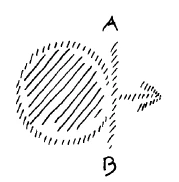
[ 14 ] With the circle, we wish to depict the existence of a human being between birth and ‘death.’ The human being dies. Let the line AB indicate the moment of death. What, then, remains of everything that is bound up in the present existence between birth and death? A sum of causes—the results of actions, everything a person has done that is good or evil, beautiful or ugly, wise or foolish—remains. What remains there continues to act as causes and forms a causal core C for the next incarnation. Around this, new physical bodies D are formed in the next incarnation; these experience new facts and new experiences in accordance with this earlier causal core. From these experiences and so on, a core of causes E remains for the following incarnation, which can encompass what extends into it from the previous incarnation, and which then, together with what is added as something entirely independent during this incarnation, again forms the causal core for the next incarnation, and so on. That is to say: what passes through the incarnations is exhausted in causes and effects that, without a common “I” holding the incarnations together, carry over from one incarnation to the next. So when I call myself “I” in this incarnation, it is not because the same “I” was also present in the previous incarnation, for all that remains from the previous incarnation are the karmic results, and what I call my “I” is merely a maya of the present reincarnation.
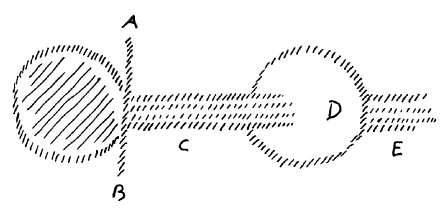
[ 15 ] Anyone who truly understands Buddhism must present it in this way; and they must realize that what we call the “self” has no place at all within Buddhism.
[ 16 ] But let us now turn to what we know from anthroposophical insight: How did human beings come to be able to develop their I in the first place? Through the evolution of the Earth! And it was only in the course of the Earth’s evolution that human beings came to develop their I. His ‘I’ was added to his physical body, etheric body, and astral body on Earth. Now, if we recall everything we have said about the stages of human development during the Saturn, Sun, and Moon epochs, we know that even during the Moon epoch the human physical body did not yet have a specific form; it was only on Earth that it acquired this form. That is why we also speak of the Earth existence as the epoch in which the spirits of form first intervened and reshaped the human physical body so that it now has its form. This shaping of the human physical body was necessary, however, so that the I could take hold within the human being, so that what stands before the physical Earth as a formed physical body provides the foundation for the emergence of the I as we know it. When we consider this, what follows will no longer seem incomprehensible to us.
[ 17 ] In discussing the Greeks’ conception of the self, we have noted that this self finds its outward expression in the physical form of the human being. Let us now turn to Buddhism, and remember that Buddhism, through its insight, seeks to shed and transcend the outer form of the human physical body as quickly as possible. Can we then be surprised that we find no appreciation in it for what is connected with this form of the physical body? Just as the outer form of the physical body is not valued from the innermost core of Buddhism, so too is the outer form that the ego needs to come into being not valued—indeed, it is even completely rejected. Buddhism has thus lost the form of the ego through the way it valued the form of the physical body.
[ 18 ] Thus we see how these two spiritual currents stand in polar opposition to one another: Hellenism, which we feel valued the outer form of the physical body as the outer form of the ego above all else, and Buddhism, which demands that the outer form of the physical body, along with all the urge to exist, be overcome as soon as possible, and which has therefore completely lost the ego in its theory.
[ 19 ] Ancient Hebrew culture stands right in the middle between these two opposing worldviews. This is far from thinking so little of the self as, for example, Buddhism does. You need only recall that within Buddhism it is heresy to acknowledge a continuous self from one incarnation to the next. But ancient Hebrew tradition adheres very strongly to this heresy. And it would never have occurred to any adherent of ancient Hebrew tradition that what lives within the human being as his actual divine spark—with which he associates his concept of the self—is lost when the human being passes through the gate of death. If we wish to understand clearly how the adherent of ancient Hebrew tradition viewed the matter, we must say: He feels inwardly connected to the deity, intimately connected; he knows that he is, as it were, attached to the essence of this deity by the finest threads of his soul life. Thus, the adherent of ancient Hebrew antiquity differs greatly from the Buddhist adherent with regard to the concept of the “I,” but on the other hand, he also differs greatly from the Greek. If one surveys the whole of antiquity: that esteem for the personality—and thus also that esteem for the external human form—which is characteristic of the Greek, is absent in ancient Hebrew times. For the Greek, it would have been utter nonsense to say: “You shall not make for yourself an image of your God!” He would not have understood it if someone had told him: ‘You shall not make for yourself an image of your Zeus, of your Apollo, and so on!’ For he felt that the highest reality is the external form, and that the greatest thing a human being can do for the gods is to clothe them in this human form that he values; and nothing would have seemed more absurd to him than a commandment: ‘You shall not make for yourself an image of God!’ As an artist, the Greek also gave his gods this human form. And in order to truly become what he envisioned—a likeness of the deity—he waged his battles, practiced his gymnastics, and so on, so as to become a true image of the god.
[ 20 ] Ancient Hebrew tradition, however, had the commandment: “You shall not make for yourself an image of God!” The reason for this was that the adherents of ancient Hebrew tradition did not value outward form as highly as the Greeks did, because they considered it unworthy of the divine essence. Thus, just as the adherent of ancient Hebrew tradition was, on the one hand, far removed from the follower of Buddhism, who would have preferred to shed the human form entirely upon passing through death, so too was he, on the other hand, far removed from the Greek. He was concerned that this form should precisely express what the commandments, the laws of the divine essence, are, and he was clear that the one who was a “righteous person” would, through the generations, pass on to posterity what he had gathered as righteousness. It was not the extinction of the form, but the propagation of the form through the generations that was before the eyes of the adherent of ancient Hebrew antiquity. Thus, a third view stood in the midst: that of a follower of the ancient Hebrew people, situated between the perspective of the Buddhist, who had lost the value of the ego, and that of the Greek, who saw the physical form as the highest good and who found it sad when the physical form had to “disappear with death.”
[ 21 ] Thus, these three perspectives stood in opposition to one another. And in order to understand ancient Hebrew culture even better, we must realize that for the adherent of ancient Hebrew culture, what he valued as his own self was, in a certain sense, also the divine self. God lived on in humanity, lived within the human being. And in union with God, the ancient Hebrew simultaneously felt his own self. Thus, the self he felt coincided with the divine self. The divine self sustained him; but the divine self was also active within him. While the Greek said: “I value my self so highly that I can only look with dread upon what becomes of the self after death!” and the Buddhist said: “What is the cause of the human being’s outer form must fall away from the human being as soon as possible!”—the adherent of ancient Hebrew tradition said: “I am united with God; it is my destiny. And as long as I am united with him, I bear my destiny. I know nothing other than the identification of my self with the divine Self! In this way of thinking of ancient Judaism—because it stands midway between Hellenism and Buddhism—the predisposition to tragedy in the face of death does not lie, as in Hellenism itself, from the outset; rather, this tragedy lies therein in a more indirect way. And if it is truly Greek for the hero to say: “Better to be a beggar in the upper world—that is, in human bodily form—than a king in the realm of shadows,” the adherent of ancient Hebrew antiquity could not have said this without further ado. For he knows that when his bodily form falls away in death, he remains connected to God. Simply by virtue of the fact of death, he cannot fall into a tragic mood. Nevertheless, the predisposition to tragedy is present—albeit indirectly—in ancient Hebrew antiquity, and it is expressed in the most marvelous dramatic narrative ever written in antiquity: the Book of Job.
[ 22 ] Here we see how Job’s self feels bound to his God and comes into conflict with him—but in a different way than the Greek self does. We are shown how misfortune upon misfortune befalls Job, even though he is aware that he is a righteous man and has done everything that can maintain the connection between his self and the divine Self. And while it seemed that his existence was blessed and had to be blessed, tragic fate strikes. He is conscious of no sin; he is conscious that he has done what a righteous man must do toward his God. Then he is told that all his possessions have been destroyed, his entire family killed; then he himself, in regard to his outer body, this divine form, is afflicted with severe illness and tribulation. There he stands, conscious of this: That which in me is connected to my God has striven to be righteous toward his God, and the fate decreed upon me by this God is that which has brought me into the world. These deeds of God—they have struck me so hard! And there stands his wife beside him, urging him with peculiar words to renounce his God. These words have been accurately handed down. What his wife speaks there is one of those words that directly correspond to what the Akashic Records also say: “Renounce your God, since you must suffer so, since He has brought these sufferings upon you, and die!” How much infinity lies in these words: Lose the awareness of your connection with your God; then you will fall out of the divine connection, fall away like a leaf from a tree, and your God can no longer punish you! — But losing the connection with God is at the same time death! For as long as the self feels connected to God, “death” cannot reach it. It must tear itself away from the connection with God; only then can death reach it. Outward appearances suggest that, fundamentally, everything is against the righteous Job; his wife sees his suffering, advises him to renounce God and die; his friends come and say, “You must have done this or that,” for God does not punish the righteous! But he is aware that, as far as his personal consciousness is concerned, he has committed no injustice. Thus, through what confronts him in the external world, he stands before an immense tragedy—the tragedy of the inability to comprehend the whole of human existence, of feeling connected to God, and of not understanding how what he is experiencing can flow from God.
[ 23 ] Let us imagine this imprinted with all its power upon a human soul, and let us now imagine the words that have been handed down to us from the Book of Job bursting forth from that soul: “I know that my Redeemer lives! I know that I shall once again be clothed with my bones, with my skin—and shall behold the God with whom I am!”—This awareness of the indestructibility of human individuality bursts forth from Job’s soul despite all suffering and pain. So strong is the sense of self contained as an inner essence in the ancient Hebrew confession. But something most remarkable confronts us here. “I know that my Redeemer lives!”—says Job—“I know that I shall once again be clothed with my skin and see with my own eyes the glory of my God!” Job connects the idea of the Redeemer with the outer body—skin and bones, eyes that see physically. Strange: suddenly, precisely in this ancient Hebrew consciousness—standing right in the middle between Hellenism and Buddhism—we encounter an awareness of the significance of the physical bodily form in connection with the idea of the Redeemer, which then became the very foundation for the idea of Christ! And when we consider the response of Job’s wife, even more light is shed on Job’s entire statement. “Renounce your God and die!”—that is to say: whoever does not renounce his God does not die. That is what these words imply. But what does it mean to die? To die means to shed the physical body. Outward Maya seems to say that the physical body passes into the elements of the earth and, so to speak, disappears. So the meaning of Job’s wife’s reply is: Do whatever is necessary so that your physical body disappears. — For it could not mean anything else; otherwise, Job’s subsequent words would make no sense. Only then can one understand such a thing, if one can understand that through which God has placed us in the world: namely, the significance of the physical body. But Job himself says—for this, too, lies in his words: “Oh, I know full well, I need not do what causes my physical body to vanish completely, which is merely what outward appearance suggests.” There is a possibility that this can be saved through the fact that my Redeemer lives—which I can summarize only with these words: I shall one day be regenerated, having my skin and my bones together, and I shall see with my own eyes the glory of my God; I shall be able to retain the natural order of my physical body; but for this I must have the awareness that my Redeemer lives!
[ 24 ] Thus, in this account of Job, we encounter—for the first time, one might say—a connection between the physical body—which the Buddhist seeks to shed, which the Greek sees as falling away and mourns—and self-consciousness. For the first time, we are confronted with something like a prospect of salvation for that which the host of gods, from ancient Saturn, the Sun, and the Moon down to the Earth, has brought forth as the physical body—and which, if it is to be preserved, if one is to say that it has a result, that which is given to us in bones, skin, and sense organs, requires that the following be added: I know that my Redeemer lives!
[ 25 ] Strange, — one might ask in light of what has just been said — does the story of Job really suggest that Christ raises the dead and preserves the physical form that the Greeks believed would vanish? And does this perhaps imply that it is not right, in the full sense of the word, for the overall development of humanity, for the outer physical form to disappear entirely? Is it perhaps interwoven with the entire process of human development? Does this play a role in the future, and is it connected to the Christ Being?
[ 26 ] This question is posed to us. And this brings us to the point where we must, in a certain sense, expand upon what we have heard so far in spiritual science. We hear that when we pass through the gate of death, we retain at least the etheric body, but shed the physical body entirely, seeing it outwardly cast to the elements. But does its form—at which work has been done for millions and millions of years—vanish without a trace, or is it preserved in a certain way?
[ 27 ] We consider this question to be the result of today’s discussion and will address the following question tomorrow: What is the relationship between the Christ impulse for human development and the significance of the outer physical body, which throughout the entire development of the Earth has been consigned to the grave, fire, or the air, and which, in terms of its form, must be preserved for the future of humanity?