

From Jesus to Christ
GA 131
11 October 1911, Karlsruhe
Translated by Steiner Online Library
Seventh Lecture
[ 1 ] In our discussion yesterday, we saw that, in a certain sense, the question of Christianity is the question of the resurrection of Christ Jesus. Specifically, it became clear to us that the herald of Christianity who, immediately upon recognizing the nature of the Christ impulse, also realized that Christ lives on after the event at Golgotha—that is, Paul—had, following his experience on the road to Damascus, gained a powerful, magnificent historical vision of the development of humanity. And yesterday, starting from this point, we carried our reflections so far that we gained an understanding of what Christ Jesus was immediately after the baptism by John in the Jordan. Our next tasks will therefore consist in investigating what happened from the baptism by John in the Jordan up to the Mystery of Golgotha. But in order to be able to ascend from yesterday’s starting point to an understanding of this Mystery of Golgotha, it will be necessary to point out a few things in order to remove certain obstacles that stand in one’s way when one wishes to grasp the Mystery of Golgotha in a profound and serious manner. You can see from all that has been said about the Gospels over the years, and also from what has already been spoken here in the few lectures of these past few days, that certain theosophical concepts, which are here and there regarded as sufficient, are in reality by no means sufficient to answer the question that concerns us.
[ 2 ] Above all, we must take very seriously what has been said about the three currents of humanity: the current that arose in Greek civilization, then the second, which arose in ancient Hebrew civilization, and finally the current that found its expression in Gotama Buddha half a millennium before our era. It has become clear to us that the current of Gotama Buddha—namely, as it has taken root in the community of the Buddha’s followers—is the least suited to conveying an understanding of the Mystery of Golgotha. For the modern person, who is imbued with an awareness of contemporary culture, the very current expressed in the Buddhist creed does indeed have a certain appeal; for hardly any other current accommodates the concepts of the present to such an extent, insofar as these concepts tend to come to a standstill precisely before the greatest thing humanity has to comprehend: the question of the Resurrection. For the entire history of human development is connected to the question of resurrection. It is simply the case that, as we have seen, what we call in the strictest sense the fourth member of human nature—the real essence of the I—has been lost within the Buddha’s teaching. Certainly, one can apply all sorts of interpretations and interpretive arts to these matters, and there will be many people who will, in a certain way, take issue with what has been said here about the Buddhist tradition. But that is not the point. For something like what I have cited—which comes from the heart of a Buddhist person, such as the conversation between King Milinda and the Buddhist sage Nagasena—such things clearly indicate that, just as we must speak of the ego-nature of the human being, within Buddhism one cannot speak of the ego-nature. We must understand that for a true adherent of Buddhism, it is even heresy to speak of the ego-nature in the way we must. Therefore, it is necessary for us to reach an understanding regarding the ego-nature.
[ 3 ] What we call the human ego—what we perceive in every human being, even the highest adept, as passing from incarnation to incarnation—of this human ego, as we noted at the end of yesterday’s discussion, we can speak in the case of Jesus of Nazareth only from his birth until his baptism by John in the Jordan. Then, after the baptism by John, we do indeed still have before us, in the being of Christ Jesus, the physical body, etheric body, and astral body of Jesus of Nazareth; but now these outer human sheaths are inhabited—not by a human ego, but by a cosmic being whom we have been trying for years to bring closer to our understanding through words as the Christ-being. For as soon as one understands the entire being of Christ Jesus, it is actually quite self-evident that one must reject any kind of physical, incarnate re-embodiment for Christ Jesus, and that the phrase used in my Mystery Drama *The Trial of the Soul* regarding the Christ’s existence in a physical body only once must be taken quite literally and seriously. We must therefore first concern ourselves with the essence, with the nature of the human ego—precisely that which the Christ Jesus-essence had to transcend, so to speak, completely from the baptism of John in the Jordan up to the Mystery of Golgotha.
[ 4 ] From the earlier lectures, in which it was shown that the development of the Earth was preceded by a Saturn phase, a Sun phase, and a Moon phase, and that these three planetary incarnations were followed by the fourth, our own Earth incarnation, —from such lectures you know that it was only within our Earth, within the fourth of the planetary states necessary to bring our Earth into being with all its beings, that what we call the human ego could enter into a connection with human nature. Just as we speak of the beginning of the physical body in relation to the ancient Saturn period, so we speak of the first development of the etheric body in relation to the ancient Sun period, of the first development of the astral body in relation to the Lunar period, and only of the unfolding of the ego in relation to the Earth period. That would be the whole matter viewed historically, from a cosmic-historical perspective. But how does the matter stand when we look at human beings?
[ 5 ] From our previous considerations, we know that although the seed of the ego was already planted in the human being during the Lemurian epoch, the possibility of attaining ego-consciousness did not arise for human beings until toward the end of the Atlantean epoch, and that even then this ego-consciousness was still very dim and obscure. Indeed, even after the Atlantean epoch, throughout the various cultural periods that preceded the Mystery of Golgotha, ego-consciousness remained, for a relatively long time, a dull, dreamlike, and dim state. And if you consider the development of the Hebrew people, it will become clear to you that it is precisely in this people that the sense of self has found expression in a very peculiar way. It was a kind of national ego that lived within every single member of the ancient Hebrew people; and, in essence, every member of this people traced their ego back to the physical progenitor, to Abraham. Therefore, we can say: The ego of a member of the ancient Hebrew people is still one that we describe as a group ego, a national-group ego. Consciousness had not yet penetrated to the individual human being. Why is this so? For the reason that the fourfold structure of the human being, which we regard as normal today, only gradually developed in the course of Earth’s evolution, and because, in essence, it was not until toward the end of the Atlantean epoch that the part of the etheric body still far outside the physical body was gradually drawn into the physical body. And only as this peculiar organization took shape—which we now recognize as normal through clairvoyant consciousness, namely that the physical body and the etheric body roughly coincide—only then was the possibility given to human beings to develop ego-consciousness. But this ego-consciousness presents itself to us in a very peculiar way. Let us gradually and slowly form a picture of how this sense of self presents itself to us in human beings!
[ 6 ] Yesterday I drew your attention to how people—who, with all the intellectuality of the present day and all the rationality of our time, were confronted with the question of the Resurrection—have spoken; how they say: If I must acknowledge what the true Pauline teaching on the Resurrection is, then I must make a rupture in my entire worldview. — This is what the people of today say, the people who are thus able to draw from their very souls everything that belongs to our present understanding. What must now be said is certainly extremely remote to such people who speak in this way.
[ 7 ] But would it not be possible for such people to consider the following: “Well,” they might say, “I must make a break with my entire rational understanding; I must make a break with everything I can intellectually conceive if I am to accept the Resurrection. But is that a reason to reject it? Is it the only way—since our understanding cannot grasp this resurrection and must regard it as a miracle—to overcome this conflict by rejecting the resurrection? Is there not another possibility? — This other possibility does not come easily to modern man; for it would be expressed in man saying to himself: Perhaps it is not the resurrection that I cannot comprehend, but perhaps it is my mind; perhaps my mind is simply not suited to understanding the resurrection!
[ 8 ] As little as people today are likely to take this matter entirely seriously, it must nevertheless be said: modern man’s arrogance—precisely because he does not even consider that there might be arrogance involved—prevents him from declaring his reason incompetent with regard to this question. For what could be more obvious: to say, “I reject whatever tears my intellectual perspective apart,” or to admit, as has just been mentioned, that reason might not be competent? But the latter is not permitted by arrogance.
[ 9 ] Now, of course, the anthroposophist would have to overcome this arrogance through self-education; and it should not be too far from the true, genuine anthroposophical heart to say to oneself: My intellect may not be competent to decide on the Resurrection. But then another difficulty arises for the anthroposophist, namely that he must now understand why the human mind, the human intellect, might not be suited to grasping the greatest fact of human evolution. We can answer this question by first examining the actual nature of the human intellect in somewhat greater detail. In this regard, I would like to refer to my Munich lectures “World Wonders, Soul Trials, and Spiritual Revelations,” the content of which I will now summarize very briefly—only to the extent that we need it.

[ 10 ] What we process internally on a soul level does not, in terms of its content, reside within our present physical body; rather, in terms of its content, it extends within our organism only as far as the human etheric body. Our thoughts, feelings, and sensations, in terms of their content, initially extend only as far as our etheric body. To make this clear to ourselves, let us imagine our human being—insofar as it consists of the I, the astral body, and the etheric body—symbolized and combined as an elliptical surface. This is a graphic, schematic representation of what we might call our inner life in this context—what we can experience psychically and what extends to the point of expressing itself in the currents and forces of the etheric body. When we grasp a thought or a sensation, this occurs within our soul being in three parts, which we can visualize in the following figure. There is simply nothing within our soul life that is not present within us in precisely this way. If a person, with their ordinary earthly consciousness, were to have their soul experiences only as I have just described them, they would indeed experience them but could not become conscious of them; they would remain unconscious soul experiences. Our soul experiences only become conscious to us through a process that we can understand if we use the following analogy. Imagine you are walking in one direction and looking straight ahead, and imagine your name is “Müller.” As you walk straight ahead like this, you do not see “Müller,” yet you are him, you experience it, you are the being “Müller.” And imagine further that as you walk along, someone holds a mirror in front of you: now “Müller” stands before you. What you previously experienced, you now see; it meets you in the mirror. — So it is with the entire soul life of the human being: the human being experiences it, but does not become aware of it unless a mirror is held up to them. And for the life of the soul, the mirror is nothing other than the physical body. Therefore, we can now schematically draw the physical body as the outer shell, and the sensations or thoughts are reflected back through the shell of the physical body. Through this, we become aware of the processes. Thus, for us as earthly human beings, the physical human body is in truth a mirroring apparatus.
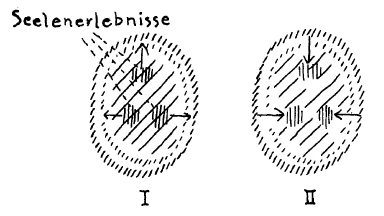
[ 11 ] As you delve deeper and deeper in this way into the nature of human soul life and the nature of human consciousness, you cannot possibly find any of the arguments repeatedly put forward by the materialism of the spiritual worldview to be in any way dangerous or significant. For it is, of course, utter nonsense to conclude, for example, from the fact that if the mirror apparatus is damaged in any way, the soul experience ceases to be perceived by consciousness, that this soul experience itself is bound to the mirror apparatus. For if someone breaks the mirror through which you perceive yourself, they do not break you; rather, you simply disappear from your own sight. So it is when the mirror apparatus for the soul life—the brain—is destroyed: perception ceases; but the soul life itself, insofar as it takes place in the etheric body and astral body, is not affected by it at all.
[ 12 ] Now let us ask ourselves: Now that we recognize this, do not the essence and nature of our physical body come into focus more than ever? — A moment’s reflection will show you that without consciousness we cannot arrive at a “I,” that is, at any awareness of the “I.” If we do not develop consciousness, we cannot arrive at a sense of self either. In order for us to acquire self-consciousness on Earth, our physical body, with its brain structure, must function as a mirror. We must learn to become conscious of ourselves through this reflection; and if we did not have this mirror, we could not become conscious of ourselves. But what is this mirror like?
[ 13 ] When we delve into occult research—tracing back through the reading of the Akashic Records to the very origin of our earthly existence—it becomes clear to us that, indeed, right at the beginning of earthly existence, this mirror apparatus, the outer physical body, was transformed by the Luciferic influence into something different from what it would have become had that influence not been present. We made it clear to ourselves yesterday what this physical body has become for the human being on Earth. It is something that disintegrates when the human being passes through the gate of death. But we said that what disintegrates there is not that which, so to speak, the divine spirits prepared through four planetary states so that it might become the physical body on Earth; but rather what we called yesterday the phantom, which belongs to the physical body as something that, like a form-body, permeates the material parts interwoven with our physical body and at the same time holds them together. Had there been no Luciferic influence, then at the beginning of earthly existence the human being would have received this phantom in full force along with his physical body. But now the Luciferic influences penetrated the human organism—insofar as it consists of physical body, etheric body, and astral body—and the consequence of this was the destruction of the phantom of the physical body. This is, as we shall see, what is symbolically expressed to us in the Bible through the Fall, and through the fact, as stated in the Old Testament, that death followed the Fall. Death was precisely the destruction of the phantom of the physical body. And the consequence of this was that human beings must witness the decay of their physical body as they pass through the gate of death. This decaying physical body, which lacks the power of the phantom, is what the human being possesses throughout their entire earthly life, from birth to death. Decay is actually constantly present, and the process of decomposition—the death of the physical body—is merely the final process, the culmination of a continuous development that, in essence, is always taking place. For if this decay is not countered by processes of building up in the same way that the destruction of the phantom proceeds, it ultimately leads to what we call death.
[ 14 ] If no Luciferic influence had taken place, there would be a balance in the physical body between the destructive and the constructive forces. But then everything in human nature during earthly existence would have turned out differently; then, for example, there would be no such mind that cannot comprehend the Resurrection. For what kind of intellect is it that man possesses, with which he cannot comprehend the Resurrection? It is the intellect that is bound to the decay of the physical body, and which exists as it does because man has taken into himself, through the Luciferic influence, the destruction of the phantom of the physical body. That is why the human mind, the human intellect, has become so thin, so flimsy, that it cannot take in the great processes of cosmic evolution; it regards them as miracles, or it says it cannot comprehend them. If the Luciferic influence had not come, the human mind would have become, through all that was intended for it—because of the constructive forces then present in the human body, which would have balanced the destructive ones—such that human beings would perceive the constructive process with their minds, just as one perceives an experiment in a laboratory. But our intellect has instead become such that it remains only on the surface of things and does not look into the depths of cosmic realities.
[ 15 ] Anyone wishing to characterize these conditions correctly would therefore have to say: At the beginning of our earthly existence, due to the Luciferic influence, the physical body did not become what it should have become according to the will of the forces that worked through Saturn, the Sun, and the Moon; rather, a process of destruction became integrated into it. And from then on—since the beginning of earthly existence—humanity has lived in a physical body that is subject to destruction, a body that cannot adequately counter the destructive forces with constructive ones.
[ 16 ] So it would indeed be true, what seems so foolish to modern man: that there is, after all, a secret connection between what came about through the influence of Lucifer and death! And let us now take a look at this influence. What, then, was the effect of this destruction of the physical body? — If we had the physical body in its entirety, as it was intended for us at the beginning of our earthly existence, our soul forces would be reflected in a completely different way, and only then would we truly know what we are. Thus, we do not know what we are, because the physical body is not given to us in its entirety. We do, of course, speak of the nature and essence of the human ego; but let us ask: To what extent does the human being know the “I”? So uncertain is the “I” that Buddhism can even deny it as passing from one incarnation to another. So uncertain is it that Greek civilization could fall into a tragic mood, which we expressed in the words of the Greek hero: Better to be a beggar in the upper world than a king in the realm of shadows! Nothing less was meant by this than that the Greek, because of his esteem for the physical body—that is, for what constitutes the phantom—and because of the destruction of the physical body, felt unhappy in the face of the fading and dimming of the self, because he felt that the self can exist only through self-consciousness. And as he saw the form of the physical body decaying, he was horrified at the thought that his “I” might fade away; this “I” that emerges only by reflecting itself in the form of the physical body. And if we trace human development from the dawn of the Earth to the Mystery of Golgotha, we find that the process we have just indicated manifests itself to an ever-increasing degree. We can already see this from the fact that, for example, in earlier times no one would have been found who preached the destruction of the physical body in such a radical manner as Gotama Buddha did. For this to happen, it was first necessary that this decay of the physical body—its complete annihilation in terms of its form—should proceed more and more, so that any prospect vanished that what becomes conscious through the physical body, or rather through its form, could truly pass over from one incarnation to the next. In truth, the matter is such that in the course of Earth’s evolution, humanity has lost the form of the physical body; it no longer possesses what was, so to speak, intended for it by the gods from the very beginning of the Earth. It first had to regain this; it first had to be imparted to it once more. And it is impossible to understand Christianity unless one realizes that at the time the events in Palestine were taking place, the human race had reached a point on Earth where this disintegration of the physical body had reached its peak, and where, precisely for that reason, there was a danger for the entire development of humanity that self-consciousness—the very achievement of Earth’s evolution—would be lost. Had nothing further been added to what existed up to the events in Palestine, the process would have continued—the destructive forces would have increasingly penetrated the physical human body, and the people born after the time of the events in Palestine would have had to live with an ever-dulled sense of self. That which depends on the perfection of the reflection of a physical body would have become increasingly dull.
[ 17 ] Then the Mystery of Golgotha took place, just as we have described it, and through this Mystery of Golgotha, what is so difficult to comprehend for the mind that is bound solely to the physical body—which is predominantly imbued with destructive forces—did indeed occur. What occurred was that this one human being, who was the bearer of Christ, underwent such a death that after three “days,” that which in the human being is the actual mortal aspect of the physical body had to disappear, and from the grave arose that body which is the bearer of the forces of the physical-material parts. That which was actually intended for humanity by the rulers of Saturn, the Sun, and the Moon rose from the grave: the pure phantom of the physical body, with all the characteristics of the physical body. This made possible the spiritual lineage of which we have spoken. If we imagine the body of Christ that arose from the grave, we can picture it this way: just as the bodies of earthly human beings descend from the body of Adam, insofar as they possess the decaying body, so do the spiritual bodies—the phantoms for all human beings—descend from that which arose from the grave. And it is possible to establish that relationship to Christ through which the earthly human being incorporates into his otherwise decaying physical body this phantom that rose from the tomb on Golgotha. It is possible for human beings to receive within their constitution those forces that rose from the grave at that time, just as they received the Adamic constitution through their physical constitution at the beginning of the Earth as a result of the Luciferic forces.
[ 18 ] This is what Paul actually means to say: Just as the human being, as a member of the physical stream of evolution, inherited the physical body, in which the destruction of the phantom—the bearer of forces—was continually taking place, so too can he inherit from that which has risen from the grave what he has lost; he can inherit it and clothe himself in it, just as he clothed himself in the first Adam; can become one with it and thereby undergo a development through which he ascends again just as he descended in evolution before the Mystery of Golgotha. That is to say: what was taken from him at that time through the Luciferic influence can be restored to him through the fact that it exists as the risen body of Christ. That is what Paul actually means to say.
[ 19 ] Just as what has just been said in this lecture can be refuted—or seemingly refuted—from the standpoint of modern anatomy or physiology, it is, of course, also child’s play to raise another objection at this point. One might say, for example: Even if Paul truly believed that a spiritual body had risen, what does this spiritual body, which rose from the grave at that time, have to do with what every human being now carries within themselves? — It is certainly understandable. One need only think of it by analogy with what makes every human being a physical human being. One might ask: from what does the individual human being originate? As a physical human being, he originates from a single egg cell. But a physical body consists entirely of individual cells, all of which are the offspring of the original egg cell; all the cells that make up a human body can be traced back to the original egg cell. Now imagine that, through what can be conceived as a mystical Christological process, a human being receives a body entirely different from the one they have gradually acquired through the descending line. And imagine each of these bodies that human beings receive as being just as closely connected to what rose from the grave as the human cells of the physical body are connected to the original egg cell. That is to say, we must conceive of what rose from the grave as multiplying and increasing in number just as the egg cell multiplies, which forms the basis of the physical body. Thus, in the development following the event of Golgotha, every human being can indeed acquire something that is within them and that spiritually descends from what rose from the grave just as—to speak with Paul—the ordinary body, which decays, descends from Adam.
[ 20 ] Of course, it is a mockery of human reason—which currently considers itself so arrogant—to say that a process similar to the fertilization of the egg cell, which can at best be observed, takes place in the unseen realm. And what has happened with the Mystery of Golgotha is an occult fact. And there, for those who observe the development with a clairvoyant eye, the fact unfolds that that spiritual cell—that is, the body that has conquered death, the body of Christ Jesus—has risen from the grave and communicates itself to everyone who, over time, establishes the appropriate relationship with Christ. For those who wish to deny supersensible processes altogether, this will of course seem absurd. But for those who already acknowledge supersensible processes, this supersensible process must first be presented in such a way that what rises from the grave reveals itself to those who make themselves receptive to it. Thus, for anyone who acknowledges the supersensible, it is a comprehensible matter.
[ 21 ] If we take this—which is truly the Pauline teaching—to heart, we come to regard the Mystery of Golgotha as something real, as something that happened and had to happen in the course of Earth’s evolution; for it is, quite literally, the salvation of the human “I.” We have seen that if the process of development had continued as it had unfolded up to the events in Palestine, then self-consciousness would not have been able to develop; not only would it have made no further progress from the time of Christ Jesus onward, but it would have descended further and further into darkness. But now it has set out on the path upward and will ascend to the same extent that human beings find their relationship to the Christ Being.
[ 22 ] Now, in essence, we can also understand Buddhism very well. Let us imagine, half a millennium before the events in Palestine, a person speaking the truth—but, due to the direction of his development, paying no heed to the event at Golgotha: Everything that surrounds the human being as a physical body, everything that makes him a being in a physical incarnation, must be regarded as worthless; this is, in essence, something ultimate that must be cast off. — Up to that point, however, it was the case that humanity would have had to move toward such a worldview if nothing else had come along. But the event of Golgotha did occur and brought about a complete restoration of the lost principles of human development. By taking in what we already referred to yesterday as the “incorruptible body”—and what we have now brought more clearly before our souls—and by incorporating this incorruptible body into himself, human beings will increasingly come to make their sense of self ever brighter; they will increasingly recognize within their nature that which runs through from incarnation to incarnation.
[ 23 ] Thus, what came into the world with Christianity must be regarded not merely as a new doctrine—this must be expressly emphasized—not as a new theory, but as something real and factual. Therefore, when people emphasize that everything Christ taught was already there before, this would mean nothing for a true understanding of Christianity; for that is not the essential point. The essential point is not what Christ taught, but what Christ gave: his body! For until then, nothing had ever entered into the development of the Earth through a human being who had died that was like what arose from the grave on Golgotha. Never since the beginning of human development on Earth had there been on Earth, through a human being who had passed through death, that which was present with the risen body of Christ Jesus. For of everything that existed in a similar way, it can be said: it was there because, after passing through the gate of death and undergoing the time between death and new birth, human beings entered into existence through a new birth. But then they brought with them the imperfect phantom, subject to decay; that is to say, they did not raise a phantom that is complete. And then we could also cite the cases of the initiates or the adepts. With them, it was always the case that they had to receive the initiation outside their physical body, by overcoming their physical body, which, however, did not extend to a raising of the physical phantom. All initiations of pre-Christian times were such that they went only as far as the outermost limit of the physical body; they had not touched the forces of the physical body—only to the general extent that the inner organization touches the outer one. In no case had it ever happened that what had passed through human death had overcome that death as a human phantom. Similar things had indeed occurred, but never this one thing: that a complete human death had been passed through and that afterwards the complete phantom had emerged victorious over death. Just as surely as only this phantom can give us the complete humanity of the Earth in the course of Earth’s development, so surely did this phantom take its starting point from the grave of Golgotha.
[ 24 ] This is what is important in Christian development. That is why it is no reproach when enlightened thinkers say time and again that the teaching of Christ Jesus has been transformed into a teaching about Christ Jesus. It had to be so. For what is important is not what Christ Jesus taught, but what he gave to humanity. His resurrection is the birth of a new aspect of human nature: an imperishable body. But that this could happen—that this human phantom could be saved through death—depends on two things: first, that the Christ-Jesus Being was what we characterized yesterday: physical body, etheric body, and astral body, as we described them—and not a human ego, but the Christ-Being. And the other is that the Christ-being had resolved to descend into a human body, to incarnate in a human physical body. For if we wish to view this Christ-being in the proper light, we must seek it as a being in the time that lies before the dawn of humanity on Earth. The Christ-Being is naturally present there. It does not enter the cycle of human evolution; it continues to live in the spiritual world. Humanity descends ever deeper and deeper. And at a moment when a crisis had come for human evolution, the Christ-Being incarnated in the physical body of a human being. — This is nothing other than the greatest sacrifice that the Christ-being could have made for the development of the Earth! And this is the second thing we must understand: what constitutes the sacrifice that the Christ-being made for human development on Earth. That is why yesterday we posed one part of the question regarding the nature of the Christ in relation to the time following John’s baptism in the Jordan. Today we have posed the other question: What does it mean that, with the baptism of John in the Jordan, the Christ-being was immersed into a physical body?
[ 25 ] And how did death come about in the mystery of Golgotha? That is something we will continue to explore over the next few days.