

From Jesus to Christ
GA 131
11 October 1911, Karlsruhe
Translate the original German text into any language:
Versions Available:
From Jesus to Christ, tr. SOL
Siebenter Vortrag
Seventh Lecture
[ 1 ] Wir haben durch unsere gestrige Betrachtung gesehen, daß in einer gewissen Beziehung die Frage des Christentums die der Auferstehung des Christus Jesus ist. Namentlich hat sich uns gezeigt, daß demjenigen Verkündiger des Christentums, der sogleich nach seiner Erkenntnis des Wesens des Christus-Impulses auch erkannt hatte, daß der Christus nach dem Ereignis von Golgatha lebt, daß dem Paulus nach seinem Erlebnis vor Damaskus ein gewaltiges, ein großartiges Geschichtsbild von derEntwickelung der Menschheit aufgegangen war. Und wir haben gestern, von diesem Punkte ausgehend, unsere Betrachtungen so weit geführt, daß wir uns eine Vorstellung verschafft haben von dem, was der Christus Jesus unmittelbar nach der Johannes-Taufe im Jordan war. Unsere nächsten Aufgaben werden also darin bestehen, zu untersuchen, was geschehen ist von der JohannesTaufe im Jordan bis zu dem Mysterium von Golgatha. Um aber von dem gestrigen Ausgangspunkte aus aufsteigen zu können zu dem Verständnis dieses Mysteriums von Golgatha, wird es notwendig sein, auf einiges hinzuweisen, um gewisse Hindernisse aus dem Wege zu räumen, die sich einem entgegenstellen, wenn man in einer tiefgehenden und ernsten Weise das Mysterium von Golgatha begreifen will. Sie können ja aus alledem, was über die Evangelien im Laufe der Jahre gesagt worden ist, und auch aus dem, was schon in den wenigen Vorträgen dieser Tage hier gesprochen wurde, entnehmen, daß gewisse, da oder dort für genügend erachtete theosophische Vorstellungen in Wirklichkeit durchaus nicht genügen, um die Frage zu beantworten, die uns beschäftigt.
[ 1 ] In our discussion yesterday, we saw that, in a certain sense, the question of Christianity is the question of the resurrection of Christ Jesus. Specifically, it became clear to us that the herald of Christianity who, immediately upon recognizing the nature of the Christ impulse, also realized that Christ lives on after the event at Golgotha—that is, Paul—had, following his experience on the road to Damascus, gained a powerful, magnificent historical vision of the development of humanity. And yesterday, starting from this point, we carried our reflections so far that we gained an understanding of what Christ Jesus was immediately after the baptism by John in the Jordan. Our next tasks will therefore consist in investigating what happened from the baptism by John in the Jordan up to the Mystery of Golgotha. But in order to be able to ascend from yesterday’s starting point to an understanding of this Mystery of Golgotha, it will be necessary to point out a few things in order to remove certain obstacles that stand in one’s way when one wishes to grasp the Mystery of Golgotha in a profound and serious manner. You can see from all that has been said about the Gospels over the years, and also from what has already been spoken here in the few lectures of these past few days, that certain theosophical concepts, which are here and there regarded as sufficient, are in reality by no means sufficient to answer the question that concerns us.
[ 2 ] Vor allen Dingen müssen wir ganz ernst nehmen, was über die drei Strömungen der Menschheit gesagt worden ist: die Strömung, die über das Griechentum heraufgeht, dann die zweite, die über das althebräische Altertum geht, und endlich diejenige Strömung, die ein halbes Jahrtausend vor unserer Zeitrechnung in dem Gotama Buddha ihren Ausdruck gefunden hat. Gezeigt hat sich uns, daß die Strömung des Gotama Buddha — namentlich so, wie sie sich eingelebt hat in die Bekennerschaft des Buddha — am allerwenigsten geeignet sein kann, ein Verständnis des Mysteriums von Golgatha zu vermitteln. Für den modernen Menschen, der erfüllt ist von dem Bewußtsein der gegenwärtigen Bildung, hat ja allerdings gerade die Strömung, die im Buddha-Bekenntnis zum Ausdruck kommt, etwas Bequemes; denn kaum eine andere Strömung kommt so den Begriffen der Gegenwart entgegen, insofern diese Begriffe gerade vor dem Größten stillestehen wollen, was die Menschheit zu begreifen hat: vor der Auferstehungsfrage. Denn mit der Auferstehungsfrage hängt die ganze Entwicklungsgeschichte der Menschheit zusammen. Es ist nun einmal so, daß, wie wir gesehen haben, innerhalb der Buddha-Lehre dasjenige verlorengegangen ist, was wir im eigentlichen Sinne das vierte Glied der menschlichen Natur nennen: die reale Wesenheit des Ich. Gewiß, man kann ja auch bei diesen Dingen allerlei Deutelungen und Interpretationskünste anwenden, und es wird viele Menschen geben, die in einer gewissen Weise bemängeln werden, was hier über die Buddha-Strömung gesagt worden ist. Aber darauf kommt es nicht an. Denn so etwas, wie ich es angeführt habe, was aus dem Herzen eines buddhistischen Menschen kommt, wie zum Beispiel das Gespräch zwischen dem König Milinda und dem buddhistischen Weisen Nagasena, solche Dinge sprechen deutlich dafür, daß so, wie wir von der Ich-Natur des Menschen sprechen müssen, innerhalb des Buddhismus nicht über die Ich-Natur gesprochen werden kann. Wir müssen es begreifen, daß es für einen echten Bekenner des Buddhismus sogar eine Ketzerei ist, wenn über die Ich-Natur so gesprochen wird, wie wir es vertreten müssen. Deshalb ist es notwendig, uns über die Ich-Natur zu verständigen.
[ 2 ] Above all, we must take very seriously what has been said about the three currents of humanity: the current that arose in Greek civilization, then the second, which arose in ancient Hebrew civilization, and finally the current that found its expression in Gotama Buddha half a millennium before our era. It has become clear to us that the current of Gotama Buddha—namely, as it has taken root in the community of the Buddha’s followers—is the least suited to conveying an understanding of the Mystery of Golgotha. For the modern person, who is imbued with an awareness of contemporary culture, the very current expressed in the Buddhist creed does indeed have a certain appeal; for hardly any other current accommodates the concepts of the present to such an extent, insofar as these concepts tend to come to a standstill precisely before the greatest thing humanity has to comprehend: the question of the Resurrection. For the entire history of human development is connected to the question of resurrection. It is simply the case that, as we have seen, what we call in the strictest sense the fourth member of human nature—the real essence of the I—has been lost within the Buddha’s teaching. Certainly, one can apply all sorts of interpretations and interpretive arts to these matters, and there will be many people who will, in a certain way, take issue with what has been said here about the Buddhist tradition. But that is not the point. For something like what I have cited—which comes from the heart of a Buddhist person, such as the conversation between King Milinda and the Buddhist sage Nagasena—such things clearly indicate that, just as we must speak of the ego-nature of the human being, within Buddhism one cannot speak of the ego-nature. We must understand that for a true adherent of Buddhism, it is even heresy to speak of the ego-nature in the way we must. Therefore, it is necessary for us to reach an understanding regarding the ego-nature.
[ 3 ] Was wir das menschliche Ich nennen, was wir bei jedem Menschen — und sei es der höchste Adept — als von Inkarnation zu Inkarnation gehend auffassen, von diesem menschlichen Ich — das haben wir gestern zum Schluß angeführt — können wir bei dem Jesus von Nazareth nur sprechen von der Geburt bis zur Johannes-Taufe im Jordan. Dann, nach der Johannes-Taufe, haben wir zwar in der Wesenheit des Christus Jesus noch vor uns den physischen Leib, Ätherleib und Astralleib des Jesus von Nazareth, aber jetzt sind diese äußeren menschlichen Hüllen bewohnt — nicht von einem menschlichen Ich, sondern von einem kosmischen Wesen, das wir als das Christus-Wesen uns nun schon in jahrelangen Bemühungen dem Verständnis durch Worte nahezubringen versuchen. Sobald man nämlich die ganze Wesenheit des Christus Jesus versteht, ist es eigentlich ganz selbstverständlich, daß man für den Christus Jesus eine jegliche Art der physischen, der fleischlichen Wiederverkörperung ablehnen muß, und daß die in meinem Mysteriendrama «Die Prüfung der Seele» gebrauchte Wendung von dem nur einmaligen Vorhandensein des Christus in einem fleischlichen Leibe ganz wörtlich und ernst genommen werden muß. Wir müssen demnach zuerst uns beschäftigen mit der Wesenheit, mit der Natur des menschlichen Ich, gerade mit demjenigen also, über das sozusagen vollständig hinaus sein mußte die Christus Jesus-Wesenheit von der Johannes-Taufe im Jordan an bis zum Mysterium von Golgatha.
[ 3 ] What we call the human ego—what we perceive in every human being, even the highest adept, as passing from incarnation to incarnation—of this human ego, as we noted at the end of yesterday’s discussion, we can speak in the case of Jesus of Nazareth only from his birth until his baptism by John in the Jordan. Then, after the baptism by John, we do indeed still have before us, in the being of Christ Jesus, the physical body, etheric body, and astral body of Jesus of Nazareth; but now these outer human sheaths are inhabited—not by a human ego, but by a cosmic being whom we have been trying for years to bring closer to our understanding through words as the Christ-being. For as soon as one understands the entire being of Christ Jesus, it is actually quite self-evident that one must reject any kind of physical, incarnate re-embodiment for Christ Jesus, and that the phrase used in my Mystery Drama *The Trial of the Soul* regarding the Christ’s existence in a physical body only once must be taken quite literally and seriously. We must therefore first concern ourselves with the essence, with the nature of the human ego—precisely that which the Christ Jesus-essence had to transcend, so to speak, completely from the baptism of John in the Jordan up to the Mystery of Golgotha.
[ 4 ] Aus den früheren Vorträgen, wo gezeigt worden ist, daß der Entwickelung der Erde voraufgegangen ist ein Saturndasein, ein Sonnendasein, ein Monddasein, und daß auf diese drei planetarischen Verkörperungen die vierte, unsere eigene Erdenverkörperung gefolgt ist, — aus solchen Vorträgen wissen Sie, daß erst innerhalb unserer Erde, innerhalb des vierten der planetarischen Zustände, die nötig waren, um unsere Erde mit allen ihren Wesen zustande zu bringen, dasjenige mit der menschlichen Natur in eine Verbindung treten konnte, was wir das menschliche Ich nennen. Wie wir für die alte Saturnzeit sprechen von dem Beginn des physischen Leibes, so sprechen wir bei der alten Sonnenzeit von der ersten Entwickelung des Ätherleibes, bei dem Mondendasein von der ersten Entwickelung des Astralleibes und erst bei der Erdentwickelung von der Entfaltung des Ich. Das wäre die ganze Sache geschichtlich, kosmisch-geschichtlich betrachtet. Wie stellt sich denn aber die Sache, wenn wir den Menschen ansehen?
[ 4 ] From the earlier lectures, in which it was shown that the development of the Earth was preceded by a Saturn phase, a Sun phase, and a Moon phase, and that these three planetary incarnations were followed by the fourth, our own Earth incarnation, —from such lectures you know that it was only within our Earth, within the fourth of the planetary states necessary to bring our Earth into being with all its beings, that what we call the human ego could enter into a connection with human nature. Just as we speak of the beginning of the physical body in relation to the ancient Saturn period, so we speak of the first development of the etheric body in relation to the ancient Sun period, of the first development of the astral body in relation to the Lunar period, and only of the unfolding of the ego in relation to the Earth period. That would be the whole matter viewed historically, from a cosmic-historical perspective. But how does the matter stand when we look at human beings?
[ 5 ] Da wissen wir aus unseren bisherigen Betrachtungen, daß, wenn auch der Keim des Ich schon in der lemurischen Zeit in die menschliche Wesenheit gelegt worden ist, eine Möglichkeit, zum Ich-Bewußtsein zu kommen, für den Menschen erst eingetreten ist gegen das Ende der atlantischen Zeit, und daß eigentlich auch dann noch dieses Ich-Bewußtsein sehr dämmerhaft und dunkel war. Ja, auch noch nach der atlantischen Zeit, durch die verschiedenen Kulturperioden hindurch, die dem Mysterium von Golgatha voraufgegangen sind, war verhältnismäßig lange noch das Ich-Bewußtsein ein dumpfes, traumhaftes, dämmerhaftes. Und wenn Sie die Entwickelung des hebräischen Volkes ins Auge fassen, wird Ihnen klar sein, daß gerade bei diesem Volke das Ich-Bewußtsein in einer sehr eigenartigen Weise zum Ausdruck gekommen ist. Es war eine Art von Volks-Ich, welches gelebt hat in jedem einzelnen Gliede des althebräischen Volkes; und im Grunde genommen hat jeder Angehörige dieses Volkes sein Ich hinaufgeleitet bis zum fleischlichen Stammvater, bis zu Abraham. Deshalb können wir sagen: Das Ich eines Gliedes des althebräischen Volkes ist noch ein solches, das wir als ein Gruppen-Ich, ein VolksGruppen-Ich bezeichnen. Es ist das Bewußtsein da noch nicht durchgedrungen bis zum individuellen Einzelwesen des Menschen. Warum ist das so? Aus dem Grunde, weil jenes Gefüge der viergliedrigen Menschenwesenheit, das wir heute als das normale ansehen, erst nach und nach im Laufe der Erdentwickelung sich herausgebildet hat, und weil im Grunde genommen erst gegen Ende der atlantischen Zeit der noch weit außer dem physischen Leib befindliche Teil des Ätherleibes nach und nach hineingezogen ist in den physischen Leib. Und erst indem diese eigentümliche Organisation sich herausgebildet hat, die wir jetzt als die normale mit dem hellseherischen Bewußtsein erkennen, daß nämlich der physische Leib und der Ätherleib sich ungefähr decken, erst dann ist die Möglichkeit für den Menschen gegeben worden, das Ich-Bewußtsein zu entfalten. Aber dieses Ich-Bewußtsein tritt uns in einer sehr eigentümlichen Art entgegen. Machen wir uns allmählich und langsam eine Vorstellung, wie uns dieses Ich-Bewußtsein beim Menschen entgegentritt!
[ 5 ] From our previous considerations, we know that although the seed of the ego was already planted in the human being during the Lemurian epoch, the possibility of attaining ego-consciousness did not arise for human beings until toward the end of the Atlantean epoch, and that even then this ego-consciousness was still very dim and obscure. Indeed, even after the Atlantean epoch, throughout the various cultural periods that preceded the Mystery of Golgotha, ego-consciousness remained, for a relatively long time, a dull, dreamlike, and dim state. And if you consider the development of the Hebrew people, it will become clear to you that it is precisely in this people that the sense of self has found expression in a very peculiar way. It was a kind of national ego that lived within every single member of the ancient Hebrew people; and, in essence, every member of this people traced their ego back to the physical progenitor, to Abraham. Therefore, we can say: The ego of a member of the ancient Hebrew people is still one that we describe as a group ego, a national-group ego. Consciousness had not yet penetrated to the individual human being. Why is this so? For the reason that the fourfold structure of the human being, which we regard as normal today, only gradually developed in the course of Earth’s evolution, and because, in essence, it was not until toward the end of the Atlantean epoch that the part of the etheric body still far outside the physical body was gradually drawn into the physical body. And only as this peculiar organization took shape—which we now recognize as normal through clairvoyant consciousness, namely that the physical body and the etheric body roughly coincide—only then was the possibility given to human beings to develop ego-consciousness. But this ego-consciousness presents itself to us in a very peculiar way. Let us gradually and slowly form a picture of how this sense of self presents itself to us in human beings!
[ 6 ] Ich habe Sie gestern darauf aufmerksam gemacht, wie Menschen gesprochen haben, die mit aller Intellektualität der Gegenwart, mit aller Verständigkeit der Zeit gestellt wurden vor die Auferstehungsfrage; wie sie sagen: Wenn ich zugeben muß, was echte Paulinische Lehre ist für die Auferstehung, dann muß ich einen Riß machen in meine ganze Weltanschauung. — So sagen die Menschen der Gegenwart, die Menschen, die also aus ihrer Seele herausziehen können alles, was zu unserem gegenwärtigen Verstande gehört. Es ist solchen Menschen, die so sprechen, ganz gewiß außerordentlich fernliegend, was jetzt gesagt werden muß.
[ 6 ] Yesterday I drew your attention to how people—who, with all the intellectuality of the present day and all the rationality of our time, were confronted with the question of the Resurrection—have spoken; how they say: If I must acknowledge what the true Pauline teaching on the Resurrection is, then I must make a rupture in my entire worldview. — This is what the people of today say, the people who are thus able to draw from their very souls everything that belongs to our present understanding. What must now be said is certainly extremely remote to such people who speak in this way.
[ 7 ] Aber wäre es denn nicht möglich, daß solche Menschen einmal folgende Überlegung anstellten: Gut, könnten sie sagen, ich muß einen Rifß machen in meine ganze Verstandesanschauung; in alles, was ich intellektuell denken kann, muß ich einen Riß machen, wenn ich die Auferstehung annehmen soll. Ist das aber ein Grund, sie abzulehnen? Ist es die einzige Möglichkeit, weil unser Verständnis diese Auferstehung nicht begreift und sie als ein Wunder ansehen soll, über diesen Zwiespalt dadurch hinüberzugelangen, daß wir die Auferstehung ablehnen? Gäbe es nicht noch eine andere Möglichkeit? — Diese andere Möglichkeit kommt dem modernen Menschen gar nicht leicht; sie würde sich nämlich darin ausdrücken, daß sich der Mensch sagte: Vielleicht liegt es nicht an der Auferstehung, daß ich sie nicht begreifen kann, sondern vielleicht liegt es an meinem Verstande; vielleicht ist mein Verstand nur nicht geeignet, um die Auferstehung zu verstehen!
[ 7 ] But would it not be possible for such people to consider the following: “Well,” they might say, “I must make a break with my entire rational understanding; I must make a break with everything I can intellectually conceive if I am to accept the Resurrection. But is that a reason to reject it? Is it the only way—since our understanding cannot grasp this resurrection and must regard it as a miracle—to overcome this conflict by rejecting the resurrection? Is there not another possibility? — This other possibility does not come easily to modern man; for it would be expressed in man saying to himself: Perhaps it is not the resurrection that I cannot comprehend, but perhaps it is my mind; perhaps my mind is simply not suited to understanding the resurrection!
[ 8 ] So wenig man in unserer Gegenwart diese Sache ganz ernst nehmen wird, so darf doch gesagt werden: den modernen Menschen hindert sein Hochmut, eben weil er gar nicht daran denkt, daß darin ein Hochmut sitzen könnte, seinen Verstand inbezug auf diese Frage für inkompetent zu erklären. Denn was könnte erklärlicher sein: Zu sagen, was meine Verstandesanschauung zerreißt, das lehne ich ab, oder sich zu sagen, was eben erwähnt worden ist, daß der Verstand vielleicht nicht kompetent sein könnte? Das letztere läßt aber der Hochmut nicht zu.
[ 8 ] As little as people today are likely to take this matter entirely seriously, it must nevertheless be said: modern man’s arrogance—precisely because he does not even consider that there might be arrogance involved—prevents him from declaring his reason incompetent with regard to this question. For what could be more obvious: to say, “I reject whatever tears my intellectual perspective apart,” or to admit, as has just been mentioned, that reason might not be competent? But the latter is not permitted by arrogance.
[ 9 ] Nun müßte natürlich der Anthroposoph über diesen Hochmut durch Selbsterziehung hinauskommen; und es müßte verhältnismäßig dem wahren, echten anthroposophischen Herzen nicht ferne liegen, sich zu sagen, mein Verstand ist vielleicht nicht kompetent, um über die Auferstehung zu entscheiden. Aber dann kommt für den Anthroposophen eine andere Schwierigkeit, die nämlich, daß er nun doch eine solche Antwort begreifen muß, warum der Verstand, der Intellekt des Menschen nicht geeignet sein könnte, um die größte Tatsache der menschlichen Entwickelung zu begreifen. Die Antwort auf diese Frage können wir uns dadurch geben, daß wir zunächst einmal etwas genauer eingehen auf das eigentliche Wesen des menschlichen Verstandes. Erinnern möchte ich dabei an meine Münchner Vorträge «Weltenwunder, Seelenprüfungen und Geistesoffenbarungen», wovon ich jetzt nur — soweit wir es brauchen — ganz kurz den Inhalt angeben will.
[ 9 ] Now, of course, the anthroposophist would have to overcome this arrogance through self-education; and it should not be too far from the true, genuine anthroposophical heart to say to oneself: My intellect may not be competent to decide on the Resurrection. But then another difficulty arises for the anthroposophist, namely that he must now understand why the human mind, the human intellect, might not be suited to grasping the greatest fact of human evolution. We can answer this question by first examining the actual nature of the human intellect in somewhat greater detail. In this regard, I would like to refer to my Munich lectures “World Wonders, Soul Trials, and Spiritual Revelations,” the content of which I will now summarize very briefly—only to the extent that we need it.

[ 10 ] Was wir innerlich seelisch verarbeiten, das ist seinem Inhalte nach nicht in unserem gegenwärtigen physischen Leib; sondern das ist seinem Inhalte nach innerhalb unserer Organisation nur so weit, daß es bis zum Ätherleibe des Menschen geht. Unsere Gedanken, Gefühle und Empfindungen, dem Inhalte nach, spielen zunächst bis zu unserem Ätherleib. Um uns das klarzumachen, denken wir uns unsere menschliche Wesenheit, insofern sie besteht aus Ich, Astralleib und Ätherleib, symbolisiert, zusammengefügt als eine elliptische Fläche. Das sei graphisch, schematisch dargestellt, was wir in dieser Beziehung unsere Innerlichkeit nennen können, was wir seelisch erleben können und was so weit geht, daß es sich noch in den Strömungen und Kräften des Ätherleibes zum Ausdruck bringt. Wenn wir einen Gedanken, eine Empfindung fassen, so ist das in unserem Seelenwesen in drei Gliedern, die wir uns in der folgenden Figur vorstellen. Es gibt nun schlechterdings innerhalb unseres Seelenlebens nichts, was nicht gerade in dieser Weise in uns wäre. Wenn nun der Mensch mit seinem gewöhnlichen irdischen Bewußtsein seine Seelenerlebnisse nur so hätte, wie ich sie jetzt geschildert habe, so erlebte er sie zwar, könnte sich ihrer aber nicht bewußt werden; sie würden unbewußt Seelenerlebnisse bleiben. Bewußt werden unsere Seelenerlebnisse uns erst durch einen Vorgang, den wir uns begreiflich machen können, wenn wir folgendes Gleichnis gebrauchen. Denken Sie, Sie gehen in einer Richtung und schauen geradeaus, und denken Sie, Sie hießen «Müller». Indem Sie so geradeaus gehen, sehen Sie den «Müller» nicht, dennoch sind Sie es, erleben es, sind die Wesenheit «Müller». Und denken Sie weiter, indem Sie so hingehen, schiebt Ihnen jemand einen Spiegel vor: jetzt steht der «Müller» vor Ihnen. Was Sie früher erlebt haben, sehen Sie jetzt; das tritt Ihnen im Spiegel entgegen. — So ist es mit dem gesamten Seelenleben des Menschen: der Mensch erlebt es, wird sich dessen aber nicht bewußt, wenn ihm nicht ein Spiegel entgegengehalten wird. Und für das Seelenleben ist der Spiegel nichts anderes als der physische Leib. Daher können wir den physischen Leib jetzt schematisch als die äußere Hülle zeichnen, und die Empfindungen oder Gedanken werden zurückgeworfen durch die Hülle des physischen Leibes. Dadurch werden uns die Vorgänge bewußt. So ist für uns als irdische Menschen der physische Menschenleib in Wahrheit ein Spiegelungsapparat.
[ 10 ] What we process internally on a soul level does not, in terms of its content, reside within our present physical body; rather, in terms of its content, it extends within our organism only as far as the human etheric body. Our thoughts, feelings, and sensations, in terms of their content, initially extend only as far as our etheric body. To make this clear to ourselves, let us imagine our human being—insofar as it consists of the I, the astral body, and the etheric body—symbolized and combined as an elliptical surface. This is a graphic, schematic representation of what we might call our inner life in this context—what we can experience psychically and what extends to the point of expressing itself in the currents and forces of the etheric body. When we grasp a thought or a sensation, this occurs within our soul being in three parts, which we can visualize in the following figure. There is simply nothing within our soul life that is not present within us in precisely this way. If a person, with their ordinary earthly consciousness, were to have their soul experiences only as I have just described them, they would indeed experience them but could not become conscious of them; they would remain unconscious soul experiences. Our soul experiences only become conscious to us through a process that we can understand if we use the following analogy. Imagine you are walking in one direction and looking straight ahead, and imagine your name is “Müller.” As you walk straight ahead like this, you do not see “Müller,” yet you are him, you experience it, you are the being “Müller.” And imagine further that as you walk along, someone holds a mirror in front of you: now “Müller” stands before you. What you previously experienced, you now see; it meets you in the mirror. — So it is with the entire soul life of the human being: the human being experiences it, but does not become aware of it unless a mirror is held up to them. And for the life of the soul, the mirror is nothing other than the physical body. Therefore, we can now schematically draw the physical body as the outer shell, and the sensations or thoughts are reflected back through the shell of the physical body. Through this, we become aware of the processes. Thus, for us as earthly human beings, the physical human body is in truth a mirroring apparatus.
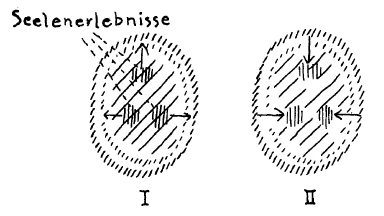
[ 11 ] Wenn Sie in dieser Weise immer tiefer und tiefer in das Wesen des menschlichen Seelenlebens und in das Wesen des menschlichen Bewußtseins eindringen, können Sie unmöglich alle diejenigen Dinge, die immer wieder und wieder von dem Materialismus der spirituellen Weltauffassung entgegengebracht werden, irgendwie gefährlich oder bedeutsam finden. Denn es ist natürlich ein vollständiger Unsinn, daraus zum Beispiel, daß bei irgendeiner Beschädigung des Spiegelungsapparates das seelische Erleben für das Bewußtsein aufhört wahrgenommen zu werden, den Schluß zu ziehen, daß dieses seelische Erleben selbst an den Spiegelapparat gebunden wäre. Denn wenn jemand den Spiegel zerbricht, dem Sie entgegengehen, und durch den Sie sich wahrnehmen, zerbricht er nicht Sie, sondern Sie verschwinden nur vor Ihrem Blick. So ist es, wenn der Spiegelapparat für das Seelenleben, das Gehirn, zerstört wird: es hört die Wahrnehmung auf; aber das Seelenleben selbst, insofern es im Ätherleib und Astralleib abläuft, wird gar nicht davon berührt.
[ 11 ] As you delve deeper and deeper in this way into the nature of human soul life and the nature of human consciousness, you cannot possibly find any of the arguments repeatedly put forward by the materialism of the spiritual worldview to be in any way dangerous or significant. For it is, of course, utter nonsense to conclude, for example, from the fact that if the mirror apparatus is damaged in any way, the soul experience ceases to be perceived by consciousness, that this soul experience itself is bound to the mirror apparatus. For if someone breaks the mirror through which you perceive yourself, they do not break you; rather, you simply disappear from your own sight. So it is when the mirror apparatus for the soul life—the brain—is destroyed: perception ceases; but the soul life itself, insofar as it takes place in the etheric body and astral body, is not affected by it at all.
[ 12 ] Nun fragen wir weiter: Kommt nicht gerade jetzt, wo wir dieses einsehen, die Wesenheit und die Natur unseres physischen Leibes gar sehr in Betracht? — Eine leichte Überlegung kann Ihnen zeigen, daß wir ohne Bewußtsein zu keinem Ich kommen können, nämlich zu keinem Bewußtsein vom Ich. Wenn wir kein Bewußtsein entwickeln, können wir auch zu keinem Ich kommen. Daß wir uns auf der Erde das Ich-Bewußstsein aneignen können, dazu muß unser physischer Leib mit der Gehirnorganisation ein Spiegelapparat sein. Wir müssen lernen, an der Spiegelung uns unser selbst bewußt zu werden; und hätten wir keinen Spiegelapparat, so könnten wir uns nicht unser selbst bewußt werden. Wie ist aber dieser Spiegel?
[ 12 ] Now let us ask ourselves: Now that we recognize this, do not the essence and nature of our physical body come into focus more than ever? — A moment’s reflection will show you that without consciousness we cannot arrive at a “I,” that is, at any awareness of the “I.” If we do not develop consciousness, we cannot arrive at a sense of self either. In order for us to acquire self-consciousness on Earth, our physical body, with its brain structure, must function as a mirror. We must learn to become conscious of ourselves through this reflection; and if we did not have this mirror, we could not become conscious of ourselves. But what is this mirror like?
[ 13 ] Da zeigt sich uns nun, wenn wir eingehen auf die okkulten Forschungen, die zurückgehen durch das Lesen der Akasha-Chronik bis zum Ursprunge unseres Erdendaseins, daß in der Tat gerade im Beginne des Erdendaseins dieser Spiegelapparat, der äußere physische Leib, durch den luziferischen Einfluß anders geworden ist, als er geworden wäre, wenn der luziferische Einfluß nicht vorhanden gewesen wäre. Wir haben es uns ja gestern klargemacht, was dieser physische Leib für den Erdenmenschen geworden ist. Er ist etwas, was zerfällt, wenn der Mensch durch die Pforte des Todes schreitet. Wir haben aber gesagt, was da zerfällt, ist nicht dasjenige, was sozusagen die göttlichen Geister durch vier planetarische Zustände vorbereitet haben, damit es auf der Erde zum physischen Leib hat werden sollen; sondern was wir gestern als das Phantom bezeichnet haben, das gehört zum physischen Leibe als etwas, was wie ein Formleib die materiellen Teile, welche unserm physischen Leibe einverwoben sind, durchdringt und zu gleicher Zeit zusammenhält. Wäre kein luziferischer Einfluß geschehen, dann hätte der Mensch im Beginne des Erdendaseins in voller Kraft dieses Phantom mit seinem physischen Leibe bekommen. Nun aber drangen in die menschliche Organisation, insofern sie besteht aus physischem Leib, Ätherleib und Astralleib, die luziferischen Einflüsse ein, und die Folge davon war die Zerstörung des Phantoms des physischen Leibes. Das ist es, wie wir sehen werden, was uns in der Bibel symbolisch mit dem Sündenfall ausgedrückt wird, und mit der Tatsache, wie es im Alten Testament gesagt wird, daß auf den Sündenfall der Tod folgte. Der Tod war eben die Zerstörung des Phantoms des physischen Leibes. Und die Folge davon war, daß der Mensch zerfallen sehen muß seinen physischen Leib, wenn er durch die Pforte des Todes schreitet. Diesen zerfallenden physischen Leib, dem die Kraft des Phantoms mangelt, hat der Mensch überhaupt sein ganzes Erdenleben hindurch, von der Geburt bis zum Tode. Das Zerfallen ist fortwährend eigentlich vorhanden, und das Zersetztwerden, der Tod des physischen Leibes, ist nur der letzte Prozeß, der Schlußstein einer fortdauernden Entwickelung, die im Grunde genommen fortwährend geschieht. Denn wenn nicht in gleicher Art, wie die Zerstörung des Phantoms vor sich geht, durch Aufbauprozesse diesem Abbauen entgegengetreten wird, kommt es schließlich zu dem, was wir den Tod nennen.
[ 13 ] When we delve into occult research—tracing back through the reading of the Akashic Records to the very origin of our earthly existence—it becomes clear to us that, indeed, right at the beginning of earthly existence, this mirror apparatus, the outer physical body, was transformed by the Luciferic influence into something different from what it would have become had that influence not been present. We made it clear to ourselves yesterday what this physical body has become for the human being on Earth. It is something that disintegrates when the human being passes through the gate of death. But we said that what disintegrates there is not that which, so to speak, the divine spirits prepared through four planetary states so that it might become the physical body on Earth; but rather what we called yesterday the phantom, which belongs to the physical body as something that, like a form-body, permeates the material parts interwoven with our physical body and at the same time holds them together. Had there been no Luciferic influence, then at the beginning of earthly existence the human being would have received this phantom in full force along with his physical body. But now the Luciferic influences penetrated the human organism—insofar as it consists of physical body, etheric body, and astral body—and the consequence of this was the destruction of the phantom of the physical body. This is, as we shall see, what is symbolically expressed to us in the Bible through the Fall, and through the fact, as stated in the Old Testament, that death followed the Fall. Death was precisely the destruction of the phantom of the physical body. And the consequence of this was that human beings must witness the decay of their physical body as they pass through the gate of death. This decaying physical body, which lacks the power of the phantom, is what the human being possesses throughout their entire earthly life, from birth to death. Decay is actually constantly present, and the process of decomposition—the death of the physical body—is merely the final process, the culmination of a continuous development that, in essence, is always taking place. For if this decay is not countered by processes of building up in the same way that the destruction of the phantom proceeds, it ultimately leads to what we call death.
[ 14 ] Wäre nun kein luziferischer Einfluß geschehen, so wäre im physischen Leibe ein Gleichgewicht vorhanden zwischen den zerstörenden und den aufbauenden Kräften. Dann aber wäre alles in der menschlichen Natur im Erdendasein anders geworden; dann gäbe es zum Beispiel keinen solchen Verstand, der die Auferstehung nicht begreifen kann. Denn was ist das für ein Verstand, den der Mensch hat, mit dem er die Auferstehung nicht begreifen kann? Das ist der Verstand, der an das Zerfallen des physischen Leibes gebunden ist, und der so, wie er ist, deshalb besteht, weil der Mensch in sich aufgenommen hat durch den luziferischen Einfluß die Zerstörung des Phantoms des physischen Leibes. Deshalb ist der menschliche Verstand, der menschliche Intellekt so dünn, so fadenscheinig geworden, daß er nicht in sich hereinnehmen kann die großen Prozesse der kosmischen Entwickelung; er sieht sie als Wunder an, oder er sagt, er könne sie nicht begreifen. Wenn der luziferische Einfluß nicht gekommen wäre, wäre der menschliche Verstand durch alles, was ihm zugedacht war, so geworden — wegen der dann im menschlichen Leibe befindlichen aufbauenden Kräfte, die den zerstörenden die Waage gehalten hätten —, daß der Mensch mit dem Verstande einsehen würde den aufbauenden Prozeß, wie man ein Experiment im Laboratorium einsieht. So ist aber unser Verstand so geworden, daß er nur an der Oberfläche der Dinge bleibt und nicht in die Tiefen der kosmischen Dinge sieht.
[ 14 ] If no Luciferic influence had taken place, there would be a balance in the physical body between the destructive and the constructive forces. But then everything in human nature during earthly existence would have turned out differently; then, for example, there would be no such mind that cannot comprehend the Resurrection. For what kind of intellect is it that man possesses, with which he cannot comprehend the Resurrection? It is the intellect that is bound to the decay of the physical body, and which exists as it does because man has taken into himself, through the Luciferic influence, the destruction of the phantom of the physical body. That is why the human mind, the human intellect, has become so thin, so flimsy, that it cannot take in the great processes of cosmic evolution; it regards them as miracles, or it says it cannot comprehend them. If the Luciferic influence had not come, the human mind would have become, through all that was intended for it—because of the constructive forces then present in the human body, which would have balanced the destructive ones—such that human beings would perceive the constructive process with their minds, just as one perceives an experiment in a laboratory. But our intellect has instead become such that it remains only on the surface of things and does not look into the depths of cosmic realities.
[ 15 ] Es müßte also jemand, der diese Verhältnisse richtig charakteristeren wollte, sagen: Im Beginne unseres Erdendaseins ist durch den luziferischen Einfluß der physische Leib nicht so geworden, wie er hätte werden sollen durch den Willen der Mächte, die durch Saturn, Sonne und Mond gewirkt haben; sondern es hat sich ihm eingegliedert ein Zerstörungsprozeß. Und der Mensch lebt fortan — seit dem Beginn des Erdendaseins — in einem physischen Leib, der der Zerstörung unterworfen ist, der nicht in entsprechender Weise den zerstörenden Kräften entgegensetzen kann die aufbauenden Kräfte.
[ 15 ] Anyone wishing to characterize these conditions correctly would therefore have to say: At the beginning of our earthly existence, due to the Luciferic influence, the physical body did not become what it should have become according to the will of the forces that worked through Saturn, the Sun, and the Moon; rather, a process of destruction became integrated into it. And from then on—since the beginning of earthly existence—humanity has lived in a physical body that is subject to destruction, a body that cannot adequately counter the destructive forces with constructive ones.
[ 16 ] So wäre es denn also wahr, was dem modernen Menschen so töricht erscheint: daß doch eine geheime Beziehung ist zwischen dem, was durch die Wirkung Luzifers geschehen ist, und dem Tode! Und sehen wir jetzt diese Wirkung einmal an. Welches war denn die Wirkung dieser Zerstörung des physischen Leibes? — Hätten wir den physischen Leib vollständig, wie er uns im Beginne des Erdendaseins zugedacht war, so würden sich unsere Seelenkräfte in ganz anderer Weise spiegeln, und wir würden dann erst wahrhaftig wissen, was wir sind. So wissen wir nicht, was wir sind, weil uns der physische Leib nicht in seiner Vollständigkeit gegeben ist. Wir sprechen allerdings von der Natur und Wesenheit des Ich des Menschen; aber fragen wir einmal: Wie weit kennt denn der Mensch das Ich? So zweifelhaft ist das Ich, daß es der Buddhismus sogar leugnen kann als von einer Inkarnation zur andern gehend. So zweifelhaft ist es, daß das Griechentum in eine tragische Stimmung verfallen konnte, die wir mit den Worten des griechischen Heros ausdrückten: Lieber ein Bettler sein in der Oberwelt, als ein König im Reiche der Schatten! Nichts Geringeres war damit gesagt, als daß der Grieche wegen der Schätzung des physischen Leibes, das heißt dessen, was das Phantom ausmacht, und wegen der Zerstörung des physischen Leibes, sich unglücklich fühlte gegenüber dem Hinschwinden und Hindämmern des Ich, weil er fühlte, daß das Ich nur beim Ichbewußtsein bestehen kann. Und indem er zerfallen sah die Form des physischen Leibes, graute ihm bei dem Gedanken, daß sein Ich hindämmere; dieses Ich, das nur dadurch hervorgeht, daß es sich spiegelt an der Form des physischen Leibes. Und wenn wir verfolgen die menschliche Entwickelung vom Erdenanfang bis zum Mysterium von Golgatha, so finden wir, daß der Prozeß, den wir eben angedeutet haben, sich in einem immer steigenderen Maße zeigt. Das können wir schon daraus ersehen, daß zum Beispiel in älteren Zeiten niemand sich gefunden haben würde, der in solcher radikalen Art die Vernichtung des physischen Leibes gepredigt haben würde, wie sie Gotama Buddha gepredigt hat. Dazu war erst notwendig, daß dieser Zerfall des physischen Leibes, die völlige Vernichtung in bezug auf seine Form, sich immer mehr und mehr vollzog, so daß jede Aussicht schwand, daß das, was durch den physischen Leib beziehungsweise durch seine Form bewußt wird, wirklich von einer Inkarnation in die andere hinüberziehen kann. In Wahrheit liegt die Sache so, daß der Mensch im Laufe der Erdentwickelung die Form des physischen Leibes verloren hat, daß er nicht das hat, was ihm sozusagen von Göttern zugedacht war vom Erdenanfang an. Das mußte er erst wieder bekommen; das mußte ihm erst wieder mitgeteilt werden. Und es ist unmöglich, das Christentum zu begreifen, wenn man nicht einsieht, daß zur Zeit, als die Ereignisse von Palästina sich abspielten, das Menschengeschlecht über die Erde hin dort angekommen war, wo dieser Zerfall des physischen Leibes seinen Höhepunkt erreicht hatte, und wo eben deswegen für die gesamte Entwickelung der Menschheit die Gefahr bestand, daß das Ichbewußtsein, die eigentliche Errungenschaft der Erdentwickelung, verlorengehe. Wäre nichts weiter hinzugetreten zu dem, was vorhanden war bis zu den Ereignissen von Palästina, wäre der Prozeß fortgeschritten — immer mehr und mehr wäre das Zerstörende eingezogen in die physische menschliche Leiblichkeit, und die Menschen, die geboren worden wären nach der Zeit des Ereignisses von Palästina, hätten leben müssen mit einem immer dumpferen Ichgefühl. Immer stumpfer wäre das geworden, was von der Vollkommenheit der Spiegelung eines physischen Leibes abhängt.
[ 16 ] So it would indeed be true, what seems so foolish to modern man: that there is, after all, a secret connection between what came about through the influence of Lucifer and death! And let us now take a look at this influence. What, then, was the effect of this destruction of the physical body? — If we had the physical body in its entirety, as it was intended for us at the beginning of our earthly existence, our soul forces would be reflected in a completely different way, and only then would we truly know what we are. Thus, we do not know what we are, because the physical body is not given to us in its entirety. We do, of course, speak of the nature and essence of the human ego; but let us ask: To what extent does the human being know the “I”? So uncertain is the “I” that Buddhism can even deny it as passing from one incarnation to another. So uncertain is it that Greek civilization could fall into a tragic mood, which we expressed in the words of the Greek hero: Better to be a beggar in the upper world than a king in the realm of shadows! Nothing less was meant by this than that the Greek, because of his esteem for the physical body—that is, for what constitutes the phantom—and because of the destruction of the physical body, felt unhappy in the face of the fading and dimming of the self, because he felt that the self can exist only through self-consciousness. And as he saw the form of the physical body decaying, he was horrified at the thought that his “I” might fade away; this “I” that emerges only by reflecting itself in the form of the physical body. And if we trace human development from the dawn of the Earth to the Mystery of Golgotha, we find that the process we have just indicated manifests itself to an ever-increasing degree. We can already see this from the fact that, for example, in earlier times no one would have been found who preached the destruction of the physical body in such a radical manner as Gotama Buddha did. For this to happen, it was first necessary that this decay of the physical body—its complete annihilation in terms of its form—should proceed more and more, so that any prospect vanished that what becomes conscious through the physical body, or rather through its form, could truly pass over from one incarnation to the next. In truth, the matter is such that in the course of Earth’s evolution, humanity has lost the form of the physical body; it no longer possesses what was, so to speak, intended for it by the gods from the very beginning of the Earth. It first had to regain this; it first had to be imparted to it once more. And it is impossible to understand Christianity unless one realizes that at the time the events in Palestine were taking place, the human race had reached a point on Earth where this disintegration of the physical body had reached its peak, and where, precisely for that reason, there was a danger for the entire development of humanity that self-consciousness—the very achievement of Earth’s evolution—would be lost. Had nothing further been added to what existed up to the events in Palestine, the process would have continued—the destructive forces would have increasingly penetrated the physical human body, and the people born after the time of the events in Palestine would have had to live with an ever-dulled sense of self. That which depends on the perfection of the reflection of a physical body would have become increasingly dull.
[ 17 ] Da trat das Mysterium von Golgatha ein, trat so ein, wie wir es charakterisiert haben, und durch dieses Mysterium von Golgatha ist in der Tat dasjenige geschehen, was so schwierig zu begreifen ist für jenen Verstand, der nur gebunden ist an den überwiegend mit den zerstörenden Kräften behafteten physischen Leib. Es ist eingetreten, daß dieser eine Mensch, der der Träger des Christus war, einen solchen Tod durchgemacht hat, daß nach drei "Tagen dasjenige, was am Menschen das eigentlich Sterbliche des physischen Leibes ist, verschwinden mußte und aus dem Grabe sich erhob jener Leib, der der Kräfterräger der physisch-materiellen Teile ist. Das, was eigentlich dem Menschen zugedacht war von den Beherrschern von Saturn, Sonne und Mond, das hat sich erhoben aus dem Grabe: das reine Phantom des physischen Leibes, mit allen Eigenschaften des physischen Leibes. Dadurch war die Möglichkeit gegeben jenes spirituellen Stammbaumes, von dem wir gesprochen haben. Denken wir uns den aus dem Grabe erstandenen Leib des Christus, so können wir uns vorstellen: ebenso wie von dem Leibe des Adam abstammen die Leiber der Erdenmenschen, insofern sie den zerfallenden Leib haben, so stammen ab von dem, was aus dem Grabe auferstand, die geistigen Leiber, die Phantome für alle Menschen. Und es ist möglich, jene Beziehung zu dem Christus herzustellen, durch welche der Erdenmensch seinem sonst zerfallenden physischen Leib einfügt dieses Phantom, das aus dem Grabe von Golgatha auferstanden ist. Es ist möglich, daß der Mensch in seiner Organisation jene Kräfte, die damals auferstanden sind, so erhält, wie er durch seine physische Organisation im Erdenanfang infolge der luziferischen Kräfte die Adamorganiisation erhalten hat.
[ 17 ] Then the Mystery of Golgotha took place, just as we have described it, and through this Mystery of Golgotha, what is so difficult to comprehend for the mind that is bound solely to the physical body—which is predominantly imbued with destructive forces—did indeed occur. What occurred was that this one human being, who was the bearer of Christ, underwent such a death that after three “days,” that which in the human being is the actual mortal aspect of the physical body had to disappear, and from the grave arose that body which is the bearer of the forces of the physical-material parts. That which was actually intended for humanity by the rulers of Saturn, the Sun, and the Moon rose from the grave: the pure phantom of the physical body, with all the characteristics of the physical body. This made possible the spiritual lineage of which we have spoken. If we imagine the body of Christ that arose from the grave, we can picture it this way: just as the bodies of earthly human beings descend from the body of Adam, insofar as they possess the decaying body, so do the spiritual bodies—the phantoms for all human beings—descend from that which arose from the grave. And it is possible to establish that relationship to Christ through which the earthly human being incorporates into his otherwise decaying physical body this phantom that rose from the tomb on Golgotha. It is possible for human beings to receive within their constitution those forces that rose from the grave at that time, just as they received the Adamic constitution through their physical constitution at the beginning of the Earth as a result of the Luciferic forces.
[ 18 ] Das ist es, was eigentlich Paulus sagen will: Wie der Mensch, indem er als Angehöriger der physischen Entwickelungsströmung den physischen Leib erbte, an dem sich fort und fort die Zerstörung des Phantoms, des Kräfteträgers vollzog, so kann er erben von dem, was auferstanden ist aus dem Grabe, dasjenige, was er verloren hat; kann es erben und sich anziehen, wie er den ersten Adam angezogen hat; kann mit ihm eins werden und dadurch eine Entwickelung durchmachen, durch die er ebenso hinaufsteigt wieder, wie er vor dem Mysterium von Golgatha heruntergestiegen ist in der Entwickelung. Das heißt: was ihm dazumal genommen worden ist durch den luziferischen Einfluß, das kann ihm wiedergegeben werden dadurch, daß es vorhanden ist als auferstandener Leib des Christus. Das ist es, was eigentlich Paulus sagen will.
[ 18 ] This is what Paul actually means to say: Just as the human being, as a member of the physical stream of evolution, inherited the physical body, in which the destruction of the phantom—the bearer of forces—was continually taking place, so too can he inherit from that which has risen from the grave what he has lost; he can inherit it and clothe himself in it, just as he clothed himself in the first Adam; can become one with it and thereby undergo a development through which he ascends again just as he descended in evolution before the Mystery of Golgotha. That is to say: what was taken from him at that time through the Luciferic influence can be restored to him through the fact that it exists as the risen body of Christ. That is what Paul actually means to say.
[ 19 ] So wie das, was eben in dieser Stunde gesagt worden ist, vom Standpunkte der modernen Anatomie oder Physiologie aus zu widerlegen — scheinbar zu widerlegen ist, so ist es natürlich auch kinderleicht, einen anderen Einwand jetzt zu erheben. Es könnte etwa gesagt werden: Wenn schon wirklich Paulus geglaubt hat, daß da ein spiritueller Leib auferstanden ist, was hat dann dieser spirituelle Leib, der sich damals aus dem Grabe erhoben hat, mit dem zu tun, was nun jeder Mensch in sich trägt? — Zu verstehen ist es schon. Man braucht es sich nur nach der Analogie dessen zu denken, wodurch jeder Mensch als physischer Mensch da ist. Gefragt könnte werden: wovon geht der einzelne Mensch aus? Als physischer Mensch geht er aus von der einen Eizelle. Ein physischer Leib besteht aber aus lauter einzelnen Zellen, welche alle die Kinder der ursprünglichen Eizelle sind; alle Zellen, die einen menschlichen Leib zusammensetzen, führen auf die ursprüngliche Eizelle zurück. So denken Sie sich nun, daß der Mensch durch das, was man sich als mystisch christologischen Prozeß vorstellen kann, einen ganz anderen Leib bekommt, als der ist, welchen er allmählich in der absteigenden Linie bekommen hat. Und jeden von diesen Leibern, welche die Menschen bekommen, denken Sie sich mit dem, was aus dem Grabe auferstanden ist, ebenso zusammenhängend, wie die menschlichen Zellen des physischen Leibes mit der ursprünglichen Eizelle zusammenhängen. Das heißt, wir müssen uns das, was aus dem Grabe auferstanden ist, so in die Zahl schießend, so sich vermehrend denken, wie die Eizelle sich vermehrt, die dem physischen Leib zugrunde liegt. So kann sich in der Tat in der Entwickelung, die auf das Ereignis von Golgatha folgt, jeder Mensch etwas erwerben, was in ihm ist, und was geistig ebenso von dem abstammt, was aus dem Grabe auferstanden ist, wie — um mit Paulus zu sprechen — der gewöhnliche Leib, der zerfällt, von Adam abstammt.
[ 19 ] Just as what has just been said in this lecture can be refuted—or seemingly refuted—from the standpoint of modern anatomy or physiology, it is, of course, also child’s play to raise another objection at this point. One might say, for example: Even if Paul truly believed that a spiritual body had risen, what does this spiritual body, which rose from the grave at that time, have to do with what every human being now carries within themselves? — It is certainly understandable. One need only think of it by analogy with what makes every human being a physical human being. One might ask: from what does the individual human being originate? As a physical human being, he originates from a single egg cell. But a physical body consists entirely of individual cells, all of which are the offspring of the original egg cell; all the cells that make up a human body can be traced back to the original egg cell. Now imagine that, through what can be conceived as a mystical Christological process, a human being receives a body entirely different from the one they have gradually acquired through the descending line. And imagine each of these bodies that human beings receive as being just as closely connected to what rose from the grave as the human cells of the physical body are connected to the original egg cell. That is to say, we must conceive of what rose from the grave as multiplying and increasing in number just as the egg cell multiplies, which forms the basis of the physical body. Thus, in the development following the event of Golgotha, every human being can indeed acquire something that is within them and that spiritually descends from what rose from the grave just as—to speak with Paul—the ordinary body, which decays, descends from Adam.
[ 20 ] Selbstverständlich ist es ein Hohn auf den menschlichen Verstand, wie er sich gegenwärtig so hochmütig dünkt, wenn man sagt: ein ähnlicher Prozeß wie der der Vermehrung der Eizelle, den man allenfalls sehen kann, spielt sich im Unsichtbaren ab. Und was geschehen ist mit dem Mysterium von Golgatha, ist eine okkulte Tatsache. Und da spielt sich für den, der mit hellseherischem Auge die Entwickelung betrachtet, die Tatsache ab, daß jene geistige Zelle, das heißt der Leib, der den Tod besiegt hat, der Leib des Christus Jesus, aus dem Grabe auferstanden ist und sich jedem mitteilt, der die entsprechende Beziehung zu dem Christus sich aneignet im Laufe der Zeit. Für den, der übersinnliche Prozesse überhaupt leugnen will, wird das natürlich etwas Absurdes sein. Wer aber übersinnliche Prozesse schon einmal zugibt, für den wird dieser übersinnliche Prozeß zunächst so vorgestellt werden müssen, daß sich das, was sich aus dem Grabe erhebt, denjenigen Menschen mitteilt, die sich dazu geeignet machen. So ist es für jeden, der Übersinnliches zugibt, eine verständliche Sache.
[ 20 ] Of course, it is a mockery of human reason—which currently considers itself so arrogant—to say that a process similar to the fertilization of the egg cell, which can at best be observed, takes place in the unseen realm. And what has happened with the Mystery of Golgotha is an occult fact. And there, for those who observe the development with a clairvoyant eye, the fact unfolds that that spiritual cell—that is, the body that has conquered death, the body of Christ Jesus—has risen from the grave and communicates itself to everyone who, over time, establishes the appropriate relationship with Christ. For those who wish to deny supersensible processes altogether, this will of course seem absurd. But for those who already acknowledge supersensible processes, this supersensible process must first be presented in such a way that what rises from the grave reveals itself to those who make themselves receptive to it. Thus, for anyone who acknowledges the supersensible, it is a comprehensible matter.
[ 21 ] Wenn wir uns dieses, was ganz wirklich die paulinische Lehre ist, in die Seele schreiben, dann kommen wir dazu, das Mysterium von Golgatha als etwas Reales zu betrachten, als etwas, was in der Erdentwickelung geschehen ist und geschehen mußte; denn es ist ja wörtlich die Rettung des menschlichen Ich. Wir haben gesehen, wenn der Entwickelungsprozeß fortgegangen wäre, wie er sich bis zu den Ereignissen von Palästina abgespielt hatte, dann hätte sich das Ichbewußtsein nicht entwickeln können, wäre nicht nur nicht weiter gekommen von der Zeit des Christus Jesus ab, sondern wäre immer mehr und mehr in die Dunkelheit hinuntergestiegen. So aber trat es den Weg aufwärts an und wird in demselben Maße aufsteigen, als die Menschen ihr Verhältnis zur Christus-Wesenheit finden.
[ 21 ] If we take this—which is truly the Pauline teaching—to heart, we come to regard the Mystery of Golgotha as something real, as something that happened and had to happen in the course of Earth’s evolution; for it is, quite literally, the salvation of the human “I.” We have seen that if the process of development had continued as it had unfolded up to the events in Palestine, then self-consciousness would not have been able to develop; not only would it have made no further progress from the time of Christ Jesus onward, but it would have descended further and further into darkness. But now it has set out on the path upward and will ascend to the same extent that human beings find their relationship to the Christ Being.
[ 22 ] Jetzt können wir auch im Grunde genommen den Buddhismus sehr gut verstehen. Denken wir uns einmal ein halbes Jahrtausend vor den Ereignissen von Palästina einen Menschen die Wahrheit aussprechen — nur vermöge seiner Entwickelungsrichtung nicht achtend auf das Ereignis von Golgatha: Alles was den Menschen als physischer Leib umschließt, was ihn zu einem Wesen in fleischlicher Inkarnation macht, das muß als wertlos angesehen werden; das ist im Grunde genommen etwas Letztes, was abgestreift werden muß. — Bis dahin war es allerdings so, daß die Menschheit einer solchen Weltanschauung hätte zusteuern müssen, wenn nichts anderes gekommen wäre. Aber es trat eben das Ereignis von Golgatha ein und bewirkte eine vollständige Wiederaufrichtung der verlorenen Entwickelungsprinzipien des Menschen. Indem der Mensch das aufnimmt, was wir gestern schon mit dem Namen «unverweslicher Leib» belegten, und was wir uns heute genauer vor die Seele gestellt haben, indem er sich diesen unverweslichen Leib einverleibt, wird er immer mehr dazu kommen, sein Ichbewußtsein heller und heller zu machen, wird er immer mehr das in seiner Natur erkennen, was sich von Inkarnation zu Inkarnation hindurchzieht.
[ 22 ] Now, in essence, we can also understand Buddhism very well. Let us imagine, half a millennium before the events in Palestine, a person speaking the truth—but, due to the direction of his development, paying no heed to the event at Golgotha: Everything that surrounds the human being as a physical body, everything that makes him a being in a physical incarnation, must be regarded as worthless; this is, in essence, something ultimate that must be cast off. — Up to that point, however, it was the case that humanity would have had to move toward such a worldview if nothing else had come along. But the event of Golgotha did occur and brought about a complete restoration of the lost principles of human development. By taking in what we already referred to yesterday as the “incorruptible body”—and what we have now brought more clearly before our souls—and by incorporating this incorruptible body into himself, human beings will increasingly come to make their sense of self ever brighter; they will increasingly recognize within their nature that which runs through from incarnation to incarnation.
[ 23 ] So wird das, was mit dem Christentum in die Welt gekommen ist, anzusehen sein nicht bloß als eine neue Lehre — das muß ausdrücklich betont werden —, nicht als eine neue Theorie, sondern als etwas Reales, Tatsächliches. Wenn daher die Menschen betonen, daß alles, was der Christus gelehrt habe, schon früher da war, so würde das nichts bedeuten für das wirkliche Verständnis des Christentums; denn das ist nicht das Wesentliche. Das Wesentliche ist nicht, was der Christus gelehrt hat, sondern was der Christus gegeben hat: seinen Leib! Denn bis dahin war niemals mit einem Menschen, der gestorben war, dasjenige in die Erdentwickelung hineingekommen, was aus dem Grabe von Golgatha auferstanden ist. Niemals seit dem Beginn der Menschheitsentwickelung auf der Erde war durch einen Menschen, der durch den Tod gegangen war, auf der Erde das dagewesen, was mit dem auferstandenen Leib des Christus Jesus da war. Denn von allem, was in einer ähnlichen Weise da war, kann gesagt werden: es war da dadurch, daß die Menschen, nachdem sie durch die Pforte des Todes gegangen sind und die Zeit zwischen Tod und neuer Geburt durchgemacht haben, mit einer neuen Geburt ins Dasein getreten sind. Dann haben sie aber das mangelhafte, dem Verfall preisgegebene Phantom mitgebracht, das heißt, sie haben nicht ein Phantom auferstehen lassen, das vollständig ist. Und dann könnten wir noch die Fälle der Eingeweihten oder der Adepten anführen. Bei diesen war es immer so, daß sie die Einweihung empfangen mußten außerhalb ihres physischen Leibes, mit Überwindung ihres physischen Leibes, die sich aber nicht erstreckt hat auf eine Auferweckung des physischen Phantoms. Alle Einweihungen der vorchristlichen Zeit waren so, daß sie nur gegangen sind bis zu der äußersten Grenze des physischen Leibes; nicht berührt hatten sie die Kräfte des physischen Leibes — nur in dem allgemeinen Maße, wie überhaupt die innere Organisation die äußere berührt. In keinem Falle war jemals vorgekommen, daß das, was durch den menschlichen Tod gegangen war, als menschliches Phantom diesen Tod überwunden hätte. Es waren ja allerdings ähnliche Dinge vorgekommen, aber niemals dies eine, daß durch einen vollständigen menschlichen Tod geschritten worden wäre und nachher das völlige Phantom über den Tod den Sieg davon getragen hätte. So wahr also, als nur dieses Phantom uns die vollständige Erdenmenschheit im Laufe der Erdentwickelung geben kann, so wahr ist es, daß dieses Phantom von dem Grabe von Golgatha seinen Ausgangspunkt genommen hat.
[ 23 ] Thus, what came into the world with Christianity must be regarded not merely as a new doctrine—this must be expressly emphasized—not as a new theory, but as something real and factual. Therefore, when people emphasize that everything Christ taught was already there before, this would mean nothing for a true understanding of Christianity; for that is not the essential point. The essential point is not what Christ taught, but what Christ gave: his body! For until then, nothing had ever entered into the development of the Earth through a human being who had died that was like what arose from the grave on Golgotha. Never since the beginning of human development on Earth had there been on Earth, through a human being who had passed through death, that which was present with the risen body of Christ Jesus. For of everything that existed in a similar way, it can be said: it was there because, after passing through the gate of death and undergoing the time between death and new birth, human beings entered into existence through a new birth. But then they brought with them the imperfect phantom, subject to decay; that is to say, they did not raise a phantom that is complete. And then we could also cite the cases of the initiates or the adepts. With them, it was always the case that they had to receive the initiation outside their physical body, by overcoming their physical body, which, however, did not extend to a raising of the physical phantom. All initiations of pre-Christian times were such that they went only as far as the outermost limit of the physical body; they had not touched the forces of the physical body—only to the general extent that the inner organization touches the outer one. In no case had it ever happened that what had passed through human death had overcome that death as a human phantom. Similar things had indeed occurred, but never this one thing: that a complete human death had been passed through and that afterwards the complete phantom had emerged victorious over death. Just as surely as only this phantom can give us the complete humanity of the Earth in the course of Earth’s development, so surely did this phantom take its starting point from the grave of Golgotha.
[ 24 ] Das ist das Wichtige in der christlichen Entwickelung. Deshalb ist es kein Tadel, wenn immer wieder und wieder von Aufklärern gesagt wird, daß sich die Lehre des Christus Jesus in eine Lehre von dem Christus Jesus verwandelt hätte. Das mußte so sein. Denn das Wichtige ist nicht, was der Christus Jesus gelehrt hat, sondern was er der Menschheit gegeben hat. Seine Auferstehung ist ein Geborenwerden eines neuen Gliedes der menschlichen Natur: eines unverweslichen Leibes. Daß dies aber geschehen konnte, daß durch den Tod hindurch gerettet werden konnte dieses menschliche Phantom, das hängt von zwei Dingen ab: einmal davon, daß die Christus JesusWesenheit das war, was wir gestern charakterisiert haben: physischer Leib, Ätherleib und Astralleib, wie wir sie beschrieben haben, — und nicht ein menschliches Ich, sondern die Christus-Wesenheit. Und das andere ist, daß die Christus-Wesenheit sich dazu entschlossen hatte in einen menschlichen Leib unterzutauchen, in einem menschlichen fleischlichen Leib sich zu inkarnieren. Denn wenn wir diese ChristusWesenheit im rechten Lichte betrachten wollen, müssen wir sie als Wesenheit in der Zeit suchen, die vor dem Menschenbeginn auf der Erde liegt. Da ist die Christus-Wesenheit natürlich vorhanden. Sie geht nicht ein in den Kreislauf der menschlichen Entwickelung; sie lebt in der geistigen Welt weiter. Der Mensch steigt immer tiefer und tiefer. Und in einem Zeitpunkt, wo die Krisis für die menschliche Entwickelung gekommen war, verkörperte sich die Christus-Wesenheit in dem fleischlichen Leib eines Menschen. — Das ist nichts anderes als das größte Opfer, das von der Christus-Wesenheit der Erdentwickelung hat gebracht werden können! Und das ist das Zweite, was wir werden verstehen müssen: worin das Opfer besteht, das die Christus-Wesenheit der menschlichen Entwickelung auf der Erde gebracht hat. Daher haben wir gestern den einen Teil der Frage nach dem Wesen des Christus im Hinblick auf die Zeit nach der Johannes-Taufe im Jordan gestellt. Heute haben wir die andere Frage gestellt: Was bedeutet es, daß mit der Johannes-Taufe im Jordan die Christus-Wesenheit untergetaucht ist in einen fleischlichen Leib?
[ 24 ] This is what is important in Christian development. That is why it is no reproach when enlightened thinkers say time and again that the teaching of Christ Jesus has been transformed into a teaching about Christ Jesus. It had to be so. For what is important is not what Christ Jesus taught, but what he gave to humanity. His resurrection is the birth of a new aspect of human nature: an imperishable body. But that this could happen—that this human phantom could be saved through death—depends on two things: first, that the Christ-Jesus Being was what we characterized yesterday: physical body, etheric body, and astral body, as we described them—and not a human ego, but the Christ-Being. And the other is that the Christ-being had resolved to descend into a human body, to incarnate in a human physical body. For if we wish to view this Christ-being in the proper light, we must seek it as a being in the time that lies before the dawn of humanity on Earth. The Christ-Being is naturally present there. It does not enter the cycle of human evolution; it continues to live in the spiritual world. Humanity descends ever deeper and deeper. And at a moment when a crisis had come for human evolution, the Christ-Being incarnated in the physical body of a human being. — This is nothing other than the greatest sacrifice that the Christ-being could have made for the development of the Earth! And this is the second thing we must understand: what constitutes the sacrifice that the Christ-being made for human development on Earth. That is why yesterday we posed one part of the question regarding the nature of the Christ in relation to the time following John’s baptism in the Jordan. Today we have posed the other question: What does it mean that, with the baptism of John in the Jordan, the Christ-being was immersed into a physical body?
[ 25 ] Und wie kam der Tod bei dem Mysterium von Golgatha zustande? Das wird uns auch die nächsten Tage noch beschäftigen.
[ 25 ] And how did death come about in the mystery of Golgotha? That is something we will continue to explore over the next few days.