

Spiritual Entities
in Heavenly Bodies and Nature Realms
GA 136
6 April 1912, Helsinki
Translated by Steiner Online Library
Fourth Lecture
[ 1 ] If we wish to understand the nature of the spiritual forces and powers at work in the various kingdoms of nature and in the celestial bodies, we must first come to know these spiritual beings themselves, and we have already made a start on this in the three lectures that have been given. We have attempted to characterize the so-called nature spirits, and then ascended to the beings who stand immediately above human beings in the next higher world, which we can find by proceeding from our own. Today we will continue this exploration and must therefore build upon what has proven to us to be the path by which we can first ascend to the beings of the third hierarchy. It was shown in the previous lecture that it is possible for human beings to rise above themselves, to overcome all that in them consists of specific egoistic interests and concerns, and thereby to ascend into a sphere in which they first find their own guide, who can already give them a mental image of those beings whom we, in the sense of Western esotericism, call angels, Angeloi. And we then showed how proceeding further along this path leads to becoming acquainted with the tribal and national spirits, whom we have referred to as archangels, Archangeloi, and how one then, as an active participant in the course of the cultural process, encounters the so-called time spirits, the Archai. As one walks the path that was sketched out yesterday, one will gain a certain sense of what is meant by these beings of the third hierarchy. For a long time, even when undergoing occult development, it will remain the case that one has merely a kind of feeling. Only when one has patiently and perseveringly gone through all the feelings and sensations indicated yesterday will one be able to pass over to what may be called the clairvoyant perception of these beings of the third hierarchy.
[ 2 ] If one continues along this path, one will find that one gradually trains oneself and develops oneself into a different state of consciousness, and then the clairvoyant perception of the beings of the third hierarchy can begin. This other state of consciousness can be compared to human sleep, primarily because in this state the human being, with his ego and astral body, feels liberated from the physical and etheric bodies. One must experience this feeling of liberation as a sensation. One must gradually learn what it means not to see through one’s eyes, not to hear through one’s ears, not to think through the mind bound to the brain. We must distinguish this state from ordinary sleep by the fact that in it we are not unconscious, but rather have perceptions of spiritual beings in our surroundings; first a vague sense that such beings are present in our surroundings, but then, as I said, the dawning of clairvoyant consciousness and the vivid perception of the beings of the third hierarchy and their descendants, the nature spirits. If one wishes to characterize this state even more precisely, one can say that the person who, through occult development, rises to this state, initially truly perceives a kind of separation between their ordinary consciousness and this new state of consciousness. Just as there is a distinction between waking and sleeping, so too is there, at first, for the one undergoing occult development, a distinction between the state of consciousness in which a person sees with their ordinary eyes, hears with their ordinary ears, and thinks with their ordinary intellect, and that clairvoyant state in which he has none of the things around him that he perceives in the ordinary, normal state of consciousness, but instead has a different world around him—the world of the third hierarchy and its descendants. The first step is to learn to recall, within ordinary consciousness, what one has experienced in this other state of consciousness.
[ 3 ] We can thus distinguish exactly one stage in the occult development of the human being at which the individual can alternate between living in his ordinary consciousness—where he sees, hears, and thinks like other people with normal consciousness— and in the other state of consciousness, which they can in a certain sense also bring about at will, in which they perceive what is in the spiritual world of the third hierarchy around them. And then, just as one remembers a dream, when he is in his ordinary state of consciousness, he can recall what he experienced in the other, clairvoyant state, and he can speak of it; he can translate into ordinary concepts and ideas what he experienced in the clairvoyant state. So when such a clairvoyant is in his ordinary state of consciousness and wishes to know something about the spiritual world himself, or to speak of it, he must recall what he experienced in his other, clairvoyant state of consciousness. A clairvoyant at this stage of development can know only of those spiritual beings we have described so far as the beings of the third hierarchy and their descendants. He knows nothing, at first, of even higher worlds. If he wishes to know anything about even higher worlds, he must also attain a higher stage of clairvoyance.
[ 4 ] This higher stage is achieved by the person continuing to practice the exercises described in the book *How Does One Gain Knowledge of the Higher Worlds?*, specifically those exercises described there as observing, for example, plants, animals, and so on. So when a person continues these exercises, they reach a higher level of clairvoyance. This consists in the fact that the person then has not only two alternating states—an ordinary, normal state of consciousness and a clairvoyant one— and can thus recall the clairvoyant experiences while in the ordinary state of consciousness, but once the person has reached this higher stage of clairvoyance, they can also perceive spiritual worlds, spiritual beings, and spiritual realities even when they are in their ordinary state of consciousness and looking at the things of the outer world through their eyes. They can, so to speak, bring clairvoyance into their ordinary state of consciousness and see, behind the beings that surround them in the external world, the deeper spiritual beings and forces hidden everywhere as if behind a veil.
[ 5 ] We ask ourselves: What has happened to such a clairvoyant who has reached a point where he no longer merely has to recall the experiences of another state of consciousness, but can have clairvoyant experiences in his everyday state of consciousness? Once a person has ascended to the first stage of clairvoyance, they can only use their astral body to look into the spiritual world. The body, then, that a person uses to look into the spiritual world at the first stage of clairvoyance is the astral body. At the second stage of clairvoyance, which has just been described, a person can learn to make use of their etheric body. Through this, they can also look into a spiritual world while in their ordinary, normal state of consciousness. When a person learns in this way to use their etheric body as a tool for their clairvoyance, they gradually learn to recognize in the spiritual world all that belongs to the beings of the second hierarchy.
[ 6 ] However, a person must not stop at merely perceiving, so to speak, their own etheric body; rather, when they ascend to this second stage of clairvoyance, they have a very specific experience. Namely, they experience a sense of stepping outside themselves, of no longer feeling confined within their own skin, as it were. When they stand, say, before a plant, an animal, or even another human being, they feel as if a part of themselves were inside that other being. They feel as if they have been submerged into the other being. In normal consciousness, and when we are at the first stage of clairvoyance, we can still say in a certain sense: I am here; the being I see is there. — At the second stage of clairvoyance, however, we can no longer say this; instead, we can only say: Where the being we perceive is, there we ourselves are. — We are, as it were, extending our own etheric body like tentacles in all directions and drawing ourselves into the beings into which, through our perception, we immerse our own being.
[ 7 ] In ordinary, normal consciousness, there is a feeling that can give us a mental image of what the clairvoyant experiences at this second stage of clairvoyance; however, what the clairvoyant experiences there is infinitely more intense and is not merely a feeling, but escalates into perception, into understanding, into immersion. The feeling in ordinary consciousness that can be compared to this experience of the clairvoyant on the second stage of clairvoyance is, in fact, compassion; it is love. What does it mean, then, when we feel compassion and love in ordinary life? If one thinks more closely about the nature of compassion and love—some of this was already hinted at yesterday—then one finds that compassion and love lead us to detach from ourselves and to live our way into the other being. It is actually a wonderful mystery of human life that we are capable of feeling compassion and love. And among the ordinary phenomena of normal consciousness, there is hardly anything that can convince a person so deeply of the divinity of existence as the possibility that they can develop love and compassion. As a human being, one otherwise experiences one’s own existence within oneself, or one experiences the world by perceiving it through the senses or by understanding it through the intellect. To look into a human heart, to gaze into a human soul, is impossible for any mind, for any eye, for the other soul keeps locked away in its innermost chambers whatever suffering and joy it holds within itself. And it should seem wondrous, indeed mysterious, to every human being that they can, as it were, pour themselves into the being of another soul, into its life with its joys and its sufferings. Just as we can, with our normal consciousness, immerse ourselves through compassion and love in the sufferings and joys of conscious beings, so does the clairvoyant on the second stage of clairvoyance learn to immerse themselves not only in everything conscious that can suffer and rejoice in a human or human-like way, but such a clairvoyant learns to immerse themselves in all that is living. Mind you, I say: into everything that lives. For on this second stage of clairvoyance, one learns only to immerse oneself in everything that lives, not yet in that which appears to us as lifeless, dead, that which surrounds us as the mineral world. But connected with this immersion into the living is a beholding of what is taking place within the beings. We ourselves feel ourselves there within the living beings; we learn to live with the plants, with the animals, and with other human beings on this second stage of clairvoyance. But not only that. We also come to know, behind all that lives there, a higher spiritual world—namely, with the beings of the second hierarchy. It is necessary that we clarify these concepts for ourselves, for it appears as dry theory if one merely lists which beings belong to the various hierarchies. A living mental image of what weaves and lives behind the sensory world can be formed by the human being only if he knows the path by which clairvoyant consciousness penetrates there.
[ 8 ] Now, just as we attempted yesterday to characterize the beings of the third hierarchy, let us once again describe the beings of the second hierarchy, starting from the human being. We said yesterday that the beings of the third hierarchy are characterized by the fact that, in place of human perception, they have the revelation of their own being, and in place of human inner life, what we might call spiritual fulfillment. With the beings of the second hierarchy, as we immerse ourselves in them, we experience that not only is their perception a revelation of their being—that they reveal not only their own being—but that this revelation of their own being remains as something independent, which separates itself from these beings themselves. We can form a mental image of what we perceive there if we think, for example, of a snail that secretes its own shell. The shell, we imagine, consists of a substance that is initially contained within the snail’s body. Then the snail secretes its shell. It has not only revealed its own being outwardly for all to see, but it has separated something that then becomes an object, that remains. So it is with the own being, with the selfhood of the beings of the second hierarchy. They do not merely reveal their self, as the beings of the third hierarchy do, but they separate this being from themselves, so that it remains as an independent entity.
[ 9 ] This will become clearer to us if we create a mental image of a being of the third hierarchy on one side and a being of the second hierarchy on the other. We direct our occult gaze toward a being of the third hierarchy. This being becomes recognizable to us in that it reveals its selfhood, its inner nature, to the outside world, and its perception is contained within this revelation; but when it changes its inner mental image, its inner experience, then a different revelation is present. Just as this being of the third hierarchy changes its inner states and varies its experiences, so too does the outer revelation continually change. When we look at a being of the second hierarchy with the occult gaze, it is different. There, let us say, the being also creates a mental image, also experiences inwardly, but what it experiences inwardly, it separates from itself like a kind of shell, like a kind of skin: it becomes an independent entity. And when the being then transitions to a different inner state, when the being creates a mental image of something else and thus reveals itself in a new way, the old manifestation of the being is still present, remains in existence, and does not pass away as it does with the beings of the third hierarchy. So that we can call what takes the place of the manifestation in the beings of the second hierarchy a self-creation of a kind of shell or skin. Creating an imprint of itself, objectifying itself in a kind of image—that is what characterizes the beings of the second hierarchy. And when we ask ourselves: What takes the place of the spirit-filling of the beings of the third hierarchy in the beings of the second hierarchy? — then it becomes apparent to the occult eye that every time the being secretes such an image of itself, such a kind of shell of itself that bears the imprint of itself, life is stirred within the being. The stirring of life is always the consequence of such self-creation.
[ 10 ] Thus, with regard to the beings of the third hierarchy, we must distinguish between their outward aspect in their manifestation and their inner aspect in their being filled with the Spirit; we must distinguish, in the case of the beings of the second hierarchy, their outer aspect as “creating themselves in an imprint, in an image, objectifying themselves” and their inner aspect as a stirring of life, as if a liquid were continually trickling within itself, secreting its image outward as it freezes. This is roughly how what fills the beings of the second hierarchy, both outwardly and inwardly, appears to the occult gaze. While to the occult gaze the spiritual fulfillment of the beings of the third hierarchy appears in the image, in the imagination, as a kind of spiritual light, this trickling of life, this stirring of life, which is linked to outward secretion, appears in such a way that occult perception hears something like spiritual sound, music of the spheres. It is like spiritual sound, not like spiritual light as with the beings of the third hierarchy.
[ 11 ] We can now distinguish several categories among these beings of the second hierarchy, just as we were able to distinguish several categories among the beings of the third hierarchy. However, if we wish to consider the differences between these categories, the task becomes more difficult, because things grow increasingly complex the higher we ascend into the higher hierarchies. As we ascend there, we must first gain a mental image of everything that underlies the world around us, insofar as this surrounding world has forms. As I have already said, for this second stage of clairvoyance, only that which is alive comes into consideration, not that which initially appears to us as lifeless. What is alive comes into consideration, but what is alive is first of all formed. Plants have forms, animals have forms, and human beings have a form. When the clairvoyant gaze, with all the qualities we have described today, is directed toward everything in nature around us that is formed, and if it disregards everything else in the beings and looks only at the forms—thus observing the diversity of forms in plants, as well as in animals and in human beings—then this clairvoyant gaze perceives, from the totality of the beings of the second hierarchy, those whom we call the Spirits of Form, the Exusiai.
[ 12 ] However, we can also perceive something other than form in the entities of the nature that surrounds us. We know, after all, that everything that lives changes its form in a certain sense as it grows. This change, this transformation of form, this metamorphosis, is most striking in the plant world. We now observe—by directing not our ordinary gaze but the clairvoyant gaze of the second stage toward the growing plant world—how the plant gradually acquires its form, how it transitions from the form of the root to the form of the leaf, to the form of the flower, to the form of the fruit. We observe the growing animal, the growing human being; in short, we observe not merely a form as it exists in a single moment, but rather the becoming of living beings. When we allow ourselves to be inspired by this observation of the becoming of living beings—how forms change, how they are in living metamorphosis—then what we call the category of the spirits of movement, Dynamis, presents itself to the clairvoyant gaze of the second stage.
[ 13 ] It is now more difficult to consider a third category of such entities of the second hierarchy. Here we must consider neither form as such nor movement—the change in form—but rather that which is expressed in the form. We can describe how a person can train themselves to engage in such contemplation. Of course, it is not enough to train ordinary, normal consciousness in the manner described here; rather, the other exercises that have helped the individual develop occult vision must also be included. One must perform the other exercises and not, as it were, train oneself with ordinary consciousness in what has just been described, but rather train oneself already with clairvoyant consciousness. Clairvoyant consciousness must first train itself in the way in which the human being himself, in his outer form, becomes an expression of his inner self. As I said, ordinary consciousness can do this as well. But one will achieve nothing more than a hunch, a guess as to what lies behind the facial expression, behind the gesture, behind the facial features, behind the physiognomy of the person. But when the clairvoyant gaze—which has already been trained up to the second stage of clairvoyance—allows the physiognomy, the gesture, and the facial expression of a person to take effect upon itself, it evokes within itself impulses through which it can gradually train itself to observe the beings of the third category of the second hierarchy.
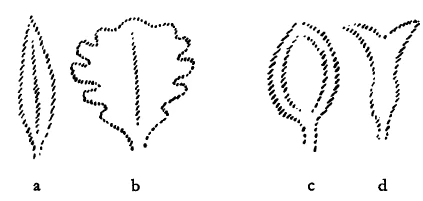
[ 14 ] But that cannot happen—please pay close attention to what I am about to say—if one limits oneself to observing only a person’s gestures, facial expressions, and physiognomy. That actually achieves very little. One must then—and this is the most rational approach in occult training in this field—move on to plants. One can skip the animals; it is not particularly important to train oneself using animals. But it is important that, after one has trained oneself clairvoyantly to some extent to empathize with the inner life of a person’s soul through their facial expressions, physiognomy, and gestures—after one has trained oneself in this way with regard to human beings—one then turns to the plant world and continues one’s training through the plant world. There, the clairvoyantly trained person will be able to have very remarkable experiences; there, the clairvoyantly trained person will be able to deeply sense a difference between a plant leaf that, let’s say, tapers to a point (a), and a plant leaf that has this shape (b); between a flower that grows upward in this manner (c) and a flower that opens outward in this way (d). Whole worlds of differences in inner experiences arise when one turns the occult gaze of the second stage toward a lily blossom or a tulip blossom, when one allows the panicle of an oat or the stalk of barley or wheat to take effect upon oneself. All of this becomes as vividly expressive as the physiognomy of a human being. And when this becomes as vividly expressive as a human face speaks, as even a human gesture speaks, when we sense how a flower that opens outward has something like a hand that turns outward, with the inner surface down and the outer surface up, and when we then find a flower that closes its petals upward like a hand movement, where the two hands fold together—when we thus perceive in the gesture, the physiognomy of the plant world, and in the color of the flower something akin to physiognomy, then the occult inner gaze, the occult perception, and the occult understanding are enlivened, and we then recognize a third category of beings of the second hierarchy, whom we call the Spirits of Wisdom. This name is chosen by analogy for the reason that, when we observe a human being in their facial expressions, in their physiognomy, in their gestures, we see their spiritual, their wisdom-filled nature sprouting outward, revealing itself. Thus we feel how spiritual beings of the second hierarchy permeate all of nature and express themselves in the overall physiognomy, in the overall gesture, in the entire facial expression of nature. Flowing wisdom courses vibrantly through all beings, all realms of nature, and it is not merely a generally flowing wisdom, but this flowing wisdom is differentiated into a multitude of spiritual beings, into the multitude of spirits of wisdom. When occult consciousness rises up to these spirits, it is first the highest level of these spiritual beings that we reach in this way.
[ 15 ] But just as we could say that the beings of the third hierarchy—the angels, archangels, and spirits of the ages—have offspring that branch off from them, so too do the beings of this second hierarchy have offspring. Over time, in a manner similar to what we described yesterday regarding the beings of the third hierarchy, other beings split off from these beings of the second hierarchy; these then become of a lower category and are sent down into the realms of nature just as the nature spirits are sent down from the beings of the third hierarchy, who are, as it were, the architects and master builders on a small scale within the natural realms. The spiritual beings, then, that split off from the second hierarchy and descend into the realms of nature are those beings we refer to in occultism as the group souls of plants and animals—the group souls within the individual beings. So that the occult gaze, at the second level, finds in the beings belonging to the plant and animal kingdoms spiritual beings who are not, as in the case of humans, individual spirits within the individual human personalities, but rather we find groups of animals and plants that are similarly formed, animated by a common spiritual being. Let us say we find the form of lions, the form of tigers, and other forms animated by common soul beings. These common soul beings, which we call group souls, are offshoots of the beings of the second hierarchy, just as the nature spirits are offshoots of the beings of the third hierarchy.
[ 16 ] Thus we ascend from below into the higher worlds; when we survey the elements that are essential to all beings of the plant, animal, and human kingdoms, we find that within these elements—the solid, the liquid, and the gaseous—the nature spirits reign, who are the descendants of the beings of the third hierarchy. We find, as we ascend from the elements earth, water, and air to that which lives in the natural kingdoms with the aid of these elements, spiritual beings who permeate the beings of these natural kingdoms with life-giving energy—group souls—and these group souls are spiritual beings who have split off from those we know as the beings of the second hierarchy.
[ 17 ] You can see from this that these beings, whom we call group souls, are truly perceptible only to the occult eye of the second level. Only for the occultly developed human being who can extend the essence of his own etheric body as if in tentacles is it possible to become acquainted with the beings of the second hierarchy and also with the beings of the group souls that exist in the various kingdoms of nature. Even more difficult is the ascent to the beings of the first hierarchy and to those beings in the natural realms who are, in turn, the descendants of these beings of the first hierarchy. We shall speak further of this tomorrow.