

Spiritual Entities
in Heavenly Bodies and Nature Realms
GA 136
11 April 1912, Helsinki
Translated by Steiner Online Library
Eighth Lecture
[ 1 ] It would be good to begin today’s lecture by discussing the extent to which the physical cosmos—the physical world system that we examined yesterday in terms of its parts, or at least some of its parts—has any significance for human observation, perception, and understanding. Yesterday we spoke of the life of comets, the life of fixed stars, solar life, planetary life, and lunar life—the life of the moons. When one speaks of these celestial bodies from the standpoint of ordinary consciousness, one naturally means only those celestial bodies that the eye perceives. Now, in the course of our lectures, we have actually, so to speak, replaced this system of celestial bodies with something else. We have replaced it with the consideration of corresponding spiritual beings, whom we have recognized as the members of the various hierarchies. Perhaps what was actually meant by this will become even clearer if we mention the following. We have identified the Angeloi, or angelic beings, as the category of beings standing immediately above human beings. We have also shown how, in fact, if a human being wishes to attain a vision of the spiritual world, the supersensible world, they must, so to speak, organize themselves upward to this next being standing above them, just as they must, as it were, learn to view the world through the mode of perception of the angel or the Angeloi. Now we can also raise the question: If such a being of the next higher category within the hierarchy of our hierarchies, in its perception—which we call revelation—acquires a consciousness of the cosmos, what does the cosmos look like to such a being? If we answer this question, it will become even clearer to us what actually needed to be said. For such an angelic being would, in the cosmos, see nothing of all that we see—and of which we know it is a maya, an illusion, brought about solely by human perception—in such a way. We must hold this very clearly before our soul. But an angelic being would instead see or perceive, in its own way as we have described, the various interactions of the beings of the hierarchies that we have mentioned. Instead of such a being speaking of Mars being up there, it would rather say: Up there, these or those beings of the higher hierarchies are working together in the manner we have characterized. — That is to say, to these beings, to the angels or angeloi, the entire cosmic system would appear directly as a sum of spiritual forces. Indeed, how would the planets and other celestial bodies visible to our eyes appear to such a being?
[ 2 ] We are able to speak about these things because we could not possibly speak of the entire supersensible world—which underlies the planetary system, the celestial system, and the cosmos as a whole—if we were not able, through occult training, to place ourselves, as it were, artificially into the perspective of such a being. For to be clairvoyant means nothing other than to evoke within oneself the ability to see the world as such a being sees it. Thus, for the clairvoyant consciousness as well, the forms—these light forms of the celestial bodies normally visible to the eye—actually disappear. They are no longer there; they vanish. On the other hand, the clairvoyant consciousness, and thus, as has been said, the consciousness of such an angelic being, does receive an impression of what corresponds to the physical celestial body. The clairvoyant consciousness cannot perceive the Moon or Mars as an earth dweller sees them, for that would be from a physical perspective; yet the clairvoyant consciousness can still know what is there. Now I would like to give you a mental image of the nature of what the clairvoyant consciousness knows about such a celestial body.
[ 3 ] You can form an idea of this—albeit initially only in theory, since practical application comes only through occult training—by visualizing what constitutes a mental image, a memory, or a mental picture in your soul of what you experienced yesterday or the day before. Isn’t it true that this mental image, which lies within your soul, differs from the mental image of an object that is right before your eyes? You see that with all the necessary intensity. When you recall this rose tomorrow, you will have the memory image of this rose. Now realize how, in your mind, in your soul, the mere memory image differs from what arises as a perceptual image through immediate impression; then you will have the opportunity to understand how clairvoyant consciousness perceives the celestial bodies. It thus projects itself clairvoyantly into the world, and when it projects itself, for example, into Mars or the Moon, it does not immediately know what would now appear before the eye if one were to physically observe the celestial body; but through this projection, it possesses within itself something that can be described as nothing other than a mental image, a memory image. And so it is with everything that appears to us in the cosmos as physical celestial bodies in our ordinary, normal consciousness. To the clairvoyant consciousness, all this presents itself in such a way that we know immediately: everything that appears to us there is actually something past, something that had a full life in the past, and just as it is in the present, it does not actually appear to us in its original living form, but rather, comparatively speaking, like a snail shell from which the snail has departed. The entire physical system of celestial bodies is a testimony to nothing but the past, to nothing but past events. While on our Earth we are in the same moment as the things that appear before our physical eyes, what we see in the starry sky—because it does not represent a state corresponding to the living present—is all the more a maya; it represents something that actually had its full significance in the past and has been left behind. The physical world of celestial bodies represents the remnants of past deeds of the corresponding beings of the hierarchies, which reach into the present only through their aftereffects.
[ 4 ] Let us examine the matter more closely by considering a specific example. When we look at our Earth’s moon, the clairvoyant consciousness—which abstracts from everything else and, so to speak, confronts only the moon—has the peculiar impression that the outer physical moon disappears and is replaced by something that makes an impression similar to that one has when facing a mental image. One has the impression that what otherwise appears to the physical eye—which is, of course, physically present, but all physicality is merely a maya—is, in essence, conveying an impression of the past, just as a memory of the past conveys an impression to us. And if we allow all this to sink in—what is now beginning to tell us of a past—the impression tells us: If what actually appears before our occult eye were to act as it appears, if it were not paralyzed in its mode of action by other things, then, due to the proximity of what we perceive there on the Moon, our Earth could not exist at all in its present form. The Moon tells us something for the occult consciousness that ought not to happen, as it presents itself, if our earthly life is to be possible at all. If what is presented to us there were not, I might say, paralyzed by other things, then, for example, human beings would not be possible at all in their present life due to what the planet itself tells us in relation to the Moon. On the other hand, present-day animal life on Earth, as well as plant life and the processes within the mineral world, would not be particularly affected. Certain beings from the animal and plant kingdoms, however, would have to take on different forms; we recognize this directly through the forces that act upon us with such vehemence from the moon, but essentially, animal, plant, and mineral life on our Earth would still be possible—human life, however, would not. Thus, by appearing before us in this way, the Moon tells us of a state which, if it were active, would preclude human life on Earth.
[ 5 ] You see, my dear friends, I am trying to describe things as concretely as possible, just as they appear to the occult eye. I do not wish to speak in abstract terms; one can say all sorts of things that way. I would like to present things as they appear to the occult eye. The impression one receives there can only be compared to the following. If, in a person who is, say, thirty years old, all the mental images he had when he was fifteen were to suddenly reappear, and if all the mental images he has been able to process in his soul since the age of fifteen were to fall silent, then he would, as it were, be objectified, confronted with his own consciousness, and have his inner soul at the age of fifteen standing before him. But he would have to say to himself: If I now had within me only what was the content of my soul back then, well, then I could not think all that I now think; then I would not be possible at all in this state of mind in which I now find myself. — Set back fifteen years, the person would feel as though he were there, and he would be clear that everything he experiences there as the content of his soul at the age of fifteen would not produce his present self, but that this has to do with how he has become. So you see that we can indeed, in a certain way, characterize the impression we receive from the moon. We can say that we have the immediate impression: You have something before you that does not actually indicate the present to you, but rather speaks to you of a past; and just as, if at the age of thirty you could only perceive the content of your soul from the age of fifteen, you would have to disregard everything that has become of you in the last fifteen years, so now you must disregard the very possibility that there is an Earth at all. — For the Earth, as it is now, which contains the conditions of human life, is not possible if what the Moon presents itself as were to become reality. It is precisely because this impression arises for the clairvoyant gaze that it is possible at all to train this clairvoyant gaze in such a way that one can gain a concept, a mental image of what was there before an Earth was possible. For what one sees there was possible before the Earth, and what later led to the Earth only became possible once the state one beholds there had disappeared.
[ 6 ] I have now described to you what the clairvoyant must do in order to, as they say, go back in the Akashic Records to an earlier state of our planetary system; for by fixing the clairvoyant gaze on the Moon, one has captured an earlier state of our planetary system. And when one now attempts to describe this, one can say what the state of our planetary system was like before our present Earth existed. And because one must proceed in such a way as to learn to recognize the state prior to the formation of our present Earth by fixing one’s gaze on what has been preserved in the Moon as a memory, one has come to call the ancestral state of our Earth’s condition a “lunar state.” However, one only gains a full understanding of the entire situation when, from the clairvoyant state one has developed in order to arrive at a kind of memory image of the planetary system, one returns to the ordinary state of consciousness and attempts to clarify what the difference consists of. The difference lies in the fact that one must try to reconcile the two impressions in some way, and this reconciliation is only possible by first setting aside the Moon entirely. For the ordinary external view of normal consciousness does not tell us much about the Moon. You know, of course, that external astronomy attempts to explore various aspects of the Moon, but in general, external observation does not reveal much. Rather, we must draw upon a certain clairvoyant observation of our own Earth for comparison, as it currently exists as the celestial body upon which we ourselves walk. If we exclude all that is physical, which presents itself to our eyes in the various realms of nature, and regard our Earth clairvoyantly, then it becomes apparent to us that this Earth, which as a physical planet is immediately beneath and around us, reveals itself as a further-developed state of what existed as the Moon. And when we then compare the two impressions, we may ask ourselves: How did one state emerge from the other? And then, I might say as if of its own accord, the work that was accomplished to transition an ancient state of our Earth—which we have just characterized as the lunar state—into our present Earthly state is presented before our clairvoyant gaze. We then get the impression that this transition was brought about by one of those spiritual beings—or a number of them—whom we have called, in the hierarchical order, the Spirits of Form. Thus we gain the opportunity to penetrate into the planet’s becoming, into its earlier states. The question now is: Can we look back even further? We must make these observations for the very reason that only in this way will we truly understand the spiritual beings involved in these celestial bodies.
[ 7 ] As a second attempt at clairvoyant observation, we must now once again look beyond our Earth, beyond our Moon, and indeed beyond anything lunar in the entire planetary system; and, as far as we are able, place ourselves in the state of another planet or a series of other planets and compare these states with one another. Mind you, I am now recounting actual facts that can arise in clairvoyant consciousness. The clairvoyant gaze can be directed—though perhaps not simultaneously, as circumstances sometimes do not permit it—toward other planets in our solar system, and it can perceive what emerges as an impression from these other planets. If one observes one or another planet, or several, in this way, not much emerges yet; one does not yet get a clear mental image. But one immediately gets a clear mental image if one proceeds in a certain way with one’s clairvoyant impressions. I will again choose a comparison so that we can understand what I actually mean. Suppose you were to recall something you experienced when you were eighteen years old, and you were to say to yourself: But in my eighteenth year, I took a stance toward that very experience that I was mature enough for at the time. I might gain a clearer understanding of the matter if I recall another experience. After all, I experienced something related to the very same event I just recalled when I was twenty-five. I want to compare the two impressions with one another. — Try to realize what you gain in life by comparing the same things that lie apart from one another. You then gain an overall impression where one illuminates the other, one clarifies the other. Through such a comparison, you will form a kind of arithmetic mean and actually bring forth something entirely new in your mental images from the interplay of your two memories. This is what the clairvoyant must do once he has succeeded in allowing his clairvoyant gaze to be impressed, say, by Mars, Mercury, Venus, Jupiter, and so on. And he must not regard these individual impressions as such, but must compare them with one another, allow them to interact, and bring them into relationship and connection with one another. When one undertakes this work, one then gains the impression: with what one has gained through the comparison of these impressions, one has before one something like a mental image of the planetary system. Again, this is not a state that is possible in the present, but a state that must have been possible in the past, for it expresses itself as something that, in the same way I described earlier for the lunar state, is the cause of what now exists in the planetary system.
[ 8 ] Now, this impression one gains in this way truly possesses remarkable qualities. What one must describe—I would say—using seemingly rather dry mental images actually belongs to the most sublime impressions one can possibly have. And if one were to describe what makes this impression so distinctive, one can again only resort to a comparison. I must confess, I could not very well cite anything other than what I am about to cite if I were to describe the impression one receives in the manner described.
[ 9 ] I don’t know if you have ever had the following experience in your ordinary physical life. Surely you have cried at times, felt sad enough to weep, and felt compassion for the beings around you in physical life. But one can also have a different kind of experience. There are certainly many among you who are familiar with that feeling that sometimes arises when you are faced with a captivating, moving description in a work of art—in a novel, for example—and read a scene where, if you reflect just a little, you immediately know that you are not dealing with reality, yet tears well up in your eyes. One does not have the opportunity to think about whether one is dealing with reality or not, but rather one takes what is merely described to one, what one absorbs only in thought and feeling, in such a way that it appears as reality, that it squeezes streams of tears from us. Anyone who has ever had this impression has a mental image of what it means to be inspired by a spiritual experience—one in which one is not at all put in the position of asking whether a sensory reality underlies it—to arrive at an impression, at such an impression in which one asks for nothing other than what seizes one and brings one together with oneself, of which one is filled only inwardly and yet also filled as by some normal act of perception of normal consciousness.
[ 10 ] One must speak of such an impression when describing the state that comes over one when comparing the impressions that the clairvoyant consciousness receives from the individual planets. Everything one experiences is such that it works solely through our inner being, like a spiritual impression. And one then gains a very real understanding of what inspiration actually is when one knows things for which there is only an impulse of knowledge from within. For example, no one truly understands the content of the Gospels who cannot compare their impression with an impression such as the one just described. For the Gospels were written out of inspiration; one must, however, go back to their original texts. But even more magnificent and powerful is the impression one receives in the manner described by comparing the impressions from the individual planets.
[ 11 ] That is the first thing I would like to say about this impression. The second is that one cannot experience this impression undisturbed and uninhibited unless one is capable, at least for a few moments—and in our present cycle of time, hardly anyone is capable of this for longer than a few moments—of feeling nothing but compassion and love, of completely banishing egoism from one’s soul, for every degree of egoism with which this impression combines has an immediate numbing effect, and instead of what I have described, one immediately experiences a state of numbness, a dulling of consciousness. Consciousness then darkens immediately. Therefore, receiving such an impression is at the same time one of the most blissful experiences.
[ 12 ] If one is fortunate enough to have such an impression, something quite peculiar occurs. No matter what one does, the sun can no longer be found as a sun in one’s consciousness. Just as the sun can be found in other states of consciousness, so it can no longer be found here. The sun ceases to be something separate. Only once we have found our bearings a little do we get the impression: We do indeed have something before us, a state for which a separate sun actually no longer makes sense. For the whole that appears before our occult eyes, we can only have that, in turn, if we disregard our entire present planetary system and attune ourselves to our present sun—that is, if we also erase the physical impression of the sun. The best way to do this is to try to perceive the occult impression of the sun not during the day, but at night. For the occult perception, of course, the fact that at night the physical Earth stands before the sun is no reason not to have an impression of the sun, for while the physical Earth is opaque to physical eyes, it is not so to the occult eyes. On the contrary, if one attempts to direct the occult gaze toward the sun in full, bright daylight, the disturbances are so great that one can hardly arrive at a good occult impression of the sun without physical harm. For this reason, in the ancient mysteries, no attempt was made to allow the students to gain an occult impression of the Sun during the day; rather, they were instructed to become acquainted with the Sun’s peculiar nature occultly precisely when it is least visible to the physical eye—namely, at midnight. They were instructed to direct their occult gaze toward the sun through the physical earth precisely at midnight. That is why, among the various descriptions that have survived from the ancient mysteries—among the things that are mostly not understood today, for example in the Egyptian mysteries—you find the statement: “The student must see the sun at midnight.”
[ 13 ] All the amateurish attempts that have been made to explain, through all sorts of charming and endearing symbols, what it means to see the sun at midnight. Usually, people have no idea that the best way to understand the things communicated in the occult writings is not by striving as little as possible to interpret them symbolically, but by taking them as literally as possible. And it is usually only the modern person who feels compelled to resort to symbolic interpretations, because contemporary consciousness is no longer properly attuned to an understanding of these ancient facts. For those who think more deeply, it should be clear everywhere that in ancient writings people were quite accustomed to speaking precisely. I would just like to draw attention, as it were, to something in parentheses that could have been included in the public lecture the day before yesterday during the discussion of Kriemhilde. It is told, after all, that after Siegfried was dead, she had the Nibelung hoard to herself and did good with it, and then Hagen took it from her and sank it into the Rhine, and when she later demanded it back from Hagen, down by King Etzel, he did not reveal to her the place where it lay. Yes, you see, this passage is described in detail in the Nibelungen saga to shed light on certain things. I have found truly ingenious, even super-ingenious interpretations by symbolic interpreters of the Nibelungen saga, intended to explain what all of this is supposed to mean. For one, the Nibelung treasure is supposed to mean this; for another, that. I admit, the intellectual depth brought to bear on such interpretations sometimes seems overwhelming. Most often, the Nibelung treasure is explained as a symbol for this or that spiritual concept. First, however, it is generally difficult to heal the sick with mere symbols; second, one cannot hide symbols from anyone—including Kriemhilde—by, say, throwing them into the Rhine. At least, I don’t have a clear mental image of a symbol of the kind cited by some commentators being sunk into the Rhine. In general, I have a hard time forming a mental image of something being taken away from someone externally that can only be explained symbolically. Of course, anyone who knows the facts understands that this was something quite special—something we would now call a talisman, a very physical talisman, crafted in such a way that its entire substance was composed of gold. But this gold was obtained solely from alluvial deposits, solely from what the water had washed up in the river sand, and all the power that this alluvial gold possesses was further concentrated—here the symbol comes into play—in the form of the talisman, and the effect of this talisman on Kriemhilde generated within her the powers through which she could heal the sick and the like. Hagen was indeed able to hide this talisman from her and later conceal its location from her. Here we are indeed dealing with a physical object, with a very real object, since it possessed occult powers solely due to the special manner of its manufacture.
[ 14 ] I mentioned this only as an example to show you how such things are often to be understood in ancient writings. The expression “seeing the sun at midnight” must also be taken literally. One therefore gains the best occult impression of the sun when one is not at all disturbed by the physical impression—that is, when one sees nothing of the sunlight at all, but instead observes the sun at night. Then one gains an impression of the present sun, and this is, to a very high degree, similar to what arises from the impression described earlier. It is precisely through everything I have described to you that the impression arises of an even earlier state of our entire planetary system, to which our Earth also belongs—a state in which a separate sun did not exist, but rather the entire planetary system was, in a certain sense, a sun and also contained the substance of our Earth. This state, which was therefore simultaneously the state of our Earth, is thus referred to as the solar state. So that we can say: Our Earth was, before it became Earth, in a lunar state; before it was a moon, in a solar state.
[ 15 ] One would gain a corresponding impression of an even earlier state of our Earth if one tried to form an occult impression of the category of celestial bodies discussed yesterday at the end of the lecture: comets. To describe this in more detail would take up too much of our time, but methodologically it is similar to what has already been described. If we now compare what we gain here through the occult perception of cometary life with the mental image—and here we must form a certain mental image, for the memory-image one receives there cannot be well compared to anything tangible—one immediately gains the impression, and one cannot go further than this, that one has received an impression of a state preceding the solar state, which for certain reasons is called the Saturn state. Thus you see how our inner experiences, which we can have of the planetary system, are decisive for the occultist in forming the mental image he forms of this planetary system.
[ 16 ] And now let us turn our attention away from the planetary system for a brief moment. Everything I have presented so far has been done with the purpose and aim of culminating in a comprehensive description of the modes of action of spiritual beings within the celestial bodies. However, since the celestial bodies are, as it were, composed of the kingdoms of nature, we must now, at least approximately, also form a mental image—from the occultist’s standpoint—of the next fact that presents itself to the occult gaze when we allow the individual kingdoms of nature to take effect upon us.
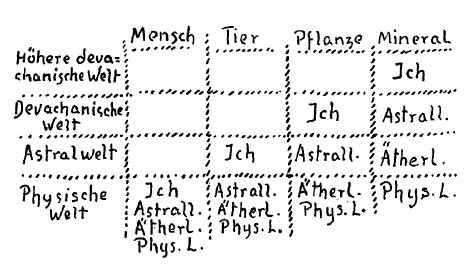
[ 17 ] Let us begin our examination of the individual kingdoms of nature by looking at the human being. As you know, when we consider the human being, we speak of the human being as consisting of a physical body, an etheric body, an astral body, and what we call the “I,” the “self.” This fourfold human being—where does it stand, initially, from the perspective of Spiritual Science? Well, you see, this fourfold human being is in the physical world, for everything that has just been listed regarding the human being acts upon us within the physical world. Now let us turn to the animal world. When we consider the animal, it is undoubtedly the case that we find a physical body within our ordinary physical sensory world in the animal just as we do in the human being. There can be no doubt about that. But we must also attribute an etheric and astral body to the animal, for we do attribute an etheric body to the human being within the physical world, since the human physical body alone within the physical world is actually an impossibility. This becomes immediately apparent when the human being has passed through the gate of death. There, their physical body is alone in the physical world; there it decays; there it is left to its own devices. While a human being lives, therefore, there must be a constant fighter against the decay of the physical body, and that is the etheric body, which only occult consciousness truly perceives. The same relationship exists in the animal as well, so that we must attribute an etheric body to it in the physical world. Because we are aware that facts and things not only exert effects on the human being, but that they are reflected within him, that they evoke in him something that can be called an inner reflection, we therefore attribute the astral body to the human being; the occult gaze perceives it. But exactly the same is true of animals. While a plant, for example, does not utter a cry when an external impression is made upon it, the animal makes itself heard in a cry; that is to say, such an external impression also manifests as an inner experience. The occult gaze teaches us that this inner experience is only possible if an astral body is present. To speak of an “I” in the animal, however, while remaining within the phenomena of the physical world, makes sense at most for certain modern natural philosophers who proceed purely by analogy. But if one proceeds merely by analogy, then one can really claim anything at all. There are even theosophists today who are somewhat impressed when a naturalist who has become somewhat well-known, Raoul France, attributes a soul to plants and then makes no distinction between what is called a soul in animals and what is called a soul in plants. He finds, as is indeed correct, that there are certain plants which, when a small insect comes near them, fold their leaves in such a way that they attract and consume this small insect. Such an external observer therefore says to himself: Where in nature an external phenomenon occurs that resembles the act of attracting and consuming food, there must be something analogous to beings who, from an inner soul-like essence, attract and consume these things. Well, I know of something that also attracts small creatures, but to which one certainly would not ascribe a soul according to the model of modern natural philosophers. Namely, a mouse trap laced with bacon. It also attracts small creatures, and if one proceeds according to the method of such natural philosophers, then just as one attributes a soul to the Venus flytrap, Dionaea muscipula, one must attribute a soul to the mouse trap; for it attracts mice when it is well-stocked with bacon. — All these observers, who do not focus solely on the external, should by no means lose that longing which is present in many spiritually minded people, and be content if only a little is said about the spirit.
[ 18 ] In German literature in particular, as some say, much beauty has been brought to light in this regard; as an occultist might put it, much nonsense has been perpetrated. Just as one cannot speak of a soul-being similar to the animal soul in the case of the Venus flytrap or any other plant, so too, when viewed impartially, one cannot speak of any animal as having an “I.” The animal has no “I” within what confronts us on the physical plane. Only occult investigation leads us to the animal’s “I.” But this animal ego is no longer to be found within the same realm where the human ego is found. The animal ego can only be found when separated from the physical body, so that we actually come to know a completely different world when we ascend with the occult gaze to the animal ego. And if one does not care for making all sorts of schematic divisions and stating from the outset: the world consists of the physical plane, the astral plane, the mental plane, and so on—if one does not care for that, because all these labels do not amount to much—then one must proceed in a different way. I have even found in theosophical books that much is said about the term Logos, but I have not found that this actually evokes any mental image of what the Logos truly is. Usually I found only that the authors of these books know that this Logos consists of five letters. But as soon as one tries to arrive at truly concrete mental images, so that one retains something in one’s mind, the mental images vanish. For by telling all sorts of things—that the Logos spins and so on—a consciousness that wants to be concrete will not know what to make of it. Whatever the Logos may be: it is certainly not a spider, and what it does certainly cannot be described as a web. It is therefore not good to proceed with abstractions to evoke mental images when speaking of things that go beyond the physical realm of human beings.
[ 19 ] It is a different matter when the occult gaze seeks in the animal that which, in humans, already announces itself in the physical world through all human actions and behavior: the ego. When it seeks this in the animal, it does indeed find it, though not in the world where the animal’s physical body, etheric body, and astral body are present, but in a supersensible world that, however, immediately reveals itself when one draws back the veil of the ordinary world to reveal the world closest to the sensory world. So that we can say: The animal ego is to be found in a world of a supersensible nature. And of this animal ego one must again say: It appears to us there as a reality, but does not manifest itself in the physical world as an individuality; rather, we understand it here only when we direct our attention to a whole group of animals, to a group of wolves, of lambs, and so on. And just as a soul with an ego within it belongs to our two hands, our ten fingers, and our feet, so does such an ego—which we do not find in our physical world—belong to a group of animals of the same form; it reveals itself only in the physical world. The ordinary abstract thinker, today’s materialist, says: “Yes, actually, the only thing real about an animal is what one sees with physical eyes, and when we form the concept of a wolf or the concept of a lamb, these are merely concepts.” — For the occultist, they are not merely concepts; they are not mere concepts existing within us, but rather mirror images of something real that exists not on the physical plane, but in a supersensible world. Yet even on the physical plane, a little reflection reveals that besides what can be sensed, there is something else present that cannot be perceived in the physical world and yet has significance for the inner power dynamics of the animal. I would simply like to draw the attention of those who, for example, regard the mental image of a “wolf” as a concept that has no basis in reality to the following experiment: Take a number of lambs—as is well known, the wolf eats lambs—and feed them to the wolf until, in accordance with what natural science has established, the entire physical matter has been transformed, so that during the time in which the physical body is being replaced, the wolf has eaten nothing but lambs. Now the wolf has nothing but lambs within it. What you can see in the wolf alone—the physical matter—derives entirely from the lambs. Try then to draw the conclusion as to whether the wolf has become a lamb. If it has not become a lamb, then you have no right to say that what you have as the concept of the wolf is exhausted in what can be physically perceived, but rather there is something supersensory in it. This is not found until one enters the supersensible realm. There it presents itself in such a way that, just as our ten fingers belong to the one soul, so all wolves belong to the one group-I. And the world in which we find the group-I of animals, we initially designate quite concretely as the astral world.
[ 20 ] As for plants, a similar line of reasoning leads us to conclude that, within the physical world, we find nothing in a plant other than the physical and etheric bodies! Precisely because the plant has only a physical and etheric body in this physical world, it does not cry out when it is injured. So we must say: In the physical world, the plant possesses the physical and etheric bodies. If we now search that world with the occult gaze—that is, simply place ourselves within it, into which we had to place the animal group-I—we find something very characteristic regarding the plant world: We find, in fact, that there is indeed pain in the plant world, namely when plants are torn out of the ground by the roots. Then a pain similar to that experienced when a hair is plucked from an organism is present for the entire earth organism. But other life, conscious life, is also present in plant growth. Try to create a mental image of the sprouting—I have already referred to this on another occasion during these lectures—the pushing forth of the plant shoots from the earth in spring. This sprouting is something that corresponds to a sensation in certain spiritual beings that belong to the earth, that constitute the earth in its spiritual atmosphere. If one were to describe this sensation, one could compare it to the sensation one has in one’s consciousness in those moments in the evening when one transitions from the waking state to the sleeping state. Just as consciousness gradually subsides there, so do certain spirits of the Earth feel similarly when plants sprout in the spring. With the gradual withering and dying of the plant world, certain spiritual beings connected to the Earth’s spiritual atmosphere, in turn, have the same sensation that a human being has when waking up in the morning. We can therefore say: There are spiritual beings connected to our Earth organism that feel in the same way as our own astral body feels when falling asleep and waking up. However, one must not make an abstract comparison. It would, of course, be much more natural to compare the sprouting of spring nature with waking up and the dying off of the plant world in autumn with falling asleep. But the opposite is true, namely that the beings in question feel as if they are waking up in autumn and as if they are falling asleep when the plants sprout in spring. These beings are nothing other than the astral bodies of plants, and we find them in the same realm where we find the group-ego of animals. The astral bodies of plants are located on the so-called astral plane.
[ 21 ] Now, when we consider plants from an occult perspective, we must also speak of an “I” in relation to them. We find this “I” of plants, in a similar way, as a group-I—something that belongs to an entire group of plants of the same form—just as we have considered the group-I of animals. But we will search in vain for this group-I of plants where we found the astral body of plants and the group-I of animals. Rather, we must enter an even higher supersensible world; we must rise from the astral plane to a world that we perceive as even higher. Only in such a world may we place the group-I of plants. And now, as we explore this world in which the group-I’s of plants are to be found, we can give this world a name. Although there is much else within it, it is characterized for us primarily by the fact that the group-I’s of plants are present there. We call it—the names are of no consequence—the Devachan world.
[ 22 ] In the case of minerals—and this is easy to see—we have only the physical body in the physical world. This is precisely why minerals appear to us as inorganic and lifeless. In contrast, in the same world where the group-I’s of animals and the astral bodies of plants exist, we have the etheric body of minerals. Yet we find no evidence that the mineral being exhibits any sensation whatsoever. Nevertheless, the mineral too proves to be something living. We come to know the enduring life of minerals, the growth and development, let us say, of ores or the like; in short, we come to know the manifold mineral life of our planet on the astral plane. We learn to recognize, when a single mineral presents itself to us, that it is not much different from our own mineral-like bones, which are nevertheless connected to our life. Thus, everything mineral is also connected to something living, only this living aspect is to be found on the astral plane. Thus, the etheric body of the mineral world is to be found on the astral plane. If we now dwell, so to speak, occultly in the same world in which the group-I’s of the plants are found, then we notice that the mineral world is also connected to something capable of sensation, to something astral. When stones are struck in a quarry, one does not, of course, perceive on the astral plane that there is any sensation present, but on the Devachan plane, one immediately notices that when the stones are struck, when pieces break off, something does indeed arise that resembles a sense of well-being, a kind of pleasure. That is also a sensation; it is simply the opposite of the sensation that animals and humans have in such a case. If one were to strike them, they would feel pain. With minerals, the opposite is true: when they are struck, they experience a sense of well-being. If one has dissolved table salt in a glass of water and observes with a gaze directed toward the devachanic world how the table salt reassembles into crystals, one sees how this happens with pain; one then feels pain in the relevant areas. This is the case throughout mineral life, where a solid forms from the liquid through crystallization. This was essentially the case with our Earth as well, which was once in a softer and more fluid state. The solid form only gradually emerged from the liquid, and now we walk upon solid ground and drive our plow across the earth. In doing so, however, we do not harm the Earth; on the contrary, it benefits her greatly. But it did not do the beings connected to the Earth—who, as the astral realm, belong to the planet—any good that they had to compact themselves into a solid mass so that human life on the planet could become possible. The beings who stand behind the stones as astral bodies had to endure pain upon pain. In the mineral kingdom, the being, the creature, suffers with the advancing process of the earth. One feels quite strange when one recognizes this through occult investigation and then once again comes across the famous passage in an initiate: “All creation groans and suffers in pain, awaiting redemption, awaiting adoption as a child.” One tends to skim over such things in writings grounded in occult insight. But when one approaches these writings with the occult gaze, only then does one realize: they offer much to the simplest mind, but even more to the one who can perceive all that lies within them, or at least much of it. The groaning and sighing of the mineral kingdom, which must exist because the cultural process of our Earth needs solid ground beneath its feet—this is what Paul depicts when he speaks of the groaning of creation.
[ 23 ] All of this takes place within those entities that underlie the mineral kingdom as its astral body and which we find in the devachanic world. The true Self, the real Group-Self of the mineral kingdom, is to be found in a higher world, which we shall call the higher Devachanic world. It is here alone that the Group-Selves of the mineral kingdom are found. For you must completely free yourselves from the mental image of identifying that which we call, say, the astral body of a being with the astral world. In the case of minerals, the astral body is to be found on the Devachanic plane, whereas the etheric body of minerals is in the astral world; the group-I of animals is on the astral plane, and the astral body of animals is on the physical plane. As the world presents itself to us, we must say: We must not identify what we find in the beings as the individual members with the corresponding worlds, but rather we must accustom ourselves to assuming distinctions among the various beings. A more precise occult insight shows this quite clearly. Thus, for the time being, we find only the group souls of the minerals in a higher devachanic region. In this way, we have outlined the individual beings of the various kingdoms of nature in their relationships to the higher worlds, and only this can provide us with the foundation for investigating the relationships of these various kingdoms of nature to the creative beings of the hierarchies who act in the world, as we have come to know them.