

Occult Studies on Life Between Death and Rebirth
The dynamic interaction between the living and the dead
GA 140
27 October 1912, Milan
Translated by Steiner Online Library
2. Studies on Life Between Death and Rebirth II
[ 1 ] Our discussion has led us to the point where the consciousness of the deceased is sustained solely by the memory of the Mystery of Golgotha. Up to this point, all life has been a life of remembrance of the earthly existence, conveyed not through the senses but through visions. Even the realities of the spiritual world can be perceived at this point only through visions.
[ 2 ] Gradually, it becomes increasingly difficult for souls to retain memories of their time on Earth; a forgetting of all that has been experienced spreads ever more widely. If, for example, one encounters a person once known during this time between death and rebirth, one recognizes them easily at first, but gradually with increasing difficulty; later, one can only recall the relationship with them by connecting to the Mystery of Golgotha. The more one is imbued with this, the easier it is to recognize one’s surroundings. But once this point is reached, where we need the memory of the Mystery of Golgotha to preserve our recollection, a great change begins again. For then we are no longer able to retain the visions of before within us. Up to that point, for example, we can speak of astral color phenomena; in the world in which we live up to that point, we can speak of seeing astral colors; we can speak of seeing the beings around us even in visionary reproductions. At this moment, however—which, as I said, lies midway between death and a new birth—the visions and memories fall away from us, as it were, like scales; we lose our connection to them; they detach themselves completely from our being. To characterize this moment more precisely, it is helpful to draw upon something that may seem shocking at first glance.
[ 3 ] At this moment, one feels detached from the Earth, the Earth, as it were, far below and far away, and feels that, through living into the spiritual world, one has arrived at the Sun. For just as one felt united with the Earth in earthly life, so one now feels united with the Sun and its entire planetary system. And that is why our modern occultism places such great emphasis on understanding how Christ came to us as a solar being, because it is necessary to understand how he leads us to the Sun through the Mystery of Golgotha. Occultism shows us that Christ is a solar being who leads us back to the Sun. And now comes the shocking part: just as it is necessary to understand our relationship to Christ, so too must another be understood. Now begins the time when, facing a real being, one comes to know that which has always been called Lucifer. When one now feels oneself in the sun, one does not feel oneself in streaming physical light, but rather in purely spiritual light. And from this point on, one perceives Lucifer as a being who is no longer hostile as before, but rather one increasingly perceives him as a being who is entirely justified in the world. One now feels the necessity, in the further course of life after death, to regard Lucifer and the Christ being as two powers standing side by side on equal terms. As strange as this equivalence of Christ and Lucifer may sound, one comes to understand it from the point in time described; to view both powers as a kind of brothers. How this is to be explained becomes clear from what one experiences in the further course of life after death.
[ 4 ] If you take the description I have often given of the lives of Saturn, the Sun, and the Moon, you will find in it the course of the path that one actually experiences spiritually after death. The only curious thing is that one does not experience these things in the order of their cosmic origin: Saturn, Sun, Moon, but rather first experiences the lunar state, then the solar, and finally the Saturnian state. If you read through everything I have described in this way in the *Akasha Chronicle* and go back from the Moon, you will find the world that the soul experiences on the path it travels after death. And one then notices that, when one looks at these things, as it were, from the spiritual world, one has something like a memory of life in the pre-birth existence. Even more significant, however, is, so to speak, the moral element of the further life in this world, which has just been characterized. As described in the *Akasha Chronicle*, one gradually loses the interest that one had previously, up to this point, in what is to be experienced on Earth. Interest in the individual people with whom one had connections fades; interest in individual things fades. One knows that the memories one now retains are carried on by no one other than the Christ: the Christ accompanies one, and as a result, one can retain the memory. If the Christ were not to accompany one, the memory of earthly life would fade; for what connects us to the earth beyond the point described is, in fact, the experience that we have united ourselves with the Christ. Through our new life in the spiritual world, we then gain a completely new interest in Lucifer and his world. For we find that now that we have become free from earthly interests, we can face Lucifer without any harm. And we make the remarkable discovery that Lucifer has a harmful effect on us only when we ourselves are entangled in the earthly. Now he appears to us as the very being who can explain to us what we still have to experience in the world of the spirit, and for a long time we dwell in the experience of mastering what Lucifer can then give us in these vast expanses of the spiritual world.
[ 5 ] Perhaps it is shocking once again to say what we merely feel subjectively; but even if what is said is initially shocking, it may well be the most understandable thing in this case: After all, after some time, we now feel like inhabitants of Mars. Having felt like inhabitants of the Sun, we are gradually realizing that just as we once left the Earth behind us, we are now leaving the Sun behind us, and in terms of our cosmic reality, we feel like inhabitants of Mars. And regarding the life we are now going through, it indeed seems to us that Christ has given us everything from the past that lies behind us, and that Lucifer is preparing us for future reincarnation. If we consciously go through this Martian life and can later recall it on Earth through initiation, we will experience that everything we do not carry within us as experiences from our earthly existence through the great ‘cosmic space,’ that everything we do not have from Earth, is given to us by Lucifer. Our former human interest is now becoming increasingly cosmic. Whereas on Earth we absorbed what the mineral, the plant, the animal, what the air and water, the mountain and the valley gave us, from this point on we absorb the experiences of the cosmos, that which penetrates us from the world of the cosmos. That form of perception begins which has always been described—but which is little understood—as the music of the spheres. Everything that is is perceived as it resounds toward us from the expanse of the cosmos. Yet, just as if one were hearing loud harmonies, it resounds from the cosmos, not like the sounds of the physical world. One reaches a point in the experience where one feels oneself as if at the center of the cosmos, and, with sounds ringing in from all sides, one perceives the facts of the world through this music of the spheres.
[ 6 ] Now we have also left the Mars existence behind us, and the occultist speaks of our having arrived in the Jupiter existence. As we continue to live, the music of the spheres grows ever louder; but in the end it becomes so intense that it numbs us. We live our way into the music of the spheres as if in a state of numbness.
[ 7 ] The journey of life continues in such a way that, after we have passed through the Jupiter stage, we leave that behind us as well and find ourselves at the very outer edge of our solar system: Saturn. Once we arrive here, we have a very important moral experience: If, up to this point, Christ has preserved for us the memory of our earlier earthly states and thereby protected us from the states of anxiety associated with fading consciousness, we realize precisely in this present state of our soul after death how little what we went through on Earth was in keeping with the higher moral demands, how little it was in keeping with the majesty of the entire cosmic being. The life we have left behind touches us like a reproach. And something extraordinarily significant now takes place. As if emerging from an indefinite nocturnal darkness, the entire sum of our life, as it was karmically formed in our last earthly incarnation, appears before the soul. When you contemplate your present earthly existence, your present incarnation, you indeed see it again as it stands before your soul at that moment after death which has just been described; but within yourself you keenly feel everything you have to object to regarding that incarnation. You view this last incarnation from a cosmic standpoint.
[ 8 ] From this point on, neither the Christ principle nor the Lucifer principle can sustain our consciousness; instead, unless an initiation has taken place earlier in life, a decline in consciousness sets in under all circumstances. A certain spiritual sleep begins, which is necessary for human life, since up to this point a kind of consciousness existed that was sustained by the conditions described. This spiritual sleep, however, is now connected to something else. Because the human being can no longer feel anything, can no longer create mental images, all cosmic influences can act directly upon him, with the exception of those of the solar system. Imagine the entire solar system switched off and only that which exists outside of it remaining—then you have the effects that now occur. And this brings us to the point from which yesterday’s remarks originated.
[ 9 ] What is important to examine now is the connection between this second phase of life—between death and rebirth—and the embryonic life of the human being. As you know, the embryonic life of the human being begins with the small, round embryo. Now, what is remarkable from an occult perspective is that this human germ, right at the very beginning, presents itself as a mirror image of what the human being experiences from the cosmos in the manner just described. At the beginning of embryonic life, the human embryo is indeed a cosmic product, a mirror image of cosmic life, in which life within the solar system is not expressed. And the remarkable thing is that everything that now happens to the embryo during embryonic life proves to be a withdrawal of the cosmic influence and an absorption of the influences of the solar system. Only at a relatively later stage, when the processes during life after death have once again retraced the path through the Saturn, Jupiter, and Mars states, do those influences begin to take effect in the embryo that are the so-called inherited ones. Thus we may say that the human being prepares its embryonic life already in a cosmic existence prior to embryonic life, in a kind of world sleep that also envelops it. If one were then to take the processes that take place in this way during embryonic life within this kind of cosmic existence, this cosmic sleep, if one were to take the states of the prenatal human, the embryo, one after another, and were to now view them graphically in such a way that one created a mirror image here, that is, like this:
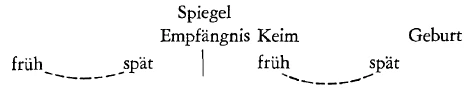
[ 10 ] then one would have to place all the states that appear latest in the embryo later in the image, and see what occurs earlier in embryonic life earlier here in the mirror image. In this way, one would obtain a mental mirror image of embryonic life in reverse. If I were to draw the embryonic life in one direction and, for each stage, a different mirror image in the other direction, this would actually look on the board like an image and its mirror image, and the point at which the reflection occurs is conception. If I were to draw this now, I would have to make the drawing such that one—the embryonic life—is drawn small, and the other mirror image is greatly enlarged in the background; for what a human being experiences in ten lunar months before birth is actually experienced in its reflection over many years. Just consider all that a human being experiences in the spiritual world up to their reincarnation, according to the indications described. In the first part of their life after death, they have absorbed the echoes of their former earthly existence. In the second part of this life between death and new birth, they have sought experiences from the cosmos. In this experience between death and the new birth, there is much within it, yet one thing is not there: We do indeed relive everything we have experienced from the previous incarnation up to the present; we sense cosmic existence, but during the first part of our life between death and the new birth, we do not experience what has already taken place on Earth between the two incarnations. Until we reach the state of being a sun, we are so occupied with memories of what was before death that our interest is completely withdrawn from what is happening on Earth. We live with those people who, like us, are in the spiritual world in the life after death; we immerse ourselves in all the relationships we already had with these people on Earth, and continue to live within these relationships, working out their consequences. And because we are constantly distracted, we are able to maintain less interest during this time for the people we still have on Earth. Only when these people seek us out with their whole soul is a bond of connection created with them. This is to be regarded as a very important moral element. For it sheds light on the relationship between the deceased and those left behind. Someone who has died before us and whom we have completely forgotten finds it extremely difficult to make their way back to us in earthly life. Our love, our enduring sympathy for the deceased, provides a way for this, because it establishes a connection with earthly existence. And through this connection, the departed must live with us in these early days following death. And it is truly a surprising fact how much the instinctive cult of remembrance for the dead is confirmed by occultism in its deepest sense. Our departed loved ones reach us most easily when they can find thoughts, feelings, and emotions directed toward them here on earth.
[ 11 ] For the second part of life, between death and rebirth, however, the situation is quite different. We are then so deeply immersed in our cosmic concerns that it is extremely difficult for us to maintain any connection with the Earth during this second period. What occupies us besides our cosmic interests is: working to shape our future karma correctly. Alongside our cosmic impressions, we retain most clearly that which we must, so to speak, correct karmically, and we work to shape a future life that can help balance our karmic debts.
[ 12 ] Some people say they cannot believe in reincarnation because they do not wish to return to earthly life. This, for example, is an objection that has often been raised: I certainly do not wish to return to the earthly realm. — That is what some say. Considering the period just mentioned between death and a new birth corrects this view considerably. During this period, we actually want with all our might to return to life in order to correct our karma, and we simply forget, when we awaken from the cosmic sleep described above into the present, that we wanted this rebirth. Whether we wish to reappear on Earth again during the life between birth and death is not the point; rather, it is whether we wish it between death and new birth. And there we do wish it. We must simply create a mental image of what life is like between death and new birth, as we have just seen, which is virtually the opposite of what we experience here on Earth between birth and death. Just as we are strengthened and equipped with new strength through sleep in this physical life, so too are we equipped with new strength for the new incarnation through the world sleep described. Another important question can be answered by the facts described. It is often asked: Why must a person, if they reincarnate so often, learn everything anew from childhood on, rather than being born with everything they need to learn from childhood? This question is answered when one takes into account that—with the exception of what has been indicated: the connection to life, to people, and to the entire karma—one does not experience what has taken place on this Earth between our incarnations. So if, for example, someone was incarnated on Earth before the invention of the printing press and is incarnating again today, they have not experienced everything that has developed in the time between the invention of the printing press and now. And indeed, if one examines cultural history more closely, one sees that in every incarnation, as a child, one learns what has taken place on Earth in the meantime. One need only consider what a six-year-old boy in ancient Rome learned: that was something quite different from what a six-year-old child learns today. Such a long period of time elapses between two incarnations that the cultural landscape of the Earth has, in fact, completely changed by then. We do not come down to an incarnation until conditions on Earth have changed so much that they bear almost no resemblance to life in the previous incarnation.
[ 13 ] What I have just described refers to the average human life. But it is, after all, an average, and consciousness can, for example, fade away earlier in a person after death; sleep can set in earlier, as you can see from some of the facts that were cited yesterday.
[ 14 ] However, there is a cosmic law that this world sleep shortens the time we spend in the cosmos after death: the one who enters the state of unconsciousness earlier experiences it more quickly; time passes at a faster pace for them; it is shorter than for the one who extends their consciousness further. Indeed, when we examine human life between death and rebirth, we can observe that unspiritual people return relatively quickly. If someone lives solely for their sensual pleasures, their sensual passions—that is, for what might be called the animal nature in human beings—then a relatively short period of time elapses between two incarnations. This happens because a state of unconsciousness sets in relatively early for such a person—a state of sleep—and they then pass quickly through this life between death and rebirth.
[ 15 ] Furthermore, I spoke only of an average lifespan because I was primarily concerned with those people who, so to speak, reach a normal age.
[ 16 ] There is, in fact, a significant difference between those who have died after the age of 35 and those who have departed from this life before that age. Only those who have lived past the age of 35 actually experience, to a greater or lesser degree of consciousness, all the states we have described. In the case of an earlier death, a kind of preliminary sleep state actually occurs between death and rebirth.
[ 17 ] If someone were to object that one cannot help an early death and therefore falls into an earlier sleep of the world through no fault of one’s own, such an objection would not be correct. It would be incorrect for the reason that an early death has already been prepared by earlier karmic causes, and further development can now be promoted through an earlier re-entry into the cosmic worlds. As strange and equally shocking as this may sound, we know from entirely objective studies of cosmic life: From a certain point onward, the human being is a being that extends into vast cosmic spheres and is exposed to the perceptions of the cosmos, the macrocosm. Just as the human being is, so to speak, most entangled with the Earth in the middle of their physical earthly life, so are they most entangled in cosmic existence in the middle of the life between death and new birth. Take the child: it does not yet live fully on Earth, so to speak; it lives with all the inherited traits it has received from earlier times, and it must first conquer earthly life. Now consider human life after death: in a certain sense, the person lives with what they have carried out of the earth and must first attain the capacity for perception in the life of the cosmos. In the middle of earthly life, we are, after all, most deeply entangled in earthly conditions; in the middle between death and new birth, we are most deeply entangled in cosmic conditions. The closer we come to the end of our life on earth, the more we withdraw from earthly conditions in the physical sense. The further we move beyond the midpoint of life between death and new birth, the more we withdraw from the cosmos and turn back toward earthly life.
[ 18 ] However, do not regard what I just mentioned to you as a kind of analogy as if it had formed the basis of Spiritual Science research. Such an analogy only becomes apparent to the occultist once he has conducted occult investigations and compares them with the available facts. Such an analogy also has another flaw: if we were to call the life in the first period after death “childhood” and the second period between death and rebirth “old age,” we would be making a mistake. For in the spiritual existence between death and new birth, we are first the elderly and then, in the second half, become children in relation to spiritual life. Spiritual life flows in reverse. First, we carry the faults and infirmities of physical life into it; then, during the cosmic life, they are gradually cast out.
[ 19 ] I was very surprised to find in ancient traditions an expression that serves as a kind of—I don’t want to say confirmation, but a kind of reference to these experiences. When we are on Earth in physical life, we say: We grow old. In spiritual life, between death and rebirth, we must say, in a sense: We are becoming young. So that one could say, when someone is born here or there and one considers their spiritual existence: They have become young here and there.
[ 20 ] Now, curiously enough, the following words appear in the second part of *Faust*: He has “become young in the age of mist.” Why does Goethe use the expression “become young” to describe being born? If we were to go further back, we would find that this is a tradition of humanity, which felt that one becomes young through spiritual birth. We find, in general—as is always emphasized in our occultism—that the further back we go in evolution, the more we encounter clairvoyant states. We find them confirmed everywhere.
[ 21 ] Take, for example, what was alluded to yesterday. From the moment of death, we gradually detach ourselves from earthly conditions, but we experience the cosmic states right in the midst of the life between death and rebirth. We experience them in visions that take the place of sensory perception; then, as I said, the light of the hierarchies falls upon what we experience. A certain state does indeed arise after death that we can characterize as follows: Imagine that your consciousness were not within you, but outside in your surroundings, and that you would not have the feeling that life is within your body, but rather that life is outside your body, and you would perceive from the outside: this is my eye, this my nose, this my leg. Then we would have to relate what we experience externally in the spiritual realm to ourselves; we would also have to relate the life of God to ourselves and allow it to be reflected within us. Such a moment occurs when, after death, as we look back upon the human being, we see everything in the surroundings reflected within him: so that even the Godhead is reflected in the human being.
[ 22 ] Would it therefore be too bold to accept as a truth a poet’s statement that life after death is a reflection of the divine? Everyone surely knows that Dante used this expression to describe the moment in the spiritual life when one sees God as a human being.
[ 23 ] Such a reference may indeed seem unwarranted at times, perhaps even appear to be a mere trifle. But those who look into the deep connections of humanity will no longer regard these things as trifles. In the works of the great poets, echoes of humanity’s ancient clairvoyant knowledge are constantly revived, and through initiation, such echoes are refreshed and elevated to human knowledge.
[ 24 ] With that, my dear friends, I have presented you with some facts pertaining to the most recent research on life between death and rebirth, and I hope that we will be able to continue our discussion of such insights into life between death and rebirth in the not-too-distant future.