

Life Between Death and Rebirth
in Relation to Cosmic Realities
GA 141
14 January 1913, Berlin
Translated by Steiner Online Library
Seventh Lecture
[ 1 ] Over the course of this winter, we have held various events to gain an even deeper understanding—more so than has been possible in previous years—of human life, that is, the entirety of human existence, as it unfolds, on the one hand, between birth and death in the physical world, and on the other hand, between death and new birth in the spiritual world. We will have various things to discuss on this subject in the course of this winter.
[ 2 ] It will now be necessary for us to make an effort to gather together various details that can contribute to a complete understanding of this matter, and also to shed light in a very special way on certain aspects that we have already considered from other perspectives. So today, above all else, I ask you to recall how we—in the spirit of the short treatise *The Education of the Child from the Standpoint of Spiritual Science*—have viewed the course of human physical life, and how we have depicted this course in cycles: a cycle from birth to about the seventh year, or, let us say, until the change of teeth; a second cycle from the change of teeth to sexual maturity, roughly until the age of fourteen; then a third cycle—the cycles, that is, of seven to seven years. It will certainly be clear to you that even based on what can be observed externally, the division into life cycles is entirely justified; but on the other hand, it can also be understood that in the actual life of a human being these cycles are not strictly adhered to, and that other factors deeply affecting human life, so to speak, disrupt these cycles. After all, we ourselves have repeatedly emphasized an important fact that deeply affects human life, one that, so to speak, falls outside this division into cycles. This is the point in time up to which a person can recall events in their life and from which they begin to actually know and feel themselves as an “I”—that is, the onset of ego-consciousness, the point in time up to which a person later recalls events in their memory. This fact does not always occur at exactly the same point in time, but usually falls somewhere in the period between birth and the age of seven; this is when ego-consciousness breaks upon the human being. And one can say something similar about later stages of life as well. Even if nothing bursts into human life as abruptly as this flash of ego-consciousness, there are still other things that, in a sense, blur the pure seven-year cycle in human life. However, we can always point out that everything that enters human life in this way and, as it were, intersects the cycle period, unfolds in a much more irregular manner than the actual cyclical experiences. Thus, one will hardly find two people who can recall the exact same moment—that is, who experienced the flash of ego-consciousness at precisely the same time. However, the change of teeth does not occur at exactly the same time for two people either. But why the latter is not the case is something we will have to discuss later.
[ 3 ] If we consider the cyclical periods we mentioned earlier, and which are discussed in my treatise on the education of the child, we can say: These periods have a very specific characteristic; they begin, so to speak, with the most physical aspect of the human being, with the most external aspect of the human being, and move more inward. We speak of the fact that from birth to the age of seven, development is primarily devoted to the physical body, then to the etheric body, then to the astral body, the feeling soul, and so on. Thus, the factors of development increasingly shift from the outer to the inner. That is the distinctive feature of these seven-year periods. |
[ 4 ] What, then, of that which intervenes in the manner just mentioned and disrupts these life cycles? The flash of ego-consciousness in the first cycle is something very intimate, something extraordinarily intimate. To clarify this point, let us consider what stands in contrast, so to speak, to this flash of ego-consciousness.
[ 5 ] When we consider human life in this context, we find that the cessation of growth—which does indeed occur at some point in a person’s life—can, in a certain sense, be compared to a phenomenon that, as it were, cuts across the seven-year developmental periods and enters into life. Now let us consider the cessation of growth, which occurs very late in human life—that is, the fact that a person eventually stops growing. How does this manifest itself in human life?
[ 6 ] If we consider the first seven-year period, we find that it ends with the change of teeth. With the eruption of the teeth, so to speak, the final act of what might be called the outliving of the formative principle takes place. The formative forces of the human being make their final effort when they drive the teeth out. This is, as it were, the final stage in the shaping of the human being; for later on, the principle that forms the human figure no longer actually comes into play. By the seventh year, the formative principle is complete. What occurs later is merely a growth in size of what is already predisposed in terms of form. From the seventh year onward, the human being no longer undergoes any particular transformation of the brain. Only what is already laid down grows; but the actual form is already fully present in the human being; the rest is growth. Therefore, we can also say: The form-giving principle unfolds its activity during the first seven years of a human being’s life. The form-giving principle comes from the spirits of form; thus these spirits of form unfold their activity in the human being during the first seven years of life. — I can therefore say: When a human being enters the world through birth, their form is not yet fully formed; rather, the formative principle, the spirits of form, continue to intervene during the first seven years and only after the seventh year have they brought the human being to the point where the form then merely needs to grow. But all the formative potentials are present by the seventh year, and the second set of teeth is what the formative principles still bring forth in the human being. This is the culmination of the formative principle. If the formative principle were to continue acting, the teeth would appear even later or would have to appear later.
[ 7 ] Now we may ask: Does the fact that these spirits of form continue to shape the human being until the age of seven mean that everything that comes from the spirits of form is, in fact, complete for the human being?
[ 8 ] That is precisely not the case; rather, the human being continues to grow; he grows and grows, further developing the potential of the form. If nothing else were to occur, they could continue to grow indefinitely; they could grow more and more. For if we consider only the form-principles active in human beings up to the age of seven, there is no reason why these forms should not continue to grow ever larger. There is just as little reason for this as there is for the growth of any other beings. Human beings could continue to grow if nothing else were to happen. But something else does happen. For when human beings cease to grow, form principles approach them once more. They have been creeping up on them all along, but then they unite completely with their organism by seizing hold of it—yet in such a way that they now form an obstacle, and the organism cannot grow any further. The form principles that are active up to the seventh year leave the human being with elasticity. Then other form principles approach the human being, and these are such that they capture what is elastic into a closed form and prevent the human being from further growth. That is why growth ceases at some point. And where growth ceases, those form principles that approach the human being from the outside are at work. Whenever formative principles are at work, whenever forms are growing, the cessation of growth must be ensured by formative principles from the other side meeting the first ones, striving toward them in a polar manner. This is also the case with human beings. So if a person has developed this form—represented in the drawing as the hatched area—by about the age of seven, this form can continue to grow. Up to the age of seven—within the hatched area—the form principles have been at work. Then other form principles come into play; the first ones act from within, the second ones from without—and oppose the human being, so that he can grow only up to the line b-b within the other, lightly hatched area. For it is truly as if, up to the age of seven, a person were given a garment that is elastic and that he can continually enlarge. But at a certain point, he is given one that is no longer elastic; he must then put this on, and he can no longer go beyond it.
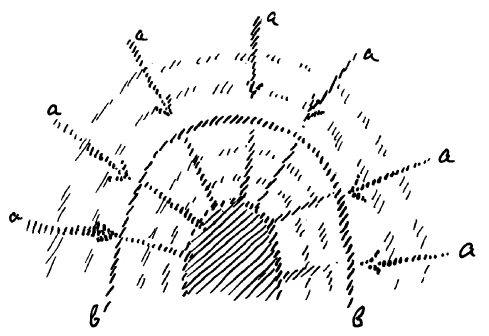
[ 9 ] We can therefore say that within the human being, inner principles of form encounter outer principles of form; the former come from the spirits of form, specifically from those spirits of form that have undergone a completely regular development in the universe. The external principles of form are not of the same kind, but stem from backward spirits of form—from those spirits of form that have taken on a Luciferic character. These are thus what acts purely spiritually; whereas that which acts through the material world proceeds in such a regular manner that it has properly undergone development through Saturn, the Sun, and the Moon, has come to Earth in a regular way, and shapes the human form from within the physical body. The irregular spirits of form act in such a way that they accept what is offered to them and hold back in the corresponding manner. Thus, human growth is hindered by such backward spirits of form. The beings of the higher hierarchies have the most manifold tasks. Among other things, we have also highlighted a task in this regard today.
[ 10 ] We have now described in various ways both how the regular hierarchies operate and how the spiritual beings who have lagged behind from the various hierarchies operate. And we have shown that through the Spirits of Form—you can read about this yourself in *An Outline of Esoteric Science*—humanity has actually come to possess the capacity for the I. We know, of course, that through the Thrones human beings have received the physical predisposition, through the Spirits of Wisdom the etheric predisposition, through the Spirits of Movement the astral predisposition, and that they have thus received the predisposition for the I in their physical body through the Spirits of Form. If we consider this, we can say that in his outer expression, human beings are initially organized into an ego-being by the regular spirits of form, and that this is expressed in his first life cycle; but then he is held back in his growth by the adversaries of these spirits of form, by the backward spirits of form. In this way, we have indeed come to know the contrast to that which first appears in the human being as the innermost aspect: the flash of ego-consciousness. This innermost aspect appears already in the first years. The outermost aspect, the form, is held back only in later years; this is, so to speak, a final act. Thus we have come to know the two evolutions in the human being as opposites. Of one I have said: It comes from the outside and goes inward; it takes hold of the feeling soul in the twenty-first year, and so on. — Then we have another development of the facts: this goes from the inside to the outside — until the growth of form is held back. One development proceeds from the spiritual to the physical. The regular one, which is of particular interest for education, proceeds from the inside out. The other, which is much more irregular and individual, proceeds from the outside in and expresses itself, when the human being has reached a certain age, in the completion of the outermost aspect, the physical body.
[ 11 ] Thus, we have two lines of development in human beings that work in opposite directions. It is very important for the educator to know this. That is why the book *The Education of the Child from the Standpoint of Spiritual Science* rightly focuses on the first line of development, which proceeds from the inside out, because that is the only area where education can take place. One cannot influence the other line of development, which proceeds from the outside to the inside, at all: this is individual development. This is something that can be taken into account, but which cannot be stopped and on which one cannot educate much. And distinguishing between what one can and cannot educate is of the utmost importance.
[ 12 ] Just as the stunted growth stems from the backward-looking spirits of form, so too does the first emergence of the “I” in human beings—as it flashes into view in early childhood—stem from the backward-looking spirits of will. And in between there are still several instances where backward spirits of wisdom and backward spirits of movement are at work.
[ 13 ] Now, one cannot characterize the whole of human life—including the life between death and rebirth—without taking into account all the factors that influence human beings, without realizing that even in ordinary life the influence of Luciferic beings manifests itself in the most diverse ways. But the influence of Luciferic natures also manifests itself in many other aspects of life. And because in these lectures we wish to attempt to understand the whole of human life, so to speak, from its very foundations, we shall not shy away from delving into somewhat broader contexts.
[ 14 ] First, let us draw attention to a phenomenon that can show us that even on the physical plane—that is, between birth and death—life has changed significantly in the course of human evolution. And once we understand this, we will also be able to see to what extent life has changed between death and rebirth. Anyone who views life today intellectually but superficially may easily believe that, in the main, things have always been as they are today. But this has not always been the case. And for certain phenomena, we need only go back a few centuries to find that certain things were quite different. Thus, there is something today that is infinitely important for the human soul’s life between birth and death, and which did not exist in its present form even in centuries not so long past. This is what is today expressed by the term “public opinion.” As recently as the 13th century, it would have been nonsense to speak of public opinion in the way we do today. People speak out a great deal today against blind faith in authority. Yet today, this blind faith in authority is far more pervasive than it was in those earlier centuries so often reviled. Abuses certainly existed back then as well; but there was no such blind faith in authority. The blindness of this faith in authority is generally expressed by the fact that the authority itself cannot be grasped. Today, people will very quickly feel defeated—whether this or that is said, based on these or those principles—when someone says: “But science has proven this or that.” In earlier centuries, people placed more trust in authorities who stood before them in the flesh. But that intangible entity—what is meant when one says, “Science has proven this”—is a very questionable thing. In what is designated by this lies something that today establishes a belief in authority toward the intangible, something that did not exist in earlier centuries. With matters about which, in a certain sense—and this is truly the case—even the simplest, most primitive person in earlier centuries attempted, in their own way, to know a little—to know something about healthy and sick life, for example—people today, in our culture, generally concern themselves very little. For why should anyone today need to know anything about healthy and sick life? The doctors know that, after all, and to them one can entrust the management of health and illness! That, too, is part of what falls under this heading today: an untraceable, supreme authority. But what else intrudes into life all around us, something on which people become dependent from their earliest youth, through which judgments and emotional tendencies force their way into our lives, starting from the earliest youth! This buzzing around, these currents living among people, are usually referred to as public opinion, about which philosophers have said: Public opinions are mostly private errors. — Yet what matters is not that one knows public opinions are mostly private errors, but that public opinions exert an immense power over the life of the individual. For the 13th century, one would be quite foolish to speak of public opinion as influencing the life of the individual. At that time, there were individual personalities; they certainly exercised authority in regard to this or that; people obeyed them, whether in practical matters or in matters of administration. But what impersonal public opinion has become today did not exist back then. Anyone who does not wish to believe this based on occult facts should study, for example, the history of Florence from those centuries—and even in later times—when the leadership of the city had passed to the Medici. There they will see how powerful the individual authorities were, but public opinion did not yet exist. It only began to take shape in a time four to five centuries prior to our own, and one can truly speak of the emergence of public opinion. Such things must be regarded as realities. It is a real sphere, a sphere of swirling thoughts!
[ 15 ] Where does this come from, this thing we often perceive as indefinable? What is this public opinion?
[ 16 ] Perhaps you recall that I have spoken of spiritual beings who belong to the hierarchies immediately above humankind and who are involved in guiding humanity in various ways. You need only pick up my book *The Spiritual Guidance of the Individual and of Humanity*, and there you will find much about such spiritual beings belonging to the higher hierarchies. Now we also know that the greatest turning point in the earthly development of humanity is the one brought about by the Mystery of Golgotha. Through this, something happened that, in essence, is already expressed in the most wonderful way by the esotericism of Paul. Paul spoke simply, but his manner of speaking is grounded in deep esotericism. Paul could not always readily say what he knew as an initiate: for one thing, he wanted to speak to a wider audience, and for another, it was not possible in his time to say everything he knew in the way he was able to express things. But his entire mental image is grounded in deep esotericism. There we find, for example, that a profoundly significant fact underlies his distinction between the “first Adam” and the “higher Adam,” the Christ. In his sense, the various generations of humanity descend from the first Adam, in that the bodies descend from Adam. Therefore, we can say: The physical spread of humanity across the earth, through the various periods, ultimately leads back to the physical body of Adam—of course, Adam and Eve. —Then we will ask: What underlies the physical development of humanity from Adam onward? —Of course, soul development! Souls live within the physical bodies that descend from Adam. These souls, which came down from the world-space, brought a certain spiritual inheritance, an inheritance of spiritual wealth, with them to Earth. But this spiritual wealth has been subject to decline over time. People who lived, for example, in the 6th or 7th millennium before the founding of Christianity had a more intense, far-reaching spiritual content than people who lived in the 1st millennium before the Mystery of Golgotha. The wealth that people once possessed has gradually diminished in the soul, seeping away. For spiritual good, the life between death and new birth is particularly significant. We can also say: If we go far back in time to the period before the Mystery of Golgotha, we find that after death people have a lively, luminous soul life; but then the soul life becomes increasingly gloomy and gloomy, increasingly dark and darker; people take with them, more and more, only a twilight soul life when they pass through death. Especially among the most advanced peoples, for example the Greeks, it was indeed the case that these Greeks, even though they were the most advanced people on the globe, could well say in their wisdom, in the sense of progress in development: “Better to be a beggar in the upper world than a king in the realm of shadows!” This is a saying we know applied to the Greek people, because the Greeks were able to live a fully saturated life on the physical plane; but as soon as they had passed through death, their life was a shadowy one.
[ 17 ] It is a complete truth that this spiritual life, which people had experienced and which manifested itself after death as a more clairvoyant or twilight-like consciousness, had descended into a dull existence. And especially in the fourth post-Atlantean epoch, the Greco-Latin epoch, in which the Mystery of Golgotha took place, it had already become the darkest.
[ 18 ] The significance of John the Baptist’s baptism lies in the fact that, for certain people he baptized, this very fact was to be brought to their consciousness. He fully immersed the people he baptized in water. His baptism was a complete submersion. Through this, the etheric body of such people was lifted out, and for a brief moment they became clairvoyant underwater. What John was able to show them was the fact that, over the course of time, humanity had regressed so far in terms of its soul life that it possessed only a small remnant of the former spiritual wealth that it could carry through the gate of death and that could give it a clairvoyant consciousness. And to those who were baptized in this way by John, he gave the insight: A revitalization of the soul life is necessary. Something new had to shine into the souls so that a life after death could develop once more. And this new thing has shone into the souls through the Mystery of Golgotha. You need only read the lecture series “From Jesus to Christ,” and you will see that a rich spiritual life emanates from the Mystery of Golgotha, which shines upon the individual human beings who develop a relationship to the Mystery of Golgotha here on Earth. And from there, the souls are revitalized.
[ 19 ] That is why Paul could say: Just as physical human bodies descend from Adam, so too will the inner lives of human beings increasingly descend from Christ, the second Adam, the spiritual Adam. — This is a profound truth that Paul has expressed in his simple words. For if the Mystery of Golgotha had not come, human beings would have lost more and more of their spiritual substance and would either have come to long only to live outside the physical body, or would have continued to live with desires and longings for a purely physical life on earth, becoming ever more and more materialistic. Because everything happens slowly and gradually, the original spiritual heritage has not yet dried up for the entire population of the Earth; there are still peoples on Earth who possess something of the old spiritual heritage, even though they have not found a connection to the Mystery of Golgotha. But it is precisely the most advanced peoples who can attain a consciousness after death only in the sense that they come to be able to “die into the Christ,” as the middle part of the Rosicrucian formula states. Thus, this Mystery of Golgotha has indeed acted as a kind of permeation of the soul’s content of human beings on Earth.
[ 20 ] If we consider this in the appropriate way, we have gained an understanding, with regard to the line of human development, of a very specific question, namely: What actually happened when, so to speak, human beings acquired the ability, through an understanding of the Mystery of Golgotha, to receive a soul content that radiates into their own I? How does this soul content differ from the other one that existed before the Mystery of Golgotha, like an ancient genetic heritage? j
[ 21 ] The difference is that, before the Mystery of Golgotha, human beings possessed this inner life in a much more dependent manner. They were thus under the much more direct guidance of the beings we know as Angeloi, Archangeloi, and so on—the beings of the next higher hierarchies. These beings of the next higher hierarchies guided human beings in a much, much less independent manner before the Mystery of Golgotha than after it. And the progress, in turn, of these beings of the higher hierarchies—Angels, Archangels, Archai—consists in the fact that they, for their part, have learned to carry out the guidance of human beings in a way that respects human independence. Human beings on Earth were to live more and more independently. The leading spiritual beings of the higher hierarchies have learned this for their part, and therein lies their progress.
[ 22 ] But even these spirits are such that they can remain behind. Not all spirits who were involved in guiding humanity have truly acquired, through the Mystery of Golgotha, the ability to freely become guides and leaders of humanity. Some of these beings from the higher hierarchies have remained behind and taken on a Luciferic character. And what some of them embody includes, for example, what we today call public opinion. Public opinion is not merely shaped by human beings, but also by a certain kind of Luciferic spirits at the lowest level—angels and archangels who have remained behind. These are only just beginning their Luciferic career; they have not yet risen very high in the hierarchy of the Luciferic spirits; but they are Luciferic spirits. One can observe with the eye of a seer how certain spirits of the higher hierarchies do not participate in the development following the Mystery of Golgotha, how they harden themselves in the old way of leadership and therefore cannot approach human beings directly. Those who have participated in the development can approach human beings in a regular manner; those who have not participated cannot approach them, and they operate through a blurred, chaotic flood of thought-power within public opinion. One can only understand the function of public opinion if one knows that it enters humanity in this way.
[ 23 ] Thus, we have right before us the phenomenon of beings deviating from a normal course of development and taking on a Luciferic character. It is important to know this. For those Luciferic beings we have already encountered, who possess greater power, also began “on a small scale.” The entire host of Luciferic beings began on a small scale. Admittedly, there was no public opinion on the ancient Moon, but there was something comparable to it: a kind of leadership of humanity. And when we consider this host of Luciferic spirits—what we have otherwise referred to as Luciferic spirits are powerful, significant beings, for example those who are spirits of form and swarm around human beings in such a way as to hinder their growth—but when we now speak of the others, of the host of Luciferic spirits, these are, so to speak, merely the recruits; but here the career of the Luciferic spirits begins, a process that will only later take on entirely different dimensions, because the spirits intervening there become ever more powerful. Public opinion, which approaches human beings in this way and is directed and guided by certain Luciferic beings of the lowest nature, must—because human beings, so to speak, take it in between birth and death—also have its counterbalance in the life between death and new birth. This means: because the human being is caught up in such a current in the life between birth and death as has now been characterized, he must experience a corresponding counterbalance between death and new birth. For if he were not to experience this, the following would occur.
[ 24 ] Those spirits who have remained behind and shape public opinion have no significance whatsoever, no power whatsoever over the life that a person experiences between death and rebirth. They have completely relinquished this power to act there, because they are already active here on the physical plane, active in a spiritual way—and in a way that is only possible as public opinion. A person cannot take anything from public opinion into the spiritual world. Everything they might wish to take with them would seem highly out of place if we were to apply it after death. It must be said, even though it will seem very strange to some: all public judgments, everything that captures a person relatively early in life with regard to their judgment, makes their life in Kamaloka difficult if they are attached to these things and have grown fond of them. And especially those people who, within public opinion, believe that one has one’s own judgment—for one never has that there—make their Kamaloka difficult at best. But after the Kamaloka, public opinion has no significance whatsoever. And for the conditions after death, it truly has not the slightest value whether people even have such nuances of public opinion as liberal or conservative, radical or reactionary. This is something that has no significance for the classification of the various groups of people, and which is founded solely on Earth to prevent people from making the progress they are meant to make toward the enlightenment of consciousness that operates after death. These entities behind public opinion wished to lag behind the progress brought about by the Mystery of Golgotha. For the development of the Earth, however, the Mystery of Golgotha will take on ever greater and greater significance. And we must be absolutely clear that the future of the Earth’s development cannot unfold in such a way that these things—public opinion and the like—which represent a necessity in development, can be improved. Rather, human beings can become better within themselves. Therefore, development must increasingly penetrate into the inner self; so that in the future, human beings will face public opinion much more, but their inner being will have grown stronger. This can only be achieved through Spiritual Science. But for human beings to become increasingly capable of standing up to those spirits who, as recruits of the Luciferic beings, are now asserting themselves—and whose assertion is now expressed in public opinion—this will only be possible if, between death and rebirth, human beings undergo something that strengthens their inner being once more, that strengthens that part of them which is independent of earthly life. While public opinion is making him more and more dependent on earthly life, he must take in something between death and rebirth that will make him increasingly free from public opinion in his next earthly life.
[ 25 ] This is connected to the fact that, precisely at a time when public opinion is rising and gaining significance, what has been described here in our Christmas lectures is being established—the Buddha Realm on Mars—so that between death and rebirth, the human being passes through the Buddha Realm on Mars. Christian Rosenkreutz had given the Buddha the mission to work in a special way on Mars. And what would be of no use here on Earth—the desire to flee, the desire to break free from earthly conditions—this is what the human being must undergo between death and new birth, while passing through the sphere of Mars. Among other things, what is achieved there is that he sheds the shell of public opinion, which is suitable only for Earth. For even more oppressive things will come in the future, and it will be even more necessary to go through what a human being can go through as a disciple of the Buddha on Mars. Here on Earth, people can only be disciples of the Buddha if they do not wish to go along with the advanced portion of the Earth’s population. But between death and new birth, the Buddha unfolds what has become of his teaching—what he asserted here—that humanity is to be freed from incarnations—as a teaching that does not serve life on Earth, which is to continue from incarnation to incarnation. What he gave at that time was designed for humanity in the disembodied state. The advanced Buddha-teaching is the right one for the time between death and new birth. And just as the Buddha appeared in the astral body of the boy Luke-Jesus, so too does the Christ himself guide human beings between death and new birth by leading them through the sphere of Mars, so that they may receive the advanced Buddha-teaching. So that in the sphere of Mars, human beings may be freed from what they—unfit for their further progress on Earth—take in through the homogenizing influence of public opinion. And while Mars was indeed described in earlier times as the planet of warlike virtues, the Buddha has gradually taken on the task of transforming these warlike virtues within the human being in such a way that they establish a free, independent spirit in the manner that has become necessary today. While human beings today are inclined to surrender their sense of freedom to what, as public opinion, seeks to bind people ever more tightly, it is precisely on Mars, between death and new birth, that they will have the aspiration to free themselves from these bonds and not to bring them back into life on Earth when they return to a new incarnation.
[ 26 ] In this context, we have something that, it seems to me, characterizes in the most wonderful way how wisdom reigns in the world, how everything that advances and everything that lags behind is, in fact, ultimately guided in the course of world development in such a way that the harmony of this world development is, after all, the final result. For human beings really cannot, so to speak, bring about their progress by taking the middle path. Some do come to realize—as I may have already mentioned here—that one cannot take a one-sided stance on this or that point of view. We do, however, see idealists, materialists, and other “ists” out in the world swearing by their respective points of view. Great minds like Goethe, for example, do not do this; they seek to approach material conditions through material thinking and the spiritual through idealistic thinking. When lesser minds then believe they have grasped this, they say: Between two different standpoints, the truth lies in the middle. — That would be roughly the same as if someone in practical life wanted to sit between two chairs. But the truth is found only when one does not take a one-sided stance on this or that point of view, that is, when one is able to apply, in a corresponding manner, what materialism has as a mode of knowledge and what idealism has as such. The world does not progress by always holding to the middle; the middle exists in an appropriate way only when the individual sides are also present, and when one takes them into account as forces. If, for example, one wants to weigh something on a scale, one needs not only what is in the middle of the scale, but also the two scales. So, alongside what public opinion is, its opposite must also be present: the Buddha’s teaching on Mars, which would not exist if public opinion had not arisen. Life needs polarity, needs contrast; one cannot simply seek to eliminate the individual opposites, for life progresses through polarity. — One might well believe that, since the South Pole and the North Pole of the Earth are opposites, it would be better if neither existed! Even if they are not as opposite as that professor claimed—who is said to have written his books so quickly that he could not think while doing so, and thus it happened that he wrote the sentence: “Culture could only develop in the middle zone of the Earth, for at the North Pole culture would freeze to death from the cold and at the South Pole melt away from the heat”—but in another sense, the North Pole and the South Pole are truly polar opposites that must exist, because progress cannot be achieved through neutrality, but rather through the maintenance and harmonization of opposites. Thus, what develops on Earth must undergo a development that descends below the level of progress. For public opinion is of less value than what the individual can attain as opinion as he progresses. It is subhuman. Opposed to this subhuman aspect is the Buddha Current, which the human being undergoes between death and new birth. Both must exist. It is extremely important to take this into account in the course of development.
[ 27 ] So it is truly the case that we can say: Yes, there are spirits who have fallen behind; but everything that lags behind on one side, and everything that goes beyond the stage of development on the other, is arranged by the total wisdom of the world in such a way that harmony ultimately prevails. The spirits who have lagged behind are used to always represent the opposite pole of more advanced spirits.
[ 28 ] If we look at life in this way, it will become clear to us how, as the Earth’s development progresses, human beings will increasingly bring into life faculties that assert themselves in ways other than purely physical ones. And this will be something that will increasingly demonstrate that we will have to reckon with other human predispositions besides purely physical ones. Physical dispositions will be found—even if they only gradually reveal themselves—that can be traced back to infancy; but there will gradually be other dispositions that cannot be traced back to infancy, but which appear in a certain distinct way only in later life. And this will be a characteristic of future development: there will be more and more people of whom one will have to say: What has actually happened to this person at a certain age? They are like a different person, as if transformed! — This will become increasingly evident. Dispositions will emerge that were not at all present earlier, that only appear at a certain age. These will be the most highly developed souls, who exhibit something like a certain break in their lives—for the fact that a person was a disciple of the Buddha in the life between death and rebirth does not become apparent immediately, but only in later life—and this will be the case with those of whom we can say: Up to a certain point we were able to follow them; there they displayed their individual characteristics; then entirely new patterns emerge; they gained an understanding of something quite different from what they had previously understood. These will be the people who, in the future as well, will be the true bearers of spiritual progress, who may even be regarded merely as late bloomers, because people will believe: ‘He was simply undeveloped earlier, which is why these qualities only emerged later.’ — In truth, however, it will be the case that these people only bring forth the qualities that are so characteristic of them later in life, for the reason that in earlier earthly incarnations they laid the groundwork to be able to pass through the Mars culture in a particularly intense way and acquire aptitudes there through which they could act in an original way within human development, bringing a new direction to human development. Therefore, more and more people will enter into the actual spiritual culture who, so to speak—I have already discussed this from a different perspective—show fewer predispositions from their youth onward for the kind of spiritual standpoint they will adopt in later life.
[ 29 ] And we now see that it is for this reason that the Rosicrucian tradition has always emphasized a fact which we were indeed able to cite in times past, but—because we were not as advanced in our understanding as we are now—could not substantiate. Those who, in the Rosicrucian sense, represented the principle of initiation in the West have always expressly emphasized that it is impossible to determine, even in childhood, that the true leading individuals are indeed leading individuals, because these are individuals in whom, in the sense indicated, a kind of rupture manifests itself in later life. — When the seer speaks of the Buddha today, he knows above all that the Buddha faithfully upheld what his teaching promised: he continued to work for that aspect of the human being which does not immediately strive toward physical corporeality, which therefore does not appear incarnated in physical corporeality from the very beginning, but only enters into the human being once physical corporeality has undergone a certain development, once it has approached the spirit to a certain degree. Then comes what the Buddha gives to human beings. This only occurs in later life.
[ 30 ] We must take this into account if we are to understand the full development of the human being. We will discuss later what this means for the individual in terms of life between birth and death.