

Human and Cosmic Thought
GA 151
20 January 1914, Berlin
Translate the original German text into any language:
Versions Available:
Human and Cosmic Thought, tr. SOL
Erster Vortrag
First Lecture
[ 1 ] In diesen vier Vorträgen, die ich im Verlaufe unserer Generalversammlung vor Ihnen werde zu halten haben, möchte ich sprechen über den Zusammenhang des Menschen mit dem Weltall von einem gewissen Gesichtspunkte aus. Und diesen Gesichtspunkt möchte ich mit folgenden Worten andeuten.
[ 1 ] In these four lectures that I will be giving to you during our General Assembly, I would like to discuss the relationship between humanity and the universe from a particular perspective. And I would like to hint at this perspective with the following words.
[ 2 ] Der Mensch erlebt in sich das, was wit den Gedanken nennen können, und in dem Gedanken kann sich der Mensch als etwas unmittelbar Tätiges, als etwas, was seine Tätigkeit überschauen kann, erfühlen. Wenn wir irgendein äußeres Ding betrachten, zum Beispiel eine Rose oder einen Stein, und wir stellen dieses äußere Ding vor, so kann jemand mit Recht sagen: Du kannst niemals eigentlich wissen, wieviel du in dem Steine oder in der Rose, indem du sie vorstellst, von dem Ding, von der Pflanze, eigentlich hast. Du siehst die Rose, ihre äußere Röte, ihre Form, wie sie in einzelne Blumenblätter abgeteilt ist, du siehst den Stein mit seiner Farbe, mit seinen verschiedenen Ecken, aber du mußt dir immer sagen: Da kann noch etwas drinnenstecken, was dir nicht nach außen hin erscheint. Du weißt nicht, wieviel du in deiner Vorstellung von dem Steine, von der Rose eigentlich hast.
[ 2 ] Human beings experience within themselves what we might call “thought,” and in thought, human beings can sense themselves as something directly active, as something capable of surveying its own activity. When we look at any external object, for example a rose or a stone, and we create a mental image of the object, one can rightly say: You can never really know how much of the object, of the plant, you actually have in the stone or in the rose when you create a mental image of it. You see the rose, its outer redness, its shape, how it is divided into individual petals; you see the stone with its color, with its various corners, but you must always tell yourself: There may still be something inside that does not appear to you on the outside. You do not know how much of the stone, of the rose, you actually have in your mental image.
[ 3 ] Wenn aber jemand einen Gedanken hat, dann ist er es selber, der diesen Gedanken macht. Man möchte sagen, in jeder Faser dieses seines Gedankens ist er drinnen. Daher ist er für den ganzen Gedanken ein Teilnehmer seiner Tätigkeit. Er weiß: Was in dem Gedanken ist, das habe ich so in den Gedanken hineingedacht, und was ich nicht in den Gedanken hineingedacht habe, das kann auch nicht in ihm drinnen sein. Ich überschaue den Gedanken. Keiner kann behaupten, wenn ich einen Gedanken vorstelle, da könnte in dem Gedanken noch soundso viel anderes drinnen sein wie in der Rose und in dem Stein; denn ich habe ja selber den Gedanken erzeugt, bin in ihm gegenwärtig, weiß also, was drinnen ist.
[ 3 ] But when someone has a thought, it is he himself who creates that thought. One might say that he is present in every fiber of that thought of his. Therefore, he is a participant in the activity of the entire thought. He knows: What is in the thought, I have put into the thought in that way, and what I have not put into the thought cannot be in it either. I have a clear grasp of the thought. No one can claim that when I create a mental image, there could be so many other things in it as there are in a rose or a stone; for I myself have generated the thought, am present within it, and thus know what is inside.
[ 4 ] Wirklich, der Gedanke ist unser Ureigenstes. Finden wir die Beziehung des Gedankens zum Kosmos, zum Weltall, dann finden wir die Beziehung unseres Ureigensten zum Kosmos, zum Weltall. Das kann uns versprechen, daß es wirklich ein fruchtbarer Gesichtspunkt ist, einmal die Beziehung des Menschen zum Weltall vom Gedanken aus zu betrachten. Wir werden also diese Betrachtung anstellen, und sie wird uns in bedeutsame Höhen anthroposophischer Betrachtung führen. Aber wir werden heute einen Unterbau aufzurichten haben, der vielleicht manchem von Ihnen etwas abstrakt vorkommen mag. Aber in den nächsten Tagen werden wir sehen, daß wir diesen Unterbau brauchen und daß wir ohne ihn uns nur mit einer gewissen Oberflächlichkeit den hohen Zielen nähern können, die wir in diesen vier Vorträgen anstreben. Das also, was eben gesagt worden ist, verspricht uns, daß der Mensch, wenn et sich an das hält, was er im Gedanken hat, eine intime Beziehung seines Wesens zum Weltall, zum Kosmos, finden kann.
[ 4 ] Truly, thought is our most essential being. If we discover the relationship of thought to the cosmos, to the universe, then we discover the relationship of our most essential being to the cosmos, to the universe. This can assure us that it is indeed a fruitful approach to consider the relationship of the human being to the universe from the perspective of thought. We shall therefore undertake this examination, and it will lead us to significant heights of anthroposophical contemplation. But today we will have to lay a foundation that may seem somewhat abstract to some of you. But in the coming days we will see that we need this foundation and that without it we can only approach the lofty goals we are striving for in these four lectures with a certain superficiality. What has just been said, therefore, promises us that if the human being holds fast to what he has in thought, he can find an intimate relationship of his being to the universe, to the cosmos.
[ 5 ] Nur hat die Sache eine Schwierigkeit, wenn wir uns auf diesen Gesichtspunkt begeben wollen, eine große Schwierigkeit. Ich meine nicht für unsere Betrachtung, aber für den objektiven Tatbestand hat es eine große Schwierigkeit. Und diese Schwierigkeit besteht darin, daß es zwar wahr ist, daß man in jeder Faser des Gedankens drinnen lebt und daher den Gedanken, wenn man ihn hat, von allen Vorstellungen am intimsten kennen muß; aber, ja aber — die meisten Menschen haben keine Gedanken! Und dies wird gewöhnlich nicht mit aller Gründlichkeit durchdacht, daß die meisten Menschen keine Gedanken haben. Aus dem Grunde wird es nicht mit aller Gründlichkeit durchdacht, weil man dazu — eben Gedanken brauchte! Auf eines muß zunächst aufmerksam gemacht werden. Was im weitesten Umkreise unseres Lebens die Menschen verhindert, Gedanken zu haben, das ist, daß die Menschen für den gewöhnlichen Gebrauch des Lebens gar nicht immer das Bedürfnis haben, wirklich bis zum Gedanken vorzudringen, sondern daß sie statt des Gedankens sich mit dem Worte begnügen. Das meiste von dem, was man im gewöhnlichen Leben Denken nennt, verläuft nämlich in Worten. Man denkt in Worten. Viel mehr, als man glaubt, denkt man in Worten. Und viele Menschen sind, wenn sie nach einer Erklärung von dem oder jenem verlangen, damit zufrieden, daß man ihnen irgendein Wort sagt, das einen für sie bekannten Klang hat, das sie an dieses oder jenes erinnert; und dann halten sie das, was sie bei einem solchen Wort empfinden, für eine Erklärung und glauben, sie hätten dann den Gedanken.
[ 5 ] But there is a problem with this approach—a major one, in fact. I don’t mean for our consideration, but for the objective facts, there is a major difficulty. And this difficulty lies in the fact that, while it is true that one lives within every fiber of a thought and therefore, if one has it, must know that thought more intimately than any other mental image; but, yes, but—most people have no thoughts! And this is usually not thought through with all due thoroughness—that most people have no thoughts. The reason it is not thought through with all due thoroughness is that one would need—precisely—thoughts to do so! One thing must first be pointed out. What prevents people, in the broadest sphere of our lives, from having thoughts is that, for the ordinary purposes of life, people do not always feel the need to really penetrate to the thought itself, but instead of the thought, they content themselves with the word. Most of what is called thinking in ordinary life takes place in words. People think in words. Much more than one realizes, people think in words. And many people, when they ask for an explanation of this or that, are satisfied with being told some word that has a familiar sound to them, that reminds them of this or that; and then they regard what they feel upon hearing such a word as an explanation and believe they have arrived at the thought.
[ 6 ] Ja, das, was ich eben gesagt habe, das hat in der Entwickelung des menschlichen Geisteslebens zu einer bestimmten Zeit dazu geführt, eine Ansicht heraufzubringen, welche heute noch viele Menschen, die sich Denker nennen, teilen. In der Neuauflage meiner «Welt- und Lebensanschauungen im neunzehnten Jahrhundert» habe ich versucht, dieses Buch ganz gründlich umzugestalten, indem ich eine Entwickelungsgeschichte des abendländischen Gedankens vorausgeschickt habe, angefangen vom 6. vorchristlichen Jahrhundert bis herauf ins 19. Jahrhundert, und indem ich dann am Schlusse zu dem, was gegeben war, als das Buch zuerst erschien, hinzufügte eine Darstellung des, sagen wir, gedanklichen Geisteslebens bis in unsere Tage herein. Auch der Inhalt, der schon da war, ist vielfach umgestaltet worden. Da habe ich denn zu zeigen gehabt, wie der Gedanke in einem bestimmten Zeitalter eigentlich erst entsteht. Er entsteht wirklich erst, man könnte sagen, um das 6. oder 8. vorchristliche Jahrhundert. Vorher erlebten die menschlichen Seelen gar nicht das, was man im rechten Sinne des Wortes Gedanken nennen kann. Was erlebten die menschlichen Seelen vorher? Sie erlebten vorher Bilder. Und alles Erleben der Außenwelt geschah in Bildern. Von gewissen Gesichtspunkten aus habe ich das oftmals gesagt. Dieses Bilder-Erleben ist die letzte Phase des alten hellseherischen Erlebens. Dann geht für die menschliche Seele das Bild in den Gedanken über.
[ 6 ] Yes, what I have just said led, at a certain point in the development of human spiritual life, to the emergence of a view that is still shared today by many people who call themselves thinkers. In the new edition of my Worldviews and Life Views in the Nineteenth Century, I attempted to thoroughly restructure this book by prefacing it with a history of the development of Western thought, beginning in the 6th century B.C. and extending up to the 19th century, and by then adding, at the end, to what was already there when the book first appeared, a description of, let us say, intellectual and spiritual life right up to the present day. The content that was already there has also been extensively revised. There I had to show how thought actually first arises in a particular age. It truly arises, one might say, only around the 6th or 8th century B.C.E. Before that, human souls did not experience at all what can be called thought in the proper sense of the word. What did human souls experience before that? They experienced images. And all experience of the external world took place in images. From certain points of view, I have often said this. This experience of images is the final phase of the old clairvoyant experience. Then, for the human soul, the image gives way to thought.
[ 7 ] Was ich in diesem Buche beabsichtigte, ist, dieses Ergebnis der Geisteswissenschaft einmal rein durch Verfolgung der philosophischen Entwickelung zu zeigen. Ganz nur auf dem Boden der philosophischen Wissenschaft bleibend, wird gezeigt, daß der Gedanke einmal im alten Griechenland geboren worden ist, daß er entsteht dadurch, daß er herausspringt für das menschliche Seelenerleben aus dem alten sinnbildlichen Erleben der Außenwelt. Dann versuchte ich zu zeigen, wie dieser Gedanke weitergeht in So£rates, in Plato, Aristoteles, wie er bestimmte Formen annimmt, wie er sich weiter heraufentwickelt und dann im Mittelalter zu dem führt, was ich jetzt erwähnen will.
[ 7 ] My intention in this book is to demonstrate this outcome of Spiritual Science purely through an examination of the development of philosophy. Remaining entirely within the realm of philosophical science, it is shown that the idea was first born in ancient Greece, that it arises by leaping out of the ancient symbolic experience of the external world into the experience of the human soul. I then attempted to show how this idea continues in Socrates, Plato, and Aristotle, how it takes on certain forms, how it develops further, and how it leads in the Middle Ages to what I now wish to mention.
[ 8 ] Zu dem Zweifel führt die Entwickelung des Gedankens, ob es dasjenige überhaupt geben könne in der Welt, was man allgemeine Gedanken, allgemeine Begriffe nennt, zu dem sogenannten Nominalismus, zu der philosophischen Anschauung, daß die allgemeinen Begriffe nur Namen sein können, also überhaupt nur Worte. Es gab also für diesen allgemeinen Gedanken sogar die philosophische Anschauung, und viele haben sie noch heute, daß diese allgemeinen Gedanken überhaupt nur Worte sein können.
[ 8 ] This line of thought—the question of whether there can be such a thing in the world as what we call general ideas or general concepts—leads to so-called nominalism, the philosophical view that general concepts can be nothing more than names, that is, nothing but words. Thus, there was even a philosophical view regarding this general idea—and many still hold it today—that these general ideas can be nothing more than words.
[ 9 ] Nehmen wir einmal, um uns das zu verdeutlichen, was eben gesagt worden ist, einen leicht überschaubaren und zwar allgemeinen Begriff; nehmen wir den Begriff «Dreieck» als allgemeinen Begriff. Derjenige nun, der da mit seinem Standpunkte des Nominalismus kommt, der nicht hinwegkommen kann von dem, was als Nominalismus sich in dieser Beziehung ausgebildet hat in der Zeit des 11. bis 13. Jahrhunderts, der sagt etwa folgendes: Zeichne mir ein Dreieck hin! — Gut, ich werde ihm ein Dreieck hinzeichnen, zum Beispiel ein solches:
[ 9 ] To illustrate what has just been said, let us take a simple and general concept; let us take the concept of “triangle” as a general concept. Now, someone who approaches this from a nominalist standpoint—someone who cannot escape what developed as nominalism in this regard during the 11th to 13th centuries—might say something like this: Draw me a triangle! — All right, I will draw him a triangle, for example, one like this:
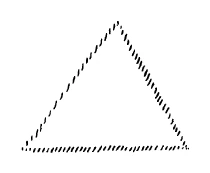
[ 10 ] Schön, sagt er, das ist ein besonderes, spezielles Dreieck mit drei spitzen Winkeln, das gibt es. Aber ich werde dir ein anderes hinzeichnen. - Und er zeichnet ein Dreieck hin, das einen rechten Winkel hat, und ein solches, das einen sogenannten stumpfen Winkel hat.
[ 10 ] “Fine,” he says, “that's a special kind of triangle with three acute angles—it exists. But I'll draw you another one.”—And he draws a triangle with a right angle, and one with what's called an obtuse angle.
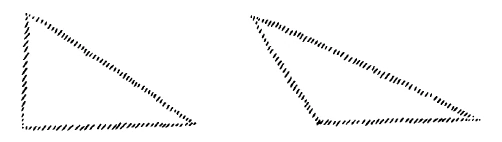
[ 11 ] So, jetzt nennen wir das erste ein spitzwinkliges Dreieck, das zweite ein rechtwinkliges und das dritte ein stumpfwinkliges. Da sagt der Betreffende: Das glaube ich dir, es gibt ein spitzwinkliges, ein rechtwinkliges und ein stumpfwinkliges Dreieck. Aber das alles ist ja nicht das Dreieck. Das allgemeine Dreieck muß alles enthalten, was ein Dreieck enthalten kann. Unter den allgemeinen Gedanken des Dreiecks muß das erste, das zweite und das dritte Dreieck fallen. Es kann aber doch nicht ein Dreieck, das spitzwinklig ist, zugleich rechtwinklig und stumpfwinklig sein. Ein Dreieck, das spitzwinklig ist, ist ein spezielles, ist nicht ein allgemeines Dreieck; ebenso ist ein rechtwinkliges und ein stumpfwinkliges Dreieck ein spezielles. Ein allgemeines Dreieck kann es aber nicht geben. Also ist das allgemeine Dreieck ein Wort, das die speziellen Dreiecke zusammenfaßt. Aber den allgemeinen Begriff des Dreiecks gibt es nicht. Das ist ein Wort, das die Einzelheiten zusammenfaßt.
[ 11 ] So, let’s call the first one an acute-angled triangle, the second a right-angled triangle, and the third an obtuse-angled triangle. The person in question says: I believe you; there is an acute-angled, a right-angled, and an obtuse-angled triangle. But all of that is not the triangle. The general concept of the triangle must include everything that a triangle can include. The first, second, and third triangles must fall under the general concept of the triangle. But a triangle that is acute-angled cannot be both right-angled and obtuse-angled at the same time. An acute-angled triangle is a specific one, not a general triangle; likewise, a right-angled and an obtuse-angled triangle are specific ones. But there cannot be a general triangle. Thus, the general triangle is a word that summarizes the specific triangles. But the general concept of the triangle does not exist. It is a word that summarizes the particulars.
[ 12 ] Das geht natürlich weiter. Nehmen wir an, es spricht jemand das Wort Löwe aus. Nun sagt der, welcher auf dem Standpunkt des Nominalismus steht: Im Berliner Tiergarten ist ein Löwe, im Hannoverschen Tiergarten ist auch ein Löwe, im Münchner Tiergarten ist auch einer. Die einzelnen Löwen gibt es; aber einen allgemeinen Löwen, der etwas zu tun haben sollte mit dem Berliner, Hannoverschen und Münchner Löwen, den gibt es nicht. Das ist ein bloßes Wort, das die einzelnen Löwen zusammenfaßt. Es gibt nur einzelne Dinge, und es gibt außer den einzelnen Dingen, so sagt der Nominalist, nichts als Worte, welche die einzelnen Dinge zusammenfassen.
[ 12 ] Of course, this goes further. Let’s suppose someone utters the word “lion.” Now, the person who holds the nominalist position says: There is a lion in Berlin’s Tiergarten, there is also a lion in Hanover’s Tiergarten, and there is one in Munich’s Tiergarten as well. The individual lions exist; but there is no such thing as a general “lion” that has anything to do with the lions in Berlin, Hanover, and Munich. It is merely a word that summarizes the individual lions. There are only individual things, and apart from the individual things, says the nominalist, there is nothing but words that summarize the individual things.
[ 13 ] Diese Anschauung, wie gesagt, ist heraufgekommen; sie vertreten heute noch scharfsinnige Logiker. Und wer sich die Sache, die jetzt eben auseinandergesetzt worden ist, ein wenig überlegt, wird sich auch im Grunde genommen gestehen müssen: Es liegt da doch etwas Besonderes vor; ich kann nicht so ohne weiteres darauf kommen, ob es nun wirklich diesen «Löwen im allgemeinen» und das «Dreieck im allgemeinen» gibt, denn ich sehe es ja nicht recht. Wenn nun wirklich jemand käme, der sagen würde: Sieh einmal, lieber Freund, ich kann dir nicht zubilligen, daß du mir den Münchner, den Hannoverschen oder den Berliner Löwen zeigst. Wenn du behauptest, es gäbe den Löwen «im allgemeinen», so mußt du mich irgendwo hinführen, wo es den «Löwen im allgemeinen» gibt. Wenn du mir aber den Münchner, den Hannoverschen und den Berliner Löwen zeigst, so hast du mir nicht bewiesen, daß es den «Löwen im allgemeinen» gibt. — Wenn jemand käme, der diese Anschauung hat, und man sollte ihm den «Löwen im allgemeinen» zeigen, so würde man zunächst etwas in Verlegenheit geraten. Es ist nicht so leicht, die Frage zu beantworten, wo man den Betreffenden hinführen soll, dem man den «Löwen im allgemeinen» zeigen soll.
[ 13 ] This view, as I said, has gained traction; it is still held today by astute logicians. And anyone who gives the matter just discussed a little thought will ultimately have to admit: there is indeed something special at work here; I cannot readily determine whether this “lion in general” and the “triangle in general” actually exist, for I do not really see it. If someone were to come along and say: Look here, my dear friend, I cannot accept that you show me the Munich, Hanover, or Berlin lion. If you claim that the lion “in general” exists, then you must lead me somewhere where the “lion in general” exists. But if you show me the Munich, Hanover, and Berlin lions, you have not proven to me that the “lion in general” exists. — If someone were to come along who held this view, and one were to show him the “lion in general,” one would initially be somewhat at a loss. It is not so easy to answer the question of where one should take the person in question to whom one is to show the “lion in general.”
[ 14 ] Nun, wir wollen jetzt nicht zu dem gehen, was uns die Geisteswissenschaft gibt; das wird schon noch kommen. Wir wollen einmal beim Denken bleiben, wollen bei dem bleiben, was dutch das Denken erreicht werden kann, und wir werden uns sagen müssen: Wenn wir auf diesem Boden bleiben wollen, so geht es eben nicht recht, daß wir irgendeinen Zweifler zum «Löwen im allgemeinen» hinführen. Das geht wirklich nicht. Hier liegt eine der Schwierigkeiten vor, die man einfach zugeben muß. Denn will man auf dem Gebiete des gewöhnlichen Denkens diese Schwierigkeit nicht zugeben, dann läßt man sich eben nicht auf die Schwierigkeit des menschlichen Denkens überhaupt ein.
[ 14 ] Well, let’s not turn to what Spiritual Science has to offer just yet; that will come in due time. Let’s stick to thinking for now, let’s stick to what can be achieved through thinking, and we will have to admit: If we wish to remain on this ground, it simply does not work to lead any skeptic to the “Lion in general.” That really does not work. Herein lies one of the difficulties that one must simply admit. For if one does not wish to admit this difficulty in the realm of ordinary thinking, then one is simply not engaging with the difficulty of human thinking at all.
[ 15 ] Bleiben wir beim Dreieck; denn schließlich ist es für die allgemeine Sache gleichgültig, ob wir uns die Sache am Dreieck, am Löwen oder an etwas anderem klarmachen. Zunächst erscheint es aussichtslos, daß wir ein allgemeines Dreieck hinzeichnen, das alle Eigenschaften, alle Dreiecke enthält. Und weil es aussichtslos nicht nur erscheint, sondern für das gewöhnliche menschliche Denken auch ist, deshalb steht hier alle äußere Philosophie an einer Grenzscheide, und ihre Aufgabe wäre es, sich einmal wirklich zu gestehen, daß sie als äußere Philosophie an einer Grenzscheide steht. Aber diese Grenzscheide ist eben nur diejenige der äußeren Philosophie. Über diese Grenzscheide gibt es doch eine Möglichkeit, hinüberzukommen, und mit dieser Möglichkeit wollen wir uns jetzt einmal bekanntmachen.
[ 15 ] Let us stick with the triangle; after all, it makes no difference to the general issue whether we illustrate the concept using a triangle, a lion, or something else. At first glance, it seems hopeless to try to draw a general triangle that encompasses all properties, all triangles. And because it not only seems hopeless but is so for ordinary human thinking, all external philosophy stands here at a watershed, and its task would be to truly admit to itself that, as external philosophy, it stands at a watershed. But this watershed is precisely that of external philosophy alone. There is, however, a way to cross this threshold, and let us now familiarize ourselves with this possibility.
[ 16 ] Denken wir uns, wir zeichnen das Dreieck nicht einfach so hin, daß wir sagen: Jetzt habe ich dir ein Dreieck hingezeichnet, und da ist es. — Da wird immer der Einwand gemacht werden können: Das ist eben ein spitzwinkliges Dreieck, das ist kein allgemeines Dreieck. Man kann das Dreieck nämlich auch anders hinzeichnen. Eigentlich kann man es nicht; aber wir werden gleich sehen, wie sich dieses Können und Nichtkönnen zueinander verhalten. Nehmen wir an, dieses Dreieck, das wir hier haben, zeichnen wir so hin und erlauben jeder einzelnen Seite, daß sie sich nach jeder Richtung, wie sie will, bewegt. Und zwar erlauben wir ihr, daß sie sich mit verschiedenen Schnelligkeiten bewege (an der Tafel zeichnend gesprochen):
[ 16 ] Let’s imagine that we don’t just draw the triangle in such a way that we say: “Now I’ve drawn a triangle for you, and there it is.” — Someone will always be able to object: “That’s just an acute-angled triangle; it’s not a general triangle.” After all, one can also draw the triangle differently. Actually, one cannot; but we will see in a moment how this ability and inability relate to one another. Let us assume that we draw this triangle we have here in such a way that we allow each individual side to move in any direction it wishes. And we allow it to move at different speeds (speaking while drawing on the board):
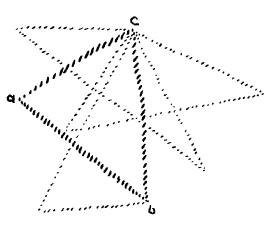
[ 17 ] Diese Seite bewegt sich so, daß sie im nächsten Augenblick diese Lage einnimmt, diese so, daß sie im nächsten Augenblick diese Lage einnimmt. Diese bewegt sich viel langsamer, diese bewegt sich schneller und so weiter. Jetzt kehrt sich die Richtung um
[ 17 ] This page moves in such a way that it assumes this position the next moment, and that one moves in such a way that it assumes this position the next moment. This one moves much more slowly, that one moves faster, and so on. Now the direction reverses
[ 18 ] Kurz, wir begeben uns in die unbequeme Vorstellung hinein, daß wir sagen: Ich will nicht nur ein Dreieck hinzeichnen und es so dann stehen lassen, sondern ich stelle an dein Vorstellen gewisse Anforderungen. Du mußt dir denken, daß die Seiten des Dreiecks fortwährend in Bewegung sind. Wenn sie in Bewegung sind, dann kann ein rechtwinkliges oder ein stumpfwinkliges Dreieck oder jedes andere gleichzeitig aus der Form der Bewegungen hervorgehen.
[ 18 ] In short, we are embracing the uncomfortable mental image that we say: I don’t just want to draw a triangle and leave it at that, but I am placing certain demands on your imagination. You must imagine that the sides of the triangle are in constant motion. If they are in motion, then a right-angled or an obtuse-angled triangle—or any other—can emerge simultaneously from the pattern of the movements.
[ 19 ] Zweierlei kann man machen und auch verlangen auf diesem Gebiete. Das erste, was man verlangen kann, ist, daß man es hübsch bequem hat. Wenn jemand einem ein Dreieck aufzeichnet, dann ist es fertig, und man weiß, wie es aussieht; jetzt kann man hübsch ruhen in seinen Gedanken, denn man hat, was man will. Man kann aber auch das andere machen: das Dreieck gleichsam als einen Ausgangspunkt betrachten und jeder Seite erlauben, daß sie sich mit verschiedenen Geschwindigkeiten und nach verschiedenen Richtungen dreht. In diesem Falle hat man es aber nicht so bequem, sondern man muß in seinen Gedanken Bewegungen ausführen. Aber dafür hat man auch wirklich den allgemeinen Gedanken Dreieck darinnen; et ist ja nur nicht zu erreichen, wenn man bei einem Dreieck abschließen will. Der allgemeine Gedanke Dreieck ist da, wenn man den Gedanken in fortwährender Bewegung hat, wenn er versatil ist.
[ 19 ] There are two things one can do—and also demand—in this area. The first thing one can demand is to have things nice and comfortable. When someone draws a triangle for you, it’s finished, and you know what it looks like; now you can rest easy in your thoughts, because you have what you want. But one can also do the other thing: regard the triangle, as it were, as a starting point and allow each side to rotate at different speeds and in different directions. In this case, however, one is not so comfortable, but must carry out movements in one’s thoughts. But in return, one truly has the general concept of a triangle within it; it is simply unattainable if one wishes to conclude with a single triangle. The general concept of a triangle is present when one keeps the thought in constant motion, when it is versatile.
[ 20 ] Weil die Philosophen das, was ich eben jetzt ausgesprochen habe, den Gedanken in Bewegung zu bringen, nicht gemacht haben, deshalb stehen sie notwendigerweise an einer Grenzscheide und begründen den Nominalismus. Jetzt wollen wir uns das, was ich eben jetzt ausgesprochen habe, in eine uns bekannte Sprache übersetzen, in eine uns längst bekannte Sprache.
[ 20 ] Because philosophers have not done what I have just said—that is, set thought in motion—they necessarily find themselves at a crossroads and end up advocating nominalism. Now let us translate what I have just said into a language familiar to us, a language we have known for a long time.
[ 21 ] Gefordert wird von uns, wenn wir von dem speziellen Gedanken zu dem allgemeinen Gedanken aufsteigen sollen, daß wir den speziellen Gedanken in Bewegung bringen, so daß der bewegte Gedanke der allgemeine Gedanke ist, der von einer Form in die andere hineinschlüpft. Form sage ich; richtig gedacht ist: Das ganze bewegt sich, und jedes einzelne, was da herauskommt durch die Bewegung, ist eine in sich abgeschlossene Form. Früher habe ich nur Einzelformen hingezeichnet, ein spitzwinkliges, ein rechtwinkliges und ein stumpfwinkliges Dreieck. Jetzt zeichne ich etwas auf — ich zeichne es eigentlich nicht auf, das sagte ich schon, aber vorstellen kann man sich das —, was die Vorstellung hervorrufen soll, daß der allgemeine Gedanke in Bewegung ist und die einzelne Form durch sein Stillestehen erzeugt — «die Form erzeugt, sage ich.
[ 21 ] If we are to ascend from the particular thought to the general thought, we are required to set the particular thought in motion, so that the thought in motion is the general thought, which slips from one form into another. I say “form”; the correct way to think of it is: the whole is in motion, and every single thing that emerges from this motion is a self-contained form. Earlier, I drew only individual forms: an acute-angled, a right-angled, and an obtuse-angled triangle. Now I sketch something—I don’t actually sketch it, as I’ve already said, but one can create a mental image of it—that is meant to evoke the idea that the general thought is in motion and produces the individual form through its stillness—“produces the form,” I say.
[ 22 ] Da sehen wir, die Philosophen des Nominalismus, die notwendig an einer Grenzscheide stehen, bewegen sich in einem gewissen Reiche, in dem Reiche der Geister der Form. Innerhalb des Reiches der Geister der Form, das um uns herum ist, herrschen die Formen; und weil die Formen herrschen, sind in diesem Reiche einzelne, streng in sich abgeschlossene Einzeldinge. Daraus ersehen Sie, daß die Philosophen, die ich meine, niemals den Entschluß gefaßt haben, aus dem Reiche der Formen herauszugehen, und daher in den allgemeinen Gedanken nichts anderes haben können als Worte, richtig bloße Worte. Würden sie herausgehen aus dem Reiche der speziellen Dinge, das heißt der Formen, so würden sie in ein Vorstellen hineinkommen, das in fortwährender Bewegung ist, das heißt, sie würden in ihrem Denken eine Vergegenwärtigung des Reiches der Geister der Bewegung haben, der nächsthöheren Hierarchie. Dazu lassen sich aber die meisten Philosophen nicht herbei. Und als sich einmal einer in der letzten Zeit des abendländischen Denkens herbeigelassen hat, so recht in diesem Sinne zu denken, da wurde er wenig verstanden, obwohl viel von ihm gesprochen und gefaselt wird. Man schlage auf, was Goethe in seiner «Metamorphose der Pflanzen» geschrieben hat, was er die «Urpflanze» nannte; man schlage dann das auf, was er das «Urtier» nannte, und man wird finden, daß man mit diesen Begriffen «Urpflanze», «Urtier» nur zurechtkommt, wenn man sie beweglich denkt. Wenn man diese Beweglichkeit aufnimmt, von der Goethe selber spricht, dann hat man nicht einen abgeschlossenen, in seinen Formen begrenzten Begriff, sondern man hat das, was in seinen Formen lebt, was durchkriecht in der ganzen Entwickelung des Tierreiches oder des Pflanzenteiches, was sich in diesem Durchkriechen ebenso verändert, wie das Dreieck sich in ein spitzwinkliges oder ein stumpfwinkliges verändert, und was bald «Wolf» und «Löwe», bald «Käfer» sein kann, je nachdem die Beweglichkeit so eingerichtet ist, daß die Eigenschaften sich abändern in dem Durchgehen durch die Einzelheiten. Goethe brachte die starren Begriffe der Formen in Bewegung. Das war seine große, zentrale Tat. Das war das Bedeutsame, was er in die Naturbetrachtung seiner Zeit eingeführt hat.
[ 22 ] There we see the philosophers of nominalism, who necessarily stand at a crossroads, moving within a certain realm—the realm of the spirits of form. Within the realm of the spirits of form that surrounds us, forms reign; and because forms reign, there are in this realm individual, strictly self-contained particular things. From this you can see that the philosophers I am referring to have never resolved to leave the realm of forms, and therefore can have nothing in general thought but words—merely words, strictly speaking. If they were to step out of the realm of particular things—that is, of forms—they would enter into a mental image that is in constant motion; that is to say, in their thinking they would have a visualization of the realm of the spirits of motion, the next higher hierarchy. But most philosophers do not allow themselves to do this. And when, in the recent history of Western thought, one person did deign to think in this very sense, he was little understood, although much is spoken and rambled about him. One should look up what Goethe wrote in his Metamorphosis of Plants, what he called the “primordial plant”; one should then look up what he called the “primordial animal,” and one will find that one can only make sense of these concepts of “primordial plant” and “primordial animal” if one conceives of them as dynamic. If one embraces this flexibility, of which Goethe himself speaks, then one does not have a closed concept limited in its forms, but rather one has that which lives within its forms, that which creeps through the entire development of the animal kingdom or the plant kingdom, that which changes in this creeping just as the triangle changes into an acute-angled or an obtuse-angled one, and that which can soon be a “wolf” and “lion,” and at other times a “beetle,” depending on how this flexibility is arranged so that the characteristics change as they pass through the particulars. Goethe set the rigid concepts of form in motion. That was his great, central achievement. That was the significant contribution he made to the observation of nature in his time.
[ 23 ] Sie sehen hier an einem Beispiele, wie das, was wir Geisteswissenschaft nennen, tatsächlich dazu geeignet ist, die Menschen aus dem herauszuführen, woran sie notwendig heute haften müssen, selbst wenn sie Philosophen sind. Denn ohne Begriffe, die durch die Geisteswissenschaft gewonnen werden, ist es gar nicht möglich, wenn man ehrlich ist, etwas anderes zuzugeben, als daß die allgemeinen Gedanken bloße Worte seien. Das ist der Grund, warum ich sagte: Die meisten Menschen haben nur keine Gedanken. Und wenn man ihnen von Gedanken spricht, so lehnen sie das ab.
[ 23 ] Here you can see, through an example, how Spiritual Science is in fact capable of leading people out of what they are inevitably bound to today, even if they are philosophers. For without concepts derived from Spiritual Science, it is simply not possible—if one is honest—to admit anything other than that general ideas are mere words. That is why I said: Most people simply have no ideas. And when one speaks to them of ideas, they reject the notion.
[ 24 ] Wann spricht man zu den Menschen von Gedanken? Wenn man zum Beispiel sagt, die Tiere und Pflanzen hätten Gruppenseelen. Ob man sagt allgemeine Gedanken oder Gruppenseelen — wir werden im Laufe der Vorträge sehen, was für eine Beziehung zwischen den beiden ist —, das kommt für das Denken auf dasselbe heraus. Aber die Gruppenseele ist auch nicht anders zu begreifen als dadurch, daß man sie in Bewegung denkt, in fortwährender äußerlicher und innerlicher Bewegung; sonst kommt man nicht zur Gruppenseele. Aber das lehnen die Menschen ab. Daher lehnen sie auch die Gruppenseele ab, lehnen also den allgemeinen Gedanken ab.
[ 24 ] When do we speak of thoughts in relation to human beings? For example, when we say that animals and plants have group souls. Whether we speak of general thoughts or group souls—we will see in the course of these lectures what the relationship between the two is—it amounts to the same thing for our thinking. But the group soul cannot be understood in any other way than by conceiving it as being in motion, in constant external and internal motion; otherwise, one cannot arrive at the group soul. But people reject this. Therefore, they also reject the group soul, and thus reject the general idea.
[ 25 ] Zum Kennenlernen der offenbaren Welt braucht man aber keine Gedanken; da braucht man nur die Erinnerung an das, was man gesehen hat im Reiche der Form. Und das ist das, was die meisten Menschen überhaupt nur wissen: was sie gesehen haben im Reiche der Form. Da bleiben dann die allgemeinen Gedanken bloße Worte. Daher konnte ich sagen: Die meisten Menschen haben keine Gedanken. Denn die allgemeinen Gedanken bleiben für die meisten Menschen nur Worte. Und wenn es unter den mancherlei Geistern der höheren Hierarchien nicht auch den Genius der Sprache geben würde, der die allgemeinen Worte für die allgemeinen Begriffe bildet, die Menschen selber würden das nicht tun. Also richtig aus der Sprache heraus bekommen die Menschen zunächst ihre allgemeinen Gedanken, und sie haben auch nicht viel anderes als die in der Sprache aufbewahrten allgemeinen Gedanken.
[ 25 ] But to get to know the revealed world, one does not need thoughts; one needs only the memory of what one has seen in the realm of form. And that is all most people know at all: what they have seen in the realm of form. General thoughts then remain mere words. That is why I could say: Most people have no thoughts. For general thoughts remain mere words for most people. And if, among the various spirits of the higher hierarchies, there were not also the Genius of Language, who forms the general words for the general concepts, human beings themselves would not do so. Thus, people derive their general thoughts primarily from language, and they have little else besides the general thoughts preserved in language.
[ 26 ] Daraus ersehen wir aber, daß es doch etwas Eigenes sein muß mit dem Denken von wirklichen Gedanken. Daß es etwas ganz Eigentümliches damit sein muß, das können wir uns daraus verständlich machen, daß wir sehen, wie schwer es eigentlich den Menschen wird, auf dem Felde des Gedankens zur Klarheit zu kommen. So im äußeren trivialen Leben wird man vielleicht oftmals behaupten, wenn man ein bißchen renommieren will, das Denken sei leicht. Aber es ist nicht leicht. Denn es erfordert das wirkliche Denken immer ein ganz enges, in gewisser Beziehung unbewußtes Berührtsein von einem Hauch aus dem Reiche der Geister der Bewegung. Würde das Denken so ganz leicht sein, so würden nicht so kolossale Schnitzer auf dem Gebiete des Denkens gemacht werden, und man plagte sich nicht so lange mit allerlei Problemen und Irrtümern herum. So plagt man sich jetzt seit mehr als einem Jahrhundert mit einem Gedanken, den ich schon öfter angeführt habe und den Kart ausgesprochen hat.
[ 26 ] From this, however, we can see that there must be something unique about the act of thinking real thoughts. We can understand that there must be something quite distinctive about it by observing how difficult it actually is for people to achieve clarity in the realm of thought. In everyday trivial life, people may often claim, if they wish to show off a bit, that thinking is easy. But it is not easy. For true thinking always requires a very close, in a certain sense unconscious, contact with a breath from the realm of the spirits of movement. If thinking were so very easy, such colossal blunders would not be made in the realm of thought, and people would not struggle for so long with all manner of problems and errors. Thus, for more than a century now, people have been struggling with a thought that I have cited frequently and that Kart has expressed.
[ 27 ] Kant wollte den sogenannten ontologischen Gottesbeweis aus der Welt schaffen. Dieser ontologische Gottesbeweis stammt auch aus der Zeit des Nominalismus, wo man sagte, daß es für die allgemeinen Begriffe nur Worte gäbe und daß nicht etwas Allgemeines existiere, das den einzelnen Gedanken entsprechen würde wie die einzelnen Gedanken den Vorstellungen. Diesen ontologischen Gottesbeweis will ich als ein Beispiel anführen, wie gedacht wird.
[ 27 ] Kant wanted to do away with the so-called ontological proof of God. This ontological proof of God also originates from the era of nominalism, when it was said that general concepts were merely words and that nothing general existed that corresponded to individual thoughts in the same way that individual thoughts correspond to mental images. I wish to cite this ontological proof of God as an example of how people think.
[ 28 ] Er sagt ungefähr: Wenn man einen Gott annehme, so müsse er das allervollkommenste Wesen sein. Wenn er das allervollkommenste Wesen ist, dann dürfe ihm nicht das Sein fehlen, die Existenz; denn sonst gäbe es ja ein noch vollkommeneres Wesen, das diejenigen Eigenschaften hätte, die man denkt, und das außerdem existieren würde. Also muß man das vollkommenste Wesen so denken, daß es existiere. Man kann also den Gott gar nicht anders denken als existierend, wenn man ihn als allervollkommenstes Wesen denkt. Das heißt, man kann aus dem Begriffe selbst ableiten, daß es nach dem ontologischen Gottesbeweis den Gott geben muß.
[ 28 ] He says, in essence: If one assumes the existence of a God, then he must be the most perfect being. If he is the most perfect being, then he cannot lack being, or existence; for otherwise there would be an even more perfect being who would possess the qualities one conceives of and who, moreover, would exist. Therefore, one must conceive of the most perfect being in such a way that it exists. Thus, one cannot conceive of God as anything other than existing if one conceives of him as the most perfect being. That is to say, one can deduce from the concept itself that, according to the ontological proof of God, God must exist.
[ 29 ] Kant wollte diesen Beweis widerlegen, indem er zu zeigen versuchte, daß man aus einem Begriffe heraus überhaupt nicht die Existenz eines Dinges beweisen kann. Er hat dazu das berühmte Wort geprägt, das ich auch schon öfter angedeutet habe: Hundert wirkliche Taler seien nicht mehr und nicht weniger als hundert mögliche Taler. Das heißt, wenn ein Taler dreihundert Pfennige hat, so müsse man hundert wirkliche Taler zu je dreihundert Pfennigen rechnen, und ebenso müsse man hundert mögliche Taler zu je dreihundert Pfennigen rechnen. Es enthalten also hundert mögliche Taler ebensoviel wie hundert wirkliche Taler; das heißt, es ist kein Unterschied, ob ich hundert wirkliche oder hundert mögliche Taler denke. Daher darf man nicht aus dem bloßen Gedanken des allervollkommensten Wesens die Existenz herausschälen, weil der bloße Gedanke eines möglichen Gottes dieselben Eigenschaften hätte wie der Gedanke eines wirklichen Gottes.
[ 29 ] Kant sought to refute this proof by attempting to show that one cannot prove the existence of a thing at all from a concept. To this end, he coined the famous phrase that I have also alluded to on several occasions: One hundred real thalers are no more and no less than one hundred possible thalers. That is to say, if a thaler is worth three hundred pfennigs, then one must count one hundred real thalers, each worth three hundred pfennigs, and likewise one must count one hundred possible thalers, each worth three hundred pfennigs. Thus, one hundred possible thalers contain just as much as one hundred real thalers; that is to say, there is no difference between thinking of one hundred real thalers or one hundred possible thalers. Therefore, one must not deduce existence from the mere thought of the most perfect being, because the mere thought of a possible God would possess the same properties as the thought of a real God.
[ 30 ] Das erscheint sehr vernünftig. Und seit einem Jahrhundert plagen sich die Menschen herum, wie es mit den hundert möglichen und den hundert wirklichen Talern ist. Nehmen wir aber einen naheliegenden Gesichtspunkt, nämlich den des praktischen Lebens. Kann man von diesem Gesichtspunkte aus sagen, daß hundert wirkliche Taler nicht mehr enthalten als hundert mögliche? Man kann sagen, daß hundert wirkliche Taler just um hundert Taler mehr enthalten als hundert mögliche Taler! Es ist doch ganz klar: Hundert mögliche Taler auf der einen Seite gedacht und hundert wirkliche auf der anderen Seite, das ist ein Unterschied! Es sind auf der anderen Seite gerade hundert Taler mehr. Und auf die hundert wirklichen Taler scheint es doch gerade in den meisten Fällen des Lebens anzukommen.
[ 30 ] That seems very reasonable. And for a century now, people have been struggling with the question of the difference between the hundred possible thalers and the hundred real thalers. But let us consider an obvious perspective, namely that of practical life. From this perspective, can one say that a hundred real thalers contain no more than a hundred possible ones? One can say that a hundred real thalers contain exactly a hundred thalers more than a hundred possible thalers! It is quite clear: a hundred possible thalers on one side and a hundred real ones on the other—that is a difference! There are exactly a hundred more thalers on the other side. And in most cases in life, it seems to come down to those hundred real thalers.
[ 31 ] Aber die Sache hat doch auch einen tieferen Aspekt. Man kann nämlich die Frage stellen: Worauf kommt es denn an bei dem Unterschied von hundert möglichen und hundert wirklichen Talern? Ich denke, es wird jeder zugeben: Für den, der die hundert Taler haben kann, ist zweifellos ein großer Unterschied zwischen hundert möglichen und hundert wirklichen Talern vorhanden. Denn denken Sie sich, Sie brauchen hundert Taler, und jemand stellt Ihnen die Wahl, ob er Ihnen hundert mögliche oder hundert wirkliche Taler geben soll. Wenn Sie sie haben können, scheint es doch auf den Unterschied anzukommen. Aber nehmen Sie an, Sie wären in dem Fall, daß Sie die hundert Taler wirklich nicht haben könnten; dann könnte es sein, daß es für Sie höchst gleichgültig ist, ob Ihnen jemand hundert mögliche oder hundert wirkliche Taler nicht gibt. Wenn man sie nicht haben kann, dann enthalten tatsächlich hundert wirkliche und hundert mögliche Taler ganz gleich viel.
[ 31 ] But there is also a deeper aspect to this matter. One might ask: What really matters when it comes to the difference between a hundred possible thalers and a hundred actual thalers? I think everyone would agree: For someone who can have the hundred thalers, there is undoubtedly a big difference between a hundred possible thalers and a hundred actual thalers. Just imagine: You need a hundred thalers, and someone gives you the choice of whether to give you a hundred possible thalers or a hundred actual thalers. If you can have them, the difference does seem to matter. But suppose you were in a situation where you really could not have the hundred thalers; then it might be that it is of the utmost indifference to you whether someone gives you a hundred possible or a hundred real thalers. If one cannot have them, then a hundred real and a hundred possible thalers actually amount to exactly the same thing.
[ 32 ] Das hat doch eine Bedeutung. Die Bedeutung hat es nämlich, daß so, wie Kant über den Gott gesprochen hat, nur in einer Zeit gesprochen werden konnte, als man durch menschliche Seelenerfahrung den Gott nicht mehr haben konnte. Als er nicht erreichbar war als eine Wirklichkeit, da war der Begriff des möglichen Gottes oder des wirklichen Gottes gerade so einerlei, wie es einerlei ist, ob man hundert wirkliche Taler oder hundert mögliche Taler nicht haben kann. Wenn es für die Seele keinen Weg gibt zu dem wirklichen Gott, dann führt ganz gewiß auch keine Gedankenentwickelung dazu, die im Stile Kants gehalten ist.
[ 32 ] This does have significance. The significance lies in the fact that the way Kant spoke of God could only be done at a time when, through human spiritual experience, God could no longer be attained. Since God was not accessible as a reality, the concept of a possible God or a real God was just as irrelevant as it is irrelevant whether one cannot have a hundred real thalers or a hundred possible thalers. If there is no path for the soul to the real God, then certainly no line of thought in the style of Kant will lead to it either.
[ 33 ] Da sehen Sie, daß die Sache doch auch eine tiefere Seite hat. Ich führe es aber nur an, weil ich dadurch klarmachen wollte, daß, wenn die Frage nach dem Denken kommt, man schon etwas tiefer schürfen muß. Denn Denkfehler schleichen sich durch die erleuchtetsten Geister fort, und man sieht lange nicht ein, worin eigentlich das Brüchige eines solchen Gedankens besteht, wie zum Beispiel des kantischen Gedankens von den hundert möglichen und den hundert wirklichen Talern. Es kommt beim Gedanken auch immer darauf an, daß man die Situation berücksichtigt, in welcher der Gedanke gefaßt wird.
[ 33 ] There you see that the matter does indeed have a deeper side to it. But I mention this only because I wanted to make it clear that, when it comes to the question of thought, one must dig a little deeper. For errors in reasoning creep into even the most enlightened minds, and for a long time one fails to see where the flaw in such a thought actually lies, as in the case of Kant’s idea of the hundred possible and the hundred real thalers. With thought, it always depends on taking into account the situation in which the thought is conceived.
[ 34 ] Aus der Natur des allgemeinen Gedankens zuerst und dann aus dem Dasein eines solchen Denkfehlers wie des kantischen im besonderen versuchte ich Ihnen zu zeigen, daß die Wege des Denkens dennoch nicht so ganz ohne Vertiefung in die Dinge betrachtet werden können. Ich will noch von einer dritten Seite aus mich der Sache nähern.
[ 34 ] First from the nature of general thought, and then from the existence of a specific error in reasoning such as Kant’s, I have attempted to show you that the paths of thought cannot, after all, be considered without delving more deeply into the matters at hand. I would now like to approach the matter from a third perspective.
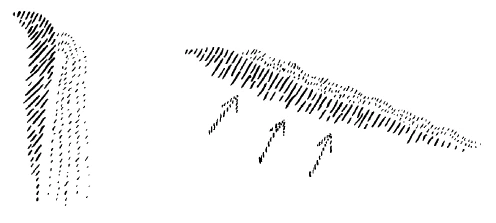
[ 35 ] Nehmen wit einmal an, hier wäre ein Berg oder ein Hügel (siehe Zeichnung) und hier sei ein schroffer Abhang (Zeichnung, links). An diesem schroffen Abhange entspringe eine Quelle; die Quelle stürzt senkrecht wie ein richtiger Wasserfall den Abhang hinunter. Unter den ganz gleichen Verhältnissen wie da sei auf der andern Seite auch eine Quelle. Die will ganz dasselbe wie die erstere; aber sie tut es nicht. Sie kann nämlich nicht als Wasserfall hinunterstürzen, sondern rinnt ganz hübsch in Form eines Baches oder Flusses hinunter. — Hat das Wasser andere Kräfte bei der zweiten Quelle als bei der ersten? Ganz offenbar nicht. Denn die zweite Quelle würde ganz dasselbe tun wie die erste, wenn der Berg sie nicht hinderte und nicht seine Kräfte hinaufschicken würde. Sind die Kräfte, die der Berg hinaufschickt, die Haltekräfte, nicht vorhanden, so wird sie wie die erste Quelle hinunterstürzen. Es kommen also zwei Kräfte in Betracht: die Haltekraft des Berges und die Schwerkraft der Erde, vermöge der die eine Quelle hinunterstürzt. Die ist aber bei der anderen Quelle genau ebenso vorhanden, denn man kann sagen: Sie ist da, ich sehe, wie sie die Quelle herunterzieht. Wenn nun jemand ein Skeptiker wäre, so könnte er dies bei der zweiten Quelle leugnen und sagen: Da sieht man zunächst nichts, während bei der ersten Quelle jedes Wasserstäubchen heruntergezogen wird. Man muß also bei der zweiten Quelle in jedem Punkte hinzufügen die Kraft, welche der Schwerkraft entgegenwirkt, die Haltekraft des Berges.
[ 35 ] Let us suppose there is a mountain or a hill here (see drawing) and a steep slope here (drawing, left). A spring rises from this steep slope; the spring plunges vertically down the slope like a real waterfall. Under exactly the same conditions, let there also be a spring on the other side. It wants to do exactly the same as the first one; but it does not. For it cannot plunge down as a waterfall, but trickles down quite nicely in the form of a stream or river. — Does the water have different forces at the second spring than at the first? Quite obviously not. For the second spring would do exactly the same as the first if the mountain did not hinder it and did not exert its forces upward. If the forces exerted upward by the mountain—the restraining forces—are not present, it will plunge down just like the first spring. So there are two forces to consider: the holding force of the mountain and the gravitational force of the Earth, by virtue of which one spring plunges downward. But this force is just as present at the other spring, for one can say: It is there; I see how it pulls the spring downward. Now, if someone were a skeptic, they might deny this in the case of the second spring and say: At first glance, one sees nothing there, whereas in the case of the first spring, every droplet of water is being pulled down. One must therefore add, at every point in the case of the second spring, the force that counteracts gravity—the holding force of the mountain.
[ 36 ] Nehmen wir nun an, es käme jemand und sagte: Was du mir da von der Schwerkraft erzählst, glaube ich nicht recht, und das, was du mir von deiner Haltekraft sagst, glaube ich dir auch nicht. Ist der Berg dort die Ursache, daß die Quelle jenen Weg nimmt? Ich glaube es nicht. — Nun könnte man diesen fragen: Was glaubst du denn dann? — Er könnte antworten: Ich glaube, da unten ist etwas von dem Wasser; gleich darüber ist ebenso etwas von dem Wasser, darüber wieder und so weiter. Ich glaube, daß das Wasser, welches unten ist, von dem Wasser darüber hinuntergestoßen wird, und dieses obere Wasser wird von dem über ihm hinuntergestoßen. Jede darüberliegende Wasserpartie stößt immer die vordere hinunter. Das ist ein beträchtlicher Unterschied. Der erste Mensch behauptet: Die Schwerkraft zieht die Wassermassen herunter. Der zweite dagegen sagt: Das sind Wasserpartien, die schieben immer die unter ihnen liegenden hinunter, und dadurch geht dann das darüberliegende Wasser hinterher.
[ 36 ] Now suppose someone came along and said: “I don’t really believe what you’re telling me about gravity, and I don’t believe what you’re telling me about your holding force either. Is that mountain over there the reason the spring takes that path? I don’t think so.” — Now one might ask this person: “What do you believe, then?” — He might answer: “I believe there is some water down there; just above it there is also some water, and above that again, and so on. I believe that the water below is pushed down by the water above it, and this upper water is pushed down by the water above it.” Each layer of water above always pushes the one below it down. That is a significant difference. The first person claims: Gravity pulls the masses of water down. The second, on the other hand, says: These are layers of water that always push the ones beneath them down, and as a result, the water above follows.
[ 37 ] Nicht wahr, es wäre ein Mensch recht albern, der von einer solchen Schieberei sprechen würde. Aber nehmen wir an, es handle sich nicht um einen Bach oder einen Strom, sondern um die Geschichte der Menschheit, und es würde ein solcher zuletzt Charakterisierter sagen: Das einzige, was ich dir glaube, ist dies: Jetzt leben wir im 20. Jahrhundert, da haben sich gewisse Ereignisse abgespielt; die sind bewirkt von solchen im letzten Drittel des 19. Jahrhunderts; diese letzteren sind wieder verursacht von denen im zweiten Drittel des 19. Jahrhunderts und diese wieder von denen aus dem ersten Drittel. — Das nennt man pragmatische Geschichtsauffassung, wo man in dem Sinne von Ursachen und Wirkungen spricht, daß man immer aus den betreffenden vorhergehenden Ereignissen die folgenden erklärt. So wie jemand die Schwerkraft leugnen und sagen kann, da schiebe bei den Wasserpartien immer jemand nach, so ist es auch, wenn jemand pragmatische Geschichte treibt und den Zustand im 19. Jahrhundert als eine Folge der Französischen Revolution erklärt. Wir freilich sagen: Nein, es sind noch andere Kräfte da außer denen, die da hinten schieben, die überhaupt gar nicht einmal im richtigen Sinne vorhanden sind. Denn geradesowenig wie jene Kräfte beim Bergstrome dahinten schieben, sowenig schieben die dahinterstehenden Ereignisse in der Geschichte der Menschheit; sondern es kommen immer neue Einflüsse aus der geistigen Welt, wie bei der Quelle die Schwerkraft immerfort wirkt; und mit anderen Kräften kreuzen sie sich, wie sich die Schwerkraft bei dem Strom kreuzt mit der Haltekraft des Berges. Wäre nur die eine Kraft vorhanden, dann würdest du sehen, daß die Geschichte ganz anders verläuft. Aber du siehst nicht die einzelnen Kräfte darin. Du siehst nicht das, was physische Weltentwickelung ist, was beschrieben wurde als Folge der Saturn-, Sonnen-, Mond- und Erdenentwickelung; und du siehst nicht das, was fortwährend mit den Menschenseelen vorgeht, welche die geistige Welt durchleben und wieder herunterkommen, was aus den geistigen Welten immer wieder in diese Entwickelung hereinkommt. Das leugnest du einfach.
[ 37 ] Wouldn’t it be rather silly for anyone to speak of such scheming? But let’s suppose we’re not talking about a stream or a river, but about the history of humanity, and that the person described above were to say: The only thing I believe you is this: We now live in the 20th century, and certain events have taken place; these were brought about by events in the last third of the 19th century; these, in turn, were caused by those in the second third of the 19th century, and those, in turn, by those from the first third. — This is called a pragmatic view of history, where one speaks of causes and effects in the sense that one always explains the subsequent events by referring to the preceding ones. Just as someone might deny gravity and claim that someone is always pushing the water along, so too is it when someone practices pragmatic history and explains the state of affairs in the 19th century as a consequence of the French Revolution. We, however, say: No, there are other forces at work besides those pushing from behind, which do not even exist in the proper sense. For just as those forces do not push the mountain stream from behind, so too do the underlying events in human history not push; rather, new influences are constantly emerging from the spiritual world, just as gravity is always at work at the source; and they intersect with other forces, just as gravity in the stream intersects with the mountain’s holding force. If only that one force were present, then you would see that history unfolds quite differently. But you do not see the individual forces at work there. You do not see what the physical development of the world is, which has been described as the result of the Saturn, Sun, Moon, and Earth evolutions; and you do not see what is constantly happening with human souls as they pass through the spiritual world and return, what continually flows from the spiritual worlds into this evolution. You simply deny this.
[ 38 ] Aber wir haben eine solche Geschichtsauffassung, die sich ausnimmt, wie wenn jemand mit solchen eben charakterisierten Anschauungen kommen würde, und sie ist nicht so besonders selten. Sie wurde sogar im 19. Jahrhundert als ungeheuer geistreich aufgefaßt. Was würden wir aber dazu sagen können von dem eben gewonnenen Gesichtspunkte aus? Wenn jemand von dem Bergstrome dasselbe behauptete wie von der Geschichte, so würde er einen absoluten Unsinn behaupten. Was liegt denn aber da vor, daß er denselben Unsinn behauptet in bezug auf die Geschichte? — Die Geschichte ist so kompliziert, daß man nicht merkt, daß sie als pragmatische Geschichte fast überall so vorgetragen wird; man merkt es nur nicht.
[ 38 ] But we do have a view of history that comes across as if someone were to put forward the very views just described, and it is not particularly rare. It was even regarded as tremendously witty in the 19th century. But what could we say about it from the perspective we have just gained? If someone were to claim the same thing about a mountain stream as they do about history, they would be spouting utter nonsense. But what is it, then, that leads them to spout the same nonsense with regard to history? — History is so complicated that one does not notice that it is presented almost everywhere as pragmatic history; one simply does not notice it.
[ 39 ] Wir sehen daraus, daß allerdings die Geisteswissenschaft, welche für die Auffassung des Lebens gesunde Prinzipien zu gewinnen hat, auf den mannigfaltigen Gebieten des Lebens etwas zu tun hat; daß tatsächlich eine gewisse Notwendigkeit besteht, das Denken erst zu lernen, sich erst bekanntzumachen mit den inneren Gesetzen und Impulsen des Denkens. Sonst kann einem nämlich allerlei Groteskes passieren. So zum Beispiel holpert, stolpert, humpelt einer gerade an dem Problem Denken und Sprache heute daher. Das ist der berühmte Sprachkritiker Fritz Mauthner, der jetzt auch ein großes philosophisches Wörterbuch geschrieben hat. Die dicke Mauthnersche «Kritik der Sprache» hat jetzt schon die zweite Auflage erlebt; es ist also ein berühmtes Buch für unsere Zeitgenossen geworden. Viel Geistreiches ist in diesem Buche enthalten, aber auch schreckliche Dinge. So zum Beispiel kann man darin den kuriosen Denkfehler finden — und man stolpert fast nach jeder fünften Zeile über einen solchen Denkfehler —, daß der gute Mauthner die Nützlichkeit der Logik anzweifelt. Denn für ihn ist Denken überhaupt nur Sprechen, und dann hat es keinen Sinn, Logik zu treiben, dann treibt man nur Grammatik. Aber außerdem sagt er: Da es also eine Logik mit Recht gar nicht geben kann, so sind also die Logiker alle Toren gewesen. Schön. Und dann sagt er: Im gewöhnlichen Leben entstehen ja aus Schlüssen Urteile und aus Urteilen erst Vorstellungen. So machen es die Menschen. Wozu braucht man dann erst eine Logik, wenn die Menschen es so machen, daß sie aus Schlüssen Urteile, aus Urteilen Vorstellungen entstehen lassen? Wozu brauchen wir da eine Logik? — Es ist das ebenso geistreich, als wenn jemand sagte: Wozu braucht man eine Botanik? Im vorigen Jahr und vor zwei Jahren sind noch immer die Pflanzen gewachsen! — Aber solche Logik findet man bei dem, der die Logik verpönt. Es ist ja begreiflich, daß er sie verpönt. Man findet noch viel merkwürdigere Dinge in diesem sonderbaren Buche, das mit Bezug auf das Verhältnis zwischen Denken und Sprechen nicht zur Klarheit, sondern zur Konfusion kommt.
[ 39 ] We can see from this that the Spiritual Science, which must develop sound principles for understanding life, has a role to play in the many diverse areas of life; that there is indeed a certain necessity to first learn how to think, to first familiarize oneself with the inner laws and impulses of thought. Otherwise, all sorts of grotesque things can happen. For example, someone is currently stumbling, tripping, and limping his way through the problem of thought and language today. This is the famous language critic Fritz Mauthner, who has now also written a major philosophical dictionary. Mauthner’s thick “Critique of Language” has already reached its second edition; it has thus become a famous book for our contemporaries. There is much that is witty in this book, but also terrible things. For example, one can find in it the curious error in reasoning—and one stumbles upon such an error almost every fifth line—that good old Mauthner doubts the usefulness of logic. For him, thinking is nothing but speaking, and so there is no point in practicing logic; one is merely practicing grammar. But he also says: Since logic, by definition, cannot exist at all, then all logicians have been fools. Fine. And then he says: In ordinary life, judgments arise from inferences, and from judgments come mental images. That is how people do it. Why, then, do we need logic at all, if people do it in such a way that they let judgments arise from inferences, and mental images from judgments? Why do we need logic there? — It is just as witty as if someone were to say: Why do we need botany? Last year and the year before, plants were still growing! — But such logic is found in those who disparage logic. It is, of course, understandable that they disparage it. One finds even stranger things in this peculiar book, which, with regard to the relationship between thought and speech, leads not to clarity but to confusion.
[ 40 ] Ich sagte, daß wir einen Unterbau brauchen für die Dinge, die uns allerdings zu den Höhen geistiger Betrachtung führen sollen. Ein Unterbau, wie er heute ausgeführt worden ist, mag manchem etwas abstrakt erscheinen; aber wir werden ihn brauchen. Und ich denke, ich versuche die Sache doch so leicht zu machen, daß durchsichtig sein kann, worauf es ankommt. Besonders möchte ich Wert darauf legen, daß man schon durch solche einfachen Betrachtungen einen Begriff davon bekommen kann, wo die Grenze liegt zwischen dem Reiche der Geister der Form und dem Reiche der Geister der Bewegung. Daß man aber einen solchen Begriff bekommt, hängt innig damit zusammen, ob man überhaupt allgemeine Gedanken zugeben darf oder ob man nur Vorstellungen oder Begriffe von einzelnen Dingen zugeben darf. Ich sage ausdrücklich: zugeben darf.
[ 40 ] I said that we need a foundation for the things that are, after all, meant to lead us to the heights of spiritual contemplation. A foundation such as the one presented today may seem somewhat abstract to some; but we will need it. And I think I am trying to make the matter as clear as possible so that it becomes evident what is at stake. In particular, I would like to emphasize that even through such simple considerations, one can gain an understanding of where the boundary lies between the realm of the spirits of form and the realm of the spirits of movement. However, whether one can gain such an understanding is intimately connected with whether one is permitted to acknowledge general ideas at all, or whether one is permitted to acknowledge only mental images or concepts of individual things. I say explicitly: permitted to acknowledge.
[ 41 ] Auf diese Voraussetzungen, zu denen ich, weil sie etwas abstrakt sind, nichts weiter hinzufüge, wollen wir morgen weiter aufbauen.
[ 41 ] We will build on these premises tomorrow; since they are somewhat abstract, I will say no more about them at this time.