

Human and Cosmic Thought
GA 151
20 January 1914, Berlin
Translated by Steiner Online Library
First Lecture
[ 1 ] In these four lectures that I will be giving to you during our General Assembly, I would like to discuss the relationship between humanity and the universe from a particular perspective. And I would like to hint at this perspective with the following words.
[ 2 ] Human beings experience within themselves what we might call “thought,” and in thought, human beings can sense themselves as something directly active, as something capable of surveying its own activity. When we look at any external object, for example a rose or a stone, and we create a mental image of the object, one can rightly say: You can never really know how much of the object, of the plant, you actually have in the stone or in the rose when you create a mental image of it. You see the rose, its outer redness, its shape, how it is divided into individual petals; you see the stone with its color, with its various corners, but you must always tell yourself: There may still be something inside that does not appear to you on the outside. You do not know how much of the stone, of the rose, you actually have in your mental image.
[ 3 ] But when someone has a thought, it is he himself who creates that thought. One might say that he is present in every fiber of that thought of his. Therefore, he is a participant in the activity of the entire thought. He knows: What is in the thought, I have put into the thought in that way, and what I have not put into the thought cannot be in it either. I have a clear grasp of the thought. No one can claim that when I create a mental image, there could be so many other things in it as there are in a rose or a stone; for I myself have generated the thought, am present within it, and thus know what is inside.
[ 4 ] Truly, thought is our most essential being. If we discover the relationship of thought to the cosmos, to the universe, then we discover the relationship of our most essential being to the cosmos, to the universe. This can assure us that it is indeed a fruitful approach to consider the relationship of the human being to the universe from the perspective of thought. We shall therefore undertake this examination, and it will lead us to significant heights of anthroposophical contemplation. But today we will have to lay a foundation that may seem somewhat abstract to some of you. But in the coming days we will see that we need this foundation and that without it we can only approach the lofty goals we are striving for in these four lectures with a certain superficiality. What has just been said, therefore, promises us that if the human being holds fast to what he has in thought, he can find an intimate relationship of his being to the universe, to the cosmos.
[ 5 ] But there is a problem with this approach—a major one, in fact. I don’t mean for our consideration, but for the objective facts, there is a major difficulty. And this difficulty lies in the fact that, while it is true that one lives within every fiber of a thought and therefore, if one has it, must know that thought more intimately than any other mental image; but, yes, but—most people have no thoughts! And this is usually not thought through with all due thoroughness—that most people have no thoughts. The reason it is not thought through with all due thoroughness is that one would need—precisely—thoughts to do so! One thing must first be pointed out. What prevents people, in the broadest sphere of our lives, from having thoughts is that, for the ordinary purposes of life, people do not always feel the need to really penetrate to the thought itself, but instead of the thought, they content themselves with the word. Most of what is called thinking in ordinary life takes place in words. People think in words. Much more than one realizes, people think in words. And many people, when they ask for an explanation of this or that, are satisfied with being told some word that has a familiar sound to them, that reminds them of this or that; and then they regard what they feel upon hearing such a word as an explanation and believe they have arrived at the thought.
[ 6 ] Yes, what I have just said led, at a certain point in the development of human spiritual life, to the emergence of a view that is still shared today by many people who call themselves thinkers. In the new edition of my Worldviews and Life Views in the Nineteenth Century, I attempted to thoroughly restructure this book by prefacing it with a history of the development of Western thought, beginning in the 6th century B.C. and extending up to the 19th century, and by then adding, at the end, to what was already there when the book first appeared, a description of, let us say, intellectual and spiritual life right up to the present day. The content that was already there has also been extensively revised. There I had to show how thought actually first arises in a particular age. It truly arises, one might say, only around the 6th or 8th century B.C.E. Before that, human souls did not experience at all what can be called thought in the proper sense of the word. What did human souls experience before that? They experienced images. And all experience of the external world took place in images. From certain points of view, I have often said this. This experience of images is the final phase of the old clairvoyant experience. Then, for the human soul, the image gives way to thought.
[ 7 ] My intention in this book is to demonstrate this outcome of Spiritual Science purely through an examination of the development of philosophy. Remaining entirely within the realm of philosophical science, it is shown that the idea was first born in ancient Greece, that it arises by leaping out of the ancient symbolic experience of the external world into the experience of the human soul. I then attempted to show how this idea continues in Socrates, Plato, and Aristotle, how it takes on certain forms, how it develops further, and how it leads in the Middle Ages to what I now wish to mention.
[ 8 ] This line of thought—the question of whether there can be such a thing in the world as what we call general ideas or general concepts—leads to so-called nominalism, the philosophical view that general concepts can be nothing more than names, that is, nothing but words. Thus, there was even a philosophical view regarding this general idea—and many still hold it today—that these general ideas can be nothing more than words.
[ 9 ] To illustrate what has just been said, let us take a simple and general concept; let us take the concept of “triangle” as a general concept. Now, someone who approaches this from a nominalist standpoint—someone who cannot escape what developed as nominalism in this regard during the 11th to 13th centuries—might say something like this: Draw me a triangle! — All right, I will draw him a triangle, for example, one like this:
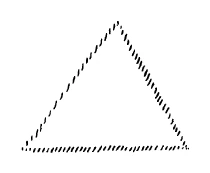
[ 10 ] “Fine,” he says, “that's a special kind of triangle with three acute angles—it exists. But I'll draw you another one.”—And he draws a triangle with a right angle, and one with what's called an obtuse angle.
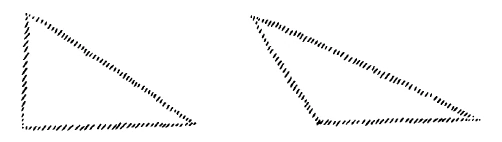
[ 11 ] So, let’s call the first one an acute-angled triangle, the second a right-angled triangle, and the third an obtuse-angled triangle. The person in question says: I believe you; there is an acute-angled, a right-angled, and an obtuse-angled triangle. But all of that is not the triangle. The general concept of the triangle must include everything that a triangle can include. The first, second, and third triangles must fall under the general concept of the triangle. But a triangle that is acute-angled cannot be both right-angled and obtuse-angled at the same time. An acute-angled triangle is a specific one, not a general triangle; likewise, a right-angled and an obtuse-angled triangle are specific ones. But there cannot be a general triangle. Thus, the general triangle is a word that summarizes the specific triangles. But the general concept of the triangle does not exist. It is a word that summarizes the particulars.
[ 12 ] Of course, this goes further. Let’s suppose someone utters the word “lion.” Now, the person who holds the nominalist position says: There is a lion in Berlin’s Tiergarten, there is also a lion in Hanover’s Tiergarten, and there is one in Munich’s Tiergarten as well. The individual lions exist; but there is no such thing as a general “lion” that has anything to do with the lions in Berlin, Hanover, and Munich. It is merely a word that summarizes the individual lions. There are only individual things, and apart from the individual things, says the nominalist, there is nothing but words that summarize the individual things.
[ 13 ] This view, as I said, has gained traction; it is still held today by astute logicians. And anyone who gives the matter just discussed a little thought will ultimately have to admit: there is indeed something special at work here; I cannot readily determine whether this “lion in general” and the “triangle in general” actually exist, for I do not really see it. If someone were to come along and say: Look here, my dear friend, I cannot accept that you show me the Munich, Hanover, or Berlin lion. If you claim that the lion “in general” exists, then you must lead me somewhere where the “lion in general” exists. But if you show me the Munich, Hanover, and Berlin lions, you have not proven to me that the “lion in general” exists. — If someone were to come along who held this view, and one were to show him the “lion in general,” one would initially be somewhat at a loss. It is not so easy to answer the question of where one should take the person in question to whom one is to show the “lion in general.”
[ 14 ] Well, let’s not turn to what Spiritual Science has to offer just yet; that will come in due time. Let’s stick to thinking for now, let’s stick to what can be achieved through thinking, and we will have to admit: If we wish to remain on this ground, it simply does not work to lead any skeptic to the “Lion in general.” That really does not work. Herein lies one of the difficulties that one must simply admit. For if one does not wish to admit this difficulty in the realm of ordinary thinking, then one is simply not engaging with the difficulty of human thinking at all.
[ 15 ] Let us stick with the triangle; after all, it makes no difference to the general issue whether we illustrate the concept using a triangle, a lion, or something else. At first glance, it seems hopeless to try to draw a general triangle that encompasses all properties, all triangles. And because it not only seems hopeless but is so for ordinary human thinking, all external philosophy stands here at a watershed, and its task would be to truly admit to itself that, as external philosophy, it stands at a watershed. But this watershed is precisely that of external philosophy alone. There is, however, a way to cross this threshold, and let us now familiarize ourselves with this possibility.
[ 16 ] Let’s imagine that we don’t just draw the triangle in such a way that we say: “Now I’ve drawn a triangle for you, and there it is.” — Someone will always be able to object: “That’s just an acute-angled triangle; it’s not a general triangle.” After all, one can also draw the triangle differently. Actually, one cannot; but we will see in a moment how this ability and inability relate to one another. Let us assume that we draw this triangle we have here in such a way that we allow each individual side to move in any direction it wishes. And we allow it to move at different speeds (speaking while drawing on the board):
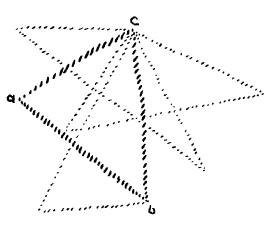
[ 17 ] This page moves in such a way that it assumes this position the next moment, and that one moves in such a way that it assumes this position the next moment. This one moves much more slowly, that one moves faster, and so on. Now the direction reverses
[ 18 ] In short, we are embracing the uncomfortable mental image that we say: I don’t just want to draw a triangle and leave it at that, but I am placing certain demands on your imagination. You must imagine that the sides of the triangle are in constant motion. If they are in motion, then a right-angled or an obtuse-angled triangle—or any other—can emerge simultaneously from the pattern of the movements.
[ 19 ] There are two things one can do—and also demand—in this area. The first thing one can demand is to have things nice and comfortable. When someone draws a triangle for you, it’s finished, and you know what it looks like; now you can rest easy in your thoughts, because you have what you want. But one can also do the other thing: regard the triangle, as it were, as a starting point and allow each side to rotate at different speeds and in different directions. In this case, however, one is not so comfortable, but must carry out movements in one’s thoughts. But in return, one truly has the general concept of a triangle within it; it is simply unattainable if one wishes to conclude with a single triangle. The general concept of a triangle is present when one keeps the thought in constant motion, when it is versatile.
[ 20 ] Because philosophers have not done what I have just said—that is, set thought in motion—they necessarily find themselves at a crossroads and end up advocating nominalism. Now let us translate what I have just said into a language familiar to us, a language we have known for a long time.
[ 21 ] If we are to ascend from the particular thought to the general thought, we are required to set the particular thought in motion, so that the thought in motion is the general thought, which slips from one form into another. I say “form”; the correct way to think of it is: the whole is in motion, and every single thing that emerges from this motion is a self-contained form. Earlier, I drew only individual forms: an acute-angled, a right-angled, and an obtuse-angled triangle. Now I sketch something—I don’t actually sketch it, as I’ve already said, but one can create a mental image of it—that is meant to evoke the idea that the general thought is in motion and produces the individual form through its stillness—“produces the form,” I say.
[ 22 ] There we see the philosophers of nominalism, who necessarily stand at a crossroads, moving within a certain realm—the realm of the spirits of form. Within the realm of the spirits of form that surrounds us, forms reign; and because forms reign, there are in this realm individual, strictly self-contained particular things. From this you can see that the philosophers I am referring to have never resolved to leave the realm of forms, and therefore can have nothing in general thought but words—merely words, strictly speaking. If they were to step out of the realm of particular things—that is, of forms—they would enter into a mental image that is in constant motion; that is to say, in their thinking they would have a visualization of the realm of the spirits of motion, the next higher hierarchy. But most philosophers do not allow themselves to do this. And when, in the recent history of Western thought, one person did deign to think in this very sense, he was little understood, although much is spoken and rambled about him. One should look up what Goethe wrote in his Metamorphosis of Plants, what he called the “primordial plant”; one should then look up what he called the “primordial animal,” and one will find that one can only make sense of these concepts of “primordial plant” and “primordial animal” if one conceives of them as dynamic. If one embraces this flexibility, of which Goethe himself speaks, then one does not have a closed concept limited in its forms, but rather one has that which lives within its forms, that which creeps through the entire development of the animal kingdom or the plant kingdom, that which changes in this creeping just as the triangle changes into an acute-angled or an obtuse-angled one, and that which can soon be a “wolf” and “lion,” and at other times a “beetle,” depending on how this flexibility is arranged so that the characteristics change as they pass through the particulars. Goethe set the rigid concepts of form in motion. That was his great, central achievement. That was the significant contribution he made to the observation of nature in his time.
[ 23 ] Here you can see, through an example, how Spiritual Science is in fact capable of leading people out of what they are inevitably bound to today, even if they are philosophers. For without concepts derived from Spiritual Science, it is simply not possible—if one is honest—to admit anything other than that general ideas are mere words. That is why I said: Most people simply have no ideas. And when one speaks to them of ideas, they reject the notion.
[ 24 ] When do we speak of thoughts in relation to human beings? For example, when we say that animals and plants have group souls. Whether we speak of general thoughts or group souls—we will see in the course of these lectures what the relationship between the two is—it amounts to the same thing for our thinking. But the group soul cannot be understood in any other way than by conceiving it as being in motion, in constant external and internal motion; otherwise, one cannot arrive at the group soul. But people reject this. Therefore, they also reject the group soul, and thus reject the general idea.
[ 25 ] But to get to know the revealed world, one does not need thoughts; one needs only the memory of what one has seen in the realm of form. And that is all most people know at all: what they have seen in the realm of form. General thoughts then remain mere words. That is why I could say: Most people have no thoughts. For general thoughts remain mere words for most people. And if, among the various spirits of the higher hierarchies, there were not also the Genius of Language, who forms the general words for the general concepts, human beings themselves would not do so. Thus, people derive their general thoughts primarily from language, and they have little else besides the general thoughts preserved in language.
[ 26 ] From this, however, we can see that there must be something unique about the act of thinking real thoughts. We can understand that there must be something quite distinctive about it by observing how difficult it actually is for people to achieve clarity in the realm of thought. In everyday trivial life, people may often claim, if they wish to show off a bit, that thinking is easy. But it is not easy. For true thinking always requires a very close, in a certain sense unconscious, contact with a breath from the realm of the spirits of movement. If thinking were so very easy, such colossal blunders would not be made in the realm of thought, and people would not struggle for so long with all manner of problems and errors. Thus, for more than a century now, people have been struggling with a thought that I have cited frequently and that Kart has expressed.
[ 27 ] Kant wanted to do away with the so-called ontological proof of God. This ontological proof of God also originates from the era of nominalism, when it was said that general concepts were merely words and that nothing general existed that corresponded to individual thoughts in the same way that individual thoughts correspond to mental images. I wish to cite this ontological proof of God as an example of how people think.
[ 28 ] He says, in essence: If one assumes the existence of a God, then he must be the most perfect being. If he is the most perfect being, then he cannot lack being, or existence; for otherwise there would be an even more perfect being who would possess the qualities one conceives of and who, moreover, would exist. Therefore, one must conceive of the most perfect being in such a way that it exists. Thus, one cannot conceive of God as anything other than existing if one conceives of him as the most perfect being. That is to say, one can deduce from the concept itself that, according to the ontological proof of God, God must exist.
[ 29 ] Kant sought to refute this proof by attempting to show that one cannot prove the existence of a thing at all from a concept. To this end, he coined the famous phrase that I have also alluded to on several occasions: One hundred real thalers are no more and no less than one hundred possible thalers. That is to say, if a thaler is worth three hundred pfennigs, then one must count one hundred real thalers, each worth three hundred pfennigs, and likewise one must count one hundred possible thalers, each worth three hundred pfennigs. Thus, one hundred possible thalers contain just as much as one hundred real thalers; that is to say, there is no difference between thinking of one hundred real thalers or one hundred possible thalers. Therefore, one must not deduce existence from the mere thought of the most perfect being, because the mere thought of a possible God would possess the same properties as the thought of a real God.
[ 30 ] That seems very reasonable. And for a century now, people have been struggling with the question of the difference between the hundred possible thalers and the hundred real thalers. But let us consider an obvious perspective, namely that of practical life. From this perspective, can one say that a hundred real thalers contain no more than a hundred possible ones? One can say that a hundred real thalers contain exactly a hundred thalers more than a hundred possible thalers! It is quite clear: a hundred possible thalers on one side and a hundred real ones on the other—that is a difference! There are exactly a hundred more thalers on the other side. And in most cases in life, it seems to come down to those hundred real thalers.
[ 31 ] But there is also a deeper aspect to this matter. One might ask: What really matters when it comes to the difference between a hundred possible thalers and a hundred actual thalers? I think everyone would agree: For someone who can have the hundred thalers, there is undoubtedly a big difference between a hundred possible thalers and a hundred actual thalers. Just imagine: You need a hundred thalers, and someone gives you the choice of whether to give you a hundred possible thalers or a hundred actual thalers. If you can have them, the difference does seem to matter. But suppose you were in a situation where you really could not have the hundred thalers; then it might be that it is of the utmost indifference to you whether someone gives you a hundred possible or a hundred real thalers. If one cannot have them, then a hundred real and a hundred possible thalers actually amount to exactly the same thing.
[ 32 ] This does have significance. The significance lies in the fact that the way Kant spoke of God could only be done at a time when, through human spiritual experience, God could no longer be attained. Since God was not accessible as a reality, the concept of a possible God or a real God was just as irrelevant as it is irrelevant whether one cannot have a hundred real thalers or a hundred possible thalers. If there is no path for the soul to the real God, then certainly no line of thought in the style of Kant will lead to it either.
[ 33 ] There you see that the matter does indeed have a deeper side to it. But I mention this only because I wanted to make it clear that, when it comes to the question of thought, one must dig a little deeper. For errors in reasoning creep into even the most enlightened minds, and for a long time one fails to see where the flaw in such a thought actually lies, as in the case of Kant’s idea of the hundred possible and the hundred real thalers. With thought, it always depends on taking into account the situation in which the thought is conceived.
[ 34 ] First from the nature of general thought, and then from the existence of a specific error in reasoning such as Kant’s, I have attempted to show you that the paths of thought cannot, after all, be considered without delving more deeply into the matters at hand. I would now like to approach the matter from a third perspective.
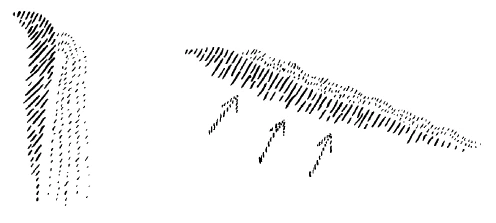
[ 35 ] Let us suppose there is a mountain or a hill here (see drawing) and a steep slope here (drawing, left). A spring rises from this steep slope; the spring plunges vertically down the slope like a real waterfall. Under exactly the same conditions, let there also be a spring on the other side. It wants to do exactly the same as the first one; but it does not. For it cannot plunge down as a waterfall, but trickles down quite nicely in the form of a stream or river. — Does the water have different forces at the second spring than at the first? Quite obviously not. For the second spring would do exactly the same as the first if the mountain did not hinder it and did not exert its forces upward. If the forces exerted upward by the mountain—the restraining forces—are not present, it will plunge down just like the first spring. So there are two forces to consider: the holding force of the mountain and the gravitational force of the Earth, by virtue of which one spring plunges downward. But this force is just as present at the other spring, for one can say: It is there; I see how it pulls the spring downward. Now, if someone were a skeptic, they might deny this in the case of the second spring and say: At first glance, one sees nothing there, whereas in the case of the first spring, every droplet of water is being pulled down. One must therefore add, at every point in the case of the second spring, the force that counteracts gravity—the holding force of the mountain.
[ 36 ] Now suppose someone came along and said: “I don’t really believe what you’re telling me about gravity, and I don’t believe what you’re telling me about your holding force either. Is that mountain over there the reason the spring takes that path? I don’t think so.” — Now one might ask this person: “What do you believe, then?” — He might answer: “I believe there is some water down there; just above it there is also some water, and above that again, and so on. I believe that the water below is pushed down by the water above it, and this upper water is pushed down by the water above it.” Each layer of water above always pushes the one below it down. That is a significant difference. The first person claims: Gravity pulls the masses of water down. The second, on the other hand, says: These are layers of water that always push the ones beneath them down, and as a result, the water above follows.
[ 37 ] Wouldn’t it be rather silly for anyone to speak of such scheming? But let’s suppose we’re not talking about a stream or a river, but about the history of humanity, and that the person described above were to say: The only thing I believe you is this: We now live in the 20th century, and certain events have taken place; these were brought about by events in the last third of the 19th century; these, in turn, were caused by those in the second third of the 19th century, and those, in turn, by those from the first third. — This is called a pragmatic view of history, where one speaks of causes and effects in the sense that one always explains the subsequent events by referring to the preceding ones. Just as someone might deny gravity and claim that someone is always pushing the water along, so too is it when someone practices pragmatic history and explains the state of affairs in the 19th century as a consequence of the French Revolution. We, however, say: No, there are other forces at work besides those pushing from behind, which do not even exist in the proper sense. For just as those forces do not push the mountain stream from behind, so too do the underlying events in human history not push; rather, new influences are constantly emerging from the spiritual world, just as gravity is always at work at the source; and they intersect with other forces, just as gravity in the stream intersects with the mountain’s holding force. If only that one force were present, then you would see that history unfolds quite differently. But you do not see the individual forces at work there. You do not see what the physical development of the world is, which has been described as the result of the Saturn, Sun, Moon, and Earth evolutions; and you do not see what is constantly happening with human souls as they pass through the spiritual world and return, what continually flows from the spiritual worlds into this evolution. You simply deny this.
[ 38 ] But we do have a view of history that comes across as if someone were to put forward the very views just described, and it is not particularly rare. It was even regarded as tremendously witty in the 19th century. But what could we say about it from the perspective we have just gained? If someone were to claim the same thing about a mountain stream as they do about history, they would be spouting utter nonsense. But what is it, then, that leads them to spout the same nonsense with regard to history? — History is so complicated that one does not notice that it is presented almost everywhere as pragmatic history; one simply does not notice it.
[ 39 ] We can see from this that the Spiritual Science, which must develop sound principles for understanding life, has a role to play in the many diverse areas of life; that there is indeed a certain necessity to first learn how to think, to first familiarize oneself with the inner laws and impulses of thought. Otherwise, all sorts of grotesque things can happen. For example, someone is currently stumbling, tripping, and limping his way through the problem of thought and language today. This is the famous language critic Fritz Mauthner, who has now also written a major philosophical dictionary. Mauthner’s thick “Critique of Language” has already reached its second edition; it has thus become a famous book for our contemporaries. There is much that is witty in this book, but also terrible things. For example, one can find in it the curious error in reasoning—and one stumbles upon such an error almost every fifth line—that good old Mauthner doubts the usefulness of logic. For him, thinking is nothing but speaking, and so there is no point in practicing logic; one is merely practicing grammar. But he also says: Since logic, by definition, cannot exist at all, then all logicians have been fools. Fine. And then he says: In ordinary life, judgments arise from inferences, and from judgments come mental images. That is how people do it. Why, then, do we need logic at all, if people do it in such a way that they let judgments arise from inferences, and mental images from judgments? Why do we need logic there? — It is just as witty as if someone were to say: Why do we need botany? Last year and the year before, plants were still growing! — But such logic is found in those who disparage logic. It is, of course, understandable that they disparage it. One finds even stranger things in this peculiar book, which, with regard to the relationship between thought and speech, leads not to clarity but to confusion.
[ 40 ] I said that we need a foundation for the things that are, after all, meant to lead us to the heights of spiritual contemplation. A foundation such as the one presented today may seem somewhat abstract to some; but we will need it. And I think I am trying to make the matter as clear as possible so that it becomes evident what is at stake. In particular, I would like to emphasize that even through such simple considerations, one can gain an understanding of where the boundary lies between the realm of the spirits of form and the realm of the spirits of movement. However, whether one can gain such an understanding is intimately connected with whether one is permitted to acknowledge general ideas at all, or whether one is permitted to acknowledge only mental images or concepts of individual things. I say explicitly: permitted to acknowledge.
[ 41 ] We will build on these premises tomorrow; since they are somewhat abstract, I will say no more about them at this time.