

Human and Cosmic Thought
GA 151
21 January 1914, Berlin
Translated by Steiner Online Library
Second Lecture
[ 1 ] Essentially, engaging with spiritual science requires a parallel, ongoing practical life of spiritual activity. It is actually impossible to achieve complete clarity regarding the various matters discussed yesterday unless one attempts to come to terms with them through a kind of living grasp of the activities of spiritual life, particularly intellectual life as well. For why is it the case in intellectual life that, for example, there is a lack of clarity regarding the relationship between general concepts—the triangle in general—and the specific conceptions of individual triangles among people who, by profession, engage with these matters intellectually? Where, then, do such things come from that have occupied entire centuries, such as the example cited yesterday regarding the hundred possible and the hundred actual Kantian talers? Why is it that one does not engage in the simplest of reflections, which would be necessary to realize that there cannot be such a thing as a pragmatic historiography, according to which the subsequent always derives from the preceding? Why is it that such a consideration is not made, one that would make one suspicious regarding what has spread in the widest circles as an impossible way of conceiving human history? Where do all these things come from?
[ 2 ] They stem from the fact that, even where it should be done, far too little effort is made to learn how to handle the tasks of intellectual life in a precise manner. In our time, everyone wants to be able to claim at least the following with good reason; they want to be able to say: Thinking—well, of course, anyone can do that. So one begins to think. There are worldviews in the world. Many, many philosophers have existed. One notices that one said this, another that. Now, the fact that these were also reasonably intelligent people who could have been aware of many things—which one oneself finds contradictory in them—is something one does not reflect upon, something one does not think about further. But one takes all the more credit for the fact that one can “think” after all. So one can ponder what those people thought, and is convinced that one will find the right answer oneself. For today one must not place any value on authority! That contradicts the dignity of human nature. One must think for oneself. In the realm of thought, one holds firmly to this view.
[ 3 ] I don’t know if people have considered that they don’t act this way in any other area of life. For example, no one feels that they are succumbing to a belief in authority or a craving for authority when they have their coat made by a tailor or their shoes by a shoemaker. They don’t say: It is beneath human dignity to have things made by people whom one knows are capable of handling those particular tasks. Indeed, one might even admit that one must learn these things. When it comes to thinking, however, one does not admit in practical life that one must also derive one’s worldviews from the very places where one has learned to think and many other things. Today, one will truly admit this only in the rarest of cases.
[ 4 ] This is something that dominates our lives in the broadest sense, something that actually contributes to the fact that human thought is not a very common phenomenon in our time. I think one could well find that understandable. For suppose everyone were to say one day: Learning to make boots is no longer a dignified pursuit; let’s all just make boots—I don’t know if that would result in nothing but good boots. But in any case, when it comes to shaping correct thoughts in one’s worldview, people today mostly proceed from this perspective. That is one factor contributing to the fact that the statement I made yesterday already has a deeper meaning: that while thought is indeed that in which the human being is, so to speak, completely immersed and which he can therefore survey within his inner being, thought is not as widespread as one might think. Added to this, however, is a very particular pretension in our time that could gradually lead to obscuring any clarity regarding thought altogether. This, too, must be addressed. One must at least turn one’s gaze toward it.
[ 5 ] Let’s assume the following: There was a shoemaker in Görlitz named Jakob Böhme. And this shoemaker named Jakob Böhme would have learned the shoemaking trade, would have learned well how to cut soles, how to shape the shoe over the last, how to drive nails into soles and leather, and so on. He would have known and mastered all of this from the ground up. Now this shoemaker named Jakob Böhme would have come along and said: Now I want to see how the world is constructed. Well, I suppose the world is based on a large last. The world’s leather was pulled over this last. Then the world’s nails were taken, and the world’s sole was fastened to the world’s leather covering with world’s nails. Then the world’s shoe polish was taken and the whole world’s shoe was polished. That is how I can explain why it gets light in the morning. That is simply the world’s shoe polish shining. And when this world’s shoe polish is smothered in the evening by all sorts of things, it no longer shines. Therefore, I imagine that someone is busy at night re-polishing the world’s boot. And that is how the difference between day and night arises. :
[ 6 ] Let’s suppose Jakob Böhme had said this. Yes, you’re laughing because Jakob Böhme certainly didn’t say this; instead, he made decent shoes for the citizens of Görlitz, using his skill as a shoemaker. But he also developed his magnificent ideas, through which he sought to build a worldview. So he turned to something else. He told himself: My thoughts on shoemaking would not suffice here; for if I am to have thoughts about the world, I must not apply the thoughts through which I make shoes for people to the structure of the world. And he arrived at his sublime thoughts about the world. So that Jakob Böhme whom I first constructed in the hypothesis did not exist in Görlitz, but rather that other one who knew how to do it.
[ 7 ] But those hypothetical Jakob Böhmes—people like the one you laughed at—are everywhere today. For example, there are physicists and chemists. They have learned the laws governing how substances in the world are combined and separated. There are zoologists who have learned how to study and describe animals. There are physicians who have learned how to treat the physical human body and what they call the soul. What do they do? They say: If one wants to seek a worldview, one takes the laws one has learned in chemistry, physics, or physiology—as if there were no others—and from these one constructs a worldview. These people do exactly the same thing as the hypothetically constructed shoemaker would have done if he had constructed the world boot. Only today one does not realize that, methodologically, worldviews come about in exactly the same way as that hypothetical world boot. It does look somewhat grotesque, however, when one imagines the difference between day and night through the wear and tear of the shoe leather and through masturbation at night. But in principle, from a true logical standpoint, it is exactly the same as when one attempts to construct a worldview using the laws of chemistry, physics, biology, and physiology. Exactly the same principle! It is the immense arrogance of the physicist, the chemist, the physiologist, and the biologist—who want to be nothing other than physicists, chemists, physiologists, and biologists, and yet still wish to pass judgment on the entire world.
[ 8 ] The point is simply that one must get to the bottom of things and not shy away from shedding a little light on them by reducing what is not so transparent to its true form. So if one considers all this methodically and logically, it is no surprise that so many contemporary attempts at a worldview yield nothing other than the “world boot.” And this is something that can point to engagement with spiritual science and with practical acts of thinking—which can incline one to consider how one must think in order to see through where inadequacies exist in the world.
[ 9 ] I would like to cite another example to show where the root of countless misunderstandings regarding worldviews lies. When one engages with worldviews, does one not repeatedly find that one person believes this, another that; one defends one thing—sometimes with good reasons, for good reasons can be found for everything—while another defends the other with equally good reasons; and one refutes one thing just as well as the other refutes it with good reasons? After all, allegiances in the world do not initially arise because one or the other is justly convinced by what is taught here or there. Just consider the paths that the disciples of great men must walk in order to reach this or that great man, and you will see that while there is certainly something significant for us in this with regard to karma, as far as the views existing in the outer world today are concerned, one must say: Whether one becomes a Bergsonian or a Haeckelian or this or that—as I said, karma does not recognize today’s external worldview—ultimately depends on factors other than the fact that one adheres, through the deepest conviction, to the one to whom one has just been led. There is a struggle back and forth. And I said yesterday: There were once nominalists, people who claimed that general concepts had no reality at all, that they were mere names. These nominalists had opponents. At that time—the word had a different meaning then than it does today—the opponents of the nominalists were called realists. They claimed: General concepts are not merely words, but they refer to a very specific reality.
[ 10 ] In the Middle Ages, the question of “realism or nominalism” was a particularly pressing one, especially in theology, in a field that today occupies thinkers only to a limited extent. For at the time when the question of “nominalism or realism” arose, in the 11th to 13th centuries, one of the most important tenets of the Christian faith was the question of the three “divine persons”—Father, Son, and Holy Spirit—who constitute a single divine being, yet are said to be three distinct persons. And the nominalists claimed: These three divine persons exist only individually, “Father” on his own, “Son” on his own, “Spirit” on his own; and when one speaks of a common God who encompasses these three, that is merely a name for the three. - Thus, nominalism abolished unity within the Trinity, and the nominalists declared to the realists that unity was not only logically absurd, but they even considered heretical the realists’ claim that the three Persons should form not merely a conceptual but a real unity.
[ 11 ] Nominalism and realism were thus opposites. And truly, anyone who delves into the literature that emerged from nominalism and realism during the centuries in question gains a deep insight into what human acumen is capable of, for the most astute arguments have been advanced for both nominalism and realism. It was, after all, more difficult back then to acquire such a way of thinking, because the art of printing did not yet exist at that time, and it was by no means easy to become involved in such disputes as those between nominalists and realists; so that anyone who took part in such disputes had to be much better prepared, in the sense of that era, than people today who participate in such disputes. A vast amount of ingenuity has been mobilized to defend realism; another vast amount of ingenuity has been mobilized to defend nominalism. Where does such a thing come from? It is indeed sad that such a thing exists. If one thinks more deeply, one must say that it is sad that such a thing exists. For if one thinks more deeply, one can say to oneself: What good does it do you to be clever? You can be clever and defend nominalism, and you can be just as clever and refute nominalism. One can go mad over all this human cleverness! It is sad to even briefly consider what is meant by such characterizations.
[ 12 ] Now let us contrast what has just been said with something that is perhaps not even as subtle as much of what has been advanced in favor of nominalism or realism, but which perhaps has one advantage over the rest: that it goes straight for the target, that is, it finds the direction in which one must think.
[ 13 ] Suppose you were to consider the way in which general concepts are formed—that is, the way in which a multitude of particulars is summarized. There are two ways—let’s start with an example—to summarize particulars. One can, just as people do in their lives, stroll through the world and see a series of certain animals that are silky or woolly, come in various colors, have whiskers, and at certain times perform a peculiar activity reminiscent of human washing, eat mice, and so on. One can call such creatures, which one has observed in this way, cats. Then one has formed a general concept, cat. All these creatures that one has seen in this way have something to do with what one calls cats.
[ 14 ] But let’s suppose the following scenario. Suppose one has lived a rich life—a life that has brought one into contact with quite a few cat owners—and in the course of that, one has found that a large number of cat owners have named their cat “Mufti.” Since this has been observed in so many cases, one groups together all the beings found to bear the name Mufti under the name “the Muftis.” Viewed from the outside, we have the general term “cat” and the general term “Mufti.” The same fact is present—the general term—and numerous individual beings belong to the general term in both cases. Nevertheless, no one would claim that the general term “Mufti” has the same meaning as the general term “cat.” Here, in reality, the difference truly exists. That is to say, in what one has done by forming the general concept “Mufti”—which is merely a collection of names that must be regarded as proper names—one has followed nominalism, and rightly so; and in forming the general concept “cat,” one has followed realism, and rightly so. In one case, nominalism is correct; in the other, realism. Both are correct. One must simply apply these things in their proper domains. And if both are correct, then it is not surprising that one can provide good reasons for one or the other. I have only used a somewhat grotesque example with the name “mufti.” But I could cite a much more significant example for you, and I would like to consider this example right here before you.
[ 15 ] There is an entire realm within the scope of our external experience for which nominalism—that is, the idea that the general concept is merely a name—is fully justified. There is “one,” there is “two,” there is “three,” “four,” “five,” and so on. But it is impossible for anyone who surveys the situation to find anything in the term “number” that truly has existence. The number has no existence. “One,” “two,” “three,” “five,” “six,” and so on—these have existence. But what I said yesterday—that to find the general concept, one must allow the corresponding element to pass into motion—cannot be done with the concept of number. For one never passes into two; one must always add one. Nor does one pass into two in thought, nor does two pass into three. Only individual numbers exist, not the number in general. For what is present in numbers, nominalism is absolutely correct; for what is present in the same way as the individual animal in relation to its genus, realism is absolutely correct. For it is impossible for a deer, and again a deer, and again a deer to exist without the genus “deer” existing. “Two” can exist in and of itself; “one,” “seven,” and so on can exist in and of themselves. But insofar as the real appears in the number, what is a number is an individual, and the term “number” has no existence of any kind. There is, in fact, a distinction between external things and their relation to general concepts, and the one must be treated in the style of nominalism, the other in the style of realism.
[ 16 ] In this way, simply by steering our thoughts in the right direction, we arrive at something entirely different. Now we begin to understand why there are so many ideological disputes in the world. People are generally not inclined, once they have grasped one thing, to grasp the other as well. Once someone has grasped in one area that “general concepts have no existence,” they generalize what they have recognized to the entire world and its structure. This statement—“general concepts have no existence”—is not false; for it is true within the realm that the person in question has examined. Only the generalization is false. It is so essential, if one wishes to form any conception of thought at all, to realize that the truth of a thought within its own domain says nothing about the general validity of that thought. A thought may well be correct within its own domain; but this says nothing about the general validity of the thought. Therefore, even if one proves this or that to me—and proves it as correctly as possible—it is impossible to apply what has been proven to a domain to which it does not belong. It is therefore necessary that anyone who wishes to seriously engage with the paths leading to a worldview first and foremost familiarize themselves with the fact that one-sidedness is the greatest enemy of all worldviews and that, above all, it is necessary to avoid one-sidedness. We must avoid one-sidedness. That is what I wish to emphasize in particular today: how necessary it is for us to avoid one-sidedness.
[ 17 ] Let us first take a look at what will be explained in detail in the following lectures, so that we can get an overview of it.
[ 18 ] There may be people who are so predisposed that it is impossible for them to find the path to the spiritual. It will be difficult to ever prove the spiritual to such people. They stick to what they know something about, to what they are predisposed to know something about. They stick, so to speak, to what makes the crudest impression on them: the material. Such a person is a materialist, and their worldview is materialism. One need not always regard as foolish what materialists have put forward in defense of, or as proof of, materialism, for an immense amount of astute writing has been produced in this field. What has been written applies first and foremost to the material realm of life, to the world of the material and its laws.
[ 19 ] There may be other people who, due to a certain inner disposition, are predisposed from the outset to see in all material things only the manifestation of the spiritual. Of course, they know just as well as materialists that material things exist externally; but they say: The material is merely the revelation, the manifestation of the underlying spiritual. Such people may not be particularly interested in the material world and its laws. They may go through the world, stirring within themselves everything that can give them ideas of the spiritual, with the awareness: The true, the high, that which one should concern oneself with, that which truly has reality, is after all only the spirit; matter is after all only an illusion, is only an external phantasmagoria. That would be an extreme standpoint, but it can exist, and it can lead to a complete denial of material life. We would have to say of such people: They fully recognize what is indeed the most real, the spirit; but they are one-sided; they deny the significance of the material and its laws. Much ingenuity can be mustered to defend the worldview of such people. Let us call the worldview of such people Spiritualism. Can one say that the Spiritualists are right? Regarding the spirit, their assertions may bring to light extraordinarily true insights; yet regarding the material and its laws, they may be able to bring to light little of significance. Can one say that the materialists are right in their assertions? Yes, regarding matter and its laws, they may be able to bring to light things that are extraordinarily useful and valuable; but when they speak of the spirit, they may produce nothing but nonsense. We must therefore say: within their respective domains, the adherents of these worldviews are right.
[ 20 ] There may be people who say: Yes, whether there is only matter or only spirit in the world of truth, I cannot know anything specific about that; human cognitive faculties cannot address this at all. The only thing that is clear is that there is a world around us that extends outwards. Whether it is based on what chemists and physicists—when they become materialists—call the atoms of matter, I do not know. But I acknowledge the world that is spread out around me; I see it, and I can think about it. Whether or not a spirit underlies it, I have no particular reason to assume anything about that. I stick to what is spread out around me. — Such people can be called realists, using the word in a slightly different sense than I used it before, and their worldview can be called realism. Just as one can muster infinite acumen for materialism as well as for spiritualism, and just as one can also say very astute things about spiritualism and the greatest follies about the material, just as one can speak very astutely about matter and very foolishly about the spiritual, so one can bring forth the most astute arguments for realism, which is neither spiritualism nor materialism, but rather what I have just characterized.
[ 21 ] However, there may be others who say something like this: All around us is matter and the world of material phenomena. But the world of material phenomena is actually devoid of meaning in and of itself. It has no true meaning unless it contains that tendency which moves forward; unless from this world spread out around us can be born that which the human soul can orient itself toward—something not contained within the world spread out around us. According to the view of such people, the ideal and the ideal must be present within the world process. Such people acknowledge the validity of real world processes. They are not realists, even though they acknowledge the validity of real life; rather, they hold the view that real life must be permeated by the ideal—only then does it acquire meaning. - In a moment of such sentiment, Fichte once said: The entire world that spreads out around us is the sensuous material for the fulfillment of duty. The proponents of such a worldview, which regards everything merely as a means for ideas that permeate the world process, can be called idealists, and their worldview idealism. Much that is beautiful, great, and magnificent has been advanced in the name of this idealism. And in the realm I have just characterized—where it matters to show how the world would be purposeless and meaningless if ideas were merely figments of human imagination and not truly grounded within the world process—in this realm, idealism has its full significance. But with this idealism, one cannot, for example, explain the external reality, the external reality of the realist. Therefore, one must distinguish from the others a worldview that can be called idealism,
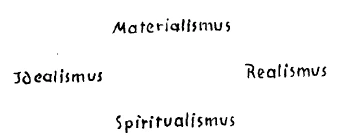
[ 22 ] We now have four worldviews that are all equally valid, each of which has its own significance in its particular domain. There is a certain transition between materialism and idealism. The most crude form of materialism—which can be clearly observed especially in our time, even though it is already on the wane—consists in taking Kant’s dictum to its extreme—Kant himself did not do this!—namely, that in the individual sciences there is only as much real science as there is mathematics. That is to say, one can go from being a materialist to becoming the universe’s calculating servant by accepting nothing other than a world filled with material atoms. They collide, swirl about, and one then calculates how the atoms swirl about. One obtains very beautiful results from this, which may serve as evidence that this worldview is fully justified. For example, one obtains the vibration frequencies for blue, for red, and so on; one views the entire world as a kind of mechanical apparatus and can calculate it precisely. But one can become somewhat confused by this matter. One might say to oneself, for example: Yes, but no matter how complicated a machine one has, nothing can ever emerge from this machine—even if it moves in the most intricate ways—that explains how one perceives blue, red, and so on. So if the brain is merely a complicated machine, then what we experience as soul-life cannot possibly emerge from the brain. But one can then say, as Du Bors-Reymond once said: If one seeks to explain the world solely through mathematics, one will indeed be unable to explain even the simplest sensation; but if one does not stop at the mathematical explanation, one becomes unscientific. — The crude materialist would say: No, I do not calculate either; for that already presupposes a superstition—the superstition that I assume things are ordered according to measure and number. And whoever now rises above this crude materialism becomes a mathematical mind and accepts as real only that which can be expressed in mathematical formulas. This results in a worldview that accepts nothing other than the mathematical formula. One might call it mathematicism.
[ 23 ] But one might reflect on this and then, having been a mathematician, say to oneself: It cannot be superstition that the color blue has so many vibrations. After all, the world is mathematically ordered. If mathematical ideas are realized in the world, why shouldn’t other ideas also be realized in the world? Such a person assumes: Ideas do indeed exist in the world. But he accepts only those ideas that he finds, not those he might grasp from within through some intuition or inspiration, but only those he derives from externally sensory-real things. Such a person becomes a rationalist, and his worldview is rationalism. — If, in addition to the ideas one finds, one also accepts those derived from the moral and the intellectual, then one is already an idealist. Thus a path leads from crude materialism through mathematism and rationalism to idealism.
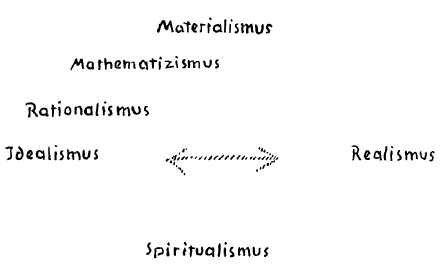
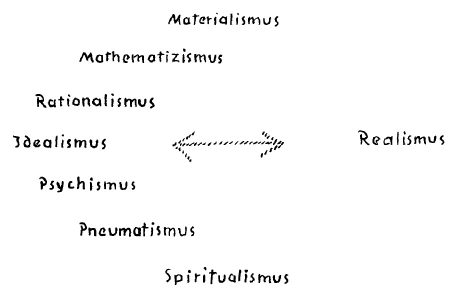
[ 24 ] But idealism can be taken a step further. In our time, there are some people who try to take idealism to the next level. After all, they find ideas in the world. If one finds ideas, then there must also be a kind of reality in the world in which ideas could exist. Ideas cannot simply live in some external thing. Nor can ideas, so to speak, hang in the air. It is true that in the 19th century there was a belief that ideas govern history. But this was merely a misunderstanding; for ideas as such have no power to act. Therefore, one cannot speak of ideas in history. Whoever realizes that ideas, if they are to exist at all, are bound to a being that can indeed possess ideas, will no longer be a mere idealist, but will proceed to the assumption that ideas are bound to beings. He becomes a psychist, and his worldview is psychism. The psychist, who can again muster an immense amount of acumen for his worldview, arrives at this worldview only through a one-sidedness that he may eventually notice.
[ 25 ] I must add here right away: All the worldviews I will discuss below the horizontal line have their adherents, and these adherents are mostly stubborn individuals who adopt this or that worldview based on certain fundamental conditions they hold within themselves and remain fixed in that position. Everything below this line (see sketch) has adherents who are more open to the realization that individual worldviews always view things from only a specific perspective, and who therefore find it easier to transition from one worldview to another.
[ 26 ] If someone is a psychic and, because they are a person of knowledge, inclined to view the world contemplatively, they come to tell themselves that they must presuppose the psychic in the world. But the moment they are not merely a person of knowledge, but also have a similar sympathy for the active, for the energetic, for the volitional in human nature, they say to themselves: It is not enough that there are beings who can only have ideas; these beings must also have something active, must also be able to act. But this is inconceivable unless these beings are individual beings. That is to say, such a person ascends from the assumption of the animacy of the world to the assumption of the spirit or spirits in the world. It is not yet clear to him whether he should assume one or more spiritual beings, but he ascends from psychism to pneumatism, to the doctrine of the spirit.
[ 27 ] If one has truly become a Pneumatist, it may well happen that one comes to see what I have said today about numbers—that, when it comes to numbers, there is indeed something problematic about speaking of a “unity.” Then they come to say to themselves: So it must be a confusion to speak of a unified spirit, of a unified Pneuma. And they then gradually come to be able to form a conception of the spirits of the various hierarchies. They then become spiritualists in the true sense, so that on this point there is a direct transition from Pneumatism to Spiritualism.
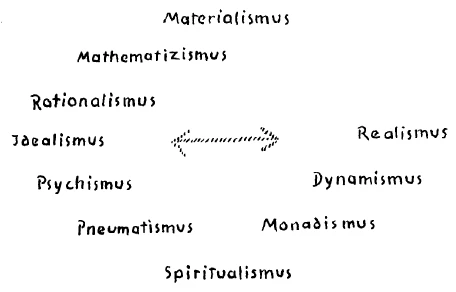
[ 28 ] Everything I have written on the blackboard are worldviews that are valid within their respective fields. For there are fields in which psychism serves as an explanation, and there are fields in which pneumatism serves as an explanation. However, if one wishes to engage with the explanation of the world as thoroughly as we have attempted, then one must arrive at Spiritualism, at the acceptance of the spirits of the hierarchies. Then one cannot stop at Pneumatism; for to stop at Pneumatism in this case would mean the following. If we are Spiritualists, we may encounter people saying: Why are there so many spirits? Why use the number? There is a single universal spirit!”—Anyone who delves deeper into the matter knows that this objection is just like when someone says: “You tell me there are two hundred mosquitoes there. But I don’t see two hundred mosquitoes; I see only a single swarm of mosquitoes.” — This is exactly how a follower of Pneumatism, Pantheism, and so on would behave toward the Spiritualist. The Spiritualist sees the world filled with the spirits of the hierarchies; the Pantheist sees only the one swarm, sees only the single Universal Spirit. But this is based solely on an imprecision of perception. Materialism
[ 29 ] Now there is another possibility: that someone does not arrive at the activity of spiritual beings through the paths we have attempted to follow, but nevertheless comes to accept the existence of certain fundamental spiritual entities in the world. One such person was, for example, Leibniz, the famous German philosopher. Leibniz transcended the prejudice that anything in the world could exist merely in a material sense. He found the real, sought the real. I have described this in more detail in my book The Riddles of Philosophy. He held the view that there is a being capable of generating existence within itself, such as the human soul. But he did not form any further concepts about it. He merely told himself that there is such a being capable of generating existence within itself, which drives forth ideas from within itself. For Leibniz, this is a monad. And he told himself: There must be many monads, and monads of the most varied degrees of clarity. If I have a bell here, there are many monads inside it—like in a swarm of mosquitoes—but monads that do not even reach the level of sleep-consciousness, monads that are almost unconscious, yet which develop the darkest ideas within themselves. There are monads that dream, there are monads that develop waking ideas within themselves; in short, monads of the most varied degrees. — Such a person does not go so far as to imagine the concrete nature of individual spiritual entities in the way a spiritualist does; but he reflects in the world upon the spiritual, which he leaves only as an indeterminate concept. He calls it a monad, that is, he concerns himself only with the nature of the concept, as if one were to say: Yes, spirit, spirits are in the world; but I describe them only in such a way that I say they are beings capable of diverse forms of perception. I extract an abstract quality from them. Thus I form this one-sided worldview, for which, above all, as much can be advanced as the brilliant Leibniz advanced for it. Thus I develop monadism. — Monadism is an abstract spiritualism.
[ 30 ] However, there may be people who do not rise to the level of the monad, who cannot admit that what exists are beings of varying degrees of conceptual capacity, but who are also not content merely to acknowledge what extends in external reality; rather, they allow what extends in external reality to be governed everywhere by forces. For example, when a stone falls to the ground, they say: There is gravity. When a magnet attracts iron filings, they say: There is magnetic force. They are not content merely to say: There is the magnet—but they say: The magnet presupposes that the magnetic force exists supersensibly, invisibly, and extends everywhere. One can form such a worldview that seeks forces everywhere to explain what is happening in the world, and one can call it dynamism.
[ 31 ] Then one might also say: No, believing in forces is superstition! An example of how someone explains in detail why believing in forces is superstition can be found in Fritz Mauthner’s Critique of Language. In this case, one sticks to what actually exists around us. In this way, we move from spiritualism through monadism and dynamism back to realism.
[ 32 ] But there is something else one can do as well. One can say: Certainly, I adhere to the world that surrounds me. But I do not claim that I have the right to say that this materialistic world is the real one. All I can say about it is that it appears to me. And I have no right whatsoever to say anything more than: This world appears to me. I have no right to say anything more about it. — So that is a difference. One can say of this world that spreads out around us that it is the real world. But one can also say: I cannot speak of another world; but I am clear that it is the world that appears to me. I am not saying that this world of colors and sounds—which arises only because certain processes take place in my eye that appear to me as colors, because processes take place in my ear that appear to me as sounds, and so on—that this world is the true one. It is the world of phenomena. - Phenomenalism is the worldview that would be at issue here.
[ 33 ] But we can go further and say: We do indeed have the world of phenomena around us. But everything we believe we have in these phenomena—in the sense that we ourselves have added it, that we ourselves have thought it in—we have simply thought it in to the phenomena. Yet only what our senses tell us is valid. — Note well that a person who says this is not a follower of phenomenalism, but rather separates from the phenomenon whatever he believes to be derived solely from the intellect and reason, and accepts as somehow indicated by reality whatever the senses present as impressions. This worldview can be called sensualism.
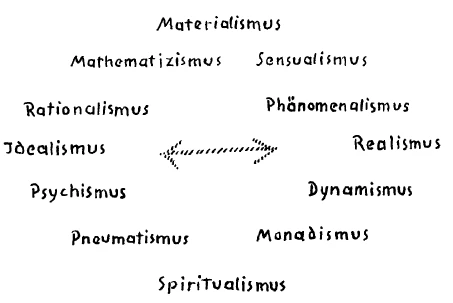
[ 34 ] Even if one were to say: “Consider that this is what the senses tell us, and no matter how astute the reasons you may cite for it—and one can indeed cite astute reasons for it”—I take the position that there is only that which looks like what the senses tell us; I accept that as material—just as the atomist who says: I assume that only atoms exist, and no matter how small they are, they possess the properties known in the physical world—then one is once again a materialist. So we have arrived back at materialism by a different route.
[ 35 ] What I have described and characterized here as worldviews actually exists and can be defended. And it is possible to present the most astute arguments for each of these worldviews; it is possible to adopt the standpoint of each of these worldviews and to refute the other worldviews with astute arguments. One can conceive of other worldviews between these; however, they differ only gradually from those listed and can be traced back to the main types. If one wishes to understand the fabric of the world, one must know that one comes to know it through these twelve gateways. There is not a single worldview that can be defended, that is justified; rather, there are twelve worldviews. And one must admit: just as many good reasons can be put forward for one worldview as for any other of the twelve. The world cannot be viewed from the one-sided standpoint of a single worldview or a single idea; rather, the world reveals itself only to those who know that one must walk around it. Just as the sun, even if we take the Copernican worldview as our basis, moves through the signs of the zodiac to illuminate the Earth from twelve different points, so too must one not take a single standpoint—the standpoint of idealism, sensualism, phenomenalism, or any worldview that might bear such a name—but one must be able to walk around the world and familiarize oneself with the twelve different viewpoints from which the world can be viewed. Intellectually, all twelve different points of view are fully justified. There is not one worldview for the thinker who can penetrate the nature of thought, but twelve equally valid ones—equally valid insofar as equally good reasons can be advanced for each from the perspective of thought. There are twelve such equally valid worldviews. From this perspective thus gained, let us continue our discussion tomorrow, so that we may rise from the intellectual contemplation of humanity to the contemplation of the cosmic.