

Human and Cosmic Thought
GA 151
22 January 1914, Berlin
Translated by Steiner Online Library
Third Lecture
[ 1 ] Yesterday I attempted to describe the various nuances of worldview that are possible for human beings—so possible, in fact, that for each of these nuances, fully valid proof of correctness and truth can be provided within a certain domain. For those who are not intent on forging everything they have been able to observe and reflect upon within a specific, narrowly defined field into a conceptual system and then seeking proof for it, but rather for those who are intent on truly penetrating the truth of the world, it is important to know that this comprehensiveness is necessary, which is expressed in the fact that the human mind is truly capable of twelve typical nuances of worldview—the transitions between them are not relevant here. If one truly wishes to arrive at the truth, one must attempt to clarify the significance of these worldview nuances for oneself, must attempt to recognize in which areas of existence one or the other of these worldview nuances provides the better key. If we review these twelve nuances of worldview once more, as we did yesterday, they are: materialism, sensualism, phenomenalism, realism, dynamism, monadism, spiritualism, pneumatism, psychism, idealism, rationalism, and mathematism.
[ 2 ] Unfortunately, in the real world of human inquiry into the truth, it is the case that in individual minds and personalities, a tendency toward one or another of these nuances of worldview always prevails, and that as a result, the one-sidedness inherent in the various worldviews of different eras has a reciprocal effect on people. What I have presented as the twelve main worldviews must be understood as something that one truly surveys in such a way that one, as it were, always places one worldview next to another in a circular fashion and regards them as at rest. They are possible; one must be familiar with them. They truly behave in such a way that they are a spiritual reflection of the zodiac, which is well known to us. Just as the Sun appears to pass through the zodiac and other planets appear to pass through it, so it is possible for the human soul to pass through a spiritual circle containing twelve worldview images. Indeed, one can even relate the characteristics of these worldview images to the individual signs of the zodiac. And this relating is by no means arbitrary; rather, there truly exists a similar relationship between the individual zodiac signs and the Earth as between these twelve worldviews and the human soul. This is meant as follows.
[ 3 ] To begin with, we cannot say that there is an easily understandable relationship, for example, between the zodiac sign of Aries and the Earth. But when the Sun, Saturn, or Mercury are positioned so that they are seen from Earth in the sign of Aries, they have a different effect than when they are positioned so that they are seen in the sign of Leo. Thus, the effect that comes to us from the cosmos—for example, from the individual planets—differs depending on whether the individual planets are covering one zodiac sign or another. In the case of the human soul, it is even easier for us to recognize the influence of these twelve “spiritual zodiac signs.” There are souls that, so to speak, tend entirely toward allowing their inner life—their scientific, philosophical, or other spiritual orientation—to be influenced solely by the light of idealism shining into their souls. Others allow materialism to shine into their souls, and still others allow sensualism to do so. One is not a sensualist, materialist, spiritualist, or pneumatist because one or the other view is correct and one can see the correctness of one or the other view, but rather one is a pneumatist, spiritualist, materialist, or sensualist because one is so predisposed in one’s soul that one is spiritually and soulfully illuminated by the respective spiritual zodiac sign. Thus, in these twelve spiritual zodiac signs, we have something that can lead us deeply into the way in which human worldviews arise, and that can lead us deeply into the reasons why, on the one hand, people argue about worldviews, but on the other hand, they should not argue, but rather should much more readily recognize why it is that people have different nuances of worldview. If, nevertheless, it is necessary for certain epochs to strictly reject one or the other worldview, we will have to explain the reason for this in tomorrow’s lecture. What I have said so far thus refers to the shaping of human thought by the spiritual cosmos of the twelve spiritual zodiac images, which, as it were, rest within our spiritual sphere.
[ 4 ] But there is something else that shapes human worldviews. You will best understand this other factor if I first show you the following.
[ 5 ] One can be in such a state of mind—regardless of which of these twelve zodiacal images of the spirit is currently illuminating one’s soul—that this state of mind, which finds expression in the entire configuration of that soul’s worldview, can be described as gnosis. One can be a Gnostic. One is a Gnostic when one is attuned to knowing the things of the world through certain powers of knowledge lying within the soul itself, not through the senses or the like. One can be a Gnostic and, for example, have a certain inclination to be illuminated by the spiritual zodiac sign that we have referred to here as Spiritualism. Then, in one’s Gnosticism, one will be able to shine deeply into the interconnections of the spiritual worlds.
[ 6 ] But one can also, for example, be a Gnostic of idealism; in that case, one will have a special predisposition to see clearly the ideals of humanity and the ideas of the world. The difference does indeed exist between one person and another, even with regard to the idealism that both may possess. Thus, one is an idealistic dreamer who is always talking about being an idealist, who constantly has the word “ideal, ideal, ideal” on his lips, but does not know many ideals, who lacks the ability to truly summon the ideals before his soul with sharp contours and inner vision. Such a person differs from the other, who not only speaks of ideals but knows how to sketch them in his soul like a sharply drawn picture. The latter, who grasps idealism quite concretely within himself, grasps it as intensely as one grasps external things with the hand, is a Gnostic in the realm of idealism. One could also say: He is a Gnostic in general, but he allows himself to be illuminated in particular by the spiritual zodiacal image of idealism.
[ 7 ] There are people who are particularly strongly influenced by the worldview of realism, yet who go through life in such a way that, through the very way they perceive the world and relate to it, they can tell others a great deal about this world. They are neither idealists nor spiritualists; they are quite ordinary realists. They are capable of truly perceiving with great sensitivity what exists in the external reality around them; they are highly attuned to the peculiarities of things. They are Gnostics, true Gnostics; only they are Gnostics of realism. Such Gnostics of realism exist, and sometimes spiritualists or idealists are not Gnostics of realism at all. We may even find that people who call themselves good Theosophists walk through a gallery of paintings and have nothing at all to say about the paintings, while others, who are not Theosophists at all but who are Gnostics of Realism, know how to say something infinitely meaningful by being in touch with the whole reality of things with their entire personality. Or how many theosophists go out into nature and do not know how to grasp the full sublimity and grandeur of nature with their whole soul: they are not Gnostics of realism. There are Gnostics of realism. There are also Gnostics of materialism. These are, admittedly, strange Gnostics. But just as one can be a Gnostic of realism, one can be a Gnostic of materialism; but these are people who have only a sense, feeling, and perception for all that is material, who seek to know the material through direct contact, like the dog that sniffs out substances and thereby gets to know them intimately, and which is actually, with regard to material things, an excellent Gnostic.
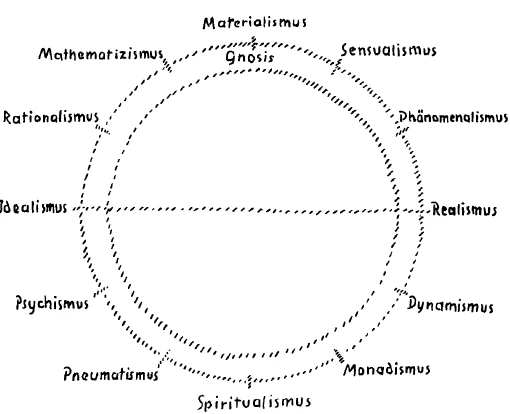
[ 8 ] One can be a Gnostic within all twelve worldviews. This means that if we want to properly situate Gnosis, we must do so by drawing a circle, where the entire circle signifies that Gnosis can move through all twelve worldviews. Just as a planet traverses the twelve signs of the zodiac, so Gnosticism can traverse all twelve worldviews.
[ 9 ] However, Gnosticism will be of greatest service to the salvation of souls when the Gnostic spirit is applied to Spiritualism. One might say: Gnosticism is truly at home in Spiritualism. There it is in “its” home. In other worldviews, it is outside its home. Logically, one has no right to say that there could be no materialistic Gnosticism. The pedants of concepts and ideas deal with such matters more easily than sound logicians, who have a somewhat more complicated time of it. One could say, for example: I will call nothing Gnosticism except that which penetrates the spirit. This is an arbitrary definition, just as arbitrary as if someone were to say: “I have only seen violets in Austria so far, so I will call only that which grows in Austria and has the color of a violet a violet, and nothing else.” Logically, it is equally impossible to say that Gnosis exists only within the worldview of Spiritualism; for Gnosis is a “planet” that traverses the constellations of the spirit.
[ 10 ] There is another worldview mood. I use the term “mood” here, whereas I usually speak of “nuances” and “images.” And in recent times, people have tended to view it in a more lighthearted way—yet even here, “the light is heavy”! —to become acquainted with this second worldview mood, because it has been represented in the constellation of the spirit of idealism precisely by Hegel. But that way of viewing the world, this particular worldview mood that Hegel possessed, need not, as in his case, remain merely within the constellation of the spirit of idealism; rather, it can pass through all the constellations once more. It is the worldview of Logism. This worldview of Logism consists primarily in the soul’s ability to allow real thoughts, concepts, and ideas to be present within itself, to have these thoughts and ideas present within itself in such a way that such a soul moves from one concept or thought to another just as one, when looking at a human organism, moves from the eye to the nose and to the mouth and regards all of this as belonging together, as is the case with Hegel, where all the concepts he can grasp are organized into a great conceptual organism. This is a logical conceptual organism. Hegel was simply capable of seeking out and absorbing everything that can be found in the world as thought, of stringing thoughts together and making an organism out of them: Logism! One can develop Logism as Hegel did, within the constellation of Idealism; one can develop it as Fichte did, within the constellation of Psychism; and one can develop it within other constellations of the spirit. Again, Logism is something that passes through the zodiacal constellations like a planet, moving in a circular path through the twelve constellations of the spirit.
[ 11 ] We can study a third disposition of the soul—one that gives rise to worldviews—in Schopenhauer, for example. While Hegel’s soul, when he looks at the world, is disposed in such a way that initially, in this Hegelian soul, everything in the world that is a concept emerges as logic, Schopenhauer, through the particular mood of his soul, grasps within the soul everything that is will-like. For him, the forces of nature are will; the hardness of the stone is will; everything that is reality is will. This stems from the particular mood of his soul. Now one can regard such a worldview of the will, such a worldview mood of the will, in turn as a planet passing through all twelve constellations of the spiritual zodiac. I wish to call this worldview mood voluntarism. It is the third worldview mood. Schopenhauer was a voluntarist, and his soul was constituted in such a way that he exposed himself to the spiritual constellation of psychism. Thus arose Schopenhauer’s peculiar metaphysics of the will: voluntarism within the spiritual constellation of psychism.
[ 12 ] Suppose, for a moment, that someone were a voluntarist and particularly inclined toward the spiritual constellation of monadism. Then he would not, like Schopenhauer, base the world on a single soul—which is essentially will—but rather on many monads, which are beings of will. This world of monadological voluntarism was developed in the most beautiful, most astute, and, I would say, most heartfelt way by the Austrian poet-philosopher Hamerling. How did the unique doctrine found in Hamerling’s “Atomistics of the Will” come about? Because his soul was of a voluntaristic disposition and he exposed himself primarily to the spiritual constellation of monadism. If we had the time, we could cite examples for every soul disposition in every constellation. They are to be found in the world.
[ 13 ] This is a particular state of mind that is not at all inclined to think deeply or ponder whether there is anything beyond the appearances of this or that—as, for example, the Gnostic mindset does, or as the logical or voluntarist mindset does—but which simply says: I want to incorporate into my worldview whatever comes to meet me in the world, whatever shows itself to me, whatever reveals itself to me externally. This can be done in all areas, that is, through all the constellations of the spirit. One can do this as a materialist, taking only what comes to meet one externally; one can also do it as a spiritualist. One does not strive to seek a particular connection behind the phenomena, but rather allows things to come to oneself and waits to see what presents itself. Such a state of mind can be called empiricism. Empiricism is a state of mind that simply accepts experience as it presents itself. One can be an empiricist—a person with an experiential worldview—throughout all twelve spiritual constellations. Empiricism is the fourth state of mind that can pass through all twelve spiritual constellations.
[ 14 ] Similarly, one can develop a state of mind regarding one’s worldview that is not satisfied with what experience presents to us, with what our lived experience yields, as is the case with empiricism; rather, one can say to oneself—that is, one can feel as an inner necessity the state of mind: Human beings are placed in the world; in their own souls they experience something about the world that they cannot experience externally. Only then does the world reveal its secrets. One may look around—one does not see what secrets the world contains. - Such a mood of the soul can often ask: What good is gnosis to me, which struggles with all its might to rise to all manner of visions? The things of the outer world, about which one has visions, cannot reveal the inner world to one. What good is logism to me in forming a worldview? The essence of the world is not expressed in logic. What good is speculation about the will? That only distracts one from looking into the depths of one’s own soul. And one does not look into these depths when the soul wills it, but precisely when it is surrendered, will-less. — Thus, voluntarism is not the state of mind the soul needs here, nor is empiricism—the mere looking at or listening to what experience provides; rather, it is the inner seeking, when the soul has become still, of how God shines forth within the soul. You see, this state of mind can be called mysticism.
[ 15 ] One can be a mystic in all twelve constellations of the spirit. It will certainly not be particularly beneficial to be a mystic of materialism—that is, to experience not the spiritual but the material within oneself. For a mystic of materialism is actually someone who has acquired a particularly refined sensitivity, for example, to the state of being one enters into when one enjoys one substance or another. It is something else entirely when one, so to speak, enjoys the sap of one plant or that of another and then waits to see what effect this has on the organism. One thus grows together with matter in one’s experience, becoming a mystic of matter. It may even be that this can become a life’s work—a task for life—in which one investigates how one substance or another, derived from this or that plant, specifically affects the organism; for one acts particularly on this organ, the other particularly on that organ. And so being a mystic of materialism is a prerequisite for investigating individual substances with regard to their healing power. One notices what the substances do in the organism. — One can be a mystic of the material world; one can be a mystic of idealism. An ordinary idealist or a Gnostic idealist is not a mystic of idealism. A mystic of idealism is one who, above all, has the capacity within one’s own soul to draw forth from inner, hidden sources the ideals of humanity, to perceive them as the inner divine, and to place them before the soul as such. A mystic of idealism is, for example, Meister Eckhart.
[ 16 ] Now, the soul may be disposed in such a way that it cannot perceive what rises up within it—and what appears to be the true inner solution to the world’s mysteries—but a soul may also be disposed in such a way that it says to itself: Yes, there is something in the world behind all things, just as there is behind my own being, insofar as I perceive this being. But I cannot be a mystic. The mystic believes that this flows into his soul. I do not feel it flowing into my soul; I only feel that it must be there, out there. — In this state of mind, one assumes that the essence of things lies beyond our soul and beyond what our soul can experience; but one does not assume that this essence of things can enter the soul itself, as the mystic assumes. If one assumes that behind everything there is still something that cannot be reached through perception, then one is—this is perhaps the best word for it—a transcendentalist. One assumes that the essence of things is transcendent, that it does not enter the soul, as the mystic assumes. So: Transcendentalism. The mindset of the transcendentalist is such that he feels: When I perceive things, the essence of things comes to me; only perception itself is not this essence. The essence lies behind it, but it comes to the human being.
[ 17 ] With his perceptions and all his cognitive faculties, man can, as it were, push the essence of things even further away than the transcendentalist does. One might say: For the human faculty of external cognition, the essence of things is completely unattainable. The transcendentalist says: When you see red and blue with your eyes, what you see as red and blue is not the essence of things; but it lies behind them. You must use your eyes; then you will penetrate to the essence of things. It is behind them. — But this state of mind, which I now mean, does not wish to dwell in transcendentalism; rather, it says: No matter how intensely one may experience red or blue or this or that tone, none of that expresses the essence of things. That is hidden only behind it. Where I perceive, the essence of things does not come into contact at all. — Whoever speaks this way speaks similarly to the way we usually speak, we who certainly stand on the standpoint: In the outward appearance of the senses, in Maya, the essence of things is not expressed. We would be transcendentalists if we said: The world spreads out around us, and this world proclaims the essence everywhere. We are not that when we say: This world is Maya, and one must seek the inner nature of things in a way other than through the external perception of the senses and the ordinary means of knowledge; that is occultism, the spiritual mood of occultism.
[ 18 ] One can, in turn, be an occultist across all the spiritual signs of the zodiac. One can certainly even be an occultist of materialism. Indeed, the rational natural scientists of today are all occultists of materialism, for they speak of atoms. But if they are not irrational, it would never occur to them to claim that one can approach the atom by any method. The atom remains in the occult. They simply do not like to be called occultists, but they are so in the fullest sense of the word.
[ 19 ] Essentially, there can be no worldviews other than these seven that I have listed here; there are only transitions from one to another. Thus, we must distinguish not only twelve different shades of worldview that appear to us as if at rest, but within each of these shades of worldview, a very particular mood of the human soul is possible. From this you can see how immensely diverse the worldviews of human personalities can be. One can develop each of these seven worldview moods in particular, but each of these worldview moods again one-sidedly in one nuance or another. What I have described here is, in the spiritual realm, the counterpart to what exists externally in the world as the relationship between the zodiac signs and the planets, as we have often cited in spiritual science regarding the seven known planets, and so one has a picture, as it were an external picture, which we have not created but which exists within the cosmos, for the relationships of our seven worldview moods to our twelve worldview nuances. And one perceives this picture correctly when one perceives it in the following way.
[ 20 ] Let us begin with idealism, designating it as the spiritual zodiac sign of Aries; in the same way, let us designate rationalism as Taurus, mathematism as Gemini, materialism as Cancer, sensualism as Leo, phenomenalism as Virgo, realism as Libra, dynamism as Scorpio, monadism as Sagittarius, spiritualism as Capricorn, pneumatism as Aquarius, and psychism as Pisces. The relationships that exist between the individual zodiac signs with regard to the external, spatial, and material realm are in fact present in the realm of the spirit between these worldviews. And the relationships that the individual planets we have designated enter into as they circle along the zodiac correspond to the relationships entered into by the seven worldview dispositions, but in such a way that we can perceive Gnosis as Saturn, Logism as Jupiter, Voluntarism as Mars, Empiricism as the Sun, Mysticism as Venus, Transcendentalism as Mercury, and Occultism as the Moon.
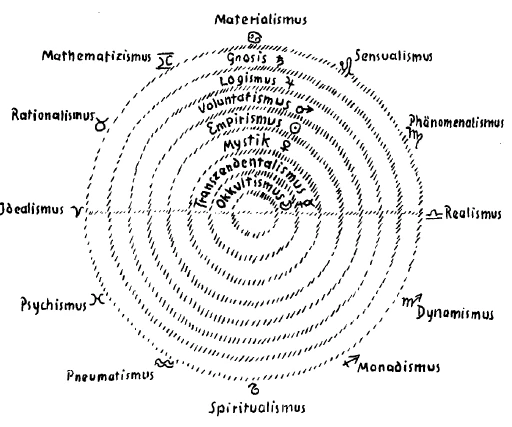
[ 21 ] Except for the outward appearances—but that is not the main point; the main point is, in fact, that the deepest inner relationships correspond to this parallelism—but even as far as the outward appearances are concerned, wherever something of this nature can be observed, you will find something similar. The moon remains occult, invisible, when it is a new moon; it must first have the light of the sun brought to it, just as occult things remain occult until the soul’s capacity is raised through meditation, concentration, and so on, and illuminates the occult things. The person who walks through the world relying solely on the sun, who takes in only what the sun illuminates, is an empiricist. Whoever also reflects on what the sun illuminates, and retains those thoughts even after the sun has set, is no longer an empiricist, because they no longer rely on the sun. “Sun” is the symbol of empiricism. — I could elaborate further on all these things, but we have only four hours for this important topic, and for now it will have to be left to you to explore more precise connections through your own thoughts or other research. They are not even difficult to find once the framework has been laid out.
[ 22 ] It seems that all too often in this world, people do not strive for comprehensiveness. If one takes the truth seriously, one really ought to be able to represent the twelve nuances of worldview within one’s soul, and one ought to have experienced something of this within oneself: What is it like to be a Gnostic? What is it like to be a logician, a voluntarist, an empiricist, a mystic, or a transcendentalist? And what is it like to be an occultist? Essentially, everyone who truly wishes to penetrate the mysteries of the world in the sense of spiritual research must go through this as a trial. And even if what is written in “How Does One Attain Knowledge of the Higher Worlds?” is not specifically tailored to these explanations, everything in it is described—albeit from different perspectives—that can lead us into the individual moods designated here as the Gnostic mood, the Jupiter mood, and so on.
[ 23 ] It often happens in the world that people are so one-sided that they expose themselves to only one constellation or only one mood. It is precisely the great figures in the realm of worldviews who all too often exhibit this one-sidedness. Hamerling, for example, is a pronounced voluntaristic monadist or a monadological voluntarist, while Schopenhauer is a pronounced voluntaristic psychic. It is precisely these great figures who have, so to speak, attuned their souls in such a way that their planetary worldview mood is situated within a very specific spiritual constellation. Other people find it much easier to come to terms with the various points of view, as they are called. But it can also happen that people are, as it were, inspired from different sides for their worldview, for what they establish as their worldview. For example, it can happen that someone is a good logician, but their logical disposition is situated in the spiritual constellation of sensualism. They can at the same time be a good empiricist, but their empiricist disposition is situated in the constellation of mathematism. This can happen. If this is the case, then one establishes a very specific worldview. We have this very worldview today, which has come about because someone has their Sun—spiritually speaking—in Gemini and their Jupiter in Leo; that is Wundt. And one will understand every detail that appears in Wundt’s philosophical writings once one has uncovered the secret of his particular soul configuration.
[ 24 ] It is particularly advantageous when a person has experienced the various states of mind—occultism, transcendentalism, mysticism, empiricism, voluntarism, logism, gnosis—in such a way through practice that they can be brought to mind, that their effects can be felt all at once, as it were, and then place all these moods—as if all at once—into the single constellation of phenomenalism, into Virgo. Then what can reveal the world to them in a favorable way truly appears before them in their manifestations, as in phenomena, with a very special grandeur. If one places the individual worldview moods one after another in the same way in relation to another constellation, this is not so good at first. That is why, in many ancient mystery schools, precisely this mood—which I have now described as if all the soul planets were situated in the spiritual constellation of Virgo—was brought about for the students, because this was the easiest way for them to penetrate the world. They grasped the phenomena, but grasped them gnostically, logically, and so on; they were able to get behind the phenomena. They did not perceive the world as crude and clumsy. That would only be the case if the soul mood of voluntarism were attuned to Scorpio. In short, through the constellation created by the soul-worldview moods—which constitute the planetary element—and by the worldview nuances—which constitute the element of the spiritual zodiac—that which the human being carries through the world as his worldview in any given incarnation is brought about.
[ 25 ] There is, however, one more factor to consider. This is that these worldviews—which already have a great many nuances if you examine all possible combinations—are further modified by the fact that they can all take on a very specific tone. But in this realm of tone, we need only distinguish between three types. All worldviews, all combinations that arise in this way, can manifest in three different ways. First, they can be theistic, so that I must name what appears in the soul as a tone “theism.” They can be such that, in contrast to theism, we must call the corresponding soul tone “intuitism.” Theism arises when a person relies on everything external to find his God, when he seeks his God in the external world. Ancient Hebrew monotheism was primarily a theistic worldview. Intuitism arises when a person seeks his worldview primarily through what intuitively shines within him. In addition to these two, there is a third tone: naturalism.
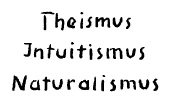
[ 26 ] These three spiritual dispositions also have a counterpart in the outer world of the cosmos; indeed, they behave within the human soul in exactly the same way as the sun, moon, and earth, so that theism corresponds to the sun—here understood as a fixed star, not as a planet—intuitivism corresponds to the moon, and naturalism to the earth. The one—translate for yourself the individual elements referred to here as the sun, moon, and earth into the spiritual realm—who goes beyond the phenomena of the world and says: When I look out, God, who fills the world, reveals Himself to me in all of this—the earthly human being who stands up straight when he steps into the sun’s rays is the theist. The person who does not transcend natural processes but remains with individual phenomena—just as one who never raises his gaze to the sun but looks only at what the sun brings forth for him on Earth—is a naturalist. He who seeks the best that he can have in his soul by allowing it to merge with his intuitions is like the intuitive poet who sings of the moon and is inspired in his soul by the silver, gentle moonlight, and can be compared to it. Just as one can connect the moonlight with the imagination, so must one, in an occult sense, relate the intuitist—as understood here—to the moon.
[ 27 ] Finally, there is a fourth; however, it is present in only a single element. When a person, so to speak, limits their worldview entirely to what they can experience in, around, or within themselves, that is anthropomorphism.

[ 28 ] It corresponds to the Earth when considered as such, regardless of whether it is surrounded by the Sun, the Moon, or anything else. Just as we can consider the Earth on its own, so too, when it comes to worldviews, we can take into account nothing other than what we as human beings can find within ourselves. Then the anthropomorphism so widespread in the world will arise.
[ 29 ] If one goes beyond what it means to be human—just as one must go beyond the Earth to the Sun and the Moon to explain the Earth’s existence—which contemporary science does not do—one comes to the conclusion that three perspectives must be recognized as equally valid: theism, intuitionism, and naturalism. For it is not a matter of insisting on one of these tones, but of allowing them to harmonize together, that corresponds to what truth is. And just as our more immediate physicality, with the sun, moon, and Earth, is re-embedded within the seven planets, so too is anthropomorphism—as the most trivial worldview—re-embedded within what can harmonize from theism, intuitism, and naturalism, and this, in turn, is re-embedded within what can harmonize from the seven soul moods. And these seven soul moods are nuanced according to the twelve signs of the zodiac.
[ 30 ] As you can see, based on the name alone—and indeed, based solely on the name—not just one worldview is true, but rather \(12 + 7 = 19 + 3 = 22 + 1 = 23\) worldviews are valid. We have twenty-three valid names for worldviews. But everything else can still arise from the fact that the corresponding planets revolve through the twelve signs of the spiritual zodiac.
[ 31 ] And now, based on what has been discussed, try to develop a sense of the task that spiritual science has in fostering peace among the various worldviews—in fostering peace based on the realization that these worldviews, in their mutual interaction, can be explained to a certain extent, but that none of them can lead to the inner core of truth if they remain one-sided; rather, one must, as it were, experience the truth value of the various worldviews inwardly within oneself in order to truly—so to speak—come to terms with the truth. Just as you can conceive of the physical cosmos—the zodiac, the planetary system, the Sun, Moon, and Earth together, the Earth on its own—so you can conceive of a spiritual cosmos: anthropomorphism; theism, intuitism, naturalism; gnosis, logism, voluntarism, empiricism, mysticism, transcendentalism, occultism; and all of this unfolding within the twelve spiritual zodiac signs. This exists; it simply exists spiritually. Just as the physical cosmos exists physically, so too does this exist spiritually.
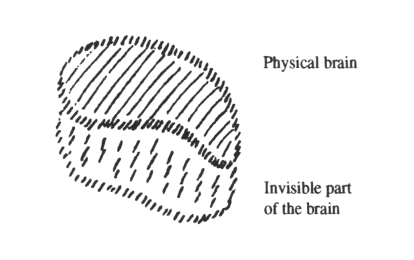
[ 32 ] The hemisphere of the brain that the anatomist identifies—which can indeed be described as the hemispherical one—is primarily influenced by those forces of the spiritual cosmos that emanate from the higher realms. In contrast, there is an invisible part of the brain that is visible only when one observes the etheric body; this part is primarily influenced by the lower region of the spiritual cosmos (see diagram). But what is the nature of this influence? Let us say that in a certain person, their logic is attuned to sensualism, and their empiricism is attuned to mathematism. Then what arises in this way generates forces that act upon their brain, and that upper part of their brain is then particularly active and overpowers the others. Countless nuances of brain activity arise from the fact that the brain, as it were, floats in the spiritual cosmos and the forces act upon the brain in this way, as we have now been able to illustrate. Human brains are truly as diverse as they can be, according to the combinations that arise from this spiritual cosmos. What is in that lower part of the spiritual cosmos does not even act upon the physical brain, but upon the etheric brain.
[ 33 ] When speaking of all this, the best impression one can gain is probably to say: It opens up a sense of the world’s infinity, of the world’s qualitative grandeur, and of the possibility that, as human beings, we can exist in infinite diversity within this world. Truly, if we can only contemplate this, then we can already say to ourselves: There is certainly no lack of possibilities for us to be different in our various incarnations that we must undergo on Earth. And one can also be convinced that whoever views the world in this way will, precisely through such a view of the world, come to the point where they must say: Oh, how rich, how magnificent the world is! What a blessing it is to participate in it ever further, ever more, ever more diversely—in its being, its effects, its striving!