

Human and Cosmic Thought
GA 151
22 January 1914, Berlin
Translate the original German text into any language:
Versions Available:
Human and Cosmic Thought, tr. SOL
Dritter Vortrag
Third Lecture
[ 1 ] Ich habe gestern diejenigen Weltanschauungsnuancen darzustellen versucht, welche dem Menschen möglich sind, so möglich, daß für jede dieser Weltanschauungsnuancen gewisse vollgültige Beweise der Richtigkeit, der Wahrheit für ein gewisses Gebiet erbracht werden können. Für den, der nicht darauf aus ist, alles, was er auf einem bestimmten engbegrenzten Gebiete zu beobachten, zu überdenken in der Lage war, zu einem Begriffssystem zusammenzuschmieden und dann die Beweise dafür zu suchen, sondern für den, der darauf aus ist, wirklich in die Wahrheit der Welt einzudringen, ist es wichtig zu wissen, daß diese Allseitigkeit notwendig ist, die sich darin ausspricht, daß dem menschlichen Geist wirklich zwölf typische Weltanschauungsnuancen - auf die Übergänge dazwischen kommt es jetzt nicht an - möglich sind. Will man wirklich zur Wahrheit kommen, dann muß man den Versuch machen, sich die Bedeutung dieser Weltanschauungsnuancen einmal klarzumachen, muß den Versuch machen, zu erkennen, auf welchen Gebieten des Daseins die eine oder die andere dieser Weltanschauungsnuancen den besseren Schlüssel bildet. Wenn wir uns noch einmal diese zwölf Weltanschauungsnuancen vor Augen führen, wie das gestern geschehen ist, so ist es also der Materialismus, der Sensualismus, der Phänomenalismus, der Realismus, der Dynamismus, der Monadismus, der Spiritualismus, der Pneumatismus, der Psychismus, der Idealismus, der Rationalismus und der Mathematizismus.
[ 1 ] Yesterday I attempted to describe the various nuances of worldview that are possible for human beings—so possible, in fact, that for each of these nuances, fully valid proof of correctness and truth can be provided within a certain domain. For those who are not intent on forging everything they have been able to observe and reflect upon within a specific, narrowly defined field into a conceptual system and then seeking proof for it, but rather for those who are intent on truly penetrating the truth of the world, it is important to know that this comprehensiveness is necessary, which is expressed in the fact that the human mind is truly capable of twelve typical nuances of worldview—the transitions between them are not relevant here. If one truly wishes to arrive at the truth, one must attempt to clarify the significance of these worldview nuances for oneself, must attempt to recognize in which areas of existence one or the other of these worldview nuances provides the better key. If we review these twelve nuances of worldview once more, as we did yesterday, they are: materialism, sensualism, phenomenalism, realism, dynamism, monadism, spiritualism, pneumatism, psychism, idealism, rationalism, and mathematism.
[ 2 ] Es ist nun in der wirklichen Welt des menschlichen Forschungsstrebens nach der Wahrheit leider so, daß bei den einzelnen Geistern, bei den einzelnen Persönlichkeiten immer die Hinneigung zu der einen oder der anderen dieser Weltanschauungsnuancen überwiegt und daß dadurch die Einseitigkeiten in den verschiedenen Weltanschauungen der verschiedenen Epochen auf die Menschen wieder wirken. Was ich so als die zwölf Hauptweltanschauungen hingestellt habe, das muß man kennen als etwas, was man wirklich so überschaut, daß man gleichsam immer die eine Weltanschauung neben die andere so kreisförmig hinstellt und sie als ruhend betrachtet. Sie sind möglich; man muß sie kennen. Sie verhalten sich wirklich so, daß sie ein geistiges Abbild des uns ja wohlbekannten Tierkreises sind. Wie den Tierkreis scheinbar die Sonne durchläuft und wie andere Planeten scheinbar den Tierkreis durchlaufen, so ist es der menschlichen Seele möglich, einen Geisteskreis zu durchlaufen, welcher zwölf Weltanschauungsbilder enthält. Ja, man kann sogar die Eigentümlichkeiten dieser Weltanschauungsbilder in Zusammenhang bringen mit den einzelnen Zeichen des Tierkreises. Und zwar ist dieses In-Beziehung-Bringen gar nichts Willkürliches, sondern es besteht wirklich ein ähnliches Verhältnis zwischen den einzelnen Tierkreisbildern und der Erde wie zwischen diesen zwölf Weltanschauungen und der menschlichen Seele. Das ist folgendermaßen gemeint.
[ 2 ] Unfortunately, in the real world of human inquiry into the truth, it is the case that in individual minds and personalities, a tendency toward one or another of these nuances of worldview always prevails, and that as a result, the one-sidedness inherent in the various worldviews of different eras has a reciprocal effect on people. What I have presented as the twelve main worldviews must be understood as something that one truly surveys in such a way that one, as it were, always places one worldview next to another in a circular fashion and regards them as at rest. They are possible; one must be familiar with them. They truly behave in such a way that they are a spiritual reflection of the zodiac, which is well known to us. Just as the Sun appears to pass through the zodiac and other planets appear to pass through it, so it is possible for the human soul to pass through a spiritual circle containing twelve worldview images. Indeed, one can even relate the characteristics of these worldview images to the individual signs of the zodiac. And this relating is by no means arbitrary; rather, there truly exists a similar relationship between the individual zodiac signs and the Earth as between these twelve worldviews and the human soul. This is meant as follows.
[ 3 ] Zunächst können wir ja nicht davon sprechen, daß ein leichtverständliches Verhältnis bestünde zum Beispiel zwischen dem Tierkreisbilde Widder und der Erde. Aber wenn die Sonne, der Saturn oder der Merkur so stehen, daß man sie von der Erde aus im Zeichen des Widders sieht, so wirken sie anders, als wenn sie so stehen, daß man sie im Zeichen des Löwen sieht. Es ist also die Wirkung, die aus dem Kosmos zum Beispiel von den einzelnen Planeten zu uns kommt, verschieden, je nachdem die einzelnen Planeten das eine oder das andere Tierkreisbild bedecken. Bei der menschlichen Seele ist es uns sogar leichter, den Einfluß dieser zwölf «Geistes-Tierkreisbilder» anzuerkennen. Es gibt Seelen, die gewissermaßen ganz dahin tendieren, allein Einfluß auf die Konfiguration ihres Innenlebens, auf ihre wissenschaftliche, philosophische oder sonstige Geistesrichtung dahin zu bekommen, daß sie sich gleichsam vom Idealismus bescheinen lassen in der Seele. Andere lassen sich in der Seele von dem Materialismus bescheinen, andere vom Sensualismus. Man ist nicht Sensualist, Materialist, Spiritualist oder Pneumatiker, weil die eine oder die andere Anschauung richtig ist und man die Richtigkeit der einen oder der anderen Anschauung einsehen kann, sondern man ist Pneumatiker, Spiritualist, Materialist oder Sensualist, weil man in seiner Seele so veranlagt ist, daß man von dem betreffenden GeistesTierkteisbilde geistig-seelisch beschienen wird. So haben wir in diesen zwölf Geistes-Tierkreisbildern etwas, was uns tief hineinführen kann in die Art, wie menschliche Weltanschauungen entstehen, und was uns tief hineinführen kann in die Gründe, warum die Menschen auf der einen Seite sich streiten über Weltanschauungen, auf der anderen Seite aber sich nicht streiten sollten, sondern viel lieber einsehen sollten, wodurch es kommt, daß die Menschen verschiedene Weltanschauungsnuancen haben. Wenn es für gewisse Epochen dennoch notwendig ist, die eine oder die andere Weltanschauungsrichtung streng zurückzuweisen, so werden wir den Grund von diesem im morgigen Vortrage noch anzugeben haben. Was ich bis jetzt gesagt habe, bezieht sich also auf die Ausformung des menschlichen Gedankens durch den geistigen Kosmos der gleichsam in unserem geistigen Umktreise ruhenden zwölf Geistes-Tierkreisbilder.
[ 3 ] To begin with, we cannot say that there is an easily understandable relationship, for example, between the zodiac sign of Aries and the Earth. But when the Sun, Saturn, or Mercury are positioned so that they are seen from Earth in the sign of Aries, they have a different effect than when they are positioned so that they are seen in the sign of Leo. Thus, the effect that comes to us from the cosmos—for example, from the individual planets—differs depending on whether the individual planets are covering one zodiac sign or another. In the case of the human soul, it is even easier for us to recognize the influence of these twelve “spiritual zodiac signs.” There are souls that, so to speak, tend entirely toward allowing their inner life—their scientific, philosophical, or other spiritual orientation—to be influenced solely by the light of idealism shining into their souls. Others allow materialism to shine into their souls, and still others allow sensualism to do so. One is not a sensualist, materialist, spiritualist, or pneumatist because one or the other view is correct and one can see the correctness of one or the other view, but rather one is a pneumatist, spiritualist, materialist, or sensualist because one is so predisposed in one’s soul that one is spiritually and soulfully illuminated by the respective spiritual zodiac sign. Thus, in these twelve spiritual zodiac signs, we have something that can lead us deeply into the way in which human worldviews arise, and that can lead us deeply into the reasons why, on the one hand, people argue about worldviews, but on the other hand, they should not argue, but rather should much more readily recognize why it is that people have different nuances of worldview. If, nevertheless, it is necessary for certain epochs to strictly reject one or the other worldview, we will have to explain the reason for this in tomorrow’s lecture. What I have said so far thus refers to the shaping of human thought by the spiritual cosmos of the twelve spiritual zodiac images, which, as it were, rest within our spiritual sphere.
[ 4 ] Aber es gibt noch etwas anderes, was die menschlichen Weltanschauungen bestimmt. Dies andere werden Sie am besten dadurch einsehen, daß ich Ihnen zunächst das Folgende zeige.
[ 4 ] But there is something else that shapes human worldviews. You will best understand this other factor if I first show you the following.
[ 5 ] Man kann in seiner Seele so gestimmt sein, gleichgültig jetzt sogar, von welchem dieser zwölf Geistes-Tierkreisbilder man in der Seele beschienen ist, daß man diese Stimmung der Seele, die sich in der ganzen Konfiguration der Weltanschauung dieser Seele zum Ausdruck bringt, bezeichnen kann als Gnosis. Man kann ein Gnostiker sein. Man ist ein Gnostiker, wenn man daraufhin gestimmt ist, durch gewisse in der Seele selbst liegende Erkenntniskräfte, nicht durch die Sinne oder dergleichen, die Dinge der Welt kennenzulernen. Man kann ein Gnostiker sein und zum Beispiel eine gewisse Neigung haben, sich bescheinen zu lassen von dem Geistes-Tierkreisbilde, das wir hier als Spiritualismus bezeichnet haben. Dann wird man in seiner Gnostik tief hineinleuchten können in die Zusammenhänge der geistigen Welten.
[ 5 ] One can be in such a state of mind—regardless of which of these twelve zodiacal images of the spirit is currently illuminating one’s soul—that this state of mind, which finds expression in the entire configuration of that soul’s worldview, can be described as gnosis. One can be a Gnostic. One is a Gnostic when one is attuned to knowing the things of the world through certain powers of knowledge lying within the soul itself, not through the senses or the like. One can be a Gnostic and, for example, have a certain inclination to be illuminated by the spiritual zodiac sign that we have referred to here as Spiritualism. Then, in one’s Gnosticism, one will be able to shine deeply into the interconnections of the spiritual worlds.
[ 6 ] Man kann aber auch zum Beispiel ein Gnostiker des Idealismus sein; dann wird man eine besondere Veranlagung haben, die Ideale der Menschheit und die Ideen der Welt klar zu sehen. Der Unterschied ist ja vorhanden zwischen dem einen und dem anderen Menschen auch in bezug auf den Idealismus, den die beiden Menschen haben können. So ist der eine ein idealistischer Schwärmer, der immer davon redet, daß er Idealist ist, der nur immer das Wort Ideal, Ideal, Ideal im Munde führt, aber nicht viele Ideale kennt, der nicht die Fähigkeit hat, in scharfen Konturen und mit innerlichem Schauen wirklich die Ideale vor seine Seele zu rufen. Ein solcher unterscheidet sich dann von dem anderen, der nicht nur von Idealen redet, sondern die Ideale in seiner Seele so zu zeichnen weiß wie ein scharf hingemaltes Bild. Der letztere, der den Idealismus ganz konkret innerlich ergreift, so intensiv ergreift, wie man mit der Hand äußere Dinge ergreift, der ist auf dem Gebiete des Idealismus ein Gnostiker. Man könnte auch so sagen: Er ist überhaupt ein Gnostiker, aber er läßt sich insbesondere von dem Geistes-Tierkreisbilde des Idealismus bescheinen.
[ 6 ] But one can also, for example, be a Gnostic of idealism; in that case, one will have a special predisposition to see clearly the ideals of humanity and the ideas of the world. The difference does indeed exist between one person and another, even with regard to the idealism that both may possess. Thus, one is an idealistic dreamer who is always talking about being an idealist, who constantly has the word “ideal, ideal, ideal” on his lips, but does not know many ideals, who lacks the ability to truly summon the ideals before his soul with sharp contours and inner vision. Such a person differs from the other, who not only speaks of ideals but knows how to sketch them in his soul like a sharply drawn picture. The latter, who grasps idealism quite concretely within himself, grasps it as intensely as one grasps external things with the hand, is a Gnostic in the realm of idealism. One could also say: He is a Gnostic in general, but he allows himself to be illuminated in particular by the spiritual zodiacal image of idealism.
[ 7 ] Es gibt Menschen, welche sich besonders stark bescheinen lassen von dem Weltanschauungsbilde des Realismus, die aber so durch die Welt gehen, daß sie durch die ganze Art, wie sie die Welt empfinden, wie sie der Welt gegenübertreten, den andern Menschen viel, viel sagen können von dieser Welt. Sie sind weder Idealisten noch Spiritualisten; sie sind ganz gewöhnliche Realisten. Sie sind imstande, wirklich fein zu empfinden, was in der äußeren Realität um sie herum ist, sie sind fein empfänglich für die Eigentümlichkeiten der Dinge. Sie sind Gnostiker, richtige Gnostiker; nur sind sie Gnostiker des Realismus. Solche Gnostiker des Realismus gibt es, und manchmal sind Spiritualisten oder Idealisten gar nicht Gnostiker des Realismus. Wir können sogar finden, daß Leute, die sich gute Theosophen nennen, durch eine Bildergalerie durchgehen und gar nichts zu sagen haben über die Bilder, während andere, die gar nicht Theosophen sind, die aber Gnostiker des Realismus sind, unendlich Bedeutungsvolles dadurch zu sagen wissen, daß sie mit ihrer ganzen Persönlichkeit in Berührung sind mit der ganzen Realität der Dinge. Oder wie viele Theosophen gehen hinaus in die Natur und wissen gar nicht das ganz Erhabene und Große der Natur mit der ganzen Seele aufzufassen: sie sind nicht Gnostiker des Realismus. Es gibt Gnostiker des Realismus. Es gibt auch Gnostiker des Materialismus. Das sind allerdings sonderbare Gnostiker. Aber ganz in dem Sinne, wie man Gnostiker des Realismus ist, kann man Gnostiker des Materialismus sein; aber es sind das Menschen, die nur Sinn und Gefühl und Empfinden haben für alles Stoffliche, die das Stoffliche durch die unmittelbare Berührung kennenzulernen suchen, wie der Hund, der die Stoffe beriecht und dadurch intim kennenlernt und der eigentlich in bezug auf die materiellen Dinge ein ausgezeichneter Gnostiker ist.
[ 7 ] There are people who are particularly strongly influenced by the worldview of realism, yet who go through life in such a way that, through the very way they perceive the world and relate to it, they can tell others a great deal about this world. They are neither idealists nor spiritualists; they are quite ordinary realists. They are capable of truly perceiving with great sensitivity what exists in the external reality around them; they are highly attuned to the peculiarities of things. They are Gnostics, true Gnostics; only they are Gnostics of realism. Such Gnostics of realism exist, and sometimes spiritualists or idealists are not Gnostics of realism at all. We may even find that people who call themselves good Theosophists walk through a gallery of paintings and have nothing at all to say about the paintings, while others, who are not Theosophists at all but who are Gnostics of Realism, know how to say something infinitely meaningful by being in touch with the whole reality of things with their entire personality. Or how many theosophists go out into nature and do not know how to grasp the full sublimity and grandeur of nature with their whole soul: they are not Gnostics of realism. There are Gnostics of realism. There are also Gnostics of materialism. These are, admittedly, strange Gnostics. But just as one can be a Gnostic of realism, one can be a Gnostic of materialism; but these are people who have only a sense, feeling, and perception for all that is material, who seek to know the material through direct contact, like the dog that sniffs out substances and thereby gets to know them intimately, and which is actually, with regard to material things, an excellent Gnostic.
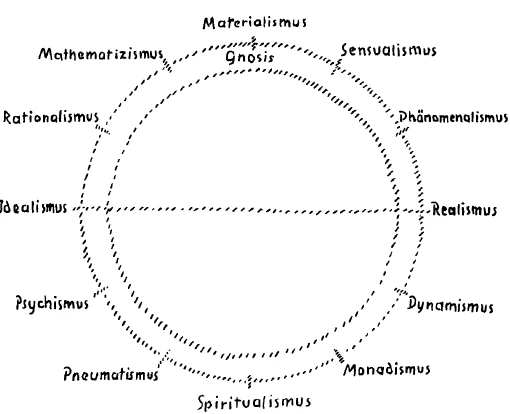
[ 8 ] Man kann Gnostiker sein für alle zwölf Weltanschauungsbilder. Das heißt, wenn wir die Gnosis richtig hineinstellen wollen, müssen wir es so machen, daß wir einen Kreis zeichnen und daß uns der ganze Kreis bedeutet: Die Gnosis kann herumwandeln durch alle zwölf Weltanschauungsbilder. Wie ein Planet die zwölf Tierkreisbilder durchwandelt, so kann die Gnosis alle zwölf Weltanschauungsbilder durchwandeln.
[ 8 ] One can be a Gnostic within all twelve worldviews. This means that if we want to properly situate Gnosis, we must do so by drawing a circle, where the entire circle signifies that Gnosis can move through all twelve worldviews. Just as a planet traverses the twelve signs of the zodiac, so Gnosticism can traverse all twelve worldviews.
[ 9 ] Allerdings wird die Gnosis die größten Dienste für das Heil der Seelen dann leisten, wenn die gnostische Stimmung angewendet wird für den Spiritualismus. Man könnte sagen: Die Gnosis ist im Spiritualismus so recht zu Hause. Sie ist da in «ihrem» Hause. Sie ist außer ihrem Hause in den anderen Weltanschauungsbildern. Logisch hat man nicht die Berechtigung zu sagen, es könnte keine materialistische Gnostik geben. Die Pedanten der Begriffe und Ideen werden mit solchen Dingen leichter fertig als die gesunden Logiker, die es etwas komplizierter haben. Man könnte zum Beispiel sagen: Ich will nichts anderes Gnosis nennen, als was in den Geist eindringt. Das ist eine willkürliche Begriffsbestimmung, ist ebenso willkürlich, wie wenn jemand sagen würde: Veilchen habe ich bis jetzt nur in Österreich gesehen, also nenne ich Veilchen nur das, was in Österreich wächst und die Veilchenfarbe hat, anderes nicht. Logisch ist es ebenso unmöglich zu sagen, Gnosis gebe es nur im Weltanschauungsbilde des Spiritualismus; denn Gnosis ist ein «Planet», der die Geistes-Sternbilder durchläuft.
[ 9 ] However, Gnosticism will be of greatest service to the salvation of souls when the Gnostic spirit is applied to Spiritualism. One might say: Gnosticism is truly at home in Spiritualism. There it is in “its” home. In other worldviews, it is outside its home. Logically, one has no right to say that there could be no materialistic Gnosticism. The pedants of concepts and ideas deal with such matters more easily than sound logicians, who have a somewhat more complicated time of it. One could say, for example: I will call nothing Gnosticism except that which penetrates the spirit. This is an arbitrary definition, just as arbitrary as if someone were to say: “I have only seen violets in Austria so far, so I will call only that which grows in Austria and has the color of a violet a violet, and nothing else.” Logically, it is equally impossible to say that Gnosis exists only within the worldview of Spiritualism; for Gnosis is a “planet” that traverses the constellations of the spirit.
[ 10 ] Es gibt eine andere Weltanschauungsstimmung. «Stimmung» sage ich hierbei, während ich sonst von «Nuancen» und «Bildern» spreche. Und man hat in den neueren Zeiten gemeint, in einer leichteren Art - doch ist auch hier «das Leichte schwer»! — diese zweite Weltanschauungsstimmung kennenzulernen, weil diese im Geistes-Sternbilde des Idealismus gerade von Hegel vertreten worden ist. Aber diejenige Art, die Welt zu betrachten, diese besondere Weltanschauungsstimmung, die Hegel gehabt hat, braucht nicht, wie bei ihm, bloß im Geistes-Sternbilde des Idealismus zu stehen, sondern sie kann wieder durch alle Sternbilder durchgehen. Es ist die Weltanschauungsstimmung des Logismus. Diese Weltanschauungsstimmung des Logismus besteht vorzugsweise darin, daß sich die Seele in die Lage versetzen kann, wirkliche Gedanken, Begriffe und Ideen in sich gegenwärtig sein zu lassen, diese Gedanken und Ideen so in sich gegenwärtig zu haben, daß eine solche Seele von einem Begriffe oder einem Gedanken zu dem anderen so kommt, wie man, wenn man einen menschlichen Organismus ansieht, von dem Auge zur Nase und zum Mund kommt und alles dieses als zusammengehörig betrachtet, wie es bei Hegel ist, wo alle Begriffe, die er fassen kann, sich zu einem großen Begriffsorganismus zusammenordnen. Das ist ein logischer Begriffsorganismus. Hegel war einfach imstande, alles, was in der Welt als Gedanke gefunden werden kann, aufzusuchen und aufzunehmen, Gedanken an Gedanken zu reihen und daraus einen Organismus zu machen: Logismus! Man kann den Logismus ausbilden so wie Hegel, im Sternbilde des Idealismus, kann ihn ausbilden so wie Fichte, im Sternbilde des Psychismus, und man kann ihn in anderen Geistes-Sternbildern ausbilden. Wiederum ist der Logismus etwas, was wie ein Planet durch die Tierkreisbilder durchgeht, was kreisförmig durch die zwölf Geistes-Tierkreisbilder geht.
[ 10 ] There is another worldview mood. I use the term “mood” here, whereas I usually speak of “nuances” and “images.” And in recent times, people have tended to view it in a more lighthearted way—yet even here, “the light is heavy”! —to become acquainted with this second worldview mood, because it has been represented in the constellation of the spirit of idealism precisely by Hegel. But that way of viewing the world, this particular worldview mood that Hegel possessed, need not, as in his case, remain merely within the constellation of the spirit of idealism; rather, it can pass through all the constellations once more. It is the worldview of Logism. This worldview of Logism consists primarily in the soul’s ability to allow real thoughts, concepts, and ideas to be present within itself, to have these thoughts and ideas present within itself in such a way that such a soul moves from one concept or thought to another just as one, when looking at a human organism, moves from the eye to the nose and to the mouth and regards all of this as belonging together, as is the case with Hegel, where all the concepts he can grasp are organized into a great conceptual organism. This is a logical conceptual organism. Hegel was simply capable of seeking out and absorbing everything that can be found in the world as thought, of stringing thoughts together and making an organism out of them: Logism! One can develop Logism as Hegel did, within the constellation of Idealism; one can develop it as Fichte did, within the constellation of Psychism; and one can develop it within other constellations of the spirit. Again, Logism is something that passes through the zodiacal constellations like a planet, moving in a circular path through the twelve constellations of the spirit.
[ 11 ] Eine dritte Stimmung der Seele, die Weltanschauungen macht, können wir zum Beispiel bei Schopenhauer studieren. Während Hegels Seele, wenn er hinschaut auf die Welt, so gestimmt ist, daß zunächst in dieser Hegel-Seele alles, was in der Welt Begriff ist, als der Logismus sich ergibt, faßt Schopenhauer durch die besondere Stimmung seiner Seele alles das in der Seele auf, was willensartig ist. Für ihn sind die Naturkräfte Wille, die Härte des Steines ist Wille, alles, was Realität ist, ist Wille. Das kommt aus der besonderen Stimmung seiner Seele. Nun kann man eine solche Weltanschauung des Willens, solche Weltanschauungsstimmung des Willens wiederum wie einen Planeten betrachten, der durch alle zwölf Geistes-Tierkreisbilder geht. Ich will diese Weltanschauungsstimmung Voluntarismus nennen. Es ist die dritte Weltanschauungsstimmung. Schopenhauer war Voluntarist, und er war in seiner Seele vorzugsweise so konstituiert, daß er sich aussetzte dem Geistes-Sternbilde des Psychismus. So entstand die eigentümliche Schopenhauersche Willensmetaphysik: Voluntarismus im Geistes-Sternbilde des Psychismus.
[ 11 ] We can study a third disposition of the soul—one that gives rise to worldviews—in Schopenhauer, for example. While Hegel’s soul, when he looks at the world, is disposed in such a way that initially, in this Hegelian soul, everything in the world that is a concept emerges as logic, Schopenhauer, through the particular mood of his soul, grasps within the soul everything that is will-like. For him, the forces of nature are will; the hardness of the stone is will; everything that is reality is will. This stems from the particular mood of his soul. Now one can regard such a worldview of the will, such a worldview mood of the will, in turn as a planet passing through all twelve constellations of the spiritual zodiac. I wish to call this worldview mood voluntarism. It is the third worldview mood. Schopenhauer was a voluntarist, and his soul was constituted in such a way that he exposed himself to the spiritual constellation of psychism. Thus arose Schopenhauer’s peculiar metaphysics of the will: voluntarism within the spiritual constellation of psychism.
[ 12 ] Nehmen Sie einmal an, es würde jemand Voluntarist sein und besonders hinneigen zu dem Geistes-Sternbilde des Monadismus. Dann würde er nicht wie Schopenhauer so eine Einheitsseele, die eigentlich Wille ist, der Welt zugrunde legen, sondern er würde viele Monaden, die aber Willenswesen sind, der Welt zugrunde legen. Diese Welt des monadologischen Voluntarismus hat in schönster, scharfsinnigster und, ich möchte sagen, innigster Weise der österreichische Dichterphilosoph Hazmerling ausgebildet. Wodurch ist die eigentümliche Lehre, die Sie in der «Atomistik des Willens» von Hamerling haben, zustande gekommen? Dadurch, daß seine Seele voluntaristisch gestimmt war und er sich vorzugsweise ausgesetzt hat dem Geistes-Sternbilde des Monadismus. Wenn wit Zeit hätten, könnten wir für jede Seelenstimmung in jedem Sternbilde Beispiele anführen. Sie finden sich in der Welt.
[ 12 ] Suppose, for a moment, that someone were a voluntarist and particularly inclined toward the spiritual constellation of monadism. Then he would not, like Schopenhauer, base the world on a single soul—which is essentially will—but rather on many monads, which are beings of will. This world of monadological voluntarism was developed in the most beautiful, most astute, and, I would say, most heartfelt way by the Austrian poet-philosopher Hamerling. How did the unique doctrine found in Hamerling’s “Atomistics of the Will” come about? Because his soul was of a voluntaristic disposition and he exposed himself primarily to the spiritual constellation of monadism. If we had the time, we could cite examples for every soul disposition in every constellation. They are to be found in the world.
[ 13 ] Eine besondere Seelenstimmung ist diese, welche nun gar nicht geneigt ist, viel nachzudenken oder nachzusinnen, ob nun hinter den Erscheinungen dieses oder jenes noch ist, wie es zum Beispiel die gnostische Stimmung tut oder wie es die logische oder die voluntatistische Stimmung tut, sondern die einfach sagt: Ich will das, was mir in der Welt entgegentritt, was sich mir zeigt, was sich mir äußerlich offenbart, meiner Weltanschauung eingliedern. Das kann man wieder auf allen Gebieten, das heißt durch alle Geistes-Sternbilder durch. Man kann es als Materialist machen, daß man nur das nimmt, was einem äußerlich entgegentritt; man kann es auch als Spiritualist machen. Man bemüht sich nicht, einen besonderen Zusammenhang hinter den Erscheinungen zu suchen, sondern man läßt die Dinge an sich herankommen und wartet, was sich einem darbietet. Solche Seelenstimmung kann man Empirismus nennen. Empirismus heißt eine Seelenstimmung, welche die Erfahrung, wie sie sich darbietet, einfach hinnimmt. Durch alle zwölf Geistes-Sternbilder hindurch kann man Empirist sein, Erfahrungsweltanschauungs-Mensch. Empirismus ist die vierte Seelenstimmung, die durch alle zwölf GeistesSternbilder durchgehen kann.
[ 13 ] This is a particular state of mind that is not at all inclined to think deeply or ponder whether there is anything beyond the appearances of this or that—as, for example, the Gnostic mindset does, or as the logical or voluntarist mindset does—but which simply says: I want to incorporate into my worldview whatever comes to meet me in the world, whatever shows itself to me, whatever reveals itself to me externally. This can be done in all areas, that is, through all the constellations of the spirit. One can do this as a materialist, taking only what comes to meet one externally; one can also do it as a spiritualist. One does not strive to seek a particular connection behind the phenomena, but rather allows things to come to oneself and waits to see what presents itself. Such a state of mind can be called empiricism. Empiricism is a state of mind that simply accepts experience as it presents itself. One can be an empiricist—a person with an experiential worldview—throughout all twelve spiritual constellations. Empiricism is the fourth state of mind that can pass through all twelve spiritual constellations.
[ 14 ] Ebenso kann man für die Weltanschauung eine solche Seelenstimmung entwickeln, welche sich nicht zufrieden gibt mit demjenigen, was die Erfahrung, die einem so entgegentritt, was das Erleben, dem man ausgesetzt ist, ergibt, wie das beim Empirismus der Fall ist; sondern man kann sich sagen, das heißt, man kann als eine innere Notwendigkeit durchfühlen die Seelenstimmung: Der Mensch ist in die Welt hereingestellt; in seiner eigenen Seele erlebt er etwas über die Welt, was er äußerlich nicht erleben kann. Da erst enthüllt die Welt ihre Geheimnisse. Man mag um sich herumschauen - man sieht nicht das, was die Welt an Geheimnissen enthält. - Solche Seelenstimmung kann oftmals sagen: Was hilft mir die Gnosis, die sich mit aller Mühe emporringt zu allerlei Schauungen? Die Dinge der äußeren Welt, über die man Schauungen hat, können einem doch nicht das Innere der Welt offenbaren. Was hilft mir der Logismus zu einer Weltanschauung? In dem Logismus drückt sich das Wesen der Welt nicht aus. Was hilft Spekulation über den Willen? Das bringt nur davon ab, in die Tiefen der eigenen Seele zu schauen. Und in diese Tiefen blickt man nicht, wenn die Seele will, sondern gerade dann, wenn sie hingebend, willenlos ist. — Also auch der Voluntarismus ist nicht die Seelenstimmung, die die Seele hier braucht, auch nicht der Empirismus, das bloße Hinschauen oder Hinhorchen auf das, was die Erfahrung, das Erleben gibt; sondern das innerliche Suchen, wenn die Seele ruhig geworden ist, wie der Gott in der Seele aufleuchtet. Sie merken, diese Seelenstimmung kann genannt werden die Mystik.
[ 14 ] Similarly, one can develop a state of mind regarding one’s worldview that is not satisfied with what experience presents to us, with what our lived experience yields, as is the case with empiricism; rather, one can say to oneself—that is, one can feel as an inner necessity the state of mind: Human beings are placed in the world; in their own souls they experience something about the world that they cannot experience externally. Only then does the world reveal its secrets. One may look around—one does not see what secrets the world contains. - Such a mood of the soul can often ask: What good is gnosis to me, which struggles with all its might to rise to all manner of visions? The things of the outer world, about which one has visions, cannot reveal the inner world to one. What good is logism to me in forming a worldview? The essence of the world is not expressed in logic. What good is speculation about the will? That only distracts one from looking into the depths of one’s own soul. And one does not look into these depths when the soul wills it, but precisely when it is surrendered, will-less. — Thus, voluntarism is not the state of mind the soul needs here, nor is empiricism—the mere looking at or listening to what experience provides; rather, it is the inner seeking, when the soul has become still, of how God shines forth within the soul. You see, this state of mind can be called mysticism.
[ 15 ] Mystiker kann man wieder durch alle zwölf Geistes-Sternbilder hindurch sein. Es wird gewiß nicht sonderlich günstig sein, wenn man Mystiker des Materialismus ist, das heißt, wenn man nicht das Geistige, das Spirituelle, sondern das Materielle innerlich erlebt. Denn Mystiker des Materialismus ist eigentlich der, welcher sich ein besonders feines Empfinden zum Beispiel für die Art des Befindens angeeignet hat, in das man kommt, wenn man den einen oder den anderen Stoff genießt. Es ist etwas anderes, wenn man, ich will sagen, den Saft der einen Pflanze genießt oder den einer anderen Pflanze und nun wartet, was dadurch im Organismus bewirkt wird. Man wächst also in seinem Erleben mit der Materie zusammen, wird Mystiker der Materie. Es kann sogar sein, daß das eine Aufgabe für das Leben werden kann, eine Aufgabe so für das Leben, daß man verfolgt, auf welche Art der eine oder der andere Stoff, der von dieser oder jener Pflanze kommt, besonders auf den Organismus wirkt; denn der eine wirkt besonders auf dieses, der andere besonders auf jenes Organ. Und so Mystiker des Materialismus sein ist eine Vorbedingung für die Untersuchung der einzelnen Stoffe hinsichtlich ihrer Heilkraft. Man merkt, was die Stoffe tun im Organismus. — Man kann Mystiker der Stoffwelt sein, man kann Mystiker des Idealismus sein. Ein gewöhnlicher Idealist oder ein gnostischer Idealist ist nicht Mystiker des Idealismus. Mystiker des Idealismus ist der, welcher vor allen Dingen in der eigenen Seele die Möglichkeit hat, aus im Innern verborgenen Quellen heraufzuholen die Ideale der Menschheit, sie als inneres Göttliches zu empfinden und als solches sich vor die Seele zu stellen. Ein Mystiker des Idealismus ist zum Beispiel der Mezster Eckhart.
[ 15 ] One can be a mystic in all twelve constellations of the spirit. It will certainly not be particularly beneficial to be a mystic of materialism—that is, to experience not the spiritual but the material within oneself. For a mystic of materialism is actually someone who has acquired a particularly refined sensitivity, for example, to the state of being one enters into when one enjoys one substance or another. It is something else entirely when one, so to speak, enjoys the sap of one plant or that of another and then waits to see what effect this has on the organism. One thus grows together with matter in one’s experience, becoming a mystic of matter. It may even be that this can become a life’s work—a task for life—in which one investigates how one substance or another, derived from this or that plant, specifically affects the organism; for one acts particularly on this organ, the other particularly on that organ. And so being a mystic of materialism is a prerequisite for investigating individual substances with regard to their healing power. One notices what the substances do in the organism. — One can be a mystic of the material world; one can be a mystic of idealism. An ordinary idealist or a Gnostic idealist is not a mystic of idealism. A mystic of idealism is one who, above all, has the capacity within one’s own soul to draw forth from inner, hidden sources the ideals of humanity, to perceive them as the inner divine, and to place them before the soul as such. A mystic of idealism is, for example, Meister Eckhart.
[ 16 ] Nun kann die Seele so gestimmt sein, daß sie nicht das gewahr werden kann, was in ihrem Innern aufsteigt und was sich wie die eigentliche innere Lösung der Weltenrätsel ausnimmt, sondern eine Seele kann so gestimmt sein, daß sie sich sagt: Ja, in der Welt ist irgend etwas hinter allen Dingen, wie hinter meiner eigenen Wesenheit, soweit ich diese Wesenheit wahrnehme. Aber ich kann kein Mystiker sein. Der Mystiker glaubt, das fließt herein in seine Seele. Ich fühle es nicht in meine Seele hereinfließen; ich fühle nur, daß es da sein muß, draußen. — Man setzt in dieser Seelenstimmung voraus, daß außer unserer Seele und außer dem, was unsere Seele erfahren kann, das Wesen der Dinge steckt; aber man setzt nicht voraus, daß dieses Wesen der Dinge in die Seele selber hereinkommen kann, wie der Mystiker es voraussetzt. Wenn man voraussetzt, daß hinter allem noch etwas ist, das man nicht erreichen kann in der Wahrnehmung, dann ist man - das ist vielleicht das beste Wort dafür — Transzendentalist. Man nimmt an, daß das Wesen der Dinge transzendent ist, daß es nicht in die Seele hereinkommt, wie es der Mystiker annimmt. Also: Transzendentalismus. Die Stimmung des Transzendentalisten ist so, daß er das Gefühl hat: Wenn ich die Dinge wahrnehme, so kommt das Wesen der Dinge an mich heran; nur die Wahrnehmung selber ist nicht dieses Wesen. Das Wesen steckt dahinter, aber es kommt an den Menschen heran.
[ 16 ] Now, the soul may be disposed in such a way that it cannot perceive what rises up within it—and what appears to be the true inner solution to the world’s mysteries—but a soul may also be disposed in such a way that it says to itself: Yes, there is something in the world behind all things, just as there is behind my own being, insofar as I perceive this being. But I cannot be a mystic. The mystic believes that this flows into his soul. I do not feel it flowing into my soul; I only feel that it must be there, out there. — In this state of mind, one assumes that the essence of things lies beyond our soul and beyond what our soul can experience; but one does not assume that this essence of things can enter the soul itself, as the mystic assumes. If one assumes that behind everything there is still something that cannot be reached through perception, then one is—this is perhaps the best word for it—a transcendentalist. One assumes that the essence of things is transcendent, that it does not enter the soul, as the mystic assumes. So: Transcendentalism. The mindset of the transcendentalist is such that he feels: When I perceive things, the essence of things comes to me; only perception itself is not this essence. The essence lies behind it, but it comes to the human being.
[ 17 ] Es kann nun der Mensch mit seinen Wahrnehmungen, mit alledem, was seine Erkenntniskräfte sind, gleichsam noch mehr das Wesen der Dinge abschieben, als es der Transzendentalist tut. Man kann sagen: Für die menschliche äußere Erkenntniskraft ist das Wesen der Dinge überhaupt nicht erreichbar. Der Transzendentalist sagt: Wenn du mit deinem Auge Rot und Blau siehst, so ist das, was du als Rot und Blau siehst, nicht das Wesen der Dinge; aber dahinter steckt es. Du mußt deine Augen anwenden, dann dringst du bis an das Wesen der Dinge heran. Dahinter ist es. - Diese Seelenstimmung aber, die ich jetzt meine, will nicht im Transzendentalismus leben, sondern sie sagt: Man mag noch so sehr Rot oder Blau oder diesen oder jenen Ton erleben, das alles drückt nicht das Wesen der Dinge aus. Das ist erst dahinter verborgen. Da, wo ich wahrnehme, stößt gar nicht das Wesen der Dinge an. - Wer so spricht, der spricht ähnlich der Art, wie wir gewöhnlich sprechen, die wir durchaus auf dem Standpunkte stehen: In dem äußeren Sinnenschein, in der Maja, drückt sich nicht das Wesen der Dinge aus. Wir wären Transzendentalisten, wenn wir sagten: Um uns herum breitet sich die Welt aus, und diese Welt kündet überall an das Wesen. Das sind wir nicht, wenn wir sagen: Diese Welt ist Maja, und man muß auf eine andere Weise als durch das äußere Wahrnehmen der Sinne und die gewöhnlichen Erkenntnismittel das Innere der Dinge suchen, Okkultismus ist das, die Seelenstimmung des Okkultismus.
[ 17 ] With his perceptions and all his cognitive faculties, man can, as it were, push the essence of things even further away than the transcendentalist does. One might say: For the human faculty of external cognition, the essence of things is completely unattainable. The transcendentalist says: When you see red and blue with your eyes, what you see as red and blue is not the essence of things; but it lies behind them. You must use your eyes; then you will penetrate to the essence of things. It is behind them. — But this state of mind, which I now mean, does not wish to dwell in transcendentalism; rather, it says: No matter how intensely one may experience red or blue or this or that tone, none of that expresses the essence of things. That is hidden only behind it. Where I perceive, the essence of things does not come into contact at all. — Whoever speaks this way speaks similarly to the way we usually speak, we who certainly stand on the standpoint: In the outward appearance of the senses, in Maya, the essence of things is not expressed. We would be transcendentalists if we said: The world spreads out around us, and this world proclaims the essence everywhere. We are not that when we say: This world is Maya, and one must seek the inner nature of things in a way other than through the external perception of the senses and the ordinary means of knowledge; that is occultism, the spiritual mood of occultism.
[ 18 ] Man kann wiederum durch alle Geistes-Tierkreiszeichen hindurch Okkultist sein. Man kann durchaus Okkultist auch sogar des Materialismus sein. Ja, die vernünftigen Naturforscher der Gegenwart sind alle Okkultisten des Materialismus, denn sie reden von Atomen. Wenn sie aber nicht unvernünftig sind, wird es ihnen gar nicht einfallen, zu behaupten, daß man mit irgendeiner Methode an das Atom herankommen kann. Das Atom bleibt im Okkulten. Sie lieben es nur nicht, Okkultisten genannt zu werden, aber sie sind es im vollsten Sinne des Wortes.
[ 18 ] One can, in turn, be an occultist across all the spiritual signs of the zodiac. One can certainly even be an occultist of materialism. Indeed, the rational natural scientists of today are all occultists of materialism, for they speak of atoms. But if they are not irrational, it would never occur to them to claim that one can approach the atom by any method. The atom remains in the occult. They simply do not like to be called occultists, but they are so in the fullest sense of the word.
[ 19 ] Andere Weltanschauungsstimmungen als diese sieben, die ich hier aufgezeichnet habe, kann es im wesentlichen nicht geben, nur Übergänge von einer zur andern. So müssen wir also unterscheiden nicht nur zwölf verschiedene Weltanschauungsnuancen, die uns wie ruhend entgegentreten, sondern in jeder dieser Weltanschauungsnuancen ist eine ganz besondere Stimmung der Menschenseele möglich. Daraus ersehen Sie, wie ungeheuer mannigfaltig die Weltanschauungen der menschlichen Persönlichkeiten sein können. Man kann jede dieser sieben Weltanschauungsstimmungen besonders ausbilden, aber jede dieser Weltanschauungsstimmungen wieder einseitig in der einen oder anderen Nuance. Was ich hier aufgezeichnet habe, das ist tatsächlich auf dem Gebiete des Geistigen das Korrelat desjenigen, was äußerlich in der Welt das Verhältnis zwischen den Tierkreisbildern und den Planeten ist, wie wir es eben in der Geisteswissenschaft als die sieben bekannten Planeten oftmals angeführt haben, und man hat so ein Bild, gleichsam ein äußeres Bild, das wir nicht geschaffen haben, sondern das im Kosmos drinnensteht, für die Beziehungen unserer sieben Weltanschauungsstimmungen zu unseren zwölf Weltanschauungsnuancen. Und richtig witd man dieses Bild empfinden, wenn man es in der folgenden Weise empfindet.
[ 19 ] Essentially, there can be no worldviews other than these seven that I have listed here; there are only transitions from one to another. Thus, we must distinguish not only twelve different shades of worldview that appear to us as if at rest, but within each of these shades of worldview, a very particular mood of the human soul is possible. From this you can see how immensely diverse the worldviews of human personalities can be. One can develop each of these seven worldview moods in particular, but each of these worldview moods again one-sidedly in one nuance or another. What I have described here is, in the spiritual realm, the counterpart to what exists externally in the world as the relationship between the zodiac signs and the planets, as we have often cited in spiritual science regarding the seven known planets, and so one has a picture, as it were an external picture, which we have not created but which exists within the cosmos, for the relationships of our seven worldview moods to our twelve worldview nuances. And one perceives this picture correctly when one perceives it in the following way.
[ 20 ] Man beginne beim Idealismus, bezeichne diesen als das GeistesTierkreisbild des Widder, bezeichne in gleicher Weise den Rationalismus als Stier, den Mathematizismus als Zwillinge, den Materialismus als Krebs, den Sensualismus als Löwe, den Phänomenalismus als Jungfrau, den Realismus als Waage, den Dynamismus als Skorpion, den Monadismus als Schütze, den Spiritualismus als Steinbock, den Pneumatismus als Wassermann, den Psychismus als Fische. Die Beziehungen, die zwischen den einzelnen Tierkreisbildern in bezug auf das äußere Räumlich-Materielle bestehen, sind tatsächlich auf dem Gebiete des Geistes zwischen diesen Weltanschauungen vorhanden. Und was die einzelnen von uns bezeichneten Planeten bei ihrem Kreisen längs des Tierkreises für Verhältnisse eingehen, das entspricht den Verhältnissen, welche die sieben Weltanschauungsstimmungen eingehen, aber so, daß wir empfinden können die Gnosis als Saturn, den Logismus als Jupiter, den Voluntarismus als Mars, den Empirismus als Sonne, die Mystik als Venus, den Transzendentalismus als Merkur und den Okkultismus als Mond.
[ 20 ] Let us begin with idealism, designating it as the spiritual zodiac sign of Aries; in the same way, let us designate rationalism as Taurus, mathematism as Gemini, materialism as Cancer, sensualism as Leo, phenomenalism as Virgo, realism as Libra, dynamism as Scorpio, monadism as Sagittarius, spiritualism as Capricorn, pneumatism as Aquarius, and psychism as Pisces. The relationships that exist between the individual zodiac signs with regard to the external, spatial, and material realm are in fact present in the realm of the spirit between these worldviews. And the relationships that the individual planets we have designated enter into as they circle along the zodiac correspond to the relationships entered into by the seven worldview dispositions, but in such a way that we can perceive Gnosis as Saturn, Logism as Jupiter, Voluntarism as Mars, Empiricism as the Sun, Mysticism as Venus, Transcendentalism as Mercury, and Occultism as the Moon.
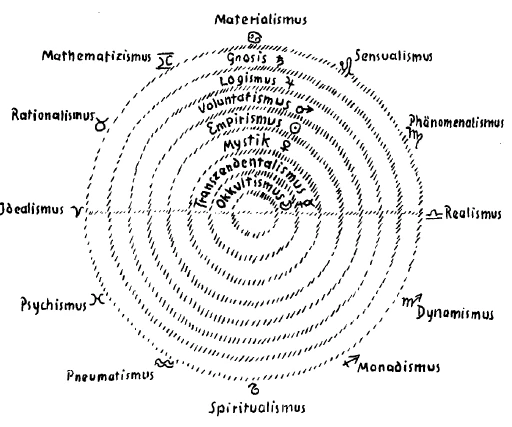
[ 21 ] Bis auf die äußeren Bilder - aber das ist nicht die Hauptsache; die Hauptsache ist tatsächlich, daß die tiefinnersten Beziehungen dieser Parallelisierung entsprechen -, aber selbst bis auf die äußeren Bilder werden Sie, wo etwas so zu konstatieren ist, etwas Ähnliches finden. Der Mond bleibt okkult, unsichtbar, wenn er Neumond ist; er muß erst das Licht von der Sonne herangeführt bekommen, geradeso wie die okkulten Dinge okkult bleiben, bis sich das Seelenvermögen dutch die Meditation, Konzentration und so weiter erhebt und die okkulten Dinge beleuchtet. Der Mensch, der durch die Welt geht und sich nur auf die Sonne verläßt, der nur aufnimmt, was die Sonne bescheint, ist Empitist. Wer auch noch etwas nachdenkt über das, was die Sonne bescheint, und auch noch die Gedanken behält, wenn die Sonne untergegangen ist, der ist nicht mehr Empirist, weil er sich nicht mehr auf die Sonne verläßt. «Sonne» ist das Symbolum des Empirismus. — Für alle diese Dinge könnte ich das weiter ausführen, aber wir haben ja nur vier Stunden zu diesem wichtigen Thema, und es wird Ihnen vorläufig überlassen bleiben müssen, genauere Beziehungen durch Ihre Gedanken oder Ihr sonstiges Forschen zu erkunden. Sie sind nicht einmal schwierig zu finden, wenn man einmal das Schema angegeben hat.
[ 21 ] Except for the outward appearances—but that is not the main point; the main point is, in fact, that the deepest inner relationships correspond to this parallelism—but even as far as the outward appearances are concerned, wherever something of this nature can be observed, you will find something similar. The moon remains occult, invisible, when it is a new moon; it must first have the light of the sun brought to it, just as occult things remain occult until the soul’s capacity is raised through meditation, concentration, and so on, and illuminates the occult things. The person who walks through the world relying solely on the sun, who takes in only what the sun illuminates, is an empiricist. Whoever also reflects on what the sun illuminates, and retains those thoughts even after the sun has set, is no longer an empiricist, because they no longer rely on the sun. “Sun” is the symbol of empiricism. — I could elaborate further on all these things, but we have only four hours for this important topic, and for now it will have to be left to you to explore more precise connections through your own thoughts or other research. They are not even difficult to find once the framework has been laid out.
[ 22 ] Nun kommt es wohl in der Welt allzuoft vor, daß die Menschen wenig nach Allseitigkeit streben. Man müßte ja wirklich, wenn man es mit der Wahrheit ernst nimmt, sich die zwölf Weltanschauungsnuancen in der Seele repräsentieren können, und man müßte in sich etwas von diesem erlebt haben: Wie erlebt es sich als Gnostiker? Wie erlebt es sich als Logiker, wie als Voluntarist, wie als Empirist, wie als Mystiker, wie als Transzendentalist? Und wie erlebt es sich als Okkultist? Probeweise muß ja das im Grunde genommen jeder durchmachen, der wirklich in die Geheimnisse der Welt im Sinne der geistigen Forschung eindringen will. Und wenn auch nicht das, was in «Wie erlangt man Erkenntnisse der höheren Welten?» steht, gerade auf diese Ausführungen hin zugeschnitten ist, so ist doch alles darin, nur von anderen Gesichtspunkten aus, geschildert, was uns in die einzelnen Stimmungen führen kann, die hier mit der gnostischen Stimmung, mit der Jupiterstimmung und so weiter bezeichnet sind.
[ 22 ] It seems that all too often in this world, people do not strive for comprehensiveness. If one takes the truth seriously, one really ought to be able to represent the twelve nuances of worldview within one’s soul, and one ought to have experienced something of this within oneself: What is it like to be a Gnostic? What is it like to be a logician, a voluntarist, an empiricist, a mystic, or a transcendentalist? And what is it like to be an occultist? Essentially, everyone who truly wishes to penetrate the mysteries of the world in the sense of spiritual research must go through this as a trial. And even if what is written in “How Does One Attain Knowledge of the Higher Worlds?” is not specifically tailored to these explanations, everything in it is described—albeit from different perspectives—that can lead us into the individual moods designated here as the Gnostic mood, the Jupiter mood, and so on.
[ 23 ] Es kommt in der Welt oft vor, daß der Mensch so einseitig ist, daß er sich nur einem Sternbilde aussetzt oder nur einer Stimmung. Gerade große Menschen auf dem Gebiete der Weltanschauungen haben diese Einseitigkeit allzu oft. So ist zum Beispiel Hamerling ausgesptochen ein voluntaristischer Monadist oder ein monadologischer Voluntarist, Schopenhauer ein ausgesprochener voluntaristischer Psychiker. Gerade die großen Menschen haben sozusagen ihre Seele so eingestellt, daß ihre planetarische Weltanschauungsstimmung in einem ganz bestimmten geistigen Sternbilde steht. Die anderen Menschen finden sich viel leichter ab mit den verschiedenen Standpunkten, wie man es so nennt. Aber es kann auch vorkommen, daß Menschen von verschiedenen Seiten her gleichsam angeregt werden für ihre Weltanschauung, für das, was sie als Weltanschauung aufstellen. So zum Beispiel kann es vorkommen, daß jemand ein guter Logist ist, aber seine logistische Stimmung steht im Geistes-Sternbilde des Sensualismus. Er kann zugleich ein guter Empiriker sein, aber seine empiristische Stimmung steht im Sternbilde des Mathematizismus. Das kann vorkommen. Wenn dieses so ist, dann stellt man ein ganz bestimmtes Weltanschauungsbild auf. Wir haben gerade in der Gegenwart dieses Weltanschauungsbild, das dadurch zustande gekommen ist, daß jemand seine Sonne - jetzt geistig gesprochen - in den Zwillingen und seinen Jupiter im Löwen hat; das ist Wundt. Und man wird alles einzelne begreifen, was in der philosophischen Literatur bei Wundt auftritt, wenn man hinter das Geheimnis seiner besonderen Seelenkonfiguration gekommen ist.
[ 23 ] It often happens in the world that people are so one-sided that they expose themselves to only one constellation or only one mood. It is precisely the great figures in the realm of worldviews who all too often exhibit this one-sidedness. Hamerling, for example, is a pronounced voluntaristic monadist or a monadological voluntarist, while Schopenhauer is a pronounced voluntaristic psychic. It is precisely these great figures who have, so to speak, attuned their souls in such a way that their planetary worldview mood is situated within a very specific spiritual constellation. Other people find it much easier to come to terms with the various points of view, as they are called. But it can also happen that people are, as it were, inspired from different sides for their worldview, for what they establish as their worldview. For example, it can happen that someone is a good logician, but their logical disposition is situated in the spiritual constellation of sensualism. They can at the same time be a good empiricist, but their empiricist disposition is situated in the constellation of mathematism. This can happen. If this is the case, then one establishes a very specific worldview. We have this very worldview today, which has come about because someone has their Sun—spiritually speaking—in Gemini and their Jupiter in Leo; that is Wundt. And one will understand every detail that appears in Wundt’s philosophical writings once one has uncovered the secret of his particular soul configuration.
[ 24 ] Besonders günstig liegt es, wenn ein Mensch die verschiedenen Seelenstimmungen — Okkultismus, Transzendentalismus, Mystik, Empirismus, Voluntarismus, Logismus, Gnosis — wirklich so übungsweise erlebt hat, daß er sie sich vergegenwärtigen kann, sie gleichsam in ihrer Wirkung auf einmal empfinden kann und dann alle diese Stimmungen - wie auf einmal - in das eine Sternbild des Phänomenalismus stellt, in die Jungfrau. Da tritt wirklich für seine Erscheinungen wie in Phänomenen vor ihm mit einer ganz besonderen Grandiosität das auf, was ihm in einer günstigen Weise die Welt enthüllen kann. Wenn man in derselben Weise hintereinander die einzelnen Weltanschauungsstimmungen stellt in bezug auf ein anderes Sternbild, so ist das nicht so gut zunächst. Daher hat man in vielen alten Mysterienschulen gerade diese Stimmung, die ich jetzt dadurch bezeichnet habe, daß gleichsam alle Seelenplaneten in dem GeistesSternbilde der Jungfrau stehen, für die Schüler herbeigeführt, weil diese dadurch am leichtesten eingedrungen sind in die Welt. Sie haben die Phänomene aufgefaßt, aber gnostisch, logisch und so weiter aufgefaßt; sie waren in der Lage, hinter die Phänomene zu kommen. Sie haben die Welt nicht grobklotzig empfunden. Das würde nur dann sein, wenn die Seelenstimmung des Voluntarismus auf den Skorpion eingestellt ist. Kurz, durch die Konstellation, die gegeben ist durch die Seelen-Weltanschauungsstimmungen, die das planetarische Element sind, und durch die Weltanschauungsnuancen, die das Element des Geistes-Tierkreises sind, wird das hervorgerufen, was der Mensch als seine Weltanschauung durch die Welt trägt in irgendeiner Inkarnation.
[ 24 ] It is particularly advantageous when a person has experienced the various states of mind—occultism, transcendentalism, mysticism, empiricism, voluntarism, logism, gnosis—in such a way through practice that they can be brought to mind, that their effects can be felt all at once, as it were, and then place all these moods—as if all at once—into the single constellation of phenomenalism, into Virgo. Then what can reveal the world to them in a favorable way truly appears before them in their manifestations, as in phenomena, with a very special grandeur. If one places the individual worldview moods one after another in the same way in relation to another constellation, this is not so good at first. That is why, in many ancient mystery schools, precisely this mood—which I have now described as if all the soul planets were situated in the spiritual constellation of Virgo—was brought about for the students, because this was the easiest way for them to penetrate the world. They grasped the phenomena, but grasped them gnostically, logically, and so on; they were able to get behind the phenomena. They did not perceive the world as crude and clumsy. That would only be the case if the soul mood of voluntarism were attuned to Scorpio. In short, through the constellation created by the soul-worldview moods—which constitute the planetary element—and by the worldview nuances—which constitute the element of the spiritual zodiac—that which the human being carries through the world as his worldview in any given incarnation is brought about.
[ 25 ] Es kommt allerdings noch eines dazu. Das ist, daß diese Weltanschauungen - es sind ihrer schon sehr viele Nuancen, wenn Sie sich alle Kombinationen suchen - noch dadurch modifiziert werden, daß sie alle einen ganz bestimmten Ton erhalten können. Aber auf diesem Gebiete des Tones haben wir nur dreierlei zu unterscheiden. Alle Weltanschauungen, alle Kombinationen, die auf diese Weise entstehen, können wieder in dreifacher Weise auftreten. Sie können erstens sein theistisch, so daß ich das, was in der Seele als Ton auftritt, zu benennen habe mit Theismus. Sie können so sein, daß wir im Gegensatz zum Theismus den betreffenden Seelenton zu nennen haben Intuitismus. Theismus entsteht, wenn der Mensch sich an alles Äußere hält, um seinen Gott zu finden, wenn er seinen Gott im Äußeren sucht. Der althebräische Monotheismus war vorzugsweise eine theistische Weltanschauung. Intuitismus entsteht, wenn der Mensch seine Weltanschauung vorzugsweise durch das sucht, was intuitiv in seinem Inneren aufleuchtet. Es gibt zu diesen beiden noch einen dritten Ton; das ist der Naturalismus.
[ 25 ] There is, however, one more factor to consider. This is that these worldviews—which already have a great many nuances if you examine all possible combinations—are further modified by the fact that they can all take on a very specific tone. But in this realm of tone, we need only distinguish between three types. All worldviews, all combinations that arise in this way, can manifest in three different ways. First, they can be theistic, so that I must name what appears in the soul as a tone “theism.” They can be such that, in contrast to theism, we must call the corresponding soul tone “intuitism.” Theism arises when a person relies on everything external to find his God, when he seeks his God in the external world. Ancient Hebrew monotheism was primarily a theistic worldview. Intuitism arises when a person seeks his worldview primarily through what intuitively shines within him. In addition to these two, there is a third tone: naturalism.
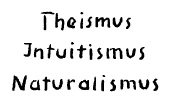
[ 26 ] Diese drei Seelentöne haben auch ein Abbild in der äußeren Welt des Kosmos, und zwar verhalten sie sich nun in der menschlichen Seele genauso wie Sonne, Mond und Erde, so daß der Theismus der Sonne entspricht - jetzt Sonne als Fixstern, nicht als Planet aufgefaßt -, daß der Intuitismus dem Mond entspricht und der Naturalismus der Erde. Derjenige - übersetzen Sie sich das einzelne, was hier als Sonne, Mond und Erde bezeichnet ist, ins Geistige —, welcher über die Erscheinungen der Welt hinausgeht und sagt: Wenn ich hinausschaue, so offenbart sich mir in alledem der Gott, der die Welt erfüllt, - der Erdenmensch, der sich aufrichtet, wenn er in die Sonnenstrahlen kommt, ist der Theist. Der Mensch, der nicht über die Naturvorgänge hinausgeht, sondern bei den einzelnen Erschetnungen stehenbleibt, so wie der, welcher nie seinen Blick zur Sonne hinaufrichtet, sondern nur auf das sieht, was ihm die Sonne hervorbringt auf der Erde, der ist Naturalist. Der, welcher das Beste, was er in der Seele haben kann, aufsucht dadurch, daß er es in seinen Intuitionen aufgehen läßt, der ist wie der den Mond besingende und vom silbernen, milden Mondenglanz in seiner Seele angeregte intuitistische Dichter und läßt sich mit ihm vergleichen. Wie man mit der Phantasie das Mondenlicht in Zusammenhang bringen kann, so muß man okkult den Intuitisten, wie er hier gemeint ist, mit dem Monde in Beziehung bringen.
[ 26 ] These three spiritual dispositions also have a counterpart in the outer world of the cosmos; indeed, they behave within the human soul in exactly the same way as the sun, moon, and earth, so that theism corresponds to the sun—here understood as a fixed star, not as a planet—intuitivism corresponds to the moon, and naturalism to the earth. The one—translate for yourself the individual elements referred to here as the sun, moon, and earth into the spiritual realm—who goes beyond the phenomena of the world and says: When I look out, God, who fills the world, reveals Himself to me in all of this—the earthly human being who stands up straight when he steps into the sun’s rays is the theist. The person who does not transcend natural processes but remains with individual phenomena—just as one who never raises his gaze to the sun but looks only at what the sun brings forth for him on Earth—is a naturalist. He who seeks the best that he can have in his soul by allowing it to merge with his intuitions is like the intuitive poet who sings of the moon and is inspired in his soul by the silver, gentle moonlight, and can be compared to it. Just as one can connect the moonlight with the imagination, so must one, in an occult sense, relate the intuitist—as understood here—to the moon.
[ 27 ] Endlich gibt es noch ein Viertes; das ist allerdings nur in einem einzigen Element vorhanden. Wenn der Mensch sich gewissermaßen in bezug auf alle Weltanschauung ganz nur an das hält, was er an oder um oder in sich selbst erfahren kann:.das ist Anthropomorphismus.
[ 27 ] Finally, there is a fourth; however, it is present in only a single element. When a person, so to speak, limits their worldview entirely to what they can experience in, around, or within themselves, that is anthropomorphism.

[ 28 ] Er entspricht der Erde, wenn man diese als solche betrachtet, abgesehen davon, ob sie von der Sonne, vom Mond oder anderem umgeben ist. Wie wir die Erde für sich allein betrachten können, so können wir auch in bezug auf Weltanschauungen auf nichts Rücksicht nehmen als auf das, was wir als Menschen in uns finden können. Dann wird der in der Welt so verbreitete Anthropomorphismus entstehen.
[ 28 ] It corresponds to the Earth when considered as such, regardless of whether it is surrounded by the Sun, the Moon, or anything else. Just as we can consider the Earth on its own, so too, when it comes to worldviews, we can take into account nothing other than what we as human beings can find within ourselves. Then the anthropomorphism so widespread in the world will arise.
[ 29 ] Geht man hinaus über das, was der Mensch ist, so wie man zur Erklärung der Erscheinung der Erde hinausgehen muß zu Sonne und Mond - was die gegenwärtige Wissenschaft nicht tut -, so kommt man dazu, dreierlei als nebeneinander berechtigt anerkennen zu müssen: Theismus, Intuitismus und Naturalismus. Denn nicht, daß man auf einem dieser Töne besteht, sondern daß man sie zusammenklingen läßt, entspricht dem, was die Wahrheit ist. Und wie unsere engere Körperlichkeit mit Sonne, Mond und Erde wieder hineingestellt ist in die sieben Planeten, so ist hineingestellt Anthropomorphismus als die trivialste Weltanschauung in das, was zusammenklingen kann aus Theismus, Intuitismus und Naturalismus, und dieses zusammen wieder in das, was zusammenklingen kann aus den sieben Seelenstimmungen. Und diese sieben Seelenstimmungen nuancieren sich nach den zwölf Zeichen des Tierkreises.
[ 29 ] If one goes beyond what it means to be human—just as one must go beyond the Earth to the Sun and the Moon to explain the Earth’s existence—which contemporary science does not do—one comes to the conclusion that three perspectives must be recognized as equally valid: theism, intuitionism, and naturalism. For it is not a matter of insisting on one of these tones, but of allowing them to harmonize together, that corresponds to what truth is. And just as our more immediate physicality, with the sun, moon, and Earth, is re-embedded within the seven planets, so too is anthropomorphism—as the most trivial worldview—re-embedded within what can harmonize from theism, intuitism, and naturalism, and this, in turn, is re-embedded within what can harmonize from the seven soul moods. And these seven soul moods are nuanced according to the twelve signs of the zodiac.
[ 30 ] Sie sehen schon, dem Namen nach, und zwar nur dem Namen nach, ist nicht eine Weltanschauung wahr, sondern es sind \(12 + 7 = 19 + 3 = 22 + 1 = 23\) Weltanschauungen berechtigt. Dreiundzwanzig berechtigte Namen für Weltanschauungen haben wir. Aber alles andere kann noch dadurch entstehen, daß die entsprechenden Planeten in den zwölf Geistes-Tierkreisbildern herumlaufen.
[ 30 ] As you can see, based on the name alone—and indeed, based solely on the name—not just one worldview is true, but rather \(12 + 7 = 19 + 3 = 22 + 1 = 23\) worldviews are valid. We have twenty-three valid names for worldviews. But everything else can still arise from the fact that the corresponding planets revolve through the twelve signs of the spiritual zodiac.
[ 31 ] Und nun versuchen Sie, aus dem, was jetzt auseinandergesetzt worden ist, sich ein Empfinden anzueignen für die Aufgabe, welche die Geisteswissenschaft für das Friedenstiften innerhalb der verschiedenen Weltanschauungen hat, für das Friedenstiften aus der Erkenntnis heraus, daß die Weltanschauungen miteinander, in ihrem gegenseitigen Aufeinanderwirken, in gewisser Beziehung erklärlich sind, daß sie aber alle nicht ins Innere der Wahrheit führen können, wenn sie einseitig bleiben, sondern daß man gleichsam den Wahrheitswert der verschiedenen Weltanschauungen innerlich in sich erfahren muß, um wirklich - wir dürfen so sagen - mit der Wahrheit zutechtzukommen. So wie Sie sich denken können den physischen Kosmos: den Tierkreis, das Planetensystem, Sonne, Mond und Erde zusammen, die Erde für sich, so können Sie sich ein geistiges Weltenall denken: Anthropomorphismus; Theismus, Intuitismus, Naturalismus; Gnosis, Logismus, Voluntarismus, Empitismus, Mystik, Transzendentalismus, Okkultismus; und das alles verlaufend in den zwölf Geistes-Tierkreisbildern. Das ist vorhanden; nur ist es geistig vorhanden. So wahr als der physische Kosmos physisch vorhanden ist, so wahr ist das geistig vorhanden.
[ 31 ] And now, based on what has been discussed, try to develop a sense of the task that spiritual science has in fostering peace among the various worldviews—in fostering peace based on the realization that these worldviews, in their mutual interaction, can be explained to a certain extent, but that none of them can lead to the inner core of truth if they remain one-sided; rather, one must, as it were, experience the truth value of the various worldviews inwardly within oneself in order to truly—so to speak—come to terms with the truth. Just as you can conceive of the physical cosmos—the zodiac, the planetary system, the Sun, Moon, and Earth together, the Earth on its own—so you can conceive of a spiritual cosmos: anthropomorphism; theism, intuitism, naturalism; gnosis, logism, voluntarism, empiricism, mysticism, transcendentalism, occultism; and all of this unfolding within the twelve spiritual zodiac signs. This exists; it simply exists spiritually. Just as the physical cosmos exists physically, so too does this exist spiritually.
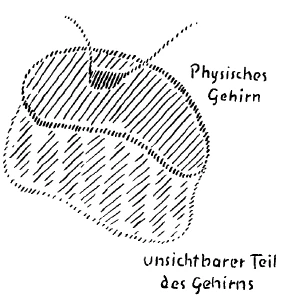
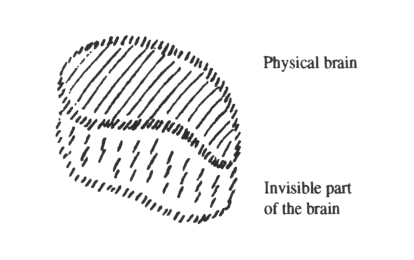
[ 32 ] In diejenige Hirnhälfte, die der Anatom findet, von der man ja sagen kann, daß sie die halbkugelförmige ist, in sie wirken herein vorzugsweise diejenigen Wirkungen des Geisteskosmos, die von den oberen Nuancen ausgehen. Dagegen gibt es einen unsichtbaren Teil des Gehirns, der nur, wenn man den Ätherleib betrachtet, sichtbar ist; der ist vorzugsweise von dem unteren Teil des Geisteskosmos beeinflußt (siehe Zeichnung.) Aber wie ist diese Beeinflussung? Sagen wir, bei jemandem ist es so, daß er mit seinem Logismus eingestellt ist in den Sensualismus, daß er eingestellt ist mit seinem Empirismus in den Mathematizismus. Dann gibt das, was auf diese Weise zustande kommt, Kräfte, die in sein Gehirn hereinwirken, und jener obere Teil seines Gehirns ist dann besonders regsam und übertönt die anderen. Unzählige Nuancen von Gehirntätigkeiten kommen dadurch zustande, daß das Gehirn gleichsam im geistigen Kosmos schwimmt und die Kräfte auf diese Weise ins Gehirn hereinwirken, wie wir das jetzt haben darstellen können. So mannigfaltig sind wirklich die menschlichen Gehirne, als sie mannigfaltig sein können nach den Kombinationen, die sich aus diesem geistigen Kosmos ergeben. Was in jenem unteren Teile des geistigen Kosmos ist, das wirkt gar nicht einmal auf das physische Gehirn, sondern auf das Äthergehirn.
[ 32 ] The hemisphere of the brain that the anatomist identifies—which can indeed be described as the hemispherical one—is primarily influenced by those forces of the spiritual cosmos that emanate from the higher realms. In contrast, there is an invisible part of the brain that is visible only when one observes the etheric body; this part is primarily influenced by the lower region of the spiritual cosmos (see diagram). But what is the nature of this influence? Let us say that in a certain person, their logic is attuned to sensualism, and their empiricism is attuned to mathematism. Then what arises in this way generates forces that act upon their brain, and that upper part of their brain is then particularly active and overpowers the others. Countless nuances of brain activity arise from the fact that the brain, as it were, floats in the spiritual cosmos and the forces act upon the brain in this way, as we have now been able to illustrate. Human brains are truly as diverse as they can be, according to the combinations that arise from this spiritual cosmos. What is in that lower part of the spiritual cosmos does not even act upon the physical brain, but upon the etheric brain.
[ 33 ] Wenn man von alledem spricht, dann ist wohl der beste Eindruck, den man davon erhalten kann, der, daß man sagt: Es eröffnet einem das die Empfindung für das Unendliche der Welt, für das qualitativ Großartige der Welt, für die Möglichkeit, daß man als Mensch in unendlicher Mannigfaltigkeit in dieser Welt existieren kann. Wahrhaftig, wenn wir nur dieses betrachten können, dann können wir uns schon sagen: Es fehlt wahrlich nicht an Möglichkeiten, daß wir verschieden sein können in unseren verschiedenen Inkarnationen, die wir auf der Erde durchzumachen haben. Und überzeugt kann man auch sein, daß der, welcher die Welt so betrachtet, gerade durch eine solche Weltbetrachtung dazu kommt, daß er sagen muß: Ach, wie reich, wie grandios ist die Welt! Welches Glück, an ihr immer weiter, immer mehr, immer mannigfaltiger teilzunehmen, an ihrem Sein, ihren Wirkungen, ihrem Streben!
[ 33 ] When speaking of all this, the best impression one can gain is probably to say: It opens up a sense of the world’s infinity, of the world’s qualitative grandeur, and of the possibility that, as human beings, we can exist in infinite diversity within this world. Truly, if we can only contemplate this, then we can already say to ourselves: There is certainly no lack of possibilities for us to be different in our various incarnations that we must undergo on Earth. And one can also be convinced that whoever views the world in this way will, precisely through such a view of the world, come to the point where they must say: Oh, how rich, how magnificent the world is! What a blessing it is to participate in it ever further, ever more, ever more diversely—in its being, its effects, its striving!