

Human and Cosmic Thought
GA 151
23 January 1914, Berlin
Translated by Steiner Online Library
Fourth Lecture
[ 1 ] We have been examining the various ideological nuances, ideological moods, and so on that can take root in the human soul, and since I can really only highlight a few specific aspects from the vast scope of this topic, I would like to illustrate one of these aspects with a particular example.
[ 2 ] Let us assume that a person lives in the world in such a way that he possesses within his nature the particular faculties that determine him to allow the ideological nuance of idealism to take effect upon him. What I mean to say is: He allows the worldview nuance of idealism to take effect within himself. He makes it, let us assume, a dominant factor in his inner life in such a way that the worldview mood in his soul—which I described yesterday as that of mysticism, as a Venusian mood—points, as it were, toward idealism and is nourished by its forces. Therefore, if one were to use the symbols of astrology, one might say that the spiritual constellation of such a person in his spiritual constitution is that Venus is in Aries.
[ 3 ] I would like to make it explicitly clear, so that there is no misunderstanding, that while these constellations are indeed far more significant in a person’s life than the constellations of the external horoscope, they do not coincide with the “nativity,” the external horoscope. For it is the case that the intensified influence exerted on a human soul by the fact that mysticism is under the sign of idealism awaits that favorable moment when it can seize the soul, so that it may draw out most strongly what can emerge from mysticism’s position under the sign of idealism. It need not be the case that these influences, which assert themselves through mysticism being under the sign of idealism, assert themselves precisely at birth; they can assert themselves before birth, and also afterward. In short, the moment is awaited that, according to the inner organic configuration of the human being, can best integrate these predispositions into the human organism.
[ 4 ] So the usual astrological birth chart does not apply here. But one can say that a certain soul has a disposition such that, spiritually speaking, Venus is in Aries, mysticism in the sign of idealism. Now, the forces that arise in this way do not persist throughout one’s entire life. They change; that is to say, the person comes under different influences, under different spiritual zodiac signs, and also under different soul moods. Let us suppose that a person changes in such a way that, in the course of his life, he enters into the soul mood of empiricism, so that, as it were, mysticism has progressed to empiricism, and empiricism stands under the sign of rationalism.
[ 5 ] As I noted yesterday, in the symbolic image, moving from the inner to the outer, empiricism follows mysticism just as the sun follows Venus. In terms of its mood, the soul has progressed toward empiricism and has at the same time placed itself under the sign of rationalism. In the life of the soul, this is expressed in such a way that such a soul changes in its worldview. What it has produced—perhaps especially if it was a particularly powerful personality during the time when mysticism stood under the sign of idealism—it will change, allowing it to transition into a different nuance of worldview. It will assert and say different things once the worldview mood of mysticism has shifted in this way toward empiricism, and the latter has aligned itself with rationalism. But from what I have just explained here, you can also infer that human souls may have a tendency to change the character and mood of their worldview. — For “this” soul, the tendency toward change is, so to speak, already indicated. Let us assume that it wishes to continue this tendency in life. It wishes to advance from empiricism to the next soul mood, to voluntarism. And if it were to advance in this way through the signs of the zodiac, it would enter into mathematism. It would then transition to a worldview that, in this symbolic image, deviates by an angle of 60 degrees from the first line, where mysticism stood in the sign of idealism. And such a soul would then, in the course of the same incarnation, express a mathematical world structure permeated by the will and based on the will. That is what it would express.
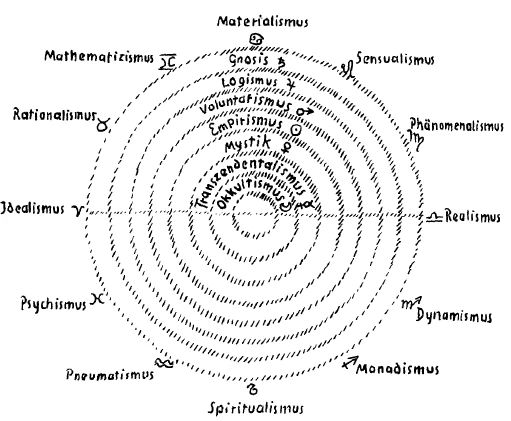
[ 6 ] But one thing becomes clear here—and I ask you to take note of this—it becomes clear that two such constellations, which exist in the soul over the course of time, interfere with and adversely influence one another when they are positioned in such a way that they form an angle of 60 degrees. In physical astrology, this is a favorable constellation; in spiritual astrology, this so-called sextile position is unfavorable. This is expressed in that this latter position—voluntarism within mathematicism—encounters a sharp obstacle in the soul, so that it cannot develop because it finds no foothold at all, since the person in question shows no aptitude whatsoever for what mathematics is. The unfavorable nature of the sextile position is expressed in the fact that no mathematical aptitude is present at all. This position—voluntarism in the sign of mathematicism—cannot therefore form. The consequence of this is that no attempt is made for the soul’s disposition to advance in this way. Rather, because the soul in question cannot now take this path toward voluntarism within mathematicism, it shifts from the position it currently holds—empiricism within rationalism—(see diagram) and seeks a way out—placing itself in opposition to the direction it can still maintain. Such a soul would therefore not advance toward voluntarism as indicated by the dotted line in the diagram, but would position itself in opposition to its empiricism within rationalism through voluntarism.
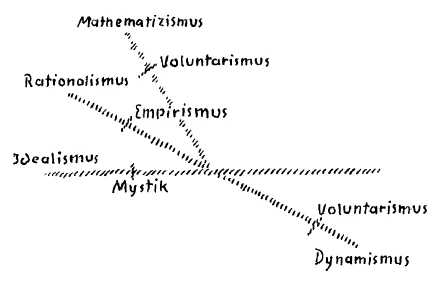
[ 7 ] This would manifest itself under the banner of dynamism. Voluntarism would stand in opposition to rationalism under the sign of dynamism. And in the course of its life, such a soul would have as its possible constellation the fact that it represents a worldview based on a special penetration of forces, of dynamism into the world, permeated by will; will—the will imbued with power. In spiritual astrology, things are different again than in physical astrology; in physical astrology, opposition has a completely different meaning than in spiritual astrology. Here, opposition arises because the soul cannot proceed further along a path that is unfavorable; it shifts into the position of opposition.
[ 8 ] I have recorded here what Nietzsche’s soul went through in the course of his life. If you try to understand the path taken in his early works, it becomes clear through the role of mysticism within the framework of idealism. From this period come The Birth of Tragedy and Untimely Meditations in its four parts: “David Strauss, the Confessor and the Writer,” “On the Use and Abuse of History for Life,” “Schopenhauer as Educator,” and “Richard Wagner in Bayreuth.” This is mysticism under the banner of idealism. Then the soul pushes forward. A second epoch begins. This is when Human, All Too Human, Dawn” and The Gay Science were written. Here, empiricism is shaped by rationalism. In the third period, emerging from a position of opposition, are the writings grounded in the will to power, in the will imbued with strength and power: Beyond Good and Evil, On the Genealogy of Morals, The Case of Wagner, Twilight of the Idols, The Antichrist, Thus Spoke Zarathustra.
[ 9 ] So you can see how there is an inner lawfulness between the spiritual cosmos and the way in which human beings are situated within this spiritual cosmos. One might say, using the symbols of astrology—which now, however, have a different meaning: In Nietzsche’s case, Venus was in Aries at a certain time in his life, but when this constellation shifted for his soul to the Sun in the sign of Taurus, he could not move forward; he could not enter the sign of Gemini with Mars, but instead moved into an opposition position, that is, with Mars in the sign of Scorpio. His final philosophical phase is characterized by the fact that he stood with Mars in the sign of Scorpio. However, one can only endure this constellation—namely, when one enters the lower positions, below the line of idealism-realism (see the diagram)—if one immerses oneself in a spiritual worldview, occultism, or the like; otherwise, these constellations must have an unfavorable effect on the person themselves. Hence Nietzsche’s tragic fate. One can endure the upper constellations if one is able to position oneself in the world in an appropriate manner through external circumstances. What lies below the line running from idealism to realism can only be endured if one immerses oneself in spiritual science, which Nietzsche was unable to do. By “positioning oneself externally in the world,” I mean everything that can be achieved, for example, through education or external living conditions; these apply to everything above the idealism-realism line. A meditative life, a life of study and understanding of spiritual science, applies to everything below the idealism-realism line.
[ 10 ] To grasp the significance of what has been outlined in these lectures, one must understand the following. One must realize what thought actually is in human experience, and how thought relates to human experience.
[ 11 ] The crude materialist of our time, in keeping with his intentions, speaks of the brain forming thought, or rather, of the central nervous system forming thought. For those who see through things, this is just as true as it would be to think, when looking into a mirror, that the mirror has created the face one sees. But it does not create the face one sees at all; rather, the face is outside the mirror. The mirror merely reflects the face, casting it back. I have even discussed this at length on several occasions in public lectures. The situation is very similar with regard to what a person experiences in terms of thoughts. Let us now set aside other aspects of the soul. The experience of thought, which is active and real within the soul as the person experiences the thought, arises no more from the brain than the image of the face is produced by the mirror. The brain, in fact, functions merely as a reflecting apparatus, so that it reflects back the activity of the soul and makes it visible to itself. The brain has as little to do with what a person perceives as thoughts as the mirror has to do with your face when you see your face in the mirror.
[ 12 ] But there is something else at work here. When a person thinks, they are actually only perceiving the final phase of their mental activity, of their mental experience. To make this clear, I would like to use the mirror analogy again. Imagine you were to stand in front of a mirror and try to see your face. If you don’t have a mirror there, you cannot see your face. No matter how long you stare, you won’t see your face. If you want to see it, you must take some material object and prepare it so that it becomes a mirror. That is, you must first prepare it so that it can produce the mirror image. Once you have done that and look into it, you see your face. - The soul must do with the brain what a person would do with a mirror. The actual mental activity of perceiving a thought is preceded by an activity which, for example, when you want to perceive the thought “lion,” first sets the parts of the brain deep inside in motion so that they become mirrors for the perception of the thought “lion.” And the one who first turns the brain into a mirror is you yourself. What you ultimately perceive as thoughts are mirror images; what you must first prepare so that the relevant mirror image appears is some part of the brain. It is you yourself, through your soul’s activity, who brings the brain into the structure and capacity to reflect what you think as a thought. If you wish to go back to the activity underlying thinking, it is the activity that reaches into the brain from the soul and operates within the brain. And when you perform a certain activity from the soul within the brain, such a reflection is brought about in the brain that you perceive the thought “lion.” - You see, a spiritual-soul element must first be present. It must be at work in the brain. Then, through this spiritual-soul activity, the brain becomes a mirroring apparatus to reflect the thought back. This is the actual process that is so confusing to so many people today that they cannot grasp it at all.
[ 13 ] Anyone who delves a little into occult perception can distinguish between the two phases of mental activity. They can observe how, when they want to think of something, they must first not only grasp the thought but also prepare it; that is, they must prepare their brain. Once they have prepared it to the point where it reflects, then they have the thought. Whenever one wishes to engage in occult research so as to be able to visualize things, one’s first task is not to visualize immediately, but rather to first perform the activity that prepares the way for visualization. This is what is so extraordinarily important to take into account. We must therefore take these things into consideration, because only now, when we take them into consideration, do we have the true efficacy of human thought before us. Only now do we know how human thought activity works. First, this thought activity takes hold of the brain, or rather the central nervous system somewhere, performs an activity, moves—let us say, for the sake of argument—the atomic particles in some way, sets them in motion. Through this, they become a mirror apparatus, and the thought is reflected and becomes conscious to the soul as such a thought. We must therefore distinguish between two phases: first, the brain activity originating from the spiritual-soul aspect; then perception comes about after the preparatory brain work for this perception has been done by the soul. In the ordinary person, the brain activity remains entirely in the subconscious; they perceive only the reflection. In the occult researcher, it is truly the case that one must first experience the preparation. One must experience how one must pour the soul activity into it and first prepare the brain so that it allows itself to present the thought to one.
[ 14 ] What I have just explained takes place continuously in human beings between waking and falling asleep. Thought activity is always at work in the brain, thus making the brain a mirror for thoughts throughout the entire waking state. But it is not enough that only what we ourselves process through thought activity is processed within us. For this is, one might say, a narrowly limited activity exercised by the spiritual-soul aspect. When we wake up in the morning, remain awake throughout the day, and fall asleep again in the evening, the spiritual-soul activity that belongs to thinking consists in this activity working on the brain throughout the day, thereby turning the brain into a mirror apparatus. But the brain must first be there; then the spiritual-soul activity can carve its little indentations—one might say, its notes and engravings—into the brain. The brain must therefore be present in its main form, in its main mass. But that is not enough for our human life.
[ 15 ] Our brain could not handle the daily demands of life if our entire organism were not prepared in such a way as to serve as a foundation for this daily work. And this work, which prepares the human organism, comes from the cosmos. Just as we work every day—from waking up to falling asleep—on the—to put it simply—engraving of the brain, which makes it a mirror for our daily thoughts, so too, where we cannot engrave ourselves—that is, give ourselves form—must form be given to us from the cosmos. Just as our small thoughts work in the brain and make their small engravings, so must our entire organism be built up from the cosmos according to the same pattern of thought activity. And it becomes so because the very same thing that works within us on these small engravings is present in the cosmos, permeating and interweaving this cosmos as thought activity. What, for example, appears to us most recently in terms of ideas—what we have as idealism—exists in the spiritual cosmos as the activity that brings about idealism, and can act upon a person in such a way that it prepares their entire organism so that they are inclined toward idealism. In the same way, the other nuances in moods and signs are worked into human beings from the spiritual cosmos.
[ 16 ] Human beings are structured according to the thoughts of the cosmos. The cosmos is the great Thinker who engraves our form within us down to the very last fingernail, just as our own small mental activities make small engravings in the brain during the course of everyday life. Just as our brain—that is, only in regard to the small areas where engravings can occur—is under the influence of mental activity, so is our entire being under the influence of cosmic mental activity.
[ 17 ] What does that mean?—In the context of the example I have presented here regarding Nietzsche, it means: Under the influence of the cosmos, Nietzsche was so prepared by his previous incarnation in his karma that, at a certain point in time, by virtue of his previous incarnation, the forces of idealism and mysticism—which interacted because mysticism was under the sign of idealism—acted upon his entire physical constitution in such a way that he was initially capable of becoming a mystical idealist. Then the constellation changed in the manner indicated.
[ 18 ] We are conceived from within the cosmos. The cosmos conceives us. And just as we make small engravings in our brains through our daily mental work, and then the concepts of lion, dog, table, rose, book, up, down, left, right come to our consciousness as reflections of what we have previously prepared in the brain—that is, just as we ultimately perceive, through the brain’s processing, lion, dog, table, rose, book, up, down, writing, reading—so do the beings of the world hierarchies act in such a way that they perform the great intellectual activity that engraves more significant things into the world than we do with our everyday thinking. Thus it comes to pass that not only do the small, minute engravings arise, which are then reflected individually as our thoughts, but that it is we ourselves, in our entire being, that appear to the beings of the higher hierarchies as their thoughts. Just as our small brain processes reflect our small thoughts, so do we, by being engraved into the world, reflect the thoughts of the cosmos. As the hierarchies of the cosmos think, they think, for example, of us humans. Just as our small thoughts arise from our tiny brain particles, so do the thoughts of the hierarchies arise from what they do—and to which we ourselves belong. Just as the parts of our brain serve as the mirroring mechanisms that we first process for our own thoughts, so are we, we small beings, that which the hierarchies of the cosmos prepare for their own thoughts. So in a certain sense we can say: We can feel toward the cosmos as a small part of our brain might feel toward ourselves. But just as we are not, spiritually and soul-wise, what our brain is, so too, of course, are the beings of the spiritual hierarchies not “us.” Therefore, we are independent of the beings of the higher hierarchies. And we can say: In a certain sense, we serve them so that they can think through us; but at the same time, we are independent beings who possess our own being within ourselves, just as, in a certain sense, the particles of our brain have their own life.
[ 19 ] Thus we find the connection between human and cosmic thought. Human thought is the ruler of the brain; cosmic thought is a ruler such that we ourselves, with our entire being, are part of what it is to carry out. However, because, due to our karma, it cannot always direct all its thoughts toward us in the same way, we must be structured according to its logic. Thus, we humans have a logic by which we think, and so too do the spiritual hierarchies of the cosmos have their logic. And their logic consists of what we have outlined as a diagram (page 69). Just as we, for example, when we think, “the lion is a mammal,” bring two concepts together into a single unit, so the spiritual hierarchies of the cosmos bring two things together, mysticism and idealism: mysticism appears in idealism. Imagine this first as a preparatory act of the cosmos: mysticism appears in idealism—thus resounds the creative “fiat,” the creative word. The preparatory act consists, for the beings of the spiritual hierarchies, in seizing a human being whose karma corresponds to the development within him of the predisposition to become a mystical idealist. Reflected back into the hierarchies of the cosmos is what we would call a thought; for them, it is the expression of a human being who is a mystical idealist, who is their thought, after they have prepared the cosmic judgment: Mysticism appears in idealism!
[ 20 ] We have, so to speak, mapped out the inner workings of the cosmic Word, of cosmic thought. What we have outlined in a diagram as cosmic logic shows us how the spiritual hierarchies of the cosmos think; for example: Let empiricism appear under the sign of rationalism! — and so on. Let us try to imagine what can be thought in this way in the cosmos. It can be thought: Let mysticism appear under the sign of idealism! Let it transform! Let empiricism become rationalism! — Resistance! What would follow would be a false cosmic judgment. The thought is redirected—we have a corrected “false thinking,” just as we verify a thought. The third standpoint must appear: voluntarism under the sign of dynamism. The result of these three judgments spoken through the ages in the cosmic worlds appears in the man “Nietzsche.” And it radiates back as the thought of the cosmos.
[ 21 ] Thus speaks the sum of the spiritual hierarchies in the cosmos. And our human thought activity is a reflection, a small reflection of this. Worlds relate to the spirit or to the spirits of the cosmos as our brain relates to our soul. Thus we can look into what we should, however, view only with a certain reverence, with a sacred awe. For we stand, so to speak, before the mysteries of human individualities with such a matter. We come to understand that—if I may speak figuratively—the eyes of the beings of the higher hierarchies roam over the individual human personalities, and that these personalities are to them what the individual letters of a book are to us as we read it. This is what we may gaze upon only with a sacred reverence. We eavesdrop on the thought activity of the cosmos.
[ 22 ] In our time, the veil of such a mystery must be lifted to a certain degree. For the laws that have been presented here as the laws of the thoughts of the cosmos are at work within human beings. And our understanding of them can bring about within us an understanding of life, and through this understanding of life, we learn to understand ourselves—to understand in such a way that we know, even if we must be placed into life in a one-sided manner through this or that: We belong to a great whole, for we are members of the cosmic logic of thought. And to see through these relationships, spiritual science then guides us, thereby giving us an instruction to understand our one-sidedness regarding our dispositions just as much as to make us all-round through the insights of spiritual science. Then we will find the mood that is necessary precisely in our time.
[ 23 ] In our time, when even many of the leading minds show not the slightest trace of insight into the conditions discussed here, we see that people nevertheless find themselves in these circumstances but do not know how to live under them. As a result, however, they bring about something that necessitates a counterbalance. Take, for example, the case of Wundt, which I presented to you yesterday. His one-sidedness is brought about by a very specific constellation of factors. Let us assume that Wundt could ever bring himself to understand spiritual science; then he would grasp his one-sidedness in such a way that he would say to himself: Well, because I stand with empiricism and so on, I am able to do good work in certain fields. I will remain in these fields and supplement the rest through spiritual science. - He would arrive at such a judgment. But he wants nothing to do with the science of the spirit. What does he do, therefore? While he could achieve good results, being productive within the very constellation that is his own, Wundt elevates what he can accomplish by virtue of this constellation to a comprehensive philosophy, whereas otherwise he could likely achieve even greater, far greater, indeed, only then could he achieve something useful if he were to give up philosophizing and experiment with phenomena of the soul—which he understands—and investigate the nature of mathematical judgments—which he also understands—instead of brewing it all up into all sorts of philosophy; for then he would be on the right track.
[ 24 ] But this must be said by many. Therefore, spiritual science must, just as it must foster the attitude of recognizing how peace between worldviews is to be maintained, must on the other hand sharply point out the overstepping of what is necessary by adhering to the constellation by the personalities of the present, who thereby cause great harm by suggestively influencing the world with judgments that have been passed without taking their constellation into account. The one-sided views that seek to assert themselves as the whole must be sharply rejected. The world cannot be explained by a person who has a predisposition for one thing or another. And if he seeks to explain it in this way and to establish a philosophy, then this philosophy brings about adverse effects, and it becomes the task of spiritual science to reject the arrogant pretensions of this one-sidedness, which presents itself as a whole in the world. The less sense and disposition there is for spiritual science in our time, the more strongly this characterized one-sidedness must come to the fore.
[ 25 ] We see, therefore, that it is precisely the understanding of the nature of human and cosmic thought that can lead us to truly grasp the significance and mission of spiritual science in our time, and to recognize within it what can place it in the proper relationship to other so-called spiritual currents—namely, philosophical currents—of our time. It would be desirable for insights of the kind we have sought to present in these lectures to be deeply inscribed in the hearts and souls of our friends, so that the course of the anthroposophical spiritual movement through the world may take on a very definite, genuine direction. If one takes this into account, one will then recognize more and more how the human being is shaped by what lives within them as cosmic thoughts.
[ 26 ] It is precisely through such an exposition that a thought like Fichte’s—who says: “The kind of philosophy one has depends on the kind of person one is”—seems to us even more profound than it might otherwise appear. Yes, truly, what kind of philosophy one has depends on what kind of person one is! That Fichte, in the early days of his incarnation at that time, when he lived as Fichte, was able to articulate as the fundamental nerve of his worldview: “Our world is the sensed material of our duty,” shows, just as the above statement he later uttered does, how his soul changed its constellation within the spiritual cosmos—that is, how richly this soul was formed, so that the spiritual hierarchies could transform it in order to think various things through it for themselves. Something similar could be said, for example, of Nietzsche.
[ 27 ] Various aspects of our view of the world emerge precisely when we hold before our soul what has been characterized in these four lectures. The greatest benefit we can gain from this, however, is that through such things we look ever deeper and deeper into the spiritual fabric of the world—looking into it with feeling and sensitivity as well. If only one thing could be achieved through such a lecture series—that as many of your souls as possible might say to themselves: Yes, if one wishes to immerse oneself in the spiritual world—that is, in the world of truth and not in the world of error—one must truly set out on the path! For much, much must be taken into account along this path in order to reach the sources of truth. And even if it might seem to me at first as though a contradiction were to arise here or there, that I might not be able to understand this or that here or there, I will nevertheless tell myself that the world is not meant to be comprehensible to every capacity of human understanding, and that I would rather become a seeker than a person who always approaches the world in such a way that they ask: What can I understand? What cannot I understand?—If one becomes a seeker, if one seriously sets out on the path of seeking, one learns to recognize that one must gather impulses from the most diverse sources in order to gain some understanding of the world. Then one completely outgrows that way of approaching the world that asks: Do I understand this? Do I not understand this? Instead, one seeks and seeks and seeks further. The worst enemies of truth are the closed-off worldviews that seek closure, which want to cobble together a few thoughts and believe they are entitled to construct a worldview with just a few thoughts.
[ 28 ] The world is infinite, both qualitatively and quantitatively. And it will be a blessing if individual souls can be found who wish to see clearly, especially with regard to what appears so terribly in our time: an arrogant one-sidedness that claims to be the whole. I would like to say, and I say this with a bleeding heart: The greatest obstacle to recognizing the fact that preparatory work for intellectual activity is carried out in the brain, that the brain is thereby made into a mirror and reflects the life of the soul —a fact whose recognition could shed infinite light on many other physiological insights—the greatest obstacle to the recognition of this fact is the modern physiology that has gone mad, which speaks of two kinds of nerves: the motor and the sensory nerves. I have also touched on this matter in several lectures. To produce this doctrine, which haunts physiology everywhere, physiology actually had to lose all reason beforehand. Nevertheless, this is today a doctrine recognized throughout the world, one that stands in the way of any true understanding of the nature of thought and the nature of the soul. Human thought will never be understood as long as physiology constitutes such an obstacle to the understanding of thought. Yet we have reached the point where a baseless physiology now opens every textbook of psychology—the study of the soul—and makes it dependent on itself. In doing so, we simultaneously block the path to the understanding of cosmic thought.
[ 29 ] One can only begin to understand what thought is in the cosmos when one senses what thought is in human beings, when one feels the truth of this thought—a thought that, as a thought, has nothing to do with the brain other than that it is itself the master of that brain. But once one has recognized thought in its essence within oneself as human thought, then one already feels oneself with this thought within the cosmic, and our understanding of the true nature of human thought expands to include an understanding of the true nature of cosmic thought. When we learn to recognize correctly how we think, then we also learn to recognize how we are thought of by the powers of the cosmos. Indeed, we even gain the ability to glimpse into the logic of the hierarchies. The individual components of the hierarchies’ judgments, the concepts of the hierarchies—I have written them down for you. The concepts of the hierarchies lie within the twelve spiritual zodiac signs, the seven worldview moods, and so on. And what human beings are, are judgments of the cosmos that emerge from these concepts. Thus we feel ourselves within the logic of the cosmos—that is, truly grasped—within the logic of the hierarchies of the cosmos; we feel ourselves as souls embedded in cosmic thoughts, just as we feel the small thoughts we think to be embedded in our soul life.
[ 30 ] Meditate for a moment on this idea: “I think my thoughts. — And I am a thought conceived by the hierarchies of the cosmos. My eternity consists in the fact that the thinking of the hierarchies is eternal. And once I have been conceived by one category of the Hierarchies, I am passed on—just as the thought of a human being is passed from the teacher to the student—from one category to another, so that they may continue to think me in my eternal, true being. This is how I feel within the world of thought of the cosmos.” This concludes this short series of lectures.