

The Human Soul in Relation to World Evolution
GA 212
29 April 1922, Dornach
Translated by Steiner Online Library
First Lecture
[ 1 ] The lecture series was announced under the title: “The human soul life in relation to world evolution.” The human soul life is initially so constituted in the human being that one does not immediately feel compelled by one's soul experiences to raise the question of the relationship between the human soul and the development of the world in the larger sense, that is, to raise it in a conscious sense. In the unconscious sense, however, the human soul continually raises precisely this question: How do I, as a human being, relate to the general development of the world in the broadest sense? And we can say that, fundamentally, the religious life of humanity has always been a result of this unconscious question in the depths of the human soul. For the relationship that human beings establish in a more or less clear way in a religious sense with the eternal is actually the expression of this unconscious question in the depths of the human soul.
[ 2 ] In consciousness, the soul life proceeds in such a way that the human being feels, as it were, closed off in his soul, that he feels himself in what he experiences through the external world with the help of his soul, that he feels himself in what remains as memories in the soul life through the impressions of the external world, that he experiences what his sensations and feelings have told him during his experience of the external world, during his experience of the further destinies of the external world, in his memories and so on, that when man looks at his life of will and action, he says to himself: From the deepest depths of my being, from depths that I cannot initially account for, spring forth the impulses of my imagination, my feelings, my will.
[ 3 ] When looking into their soul life, when they want to arrive at what is commonly called self-observation or self-reflection, human beings speak of imagination based on external sensory perceptions, of imagination that lives in memories, of impulses of the will that are expressed in external actions, of all these things as something complete. But a deeper insight into one's own nature immediately reveals that such self-observation cannot possibly satisfy the deepest needs of the soul, that human beings, when they look at their life of will and action, say to themselves: self-contemplation in everyday life. But if you look deeper into your own being, you'll quickly see that this kind of self-observation can't really satisfy your deepest soul needs, and that deep down, you have to ask yourself: What is there within me that is connected with some causal principle, perhaps with something eternal, which underlies the transitory phenomena that I see before me in nature and in human life?
[ 4 ] Human beings seek, as it were, the deepest root of their own being, initially in their feelings and sensations. And this then gives rise to the question, whether cognitive, religious, or otherwise formulated: How is this root rooted? This root that I feel within myself, how is it rooted in something objective, perhaps cosmic, in short, in something external that is similar to my inner self, such that I can be satisfied with this rooting of my inner self in it? Basically, a person's state of mind depends on whether they are somehow able to find an answer, in one way or another, to this question, which is so crucial to the life of the soul.
[ 5 ] With these words, we have briefly pointed out how, in a certain sense, human soul life is contradictory, contradictory in such a way that one initially perceives it as something complete in thinking, feeling, and willing, but that one cannot be satisfied with this at all because one also perceives externally how, in a sense, the physical shell shares the fate of other natural objects, of arising and passing away, and how, from an external point of view, it is impossible to understand how the soul can be connected with something eternal, since we initially see it disappear from external observation with the cessation of life in the physical body.
[ 6 ] The innermost need of the soul initially contradicts what the soul may have upon initial self-observation, as it occurs in ordinary life. Then, when one feels this contradiction deeply, which is connected with the fateful inner experience of man as man, one looks at this surging, weaving soul life and finds that it is, in a sense, particularly characterized by two poles, that it develops imagination in one direction and will in the other. Between imagination and will, one finds the mind, feeling, and one becomes aware of how the ideas that one draws, let us say, from the outer world are accompanied by sensations and feelings that give these ideas the inner warmth that the soul needs. We become aware of how, on the other hand, what flows out of the soul as impulses of the will is in turn connected with sensations and feelings, how we arrive at one or another decision of the will out of certain feelings and sensations, how we accompany in feeling what becomes of this decision of the will, by being either satisfied or dissatisfied within ourselves with what we want or with what comes of our wanting. are satisfied or dissatisfied within ourselves. We see, as it were, at one pole of the soul life the life of imagination, at the other pole the life of the will, and in the middle, following on from the life of imagination and the life of the will, the life of the mind, the life of feeling, and the life of sensation.
[ 7 ] And if we consider the life of imagination more closely—yes, if we are honest, we must admit that in ordinary life our life of imagination flows in such a way that it initially follows what we experience from outside, what our entire senses experience in the external world. Certainly, the life of the soul continues the experience of the senses in a certain way, colors the experience of the senses, sometimes brings forth from within memories with a completely different coloring than they have in the external sensory world. But those who do not indulge in daydreams and who face their own fantasy world in such a way that they do not indulge in illusions will find everywhere in their imaginative life how it is stimulated by external sensory perception. And when we then, as it were, shut ourselves off from external sensory perception and, without falling asleep, remain in our own imaginative life without developing the will, then all sorts of things do indeed enter this imaginative life that are memories of external perceptions, that are transformed external perceptions. But we clearly perceive the pictorial character of what we grasp in them when we close all our senses, as it were, and experience mere imagination within ourselves. We feel that we have images of what these ideas express. We even feel the fleeting nature of these ideas; they appear in our consciousness and then disappear from it again. We cannot immediately perceive whether they have any reality or whether they are mere images. Or if we assume that they are based on reality, we cannot initially grasp this reality because the ideas appear to us as images. We know quite precisely that by living in ideas, we live in a world of images.
[ 8 ] And radically different from this world of images is what we experience in our world of will. This cannot be perceived by our ordinary consciousness. Ordinary consciousness grasps a thought or an indefinite instinctive impulse: I want this or that, I want to move my arm. — After a relatively short time, the arm movement occurs. We see the arm movement again. We have two ideas: the idea that we want to raise our arm, and the idea that the arm is raised. We initially have no idea what has unfolded in our human nature as will. This disappears into the unconscious like the states of sleep. In relation to our will, we also sleep while awake. While ideas can be present in our ordinary consciousness with clear clarity, while we do not know how they are rooted in reality, but can nevertheless have them clearly and brightly in our consciousness, that which is will disappears from consciousness when this will is carried out.
[ 9 ] But we know something else about this will. When this will becomes an action, when it is real will and not mere desire, it undoubtedly expresses itself in reality. First, I have the idea, it is an image: I will raise my arm. What happens then, ordinary consciousness does not know, but the arm is raised. A real process takes place in the external world. What lives in the will becomes external reality, just as other processes in nature are external reality.
[ 10 ] My ideas have a pictorial character. At first, I do not know how what is expressed in my thoughts as an idea is connected with any reality. With my will, I know quite precisely that it is connected with reality, but I cannot see it clearly and distinctly as I can with ideas.
[ 11 ] And what lies in between, the sensation, the feeling that colors the idea, that colors the will, participates in the brightness, in the luminous clarity of the idea on the one hand, and in the darkness, in the unconsciousness of the impulses of the will on the other. We see a rose. We visualize it internally as an image. We take our eyes off the rose. We have it as an image in our imagination. As human beings, we are not completely devoid of inner warmth. We feel joy at the sight of the rose; we take pleasure in it. We are inwardly satisfied by the existence of the rose. At first, however, we cannot say how this feeling of joy, this feeling of satisfaction from the existence of the rose, this feeling of pleasure arises from our human nature. How it arises within us remains initially undefined for ordinary consciousness, but it is connected with the bright, clear clarity of the ideas. It tinges, so to speak, it colors our ideas. When we have a clear idea of the rose, we also have a clear idea of what pleases us. The bright, clear light of the idea of the rose is transferred to our feelings.
[ 12 ] But when we have an impulse of the will—we need only examine ourselves—it comes from the depths of our being: I want this, I want that. But how often do we find ourselves instinctively drawn to this or that! Our imagination often tells us: That should not happen; our imagination often tells us: We are actually dissatisfied with what is happening. But then again, when we look back on our own soul life and ask ourselves about our feelings, we must say: out of a certain feeling, something has been accomplished with which we may even be dissatisfied, and which is so deeply rooted in the dark depths of the soul that even its quality remains unconscious to us in its origin. And what we feel in the process, I would say, plunges in the same way into this unconsciousness, into this darkness of the will. In what other way do our feelings participate, on the one hand, in the bright clarity of the life of imagination and, on the other hand, in the dullness of the life of the will!
[ 13 ] Thus our soul life appears to us as threefold: as thinking, as imagining, as feeling, as willing. But it is essentially different in its inner nature according to its two poles.
[ 14 ] Now, imagination initially refers us to the sensory world. Certainly, we do not merely take simple sensory perceptions into our consciousness. Simple sensory perceptions would be: red, blue, C sharp, C, G, warm, cold, fragrant, foul-smelling, sweet, sour, and so on. We can also attribute continuous streams of these sensory impressions directly to the sensory world itself. But what about when we are confronted with more complex external processes? Let us assume that we are facing another person: countless sensory impressions come to us from this person. What we see in their face, what else we see about them, what they say, the way they move—we could list many simple sensory impressions; but all of this forms a whole, which we then experience as this person. So we can say that we experience the world through our sensory perceptions.
[ 15 ] But only the sensory perceptions themselves are bound to us in the strict sense. The simple sensory perceptions, red, blue, C sharp, G, warm, cold, and so on, are closest to us in relation to our spiritual life. What we experience in a more complex way—we think of a person, but we can also think of an entirely external event—ultimately also comes together as a sensory experience. This stands before us as an objective external experience. We know that we are closely connected with the red of the rose by exposing our eyes to the rose. But once we have seen, say, a mother giving her little son a rose, we have a more complex process. It separates itself from us; we are not so intimately connected with it, and only when we remember, from what we know about the rose of Shiraz, something more complex that we have not seen, that we have only perceived in another way, in a way in which the sensory impressions no longer have any direct connection with the external world, does it come closer to us. We may have read about it, the sensory impressions were those of the printer's ink, of the shapes of the letters on the paper, or we may have heard it from someone telling us, but these sensory impressions point us to something that is very separate from us. We can find the difference between the intimacy that sensory perceptions have with our soul life and that which is more external to us, which we only have indirectly through sensory perceptions.
[ 16 ] But something similar is also true of the other pole of human life. When I move an arm, it is an expression of my will. Nothing happens except something to my own organism. I am closely connected with what emerges as an expression of my will from the impulse of my will. I am as intimately connected with it as I am with a sensory perception. But now consider this: if, through my volitional impulses, I do not simply move my arm, but chop wood, then what happens through my will is already separated from me. It becomes an external process. It is just as much the result of my volitional impulse as the movement of my arm, but it is separated from me. It exists externally. And think of the more complicated processes that can now arise from such impulses of the will! But if you examine the matter more closely, you will be able to compare what comes into us on the one hand, in that the intimate sensory perceptions lead us to external events that are separate from us, and what comes out of us, in that the impulses of the will separate themselves from what is merely the result of the impulse of the will from our own organism, in that the impulses of the will become external events that separate themselves from us. Thus we stand in the world through the two poles of our human being.
[ 17 ] But when we consider this, we are led to look at the essential difference between the relationship of our soul life to what comes through our senses, what is happening out there in the world: any external event that takes place in the world, which I perceive through sensory impressions, is outside in the world; but something that I have brought about through my impulses of will, that has emerged from me, also stands outside in the world. Both are external processes. If I now think myself away from my sensory perceptions and imagine only the external process: it is indeed an external process; the other time, when I think myself away through my volitional impulse and look at what has happened through me: it is also an external process. I am related to the external world in two ways. But what I am related to are precisely external processes that are separate from me. In the external world, one flows into the other.
[ 18 ] Suppose I am chopping wood. First I see the wood in front of me. Perhaps I see not only the wood in front of me, but a complicated external process. I see someone carrying the wood in front of me, laying it down in front of me, which I then have to split. Now I am ready to chop and split the wood. Again, my sensory perceptions guide me with each piece. First I have the piece like this; now I chop into it, now it is like this. It was like this [as above] without me. This [below] has been done by me (see drawing). The sensory perceptions flow from one to the other, so that what happens through me and what does not happen through me in external events is a stream flowing into one another.
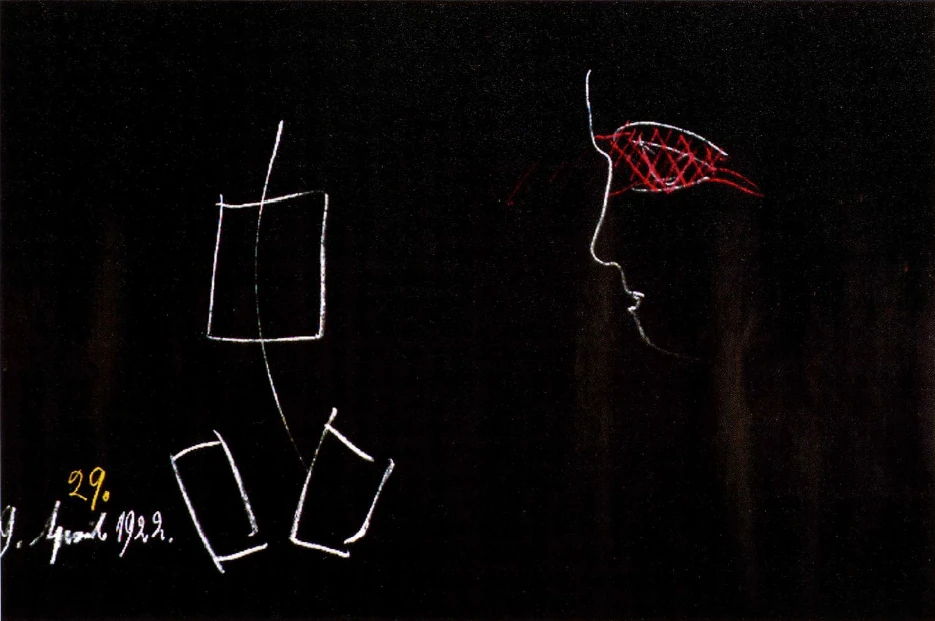
[ 19 ] One need only feel how the mystery of soul life is kindled by this simple question, how on the one hand I look at what stands there as the finished world, and on the other hand at what happens through me. This, I would say, is how the simplest external fact of our relationship as souls to the environment can be characterized. Of course, there is nothing special about this characterization, but it does at least raise the mystery from a certain point of view.
[ 20 ] Let us now approach the problem, the mystery, from another angle. We have our senses. Through these senses, we initially learn something about the outside world. We have our limbs. Through these limbs, we move ourselves. And basically, everything we bring into the outside world happens through our impulses of will, through the mediation of our limbs. So on the one hand we have our sensory world, and on the other hand we have our limbs. And from the whole situation as we have described it, we can already say to ourselves: the essence of our limbs and the essence of our senses are also polar opposites. With our senses, the outer world ceases, so to speak, before it becomes our inner world; with our limbs, an outer world begins, so to speak, which then separates from us and flows on. This invites us to seek a relationship between our senses and our limbs. You can perhaps visualize the most essential aspect of what is expressed in the human senses by considering the eye, for the eye perhaps expresses the essence of the sense most vividly. The eye is a relatively independent organ; it is inserted as an independent organ into its bony cavity. Only as strands, as a continuation backward, does what unfolds as the nerve life and blood life of the eye enter into the interior of our physical organism. There is a connection with our entire organism, but apart from that, the eye is relatively independent.
[ 21 ] We see a whole series of, I would say, initially physical processes in the eye, at least processes that we can interpret physically. If we speak symbolically, we can say: Light approaches, enters our eye, and is processed there in a certain way. I do not want to characterize the physical and chemical processes that take place, because I want to talk about the life of the soul, not about physiology. But I would like to draw your attention to how we initially have a kind of independent life in the eye.
[ 22 ] We can even compare this kind of independent life with what happens in a replica of the eye, purely as a physical apparatus, a kind of camera obscura, into which light enters in a similar way to the eye. We can have certain processes that no longer exist in the eye, that do not become sensations as they do in the eye, but we can reproduce certain processes; we can represent them as if in a certain physical apparatus. We see from this that something similar to a physical process is taking place in a relatively independent organism that does not immediately come to consciousness. What comes to consciousness is then what the external object, shaped and illuminated in a certain way, is. That which is similar to a physical process takes place, as it were, unconsciously in the human being, takes place as an independent process in the human being. That this can be so is due to the relative independence of the human organ of sight. This is less noticeable with other senses, but something similar can be said for every sense; however, we want to focus on the characteristic sense of the eye.
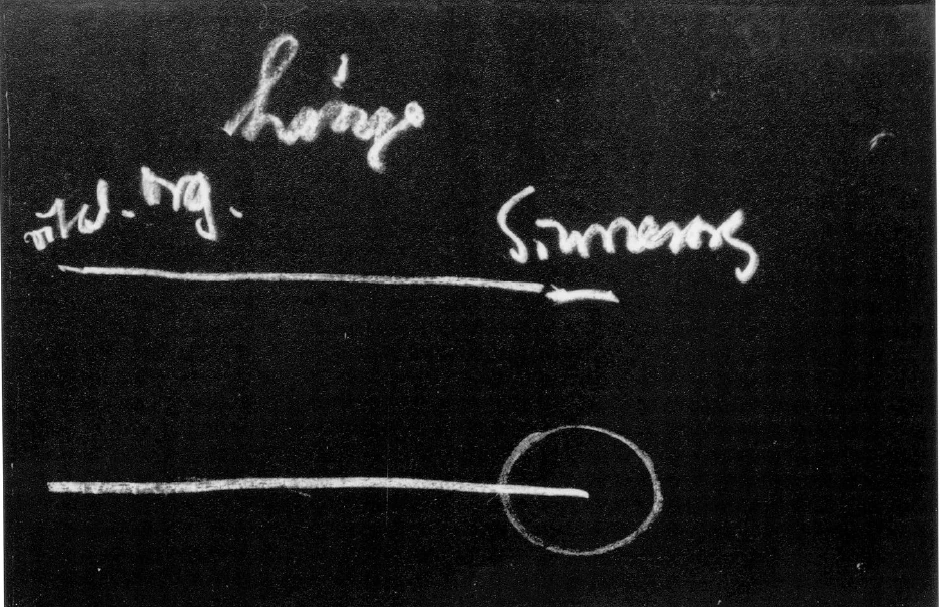
[ 23 ] We see how sensory perception is something relatively independent. We can say that when we look at the eye in the processes that take place within it (red drawing), the process inside, down to the blood vessels and nerve fibers, is something like a continuation of what is happening in the outside world, so much so that, as I have indicated, we can physically reproduce it. physically. It is as if the external world extends inward like a golf ball; in a sense, what happens in the external world continues in our inner world, I mean our physical inner world. You see, that is one side of sensory perception, that the external continues into our inner world; that we then, in a way that we want to discuss in this lecture series, encompass with our inner life, with our inner activity, that which forms itself from the outside as if in a gulf.
[ 24 ] But there is another side to sensory life. There is the side of sensory life which, if we remain with the eye, can be characterized something like this. I do not want to speak now about blind people, but rather consider the matter in a more general human sense; we will then return to all these things in detail from the standpoint of anthroposophical spiritual science. Let us assume that we are deprived of the world of the eye. We can already imagine, in a certain sense, that we would then have a deficiency in our soul life, that something would be missing, namely that which flows in through the sense of the eye. Just imagine what it would be like if it were so dark inside the soul because light cannot flow in. We know that for the ordinary soul life, being in darkness often causes states of fear in certain temperaments, in certain human natures. People who are blind or born blind are not consciously placed in such states, but they objectively experience something similar to a person who otherwise lives in darkness. And the fact that states of fear are associated with the experience of darkness can teach us that our state of mind is connected with what enters us through our eyes. But we can also imagine that such states of mind then have an effect on our organic constitution.
[ 25 ] Someone who is doomed to a certain melancholy because they have to live in darkness due to the absence of their eyesight will transfer this melancholy to certain finer structures of their eyes. And we can easily imagine that human beings would not be as they are if they had not received into their organism what comes into us through the soul experience of light. This soul experience of light pours out over our entire inner being. It continues within us, continues to such an extent that we can already form ideas about how, certain vascular processes, certain internal secretions or other processes take place differently because the refreshing, invigorating effect of perceiving light permeates our organism, while the perception of darkness also affects our internal secretions and our circulation in a different way. In short, if we consider the eye, we can imagine how we owe it not only the ability to represent certain processes and essences of the external world within ourselves, but also a certain inner state, not only of the soul, but also of the body. In a certain sense, we are what light makes us.
[ 26 ] Let us now turn our soul's gaze away from the eye, where we see, on the one hand, how it is a sense organ, how it gives us pure ideas for our inner soul life, but also how, through all kinds of unconscious, instinctive processes through the experience of light or darkness, giving us physical refreshment or discomfort, how we are in a certain way as we can be through the experience of the eye. Let us turn our soul's gaze away from this and turn it toward our lungs, for example.
[ 27 ] The lungs are also connected to the outside world. They take oxygen from the air outside and process it. They keep us alive through breathing. Unless we are Indian yogis, we are not aware of our lungs working in our normal consciousness. But depending on how the lungs function, whether they perceive the outside air in a healthy way or whether they do not perceive it correctly due to illness, this continues to have an effect on us. How we breathe through our lungs is how we are. We do not perceive through the lungs in our ordinary consciousness, but we have something through our lungs that makes us what we are in our organism.
[ 28 ] We can say this about the eye – and we can say it about every one of the outer senses – that it lives on the one hand in the process of sensory perception, and on the other hand quietly in another process, because we must first bring to consciousness that through the experience of light or darkness something is also happening within us that is not as vehement, not as radical, not as pronounced as what is happening within us through the absorption of oxygen by the lungs. Human beings know that they are what the absorption of oxygen by the lungs makes them, because this is a robust, strong, and intense vitalistic process. What we have through the eye is an intimate, quiet vitalistic process alongside the actual process of seeing. So we can say that in an organ such as the lung, what is only faintly hinted at in the eye, a sense organ, is particularly strongly pronounced.
[ 29 ] But now you can read in my book, How to Know Higher Worlds, and in the second part of my Outline of An Esoteric Science, how people can do exercises to develop certain powers of knowledge that are otherwise hidden within them into higher abilities. Through such exercises, he transforms his entire inner being. But what happens through this transformation can be characterized in our example by saying that the lungs take on a character similar to that of the eye. In a higher view, the vitalistic process recedes into the background. We are less concerned with what the lungs do to us organically through breathing; but we transform the lungs so that they now also become a sense organ, not the physical lungs, of course, but a finer part, the ethereal part of the lungs. We make the lungs, in their finer structure, into something similar to the eye, without doing anything to them. Nature has made our eye an organ of sight, alongside an organ that forms within us. For our ordinary consciousness, the lungs are initially an organ that forms within us. By experiencing insights into higher worlds within ourselves, we transform them into an organ of sight, into a higher sense organ with its finer etheric part.
[ 30 ] And when we experience this etheric being, which we are only now becoming aware of, in the lungs, we can now describe the lungs in the same way. We can say: There are the lungs, the etheric lungs. The etheric body of the lungs, which perceives, is therefore a higher sense organ. And because it carries the physical lungs within itself, it is a vitalizing organ. You see, in gaining knowledge of higher worlds, the lungs are transformed from an ordinary, non-perceiving organ of the body, which is nevertheless dedicated to the growth and development of the body, into a sense organ in the higher sense.
[ 31 ] We can make similar observations about the heart, and we can also make similar observations about other organs, such as the kidneys, the stomach, and so on. All the organs that humans carry within themselves can, through a certain higher development, become sensory organs by transforming their etheric or even more spiritual, astral nature into organs of perception.
[ 32 ] We look at nature on the one hand, then at our senses, and say to ourselves: There is something in our senses that, on the one hand, conveys sensory impressions and, on the other hand, our vitality. We look at our internal organs, lungs, heart, and so on. We find that these are, first of all, organs that maintain our vitality. We develop them through the methods I have described in How Does One Gain Knowledge of the Higher Worlds?; they become sense organs. And just as we perceive light or colors, that is, a certain part of the external sensory world, through the eye, we perceive a certain part of the external spiritual world through the etheric lung organ, and another part of the external spiritual world through the etheric heart organ. We can transform our entire organism into a sensory organism.
[ 33 ] You see, you have now grasped in a real sense what otherwise, as the external world, only penetrates to the surface of the senses and then becomes an idea. You have this more deeply, but now as the spiritual external world pressing upon the human being. In a sense, as humans develop their knowledge of higher worlds and transform their inner organs into sense organs, they gradually become as transparent inwardly as the eye is transparent. We see how the external world permeates them.
[ 34 ] But you see from this that if we remain in ordinary consciousness, we can only look at the outer senses that we have been able to describe as they are. But think about it: can a person know the entire ethnology of the earth if he knows only three peoples, if he has heard of only three peoples? No, because he must be able to compare. Think about what is given to us for comparison for the knowledge of the outer senses when we ask ourselves: What are our inner organs like when they also become senses?
[ 35 ] It is precisely through this that we attain a very special kind of knowledge of human beings. We attain knowledge of what is inherent in us, of what can become in us. Yes, but does that not point to something else? Doesn't that raise a significant question? Oh yes, it raises the question: If our lungs can become a sense organ through our own higher development, through our own efforts, if, in a sense, the process is such that we first have a vital organ in the lungs and then a sense organ, what about the eye, for example, or another sense? Is it perhaps the case that today it is a sensory organ, but that at one time, though not in a conscious process as we undergo in the attainment of higher knowledge, but rather in an earlier stage of world development, it was merely a vital organ, the eye perhaps an organ that served the organism in a similar way as the lungs do today, without already being an organ of perception?
[ 36 ] The question is raised, at least initially: Since the possibility of sense formation lies in our vital organs, since we see how sense comes into being, are we not led to consider whether the senses were not developed in a similar way through external world evolutions, whether we must not go back with the human being to earlier times when the human being had not yet turned these external senses outward, but when these external senses were internal organs, vital organs, where human beings were blind and deaf in relation to their present external senses, but their eyes, which must naturally have been differently formed, served a different purpose, just as their ears served a different purpose?
[ 37 ] At the same time, we see how the attainment of knowledge of higher worlds adds something to the knowledge of human beings that we can only attain in an external way.
[ 38 ] Most of you have heard me speak about the nature of human beings from a wide variety of perspectives. By first pointing out just one aspect today, you can see how an anthroposophical view of the world can start from a wide variety of perspectives and, by summarizing the results from these different perspectives, arrive at a comprehensive understanding of the human being.
[ 39 ] People often imagine that anthroposophical research is such that it provides a straight path to the few definitions that are usually found in books written about the higher worlds in non-anthroposophical circles. But that is not the case. Rather, what one can initially gain from one point of view — which is sometimes dismissed in a terrible way because people believe that it is only one point of view — can be illuminated again from other points of view, and then the whole thing fits together to form a structure of truth in anthroposophy that is self-supporting.
[ 40 ] Those who are accustomed to what they take as the basis of their path to truth in our materialistic age may say: Yes, this anthroposophy is not based on anything solid, whereas science is based on solid observation. It is like someone saying: The earth cannot float freely in space! Every body must rest on something if it is not to fall down; so if the earth did not rest on a mighty cosmic block, it would have to fall down. But the statement that everything must rest on the ground only applies to things on earth. It no longer applies to the bodies of the universe, and it would be foolish to transfer what applies to the earth to the relationship between the bodies of the universe. They support each other. And so it is with anthroposophical truths: they lead us out of the world we are accustomed to and into other worlds where truths support each other. However, an essential contribution must be made to this, namely that the truths themselves support each other.
[ 41 ] This was my introduction today to the lectures I will give tomorrow and next week on the human soul life in its relationship to world evolution. I wanted to structure today's introduction in such a way that it becomes clear that what can be said about this soul being with the help of supersensible research methods can indeed take its starting point in the observations of what already emerges from a reasonable interpretation of ordinary consciousness.
[ 42 ] Today I was only able to take the first step from an external description into the way in which the higher consciousness, let us say, sees the lungs in their transition into a spiritual sense organ, if I may use this contradictory expression. But we will continue along this path in order to become acquainted with the relationships of the human soul life that have been indicated in the next few days.