

The Human Soul in Relation to World Evolution
GA 212
30 April 1922, Dornach
Translated by Steiner Online Library
Second Lecture
[ 1 ] Yesterday I spoke to you about the sense organs, and I drew your attention to how the sense organs appear when we perceive them in such a way that we add to what ordinary consciousness provides us with the knowledge of the supersensible worlds. I said that at the moment when we rise to a spiritual vision of the supersensible worlds, other organs — I gave the example of the lungs yesterday — become sense organs just as our ordinary sense organs are. So that we must necessarily gain the insight that our organs are in a state of change, of becoming, and that when we look at the world as we can see it in everyday life, we actually always perceive only something that is fixed, that shows us a momentary state, while we cannot see what came before or what will come after.
[ 2 ] We must say the following to ourselves. If simply moving into the imaginative world, as I have called it in the book “How to Know Higher Worlds,” shows us the transition of our lungs from a mere organ of life to an organ of sense, then we can no longer look at these lungs as we do in ordinary life. We must say to ourselves: Our ordinary life shows us a state that is fixed. And when we compare this state, which is fixed in the lungs, with the state that is fixed, so to speak, in our eyes, we come to the conclusion that what our lungs show us is, so to speak, a younger state than what our eyes show us.
[ 3 ] Yesterday I said — we can at least raise the question —: Was the eye once in the evolution of the world such a life organ as the lungs are today? Let us stick to this, to be as cautious as possible, and raise it as a question for now. Let us say that there is at least one possibility that the lungs and the eyes behave like, say, a boy and an adult, so that one is the young form and the other is the old form, so that the eye could once have been an organ of life in the early stages of the world's development and has now become a sense organ, and that the lungs are now organs of life and could later become sense organs. But the truth will only become clear to us when we delve further into supersensible knowledge in this very area. To this end, let us today consider the other side, so to speak, the other pole of human soul life, the pole of the will. Yesterday, I would say, we characterized it in purely external terms.
[ 4 ] But if we now consider the pole of the will in such a way that we ask ourselves: How does it appear when we acquire imaginative knowledge? — Yes, when we acquire imaginative knowledge, it turns out that at first everything that is an organ of the will fades away, disappears before the spiritual gaze. We have our limbs as organs of our will; these limbs fade away. And it is characteristic that when a person rises to imaginative knowledge and looks at his outer organism, he loses his limbs and everything connected with them, the metabolic system; he loses it in his vision. It is simply no longer there in the same strength as before, as for sensory perception. And when we compare everything that we lose, so to speak, everything that is withdrawn from our higher perception, with something that exists in the sensory world, we arrive at a very strange result.
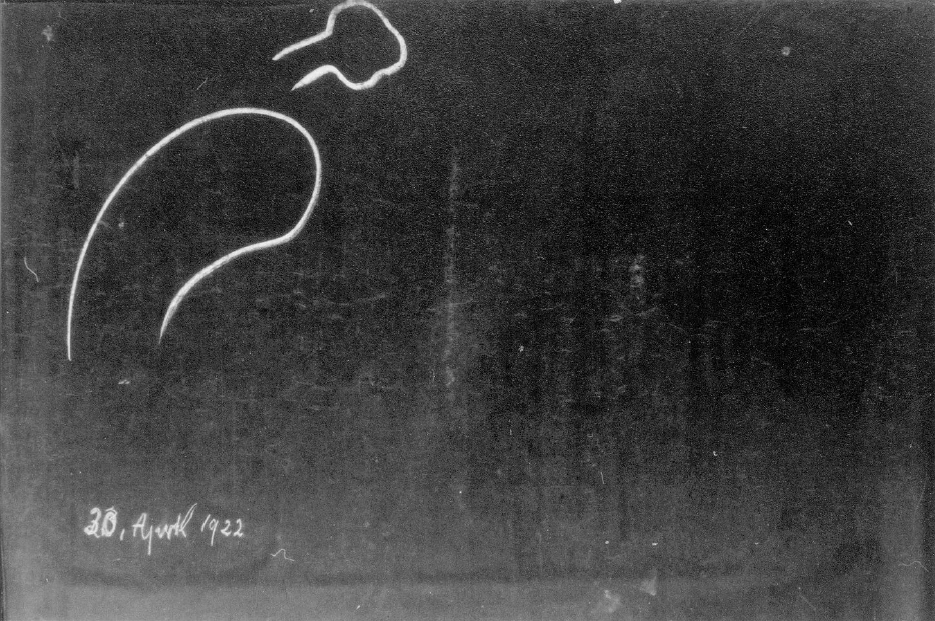
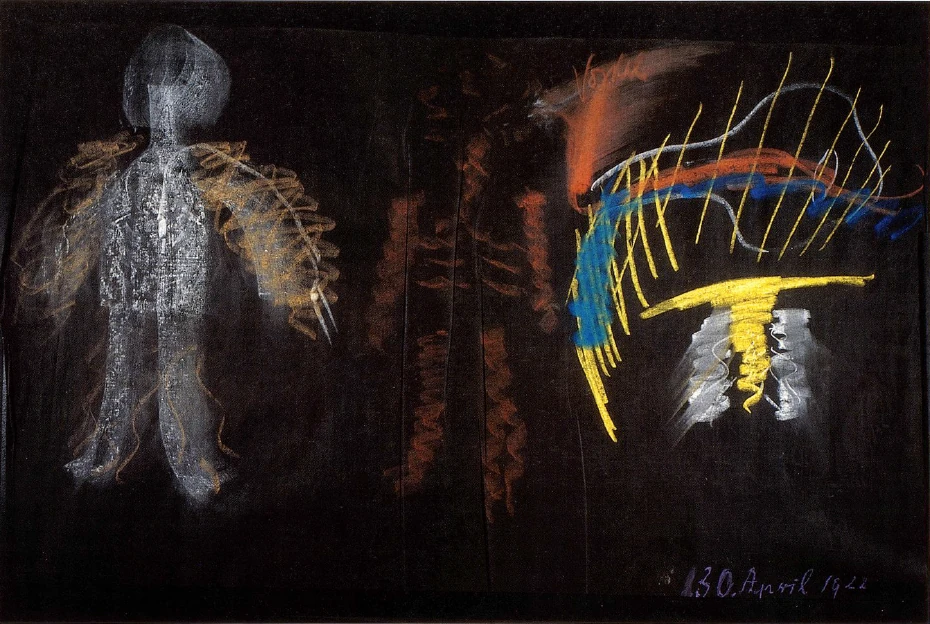
[ 5 ] I will sketch this result for you. Suppose we have here a human being as we see him in the sensory world (drawing on the left). Now we begin to look at this human being with imaginative knowledge. The limbs become pale and disappear. But everything that is bone also becomes pale. And it becomes paler and paler before imaginative knowledge.
[ 6 ] Now think about it: I draw out what fades before imaginative knowledge; what do I get then? I increasingly get the image of a human corpse. But that means nothing other than this: what remains of a human being after death, what I sink into the earth when I bury a human being, or what is burned when a human being is cremated, ceases to be visible to the same extent that one applies supersensible knowledge to human beings. But something else becomes visible. Where the arms, the physical arms, fade more and more, all kinds of things become visible that the older instinctive knowledge did not see so incorrectly when it spoke of wings, when it said that where the physical human being has arms, the spiritual being and, of course, the spiritual human being is then winged after death. But that is then a crude mental image, I would say, a ghostly crude mental image, if one replaces the spiritual being with a kind of symbol, a winged being, a better bird. For if one continues the knowledge of the higher worlds, if one ascends, as I have described, from imaginative knowledge to inspired knowledge, then one realizes what it actually is. It is a rather irregular structure in human beings, which could roughly be understood as wings. It is not at all easy to figure out what it is that one sees there. But if one goes into it, one gradually discovers, through subtle observation, what it actually is that appears, let us say, at the place of my right arm and my right hand, when I swing myself up from imaginative to inspired knowledge. Let me put it another way: it is true that, to the horror of the gentlemen who criticize materialism, especially in eurythmy, the arms make terrible movements, many movements. People who do not understand eurythmy cannot stand this. But if you look at the movements made in eurythmy with inspired knowledge—the arm is not there, the hand is not there, but all the movements are there, all the individual movements; all of that is there. And because it all merges together, because there is so much of it, because it always intertwines, it looks like wings.
[ 7 ] Now, people who are not eurythmists also make movements with their arms, and people make most movements with their arms. All these movements, the forms of movement, the curves of movement, become visible (see drawing, orange). The physical aspects, the muscles, flesh, and bones, cease to be visible. The movements become visible. Yes, you see, it is the same with the legs. But I told you yesterday: human beings do not only move themselves; yesterday, in order not to evoke thought forms that point to a useless life, I did not mention sports, but rather wood chopping. Now, when a person chops wood, they are constantly performing movements. But all these movements are also there when one ascends from imaginative knowledge to inspired knowledge. But human beings do not only perform things through their bodies; they perform things they have thought of, perhaps through other people and so on. All of this gradually begins to become visible, especially when human beings then ascend from inspired knowledge to intuitive knowledge. In short, with regard to the pole of the will, what we place in the grave with the human being gradually ceases to be visible, while everything he has done begins to become visible. And when the human being has died, what is left of him is primarily what he has done. That is what continues in life, what continues to exist in life. It is like a birth of the will that passes through death. So you see, we must choose a different path if we want to move from the physical to the soul in relation to the limb nature of the human being. And it is exactly the same with what is metabolism.
[ 8 ] So now I have considered, in a certain context, what is the sense being in the human being, and what is, in a certain sense, the will being, the deed being. We will make further progress if we now go back to sensory being, to the one pole of the human being, if we look back with developed imaginative and inspired knowledge to what now becomes of our sensory organ, let us say the eye, and then, if we live at the stage where, let us say, the lungs have become our sensory organ.
[ 9 ] When the lungs have become our sense organ, we begin to perceive a completely different world, I mean for the higher human being who is gradually detaching himself from the ordinary human being. The ordinary human being always stands by and controls — I have repeatedly stated this publicly — but I mean for the human being who is emerging, who is developing out of the other. Now, as soon as our lungs begin to become sensory organs, we also begin to perceive the world in such a way that we experience its essence more musically as rhythm, indeed that we experience everything that I have described in part in the description of the soul world and in part in the description of the spirit world in my “Theosophy.” We begin to experience something different as our environment when the lungs become sensory organs. I remarked yesterday that they become sensory organs in their etheric part. What then becomes of the ordinary sensory organs?
[ 10 ] For the limb-metabolism organs, I had to say that they disappear from view. This is not the case with the sense organs; they do not disappear, they reveal themselves to us as what they now are. They reveal themselves to us in their spirituality. The sense organs become perceptible, they become objects, but they become something like spiritual beings. They are there as what — if I may express it thus — now populates our spiritual world. And in a certain sense, there is a strong feeling that these sense organs themselves expand into the world, that we are given a universe built up from our sense organs. And this universe that we are given is now connected to something else in our soul experience. For our soul experience, it connects with what we call our memory, our recollection, in ordinary life.
[ 11 ] I must point out a significant experience that one has when ascending from imaginative to inspired knowledge. The sense organs become, in a sense, independent entities, but they take on our memory, the contents of our memory. And when we consider this, something of the nature of our soul becomes very clear to us.
[ 12 ] Take the human eye, for example. This human eye is initially an organ, as I described yesterday. Now, when we begin to develop imaginative knowledge, to ascend to inspired knowledge, the eye does not disappear, but everything physical about the eye disappears. The eye, however, becomes more and more spiritual. We gain a powerful content, I would say, expanded to the content of the world. But this connects with the content of our memory (yellow), with our thoughts that are in our memory, in our recollection (drawing, p. 39).
[ 13 ] In this way, we gradually struggle our way up to a very specific insight. You see, a very trivial idea of conventional psychology is that human beings perceive through the senses and develop ideas and thoughts based on sensory perception. Then these thoughts go somewhere. Herbart's philosophy was particularly great in that it allowed these thoughts to disappear below some threshold; then, when one remembers them, they come back up again and reappear in consciousness.
[ 14 ] This kind of psychology always reminds me of a little playful children's game that I often saw as a very small boy: you run your two hands over a child's arm up to their head and then say: “The mouse is running across the house.” Where will it rest? In Sepperl's box — and so on. Now, this children's game presents itself to the child as if a mouse could run across the arm and then be in the box, somewhere inside, in the head. But this psychology is not much smarter. It also gives rise to thoughts about sensory perceptions; which then walk into this box, into this soul box, and rise again from this money box when they are remembered. Well, it is a very banal idea, but it is an idea that is often used in psychology. But if you learn the whole process through imaginative and inspired insight, then the truth of the matter becomes clear. Then we realize the following.
[ 15 ] What inspired and imaginative insight sees, they have not done. It is just as when you look at chalk with your eyes, your eyes do not create the chalk; it is already there. So too is that which is perceived through inspirational and imaginative knowledge. So while ordinary consciousness is at work, it exists as reality. All of this is happening. It just becomes perceptible through supersensible cognition. It happens in every waking moment of human life. But the fact that there is something else besides what we perceive through ordinary consciousness, that there is a parallel process that we only perceive when we have higher consciousness, is shown by this fact. Let me put it this way: in ordinary life, everything that can be perceived with ordinary consciousness is present; but in addition, there is everything that can only be attained with imaginative, inspired consciousness. This is therefore a process that is unknown in ordinary life. When we learn about it through higher knowledge, it becomes clear that the images of memory, the memory images, are only images when we have them in ordinary consciousness. Their reality only becomes apparent in higher consciousness, only emerges in higher consciousness, so that the memory images do not come up there after they have first descended as ordinary ideas. Rather, when I form an idea based on a sensory perception and then withdraw from the sensory perception, the idea is there. Then it disappears after a while. Since it is only an image, it has completely disappeared; it is gone. But the senses do something else: they carry out a process that I do not perceive; they vitalize the real process of representation within me. So that when I have a sensory perception, I first form the representation (red) through this sensory perception, but then there is a second process (blue) through which something real is brought about, not just a mere image. Now, the image disappears when I no longer have it. When I remember, this idea arises, just as the sensory perception did before, and I perceive what was actually aroused in me when I had the sensory idea, which I just did not know.
[ 16 ] But this reality is the actual soul. If you have a physical human being in front of you today and you observe him, say, after eight or ten years, then nothing of what is physically in him today will be present after about ten years. You cut your nails, flakes fall from your skin; the physical body constantly falls away on the outside. It evaporates. And after such a period of seven to ten years, what is deepest within you today has come outwards just enough to fall away as flakes or long nails. You can safely say: That which today sits somewhere in the middle of you gradually moves outward, falls away. This physical human body continually drips away. And what remains? That which remains solely and exclusively of the human being is that which develops inwardly as a parallel process (see drawing, blue), as the reality for the image of the imagination.
[ 17 ] In ten years' time, you will be nothing more than what you have absorbed and what remains in your memory. You are woven from your memories; nothing remains in you of what you were ten years ago except what your memory has woven from you. The physical has been shed, it has dripped away. If you just look at what everyone can already have in their ordinary consciousness in a reasonable way, you can still get a pretty good idea with common sense that it has to be the way I've just explained to you with the help of imagination and inspiration.
[ 18 ] If we now want to form our own picture of the nature of human development, including its spiritual aspect, we can do so on the one hand – and please bear this in mind – by considering the one pole, the pole of thought, in no other way than this (drawing). First, when we are born, we have a physical body (light). This is filled, as it were, with processes parallel to sensory perceptions (yellow). All of this (light) gradually drips away. You eat, you absorb all kinds of things through the air. This is stored in your memory processes and constantly reshapes your body. But what is impregnated into your soul as a metabolic system is what you bury after death. But what is actually soul is woven from what the soul develops in the processes that you initially perceive only as ideas, as experiences. So you can well say: I live in thoughts, and I continually create myself through my thoughts. However, what I perceive as thoughts with my ordinary consciousness is only an image of what I am doing. It is, so to speak, a side effect.
[ 19 ] Yes, but something extremely important and significant emerges from this. It follows that, fundamentally, what goes on within me beyond what I perceive through ordinary consciousness is much more important for human development. Let us look at the world. I enjoy what my eyes show me, what my ears let me hear. I experience the other things that my senses allow me to perceive. But while I see, hear, and feel, something creeps into my inner being that can later be brought up in my memory; everything that is my soul creeps in. This is a continuous activity; it is not something that is, it is always doing, it surges and weaves.
[ 20 ] Those who have tried in all seriousness to rise to spiritual knowledge have a strong sense of what I am referring to here. What one has in black and white can be taken home with confidence. And since people in today's world prefer to have this comfort, since they do not like inner unrest very much, they now shape all their insights in such a way that they can be written down and confidently taken home. It is only said of anthroposophical lectures that they are usually “poorly transcribed,” and that one does not actually gain much from what is transcribed, that one cannot take it home with one's confidence.
[ 21 ] But you see, that is only a reflection of the experiences with higher knowledge. When a student today prepares for an exam, he is really happy when he has managed to get something into his head, and when he got it there three or four weeks ago and then the exam comes, he wants to be able to reproduce it exactly as he crammed it in. With higher, supersensible knowledge, it is not like that. Those who acquire real supersensible knowledge are confronted with the life of this supersensible knowledge. It lives on continuously; it does not behave as rigidly as those ideas that people today want to write down as scientific images of the external physical world, even for their own comfort. I want to express myself quite radically, because this radical expression points to a very important inner fact.
[ 22 ] Take the case of someone who has acquired quite advanced supersensible knowledge. He now has it. He can later regain it through the processes I have often described. Let us say he experiences it again after three or four years. In the meantime, these insights have had a life of their own. Then, as he forms them again within himself, they penetrate his soul in such a way that they are tainted with doubt. One gradually learns to recognize that this is nothing special, that all supernatural insights have this characteristic, that in their further development, when they become old, so to speak, they cause people to doubt, and one must regain their certainty anew. Yes, with the highest insights, it is such that they already appear uncertain the next day if one does not regain their certainty, does not conquer them anew. It is always lower insights that die in the human being, become ghosts, and then reappear. The human being looks at them and is satisfied that he has now attained something in the higher world of which one can rightly say: Bring me a writing tablet! — for if it is written there, it will remain. He would like to have such a writing tablet within himself.
[ 23 ] This is not the case with real higher knowledge. They live; if you recreate them, and especially the highest insights, the very next day, you become uncertain about them, and you have to reconquer their certainty. You have to go through the process again and again. You cannot relate to these higher insights in any other way than to what is an image of reality and not reality itself here in the physical world. There will hardly be many of you who will not eat today, Sunday, April 30, because you say to yourselves: I ate quite well eight days ago, that is still in me; I do not need to eat today, that will still nourish me today. You do not do that. That is a real process. The physical contents of the soul are different. They remain, and you can bring them back, unchanged in many respects, or changed. But this is not the case with spiritual contents. They are not only faded, but their certainty is always shaken, and one must conquer that certainty again and again. Yes, that is one phenomenon.
[ 24 ] This one phenomenon really presents itself in such a way that when one has acquired supersensible knowledge in one respect, it really seems as if the world has become light through this supersensible knowledge, as if one had entered a brightly lit hall, the brightly lit hall of the world. After eight days, one has something within oneself which — because one has gained this higher knowledge, because one has, so to speak, arrived at it, because it has already had an effect on the physical human being — leaves certain remnants of memory; but out of themselves, in their very essence, they live out in such a way that one always finds oneself in a dark room with them and must light the light again and again. This can be compared to the fate of supersensible insights in the human soul.
[ 25 ] Those who acquire supersensible knowledge cannot claim that it will remain within them as permanent ghosts, as is believed to be the case with instinctive, ghostly, clairvoyant ideas. These worlds into which one enters must be conquered anew again and again. But although reality cannot be preserved in ordinary memory, its effect is naturally preserved. It is preserved in particular when the person who has had extrasensory perceptions writes them down after some time or even sees them printed before them, for example when they have a subsequent edition of a book they have written in front of them; then they have before them the external effect of what they experienced earlier.
[ 26 ] I can imagine private lecturers who feel a deep inner joy when they have before them this golden juice of what they have produced, when they can later produce subsequent editions based on this golden juice. It does them good. The products of spiritual perception do not do that. They hurt, they cause pain. For what is preserved, what is recast, poured into the physical world, causes pain, hurts. That is the other side. With your supersensible insights, you don't just walk into a dark room that you first have to light up again, but you walk into a room where arrows are shooting at you from all sides, causing pain, and you first have to armor yourself against what confronts you as the residue, as the embodied remnant of the supersensible worlds.
[ 27 ] With this I am pointing out to you what the soul life that one first attains with these higher insights means for ordinary experience. Ordinary experience is not such that one experiences the soul directly. You experience it through the physical body. It is adapted to this experience in the physical body. But the soul life itself is different; it is something that is in a state of constant becoming, in constant transformation, in constant metamorphosis, which slips away from you during these metamorphoses if you do not live yourself back into these metamorphoses at all times, which you cannot bear because it hurts, because it breathes the past. By taking in the past, it hurts. If it is not present, it hurts; and one must arm oneself against that. But at the same time, you see: if one has absorbed something eventful from what is real higher knowledge, this higher knowledge is not as comfortable as what our students hear today in the universities. At most, it hurts when they have forgotten it and do poorly on an exam; and above all, students' own insights do not hurt them, but rather do them good, because when they have them, they are happy; it does them good. Their own insights hurt them at most later in life, when they see that there is something better than their own insights, and these then stick in them like ideas.
[ 28 ] But when you live your way into the supersensible, then it becomes quite alive. Then you learn to recognize how to conquer it, how to endure it. You learn joy and satisfaction from knowledge itself, you learn pain from knowledge. But through this one first learns to know the soul in its reality. The soul in ordinary everyday life has, I would say, fallen so far into materiality that it appears in pale thoughts, which we must first pour into the warmth of feeling so that they are not pale, cold thoughts at all, and so that they do not hurt. They are just images, and images do not live. But what is acquired as supersensible knowledge lives; it is living soul content.
[ 29 ] And this living soul content gives us a real concept of what we are. For our memories are a weak reflection of what we actually are. And when we pierce this tapestry of memories inwardly, we come to what I am now describing to you as a joyful, satisfying, luminous experience of the world, as a painful experience of the world, in which our soul is present. Our soul is thus inserted into a knowledge that itself contains soul life. The past pours into the pain. And what we perceive as joyful and pleasurable is what we become aware of passing through the gate of death with us; that is the future.
[ 30 ] An image of what I have said must pour into physical knowledge, but now a living image. History, that is, the backward development of humanity, viewed in mere cold historical ideas, is just an image, an image that, in essence, has meaning only as long as we carry it in our minds. Just as the ideas formed by sensory perception have meaning only as long as we carry them in our minds, as they do not descend into “Sepperl's box,” but change when they are no longer present in consciousness, so too do those ideas that are formed purely imaginatively from history have meaning only for the mind, that “what you call the spirit of the times is basically the spirit of the masters themselves, in which the times are reflected.”
[ 31 ] One can only learn to recognize real history when one lives with such living knowledge in the reality of the development of the worlds and also of humanity, when one can feel joy and suffering to the highest degree in what is happening outwardly in the world; when, for example, one turns one's soul's gaze back to, say, the ancient Persian, ancient Indian, or Greek times, or to any other time, when one feels, for example, with the Greeks how they did not experience their tragedies in the same way that people today experience their plays. Goethe already made a fundamental distinction between Greek tragedy and modern drama when he said: Modern drama is completely paralyzed, overshadowed. Greek tragedy was something that conquered the fate of the world. But that is why those who experienced Greek tragedy did not feel the same way as modern people, who go to the theater for amusement and then let it flow over them in a very neutral way. The Greek, sitting in front of his tragedy, felt that it shook him to his very core, that he saw something essential in it, whether he felt goose bumps running down his spine at this or that moment. And they felt that tragedy was something like a remedy, because the Greeks also believed that life was permeated by sin, guilt, and therefore illness, and that public performances were needed as a remedy to lift life again and again out of a guilty, sick state and back to its true, proper essence. Thus, Greek tragedy was the remedy for whatever became sick in social life, not what was there in the corner of life for amusement.
[ 32 ] I would like to say: What is modern drama for people in contemporary society? Well, so as not to say that it is merely what hairdressers do according to their taste when they style people's hair, I would like to say that it is what hairdressers do when they wash people's hair! But what Greek tragedy was, was what the doctor does, the truly understanding doctor, who infuses the sick organism with internally acting, healing powers that dynamically and thoroughly permeate this sick organism. The Greeks appealed much more to the soul than modern people do. Yes, but if you look at history in this way, if you put yourself in the position of a Greek watching a tragedy, then such a historical view is quite different from the one we usually have, in which we remain completely uninvolved.
[ 33 ] When you really study history, you enter the ancient times with your soul. In the present world, you suffer—if you go outside now and don't have an umbrella, you will see. It will not be a very serious suffering, but from the present suffering it can very easily happen that something bad arises and you really have to endure physical pain — but you do not need a remedy for the suffering. The Greek era did this; and if you really put yourself into the Greek era, then, considering anthroposophy, you put your soul into it. You enter into it with your soul. I would like to say, if I may express myself trivially: in this way you first intercept the soul, whereas otherwise you suppress it in ordinary humanity today. You intercept the soul, you learn to experience the soul for the first time in your view of the world.
[ 34 ] That is what I wanted to describe to show you how one must first seek out the soul from its hidden depths if one wants to come to the contemplation of the soul, how one gains nothing of the soul if one turns to the mere images that people initially form of the world in their ordinary consciousness. And then psychologists describe this as the content of the soul. Open a book on psychology today, and you will first find chapters on ideas, but ideas as they are in ordinary consciousness, not as they are down there. What disappears at every moment (drawing on p. 39, red) is described to you, not what is happening down there as a parallel process. In short, when you look at psychology today, it is roughly like, well, let's say, when you organize a meeting where people are supposed to discuss things.
[ 35 ] Let us assume that the English are consulting here; they like Lloyd George to have a say. They say: We now want to hold a consultation. Lloyd George should have a say. - Now they fetch his portrait, place it on a chair, and there they have him as a co-consultant. The French do the same with Clemenceau, and the Germans even with Bismarck. Well, isn't that the case there too? Yes, in relation to the world, these images behave in the same way as the human imagination behaves in relation to reality, if one describes it according to ordinary consciousness. One is merely dealing with images. One must first discover what reality lies behind these images.
[ 36 ] I have endeavored to show what reality lies behind these images. One does not have the soul for ordinary consciousness; one must first bring it up from its depths. That is the important thing. That is what one must definitely take into account if one wants to speak about the human soul in its relationship to world evolution. For one gradually enters into world evolution itself with the soul when one considers the soul in its truth.
[ 37 ] In these first two lectures, I have attempted to show you how occult knowledge gradually conquers the soul. Now that a sound foundation has been laid, we will consider the human soul life in its connection with world evolution in the next three lectures in as popular a form as possible.