

The Human Soul in Relation to World Evolution
GA 212
5 May 1922, Dornach
Translated by Steiner Online Library
Third Lecture
[ 1 ] Today we must remind ourselves of a few things that are already familiar to us from certain sources in order to continue our reflections on what was said last week. When we consider human beings as they exist in the world between birth and death, their lives can be divided into sections that can be viewed from different perspectives. We have often directed our attention to the transition between waking and sleeping. We know that there is an intermediate state between waking and sleeping, which is dreaming. These are the three states in which the consciousness of ordinary life proceeds: waking, dreaming, and sleeping. But these three states are also found elsewhere as divisions of human nature. If we follow the contents, the experiences of this ordinary consciousness, we have the experience of thinking, of having ideas, and I have often said: We are actually only really awake when we are in this state or insofar as we are in this state of having ideas. Anyone who observes themselves with an unbiased mind will be able to recognize that feeling represents a much duller state of consciousness than thinking. Feelings surge through our soul without our being able to relate them in any definite way to anything in the external world or to memories, as we can with ideas. We are also quite conscious, or at least we can be, that in the moments of our waking life these feelings come and go, really just as dreams come and go in the intermediate state between waking and sleeping. And anyone who has a sense for really comparing such things of consciousness with one another will have to say to himself: Dreams are images; feelings are something like indefinite forces surging within us. But in everything else, if we disregard this content, in everything else dreams come and go, just as feelings come and go. And out of what I would call a general darkness and dullness of consciousness, dreams emerge, just as feelings emerge from a general inner state and then sink back down again.
[ 2 ] With volition, what actually goes on inside us when we have an impulse of the will remains as unknown to us as what we sleep through. The only thing that is clear about what goes on in willing is the thought that has the purpose of a volitional act in itself. It is then the perception of, for example, our movement or of what happens externally through our willing that is again before our soul, in our consciousness. But what we say is going on in our leg or arm while we lift our leg, want to step forward with our leg, or want to lift our arm, is something that remains as unconscious as what happens between falling asleep and waking up. So that even while we are awake, we are already simultaneously experiencing these three states of consciousness in a certain sense: waking, dreaming, and sleeping.
[ 3 ] However, we can only come to a complete understanding of human beings if we subject what is given to us, namely that on the one hand we sleep, dream and wake, and on the other hand we want, feel and think, to what I would call a rational examination.
[ 4 ] Let us take, on the one hand, the sleeping human being and, on the other, the willing human being. The sleeping human being is characterized by the absence of that content of consciousness which otherwise actually makes us human, namely the experience of the I. The experience of the I is therefore absent. We usually describe this by saying that from the moment we fall asleep until we wake up, the ego is outside of what is physically present before us.
[ 5 ] Now, however, let us consider the dreaming human being on the one hand and the feeling human being on the other. It will be immediately clear to you from ordinary self-observation that dreams stand before the soul as neutral images, so to speak, that when you dream, say, upon waking or before falling asleep, these images float and weave like a web, not exactly before, but within the soul. What goes on in the soul differs from what is present when we are fully awake. When we are fully awake, we know that we hold the images we have internally, that we grasp them with our human being; they do not float as nebulously in the indefinite as they do in dreams. We grasp them with our human being.
[ 6 ] I will now sketch what I have just said on the board (drawing on the left). Let us simply take the human being schematically (light) and draw what we can imagine as the diagram for the weaving dreams (red), for example in the following way on the human being. One might say that what I have drawn in red on the board is a web that the soul experiences as it continually slips away from it and then returns to it.
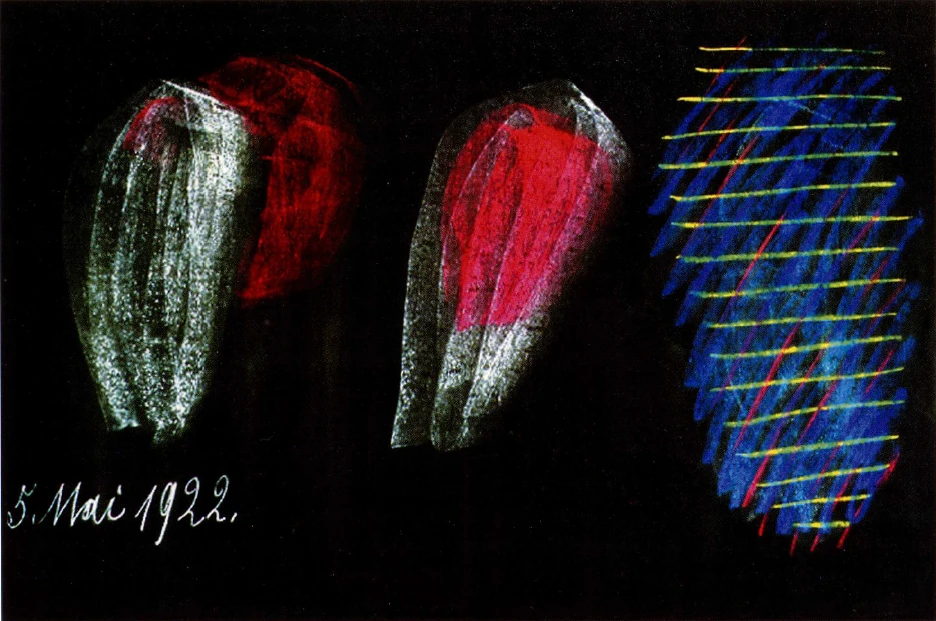
[ 7 ] At the moment of waking up, the human being does not have such a web in their soul experience. Instead, what they experience is now within them. I will now sketch (drawing on the right) how this is in the waking state. They now have this fabric, which is otherwise outside them, within them; they grasp it with their body, and thus it is not an indefinite fabric, but something that human beings control internally.
[ 8 ] In this relationship between what is woven and floats away as a dream and what then becomes a thought within the human being when he is fully awake and controls what now lives as such image-thoughts in his soul, you can, I would say, perceive to the point of soulful grasping: there is simply something drawn from the outside into the inside. And when we describe something like this, we are describing nothing other than the entry into the inner being of what is initially woven and floats in dreams, what we call the astral body, which is invisible to ordinary consciousness. So we can say that when we begin to think after waking up, the astral body is within us. We then imagine things. But we know that we have control over these ideas. As long as they are dreams, they float around out there. Just imagine a kind of cloud near you in which dreams are woven. You suck this cloud in, as it were; you control it from within. It is no longer outside. Therefore, you no longer dream. But just as you grasp any object with your hands, you grasp this dream with your inner being. And you have sucked in your astral body; you now have it inside you.
[ 9 ] However, we must ask ourselves more precisely: What do we have in there? If we take a closer look at what we have in there, we may be able to gain some insight by looking at some dreams that are not just images but are already beginning to become vague feelings. Just think about how unpleasant some dreams are; they are simply a web of images. Some dreams are associated with anxiety. You wake up from states of anxiety. In these vague states of anxiety, often accompanied by vague feelings of joy, but mostly frightening states, you see, I would say, the glimmer of something that, as it develops further, is then there when you wake up completely. What glimmers there when the dream frightens you, for example?
[ 10 ] Yes, the dream interweaves with the feeling. Fear is a feeling. The dream is still half outside; this makes the feeling vague. But it is already interweaving with the feeling. This is what causes the feeling to arise. But it intertwines with what else lives in the soul when feeling. And only when you have the astral body completely inside you do you have these specific feelings, which are conditioned by your physical organization, and which can now enforce the ideas of the astral body upon you.
[ 11 ] If you look closely at certain nightmares and anxiety dreams, you will again have, I would say, almost a spiritual grasp of what actually happens during this entry, as we call it, of the astral body into the physical human being. For what causes the fear that sometimes accompanies dreams, you will always discover to be something that is not in order in your breathing process.
[ 12 ] You can see quite clearly from this that the astral body enters and also leaves through what lies in the breathing. It is really not the case that one cannot observe these things if one simply wants to observe life impartially. It is just that one does not make such observations properly. But there is something there that gives us the instruction to recognize that what weaves in dreams and what is the astral body in reality enters our organism by taking hold of the breathing process when we awaken.
[ 13 ] This leads us to a consideration of the human being that is extremely important but is not usually made. We usually view the human being as if he were actually a complete organism, a body made up of solid components. But that is not true. The human organism actually consists of very little solid matter, hardly ten percent. The rest is a water organism, a fluid organism. So in truth we must think of this organism as being constructed in such a way that we say: there is the organism, and in a certain sense one tenth of it is solid (see drawing, light color); but this solid is permeated by the watery element (blue). And only then can you imagine the human organism properly, if you actually imagine it as a column of water that has the solid embedded in it.
[ 14 ] But that is not enough. We must also imagine the human organism as an air organism. The air is outside; we breathe it in. Part of the air that is outside is now inside us. We breathe it out again. We are at the same time an air organism. Let us draw this schematically (in red). But it is precisely this air organism that is seized by the astral body when we wake up. We breathe in the air. The air also undergoes a process; its effects spread throughout the entire organism. The oxygen absorbs the carbon and is converted into carbon dioxide. Such an air process takes place continuously within us.
[ 15 ] When we are awake, however, this air process is permeated by the astral body. The movement of the astral body follows the same paths that the air takes in our organism. The air process is only an air process when we are asleep; when we are awake, the movements of this astral body swim, so to speak, in what lives within us as the air process. But now think about this: as the astral body enters into what I have schematically drawn in red and carries out its movements within the air organism, carrying out what it does in general, this takes place in what is schematically drawn in blue, in the watery organism. These air processes, which are actually the processes of the astral body when we are awake, always come into contact with the watery organism.
[ 16 ] But in the watery organism, the etheric body of the human being is present day and night. And there you have at the same time an interaction between the astral and etheric bodies, but also the physical image of this: the air processes and the water processes in the human being. So you can well imagine that these physical processes are initially present in the human being, taking place between his breathing and the movements of his juices, in fact in everything that is liquid in the organism. But this is again only a reflection of what is happening between the astral and etheric bodies.
[ 17 ] Now, however, everything that is a more solid, liquid, or gaseous organism is in turn permeated by warmth (drawing on p. 55, yellow).. The entire organism has its own warmth: warmth ether. I would like to say: the astral moves on the waves of the airy in the human being, and the actual I moves on that which flows through the organism as warmth.
[ 18 ] Now you have the physical body as such; the liquid body, which is also physical, but which is now separated from the solid physical body, the liquid physical body, which has an intimate connection with the etheric body; the gaseous organism of the human being, which has an inner connection with the astral body, and that which are heat processes, which in other words is heat ether in the human being, which has an intimate connection with the human I. So that in the physical, I would say, we see everywhere the image of the whole human being. The solid is, so to speak, something that exists in itself. But the liquid in the organism cannot exist in itself. We have very little of the solid in our heads. What we have that is solid floats in the cerebral fluid, that is, in liquid. If you look at this liquid inside the human head, you first have the etheric part of the head in this liquid.
[ 19 ] Breathing proceeds as follows: You breathe in. The breath pushes inward and continues through the spinal fluid to the brain. At the same time, however, the astral element moves upward toward the etheric element of the head in the waking state. So that on the one hand we have a interaction between the movements of the brain fluid and the respiratory movements, and on the other hand an interaction between the etheric part of the head, of which what goes on in the brain fluid is only a reflection, and what are respiratory processes, which in turn are only a reflection of what is astral in the human being. And then we have a continuous interplay of heat states. And the blood in its movement mediates these heat states. On this wave of the sea of heat within us, our ego moves at the same time.
[ 20 ] It is important that we imagine this very vividly, that we are clear about it. We can only observe the solid organism in itself. As soon as we approach the liquid organism, it no longer has the possibility of moving in the same way as water waves move outside, but moves in such a way that its movement is a reflection of what is happening in the etheric body of the human being. Again, what goes on in the finer states of bodily respiration is a reflection of what goes on in the astral body of the human being. But now, when we consider this, we must say to ourselves: Let us just look at the cerebral fluid. It has certain movements within itself. These are a reflection of the etheric body. But the etheric body is something that human beings acquire when they descend from the spiritual worlds into this physical world; they do not yet have it within the spiritual worlds. But by taking hold of their physical body, human beings already have their etheric body. They draw the ether out of the cosmos, so to speak. And only by drawing the ether from the cosmos can they connect with the physical, which is then conveyed to them through heredity. So that we already bring with us what lives inwardly in the etheric body of the human being when we take hold of our physical body.
[ 21 ] Suppose, then, that the human germ arises in the body of the maternal organism. We examine what is liquid in this human germ. This is not done in ordinary physiology. In ordinary physiology, the germ is only investigated insofar as it contains solid matter or at least can be observed as solid matter. The liquid is not examined at all. But if one were to examine the liquid, one would discover how in the liquid, namely in the cerebral fluid, there is an image of what has slipped into the physical human being and what was already expressed in the etheric body when the ether was drawn in.
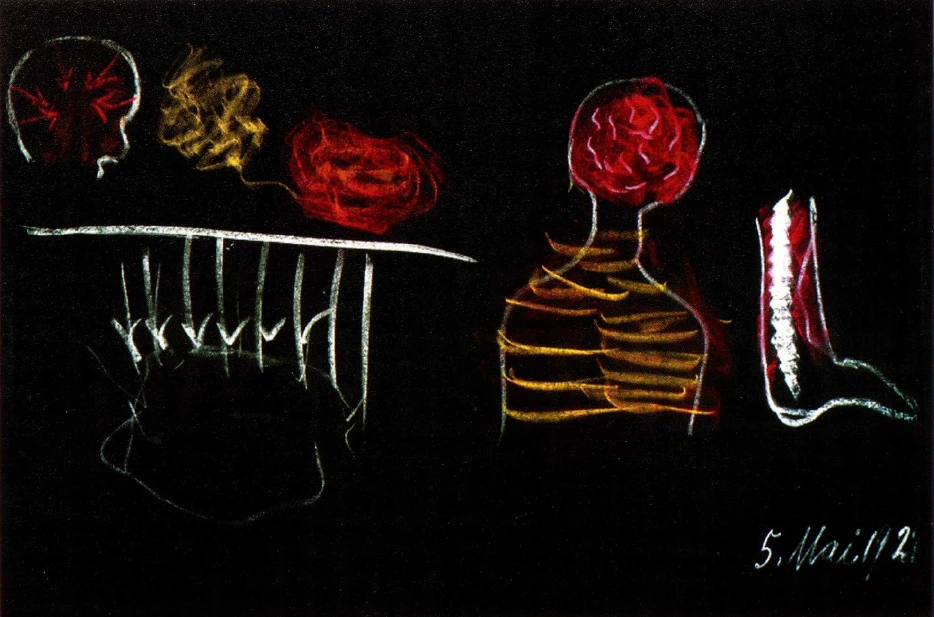
[ 22 ] So we can say: When the physical body is here (see drawing), the physical human germ is formed—I am not drawing the solid part at all; what I am drawing is the liquid human germ (red)—and that which exists as the I and the astral descends from the spiritual world. That which has already been drawn in as ether (yellow) slips in here. Simply by the human being submerging itself in the physical body, what the human being brings in from outside is taken up into the liquid organism. If you were to examine the cerebral fluid of a child in its movements, you would have to say: This is actually a photograph of what the human being was before it connected with its physical body. You see, it is very important that one can actually say: In the cerebral fluid, that is, in the movements of the cerebral fluid, one would find a photograph of what preceded conception.
[ 23 ] Now, from the cerebral fluid you can easily understand that you find there a kind of photograph of what preceded it. But consider the breathing process. The breathing process appears to us as a very physical process because our lungs are organized in a certain way, because air is sucked in, because the breathing process even takes place under the influence of the outside world when we sleep, when our eternal self is not connected to our temporal self. One might say that the breathing process is like this: it takes place both when we sleep and when we are awake. When we sleep, the wave of movement of the breathing process passes through our organism; when we are awake, this wave carries the astral body. It can carry it, but it does not need to. It does so when we sleep, but it does not carry it then.
[ 24 ] What follows from this? It follows that the brain water, because it is enclosed within, can continue to exist, can be a kind of continuation of what was there before. But something from the past cannot continue in the same way in our breathing, for example. Therefore, the following happens: When we look at the human head and then at the human chest, we find that inside the human head, through the cerebral fluid, so to speak, that is, in the physical organism, there is indeed a continuation of the pre-birth spiritual human being. This is not the case with the breathing process. There, the physical breathing process takes place on its own (see drawing, yellow), and the spiritual is much less strongly connected to the physical process (red). One might say: in the head, the spiritual human being, the spiritual-soul human being, is firmly connected to the physical human being; they have become one. This is not the case in the chest human being, where they are more separated; there, the physical organism is more on its own and the spiritual-soul is also on its own.
[ 25 ] But now compare this with the dream state. In the dream state, the whole human being is such that the ego and the astral body are outside, that they are separated. But for the chest man, they are always separated to a small extent. The chest man, that is, the breathing and heart man, the rhythmic man, is the organism for feeling. Because the spiritual-soul element is not so compactly connected with the physical organism in relation to the rhythmic human being, is not so much inside the physical human being, feeling proceeds in the same way as dreaming. You see, if one wants to consider the whole human being, one must take into account these different kinds of interaction between the soul and the body.
[ 26 ] Now, if you look at the human being in such a crude way as is done today in our materialistic age — for you can see for yourself everywhere you look at modern science that people actually view the whole human being as if it were a solid organism with the soul somehow working inside it — then you cannot understand how this soul that we experience for example, the purely soul-experienced act of will, how it lifts a leg or an arm. Yes, compared to what we experience on the one hand as the soul aspect of the act of will, what we imagine today in anatomy and physiology as the human organism is actually like a piece of wood, as foreign to the soul as a piece of wood. What you find described today as human legs in physiology is really like two pieces of wood, like wooden legs. That is how they relate to the soul. Just as you cannot find a relationship between two pieces of wood lying here and something spiritual, so you cannot find a relationship between what physiology today describes as human legs and the soul. But these human legs described by physiology are permeated by water. This brings us to something that makes it easier to understand that something spiritual is at work here. But it is still difficult.
[ 27 ] But when we come to the gaseous, to the airy, we are in the physical realm in such a thin matter that we can now more easily imagine the soul within it. And only when we come to the states of heat! Just think how obvious it is to you to connect these states of heat in the physical organism with the soul. Just think of how you may have felt a terrible fear here or there, and you became quite warm; there you already have an inner perception of the relationship between the soul and what now appears in the physical organism as states of heat. In short, if we understand the entire human organism in a reasonable way, so that we grasp it in terms of its solid, liquid, gaseous, and warm aspects, then we gradually approach the soul.
[ 28 ] We can say: The ego intervenes in the state of warmth, the astral body in the gaseous state, the etheric body in the liquid state; only the solid remains untouched. It cannot enter there. Think about how it is in the human organism: here we have the brain, but it is still watery. Now there are solid components inside it. There, I said, the soul cannot enter. Let us sketch these solid components inside it (see drawing $. 60). In reality, they are salt deposits. What we have as solids within us are always salt-like deposits. Our bones are only components of such deposits. But in our brain, very fine deposits are constantly forming and dissolving again. I would say that in our brain there is always a tendency to simply form such bones, to make the brain completely bony; it only dissolves again and again because everything is mobile. So when we look at the brain, we first have the heat states of the brain, the air lives in there, which is constantly being breathed in and out, but which rises up into the brain water; the astral body lives in there. We have the brain water; the etheric body lives in there. Now we get the solid. The soul cannot enter there. It cannot enter because we deposit salts within ourselves. Because we have this less than one-tenth of our organism, this salt formation within us, we have something within us that our soul cannot enter.
[ 29 ] Consider this: there you stand as a human being. There you have your organism. There you have the warmth, the gaseous, the liquid in your organism: your soul can enter everywhere. But there is something inside that your soul cannot enter. It is like when you have all kinds of objects here that are illuminated by light and reflect the light back. You have a mirror surface that the light cannot pass through; it is reflected back. In the same way, you have your solid salt organism within you. Your soul cannot enter there; it is constantly reflected back.
[ 30 ] Yes, if you did not have that, you would not be able to have any consciousness at all, because what you now have within you as consciousness are the soul experiences reflected back by your salt organism. Those that enter your ego, your gaseous organism, your liquid organism, you do not experience at first. It is only because everything that goes on in the warmth, in the gaseous, in the liquid as soul life is reflected back by the salt, just as light rays are reflected back by a mirror, that you experience what is soul. This gives you this inner reflection, which now lives inside you as ideas.
[ 31 ] So if, for example, a person secretes a lot of salt — but salt is produced everywhere in various forms — then he receives many such images, that is, he becomes rich in thoughts. If he secretes too little salt, then his thoughts take on such vague contours as the images in a disordered mirror. We can also express this in another way: if someone secretes an excessive amount of salt, the thoughts within them predominate. They become very definite, but the person becomes pedantic. They believe that their thoughts are real because they originate from so much that is solid within them. They become materialistic. If he secretes too little salt, or let's say if he secretes too much salt in the rest of his organism and too little in his head, then his thoughts become vague; he becomes a fantasist or perhaps a mystic. The nature of our inner life is connected with material processes within us.
[ 32 ] For example, if someone is too fanciful, it is sometimes necessary to give them the opportunity, through some remedy, to deposit more salt or to improve the structure of the salt that has been deposited. This will rescue them from their fancifulness. But the reverse is even more important, because one should not go too far in trying to cure people of fantasy or pedantry by physical means; there is not much that can be done in the first instance. But the reverse is of great value. Those who observe people, both mentally and physically, notice precisely when, for example, a person has too many deposits in one direction or another, say in the head or in the organs of the rhythmic organism or in the organs of the metabolic organism. They notice this because the entire configuration of thoughts changes, and the way in which a person changes their thoughts can contribute greatly to the diagnosis. However, most people do not observe such subtle processes.
[ 33 ] For example, people often fail to notice the connection between, say, the fact that a person suddenly starts making mistakes over and over again. It is not their usual habit, but suddenly they start making mistakes repeatedly. It lasts a few days, then it passes. A slight illness has taken hold of him, and this stumbling is merely a symptom of the slight illness. Sometimes such things can be described very precisely.p>
[ 34 ] Let us suppose, for example, that a person secretes too much stomach acid for a few days due to some process. What happens? This stomach acid dissolves certain substances in the stomach that should go further than the stomach. Now he doesn't have that in his organism; now he doesn't have the necessary sharpness of his inner reflections, now his thoughts become loose, he makes promises he won't keep. Notice the rabbit running there, and notice how this rabbit runs, then try to get hold of it somewhere so that it has less stomach acid, then its thoughts will become orderly again. Basically, however, its digestion will become orderly, and it will stop making mistakes.
[ 35 ] Or let us assume that, due to something—it could be abnormalities in the spleen, for example—someone absorbs their stomach acid too strongly, they become completely stomach-oriented; they direct the stomach acid everywhere. Such acid deposits are actually the cause of many diseases. If it does not reach the head, it can even cause very peculiar tingling pains; if it reaches the head, it causes dullness of the head. When you look at such a person, you often see that they have turned this absorption of acidity into a kind of greed; they become completely acidified. And when a person becomes acidified, the friendly expression in their eyes suffers, for example: you can see it in their eyes when a person is acidified, and you can, under certain circumstances, by giving them an acid that they can actually process in their stomach because it does not tend to pass into the organism, make this person friendlier in their outward expression.
[ 36 ] I am saying all this to show you how the spiritual science referred to here does not merely focus on some vague spiritual entity, but how the spiritual, which is truly the ruler of the physical, the builder of the physical, has an effect everywhere in the physical realm.
[ 37 ] But if one considers what is described today as the human organism as if this organism were solid through and through, if one does not take into account the liquid, gaseous, and warm aspects of the organism, which at least come close to the life of the soul, then one cannot understand how this soul lives in the human being. For the soul does not live in the solid human organism. The soul enters the solid organism as little as light passes through a mirror; therefore, it is reflected back. And so the soul recedes everywhere, especially from salt.
[ 38 ] If we have our foot here and our bone here, then the soul has the peculiar property of breaking at the bone (see drawing, red), so that we carry our bones within us in such a way that they are empty of the soul. It is not inside, but it radiates back into the organism.
[ 39 ] Our skull bones are not so stupidly attached to us, for the soul radiates in all directions and back again to the interior. We are also in our skull bones, but only as physical, solid human beings. But our soul radiates into us. So that when we draw our head completely, we must say: First, the soul spreads out inside (red). But I would say that this would leave us in a dull, unconscious state. But now, it cannot enter where the skull bones are, so it is reflected back everywhere, everywhere into us (arrows). And only when it returns do we have it as soul life. So that you have really thrown your soul life back inside you from all sides, as if from the mirror of the skull bones. That is how it is.
[ 40 ] Spiritual science does not exclude the material, but makes the material all the more understandable by viewing the soul life as it dominates the material. You don't get to know the baker by watching him perform mere movements, but by the movements he performs, which then make the rolls and the croissants. We don't get to know the soul by looking at it in abstractions, but by what the soul does, which appears to us as an image in our organism. We must understand how to view this organism in the right way, as an image of the soul. If we do not have the will to respond to people, even as they appear to us in their physical form, if we are too comfortable, so to speak, to get to know people as physical beings, then we will not get to know their souls either. for what is usually described as the soul by people who do not want to understand the physical in a spiritual sense are actually things that are just as real as if you had a delicious meal here and you set up a mirror and then you eat not the meal but what the mirror reflects back to you. You will not be satisfied. Likewise, you will not become knowledgeable about the soul if you do not view the soul in its creative, active state, in what it does, but only want to view it as an image. Therefore, one does not have to take the position that one is a true spiritual scientist if one despises the material. One must grasp the material spiritually, then it becomes spirit through and through. Otherwise, one lives in abstractions, in intellectualisms; these lead away from knowledge, not toward it.