

The Human Soul in Relation to World Evolution
GA 212
6 May 1922, Dornach
Translated by Steiner Online Library
Fourth Lecture
[ 1 ] Yesterday, I was particularly concerned with showing how the human soul is an active being, how, as an active being, it creatively permeates the human organism. At every moment when we think about the human soul, we must also be clear that we see what the soul is when we perceive the human organism as it appears externally, in its entirety as an expression, and insofar as it is a moving organism, insofar as it undergoes internal changes, also as a creation of the human soul. But that is only one side of the soul life. Today we will begin to interpret the other side.
[ 2 ] First of all, following on from what I have already developed in the first lessons of this cycle, consider the human being in relation to his environment. You will then have to say to yourselves: the human being, with his soul, is outside the beings and objects that surround him. We cannot say that we are inside the chair that supports us, or that we are inside the table that stands before us. We see the outside of these objects; but we are also outside these objects with our soul life, and in essence we are just as much outside a part of our own organism.
[ 3 ] You need only think through very intensely and clearly what we have often heard about the impulses of our will. I said that we first have the thought, the idea: I will raise my arm. Then, after this thought has somehow disappeared in our organism, we have the phenomenon of the raised arm. But what happens in the organism after the thought is there—I cannot even say after the thought has taken effect, because this effect is already beyond ordinary consciousness—until the moment when the movement of the arm can be observed, lies initially outside the human soul, lies as far outside the human soul as the table or the chair lie outside the human soul. I do not penetrate into the table; I do not penetrate into what happens when a will is carried out.
[ 4 ] But now, as soon as a higher, supersensible knowledge enters into the human being, one discovers what is actually present. For ordinary consciousness, the situation is such that the human being perceives the outer side of things with his senses, the colors, the sounds, the forces of warmth, and so on; which are then continued in the ideas that humans form of these things. This is what happens when humans look outward.
[ 5 ] When a person looks within themselves, they first become aware of how they have retained ideas about the things they have observed, ideas that reappear; at least, that is how it seems. We have seen that it is different, but for ordinary consciousness it can be characterized in this way. These ideas are saturated with feelings that rise up like dreams from our human being. In short, when we look within ourselves, we also see a world, a world that presses upon us from within just as the colors and sounds of the outer world press upon us from without. Then we stand, as it were, before something outside ourselves, just as we stand before external things, in such a way that we are outside them.
[ 6 ] But this changes inwardly and also outwardly when we ascend to a higher level of knowledge. When we ascend to a higher level of knowledge in the way I have often described in lectures and also in my book How to Know Higher Worlds, then first comes imaginative knowledge, then inspired knowledge. You may already be familiar with all this. When a person first ascends to imaginative knowledge, then inspired knowledge intervenes, then what can be called standing outside of things becomes different both in relation to the external world and in relation to the inner world of the human being.
[ 7 ] In relation to the external world, we first arrive at images through imaginative knowledge. When we then treat these images appropriately, they become images of what surrounds us as the spiritual external world. This is where inspired knowledge must now intervene. Through inspiration, we gain knowledge of a spiritual external world that surrounds us just as the sensory external world surrounds us in colors, sounds, heat impulses, and so on. When we face this whole world, which is now a spiritual external world, we must always say to ourselves: This is something different from ourselves. We come to discover elementary beings, the beings of the higher hierarchies in this spiritual environment. It is something different from what we ourselves are. In the process, we learn more and more about ourselves as spiritual beings, but we also learn to distinguish ourselves from all that is other than ourselves.
[ 8 ] But by doing the exercises that lead us to recognize the spiritual world outside, we also make progress inward, we go further inward. And the first discovery we make inwardly is that we learn, in a sense, to value our head and its knowledge a little less. On the other hand, the knowledge that is more concentrated in the heart becomes increasingly valuable to us, if I now refer to the human organism, and not that we should pay so much attention to the physical heart, but rather to the etheric and astral aspects of the heart; we become very aware of these. And now something becomes a very clear, bright realization, which is extremely significant.
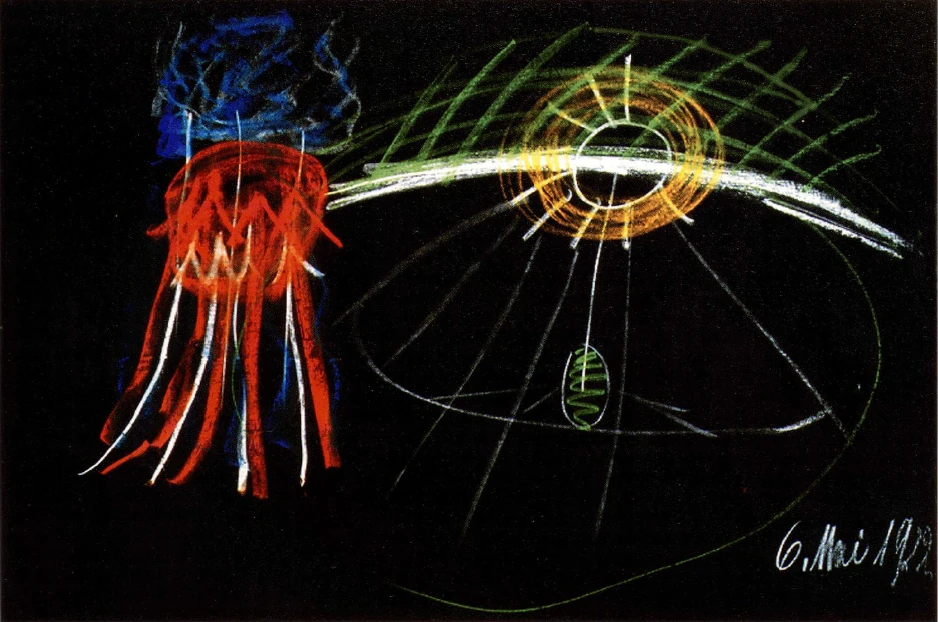
[ 9 ] You see, what human beings can recognize, I can record in the following way (see drawing). Let us assume that we have here the human heart (red) and above the human heart everything that human beings value so highly by recognizing their thought life on the physical plane (light). Human beings also feel this web of thoughts in their heads. But when humans, without attaining higher knowledge, devote themselves to their entire being, they feel these thoughts as something extraordinary, I would say, a noble part of human existence. These thoughts do not concern themselves very much with the actual personal being. Let us suppose we have the thought of a triangle. We must devote ourselves to it without this thought caring whether I have a headache or stomach ache. It is extremely indifferent to it how I personally feel. It is even indifferent to it whether I am in a different mood, sad or cheerful, whether something hurts or feels good—the thought of the triangle reigns with a certain noble nonchalance in my conscious mind and does not concern itself with my subjective state of being. Therefore, people who only want to concern themselves with their subjective state of mind immediately fall asleep when someone mentions thoughts that do not concern this subjective state of mind.
[ 10 ] Well, in a certain sense, there is a distinguished world that does not concern itself with the subjective state of mind. But when people mix their subjective feelings into this refined world and feel close to their own nature, then these feelings pass through the heart and, in a sense, radiate from the head down to other people, and then they rise up from the other people (arrows). What rises up?
[ 11 ] Yes, what comes up there are the feelings, the instincts, the drives, the passions; everything that works in the human being in the form of drives, instincts, and passions (red arrows) rages there, I would say; it rages there. There, the human being is in this very subjective realm. But what is raging there also contains all the ferment of the organism itself. What is boiling in the stomach, in the intestines, what else is boiling in the human being, rises up with these drives and instincts and comes to meet the human being. So that one can say: Up there is, in a sense, a noble world; it is very noble, but it does not become soulful in the human being because it does not concern itself with the subjective. Ultimately, it is completely irrelevant whether the miller has the idea of a triangle or a lion, or whether the schoolmaster has it. Thoughts do not concern themselves with the subjective. The soul only comes into being when that which permeates these thoughts emotionally or instinctively wells up from within the human being. If, for example, the miller is a hero and has the idea of a lion, then feelings rise up from within him such that he is not afraid of the lion; if the farmer is a coward, so that he runs away when he thinks of a lion, then it is the subjective that comes into play. That is the soul that comes into play. The lion's thoughts have something general about them that is not soul-like, but spiritual. Because this instinctive impulse comes from the human being, the thought becomes soul-like. And that also makes the idea of the lion spiritual, whether it causes the miller to always think of the instrument when he thinks of a lion, with which he attacks the lion, defends himself against it for my sake, or whether the Schulze always has to think, when he thinks of the lion, how he can run away as quickly as possible, and so on. This is what makes the whole thing spiritual in ordinary life. And the spiritual always radiates, in a certain sense, into the mental, I would say.
[ 12 ] Yes, but if you now move on to imaginative knowledge and from there to inspired knowledge, then things become different. Then, however, you first have the great difficulty of repressing what comes up much more clearly because it is unvarnished, the drives and instincts, of not allowing them to express themselves; they must now go back, they must not be allowed to express themselves. But something else comes up. These thoughts, which are stimulated by the outside world and have taken up residence in the head in such a distinguished manner, are met by the heart, which in a certain sense now becomes a wonderful sense organ — the heart becomes as large as the entire blood organism, and it becomes a large etheric sense organ — Now it is not what lives in the drives and instincts that comes up, but a sum of thoughts (bright arrows) that meet the higher thoughts. But these thoughts are powerful images, and they do not express what otherwise comes up from the organism; they now express what the human being was before birth.
[ 13 ] Human beings learn to recognize themselves in the spiritual world before they are born or conceived here on earth. This comes to meet them. Through this accommodation, the human being is not transported into his instincts and desires, but, when he has imaginative and inspired knowledge, he is transported into his existence in the spiritual world before he descended into a physical embodiment. And as human beings learn to recognize themselves there, they also learn something that is different from the outer world that otherwise surrounds us, where we encounter elemental beings, angels, archangels, and so on. We get to know ourselves from wisdom itself in our expanded being beyond earthly existence.
[ 14 ] But this provides very significant insight into the soul experience. We gradually say to ourselves: This soul experience has completely flowed out into the head; it is completely contained there in the head, has formed the head as its image (see drawing, blue). This is only presented to the outside world, so that it can paint the pictures that we then receive and hold in our memory. But down here, there is this life within, without being so intensely connected to the physical—I already hinted at this yesterday—there it is more separate. So that we look down into ourselves when the heart becomes the eye for this downward gaze onto this part, into the flaming, scorching, burning emotions, desires, passions, drives on the one hand; but on the other hand, there is that which cannot connect with what is our eternal being, what lives alongside it.
[ 15 ] And now it becomes clear to us: for our head, our soul is such that it is buried within it; it rests there. The head is actually only an external organ of reflection for the physical environment. There we only grasp the external world. We grasp ourselves when we look deeper into ourselves through the heart. Ordinary life merely throws up waves of emotion. But when we learn more about it through higher knowledge, our eternal existence comes to the surface. Now the soul learns to be connected with the spirit that we ourselves are. The external world, which we regard as our spiritual environment, is not what we are. What we see there through our heart, the organ of the senses, is what we ourselves are. The path that otherwise leads only into the soul, in that the soul shows its outer side, the instincts, the desires, this same path leads us into the eternal soul that is within us and that is permeated by the spirit, which is just as spiritual as the spiritual environment. Now we enter the realm where the soul is one with the spirit.
[ 16 ] You can look back at your brain as much as you like—it is physical; you yourself are physical there. But the brain is also the main domain of present-day materialistic observers of the soul. They say they are observing the soul, but they are only observing the brain. They can do that because the brain is an expression of the soul. The soul is buried inside it, submerged, and the corpse of the soul rests there. This corpse of the soul is the domain of contemporary soul research. But in itself, the soul is as it is as soul, and connected with the spirit, below the heart, and there it does not connect intimately with what are drives and desires, but only externally.
[ 17 ] Now, however, we make another discovery. Take any sense, for example, the eye: you first look around you physically. Let us disregard the fact that we are mostly here in artificial light; we could very easily prove that this has something to do with sunlight, albeit indirectly, but we do not want to go into that now. Let us just imagine a beautiful morning lecture in an open field, where instead of this terrible lighting we have sunlight outside. Let us imagine that; this is something that sometimes happens to people. Yes, but there we see the sun everywhere, because the sun is not just this disc or this sphere, but it shines; when it shines on a flower, the rays come back to us. It is the sun that enters our eyes and through which we perceive the flower, through which we also form the idea of the flower. Everywhere, on all objects, it is the sun. But it is easy for humans to understand that, insofar as they see the objects around them illuminated, it is the sun that, via a detour through their heads and eyes, conveys to them everything they know about these objects externally and physically. But it is not only the sun that the eye perceives. There is a deeper truth in the words of Faust: “The sun sings in ancient fashion in brotherly spheres.” Such a world harmony exists, and what makes itself felt in our atmosphere is ultimately also a reflection of the sun, so that even sound comes, in a certain roundabout way, from the sun. Everything perceptible in the outer physical world comes from the sun. Heat, sound, everything comes from the sun, only not as directly as light.
[ 18 ] And now I must say something that is naturally surprising at first hearing, something that seems as if it cannot be understood immediately. But one can penetrate it if one follows things as we are accustomed to following things through anthroposophy. In what we see externally through the presence of the sun and our sense connection with what the sun allows us to see in the external world, we are actually inside the solar sphere. We are inside the external physical-etheric solar sphere.
[ 19 ] When we now come to imaginative knowledge, to inspired knowledge — if I may express myself in this way, but only in the sense I have just explained — when we now penetrate further into our own being through our heart, something different happens with this solar element. At a certain point, where inspired knowledge arises, where we weave with inspired knowledge in a real world of images, we become conscious, as if we had suddenly entered the sun itself through an inner soul-spiritual jolt.
[ 20 ] This is an experience that you should only imagine in your soul in terms of its meaning. This sun shines upon us on earth. As human beings, we perceive what is around us as a reflection of the sun. But at the moment when we attain inspired knowledge, when the heart becomes an organ of sensory perception, as I have described, we suddenly feel ourselves inside the sun. We no longer feel as if we were looking up and seeing the sun moving there—I am now assuming only the apparent movement—but we feel as if our heart were inside the sun and we were walking with the sun itself, because the heart becomes our sense organ. For us, the heart is simultaneously moved out into the sun, and the sun becomes our eye, with which we now see what is beginning to be around us. The sun now becomes our eye, our ear, and our organ of warmth. We no longer have the feeling that we are outside the sun, but rather that we have moved into the sun, that we are standing within the light. We are otherwise always outside the light. Now, when we are immersed in our own being in our heart, we have the feeling toward the world that we are standing within the light, and our own being is light. With our light organs, which we now have in the flowing, weaving light, we touch the spiritual beings. With our soul, we now become related to the world that is not outside the sun, but within the sun, and I note expressly: we become linear, we feel as if we are on the path of the sun, linear on the path of the sun. And if our higher knowledge now goes just a little further, then we feel not only inside the sun, but then we feel, as it were, beyond the sun (see drawing). Before, we were down there as little human beings looking up at the sun. Now we have entered the sun, we feel ourselves with our soul being within the sun, and the world that was previously around us (green) is within us.
[ 21 ] But only when we have achieved this do we begin to understand that when we sleep in ordinary earthly life, we go out there with our soul. There we are, where we are so arranged that we are actually only supposed to perceive through the sun. Now we go out with our soul into the world, which can only become clear to us through the reflection of the sun; therefore, we perceive nothing there. We would have to move beyond the realm of the sun sphere. But this happens only through inspiration, later through intuition; only then do we perceive something, because when we leave our physical body and our etheric body, we squeeze through all the objects of the earth as, in a sense, human beings on earth; from the moment we fall asleep until we wake up, we squeeze through all kinds of objects on earth. At first, there is not much to perceive of ourselves. We perceive other beings, but only when we have adjusted ourselves to them; but we can only perceive ourselves when, through training, we emerge into the realm where we were between death and a new birth.
[ 22 ] What is it that separates us from this realm in which we live between death and a new birth? Yes, one can say nothing other than: it is the sun. We are born into the physical world as human beings. Before conception, before we descended, we had nothing to do with the external physical sun; we only had to do with what stands behind the sun as spirit. Now we descend into the physical world. The sun shines everywhere. What it makes visible to us in a physical way, we take into our thoughts, into our imaginations. This physical sun prevents us from seeing the spiritual. And when we are out there after falling asleep, among the objects that it otherwise makes visible to us, we are too weak to see outside the sun's realm, precisely because we are accustomed to earthly life with our physical bodies during our earthly life. and in the sun's sphere we cannot see anything, because there we would have to see the other beings that surround us in the outer world, either as elemental spirits or as spirits of the higher hierarchies.
[ 23 ] You see, then, that what is at issue here, from this point of view, is that the soul can be recognized as such, first, through a higher knowledge than that of ordinary consciousness, and second, that this soul is intimately related to what the world is. The soul is connected with the entire development of the world, and when we are in our bodies, it is the sun that makes everything external visible to us, audible, and so on, but it also prevents us from seeing into the spiritual world. When we ascend to the spiritual world, we come, so to speak, to the other side of the sun. We are here on this side of the sun; we come to the other side of the sun when we advance into the spiritual world. And in the transition from one side of solar life to the other, we have the consciousness I just spoke of, that we feel as if we were in the sun, with the sun, traveling the paths of the worlds with the sun, and so on. So we cannot get to know our soul at all without considering this soul in intimate connection with the whole development of the world, with the whole world being.
[ 24 ] What places us, I would say, in a certain location on Earth is our physical body, which is attuned to the external sun and prevents us from connecting our soul with the universe, which isolates us. The isolating factor is our organism. Thus, human beings actually live in the sun. And you know that the moon mixes into this sun—let us now consider purely the external facts—externally in this way: the sun shines on the moon. On moonlit nights, the moon reflects the sunlight. We have the sunlight from the moon. This means that we have a kind of shadowing, or lightening, one might say, of the world in everything that now comes into the world under the influence of the moon.
[ 25 ] Now, it is not only the silvery moonlight that enters the world, reflecting objects in a misty way when the moon is shining, just as sunlight reflects objects clearly, brightly, and with defined contours during the day. Not only does this reflection of sunlight from objects reach us, but the lunar aspect also lives in the beings of the earth through their ability to reproduce. The lunar aspect lives in everything that is capable of reproduction and is therefore connected with the forces of heredity.
[ 26 ] If human beings were only under the influence of the sun, they would indeed be able to exist on earth, but they would not be able to produce other human beings. If only sunlight were always present, the earth would, in a sense, be in a permanent state. No being would pass away and no new being would come into existence. Everything hereditary, everything reproductive would not exist. So that one can say: The sun-element is the primary physical force on earth. It drives our soul at the head of the human being; it makes everything into images at the head. We only become real in ordinary soul life through our instincts, through our emotions; in higher soul life, when we see through the spirit with our heart, but also when we come outside the solar element. So the solar element is the primal force in the sensory world, one might say. So that it is not powerful all by itself, so that this solar element does not become permanent, so that not all plants become permanent but die and produce new ones, so that not all animals become permanent but die and have produced new ones before, and so that the same happens with human beings, the lunar element is mixed in with the solar element in the development of the world. And so the lunar element is also incorporated into human beings.
[ 27 ] The lunar element is always active when a new human being enters the world. In a sense, the solar element does not merely reach the surface, but penetrates into the innermost being of the human being and excludes the human being from a certain sphere. Keep this in mind on the one hand. So we have, in a sense, the powerful force of the sun; and thrown out of the powerful force of the sun is a certain part of our outer world development, as the lunar element enters there.
[ 28 ] If I were to draw this schematically in relation to the human being (drawing $. 82), I would have to say: If this is a diagram of the human being, the lunar element would be integrated (orange). The whole human being, insofar as the solar element is involved, is thrown out, and the lunar element asserts itself. You see, therefore, that something is taken away from the primal solar element in the outer physical world. That is why what takes place in the lunar sphere cannot manifest itself externally in the world in the process of reproduction — only in the lowest animals does part of it manifest itself, in that the eggs are laid and then hatched by the sun — it withdraws from the external world where the lunar element becomes particularly strong.
[ 29 ] But this has a counterpole. What is taken from the sun on the one hand, and which is made possible by the lunar aspect, namely earthly reproduction and earthly inheritance on earth, is given back to it on the other hand. And in that it is given back, the sun is not merely the physical being described to you in outer science, but the sun has a spiritual aspect, a kind of super-sun that belongs to it (drawing, orange). This super-sun belongs to the sun, but this super-sun acts on human beings in exactly the same way as the moon, which is a kind of sub-sun. And in our age, people know nothing reasonable about the way the moon fits into the development of the earth; but they know even less about this super-sun, and that just as the moon has its powerful influence on the physical aspect of human beings, this super-sun has a powerful influence on the soul aspect of human beings.
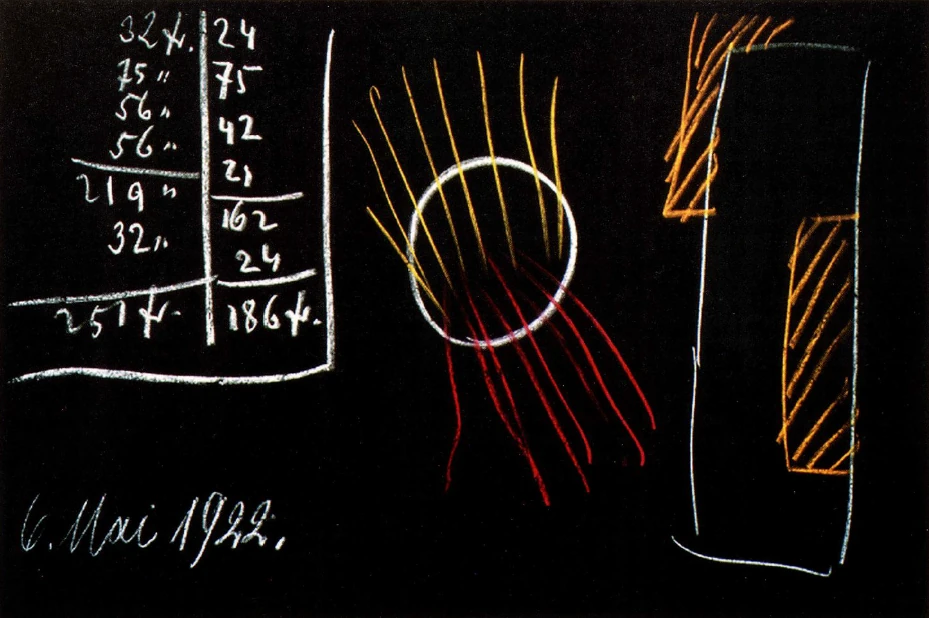
[ 30 ] You see, older people knew this from an instinctive clairvoyance, and therefore, when they wanted to hint at this to people who were particularly gifted for the spiritual, for the truly spiritual, they hinted that the super-sun was working on them, in short, that they are not merely what they are through the sun and moon, but that they are also what they are through the super-sun, that they are more than this physical body. Just as the human being is physically more than his outer physical body in its limitations, in that he can bring forth a human being from himself, in that he thus goes out beyond the physical side, so the human being is also more on a spiritual side. This was known in a time of instinctive clairvoyance, and that is why people were given halos. Just as man in the physical world goes beyond his own being by being a reproductive being, he goes beyond the ordinary soul, which is bound to the body, through the super-sun, protrudes into the spiritual, and, according to the view of the ancients, bears the halo. When modern people create halos, they are always like caps placed on the head, because they have no idea how this really relates to the human being. It is not a cap, but something that human beings have through the super-sun; it is an extension of their soul into the spiritual realm to such an extent that this extension can become visible in the ether.
[ 31 ] Through anthroposophy, we learn to understand why the halo was created from an older, atavistic view, and we are led deep into the soul-spiritual realm on the one hand, and on the other hand, we are led into what older, albeit dreamlike, atavistic clairvoyants were able to perceive of the world. They were able to see truths. And modern humanity is extremely foolish if it thinks that people in earlier times gave certain personalities halos out of some fantasy. They did not do this out of fantasy, but wanted to indicate that such people were particularly influenced by the super-sun, by what is spiritually and soulfully present in the sun. You see, then, that when you consider the human being in terms of his soul nature, he truly fills his organism; but as the lunar element penetrates him, and the lunar element can only appear there in its reflection, the human being becomes alien to his own physical nature. This goes into hereditary relationships. On the other hand, because the sun, I would say, receives through the super-sun what it loses to the earth through the moon, the human being participates in this and, with his soul, already ascends into the spiritual realm in his etheric body.
[ 32 ] These things must be mentioned if one wants to point out how intimately the soul of the human being is connected with the development of the world. One cannot simply talk about the soul of the human being without talking about the development of the world. For at the moment when one penetrates to the real soul, one also penetrates to the solar. And just as the human being is intensely connected with matter precisely because he carries the characteristics of heredity within himself, that is, because he carries within himself the impulses of physical development, so he is connected with the spiritual world in that he permeates what is mere intellectuality, which actually has something corpse-like, dead, with the super-solar, and thereby this intellectuality is animated. And so it is with human beings that the soul protrudes into their realm of ideas. As with the miller, if he is a brave fellow, courageous feelings emerge at the thought of the lion, which is an image in the spiritual realm; with the cowardly Schulze, feelings of flight emerge, as the thought becomes soulful, soulful from the human organism — for what floods into the imagination, into thinking, is ultimately the products of the organism — so now, from the other side, it is not instinct, desire, passion that flows in, but the world soul flows in from the supersensible.
[ 33 ] And we must be clear about this: If we have human beings living in mental images, in ideas, then on the one hand their instincts, their animal nature, flow into these ideas and make the imagination, which would otherwise be cold and sober, soulful (see drawing, dead); on the other hand, the supersensible flows in (yellow). This is also soulful. It is merely a prejudice to believe that someone who does not live solely in emotions, but who can also take in the supernatural from the world into their abstract thoughts, will become as dry a companion as someone who has only thoughts.
[ 34 ] People fear the spiritual when it appears in its pure, cosmic form because they believe: “I am already cold enough in my thoughts; if I now take in the thoughts of the world, I will become completely leathery.” But the opposite is true. One becomes just as warm inside, just as enthusiastic, but in a pure spiritual form, just as one is enthusiastic about the impulses, the desires, the animalistic nature that radiates from the organism into the realm of thought.
[ 35 ] In my book Goethe's World View, I pointed out that one cannot truly bring warmth into the realm of thought simply by mixing in instinctual elements. Certainly, passion and instinct warm the thoughts, but they warm them in an animalistic way. But there is also a warmth that comes from the world, that comes from the super-sun, and one can glow by absorbing this world warmth, which is not animal warmth but the warmth of the hierarchies above man. I was at least able to hint at this in my book Goethe's World View, where I talk about how wrong it is to regard a person who is full of ideas, when his ideas are imbued with a higher warmth, as such a dry companion and to believe that one will become one oneself if one takes up such ideas, as is otherwise the case with the dry ideas that are mostly known today.
[ 36 ] I have attempted to describe to you the spiritual in connection with the development of the world, and tomorrow I would like to present some specific details of this spiritual life.