

The Human Soul in Relation to World Evolution
GA 212
7 May 1922, Dornach
Translated by Steiner Online Library
Fifth Lecture
[ 1 ] There is, of course, an extraordinary amount to say about our topic, but with such a subject one can only give a few hints, and we must be content with those for now. Today, I will attempt to show you, through a kind of comprehensive overview, the place of the soul in the entire development of the world.
[ 2 ] When we, as animated human beings, allow the external world to influence us between birth and death, we initially receive a sum of impressions from this external world. Modern human beings, especially through scientific education, which extends even to the lowest schools, have been accustomed for centuries to regard this external world as the essential reality. In recent times, people have even begun to construct the science of the soul as a kind of natural science. This is not only done by scholars, but basically by the simplest human beings today. All this stems from the fact that modern man has little inclination to look back into himself. Therefore, he does not easily become attentive to such things as were discussed here yesterday. The man of the present day is little inclined, little accustomed, to look back on himself in an objective way. They look at what I called yesterday the surging and swelling drives, the desires, the passions, the emotions in general. But they are not inclined to look at this objectively, because when they look within themselves, not much else emerges from their inner being than these very desires. Even if it is sometimes refined by education, it remains this desire that arises, while the person forms certain ideas about the outside world in which he is not personally involved, which have a certain objectivity.
[ 3 ] There are many people who do not like such concepts; they stick more to what lives subjectively and personally within them. But the civilization of our time brings to people everywhere such concepts about external nature as we understand them today and have understood them for centuries. Modern man fills his inner life with these concepts about nature. Even today, through the smallest local newspapers, or at least through the Sunday supplements, he learns to view the world in this way. He does not realize that even the smallest newspaper is feeding him a scientific worldview, but that is what it is doing. So one can say that the only thing people are really concerned with today are concepts of external nature. I am not saying this as a criticism of the individual, but as a criticism of the times, or rather as a characteristic of the times, for there is nothing to criticize here; the matter is simply a necessary product of the times. Man is so little interested in man himself that he has actually become indifferent as to whether he sees the living actor on the stage or the ghost of the cinema, which of course makes a considerable difference in reality. But there is no deep feeling, no thorough feeling for this difference in today's world, otherwise we would have more feeling, more sensitivity for the large part that phenomena such as cinema culture play in the decline of our civilization.
[ 4 ] The ideas that are conveyed to people today for their souls are simply accepted because they are immediately convinced by a blind sense of authority when they are told: Science has once again brought this and that, once again established this and that. One must be clear about what it actually means to accept these things as they are described today. When we accept the description, we have no idea what is actually going on in the laboratories and so on. In short, there is the blindest belief in authority in the ideas about the external world that are communicated to people in this way.
[ 5 ] Now, this was by no means always the case. I have often pointed out that when we go back in the history of human development, we come to ancient times when people possessed something that I have always called instinctive, dreamlike clairvoyance. This clairvoyance was instinctive and dreamlike, but it was nevertheless capable of penetrating deeper into the essence of things than the so-called scientific ideas of today. People simply lived their lives through these concepts, these ideas, these images, which today seem to people to be only symbolic or allegorical, or as if they were drawn from the imagination, into reality. Whether the individual image corresponded exactly to an objective fact was not important; rather, by living with the image in reality, one was fully alive in the spiritual realm, whereas today it is of course important whether an idea one forms corresponds exactly to something outside, because this correspondence is the only thing to which human beings can hold fast.
[ 6 ] Now, when we look at this, we must place something quite bluntly before our souls that is of tremendous importance for the entire assessment of our present-day civilization. We must bluntly state that older people, with their instinctive clairvoyance, had something alive in their souls that modern people say is fantasy, that is not contained in things outside.
[ 7 ] In a certain sense, if we stand on an understanding basis with anthroposophy, we must participate in this faithful reproduction of external nature, where one no longer stands within external nature but only reproduces it. And you may know that we do this scientifically in the most extreme sense by rejecting any kind of hypothesis about what the appearance of nature is, but remaining, in our phenomenalism, as it must be called, within the phenomena, that is, within the external natural phenomena, which must explain themselves, to use Goethe's expression; to which one does not add all sorts of ideas about atomic bombardment, atomic explosions, and so on, as is still customary today, I would say, out of the inertia of an old habit. On anthroposophical ground, in the strictest sense, when it comes to external nature, we must adhere strictly to the phenomena themselves and reject the idea of thinking anything into the phenomena.
[ 8 ] Human beings can best learn how not to read anything into phenomena by adhering to something that has also emerged with the scientific worldview in recent human development, namely technology. When we make technical use of the laws of nature, we are actually creating the phenomena themselves. Of course, they still remain within the phenomena themselves, for example, the power of electricity, about which today's researchers say: I use it, but I do not know its nature. They often speak this way about all natural forces, including heat and light and so on. So there are remnants. But what really matters to us in technology, what we want to master, is what we put together ourselves in experiments, where we have a certain insight into the matter.
[ 9 ] Those who are aware of such things also have the feeling that there is something of an immediate, comprehensible certainty in what they construct technically, even in the field of chemical engineering, whereas when one talks about nature as observed, one has the possibility of thinking differently in this or that direction. So that one can say: modern thinking is actually most perfectly present in the technician. That is absolutely true. Anyone who today walks past a machine construction or, say, the manufacture of a chemical preparation and its use without any idea of what it is, is not yet thinking in the spirit of our time; I would say: he lets others think in his soul, because the people who matter think technically after all. And so the worldview of modern times has gradually become what we find outwardly realized in technology, in mechanism, in chemistry, and so on. This has gradually extended to what we still want to consider a worldview today.
[ 10 ] What, then, is our astronomy? For a long time, our astronomy was nothing more than a representation of the machinery of the world. It was a great machine, as one imagined the sun in relation to the planets and their movements. In more recent times, chemistry has come into play in spectral analysis. But astronomy does not go any further than that. Astronomy, this science of the universe, today answers only the question: How do we cope with the idea of the universe if we simply apply the ideas familiar to us from technology to the universe, if we transfer what we can observe in technology to outer space? So that our science, with the exception of what one might almost call nonsense, such as neovitalism, and with the exception of talk about psychoids and the like, has useful ideas in its worldview only to the extent that we can construct machines and chemical preparations. We then transfer the ideas we gain from this construction to the structure of the world and imagine it as a large machine within which this or that chemical process takes place.
[ 11 ] This was certainly not always the case. Until well into the 15th century, human beings – I am speaking here of the civilized areas of the Earth's development – lived with ideas about the external universe that were not merely technical, but such that human beings experienced them as something they were part of. Technology is completely outside of human beings. It is separate from them. In the past, people experienced what they knew. Today, they no longer experience what they know. That is why even our very intelligent people today always have the feeling that in earlier times, people dreamed all kinds of things into the world and created fantasies. Today, we have the opportunity to imagine the world without such fantasies. People believe that technical ideas are the only ones that can be conceived of in the world without running the risk of fantasizing about the world and failing to recognize it.
[ 12 ] But what I am describing here is based on something much, much deeper. There is something underlying it that the prophecies of the ancient mysteries already emphasized for a certain degree of initiation. This is precisely what was peculiar to the mysteries in those times when ancient clairvoyance existed, that the mysteries prophetically foresaw what kind of worldview would one day come about. In the mysteries, it was prophesied in the following way: If we were to maintain for humanity the view that exists today — this “today” was in very early times, when people experienced their surroundings in an instinctively dreamlike way — then human beings would never be able to become free beings. Then human beings would always have to receive the impulses for their actions from what they experienced in their inner lives. A divine world would arise in their hearts, it was said, but this divine world would make them unfree. — The older civilizations had people who were completely unfree. They were aware of what they were doing, unless the rulers imposed state laws on them, telling them that they were following divine commandments. So they were, so to speak, merely beings who carried out what the divine within them prompted them to do.
[ 13 ] Thus it was said in the mysteries: There must come a time when this kind of divine activity in man ceases, when man comes to look only into the outer world and see in the outer world that which has nothing more to do with the human, and to take into their souls only the external world. When human beings can no longer look with understanding and experience at the forces of humanity, but only at the forces that live outside in the world, with which human beings have nothing to do, then they are inwardly free, then they are inwardly relieved, then their souls are filled with nothing but what does not concern their own organization.
[ 14 ] This phase of development had to come once for human beings, so that they could look at nature, so to speak, only as something outside themselves, so that they could become free. That is what was said in the older mysteries. In these older mysteries, it was therefore said: What we can now give to people who show us understanding from their instinctive clairvoyance, we will not always be able to give them, because they would remain unfree. A science will have to come to them which, while not exciting any impulses in them, will provide them with ideas of what is outside them, so that in their cognition they will always hold fast to the outer, and thus educate themselves in relation to their inner impulses toward freedom.
[ 15 ] You see, I was faced with this situation in the most extreme sense when I felt compelled to write first the preparatory writings and then my Philosophy of Freedom. The fundamental question behind the writing of this Philosophy of Freedom was the following: It was a matter of saying to oneself with complete clarity: We are simply living in the technological age. Unless we amateurishly ramble on about what remains of the old ways in creeds and so on from the old instinctive worldviews, we have no other option than to stick to what can be thought about the world in technical terms, which is exhausted in mechanisms and so on. We stand inside the world, viewing it as a great machine and a great chemical process. If we want to return to the spiritual, we must radically break with everything that has been handed down to us as mysticism from ancient times, and we must find the spirit in the, I would say, spiritless, mechanical world that modern science has given us.
[ 16 ] I would like to sketch on the board the situation we faced when I wrote my Philosophy of Freedom. If this were man (drawing on the left, light) and this were the environment (yellow), then one would have to imagine things in earlier times as follows: Man looked out into the environment. But then he also experienced within himself what his instincts provided him with in the form of dreamlike, clairvoyant images (red). He connected this with what he saw in the environment, and therefore saw the environment as spiritualized (red in yellow). He saw elementary or even higher beings in all beings because he was able to bring the conditions from his own inner being to bear on them.
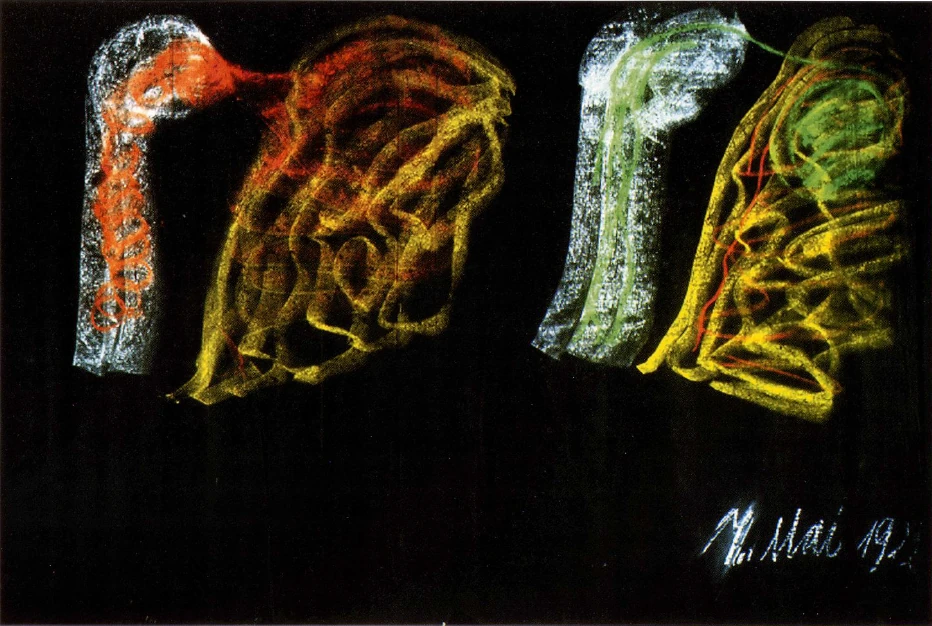
[ 17 ] The newer human being, the human being for whom I actually wrote my “Philosophy of Freedom” at the end of the 1980s and beginning of the 1990s as the civilized human being, is depicted here (drawing, right, light) and the environment here (yellow). Now, humans no longer give anything of themselves to the environment, but only pursue what can be constructed technically; they pursue the laws of the environment itself. However, no moral impulse can be found in this. In this way, only natural laws can be formed. As I have drawn here (left), because older people were still connected to the external world, moral impulses could still be perceived in everything they saw, in stone, animals, plants, because divine-spiritual beings were contained in all of these. There is nothing of this left in the laws of nature. The natural laws contain only that which passes into machines or mechanisms.
[ 18 ] What, then, was the necessary task of this “Philosophy of Freedom”? Its necessary task was to say: If human beings, standing outside nature, can no longer find moral impulses because they only receive natural laws through their senses, then human beings must go outside themselves; they can no longer remain within themselves. And I had to describe the first stepping out, where man leaves his physicality. And this first stepping out is in pure thinking, as I have described it in the Philosophy of Freedom. That means: now man does not step out with his instinctive clairvoyance, but now he steps out of his body altogether, places himself in the external world (green). And what does he have there? There, by performing the very first, most subtle clairvoyance, he has moral intuitions, or if you want to use the subjective expression I used at the time, he has moral imagination. There, man departs from himself in order to find this spiritual element within the technical realm—for the spiritual is indeed within it—in the first realm, the realm of morality.
[ 19 ] People have simply not recognized that this is the first stage of modern clairvoyance, which was brought to light in The Philosophy of Freedom, because people still thought: Well, yes, Clairvoyance is something where you are immersed in uncertainty, where you enter the unknown — whereas here it was precisely the known that was being sought, whereas here it was a departure with thinking that was being sought, thinking that no longer clings to materiality but grasps itself, because it is here first, that is, in pure spirituality, even in the purest spirituality, that the world has been grasped.
[ 20 ] And that is why The Philosophy of Freedom was doomed to be too intellectual for the mystics. And that is why the Philosophy of Freedom was doomed to be too intellectual for the mystics. In their way, they saw too many thoughts in it. And the others, the rationalists and natural scientists or even philosophers of the modern era, could not do anything with it because it led them into the realm of intuition, where they did not want to go, for they wanted to remain with mere external observation, even when they spoke of philosophy. Thus, it was precisely the whole attitude, the habitus of the Philosophy of Freedom that fulfilled what was simply imposed on modern man.
[ 21 ] That would be, so to speak, the elementary element of what can be said in connection with what was prophetically proclaimed in the ancient mysteries about what was to come. But the ancient initiates into the mysteries saw the matter even more clearly, saw it even more in connection with the human soul and the development of the world. For they also saw the following: They clearly recognized that the world that would one day be discovered through later knowledge is not only extra-human, but also extra-divine, outside the realm of that divine creation of which we—and by “we” I mean the ancient initiates—are actually speaking. We seek the revelation of the divine in what we attain through our initiation; through our initiation we commune with the divine beings. — The various pagan peoples communed with their beings, the Jews, for example, with their Yahweh or Jehovah. Insofar as they were initiates, they communed with their divine beings not only in thought but in reality. It is entirely correct to speak of real contact with these divine beings in the ancient mysteries. Yes, the initiates communed with these divine beings; but when they were outside the mysteries, and when their disciples were outside the mysteries, they all saw the environment again. However, they saw into this environment what their instinctive clairvoyance gave them. But the initiates themselves and the disciples of these initiates knew that what was out there was resisting in a certain way what they were seeing, and that a time would come when it would not only resist, but when they would only be able to see what could be perceived without such insight.
[ 22 ] What modern man, because his knowledge is superficial and not profound, would not dare to admit to himself, these ancient initiates admitted as a truth. They said to themselves: The world we see out there, if we do not first look into it with what our gods have given us—for what they saw there was given to them by their gods at the beginning of the world's development—then this world is ungodly. So we have in our environment a world that does not originate from the gods with whom we commune in the mysteries.
[ 23 ] This was what then lived on in the Middle Ages in the special form of contempt for nature and asceticism, and what lives on in certain creeds to this day, albeit very hypocritically in some creeds. This is what, originating from the ancient mysteries, man must actually say to himself: When I look into my inner self, I can commune with the gods; but the world around me does not originate from the gods at all. This world was not created by those gods to whom I want to devote myself when I allow myself to be initiated.
[ 24 ] This was a fundamental insight into which people increasingly and objectively lived themselves, that the outer world did not originate from the gods they had come to know through the mysteries and initiation. These gods had actually wanted a completely different world. Through a special event, humans sank down into this world, which their gods did not want at all. All ideas about the Fall – one could develop them all now, but there is not enough time for that today – stem from the fact that humans realized: The world we know as our environment is not the one that these gods created.
[ 25 ] But people tried to understand what these gods, with whom they wanted to communicate, actually wanted with this world that they had not created. They were able to learn this from them. And they learned from them that they actually wanted the destruction, the annihilation of this world.
[ 26 ] The initiates of earlier times were also faced with this fact. They were faced with the fact that the gods they were striving for actually revealed to them that their decision was to destroy this world. And yet they also knew that in order for human beings to become free, human knowledge must be linked precisely to this world, which the gods consider ripe for destruction, which the gods actually want to destroy.
[ 27 ] In the older Greek mysteries, this was then understood in a very peculiar way. In the oldest Greek mysteries, people worked specifically toward an artistic shaping of the world—they had no idea of the natural scientific view we have today in ancient Greece—they worked in sculpture, especially in tragedy, in short, in art, toward creating something through human beings that was based on this world but nevertheless transcended it. And the initiated Greek had the idea that The world on which you stand, the world of trees that you see, the world of springs that you perceive, and so on, will be scattered; but what you have imbued in your Venus de Milo, in Zeus, in Athena, what you have imbued in Sophocles' drama from this world, will indeed pass from the visible realm into the invisible, only the thoughts will remain, as it were, floating, but when this earth is scattered, they will go forth and save the continuation of the earthly world, which otherwise could only consist in the radical destruction of this earthly world.
[ 28 ] The Greeks of the earliest times, when art still sprang from the mysteries, already imagined: Through art we will save the destruction of that world which originated with the gods but which has been subjected to a restriction that the gods themselves wanted to destroy. And what was known at that time led to the following statement. You see, certain fundamental scientific facts were, as can be proven historically, well known to the ancient initiates of the mysteries. Certainly, we have achieved much that is new in the course of the last centuries, especially in the 19th century, with regard to technical constructions; but certain fundamental things that still have an effect in technology today were well known to the ancient initiates. They knew much more than what they told people who were not initiated. But they said to themselves: If we simply put together something technical that combines natural forces so that we have something machine-like in front of us, then in the most extreme case we are doing something that will be destroyed along with the earthly realm, something that the gods themselves wish to see destroyed. For every initiate knows that the gods whom people looked up to in the ancient mysteries, with whom they communed in the ancient mysteries, with whom they can of course still commune today, that these gods hate nothing so much as, for example, a locomotive or a car! This is something terrible to them. For these gods say: What we have to put up with from Ahriman, that he formed the earth in this machine-like way, is now being imitated by human beings; they are adding something to it. Our work is already great for what we have to destroy, if we had at least only the works of Ahriman; but we also have these steam engines, these electric machines and all that stuff; we have to destroy that too.
[ 29 ] So the ancient initiates said to themselves: It is of no use simply to increase the external forces of nature, in which nothing spiritual can be seen, through technical machinery or technical chemistry. It was a fundamental conviction of the initiates that this was so. Therefore they said: We must save as much as possible of this world. As I said, in Greece, people wanted to save through art; when we move more towards the Orient, people said to themselves: “What proceeds according to so-called natural laws has, in essence, no purpose for the true development of humanity, because the gods will one day destroy it; therefore, we clothe what we do in such a way that the spiritual lives within it.” - And from this arose cult in the older sense, not the formation of a machinery or a chemistry, but cult activity. People see something sacramental in what they do, something in which spirituality is present, in which the spirit participates. In religious cult, people wanted to save as much as possible of what could be saved from earthly evolution.
[ 30 ] I have often expressed this on previous occasions by using an image: We must once again come to see our mere technology in such a way that the laboratory table becomes an altar, that we actually perform a kind of divine service by working in the physical and chemical laboratory, that the laboratory table becomes an altar, that we actually moralize and spiritualize there. — I have expressed this in the past; it is basically the same thing that I am expressing today in more historical terms.
[ 31 ] This is how the religious cult arose, to which people are now returning because they cannot bring themselves to engage in spiritual activity. It is remarkable how large numbers of intelligent people today are returning to the bosom of the Catholic Church for the simple reason that they want to save themselves to what remains of the earth, from what must disappear without a trace by the will of God Himself. This influx of educated people into Catholicism today is not even noticed by those who do not observe the present attentively. This consists in the fact that people want to escape from what is being destroyed into something that, like Catholic ceremonies and cult practices based on very old institutions, at least wants to shape what remains, because people lack the activity through which something new, something we need for the future, can really be found. People lack inner strength. They have already lost it in our technological age.
[ 32 ] At a certain point, we should have said emphatically: We are living in the negative world of technology. There are no more impulses to be found there in the old way. We must move toward moral imagination, toward intuition. That is what we should have said. Those who ignore this necessity of the times are simply returning to Catholicism. This can be explained entirely by the weakness of the times.
[ 33 ] And because that was so, and because that was a realization among the ancient initiates, people asked themselves: Yes, how will it be now? The gods we know, with whom we are in contact through the mysteries, all these gods want the destruction of the earth. But if people want to become free, they will always become more like what is on Earth; for it is only through technical knowledge that people can become free. Thus, if the ancient initiates had been able to see this alone, they would have had to face the terrible fact of the future that was prophetically revealed to them: In order to become truly human, people must become completely entangled in the Ahrimanic world of godlessness, and they must be destroyed along with the Earth when the gods dissolve it. For people themselves are gradually becoming machinery; they are becoming more and more like machines. Their thoughts are becoming such that only technical impulses are at work in them. Astronomy is basically nothing more than thinking about the great world machine. So there is nothing in human beings except thinking about the machine; for ultimately it is all the same whether one thinks about screws and wheels or about Venus and Mercury according to the same purely technical pattern of construction.
[ 34 ] So these initiates must have been faced with a terrible future reality. And that was quite clear to them: their old gods wanted destruction in this way because they had to want the destruction of the Ahrimanic, and because, as things were at first, they could not save humanity.
[ 35 ] The other thing that was prophetically opposed in these ancient mysteries was the mystery of Golgotha, before it happened on earth, prophetically. After it happened, it became possible to understand it more and more in some way. This was simply what the ancient initiates learned in the mysteries from the gods with whom they communed. The gods knew everything; from them they could obtain comprehensive wisdom. But there was one thing they could never learn from these gods: that was everything related to human birth and death. These gods knew nothing about death as such. But at the same time, it was known in these ancient mysteries that one of their number would be sent down, the one who would later be called Christ, and that he would experience death on earth. Thus, the mystery of Golgotha lies in the fact that one of the gods, who previously knew nothing of death and therefore also nothing of birth and all the conditions of heredity, came to know death and, through this knowledge, was able to connect himself with the evolution of the earth and form a counterweight to what would have been necessary through the evolution toward freedom: the increasing kinship of human beings with the disintegrating earth. By truly devoting themselves to modern knowledge, truly accepting modern scientific discoveries, on the one hand, but turning to Christ, who was the god who experienced death and thus also birth, on the other, human beings form the opposite pole within themselves.
[ 36 ] On the one hand, therefore, one can lean completely toward what is necessary for freedom, but on the other hand, I would say, one must also put the other side of the scale, find the way to the Pauline words: Not I, but Christ in me. Then, by permeating the world with Christ, human beings will again find the possibility of transforming from their souls that which would otherwise fall away from the world of gods to which human beings actually belong.
[ 37 ] And so the Christ was set against the Ahrimanic forces that would otherwise have worked on Earth in what would have fallen away. Through an extraterrestrial divine decision, Christ was opposed so that he might now work on earth. He does not need to become free; he is a god and remains so, even though he passed through death. He does not become like the earth. He lives as a god within the earth's being. And the consequence of this is that human beings now have, on the one hand, the possibility of placing as much as possible on the scales of freedom, of going to the ultimate consequences of individualism, because moral imagination is found only in the individual human being. That is why my Philosophy of Freedom has been called the philosophy of individualism in the most extreme sense. It had to be so, because on the other hand it is the most Christian of philosophies. Therefore, on the one hand, one had to place that which in the fullest sense presents what is external knowledge of nature, which one can only enter with the spiritual, by rising to pure, free thinking. This can still be saved within purely technical knowledge. On the other side of the scale, however, must be placed that which is the real knowledge of Christ, the real knowledge of the mystery of Golgotha.
[ 38 ] It was therefore quite natural that I attempted to write The Philosophy of Freedom, as poorly and as well as I could, because one cannot do everything well at the first attempt. On the other hand, however, it was necessary to point to the mystery of Golgotha through my Mysticism at the Dawn of Modern Spiritual Life and Its Relationship to the Modern Worldview and through my Christianity as Mystical Fact. These two things simply belong together. But those people who now find a contradiction in this outwardly, who think that I am actually proceeding as if they had meat on one side of the scales and weights on the other and now say: What nonsense! These things belong together; in short, you have to mix everything together. — And now they take away the weights and throw them in with the meat. Yes, of course there is no balance. That is what today's critics do. They put mysticism on one side and philosophy on the other, and then what is in mysticism shoots into philosophy or vice versa. Now they find, of course, that the world is behaving in a terrible way; but that excludes everything that is required for the present, for which it was absolutely necessary. And so, if the present soul wants to place itself correctly in the development of the world, there must live in it, on the one hand, a strong impulse toward freedom, and on the other hand, a strong impulse toward inwardly living through the mystery of Golgotha.
[ 39 ] But this must gradually take shape both in the individual human life and in science. In the individual human life, the human being must eventually overcome the old instinctive forms of mysticism and clairvoyance and place himself entirely on the standpoint of such knowledge as we have when we understand, say, a steam engine. I presupposed in my Philosophy of Freedom only such ideas for the external knowledge of nature as are necessary in order to understand a steam engine. But in order to understand a steam engine, one must indeed lay aside one's whole human nature, but not the last, the pure thinking. That must still be developed in man and then carried out. But that is at the same time what lives in objects.
[ 40 ] So, on the one hand, one can stand entirely on the ground of freedom, but on the other hand, one must stand on the ground of the Christ fact. But this must also enter into science. And it will enter into science in such a way that one says: There is external nature. For my own sake, I describe it as Haeckelian as possible. But there remain remnants. There remain remnants that can never be understood with these ideas. Forgive me if I express myself a little clearly, but we are serious people who want to understand something, and we are not at five o'clock tea. So I would like to say: The two things are necessary, that they enter our civilization in the right way, that in earlier times—when people were aware of their connection to the spiritual world through their instinctive clairvoyance—they had developed the halo. In those earliest times, the halo was particularly well developed; it appears in many different forms, including in worship. But when the first materialism arose in people's feelings during the Middle Ages, something else became particularly popular to depict: the pregnant woman. Just look at many pictures from the Middle Ages: the women in these pictures are all pregnant. On the one hand, you have that which saves us from death and which is expressed in the highest form in the proclamation of the spiritual world in the halo, and on the other hand, you have that which brings human beings back into the physical world again and again: birth.
[ 41 ] These things are all connected with the inner spiritual motor of human development. The soul always lives in what are inner motors of development. Thus there is a connection between the soul's experience and the development of the world itself in relation to the most intimate facts, and science will gradually have to come to terms with this and say: I recognize the world as Haeckelian as possible, but two things remain: one is birth, the other is death. These cannot be understood with the ideas of chemistry and mechanics, that is, with what can be technically constructed. These are the two gates that lead out, and there one must begin with a different way of looking at things. As long as one considers freedom, one can remain within the ideas that are also expressed in technology. And when one writes a “philosophy of freedom”—for children are not yet free, the divine still works in them in bondage—one writes directly for people who are in the middle of their lives, for that is when one actually becomes free. When you begin to write the other parts, you are immediately led to the view that human beings can have in their souls about death. Therefore, the primordial mystery is the experience of death, and the inner experience of death and spiritual rebirth is what you will also find in the very first chapters of my mystical writings.
[ 42] This is something that simply arises from the present view of the world, but not in a nebulous way, rather in a way that truly wants to understand what is necessary through and through. And so one must say: with what the human soul experiences in the direction of freedom, it touches upon the Ahrimanic in the world. With what it experiences in the direction of religion, even if it leads to the mystery of Golgotha, it comes very close to the Luciferic. And there it can very easily fall into the Luciferic instincts and drives if it develops mere religious egoistic instincts, as is very easily the case in the present religious life.
[ 43 ] This is what must be taken into account for the soul out of the immediate present, and this was also what Christ taught his intimate disciples immediately after his resurrection. These intimate disciples, who were the continuers of the ancient mystery initiation, were to teach that he had descended from the world of the gods who had not yet known death and who therefore could tell human beings in the primeval earth period nothing about death; that Christ had descended in order to learn the secrets of birth and death. This is why the teachings about Christ's death and birth have remained so unclear, because people could not find a way to explain these things. But in the Christian primordial mysteries, whose actual meaning, because the sense of freedom had to be developed first, had already disappeared in the 4th century AD, Christ himself revealed this secret of learning about earthly death through a god to his first initiated disciples after his resurrection. However, this happened after the ancient, original wisdom of the old gods had been communicated to people, then passed on further and further to later generations and increasingly watered down. What Christ revealed to his intimate disciples after his resurrection was the most authentic revelation in earthly life; it was what was now to carry on the life of the soul as its foundation, as its spiritual foundation. For basically, what the ancient gods taught people when they ascended in the mysteries were the secrets of Saturn, the sun, and the moon; the actual mystery of the earth — for it was only on earth that birth and death appeared in the human sense; previously there was only metamorphosis, transformation — had to be experienced by a god on earth itself through the mystery of Golgotha in order to be conveyed to the life of the human soul. Thus, through this most fundamental revelation after Christ's death, the foundation was also laid which the human soul must take into itself in order to accomplish the salvation of earthly life from this foundation.
[ 44 ] Thus, human souls are connected with the evolution of the earth, with the evolution of the world in general; they are connected through the other facts I have presented to you in recent days; they are connected in that they correctly absorb the impulse of the mystery of Golgotha. That is what I wanted to explain to you in these lectures.