

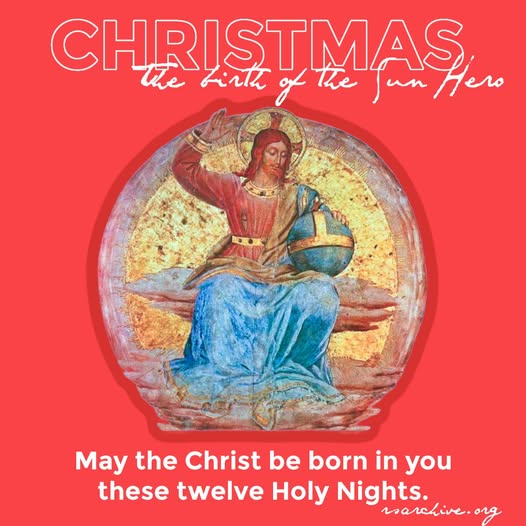
"Christianity stands as the external mystical fact for the birth of the light. Christ brought to the earth what had existed from the beginning, although it was hidden from mankind throughout the ages we have been speaking of. Now, however, a new climax was reached. Even as the light is born anew at the winter solstice, so in the fourth post-Atlantean period the Savior of Mankind, the Christ, was born. He is the new Sun Hero who was not only initiated in the depths of the Mystery temples, but who also appeared before all the world so that it could be said, “Blessed are they that have not seen and yet have believed” (John 20:29). When it was recognized that the Divine could descend into a personality, the festival celebrating the birth of the Sun Hero, the Christ, came to replace the festival celebrating the birth of the light.
What formerly was impossible could now be attained. Man could now give birth to light in his own soul. He could do this because the principle of light had incarnated in a human being for the first time. In this way the festival of the winter solstice was of necessity brought together with the Christ festival. The whole significance of the preceding evolutionary periods is determined by the establishment of the festival of the birth of Christ at the time of the festival of the winter solstice. Wisdom and light first appeared to men externally, but now, after the Christ event, the light must be kindled in man's own heart. Christ Himself must be born in man."
Rudolf Steiner, Signs and Symbols of the Christmas Festival, Lecture I. Birth of the Light, GA 90a, 19 December 1904, Berlin.