

Astronomy and Anthroposophy
by Elisabeth Vreede
June 1928
Translated by Steiner Online Library
10. About Eclipses
The Saros period
It has already been explained how the lunar nodes, those points of intersection between the orbits of the sun and the moon (currently located in Taurus and Scorpio), complete one revolution around the entire zodiac in 18 years, 7 months (and a few days). This period plays a role in every human life. For the nodes are not to be understood merely as mathematical points, as intersections of the “extended lunar orbit plane” with the “apparent solar orbit,” as modern astronomy would have it, but rather as something like gateways for the astral, as astral-sensitive points in the natal sky of every human being. Rudolf Steiner pointed out that every time the nodes return to the position they occupied at birth, i.e., when a person reaches the age of 18 years and 7 months, 37 years and 2 months, etc., they become particularly receptive to the astral world in their subconscious, which can manifest itself in strange dreams and the like. The nights experienced during such times are the most important of our entire lives. However, people usually “sleep through” these important periods because they are not aware of them. In Goethe's case, who experienced such a period four times, the influence of the node transition can be demonstrated in an interesting way from his biography, diaries, letters, and conversations. It is good when anthroposophists try to catch such moments in their lives. They may also be found halfway through the period, after 9 years and 3 1/2 months, when the ascending and descending nodes have changed their place in the zodiac.
This period is also reflected in the so-called nutation of the Earth's axis, which will be discussed next time.
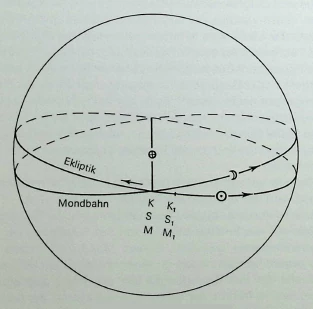
A certain shortening of the node cycle is given by the Saros period, which has to do with the return of eclipses. — Let us assume that there was a total solar eclipse, with the Sun, Moon, and nodes (S, M, N) closely aligned at a specific location in the zodiac. Now all three continue their movements: the Sun completes one revolution in approximately one year, the Moon in one month, and the nodes in the opposite direction in 18 years and 7 months. It now turns out that shortly before the node returns to its previous location, after 18 years and 10 days, it meets the sun again and the moon is also back in place (the moon has now gone around 223 times, the sun 18 times), so that the previous eclipse repeats itself in K1 under almost the same conditions. Of course, in the meantime there have been repeated solar eclipses and also lunar eclipses as soon as the sun and moon met with the nodes at any point in the zodiac. In the Saros period, however, the distance of the sun from the node, the position of the moon, and the magnitude of the eclipse phase correspond to the conditions of 18 years and 10 days ago — almost exactly. As a result, the other eclipses that preceded or followed the first one will also repeat themselves in the same order. It has already been pointed out that, with very few exceptions, the recorded eclipse series from 1924–1928 correspond to the same series from 1906–1910 (see page 95), and likewise to those from 1942–1946, with only a difference of 10 or 11 days. There is therefore a series of solar and lunar eclipses that occur in a period of 18 years and 10 days and then recur over a longer period of time (see Figure 19).
It is precisely this rule, however, that allows us to experience the wonderful vitality of cosmic “mechanics.” For all these relationships are “almost” true; the small difference that occurs everywhere causes variation in the otherwise uniformity. A particular eclipse returns under almost the same conditions after 18 years and 10 days (it can also be 11 days, depending on whether there were four or five leap years in the 18 years). Because these 10 days are added to the 18 years, the sun has moved about 10° further, so the eclipse does not take place at exactly the same point in the sky, but 10° further east. But it is not exactly 10 (or 11) days, but 10 days, 7 hours, and 42 minutes. The new eclipse will take place on the relevant day at 7 hours 42 minutes, which is almost 1/3 of a day late. This means that the Earth has rotated a further 1/3 of its axis, and the eclipse (especially the local solar eclipse) does not take place in the same region of the Earth as the first time, but in a region that is 1/3 of the Earth's circumference further west. The second one will be 2/3 of the Earth's circumference away, and only the third repetition, the fourth eclipse, after 54 years and 33 days, will occur approximately in the same area as the first (only shifted north or south again). This results in triple series of eclipses, the triple Saros period of 54 years and 33 days. But even then, the new eclipse after a Saros period does not occur at exactly the same distance from the node as the old one, but gradually, very slowly, moves from east to west toward the node and beyond it. This results in a new moon falling so close to a node over time that a very slight covering of the sun's disk is possible: for the first time, the eclipse appears as a very small partial eclipse, which now continues to assert its place in the Saros series. The next time, after 18 years and 10 days, it will also be partial, but already a little larger. After perhaps 6-10 Saros periods, it will have moved so close to the node that it will appear as a total eclipse. Then it will remain a total (possibly also annular) eclipse for many centuries. Every 18 years, it moves a little closer to the node, then beyond it, until it becomes only partial again and finally ceases to be an eclipse: it is simply a new moon, without coverage. The same thing happens with lunar eclipses, except that the full moon is always at the opposite node to the sun.
These conditions can be easily followed by looking at drawing 16. The eclipse of June 17 is one that is occurring for the very first time. It has already been mentioned that it is missing from the series of 1910. It is, so to speak, “born” as an eclipse in these days. In 18 years and 10 days, the distance between the sun and moon and the node will be slightly less than it is now, and the eclipse, as mentioned, will be 10° closer to Gemini. This will allow the sun and moon discs to cover each other a little more. It will not be until the 22nd century that the eclipse will be so close to the node that it will be total.
Or let's follow the eclipse of May 19. It is located to the far right of the node, which means that it is moving out of the eclipse zone. It was indeed total for the last time on May 19; the next time, on May 30, 1946, it will be partial, and then it will decrease more and more until August 3, 2054, when it will cease to exist as an eclipse altogether. Looking back, this eclipse was annular from 936 AD (which is a type of totality, only with the moon's disk being too small) and thus existed as such for 1000 years. It was “born” on June 24, 792 AD, on the far left of the ascending node, and will “die” on August 3, 2054, as mentioned above.
So, in the eclipse period of 1928, we have the rare occurrence of a newly emerging solar eclipse and an eclipse ending as a total eclipse. The lifespan of total solar eclipses is about 1200 years, while for lunar eclipses it is slightly shorter.
The aforementioned solar eclipse of November 12 is partial because it has already passed its period of totality (which lasted from 1171 to 1874, but was actually annular) and now appears as a partial eclipse again. It was first partial again in 1892.
One can imagine this life and weaving of eclipses even more clearly if one follows them not in the sky but on the earth, especially the most striking solar eclipses. These consist of the moon's shadow, already mentioned, drawing a strip across the earth, which travels at express train speed for a maximum of 4 hours, describing a path on the earth's surface. (The totality itself can only last for a maximum of 8 minutes at a given location on Earth.) After 18 years, this path returns, one third of the Earth's circumference further away, and after 54 years it is, in a sense, parallel to the first path.
It is now the case that a newly emerging solar eclipse, such as the one on June 17, always touches the Earth first at the poles, namely at the North Pole in the case of an eclipse that arises at the ascending node—the dragon's head—and at the South Pole when it arises at the descending node—the dragon's tail. It also always reaches its first totality in the polar regions. Then it gradually descends, moving closer to the equator over the centuries (it then occurs at the node), traverses the other half of the Earth, and ends its life at the opposite pole. Applied to this year's solar eclipses, we find the following specific details:
May 19: Originated on June 24, 792 at the North Pole; now total for the last time, therefore running entirely in the South Pole regions during its totality phase.
June 17: For the first time ever, therefore falling entirely into the northern Arctic Ocean.
November 12: Occurred on April 12, 991 at the South Pole (as it took place at the descending node), already back in partiality, therefore already running strongly in northern regions in its greatest phase. In the lesser phases of partiality, it still extends far beyond Asia and will also be visible as a very small eclipse in our regions at sunrise.
The lunar eclipse on June 3 takes place near the node, so it is, in a sense, in its middle age, in the middle of its period of totality. It was not visible in our regions only because the moon had not yet risen at the time it passed through the Earth's shadow; it was visible west of North and South America. — November 17: This lunar eclipse is quite similar to the previous one, except that the sun is now at the descending node. It is also total, of medium duration, and located further north. However, at least for Western and Northern Europe, there will be a brief period of visibility immediately before moonset. In Central Europe, it will not be visible at all.
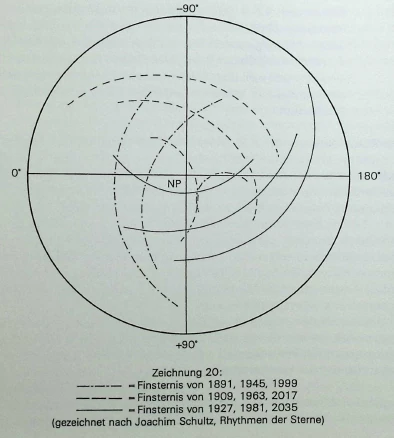
The paths of solar eclipses on Earth are highly unusual, as described by the tip of the moon's shadow cone touching the Earth. The triple Saros period will be recorded here three times (drawing 20) for the solar eclipse that occurred on June 29, 1927, which many will still remember>. It was total in northern England and Scandinavia, continuing across the northern Arctic Ocean and the northeastern part of Siberia. It is still relatively young, having existed only since 1639 as a partial eclipse and since 1891 as a total eclipse, which is why it still occurs in fairly northern regions. Imagine the Earth projected so that the North Pole is the center of the circle and the circle itself represents the Earth's equator. The countries are to be thought of as such that the line North Pole — 0° is the Greenwich meridian.
The eclipse in question is indicated for each Saros period from 1891 to 2035, i.e., 3 times 3 Saros periods, by various dotted lines. One can see the gradual descent from the pole to the equator, which will be followed in later centuries by a further descent to the South Pole.
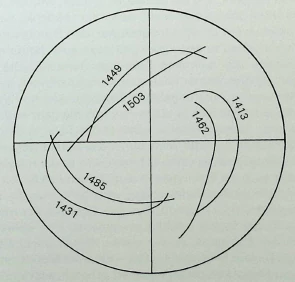
We see, as it were, the earth covered in space and time by a strange network of eclipse paths, so that evil, as it were, has an opportunity to take effect everywhere. Each year, a series of eclipse curves descends from the North Pole to the South Pole, and another series (that of the descending node) ascends in the opposite direction. These paths have been inscribed into the Earth in manifold runes over the centuries. Indeed, when tracing these characters, one gets the impression that one is dealing with the imprints or footprints of certain darkness beings who experience their birth, life, and death in a very specific way from pole to pole. In its Saros repetitions, one eclipse covers the earth with beautifully joined lines, such as those shown in Figure 20, which occurred in 1927. Another, such as the one that just passed on May 19, describes true scratches on the earth's surface. Still others have their Saros periods lying in such a way that two eclipse paths intersect in the form of crescent moons. (See drawing 21. The numbers indicate the year of the eclipse.)
In total, there are about 70 eclipse beings, 30 from the moon and 40 from the sun. The lunar eclipses make a less individualized impression overall than the solar eclipses; they also do not describe such specific paths, but rather overshadow entire continents. We can also understand this if we view eclipses as “safety valves”: solar eclipses for the evil will that radiates from the Earth into the cosmos, while lunar eclipses allow bad thoughts to flow from the universe to the Earth.
In the lecture of June 25, 1922, the ancient initiates are said to have asked their questions to the universe at sunrise, specifically at new moon. A solar eclipse also occurs at new moon, always at a place on Earth where the sun is just rising. The mystery priests expected the answer at full moon. This reminds us of lunar eclipses, which can only occur at full moon. We see how, in this sense, eclipses meant an interruption in the ancient initiates' work when they occurred. The act of will that lies in the question could not take place during a solar eclipse, nor could the illumination of thought that was to bring the answer take place during a lunar eclipse. We thus understand why, in earlier times, when “abstract science” was not yet practiced, the occurrence of eclipses was followed so closely. — Perhaps this is also the real reason for the tragic story, always told in popular works, of the two Chinese astronomers Hi and Ho, who failed to correctly predict a solar eclipse in 2154 BC to the Emperor of the Celestial Empire — according to some reports because they had drunk too much, according to others because they had miscalculated — and were therefore beheaded. In the latter case, the sentence would certainly be unjust, considering that until the last century it was not possible to calculate the occurrence of eclipses to the minute, and that even today there is still an uncertainty of several seconds. [Eclipse calculations are still among the most complicated in mathematical astronomy.] The tremendous mobility and variability of the moon's orbit can never be fully captured in rigid formulas.
During a solar eclipse, the evil in people's impulses leaves the earth without being burned by the sunlight and thus enters the universe, “where it then causes further mischief.” But even on Earth, in the eerily pale light that precedes the darkness of total eclipse, many things happen that belong to the realm of evil. As Rudolf Steiner has told us, terrible demons rise from the creations of human technology during the eclipse, revealing the true nature that is bound up in our modern technology. During a lunar eclipse, on the other hand, evil people are given the opportunity to be inspired by “devilish thoughts.”
From all this we see how spiritual science makes it possible to realize the words we quoted earlier: “But then one also learns to evaluate in the right way those transitional phenomena which — I would say — stand in the middle between the purely physical-cosmic and the cosmic-spiritual.”
10. Über die Finsternisse
Die Sarosperiode
Es ist schon ausgeführt worden, wie die Mondknoten, jene Schnittpunkte der Sonnen- und Mondbahn ( die sich zur Zeit im Stier und im Skorpion befinden ), in 18 Jahren 7 Monaten (und einigen Tagen) einmal um den ganzen Tierkreis herumgehen. In jedem Menschenleben spielt diese Periode eine Rolle. Denn die Knoten sind nicht bloss als mathematische Punkte aufzufassen, als Schnittpunkte der «verlängerten Mondbahn-Ebene» mit der «scheinbaren Sonnenbahn», wie es die heutige Astronomie ausdrücken müsste, sondern sie sind so etwas wie Einlasstore für das Astralische, wie astral-empfindliche Punkte in dem Geburtshimmel eines jeden Menschen. Rudolf Steiner hat darauf hingewiesen, dass jedesmal, wenn die Knoten wiederum an den Ort zurückkehren, den sie bei der Geburt eingenommen haben, wenn also der Mensch 18 Jahre 7 Monate, 37 Jahre 2 Monate usw. alt geworden ist, er dann in seinem Unterbewusstsein besonders empfänglich ist für die astrale Welt, was sich durch merkwürdige Träume und dergleichen äussern kann. Es sind die Nächte, die in solchen Zeiten erlebt werden, die wichtigsten unseres ganzen Lebens. Nur «verschlafen» die Menschen zumeist diese wichtigen Perioden, weil sie nicht darauf aufmerksam sind. Bei Goethe jedenfalls, der volle vier Mal eine solche Periode erlebte, lässt sich aus seiner Biographie, aus den Tagebüchern, Briefen oder Gesprächen in interessanter Weise der Einfluss des Knotenüberganges nachweisen. Es ist gut, wenn Anthroposophen versuchen, solche Zeitpunkte in ihrem Leben abzufangen. Man wird sie vielleicht auch für die halbe Periode finden können, nach je 9 Jahren 3 1/2 Monaten, wenn der aufsteigende und der absteigende Knoten ihren Platz im Tierkreis gewechselt haben.
Diese Periode hat zudem noch ihr Abbild in der sogenannten Nutation der Erdachse, von der das nächste Mal die Rede sein wird.
Eine gewisse Verkürzung des Knotenumlaufs gibt die Sarosperiode, die mit der Rückkehr von Finsternissen zu tun hat. — Nehmen wir an, es sei totale Sonnenfinsternis gewesen, Sonne, Mond und Knoten (S, M, K) haben eng zusammengestanden an einem bestimmten Ort im Tierkreis. Nun setzen alle drei ihre Bewegungen fort: die Sonne geht annähernd in einem Jahre einmal herum, der Mond in einem Monat, der Knoten in entgegengesetzter Richtung in 18 Jahren 7 Monaten. Es stellt sich nun heraus, dass, kurz bevor der Knoten wiederum an seinen früheren Ort zurückgekehrt ist, nach 18 Jahren 10 Tagen, er die Sonne wiederum trifft und auch der Mond wiederum zur Stelle ist (dieser ist inzwischen 223 mal herumgegangen, jene 18 mal), so dass die frühere Finsternis sich fast unter denselben Verhältnissen in K1 wiederholt. — Natürlich hat es in der Zwischenzeit immer wieder Sonnenfinsternisse und auch Mondfinsternisse gegeben, sobald Sonne und Mond sich an irgendeiner Stelle des Tierkreises mit den Knoten trafen. Bei der Sarosperiode ist es aber so, dass die Entfernung der Sonne zu dem Knoten, die Lage des Mondes, die Grösse der Finsternis-Phase den Verhältnissen von vor 18 Jahren 10 Tagen entsprechen, — fast genau entsprechen. Dadurch werden auch die weiteren Finsternisse, die der zuerst angenommenen vorangegangen oder gefolgt sind, sich in derselben Reihenfolge wiederholen. Es wurde schon darauf hingewiesen, wie, mit ganz geringen Ausnahmen, die notierten Finsternis-reihen von 1924-1928 entsprechen den gleichen Reihen aus den Jahren 1906-1910 (siehe Seite 95), und ebenso denen von 1942–1946, nur mit 10 oder 11 Tagen Unterschied. Es gibt also eine Reihe von Sonnen- und auch Mondfinsternissen, die sich in einer Periode von 18 Jahren 10 Tagen abspielen und die dann, auf längere Zeit, immer wiederkehren (siehe Zeichnung 19).
Gerade an dieser Regel kann man aber wiederum das wunderbare Lebendige der kosmischen «Mechanik» erleben. Denn all diese Verhältnisse treffen «beinahe» zu; der kleine Unterschied, der sich überall herausstellt, bewirkt die Abwechslung in der sonstigen Einförmigkeit. Eine bestimmte Finsternis kehrt unter fast denselben Bedingungen nach 18 Jahren 10 Tagen zurück (es können auch 11 Tage sein, je nachdem in den 18 Jahren gerade vier oder fünf Schaltjahre enthalten waren). Dadurch, dass zu den 18 Jahren diese 10 Tage hinzukommen, ist die Sonne um ungefähr 10° weitergerückt, die Finsternis findet also nicht genau an derselben Stelle am Himmel statt, sondern 10° mehr östlich. Aber es sind auch nicht genau 10 (beziehungsweise 11) Tage, sondern 10 Tage 7 Stunden 42 Minuten. Die neue Finsternis wird an dem betreffenden Tage um 7 Stunden 42 Minuten, das ist fast 1/3 Tag verspätet, stattfinden. Das will sagen, dass die Erde um 1/3 Achsendrehung weiter rotiert ist, die Finsternis (besonders die so lokale Sonnenfinsternis) findet bei der Wiederholung nicht in derselben Erdgegend statt wie das erste Mal, sondern in einer Gegend, die 1/3 Erdumfang weiter nach Westen liegt. Die zweitfolgende um 2/3 Erdumfang, und erst die dritte Wiederholung, die vierte Finsternis also, nach 54 Jahren 33 Tagen, fällt wieder annähernd in dieselbe Gegend wie die erste (nur wiederum nördlich oder südlich verschoben). Es entstehen somit dreifache Finsternisreihen, die dreifache Sarosperiode von 54 Jahren 33 Tagen. Aber auch dann noch geschieht die neue Finsternis nach einer Sarosperiode nicht genau in derselben Entfernung vom Knoten wie die alte, sondern sie rückt allmählich, ganz langsam, von Ost nach West an den Knoten heran und über ihn hinaus. Dadurch kommt eben das zustande, dass ein Neumond im Laufe der Zeiten in solche Nähe von einem Knoten fällt, dass eine ganz geringe Bedeckung der Sonnenscheibe möglich ist: es tritt zum ersten Mal die Finsternis als ganz kleine partielle Finsternis in Erscheinung, die nun weiter ihren Platz in der Sarosreihe behauptet. Das nächste Mal, nach 18 Jahren 10 Tagen, wird sie auch partiell, aber schon ein klein wenig grösser sein, nach vielleicht 6-10 Sarosperioden wird sie so nahe zum Knoten gerückt sein, dass sie als totale Finsternis auftritt. Dann wird sie sich viele Jahrhunderte lang als totale (eventuell auch ringförmige) Finsternis behaupten. Alle 18 Jahre kommt sie etwas näher an den Knoten heran, dann über ihn hinaus, bis sie wieder bloss partiell wird und endlich aufhört, eine Finsternis zu sein: es ist einfach Neumond, ohne Bedeckung. Ein Gleiches findet in bezug auf die Mondfinsternisse statt, nur dass der Vollmond eben immer beim entgegengesetzten Knoten steht wie die Sonne.
Man kann diese Verhältnisse sehr gut verfolgen, wenn man die Zeichnung 16 einmal betrachtet. Die Finsternis vom 17. Juni ist eben eine solche, die zum allerersten Mal eintritt. Es wurde schon gesagt, dass sie in der Reihe von 1910 fehlt. Sie wird sozusagen als Finsternis in diesen Tagen «geboren». In 18 Jahren 10 Tagen wird die Entfernung von Sonne und Mond zum Knoten ein klein wenig geringer sein als jetzt, und das Finsternisgeschehen, wie gesagt, 10° mehr nach den Zwillingen hin liegen. Dadurch werden Sonnen- und Mondscheibe einander etwas mehr bedekken können. Erst im 22. Jahrhundert wird die Finsternis so nahe beim Knoten stattfinden, dass sie total sein wird.
Oderverfolgen wir die Finsternis vom 19. Mai. Sie liegt ganz rechts vom Knoten, das heisst, dass sie aus dem Finsternisbereich herausrückt. Sie war in der Tat am 19. Mai zum letzten Mal total; schon das nächste Mal, am 30. Mai 1946, wird sie partiell sein, und dann immer mehr abnehmen bis zum 3. August 2054, wo sie als Finsternis überhaupt aufhört zu existieren. Rückwärts verfolgt, war diese Finsternis ab 936 n. Chr. ringförmig (was eine Art Totalität darstellt, nur mit zu kleiner Mondscheibe) und hat also als solche 1000 Jahre gelebt.«Geboren»wurde sie, ganz links vom aufsteigenden Knoten, am 24. Juni 792 n. Chr. und «sterben» wird sie, wie gesagt, am 3. August 2054.
Wir haben also in der Finsternisperiode von 1928 die an sich seltene Tatsache von einer neu entstehenden Sonnenfinsternis und von einer als totale aufhörenden Finsternis. Die Lebensdauer von totalen Sonnenfinsternissen beträgt etwa 1200 Jahre, bei Mondfinsternissen ist sie etwas kürzer.
Die genannte Sonnenfinsternis vom 12. November ist wiederum deswegen partiell, weil sie über ihre Totalitätsperiode (die von 1171-1874 dauerte, aber eigentlich ringförmig war) schon hinaus ist und jetzt erneut als partielle erscheint. Das erste Mal wieder partiell war sie 1892.
Man kann dieses Leben und Weben der Finsternisse noch deutlicher sich vorstellen, wenn man sie nicht am Himmel, sondern auf der Erde verfolgt, besonders die so markanten Sonnenfinsternisse. Diese bestehen ja darin, dass der Mondschatten, von dem schon die Rede war, einen Streifen über die Erde zieht, der während höchstens 4 Stunden mit Schnellzugsgeschwindigkeit eine Bahn auf der Erdoberfläche beschreibt. (Die Totalität selber kann an einem bestimmten Ort der Erde nur höchstens 8 Minuten währen.) Nach 18 Jahren kehrt diese Bahn, einen Drittel Erdumfang weiter gelegen, zurück, nach 54 Jahren ist sie gewissermassen parallel zum ersten Bahnstreifen.
Es ist nun so, dass eine neu entstehende Sonnenfinsternis, wie zum Beispiel diejenige vom 17. Juni, immer die Erde zuerst an den Polen streift, und zwar am Nordpol bei einer Finsternis, die beim aufsteigenden Knoten — dem Drachenkopf — entsteht; am Südpol, wenn sie beim absteigenden Knoten — dem Drachenschwanz — entspringt. Auch ihre erste Totalität erreicht sie immer noch in den Polargegenden. Dann steigt sie allmählich herab, kommt im Laufe der Jahrhunderte mehr zum Äquator hin (sie findet dann beim Knoten statt), durchwandert die andere Erdhälfte, um beim entgegengesetzten Pol ihr Leben zu beenden. Auf die diesjährigen Sonnenfinsternisse angewendet, finden wir ganz im Konkreten:
19. 5.: Entstanden 24. 6. 792 am Nordpol; jetzt zum letzten Mal total, daher in ihrer Totalitätsphase ganz in den Südpolgegenden verlaufend.
17. 6.: Zum ersten Mal überhaupt, daher ganz ins nördliche Eismeer fallend.
12. 11: Entstanden 12. 4. 991 am Südpol (da beim absteigenden Knoten stattfindend), schon wieder in die Partialität zurückgelangt, daher in ihrer grössten Phase schon stark in nördlichen Gegenden verlaufend. In den geringeren Phasen der Partialität erstreckt sie sich noch weit überAsien hinaus und wird als ganz kleine Finsternis auch in unseren Gegenden beim Sonnenaufgang zu sehen sein.
Die Mondfinsternis vom 3. 6. findet nahe beim Knoten statt, ist also gewissermassen, im mittleren Lebensalter stehend, mitten in ihrer Totalitätsperiode darinnen. Sie war in unseren Gegenden nur deshalb nicht zu sehen, weil der Mond zur Zeit des Durchgehens durch den Erdschatten noch nicht aufgegangen war, ihre Sichtbarkeit lag westlich von Nord- und Südamerika. — 17. 11.: Diese Mondfinsternis hat mit der vorhergehenden ziemliche Ähnlichkeit, nur dass die Sonne jetzt beim absteigenden Knoten steht. Sie ist ebenfalls total, von mittlerer Lebensdauer, schon mehr nördlich gelegen. Nur kommt, wenigstens für West- und Nordeuropa, eine kurze Sichtbarkeit unmittelbar vor Monduntergang zustande. In Mitteleuropa wird nichts von ihr wahrzunehmen sein.
Höchst merkwürdig sind die Bahnen der Sonnenfinsternisse auf der Erde, so wie sie von der die Erde berührenden Spitze des Mondschattenkegels beschrieben werden. Es wird hier die dreifache Sarosperiode dreimal aufgezeichnet werden (Zeichnung 20) für die Sonnenfinsternis, die am 29. 6. 1927 war, can die sich viele noch erinnern werden>. Sie war in Nordengland und Skandinavien total, verlief weiter durch das nördliche Eismeer und den nordöstlichen Teil Sibiriens. Sie ist noch verhältnismässig jung, besteht erst seit 1639 als partielle und seit 1891 als totale Finsternis, daher spielt sie sich noch immer in ziemlich nördlichen Gegenden ab. Man denke sich nun die Erde so projiziert, dass der Nordpol der Mittelpunkt des Kreises ist, der Kreis selber den Erdäquator darstellt. Die Länder sind so darauf zu denken, dass die Linie Nordpol — 0° der Meridian von Greenwich ist.
Die Finsternis, um die es sich handelt, ist von 1891 ab bis 2035 für jede Sarosperiode angegeben, 3 mal 3 Sarosperioden also, durch verschieden punktierte Linien angedeutet. Man sieht das allmähliche Herabsteigen vom Pol zum Äquator hin, worauf dann in späteren Jahrhunderten ein weiterer Abstieg bis zum Südpol folgen wird.
Wir sehen gewissermassen die Erde im Raum und in der Zeit überzogen mit einem merkwürdigen Netz von Finsternisbahnen, so dass gleichsam das Böse überall einmal Gelegenheit bekommt, sich auszuwirken. Jedes Jahr zieht eine Reihe von Finsterniskurven mehr vom Nordpol hinab zum Südpol hin, und eine andere Reihe (die vom absteigenden Knoten) steigt hinauf in entgegengesetzter Richtung. In mannigfachen Runen sind diese Bahnen im Laufe der Jahrhunderte in die Erde eingeschrieben. Ja, man bekommt, beim Verfolgen dieser Schriftzeichen, den Eindruck, dass man es mit den Abdrücken oder Fussspuren von bestimmten Finsternis-Wesen zu tun hat, die ihre Geburt, ihr Leben und Absterben in ganz bestimmter Weise von Pol zu Pol erleben43. Die eine Finsternis überzieht in ihren Saros-Wiederholungen die Erde mit schön angefügten Linienreihen, wie die in Zeichnung 20 dargestellte, die 1927 auftrat. Eine andere, wie die eben abgelaufene vom 19. Mai, beschreibt wahre Kratzbürsten auf der Erdoberfläche. Wieder andere haben ihre Sarosperioden so liegend, dass je zwei Finsternisbahnen sich in Form von Mondsicheln schneiden. (Siehe Zeichnung 21. Die Zahlen bezeichnen das Jahr der Finsternis.)
Im ganzen gibt es etwa 70 Finsterniswesen, 30 vom Monde, 40 von der Sonne. Die Mondfinsternisse machen im ganzen einen weniger individualisierten Eindruck als die Sonnenfinsternisse, sie beschreiben auch nicht solche bestimmten Bahnen, sondern überscheinen mehr ganze Erdteile. Wir können das auch verstehen, wenn wir die Finsternisse als «Sicherheitsventile» ansehen: die Sonnenfinsternisse für den bösen Willen, der von der Erde in den Kosmos hinausstrahlt, während die Mondfinsternisse die schlechten Gedanken von dem Weltall auf die Erde fliessen lassen.
Von den alten Eingeweihten wird im Vortrag vom 25. Juni 19224° über das Sonnen- und Mondenlicht erzählt, dass sie ihre Fragen dem Weltall bei Sonnenaufgang, und zwar bei Neumond, übergeben haben. Eine Sonnenfinsternis entsteht auch zu Neumond, und zwar eigentlich immer an einem Ort der Erde, wo die Sonne gerade aufgeht. Die Antwort erwarteten die Mysterienpriester beim Vollmond. Da werden wir an die Mondfinsternisse erinnert, die nur bei Vollmond sein können. Wir sehen, wie in diesem Sinne für die alten Eingeweihten die Finsternisse, wenn sie eintraten, eine Unterbrechung in dem Walten ihres Amtes bedeuteten. Der Willensakt, der im Fragen liegt, durfte nicht bei Sonnenfinsternis, die Gedankenerleuchtung, die die Antwort bringen sollte, nicht bei Mondfinsternis stattfinden. Wir verstehen so, warum man in früheren Zeiten, als man noch keine «abstrakte Wissenschaft» trieb, so sehr das Eintreten der Finsternisse verfolgt hat. — Vielleicht liegt hier auch der wahre Grund für die tragische Geschichte, die immer in populären Werken erzählt wird, von den beiden chinesischen Astronomen Hi und Ho, die versäumt hatten, dem Kaiser des himmlischen Reiches eine Sonnenfinsternis von 2154 v. Chr. richtig vorher anzumelden — nach einigen Berichten, weil sie zuviel getrunken, nach anderen, weil sie sich verrechnet hatten —, und die deswegen geköpft wurden. In letzterem Fall wäre das Urteil gewiss ungerecht, wenn man bedenkt, dass noch bis zum letzten Jahrhundert es nicht möglich war, den Eintritt von Finsternis-sen auf Minuten genau zu errechnen und dass auch heute noch immer eine Ungewissheit von mehreren Sekunden herrscht. [Die Finsternis-Berechnungen gehören immer noch zum Kompliziertesten in der mathematischen Astronomie.] Die ungeheure Beweglichkeit und Veränderlichkeit der Mondbahn lässt sich in starre Formeln nie ganz einfangen.
Während einer Sonnenfinsternis verlässt das Böse in den Willensimpulsen der Menschen die Erde, ohne durch das Sonnenlicht verbrannt zu werden, und gelangt so in das Weltall hinein, «wo es dann weiteres Unheil anrichtet». Aber auch auf Erden geht in dem unheimlich fahlen Lichte, das der Dunkelheit der totalen Verfinsterung vorangeht, mancherlei vor sich, das zum Reiche des Bösen gehört. Aus den Gebilden der menschlichen Technik — wie Rudolf Steiner erzählt hat — erheben sich während der Finsternis furchtbare Dämonen, so das wahre Wesen offenbarend, das in unsere heutige Technik hineingebannt ist.— Bei einer Mondfinsternis dagegen wird bösen Menschen die Gelegenheit geboten, sich von «Teufelsgedanken» inspirieren zu lassen.
Wir sehen aus all dem, wie es eben durch Geisteswissenschaft möglich ist, das Wort zu realisieren, das wir schon einmal anführten: «Man lernt dann aber auch solche Übergangs-Erscheinungen in der richtigen Weise bewerten, die — ich möchte sagen — zwischen dem rein Physisch-Kosmischen und dem Kosmisch-Geistigen mitten drinnen stehen.»