

Consciousness — Life — Form
GA 89
5 November 1904
Translate the original German text into any language:
Versions Available:
Consciousness — Life — Form, tr. SOL
Zehnter Vortrag
Planetary Development: Tenth Lecture
[ 1 ] Sieben mal sieben mal sieben Metamorphosen durchläuft ein Wesen, um vom Anfang bis zum Ende der Evolution zu kommen:
[ 1 ] A being undergoes seven times seven times seven metamorphoses to get from the beginning to the end of evolution:
7 Bewußtseinszustände
7 Reiche oder Lebenszustände
7 Formzustände
7 states of consciousness
7 realms or states of life
7 states of form
[ 2 ] Die sieben Bewußtseinszustände, die ein Wesen durchläuft, sind:
[ 2 ] The seven states of consciousness that a being undergoes are:
Der Tieftrance
Der traumlose Schlaf
Der Traumzustand
Der Wachzustand
Der psychische Zustand
Der überpsychische Zustand
Der spirituelle Zustand.
Deep trance
Dreamless sleep
The dream state
The waking state
The psychic state
The superpsychic state
The spiritual state.
[ 3 ] Die sieben Reiche oder Lebenszustände sind:
[ 3 ] The seven realms or states of life are:
Das erste Elementarreich
Das zweite Elementarreich
Das dritte Elementarreich
as Mineralreich
Das Pflanzenreich
Das Tierreich
Das Menschenreich.
The first elemental realm
The second elemental realm
The third elemental realm
The mineral realm
The plant realm
The animal realm
The human realm.
[ 4 ] Die sieben Formzustände oder Formmetamorphosen sind:
[ 4 ] The seven states of form or metamorphoses of form are:
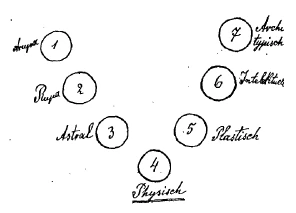
[ 5 ] Diese sieben Globen oder Formzustände sind in Wahrheit nicht sieben verschiedene Globen, sondern nur eine Kugel; diese macht sieben aufeinanderfolgende Zustände durch. Es muß immer ein Zustand in den nächstfolgenden übergeführt werden. Damit dies stattfinden kann, ist eine Wesenheit notwendig, die eine bestimmte Summe von Kraft repräsentiert und die Kugel aus einem Zustand in den anderen überführt. Solch eine Wesenheit nennt man Prajapati. Solche erhabenen geistigen Wesenheiten, die eine solche gewaltige Macht haben, haben diese Macht in vorhergehenden Evolutionen erhalten. Sie haben eine lange Lehrzeit hinter sich. Dadurch sind sie zu Energien geworden, die in dem neuen Weltall imstande sind, eine Kugel in die andere überzuführen.
[ 5 ] These seven globes or states of form are not in reality seven different globes, but only one sphere; this sphere passes through seven successive states. One state must always be transformed into the next. For this to take place, an entity is needed that represents a certain amount of power and transforms the sphere from one state to another. Such an entity is called Prajapati. Such exalted spiritual entities, which have such tremendous power, have acquired this power in previous evolutions. They have undergone a long period of learning. As a result, they have become energies that are capable of transferring one sphere into another in the new universe.
[ 6 ] Diese sieben Formzustände werden durchgemacht in allen sieben Lebensreichen und in allen sieben Bewußstseinszuständen. Wir begreifen nun, daß diese Wesenheiten (Prajapatis) das, was sie in dem einen Zyklus vollbringen, auch in den anderen Zyklen vollbringen können, so zum Beispiel auf der Erde, auf dem Monde und so weiter, so daß die gleichartigen Zustände immer von den gleichartigen Wesenheiten herbeigeführt werden können.
[ 6 ] These seven states of form are passed through in all seven realms of life and in all seven states of consciousness. We now understand that these beings (Prajapatis) can accomplish in other cycles what they accomplish in one cycle, for example, on Earth, on the Moon, and so on, so that similar conditions can always be brought about by similar beings.
[ 7 ] So geschieht es bei allen Zyklen, auf allen sieben Planeten. Die Prajapatis der Form sind ein für allemal vorhanden, sie sind hier die niedersten Prajapatis, die die letzte Umformung zu bewirken haben, und die jedesmal, wenn ein Übergang notwendig ist, in Aktion treten.
[ 7 ] This is what happens in all cycles, on all seven planets. The Prajapatis of form are present once and for all; they are the lowest Prajapatis here, who have to effect the final transformation and who spring into action whenever a transition is necessary.
[ 8 ] Der Arupazustand und der archetypische Zustand unterscheiden sich wesentlich von den fünf anderen Zuständen. Eigentlich beginnt in Wirklichkeit der Formzustand auf dem Rupaplan. Auf dem Arupaplan gibt es noch keine Form, sondern nur die Anlage dazu, und auf dem archetypischen Plan gibt die Form sich selbst ihre Form, sie ist da ganz Leben. Daher sind der erste und der siebente Formzustand eigentlich Lebenszustände, in denen der siebte immer der des Status nascendi (Entstehung) des folgenden ersten ist, oder bei denen der siebte (der archetypische) das geworden ist, was im ersten im Status nascendi war.
[ 8 ] The arupa state and the archetypal state differ significantly from the five other states. In reality, the form state actually begins on the rupaplan. On the arupaplan, there is no form yet, only the potential for it, and on the archetypal plan, form gives itself its form; it is completely life there. Therefore, the first and seventh form states are actually states of life, in which the seventh is always the status nascendi (emergence) of the following first, or in which the seventh (the archetypal) has become what was in the first in the status nascendi.
[ 9 ] Der archetypische Formzustand ist ein solcher, bei dem die Form Leben geworden ist, und der arupische ein solcher, bei dem die Form noch Leben ist. Eigentlich haben wir daher nur fünf Prajapatis der Form, weil zwei von den sieben schon zu den höheren Prajapatis des Bewußtseins gehören. Man könnte vielleicht sagen, daß Lebensstadien und Formzustände nur verdichtete Bewußtseinszustände sind, oder auch die passive Seite des aktiven Bewußtseins, oder auch die eigentliche negative Seite des Weltbildes, während das Bewußtsein die positive Seite ist. Es gehören also der erste und der letzte der Prajapatis der Formzustände schon zu der höheren Hierarchie der Prajapatis des Bewußtseins.
[ 9 ] The archetypal state of form is one in which form has become life, and the arupic one is one in which form is still life. Actually, we therefore only have five Prajapatis of form, because two of the seven already belong to the higher Prajapatis of consciousness. One could perhaps say that stages of life and states of form are only condensed states of consciousness, or also the passive side of active consciousness, or also the actual negative side of the world view, while consciousness is the positive side. Thus, the first and last of the Prajapatis of the states of form already belong to the higher hierarchy of the Prajapatis of consciousness.
[ 10 ] Jedes Wesen durchläuft auch die Reiche des Lebens. Damit kommen wir zu den Prajapatis der Runden, die je ein Lebensreich leiten. Es sind sieben Lebenszustände, die ineinander übergeführt werden von sieben Wesenheiten. Jedesmal, wenn wir die siebente Runde vollendet haben, haben wir es zu tun mit einem Zustande, der dem der ersten Runde entspricht, jedoch auf einer höheren Stufe. Der Mensch trat ein in die Erdenentwicklung mit dem erwachenden hellen Tagesbewußstsein; nun bildet er es aus und am Ende der siebenten Runde wird der Mensch in der Ausbildung das erreicht haben, was er in der ersten Runde, am Anfang, in der Anlage hatte.
[ 10 ] Every being also passes through the realms of life. This brings us to the Prajapatis of the rounds, each of whom rules a realm of life. There are seven states of life, which are transferred into one another by seven beings. Each time we complete the seventh round, we are dealing with a state that corresponds to that of the first round, but at a higher level. Humanity entered into the development of the earth with the awakening of bright daytime consciousness; now it is developing this consciousness, and at the end of the seventh round, humanity will have achieved in its development what it had in the first round, at the beginning, in its potential.
[ 11 ] Diese sieben Runden sind die sieben Schöpfungstage der Genesis. Wir stehen jetzt im vierten Schöpfungstage. Im zweiten Kapitel der Genesis haben wir eine besondere Beschreibung der vierten Runde: die Schöpfung des Menschen, und zwar zu dem Zeitpunkt, der in die Mitte der lemurischen Zeit fällt. Erst am siebten Tage ist der Mensch bei seiner wahren Gottähnlichkeit angelangt in bezug auf seinen physischen, Astral-, Mental- und Arupa-Körper. Was am Ende der Mondenentwicklung Inhalt war, das wird am Anfang der Erdenentwicklung Anlage.
[ 11 ] These seven rounds are the seven days of creation in Genesis. We are now in the fourth day of creation. In the second chapter of Genesis, we have a special description of the fourth round: the creation of man, at the point in time that falls in the middle of the Lemurian epoch. Only on the seventh day does man reach his true godlikeness in relation to his physical, astral, mental, and arupa bodies. What was content at the end of the lunar development becomes potential at the beginning of the Earth's development.
[ 12 ] Eigentlich kann man nur sechs Runden die Runden des Lebens nennen, da die siebte Runde eine Runde des nächsthöheren Bewußtseinszustandes ist. Daher gibt es eigentlich nur sechs Lebenszustände und folglich nur sechs Prajapatis des Lebens. Wir zählen einen Prajapati des Lebens zu den sieben Prajapatis des Bewußtseins und zwei Prajapatis der Form kommen auch noch dazu. So haben wir eigentlich zehn Prajapatis des Bewußtseins, von denen ein Prajapati.der ist, der zu den sechs Prajapatis des Lebens überleitet, und zwei Prajapatis, die zu den Prajapatis der Form überleiten. So entstehen:
[ 12 ] Actually, only six rounds can be called rounds of life, since the seventh round is a round of the next higher state of consciousness. Therefore, there are actually only six states of life and consequently only six Prajapatis of life. We count one Prajapati of life among the seven Prajapatis of consciousness, and two Prajapatis of form are also added. So we actually have ten Prajapatis of consciousness, one of whom is the Prajapati who transitions to the six Prajapatis of life, and two Prajapatis who transition to the Prajapatis of form. This gives rise to:
10 Prajapatis des Bewußtseins
6 Prajapatis des Lebens
5 Prajapatis der Form
10 Prajapatis of consciousness
6 Prajapatis of life
5 Prajapatis of form
[ 13 ] oder zehn + sechs + fünf = zusammen 21 Prajapatis.
[ 13 ] or ten + six + five = a total of 21 Prajapatis.
[ 14 ] Darauf bezieht sich in der «Secret Doctrine» von H. P. Blavatsky Strophe 4 des Buches Dzyan: «Die Eins aus dem Ei, die Sechs, die Fünf.» Die Zehn wird genannt: die Eins aus dem Ei = 0. Aus dem Ei (0), den 10 Prajapatis des Bewußtseins, kam zuerst der erste Prajapati des Lebens, dann folgten sechs andere Prajapatis des Lebens und fünf Prajapatis der Form = 1065, Quersumme 21 (Wert von Jehova).
[ 14 ] This is referred to in H. P. Blavatsky's “Secret Doctrine,” stanza 4 of the book Dzyan: “The One from the egg, the Six, the Five.” The ten is called: the One from the egg = 0. From the egg (0), the 10 Prajapatis of consciousness, first came the first Prajapati of life, then followed six other Prajapatis of life and five Prajapatis of form = 1065, cross sum 21 (value of Jehovah).
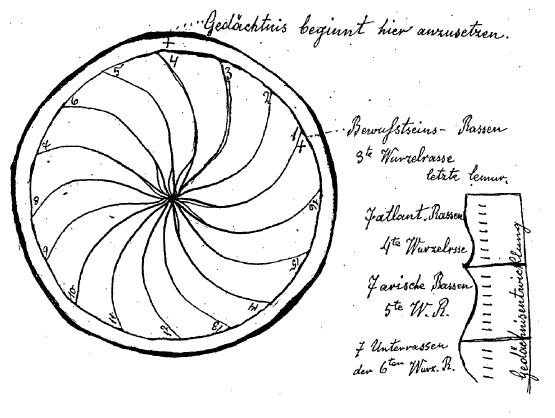
[ 15 ] Über die Chakrams des Astralkörpers: So wie der physische Körper des Menschen Sinne hat, hat auch der Astralkörper des Menschen Sinne. Sie liegen in einer Linie aufgereiht. Einer dieser Sinne liegt über dem Kehlkopf. Diese Sinne heißen Chakrams, heilige Räder. Sie sind beim gewöhnlichen Menschen unbeweglich, aber bei dem Seher beweglich und drehen sich. Das Chakram über dem Kehlkopf ist im wesentlichen eine blattförmige Bildung. Alle astralen Chakrams heißen Lotosblüten. Das über dem Kehlkopf liegende Chakram heißt die sechzehnblättrige Lotosblüte. Langsam hat sich in der Evolution des Menschen dieses Rad gebildet. Erst beim Menschen der lemurischen Rasse, in der Mitte der lemurischen Zeit, begann sich nach und nach die Vorstel lung, das Denkvermögen zu entwickeln, und erst die letzte lemurische Rasse hatte es einigermaßen ausgebildet. Damals glänzte das erste der Lotosblätter auf, und jede folgende Rasse setzte bei normaler Entwicklung ein weiteres Blatt an, nämlich:
[ 15 ] About the chakrams of the astral body: Just as the physical body of a human being has senses, so too does the astral body. They are lined up in a row. One of these senses is located above the larynx. These senses are called chakrams, sacred wheels. In ordinary people, they are immobile, but in seers, they are mobile and rotate. The chakram above the larynx is essentially a leaf-shaped formation. All astral chakrams are called lotus blossoms. The chakram above the larynx is called the sixteen-petaled lotus blossom. This wheel has slowly formed in the evolution of man. It was only in the Lemurian race, in the middle of the Lemurian period, that the concept of the ability to think began to develop gradually, and only the last Lemurian race had developed it to a certain extent. At that time, the first of the lotus leaves shone forth, and each subsequent race added another leaf in normal development, namely:
[ 16 ] sieben Blätter in den sieben Unterrassen der vierten Wurzelrasse, der atlantischen,
[ 16 ] seven leaves in the seven sub-races of the fourth root race, the Atlantean,
[ 17 ] sieben Blätter in den sieben Unterrassen der fünften Wurzelrasse, der arischen, (bis jetzt fünf, da wir in der fünften Unterrasse sind),
[ 17 ] seven leaves in the seven sub-races of the fifth root race, the Aryan, (five so far, since we are in the fifth sub-race),
[ 18 ] ein Blatt in der ersten Unterrasse der sechsten Wurzelrasse.
[ 18 ] one leaf in the first sub-race of the sixth root race.
[ 19 ] Dann leuchten alle 16 Blätter des Vorstellungsvermögens auf. Nun hat sich von der dritten Unterrasse der vierten Wurzelrasse an auch das Gedächtnis ausgebildet. Die Strömung des Gedächtnisses geht auch stufenweise auf die Räder über, durch fünf Unterrassen der vierten atlantischen Wurzelrasse, durch sieben Unterrassen der fünften Wurzelrasse und durch vier Unterrassen der sechsten Wurzelrasse.
[ 19 ] Then all 16 leaves of the faculty of imagination shine forth. Now, from the third subrace of the fourth root race, the memory has also developed. The flow of memory also gradually passes to the wheels, through five subraces of the fourth Atlantean root race, through seven subraces of the fifth root race, and through four subraces of the sixth root race.
[ 20 ] Der Durchschnittsmensch hat also jetzt dreizehn Blätter des Vorstellungsvermögens ausgebildet, und das Gedächtnis ist beim zehnten Blatt angelangt. Wenn das Gedächtnis, welches beim vierten Blatt des Vorstellungsvermögens angefangen hat, mit seinem Strom auf den des Vorstellungsvermögens trifft, so fängt das Chakram an, sich zu drehen, also beim normal entwickelten Menschen in der vierten Unterrasse der sechsten Wurzelrasse. Wie ein Wirbelwind geht dann das Rad herum. Mit jeder folgenden Rasse geht das Licht auf eine andere Speiche des Rades über beziehungsweise auf ein anderes Blatt der Lotosblüten weiter.
[ 20 ] The average person has now developed thirteen leaves of imagination, and memory has reached the tenth leaf. When the memory, which began at the fourth leaf of the imagination, meets the stream of the imagination, the chakra begins to turn, that is, in the normally developed human being in the fourth sub-race of the sixth root race. The wheel then turns like a whirlwind. With each subsequent race, the light passes to another spoke of the wheel or to another petal of the lotus flower.
[ 21 ] Mit der ersten Unterrasse der sechsten Wurzelrasse ist das Rad fertig gebildet. Es fehlen beim .Durchschnittsmenschen jetzt noch drei Speichen, die jetzt noch dunkler Raum sind. Das Rad hat nicht nur einen Wirbel, sondern zwei.
[ 21 ] With the first subrace of the sixth root race, the wheel is fully formed. The average human being is now missing three spokes, which are still dark space. The wheel has not one vortex, but two.
[ 22 ] Die zweite Strömung durchkreuzt die erste: zu dem Vorstellungsvermögen kommt bei der dritten Unterrasse der Atlantier das Gedächtnis hinzu. Das Gedächtnis reicht bis zur vierten Unterrasse der sechsten Wurzelrasse. Dann geht es verloren, weil es überflüssig sein wird.
[ 22 ] The second current crosses the first: in the third sub-race of the Atlanteans, memory is added to the power of imagination. Memory extends to the fourth sub-race of the sixth root race. Then it is lost because it will become superfluous.
[ 23 ] Als bei der vierten Unterasse das Gedächtnis auftrat, war die Erleuchtung des Vorstellungsvermögens bis zur vierten Speiche vorgeschritten; drei Unterrassen waren ohne Gedächtnis. Der letzte Teil der Gedächtnisströmung trifft auf die andere Strömung. In der vierten Unterrasse der sechsten Wurzelrasse setzt sich das Rad erst in Bewegung. Wenn dieses Rad in Bewegung versetzt ist, wird der Mensch sein Wort der Astralwelt übergeben. Was dann der Mensch spricht, wird unmittelbar wirken auf seinen Mitmenschen. So zum Beispiel wird der Mitmensch das Wohlwollen fühlen, welches durch das Wort ausgedrückt wird, er wird jedes Wort fühlen.
[ 23 ] When memory appeared in the fourth sub-race, the enlightenment of the power of imagination had progressed to the fourth spoke; three sub-races had no memory. The last part of the memory stream meets the other stream. In the fourth sub-race of the sixth root race, the wheel only begins to move. When this wheel is set in motion, man will hand over his word to the astral world. What man then speaks will have an immediate effect on his fellow human beings. For example, his fellow human beings will feel the goodwill expressed by the word; they will feel every word.
[ 24 ] Der menschliche Manu der sechsten Wurzelrasse, der diese Rasse leiten wird, er, der der erste menschliche Manu ist, kann erst mit den Menschen reden, wenn der Mensch soweit ist, daß er mit dem Meister sprechen kann und das kann er erst, wenn dieses Chakram ganz entwickelt ist, wenn das Wort des Menschen unmittelbar in den Strom der Räder übergeht. Der normale Mensch erreicht das in der vierten Unterrasse der sechsten Wurzelrasse. Ein Zurückbleiben würde bewirken, daß die 16 Speichen nicht alle entwickelt sind. Dann könnte der Mensch nicht vor dem Meister sprechen, so daß er auf dieser Stufe der Evolution nicht von dem Meister geführt werden könnte. Es ist besonders wichtig, dieses Chakram auszubilden, und das hängt davon ab, ob der Mensch sich das Verwunden durch die Stimme abgewöhnt.
[ 24 ] The human Manu of the sixth root race, who will lead this race, he who is the first human Manu, can only speak to human beings when they are ready to speak to the Master, and they can only do so when this chakram is fully developed, when the word of human beings passes directly into the stream of the wheels. The normal human being achieves this in the fourth sub-race of the sixth root race. Falling behind would mean that the 16 spokes would not all be developed. Then the human being would not be able to speak before the Master, so that at this stage of evolution he could not be guided by the Master. It is particularly important to develop this chakram, and that depends on whether the human being breaks the habit of wounding through the voice.
[ 25 ] Die Menschen haben 16 Gelegenheiten — durch 16 Unterrassen hindurch - dieses Chakram auszubilden. Wenn sie es nicht tun, so gehen sie die 16 Wege des Verderbens durch das Wort.
[ 25 ] Human beings have 16 opportunities — through 16 sub-races — to develop this chakram. If they do not do so, they go through the 16 paths of destruction through the word.
[ 26 ] In den nächsten Metamorphosen werden die [letzten Blätter der sechzehnblättrigen Lotosblume] weiter ausgebildet, plastisch, dann in Gedankenmaterie, dann archetypisch. Darauf in der nächsten Runde wird die sechzehnblättrige Lotosblume auf der physischen Stufe wirklich ein vegetatives Blatt sein. Seine Speichen sind dann wirkliche Blätter und das Mineralische ist dann ganz verschwunden. In der siebten Wurzelrasse wird das Chakram entwickelt, welches die zweiblättrige Lotosblume heißt und zwischen den Augenbrauen liegt.
[ 26 ] In the next metamorphoses, the [last petals of the sixteen-petaled lotus flower] will be further developed, first plastically, then in thought matter, then archetypically. Then, in the next round, the sixteen-petaled lotus flower will actually be a vegetative leaf on the physical plane. Its spokes will then be real leaves, and the mineral element will have disappeared completely. In the seventh root race, the chakram will be developed, which is called the two-petaled lotus flower and lies between the eyebrows.
[ 27 ] Die zwei Notizblätter von Rudolf Steiner (verkleinert) auf den folgenden Seiten stehen offensichtlich in Zusammenhang mit diesem Vortrag.
[ 27 ] The two notes by Rudolf Steiner (reduced in size) on the following pages are obviously related to this lecture.
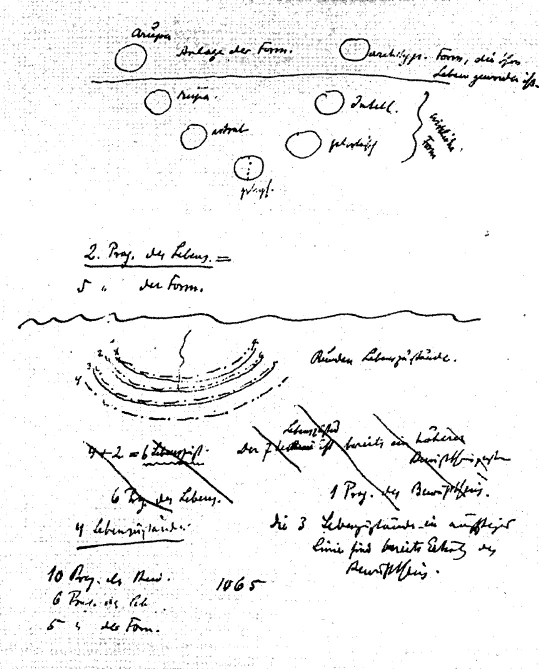
[ 28 ] Arupa / Anlage der Form / archetypisch / Form, die schon / Leben geworden ist Rupa / intellektuell / wirkliche / Form astral / plastisch / physisch _
[ 28 ] Arupa / disposition of form / archetypal / form that has already / become life Rupa / intellectual / real / form astral / plastic / physical
[ 29 ] 2. Prajapati des Lebens / 5. Prajapati der Form / Runden Lebenszustände
[ 29 ] 2. Prajapati of life / 5. Prajapati of form / cycles of life states
[ 30 ] 4 Lebenszustände / Die 3 Lebenszustände in aufsteigender / Linie sind bereits Erhöhung des / Bewußtseins
[ 30 ] 4 states of life / The 3 states of life in ascending order are already an elevation of consciousness
[ 31 ] 10 Praj. des Bewußtseins / 6 Praj. des Lebens / 5 Praj. der Form / 1065
[ 31 ] 10 Praj. of consciousness / 6 Praj. of life / 5 Praj. of form / 1065
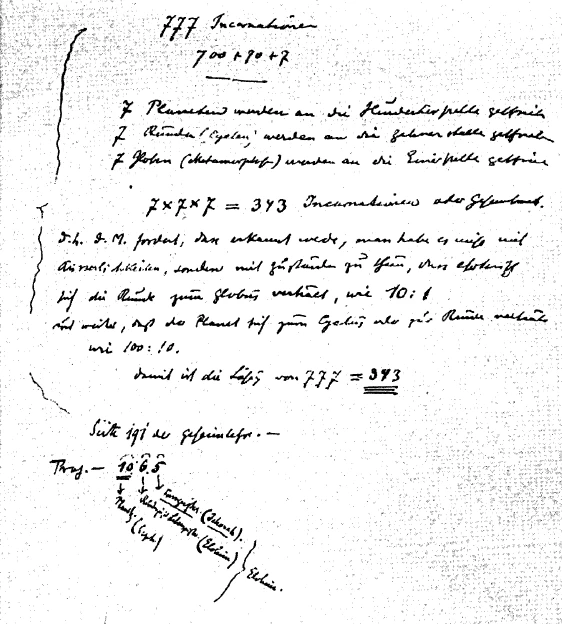
[ 32 ] 777 Incarnationen / 700 + 70 +7
[ 32 ] 777 incarnations / 700 + 70 +7
[ 33 ] 7 Planeten werden an die Hunderterstelle geschrieben
[ 33 ] 7 planets are written in the hundreds place
[ 34 ] 7 Runden (Cyklen) werden an die Zehnerstelle geschlieben
[ 34 ] 7 rounds (cycles) are written in the tens place
[ 35 ] 7 Globen (Metamorphosen) werden an die Einerstelle geschrieben
[ 35 ] 7 globes (metamorphoses) are written in the ones place
[ 36 ] 7 x 7 x 7 = 343 Incarnationen oder Gesamtmetamorphosen
[ 36 ] 7 x 7 x 7 = 343 incarnations or total metamorphoses
[ 37 ] d.h.d.M. [der Meister] fordert, daß erkannt werde, man habe es nicht mit / Äußerlichkeiten, sondern mit Zuständen zu tun, daß esoterisch / sich die Runde zum Globus verhält wie 10: 1 / und weiter, daß der Planet sich zum Cvklus oder zur Runde verhält / wie 100: 10 / damit ist die Lösung von 777 = 343
[ 37 ] i.e. [the Master] demands that it be recognized that one is not dealing with / externalities, but with states, that esoterically / the cycle relates to the globe as 10: 1 / and further, that the planet relates to the cycle or round / as 100: 10 / thus the solution of 777 = 343
[ 38 ] Seite 191 der Geheimlehre - / Praj. - 10 6 5 / Formgeister (Jehovah) / Runden: Lebensgeister (Elohim) / Plan. (Seph.)
[ 38 ] Page 191 of The Secret Doctrine - / Praj. - 10 6 5 / Form spirits (Jehovah) / Cycles: Life spirits (Elohim) / Plan. (Seph.)