Consciousness — Life — Form
GA 89
18 March 1904
Translate the original German text into any language:
Versions Available:
Awareness — Life — Form, tr. Meuss
Über die Kabbala
About the Cabbala
[ 1 ] Wir haben gesehen, daß die Bibel immer tiefer und tiefer verstanden werden kann, je mehr wir eindringen in die theosophische Lehre. Sie sollen aber heute sehen, wie die Theosophie, die theosophische Weisheit durch Jahrtausende hindurchgegangen ist und sich in den verschiedenen Zeiten nur durch Namen, Worte und so weiter verschieden gestaltet hat. Der heutige Abriß soll etwas behandeln, was gelehrt worden ist bei den alten Juden. Die Kabbala ist heute selbst unter den Juden etwas, was man seiner tiefen Weisheit nach sehr wenig kennt. Bei denjenigen kommt es manchmal noch zutage, wo man es am wenigsten vermuten würde. Wenn Sie einen gelehrten Juden träfen, der aus dem fernsten Galizien kommt, der äußerlich recht wenig auf sich gibt und für die zivilisierte Menschheit abstoßend wirken kann, dann könnten Sie die Erfahrung machen, daß derselbe Reste der kabbalistischen Weisheit noch kennt. In Österreich nennt man diese Leute «WunderRabbi», weil sie gewisse äußere magische Künste kennen, zum Beispiel können sie viel besser als unsere modernen Ärzte Suggestion ausüben. Bis zu einem gewissen Grade sind sie sogar eingeweiht.
We have seen that the Bible can be more and more deeply understood the more we penetrate into theosophical teaching. Today, however, you will see how theosophy, theosophical wisdom, existed for millennia, merely having different names, words and so on at different times. Today’s brief outline will be of something which was taught among the Jews of old. Today, the Cabbala100From the Hebrew, means tradition; refers to the secret teaching of medieval rabbis derived from earlier occult doctrines. is something the profound wisdom of which is little understood even among Jews. It will sometimes emerge where you would least expect it. If you were to meet a learned Jew coming from furthest Galicia, who does not take much care with how he looks, so that he may look repulsive to civilized people, you may find that he still knows something of cabbalistic wisdom. In Austria these people are called ‘miracle rabbis’ for they have some knowledge of magical arts, being able to use suggestion much more effectively than our modern physicians do, for example. They are also initiated to a certain degree.
[ 2 ] Etwas werde ich sagen über das, was in der Kabbala steht. In meinem Buche «Theosophie» werden Sie finden, daß jene Geheimlehren zusammenstimmen mit dem, was wir in der Theosophie lernen.
Let me first of all say something about what is written in the Cabbala. You will find it said in my Theosophy that the occult teaching in the Cabbala agrees with the things taught in theosophy.
[ 3 ] Die Kabbala unterscheidet innerhalb der Welt zwölf Glieder, wovon das erste und das letzte geheim bleiben, weil sie überhaupt nicht in Worte zu bringen sind. Nur die zehn übrigen werden in Worte gebracht. Diese zehn übrigen werden in drei Gruppen eingeteilt: erstens die sogenannte Geistwelt, die Welt der reinen geistigen Wesenheiten, zweitens die Welt des Seelischen, drittens die Welt der Körperlichkeit.
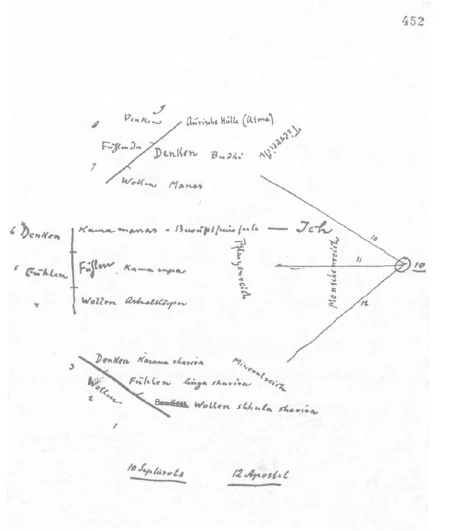
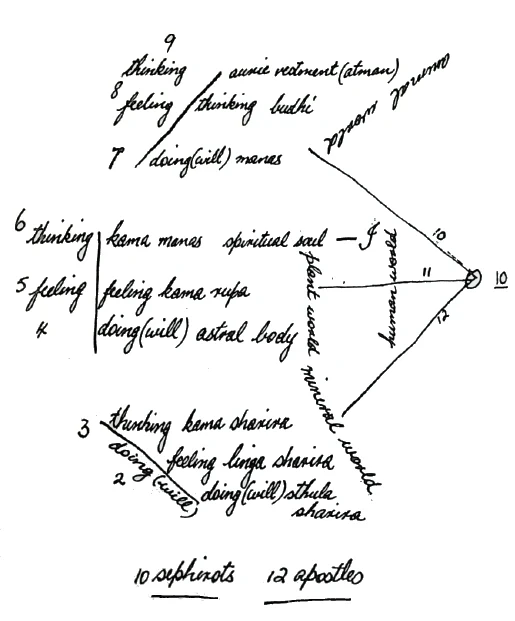
The Cabbala distinguishes twelve principles in the world, the first and last of which remain secret because they cannot be put into words at all.101In the 12th chapter of Agrippa von Nettesheim’s Kabbala, ‘The ten and its ladder’, it says: ‘God himself, the first monas, divides before he imparts himself to lower elements, first into the triad, then into the ten, which is like into the ten ideas and measures of all numbers and all that can be generated, which the Hebrews called the ten divine properties, designating them with ten special names for the godhead, which is also why there can be no more than ten.’ Generally reference is made only to one which cannot be known and which is above the ten sephiroth (ain soph, also spelled en soph; ain means ‘nothing’). Only the other ten are put in words. They are divided into three groups. Firstly, the ‘spirit world’, the world of purely spiritual entities, secondly the world of the soul, and thirdly the world of bodily nature.
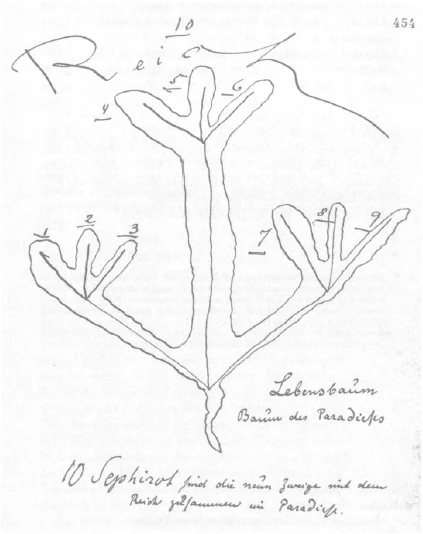
[ 4 ] Nun sagt der Kabbalist jedem seiner Schüler sofort: Niemals kannst du mit Augen eine dieser drei Welten sehen, sondern jederzeit kannst du nur das «Reich» sehen. -— Das «Reich» ist das, was unsere Welt ist, die uns umgibt. Ich sehe einen Menschen, sagt der Kabbalaschüler, aber was ich sehe, ist im «Reiche». In Wahrheit ist dieser Mensch in der dreigliedrigen Welt. Er hat Körper, Seele und Geist. Durch den Körper atmet er, ernährt sich; durch die Seele fühlt er und durch den Geist denkt er. Das alles tritt uns entgegen als ein Ganzes, als das «Reich». Das ist das zehnte der Glieder. Dieses zehnte Glied ist der Zusammenfluß der übrigen neun in der verschiedensten Art und Weise.
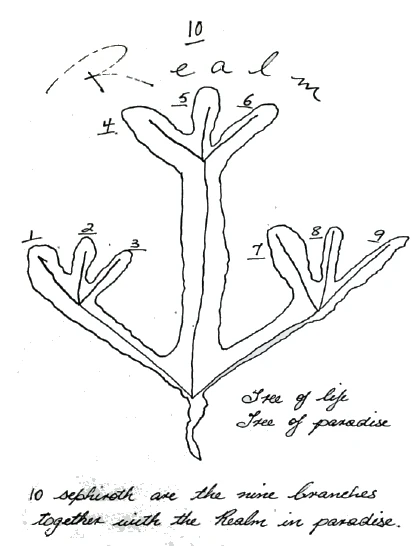
A Cabbalist will immediately say to each of his students: ‘You will never see one of these three worlds with your eyes, for at any time you can only see the “realm”.’ The ‘realm’ is our own world around us.102Concerning the concept ‘realm’ see also the discussion of the Lord’s Prayer in a lecture given in Berlin on 28 January 1907 in GA 96 Tr. A.R. Meuss, London, Completion Press 2001. I see a person, the Cabbala student will say, but what I am seeing is in the ‘realm’. In reality this human being is in the threefold world. He has body, soul and spirit. Through the body he breathes and feeds himself; through the soul he feels, and through the spirit he thinks. All this presents itself to us as a whole, as the ‘realm’. This is the tenth of the principles. This tenth principle is something in which the other nine come together in many different ways.
[ 5 ] Erstens: die Welt des Körperlichen: Das Körperliche hat wieder drei Glieder. Jeder Körper ist in sich. Wäre er nicht in sich, so wäre er überhaupt nicht da. Stößt du auf ihn, so nimmst du seine Festigkeit wahr. Stößt er auf dich, so nimmst du seinen Schein wahr. Deshalb unterscheidet man: Fundament, Festigkeit, Schein. Das sind die drei Sephiroth der Körperlichkeit. Damit haben wir vier Sephiroth:
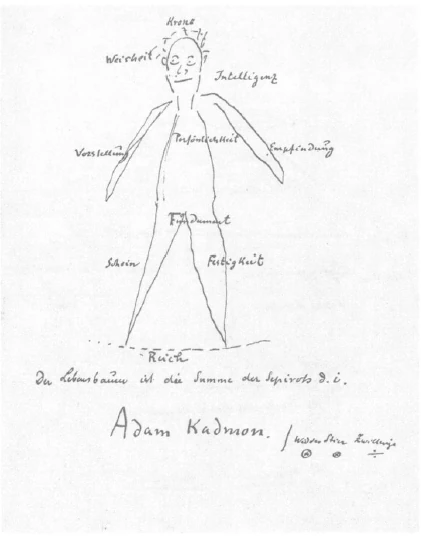
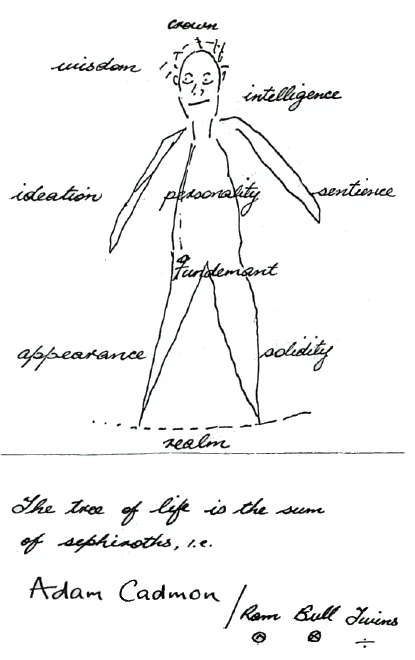
Firstly, the world of the bodily principle. This also has three parts. Every body is in itself. If it were not in itself, it would not exist at all. If you come up against it, you perceive its solid state. If it comes up to you, you perceive its appearance. Thus distinction is made between fundament, solidity, appearance. These are the three sephiroth103Sephiroth, plural of sephira (sef = number). The Hebrew plural tends to be generally used also in the singular. The ten sephiroth together symbolically are ‘Adam Kadmon”, the heavenly human being before the Fall. See the sketch Archive No. NZ 455 in this volume. In answer to questions following a lecture given in Leipzig on 12 January 1908, Rudolf Steiner said the following on the ten sephiroth, with reference to cosmology: ‘The ten sephiroth refer to periods of time, stages of evolution which the human being went through. The physical body went through four stages of evolution: Saturn, Sun, Moon and Earth. The ether body three stages: Sun, Moon and Earth, the astral body two: Moon and Earth. The I is in its first stage. Together this makes ten.’ (The lecture notes available for this lecture are not adequate for publication of the whole lecture.) of bodily nature. We now have four sephiroth:
[ 6 ] Reich 10
realm 10
[ 7 ] Festigkeit 9
solidity 9
[ 8 ] Fundament 8
fundament 8
[ 9 ] Schein 7
appearance 7
[ 10 ] Zweitens: Seelenwelt. Wiederum drei Sephiroth. Das erste ist dasjenige, was wir jetzt, in der Theosophie, die Sympathie nennen und was die Kabbala Liebe nennt. Liebe ist dasjenige, was der Seelenkörper ausgibt, wenn er an einen anderen herankommt. So wie die Festigkeit mir von einem Körper entgegentritt, so ist die Liebe das, was ich ausgebe. 6
Secondly: soul world. Again three sephiroth. The first is what we now call sympathy in theosophy; the Cabbala calls it love. Love is what the soul body gives off when it comes to another. Just as solidity comes to me from another body, so love is what I give out. 6
[ 11 ] Das zweite Sephiroth ist die Gnade, die eigentlich nicht mehr bloß ausgebend ist wie die Liebe, die schon mehr in sich geschlossen ist; die nicht sich so ausgibt wie die Liebe, sondern die von innen heraus austeilt. 5
The second of these sephiroth is grace. This is not merely giving out, like love; it is more held in; it does not give itself the way love does, but gives something 5 to the outside from inside.
[ 12 ] Das dritte Sephiroth ist die Gerechtigkeit, die lediglich ausgleichend ist. 4
The third sephiroth is justice, which merely balances 4 things out.
[ 13 ] Das sind die drei Seelen-Sephiroth.
Those are the three soul sephiroth.
[ 14 ] Nun zu den Sephiroth der Geistwelt. Sie sind das eigentlich Tätige.
Now for the sephiroth of the spirit world. They are the principle which is truly active.
[ 15 ] Das erste nennt die Kabbala den Weltverstand. 3
The first is called ‘world mind’ in the Cabbala 3
[ 16 ] Das zweite den Weltgedanken: der Verstand, der den Gedanken hat. 2
The second the ‘world thought’, the mind which has 2 the thought
[ 17 ] Das dritte ist das Grundsephiroth, das nennt der Kabba list die Höhe oder die Krone, die Vereinigung von Verstand und Gedanke (Kether — die Höhe). 1
The third is the basic sephiroth, called the ‘height’ or ‘crown’ by Cabbalists (kether - the height). 1
[ 18 ] Das sind die zehn Sephiroth. Nun sagt der Kabbalist zum Schüler: Du hast von jeder dieser Welten ein Glied in dir. Du hast aus der Körperwelt deine vegetative Seele (nephesch), Pflanzenseele, ätherischer Doppelkörper. Du hast aus der Seelenwelt die Leidenschaftsseele, die empfindende Seele (ruach), und du hast aus dem Geisterlande die denkende Seele (neschamah).
These are the ten sephiroth. The Cabbalist then says to his student: you have part of each of these worlds in you. From the bodily world you have the vegetative soul (nephesh), plant soul, etheric double body. From the soul world you have the passion soul, the sentient soul (ruach), and from the spirit land you have the thinking soul (neshamah).
[ 19 ] Das war das Gerippe der jüdischen Geheimlehre.1Die anschließenden Notizen von Ausführungen über frühgnostiche Lehren wurden hier weggelassen, da sie nicht nur lückenhaft, sondern offensichtlich auch fehlerhaft sind und die von Rudolf Steiner benützten literarischen Quellen nicht eruiert werden konnten. Jedoch finden sich die Notizen des Vortrages gesamthaft in «Beiträge zur Rudolf Steiner Gesamtausgabe», Heft 29, wiedergegeben.
These are the bare bones of Jewish occult teaching.*There followed notes referring to early Gnostic teachings. These have been omitted, being not only full of gaps but also distinctly faulty. Nor has it been possible to track the information down in the source works used by Rudolf Steiner. All the notes for the lecture have, however, been printed in their entirety [in German] in Beiträge zur Rudolf Steiner Gesamtausgabe Heft 29.
[ 20 ] Nächste vier Seiten: 4 Notizblätter zum Sephiroth-Kategorien-Problem
[ ] Not translated