Consciousness — Life — Form
GA 89
27 March 1905
Translate the original German text into any language:
Versions Available:
Awareness — Life — Form, tr. Meuss
Symbole als Ausdruck der Urweisheit
Symbols reflecting original wisdom
[ 1 ] Ich habe in der letzten Stunde über die Entwicklung der fünften Wurzelrasse gesprochen. Sie werden während meiner Abwesenheit Gelegenheit haben, über die vorhergehende, die atlantische zu hören.
[ 1 ] In the previous session 104Lecture given on 27 February 1905. The available notes are not adequate for publication. I spoke on the evolution of the fifth root-race. In my absence you will have opportunity to hear about the Atlantean root-race which went before.
[ 2 ] Die sogenannte Geheimlehre hat immer das, was sie zu sagen hat, in bestimmte Bilder und Symbole gefaßt, weil sich gewisse Wahrheiten in unserer gewöhnlichen Sprache schwer aussprechen lassen. Es ist ein Vorurteil zu glauben, daß die Wahrheiten immer klar ausgedrückt werden konnten, denn die Wahrheit ist viel älter als unsere Sprache. Die Sprache hat sich erst in dem unserer Zeit vorangegangenen Hauptzeitalter entwickelt, während der atlantischen Zeit. Die Atlantier haben gelebt auf einem Erdteil, der heute nicht mehr existiert, und unter wesentlich anderen Verhältnissen, als es unsere gegenwärtigen sind. Die Verhältnisse des Klimas, von Luft und Wasser, waren damals ganz andere als heute. In der Zeit, die der atlantischen vorangegangen ist, in der lemurischen Zeit, sind die allerersten Anfänge der Sprache zu suchen, die damals allerdings noch keine Sprache war, sondern nur eine Art Dahintönenlassen einzelner Laute.
[ 2 ] ‘Occult teaching’, as it is called, has always put what it had to say in specific images and symbols, for some truths are difficult to put into words in our ordinary language. It is wrong to think that it has always been possible to express truths clearly, for the truth is much older than our language. Speech only evolved in the main age preceding our time, in Atlantis. The Atlanteans lived on a continent which no longer exists and under completely different circumstances than those we know today. Climatic conditions, air and water were very different then. The first beginnings of speech may be found in the period which preceded the Atlantean age, which was the Lemurian age. It was not speech then, but just a way of letting individual sounds emerge.
[ 3 ] Die Wahrheit, die Weisheit, gab es schon, ehe es eine menschliche Sprache gab. Aber weil die menschliche Sprache noch jung ist, kann sie die uralten ewigen Weisheiten, die die Welt geschaffen haben und die immer noch schöpferisch tätig sind an der Welt, nicht in Worte kleiden. Die Lehren von diesen Weisheiten wurden immer im Geheimen betrieben und dem Schüler erst dann mitgeteilt, wenn er die symbolische Zeichensprache gelernt hatte, in der diese Geheimnisse gegeben wurden. Schwierig ist es, diese Zeichen in unsere Sprache zu übersetzen. Man muß auch heute noch symbolische Bezeichnungen und Bilder gebrauchen für gewisse Dinge, die besser durch Bilder als durch Worte ausgedrückt werden können.
[ 3 ] Truth, wisdom, existed before there was human speech. Being young, human speech cannot put the original and eternal truths, which created the world and are still doing creative work on the world, in words. The teaching of that wisdom was always secret. It was only told to pupils when they had learned the language of symbolic signs in which those secrets were presented.105Concerning work with the symbols, see lecture given in Dornach on 23 October 1915, [in German] in Die okkulte Bewegung im 19. Jahrhundert und ihre Beziehung zur Weltkultur GA 254. It is difficult to translate these signs into our language. For some things we still have to use symbolic signs and images, for they are better expressed in images than in words.
[ 4 ] Sehr schwer zu begreifen ist der Übergang von einer Menschenform, in der es noch nicht zwei Geschlechter gegeben hat, zu unserer heutigen. Der Körper des Menschen hat sich im Laufe einer langen Entwicklung sehr verändert. Zur lemurischen Zeit war der Körper eine Art von Feuernebel, wie eine feurige Wolke. Es gab auch noch keine feste Erde damals. Der Menschenkörper hatte zwar dieselben Stoffe in sich wie der heutige Körper, war aber gasförmig. Er machte schnell verschiedene Metamorphosen durch. Sein Wille bedeutete den Ausdruck seiner Gestalt. Wenn er etwas wollte, so konnte er nicht mit seiner Hand danach greifen, denn er hatte keine, er formte sich erst eine Hand, um dann zu greifen. Heute klingt das phantastisch.
[ 4 ] It is very difficult to understand the transition from a human form which did not yet have two genders to the human form of today. The human body has changed a great deal in the long process of evolution. In Lemurian times the body was a kind of fiery mist, like a fiery cloud. Nor was there any solid earth then. The human body did have the same kind of matter as it has today, but it was still gaseous. It went quickly through a number of metamorphoses. His will determined the expression of his form. When he wanted something, he could not reach for it with his hand, since he did not have one; he shaped a hand for himself that would allow him to reach. This sounds unbelievable today.
[ 5 ] Was ist unsere heutige Geschichte? Wir kennen ja nur wenige Jahrtausende auf der Erde. Von den ältesten Zeiten unserer Erdenentwicklung gibt es keine Aufzeichnungen, weil es noch keine Versteinerungen gab, also keine Eindrücke in Gestein. Die Materie, die jetzt die Dinge der Außenwelt und unseren eigenen Menschenkörper ausmacht, hat sich ganz und gar verändert seit jenen uralten Zeiten. Physisch erforschen kann man diese Zustände nicht. Nur durch okkultes Forschen ist es möglich, darüber etwas zu erfahren, und für dieses Forschen haben wir die Akasha-Chronik. Diese Akasha-Chronik enthält alles, was in der geistigen Welt geschieht, und da das Physische ein Ausfluß des Geistigen ist, ist alles in ihr, was überhaupt geschehen ist und was geschieht.
[ 5 ] What is our present history? We know only a few millennia on Earth. Nothing has been recorded in writing of the earliest times in Earth evolution because nothing had hardened to stone as yet, and so no impressions could be made in stone. The material which now makes up the things in the outside world and our own human body has changed utterly from those most ancient times. We cannot investigate those conditions physically. Only occult investigation makes it possible to learn something about them, and for this we have the akashic record. This contains everything which happens in the world of the spirit, and since the physical is an out-flowing of the spiritual, it contains everything which ever happened and is happening.
[ 6 ] Der Mensch erlebt tagsüber Eindrücke und verarbeitet sie seelisch. Der Astralkörper enthält alle Nachklänge aus dem Tagesleben, alles, was der Mensch empfunden, gewollt und gedacht hat. Dieser Astralleib lebt im astralen Raum, und das, was da in ihm vorgeht, drückt sich als Abbild in die Astralwelt wie Schwingungen ein, und das bleibt lebendig. In diesem vom physischen Tagesleben befreiten Zustand schreibt der Mensch in die höheren Welten das ein, was er erlebt hat, und das bleibt bestehen. Der Mensch ist so im Schlafe tätig für die Ewigkeit. Wenn er schläft, so ist sein seelischer und sein geistiger Körper außerhalb seines physischen und seines Ätherkörpers, aber er ist sich dessen nicht bewußt. Nur der Hellseher kann sehen, wie durch die Seele des Menschen gezogen ist, was sich dann eingeschrieben hat in die Akasha-Chronik.
[ 6 ] Human beings gather impressions throughout the day and digest them inwardly. The astral body contains all the echoes from the day, everything one has inwardly felt, willed and thought. This astral body lives in the astral space, and anything which happens in it is impressed in the astral world as a reflection, like waves, and stays alive. In this state, which is freed from the physical life of the day, the human being inscribes in the higher worlds what he has gone through, and this remains. In his sleep, the human being is thus working for eternity. When he is sleeping, his soul and spiritual bodies are outside the physical and ether bodies, but he is not aware of this. Only a clairvoyant can see how what has been inscribed in the akashic record has gone through a human soul.
[ 7 ] Je weiter wir zurückgehen in die Vergangenheit, desto mehr müssen wir uns auf die Akasha-Chronik verlassen, und je weiter wir zurückgehen, desto reiner ist diese Chronik. Sie ist am leichtesten zu lesen in weit, weit zurückliegenden Erdenzuständen, ehe die Erde physisch war. Viel schwieriger ist es, sie zu lesen während der atlantischen Zeit, und am allerschwierigsten während der nachatlantischen Zeit. Denn der Lesende muß sorgfältig alles eigene Wissen von diesen Zeiten aus seiner Seele ausmerzen, damit es nicht die Chronik fälscht. Daher ist es leichter, über die ältesten Zeiten etwas zu erforschen, von denen man noch keine sinnlichen Bilder hat.
[ 7 ] The further we go back into the past, the more do we have to depend on the akashic record, and the further we go back, the purer does the record get. It is easiest to read it in Earth states that lie far, far back, before the Earth became physical. It is much harder to read it in the Atlantean age, and hardest of all in post-Atlantean times. For the reader must carefully erase anything he knows of those times from his soul, so that it will not adulterate the record. It is therefore easier to investigate something that goes very far back, when no sense-perceptible images existed as yet.
[ 8 ] Es kann aber auch große Verwirrung geben, wenn jemand nicht ganz sicher im Lesen dieser Schriftzeichen ist. Zum Beispiel, wenn jemand gelebt hat zur Römerzeit, nehmen wir an Vergil. Wenn wir Vergil in der Akasha-Chronik wahrnehmen, so wirkt dieser wie ein lebendiges Bild, wie wirkliches Leben; es ist wie eine Wiederholung des Lebens selbst. Man kann nun dieses Vergil-Leben neu sich abspielen sehen; es ist eine treue Wiedergabe dessen, was sich damals zugetragen hat. Wenn Sie an dieses Bild eine Frage richten, so antwortet es so, wie Vergil möglicherweise hätte antworten können. Swedenborg hat mit diesem Akasha-Bild des Vergil gesprochen. Die Individualität des Vergil selbst hat eine eigene, andere Entwicklung durchgemacht. Wenn jemand nicht genau unterscheiden kann, dann kann er das verwechseln.
[ 8 ] Great confusion will also arise if someone is not quite sure how to read those signs. If, for instance, someone has lived in Roman times—let us assume Virgil.106Virgil, or Publius Vergilius Maro (70–19 BC). Roman poet. When we perceive Virgil in the akashic record, he is like a living image, like real life; it is like a recapitulation of life itself. You can see Virgil’s life take its course again; it is a true reproduction of what happened at the time. If you put a question to this image, it will answer the way Virgil might possibly have been able to answer. Swedenborg 107Emanuel Swedenborg (1688–1772). Swedish mystic, theologian and scientist. See also Community Life, Inner Development, Sexuality and the Spiritual Teacher GA 253, tr. C. E. Creeger, New York: Anthroposophic Press 1991. talked with this akasha image of Virgil.108The anecdote that Virgil visited Swedenborg in the spirit, probably came from Aberglaube und Zauberei von den aeltesten Zeiten an bis in die Gegenwart by Dr Alf. Lehmann, director of the psychic laboratory at Copenhagen University (German edition publ. in Stuttgart in 1898). This is in R. Steiner’s library. It says on page 219 that the well-known Prof. Porthan von Aebo visited Swedenborg in London but could not see him right away as he was seeing someone else.’ Porthan also heard Swedenborg in lively conversation with someone in the next room, though he was unable to catch a single word of what the other person was saying. Then the door opened and Swedenborg took someone who was not visible to Porthan to the door, continuing the conversation all the time until he said good-bye to that imaginary person in the most polite terms. He then turned to Porthan and told him he had just had a visit form Virgil, who had been most amicable and explained many interesting things to him.’ See also the lecture given in Berlin on 30 May 1904, from GA 52, in The History of Spiritism and the History of Hypnotism and Somnambulism, tr. F. E. Dawson, London: R. Steiner Publ. Co., 1943. The Virgil individual himself has gone through a different further development of his own. Someone who is not able to make clear distinctions may confuse these things.
[ 9 ] Nun möchte ich sprechen von den Sinnbildern, die man im Okkultismus immer gebraucht hat für die Zeit des Überganges vom zweigeschlechtlichen zum eingeschlechtlichen Menschen, für die Trennung der Geschlechter in der lemurischen Zeit. Da sprach man von drei Symbolen.
[ 9 ] I would now like to speak of the allegories 109See note 102 which have always been used in occultism to refer to the period of transition from a two-gender to a one-gender human being, to the separation of the sexes in Lemurian times. Three symbols were used.110Rudolf Steiner’s source for this clearly was the 18th century French philosopher Louis Claude Marquis de Saint-Martin (1743 - 1803). He publishes his first work Des erreurs et de la vérite ou les homines rappelés an principle universel de la science, par un ph... inc... [philosophe inconnu] in 1775, fictitious place of publication ‘Edimbourg’ (really Lyon). This earned him the epithet ‘Saint Martin, the unknown philosopher’. Rudolf Steiner would often refer to Saint-Martin as representative of a spirituality that had been lost and needed to be regained through the modern science of the spirit. He suggested that the Der Kommende Tag publishing house brought a new edition of the German translation by Matthias Claudius in 1925. The preface he had intended to write was not written because of his death. In the chapter on errors and truth, it says that in his original state, before the Fall, the human being had to fight all the time to overcome disorder and restore unity of all. This was potentially dangerous and so he was clothed in impenetrable armour and armed with a lance which would always strike in two places at once. The country where this human being was to fight his fight ‘was covered with a wood of seven trees, each of which had sixteen roots and 490 branches.’ At the end of the book the ‘book of man’ is described, saying that although it only had ten pages it nevertheless contained ‘all insights and knowledge of what has been, of what is and of what will be.’ See also note 111.
Das erste Symbol: Der Mensch erhielt seine ursprüngliche Waffenrüstung und ein zweischneidiges Schwert.
Das zweite Symbol sind die sieben Bäume.
Das dritte Symbol ist das des zehnblättrigen Buches.
The first symbol: man was given his original armour and a two-edged sword.
The second symbol are the seven trees.
The third symbol is the book of ten pages.
[ 10 ] Mit der Waffenrüstung wies man hin auf die ursprüngliche Verwandtschaft zwischen den festen Bestandteilen der Erde und den festen Bestandteilen unseres physischen Körpers. Dieser Körper, der mit dem Festen der Erde zusammenhängt, ist der erste Zustand der menschlichen Natur. Das war nicht immer so. Früher war die Erde ganz anders. Was heute fest ist, hatte damals einen anderen Zustand, weil es vermischt war mit etwas ganz anderem Substanziellen, das heute voneinander abgetrennt ist. Man bezeichnete das etwa so: Ph + G = Physischer Körper + Geist, und man lernte unter dieser Formel hinschauen darauf, wie der Geist den Körper aufgebaut hat. Staunend können wir davor stehen, was dieser Körper birgt, wenn wir zum Beispiel sehen, wie in wunderbarer Weise das Gebälk des Oberschenkelknochens konstruiert ist. Der weiseste Architekt hätte das Problem nicht besser lösen können, wie da mit dem geringstem Material [erreicht ist, daß der ganze Körper getragen werden kann]. Oder wenn wir anschauen die Anatomie des Herzens, das in einer wunderbaren Weise das ganze Leben lang funktioniert, trotz aller Angriffe, denen es durch die Unvernunft des Mensch ausgesetzt ist, indem er Gifte genießt wie Alkohol, Kaffee und so weiter.
[ 10 ] The armour referred to the original relationship between the solid parts of the Earth and the solid parts of our physical body. This body, which is connected with the solid part of the Earth is the first state or condition of human nature. It has not always been like this. The Earth was very different in earlier times. Today’s solid part was in a different state then, mingled with something of very different substance nature which has since been separated off. It would be referred to more or less like this: \(Ph\) + \(S\) = Physical body + Spirit. With this formula, people learned to look at the way in which the spirit has built up the body. We may indeed marvel to see the wonderful way in which the struts are positioned in the thigh bone. The wisest architect could not have found a better solution to the problem [of managing] with the smallest amount of matter [to have the whole body supported]. Or if we consider the anatomy of the heart, which functions for a whole life in such a wonderful way in spite of all the damage people cause from lack of sense, consuming poisons such as alcohol, coffee, and so on. If we think of this spirit as an effective, active power mixed into matter, we have the two states in which the body is able to exist. In the original vestment the spirit was still active by penetrating and configuring it directly and all the way. It then separated from this.
[ 11 ] Wenn wir uns diesen Geist als wirksame, tätige Kraft und mit der Materie vermischt denken, haben wir die zwei Zustände, in denen der Körper existieren kann. Da ist die ursprüngliche Hülle, in der der Geist noch unmittelbar durchdringend, durchbildend tätig war. Dann hat er sich abgesondert. Das zweite hat der Mensch mit dem Pflanzenreich gemeinsam: Wachstum, Fortpflanzungskraft, das heißt, er hat Lebenskraft: Lk. + W. = Lebenskraft + Wasser. Wie die Physis verbunden ist mit dem Geist, so ist die Lebenskraft gebunden an das Wasser. Der Okkultist sieht im Wasser Leben. Alles Lebendige ist quellend und nicht denkbar ohne das Wasser. Als drittes entstand die Wunschkraft in dem Menschen. Diese war ursprünglich vereinigt mit dem Feuer als geistige Kraft. Aus der Wunschkraft entstand im Menschen die Leidenschaft, das Kama. Im Kama war der Mensch vereinigt mit dem Feuer. Wk. + F. = Wunschkraft + Feuer.
[ 11 ] The second principle is something human beings have in common with plants—growth, reproductive powers, that is, vital energy. \(V_e + w =\) vital energy \(+\) water. As the physical principle is bound up with the spirit, so is vital energy bound up with water. The occultist sees water as life. All that lives is swelling and unthinkable without water. The third principle to arise in the human being was the ability to wish. Originally this was linked with fire as a spiritual power. Passion, kama, arose in human beings from that ability to wish. In kama, the human being was united with fire. \(P_w + f =\) power to wish \(+\) fire.
[ 12 ] Noch früher war das menschliche Ich noch nicht an ein einzelnes gebunden, sondern es war ein Zentrum im wogenden Meer dieser den werdenden Menschen umgebenden Elemente. Sie sehen einen degenerierten Nachklang, wo der Geist formbildend auftritt inmitten der Stofflichkeit, in der Kristallbildung. Damals war der physische Körper auch kristallförmig, strahlend. Er sog die Lebenskraft ein und ließ das Wasser zurück. Dann sog der Mensch das Feuer auf und bekam warmes Blur.
[ 12 ] At an even earlier time, the human I was not yet bound to a single entity. It was a centre in the billowing sea of these elements which surrounded the human being. You can see a degenerated echo of the spirit creating form in the midst of materiality in the development of crystals. The physical body was crystalline and radiant at that time. It absorbed vital energy and left the water behind. After that, the human being absorbed the fire and became warm-blooded.
[ 13 ] Dann bekam er das zweischneidige Schwert, das heißt das Ich, das von außen nach innen und von innen nach außen wirken kann. Es hat Kraft über die Elemente der Erde, des Wassers, des Feuers, die ihm untertan waren. Als Kama gebunden war an Feuer, Wasser an Lebenskraft, Stoff an Geist, da bildete der Mensch seine Waffenrüstung, da bekam er das zweischneidige Schwert.
[ 13 ] He was then given the two-edged sword, which was the I. It could act from the outside to the inside and from the inside to the outside. It had power over the elements of earth, water and fire which were subservient to it. When kama was bound up with fire, water with vital energy, matter with spirit, the human being developed his armour, he received his two-edged sword.
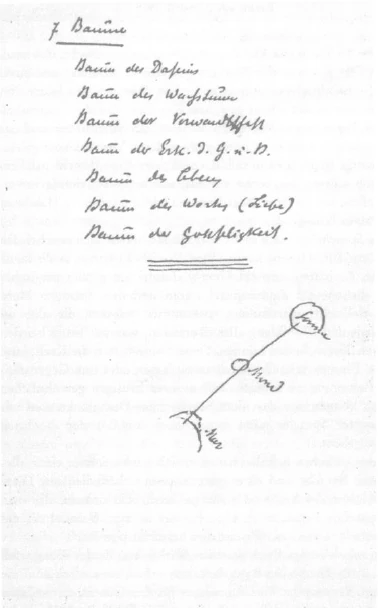
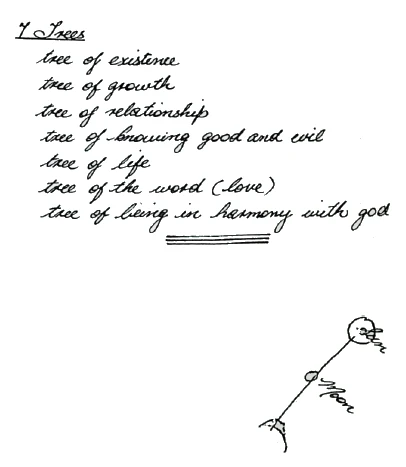
[ 14 ] Die sieben Bäume, das sind die siebenerlei Arten, wie der Mensch sich ausleben kann. Wir haben da die Vergangenheit, die Gegenwart und die Zukunft des Menschenwesens vor uns. Wir haben zuerst die physische Hülle (Sthula sharira), dann den Ätherkörper (Prana), in diesem wirken die Fortpflanzungs-, Ernährungsund Wachstumskräfte, drittens den Teil der Menschenwesenbheit, in dem die Triebe und Leidenschaften walten, den Astralkörper, und dann erst als das Zentrale das vierte, das menschliche Selbstbewußtsein. Der Mensch hat seine Vierheit unbewußt bekommen, ohne seine Mitarbeit. Sobald er das Selbstbewußtsein erhalten hat, beginnt er, an sich zu arbeiten und seinen Astralkörper zu organisieren. Dadurch durchstrahlt er seinen Astralkörper nach und nach von innen heraus. Diese Arbeit wird abgeschlossen sein am Ende unserer nachatlantischen Epoche, dann wird der Astralkörper durchtränkt sein mit Manas.
[ 14 ] The seven trees are seven ways in which the human being can be himself. Here we have man’s past, present and future. First there is the physical vestment (sthula sarira), then the ether body (prana), with powers of reproduction, nutrition and growth active in it, thirdly the part of essential human nature in which drives and passions are active, the astral body. Only then comes the most central principle, the fourth, human self-awareness. The human being received his fourfold nature unconsciously, without contributing to this himself. As soon as he had gained self-awareness he began to work on himself and organize his astral body. He is now gradually shining through his astral body from the inside. This work will come to its conclusion at the end of our post-Atlantean period, when the astral body will be steeped in manas.
[ 15 ] Es sind sieben Stadien:
[ 15 ] There are seven stages:
1. Der Baum des Daseins — wo der Mensch seinen physischen Körper entwickelt
2. Der Baum des Wachstums
3. Der Baum der Verwandtschaft — wo der Menschen Sympathie und Antipathie für die Umgebung entwickelt
4. Der Baum der Erkenntnis des Guten und des Bösen — wo der Mensch sich abschließt von der Außenwelt
5. Der Baum des Lebens — wo der Mensch anfängt, seinen Astralkörper zu beleben — Übergang vom Kama-Körper zu Manas
6. Der Baum des Wortes — wo der Mensch das sogenannte innere Wort zu vernehmen in der Lage ist, wo er mystische Erkenntnis hat
7. Der Baum der Gottseligkeit - wenn der Mensch in der Gottseligkeit des Alls ruht.
- The tree of physical existence—the human being develops his physical body
- The tree of growth
- The tree of relationship—the human being develops sympathy for and antipathy to his surroundings
- The tree of knowing good and evil—the human being closes himself off from the outside world
- The tree of life—the human being begins to bring life into his astral body; transition from kama body to manas
- The tree of the word—the human being is able to hear the ‘inner word’, gaining mystic insight
- The tree of being in harmony with God—the human being rests in harmony with God in the universe.
[ 16 ] Das nächstemal werde ich etwas über das zehnblättrige Buch sprechen. Die großen Lehrer der Menschheit haben in dem zehnblättrigen Buch gelesen, wie der heutige Mensch buchstabiert.
[ 16 ] The next time I will say something about the book of ten pages. The great teachers of humanity would read that book the way people spell words today.