

Self-Knowledge and God-Knowledge I
GA 90a
16 November 1903, Berlin
Translate the original German text into any language:
Versions Available:
Self-Knowledge and God-Knowledge I, tr. SOL
4. Woher Mannigfaltigkeit? — Aus Der Einheit
4. Where Does Diversity Come From? — From Unity
[ 1 ] Der Mensch besteht aus Körper, Seele, Geist, aus drei Epochen des Kosmos: Vergangenheit, Gegenwart und Zukunft.
[ 1 ] A person consists of body, soul, spirit, of three epochs of the cosmos: past, present and future.
[ 2 ] Unsere heutige Runde: Gegenwart; die vorhergegangene Vergangenheit; was kommen wird, die nachfolgenden Runden: Zukunft. [...]
[ 2 ] Our present round: present; the preceding past; what will come, the subsequent rounds: future. [...]
[ 3 ] ‹Vergangenheit› als Ausdruck des Urgeistes. Man denke sich den Urgeist als Wasser; alles Körperliche ist der erstarrte Zustand des Wassers. ‹Gegenwart› ist die Seele; die ‹Zukunft› liegt in uns als Keim. Noch können wir die Seele nicht sehen, doch gehen wir der Zeit entgegen, da auch die Seele zu sehen ist. Die Vergangenheit ist gleich der Zukunft —, der Inhalt beider ist die Gegenwart. Verschieden und mannigfaltig ist der Inhalt —, vom Einen ausgegangen —, die Vielheit zur Einheit zurück. — Der Urgeist als Schöpferkraft gedacht als Zentrum.
[ 3 ] 'Past' as an expression of the original spirit. Imagine the original spirit as water; everything physical is the solidified state of water. 'Present' is the soul; the 'future' lies within us as a seed. We cannot yet see the soul, but we are approaching the time when the soul can be seen. The past is the same as the future – the content of both is the present. The content is different and manifold – originating from the One – the multitude returns to the Unity. – The original spirit, conceived as the power of creation, as the center.
[ 4 ] Nun gibt die Schöpferkraft Gedanken von sich als Strahlen vom Zentrum ausgehend. Ein jeder solcher Strahl ist eine Seele. Nun ist nicht jede Seele [...] die Schöpferkraft, wohl aber ein Teil davon —, betätigt sich und strebt dem Ganzen wieder zu. Könnten wir die Seele selbst mit dieser Schöpferkraft vergleichen: Die Seele produziert fortwährend Gedanken und entsendet sie in den Raum; aber nicht jeder Gedanke ist selbstständig und kann als Wesen selbstständig wirken wie die Seele als Gottesgedanken. Die Bahn der Entwicklung ist zweierlei: Urquell als Schöpferkraft — und Gedanken.
[ 4 ] Now the power of creation emits thoughts as rays emanating from the center. Each such ray is a soul. Now, not every soul [...] is the creative power, but a part of it [...] is active and strives towards the whole again. If we could compare the soul itself to this creative power: the soul continually produces thoughts and sends them out into space; but not every thought is independent and can work independently as a being like the soul as God's thought. The path of development is twofold: the primal source as creative power – and thoughts.
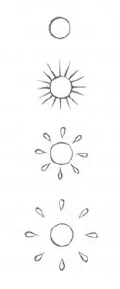
[ 5 ] Wir können den Grund der Hingabe Gottes nicht erforschen. Von einer Maschine können wir durch Studium derselben wissen, wie sie arbeitet. Bei einer Pflanze, obgleich wir auch hier die Gesetze studieren können, ist es schon schwieriger, ihre Gestaltung und ihr Werden zu bestimmen. Beim Tier ist es noch schwieriger. Beim niederen Menschen können wir noch durch Beobachtung bestimmen, was er tut, was beim höher Entwickelten nicht mehr möglich ist. Da ist es ein Akt der Freiheit. So ist der höchste Akt der Freiheit des Schöpfers diese grundlose Hingabe an die Welt aus Liebe. Kein Zwang. Es ist also kein logischer Grund für uns beim großen Geist da. Platon als Initiierter — wie auch andere Weise — nannten die Liebe den Grund des Weltalls.
[ 5 ] We cannot fathom the reason for God's devotion. We can know how a machine works by studying it. With a plant, although we can also study the laws here, it is more difficult to determine its form and development. It is even more difficult with animals. In the lower man we can still determine by observation what he does, which is no longer possible with the more highly developed. There it is an act of freedom. So the highest act of the Creator's freedom is this causeless devotion to the world out of love. No compulsion. So there is no logical reason for us with the great spirit. Plato as an initiate - like other sages - called love the reason of the universe.
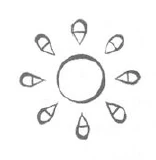
[ 6 ] Gegenwart als Verbindung zwischen Vergangenheit und Zukunft ist die Kraft in uns als Astralkörper.
[ 6 ] Present as the connection between past and future is the power in us as an astral body.
[ 7 ] Dritter Logos Weisheit. Deshalb Verzicht auf Warum? Weil Gott als Schöpfer im Akt seiner höchsten Freiheit die Welt erschaffen:
[ 7 ] Third Logos Wisdom. Therefore renunciation of Why? Because God as Creator in the act of His highest freedom created the world:
[ 8 ] Gott, Urquell, Einheit, von sich durch Hingabe an die Welt aus Liebe eine Vielheit. — Beispiel: Wasser versprengt in lauter Tropfen; der Tropfen ist doch dasselbe Wasser —, dann Annie Besant: Feuer, und aussprengend — Funken.
[ 8 ] God, the Primordial Source, Unity, through devotion to the world out of love a multiplicity. — Example: water sprinkled in many drops; the drop is still the same water —, then Annie Besant: fire, and bursting out — sparks.
[ 9 ] Da wir nun Gedanken — Tropfen, Funken — des Höchsten sind, erinnern wir uns unseres Ursprunges. Erinnerung = Gedächtnis — Platon.
[ 9 ] Now that we are thoughts – drops, sparks – of the Most High, we remember our origin. Memory = remembrance – Plato.
[ 10 ] Im Anfang war das Wort — unaussprechlich! Spreche ich aus, so besteht es aus Buchstaben; jeder Buchstabe hat einen andern Laut. Wir sind — jedes Wesen — ein solcher Buchstabe zum Wort. Deshalb die Verschiedenheit der Wesen, weil, um ein Wort zu sprechen, verschiedene Laute notwendig sind.
[ 10 ] In the beginning was the Word—inexpressible! When I utter it, it consists of letters; each letter has a different sound. We are—every being is—such a letter of the Word. The diversity of beings is because, in order to speak a word, different sounds are necessary.
[ 11 ] Wort — Mannigfaltigkeit —, das bist Du — es bin ich — ich bin ich!
[ 11 ] Word – diversity – that art Thou – it is I – I am I!
[ 12 ] I. Logos Allmacht — II. Logos Kraft — III. Logos Weisheit
[ 12 ] I. Logos omnipotence – II. Logos power – III. Logos wisdom.