

Human Development and Christ-Knowledge
GA 100
17 November 1907, Basel
Translate the original German text into any language:
Versions Available:
Human Development and Christ-Knowledge, tr. SOL
Das Johannes-Evangelium II
The Gospel of John II
[ 1 ] Der Mensch, wie er vor uns steht, wird von der Geisteswissenschaft in sieben Teile zerlegt. Der unseren Sinnesorganen wahrnehmbare physische Körper ist nur ein Teil der menschlichen Wesenheit. Diesen physischen Leib hat der Mensch gemeinschaftlich mit der ganzen uns umgebenden mineralischen Natur. Die in unserem physischen Körper wirkenden Kräfte sind die gleichen wie in der scheinbar unbelebten Natur.
[ 1 ] Spiritual Science divides the human being, as we perceive them, into seven parts. The physical body, which is perceptible to our sense organs, is only one part of the human being. Human beings share this physical body with the entire mineral world that surrounds us. The forces at work in our physical body are the same as those in seemingly inanimate nature.
[ 2 ] Dieser physische Körper ist aber noch durchdrungen von höheren Kräften, ähnlich wie ein Schwamm von Wasser durchdrungen sein kann. Der Unterschied zwischen unbelebten und belebten Körpern ist folgender: Im unbelebten Körper folgen die ihn bildenden Stoffe lediglich den physischen, chemischen Gesetzen. Im belebten Körper dagegen sind die Stoffe in sehr komplizierter Weise miteinander verkettet, und nur unter Einwirkung des Ätherleibes können sie sich in dieser ihnen unnatürlichen, aufgedrungenen Gruppierung halten. In jedem Moment will der physische Stoff sich seiner Natur gemäß gruppieren, was einen Zerfall des lebendigen Körpers bedeutet, und in jedem Moment kämpft der Ätherleib gegen diesen Zerfall an. Wenn sich der Ätherkörper aus dem physischen Körper entfernt, so gruppieren sich die Stoffe des physischen Körpers in der für sie natürlichen Weise, und der Körper zerfällt, wird ein Leichnam. Der Ätherleib ist also der fortwährende Kämpfer gegen den Zerfall des physischen Leibes.
[ 2 ] This physical body, however, is still permeated by higher forces, much as a sponge can be permeated by water. The difference between inanimate and animate bodies is as follows: In an inanimate body, the substances that compose it simply follow physical and chemical laws. In the animate body, on the other hand, the substances are linked together in a very complex manner, and only under the influence of the etheric body can they maintain this unnatural, imposed arrangement. At every moment, the physical substance seeks to group itself according to its nature, which would mean the disintegration of the living body, and at every moment the etheric body fights against this disintegration. When the etheric body withdraws from the physical body, the substances of the physical body group themselves in the manner natural to them, and the body disintegrates, becoming a corpse. The etheric body is thus the constant fighter against the disintegration of the physical body.
[ 3 ] Jedes Organ hat diesen Ätherleib zu seiner Grundkraft. Der Mensch hat ein Ätherherz, ein Äthergehirn und so weiter zum Zusammenhalten der betreffenden physischen Organe. Man ist leicht versucht, sich den Ätherleib in materieller Weise vorzustellen, etwa als einen ganz feinen Nebel. In Wahrheit ist der Ätherleib eine Summe von Kraftströmungen. Für den Hellseher erscheinen im Ätherleib des Menschen gewisse Strömungen, die von sehr großer Wichtigkeit sind. Es steigt zum Beispiel ein Strom vom linken Fuße nach der Stirne, an eine Stelle, die zwischen den Augen, etwa ein Zentimeter tief im Gehirn liegt, kehrt dann in den andern Fuß hinunter, von dort in die entgegengesetzte Hand, von dort durch das Herz in die andere Hand und von dort an ihren Ausgangspunkt zurück. Es bildet sich in dieser Weise ein Pentagramm von Kraftströmungen.
[ 3 ] Every organ has this etheric body as its fundamental force. Human beings have an etheric heart, an etheric brain, and so on, to hold the corresponding physical organs together. It is easy to be tempted to create a mental image of the etheric body in a material way, for example as a very fine mist. In truth, the etheric body is a sum of force currents. To the clairvoyant, certain currents appear in the human etheric body that are of great importance. For example, a current rises from the left foot to the forehead, to a point located between the eyes, about one centimeter deep within the brain; it then returns down to the other foot, from there to the opposite hand, from there through the heart to the other hand, and from there back to its starting point. In this way, a pentagram of currents of force is formed.
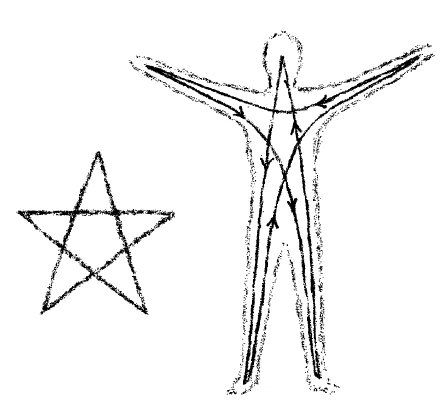
[ 4 ] Diese Kraftströmung ist nicht etwa die einzige im Ätherleibe, sondern es gibt deren noch sehr viele. Speziell dieser Kraftströmung verdankt der Mensch seine aufrechte Stellung. Das Tier ist mit seinen vorderen Gliedmaßen an die Erde gebunden, und im Tiere sehen wir eine solche Strömung nicht. In bezug auf Gestalt und Form und Größe des menschlichen Ätherleibes kann man sagen, daß derselbe in seinen oberen Partien ein vollständiges Ebenbild des physischen Leibes ist. Anders ist es mit seinen unteren Partien, welche nicht mit dem physischen Körper übereinstimmen. Dem Verhältnis von Ätherleib und physischem Leibe liegt ein großes Geheimnis zugrunde, das tief hineinleuchtet in die Menschennatur: der Ätherleib des Mannes ist weiblich, derjenige des Weibes ist männlich. Dadurch wird die Tatsache erklärt, daß wir in jeder Mannesnatur viel Weibliches, und in jeder Frauennatur viel Männliches finden. Bei den Tieren ist der Ätherleib größer als der physische Leib. So sieht der Hellseher zum Beispiel beim Pferd über dem Kopf den Ätherkopf in Form einer Kappe herausragen.
[ 4 ] This current of force is by no means the only one in the etheric body; there are many others. It is specifically to this current of force that human beings owe their upright posture. Animals are bound to the earth by their front limbs, and we do not observe such a current in animals. With regard to the shape, form, and size of the human etheric body, it can be said that its upper parts are a perfect likeness of the physical body. The situation is different with its lower parts, which do not correspond to the physical body. The relationship between the etheric body and the physical body is based on a great mystery that sheds deep light on human nature: the etheric body of the man is feminine, that of the woman is masculine. This explains the fact that we find much that is feminine in every man, and much that is masculine in every woman. In animals, the etheric body is larger than the physical body. Thus, for example, the clairvoyant sees the etheric head protruding above the horse’s head in the shape of a cap.
[ 5 ] Es gibt etwas im Menschen, was ihm viel nähersteht als Blut, Muskeln, Nerven und so weiter. Dies sind die Empfindungen von Lust und Leid, Freude und Schmerz, kurz alles das, was der Mensch sein Inneres nennt. Dies wird in der Geheimwissenschaft der Astralleib genannt, den der Mensch nur mit dem Tier gemein hat.
[ 5 ] There is something within a human being that is much closer to them than blood, muscles, nerves, and so on. These are the sensations of pleasure and suffering, joy and pain—in short, everything that a human being calls their inner self. In esoteric science, this is called the astral body, which is the only thing a human being has in common with animals.
[ 6 ] So wie ein Blindgeborener die ihn umgebende Welt nur unvollständig kennt und die Welt der Farben und des Lichtes für ihn nicht existiert, so ist der durchschnittliche Mensch in der gleichen Lage der Astralwelt gegenüber. Sie ist ebenso vorhanden, durchdringt und umgibt die physische Welt, wird aber von ihm nicht wahrgenommen. Wenn der astralische Sinn bei einem Menschen eröffnet wird, so wird ihm die Astralwelt sichtbar. Die Bedeutung und Wichtigkeit dieses Momentes der menschlichen Entwickelung ist aber noch viel größer, als wenn ein Blindgeborener durch eine Operation das Augenlicht erlangt. Aber ein jeder von uns kennt diese astrale Welt, wenn auch unvollkommen, denn jede Nacht wird unser Astralleib in diese Welt versetzt. Wir ruhen in der Astralwelt, um die Harmonie des Astralleibes wiederherzustellen, denn die Ermüdung ist vom geisteswissenschaftlichen Standpunkt aus betrachtet nur eine Disharmonie im physischen und Astralleibe. Ein Gleichnis könnte das Verhältnis des physischen zum Astralleibe beleuchten. Nehmen wir einen Schwamm, zerschneiden ihn in tausend Stücke und lassen den Inhalt von einem Glas Wasser von diesen kleinen Stücken aufsaugen, so haben wir ein Gleichnis für den wachenden Durchschnittsmenschen. Pressen wir die Schwämmchen aus und sammeln wir das Wasser wieder in seinen Behälter, so schließt es sich zu einer gleichmäßigen Masse zusammen. So treten die menschlichen Astralkörper, die tagsüber wie die aufgesogenen Wassertropfen individualisiert waren, in die gemeinsame Astralsubstanz ein und stärken und kräftigen sich in derselben. Dies erkennt man am Morgen daran, daß die Ermüdung beseitigt ist. Solange der Mensch kein Seher ist, vermischt sich sein im Schlafe herausgetretener Astralleib mit den übrigen Astralleibern. Beim Seher liegen die Verhältnisse jedoch anders.
[ 6 ] Just as a person born blind has only an incomplete understanding of the world around them and the world of colors and light does not exist for them, so too is the average person in the same position with regard to the astral world. It is just as real, permeating and surrounding the physical world, but it is not perceived by them. When a person’s astral sense is awakened, the astral world becomes visible to them. The significance and importance of this moment in human development, however, is far greater than when a person born blind regains their sight through surgery. Yet each of us is familiar with this astral world, albeit imperfectly, for every night our astral body is transported into this world. We rest in the astral world to restore the harmony of the astral body, for fatigue, viewed from a standpoint of Spiritual Science, is merely a disharmony in the physical and astral bodies. A parable might shed light on the relationship between the physical and astral bodies. If we take a sponge, cut it into a thousand pieces, and let the contents of a glass of water be absorbed by these small pieces, we have a parable for the average person while awake. If we squeeze out the little sponges and collect the water back into its container, it coalesces into a uniform mass. Thus the human astral bodies, which during the day were individualized like the absorbed drops of water, enter into the common astral substance and are strengthened and invigorated within it. This is evident in the morning by the fact that fatigue has been dispelled. As long as a person is not a seer, their astral body, which has emerged during sleep, mingles with the other astral bodies. For the seer, however, the circumstances are different.
[ 7 ] Die einzelnen Pflanzen haben keinen eigenen Astralleib, sondern die ganze Pflanzenwelt besitzt einen gemeinsamen Astralleib, denjenigen der Erde. Die Erde ist ein lebendes Wesen, die Pflanzen sind ihre Glieder.
[ 7 ] Individual plants do not have their own astral body; rather, the entire plant kingdom shares a common astral body—that of the Earth. The Earth is a living being, and plants are its limbs.
[ 8 ] Das vierte Glied des Menschen ist das Ich. Das Wort «Ich» kann der Mensch nur zu sich selber sprechen. Niemals kann dieses Wort von außen an unser Ohr klingen, um uns damit zu bezeichnen. Wenn dieses Ich in einem Wesen erklingt, dann spricht sich der Gott in ihm aus. Die Tierwelt, die Pflanzen- und Mineralwelt sind in bezug auf das Ich in einer andern Lage. Ein Tier zum Beispiel kann zu sich ebensowenig «Ich» sagen, wie ein Finger unserer Hand zu sich «Ich» sagen kann. Der Finger müßte, wenn er sein Ich bezeichnen wollte, auf das Ich des Menschen hinweisen; ebenso müßte das Tier auf ein Ich hinweisen, das einer in der Astralwelt lebenden Wesenheit angehört. Alle Löwen, alle Elefanten und so weiter haben ein gemeinschaftliches Gruppen-Ich, also ein Löwen-Ich, ein Elefanten-Ich und so weiter.
[ 8 ] The fourth element of the human being is the “I.” The word “I” can only be spoken by a person to themselves. This word can never reach our ears from outside to designate us. When this “I” resounds within a being, then the God within that being speaks. The animal, plant, and mineral worlds are in a different position with regard to the “I.” An animal, for example, can no more say “I” to itself than a finger of our hand can say “I” to itself. If the finger wanted to refer to its “I,” it would have to point to the human “I”; similarly, the animal would have to point to an “I” belonging to a being living in the astral world. All lions, all elephants, and so on have a collective group “I”—that is, a lion “I,” an elephant “I,” and so on.
[ 9 ] Wollte die Pflanze auf ihr Ich zeigen, so müßte sie hinweisen auf ein gemeinschaftliches Ich im Mittelpunkt der Erde, in der Mentalwelt. Es ist bekannt, daß wenn man ein Tier sticht, dieses Tier Schmerz empfindet. Bei der Pflanze ist es anders, und der Seher kann uns berichten, daß das Pflücken der Blumen oder das Schneiden des Kornes für die Erde dasselbe wohlige Gefühl bedeutet wie für die Kuh die Entnahme der Milch beim Säugen. Wird aber die Pflanze mit der Wurzel ausgerissen, so ist es so, wie wenn man einem Tier ein Stück seines Fleisches herausschneiden würde. Dieses Ausreißen wird in der Astralwelt als Schmerz empfunden.
[ 9 ] If the plant were to point to its own “I,” it would have to refer to a collective “I” at the center of the Earth, in the mental world. It is well known that when an animal is pricked, it feels pain. With plants, it is different, and the seer can tell us that picking flowers or cutting grain gives the earth the same pleasant sensation as milking does for a cow. But if the plant is torn out by the roots, it is as if a piece of flesh were cut out of an animal. This tearing out is experienced as pain in the astral world.
[ 10 ] Wenn man fragen wollte: Wo ist das Ich der Gesteinswelt? — so würde man nicht mehr imstande sein, ein solches einen Mittelpunkt bildendes Wesen in der Geisteswelt zu finden. Als Kraft des ganzen Kosmos überall verbreitet, ist das Ich der Mineralien in der übergeistigen Welt, theosophisch höhere Devachanwelt genannt, zu finden.
[ 10 ] If one were to ask: Where is the “I” of the mineral world? — one would no longer be able to find such a being, forming a central point, in the spiritual world. Spread everywhere as the force of the entire cosmos, the “I” of minerals is to be found in the super-spiritual world, known in theosophy as the higher Devachan world.
[ 11 ] In der christlichen Geheimlehre bezeichnet man die Welt, in welcher sich das Ich der Tiere befindet, die Astralwelt, als die Welt des Heiligen Geistes; die Welt, in der das Ich der Pflanzen ist, die geistige oder devachanische Welt, als die Welt des Sohnes. Wenn der Seher anfängt, in dieser Welt zu fühlen, so spricht zu ihm das «Wort», der Logos. Die Welt des mineralischen Ich, die übergeistige Welt, wird in der Geheimlehre die Welt des Vatergeistes genannt.
[ 11 ] In Christian esotericism, the world in which the I of animals resides—the astral world—is referred to as the world of the Holy Spirit; the world in which the I of plants resides—the spiritual or devachanic world—is referred to as the world of the Son. When the seer begins to feel in this world, the “Word,” the Logos, speaks to him. The world of the mineral ego, the super-spiritual world, is called the world of the Father Spirit in the Esoteric Doctrine.
[ 12 ] Der Mensch ist ein in fortwährender Entwickelung begriffenes Wesen; wir haben nun alle vier Glieder seiner Natur kennengelernt. Sie sind das, was Pythagoras in seiner Schule als die niedere Vierheit bezeichnet. Der Wilde, der Zivilisierte, der Idealist, der Heilige: alle haben diese vier Teile. Der Wilde aber ist der Sklave seiner Leidenschaften; der Zivilisierte folgt nicht mehr wahllos seinen Trieben und Begierden; der Idealist tut dies noch weniger, und der Heilige ist völlig Herr über dieselben geworden.
[ 12 ] Human beings are creatures in a state of constant development; we have now come to know all four aspects of their nature. These are what Pythagoras referred to in his school as the “lower fourfold.” The savage, the civilized, the idealist, the saint: all possess these four aspects. The savage, however, is a slave to his passions; the civilized person no longer follows his instincts and desires indiscriminately; the idealist does so even less, and the saint has become completely master of them.
[ 13 ] Das Ich arbeitet am Astralleib und gliedert einen Teil aus ihm heraus. Dieser Teil wird im Laufe der menschlichen Entwickelung immer größer, während der ererbte Teil immer kleiner wird. In einem Franz von Assisi ist der gesamte Astralleib vom Ich aus durchgearbeiter und umgewandelt worden. Dieser vom Ich umgewandelte Astralleib bildet. das fünfte Glied der menschlichen Natur: das Geistselbst oder Manas.
[ 13 ] The ego works on the astral body and separates a part from it. This part grows larger and larger in the course of human development, while the inherited part becomes smaller and smaller. In a figure like Francis of Assisi, the entire astral body has been worked through and transformed by the ego. This astral body, transformed by the ego, constitutes the fifth member of human nature: the Spirit-Self, or Manas.
[ 14 ] Das Ich kann aber auch Herr werden über den Ätherleib oder Lebensleib. Der vom Ich umgewandelte Teil des Ätherleibes heißt Lebensgeist oder Buddhi. Umwandelnd auf den Ätherleib wirken die Impulse der Kunst und der Religion, letztere in ganz besonders starkem Maße, weil sie sich täglich wiederholen; und Wiederholung ist die Zauberkraft, welche den Ätherleib umwandelt. Am stärksten wirkt in diesem Sinne die bewußte Arbeit in der Geheimschulung, und Meditation und Konzentration sind die Mittel, welche hier angewandt werden. Die Geschwindigkeit der Umwandlung des Ätherleibes und des Astralleibes zeigen ein Ähnliches Verhältnis wie bei der Uhr der Gang des Stundenzeigers zum Gang des Minutenzeigers. Wenn es gelungen ist, im Temperament, welches von den Verhältnissen des Ätherleibes abhängig ist, das Geringste zu ändern, so ist dies mehr wert als das Aneignen von noch so vielen geistreichen Theorien.
[ 14 ] The ego, however, can also gain mastery over the etheric body or Life-Body. The part of the etheric body transformed by the ego is called the Life-Spirit or buddhi. The impulses of art and religion act to transform the etheric body, the latter to a particularly strong degree because it is repeated daily; and repetition is the magical power that transforms the etheric body. In this sense, conscious work in the secret training has the strongest effect, and meditation and concentration are the means employed here. The speed of the transformation of the etheric body and the astral body show a similar ratio to that of the hour hand to the minute hand on a clock. If one succeeds in changing even the slightest aspect of one’s temperament—which depends on the conditions of the etheric body—this is worth more than the acquisition of even the most ingenious theories.
[ 15 ] Die stärkste Kraft ist notwendig, um den physischen Leib bewußt umzuändern. Die Mittel dazu werden nur in der Geheimschule gegeben. Angedeutet kann nur werden, daß die Regelung des Atmens den Beginn dieser Umwandlung bildet. Den vom Ich in bewußter Weise umgestalteten physischen Leib nennt man Geistesmensch oder Atma. Die Kraft zur Umgestaltung des Astralleibes flutet uns zu aus der Welt des Heiligen Geistes. Die Kraft zur Umgestaltung des Ätherleibes flutet uns zu aus der Welt des Sohnes oder des Wortes. Die Kraft zur Umgestaltung des physischen Leibes flutet uns zu aus der Welt des Vatergeistes oder des göttlichen Vaters.
[ 15 ] The greatest power is required to consciously transform the physical body. The means to do so are taught only in the secret school. It can only be hinted at that the regulation of breathing marks the beginning of this transformation. The physical body, consciously transformed by the I, is called the Spirit-Man or Atma. The power to transform the astral body flows to us from the world of the Holy Spirit. The power to transform the etheric body flows to us from the world of the Son or the Word. The power to transform the physical body flows to us from the world of the Father Spirit or the Divine Father.