Anthroposophy's Response
to Universal Questions
GA 108
14 December 1908, Breslau
Translated by Steiner Online Library
4. The Ten Commandments
[ 1 ] Today we will examine an important document of humanity which, although it seems to lie far outside the scope of our previous considerations, is nevertheless closely connected with them. These are the Ten Commandments, which we would like to examine from the perspective of spiritual science, because it is perhaps precisely in relation to this document of humanity that spiritual science is able to shed the right light on its understanding.
[ 2 ] Scholarly theology often asserts that these Ten Commandments correspond to various laws and commandments of other ancient peoples and are actually nothing special. At most, they are remarkable in that they are a compilation of what can be found here and there as commandments and laws among various ancient peoples, for example in Lycurgus of Sparta or in the tablets of Hammurabi.
[ 3 ] What has occupied us as we have considered the course of human development in the post-Atlantean era and allowed it to work upon our souls will also be able to serve as a guide for us in a certain sense, enabling us to comprehend the great and powerful event that struck humanity when the Ten Commandments were given on Mount Sinai. Let us remember what we encountered when we considered the course of human development in the post-Atlantean era. We have seen that the five cultural epochs—the Indian, Persian, Chaldean-Egyptian-Jewish, Greek-Roman, and Germanic cultural epochs—represent a gradual conquest of the physical plane by humanity. Now, at the end of the third epoch and at the beginning of the fourth, we are confronted with what we can call the “mission of Moses.” What does this mission consist of?
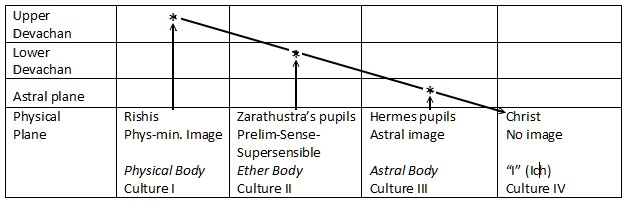
[ 4 ] Let us once again consider more closely how the inspirations of the initiates actually were in the successive periods. Yesterday we spoke of the rishis who were the inspirers of their people in ancient India. It was said of the rishis that in ordinary life they were, so to speak, simple human beings, but at certain times they were the instruments, the mouthpieces for the inspirations of higher spiritual beings. This fact was particularly striking in the times of ancient India, and these ancient Rishis, these greatest teachers of the post-Atlantean cultural epoch, were able to speak of high spiritual truths. Let us ask ourselves into which regions of the spirit these ancient Rishis transported themselves when they were inwardly permeated and filled with the higher beings who spoke through them. While the higher powers lived within them, these rishis rose not merely to the astral or lower devachan plane, but up to the higher devachan, so that what they taught originally came from the higher devachan. In those ancient times, shortly after the Atlantean catastrophe, this was still possible because the ancient Indian bodies still offered human beings the opportunity to emerge from them and enter into relationship with the beings of higher worlds.
[ 5 ] Now the stages of culture are progressing. In the cultural epoch of Zarathustra, the ancient Persian, the highest initiates still know how to tell of the highest spiritual beings, but their elevation cannot easily reach the upper parts of Devachan. They can only rise to the lower Devachan. Nevertheless, they can still receive instruction about the higher planes, for these high beings of the lower Devachan plane also know about the higher planes.
[ 6 ] In the world where the Egyptian initiates were mainly at home, people usually rose to the astral plane, and it was by no means only a small circle that was still able to rise to this astral plane in ancient Egypt. There was still a relatively large number of people who knew from their own observation what can happen on the astral plane. At least in certain intermediate states of life, between sleeping and waking, for example, many experienced communion with those beings who do not come down to the physical plane but are still at home on the astral plane. So those who entered and left the astral plane, the ancient Egyptian initiates, still found it easy to proclaim the things that were happening in higher worlds.
[ 7 ] As we approach later cultural epochs, the curtain before the spiritual worlds draws closer and closer, so to speak. The number of people who are still able to make observations in the spiritual worlds is becoming smaller and smaller, and this made a special kind of proclamation by the initiates necessary towards the fourth cultural epoch. One of those initiates who was well versed in all the occult arts of the Egyptian initiates was Moses; he moved quite freely on the astral plane. His people in particular were chosen to receive a certain revelation that would be of value to them even when they could no longer look up to the higher worlds. There had always been initiates, although their numbers had dwindled, who knew directly or indirectly about the higher worlds because they were able to live consciously outside their bodies. The majority of the people, however, had to limit their lives entirely to the physical plane. The task to be fulfilled for humanity at the time when Moses' mission began was this: to give those people who were completely dependent on the physical plane a revelation from the spiritual world behind the physical plane, according to which they could regulate their lives. How, then, was this mission of Moses to be carried out at first?
[ 8 ] Imagine that it first had to be made clear to people that what is around them, what they can see and feel, is the physical plane; there is nothing spiritual anywhere. You must not regard this as something that could somehow represent the spiritual to you, but you must be clear that the spiritual must be sought in the spiritual, and that there is only one place where you can seek the spiritual.”
[ 9 ] In the times of ancient India, when the holy rishis spoke from the upper parts of Devachan, it was possible to give images that symbolized and comparatively hinted at what was spoken from the upper Devachan as an external image. It was possible to give pictures and images, and it was relatively easy to make people understand: We are giving you pictures, but since you regard the outer world as an illusion, as Maya, these pictures will be nothing more to you than pictures, images of a world beyond the senses. There was no danger that these pictures could be used for idolatry. How could that have been possible among a people who regarded everything sensual as Maya, as illusion? This people could never have practiced idolatry. That came much later. However, it was precisely later in Eastern culture that the idol replaced the symbol. But it was easy for the holy rishis to make it clear to the entire Indian people: What we have to proclaim to you comes from the higher parts of Devachan, and the visible, the physical, is a symbol of that which is so high and sublime that you can only perceive it in symbols.
[ 10 ] During the Persian culture, however, the disciples of Zarathustra could not proceed in the same way. They could only establish a kind of connection between their people and the lower parts of the Devachan plane. Therefore, they were only able to speak of the supersensible in images, but in spiritual images. They did not use any sensual images. Above all, they spoke to their people about the actual spiritual, good being whom they called Ahura Mazdao, the being who has his outer physicality in the sun and with whom man allies himself against the dark spirit, Ahriman. This was presented to people as a sensual-supersensible image, so to speak. People were to imagine this spiritual being of light in their minds. But they were not to make a finished image or portrait. At most, they could imagine this divine Ahura Mazdao in a process, for example in fire, but not in a rigid, external, sensual image. Everything that is sensual images, images of gods, comes from a later time. The ancient Persian culture had pictorial processes that were intended to express the supersensible. That was progress.
[ 11 ] Now we come to the third stage of culture, which we encounter mainly in Egypt. As we know, the figure of Osiris stood, as it were, at the center of all religious thought and feeling. You will easily understand what must now be said. What kind of being is Osiris, mainly in his divine form? Consider that the Egyptian cultural leaders told people: If you fulfill your task here in the physical world correctly, if you do everything that makes you a worthy human being in relation to your soul, then you will be united with Osiris after death. On the other hand, they were told: Osiris had only a short life here on earth, for he was overcome by his brother Typhon—Seth—and has lived since that time in the worlds that are above the earth. His lowest realm is no longer the physical, but the astral plane; he does not descend any further. It is no longer possible for Osiris to enter the physical plane. Therefore, man cannot encounter Osiris in life. But after death, if he has made himself worthy, he will be united with Osiris, because then man enters the world where Osiris dwells. Man must therefore meet Osiris, either when he dies or when he enters the astral plane as an initiate. Therefore, it was made clear to the followers of the Osiris religion: You should not imagine the supersensible, with which you yourself are still connected, as anything other than the image of your own soul, a soul as we imagine it under the concept of the astral body. Osiris was presented as an ideal human figure with all possible virtues, and since both instincts and virtues are found in the astral body, an astral human being was presented, so to speak, as the essence of Osiris.
[ 12 ] For the Semitic people, who had, in a sense, passed through the school of Egypt and were to prepare for that great event through which the spiritual, the Christ, descended into the physical world—not only as Osiris to the astral plane, but as Christ who came to the physical plane—for this people, neither a god in parable in symbols, as in ancient India, nor could they worship a god in a sensual-supersensory image, as in Persian culture, nor in the image of an astral being, as in Egyptian culture, but solely and exclusively under the non-sensory conception of the I. All the images originally given to the ancient Indians to help them imagine the spiritual world were borrowed from the physical world, from the mineral kingdom; they were images that were expressed in physical-mineral forms. The form in which the initiates of Persian culture made the supersensible clear to their people was taken from what also lives in the human etheric body, the living etheric, for Ahura Mazdao also became visible to them by revealing himself to them in an etheric form, the sun's aura. Osiris had been presented to the Egyptians in an astral form. But the deity who announced himself to the Jewish people was to have no other attributes than those of the I, the fourth member of the human being. Through the I, man grasps something that alone can say “I” to itself.
[ 13 ] But there was something else connected with this. Man was now to pour the mission of Moses into himself; he was to imagine the deity in the image of this I. From now on, it had to be said to people: Just as an I lives in every human being and rules over all the members of human nature, so you should imagine the being that weaves and lives in the world as a creative being and rules and reigns over all that is created. No sensual, no etheric, and no astral image can reproduce this. Only in the form of the “I,” only under the name “I am the I am,” should you imagine the highest being. In the “I am” itself, every human being should feel an image of the divinity. That was the mission, the task of Moses, to tell people: Look within yourselves; there alone will you find a true image of the pure Godhead. From now on, therefore, all influence among people should come only from I to I. This was to be prepared by the mission of Moses.
[ 14 ] Let us place ourselves once again in Egyptian culture. There was much influence, but it did not go from I to I, but from astral body to astral body. What does that mean? Think of how such a gigantic pyramid was built. A large army of people was needed to build such a pyramid. The workers building such a pyramid followed the orders of those who were the master builders, and these were the temple priests, the spiritual leaders of the culture. Do not believe that these orders were given as orders are given today, from I to I. That was not the case. You will understand most easily what was happening at that time if we use the word “suggestion.” Psychic forces were used to guide the masses. The Egyptian priests were highly skilled in such forces. They did not influence the ego by saying, “Do this or that,” but rather they controlled the crowd as one who can wield psychic forces, so that people followed these priests without will, bypassing their ego. The priests stood as initiates in high service. They could not be trusted to abuse these powers; they placed them in the service of good. So it was through inspiration, psychic inspiration, that they worked, and there was no question of freedom of the ego in relation to the temple priest. If you understand this, you will also understand that in ancient India the holy rishis used spiritual powers to an even greater extent. With them it was like this: when they appeared and gave significant announcements from the spiritual worlds, it was natural that the whole people followed them without question. Just as our hands follow our heads, so the great masses of people followed their leaders, the initiates. This became less and less as man descended further and further onto the physical plane, but in ancient Egypt these psychic forces were still very effective. To tear people away from this kind of influence and to announce in advance the confrontation with the “I” was the mission of Moses. To seek the divine source in every human being, to regard the great world-I, the I that permeates and blows through space, as the archetype of one's own I, that was the great call associated with the mission of Moses.
[ 15 ] From this point of view, we will understand how this great world-I had to be proclaimed through Moses. In this way, the proclamation of the I-commandments must be translated into today's language so that we really have what was felt, sensed, and thought when, for example, the first commandment was heard at that time. All lexicographical translations render it in the most inaccurate way imaginable. And now I would like to present to you the first commandment as it really must be translated in order to express what was imagined at that time when it was heard.
[ 16 ] First commandment. I am the eternal Divine that you feel within you. I led you out of the land of Egypt, where you could not follow Me within yourself. From now on, you shall not place other gods above Me. You shall not recognize as higher gods what an image shows you of something that shines above in the sky, that works out of the earth or between heaven and earth. You shall not worship what is of all this under the divine within you. For I am the Eternal One within you and am a continuing Divine. If you do not recognize Me within you, I will disappear as your Divine in your children and grandchildren and great-grandchildren, and their bodies will wither away. If you recognize Me within you, I will live on as you until the thousandth generation, and the bodies of your people will flourish.
[ 17 ] Here we have the indication that in the individual “I” we are to recognize the archetype of the “I,” the image of the divine original “I,” and at the same time the indication that those who recognize their “I” as divine become free from the way in which the people of ancient Egypt stood before their leaders. “I brought you out of the land of Egypt, where you could not follow Me within yourself.” People followed the will of the initiates; they were not free. These initiates used their psychic powers, which people followed. The first dawn of that human freedom, which then emerged as the freedom of grace in Christianity, is revealed in this statement: “I have brought you out of the land of Egypt, where you could not follow Me within yourself.” “You shall have no other gods before Me.” Precisely in order for the Jewish people to become the great preparatory people for the manifestation of Christianity, it had to be made clear that all other representations of the divine, of the archetype of the I, had to be eliminated. Any external form of the divine, be it the constellations or anything else, had to be eliminated. The divine must not be represented by anything, for in order for human beings to become free, to find the source of everything within themselves, they must feel everything they can perceive about the divine in their own ego as the image of the great world ego. “You shall not acknowledge as higher gods what shows you an image of something that shines above in the heavens, that works out of the earth or between heaven and earth.” A god without an image! The only legitimate expression of this is the human self, the image of ‘I am the I am.’ ”You shall not worship what is of all this within you that is divine.”
[ 18 ] We have emphasized this: in ancient India, the image was taken from the physical body; in Persian culture, from the etheric body; and in Egyptian culture, from the astral body. All of this is below the I. From now on, nothing should be taken from the image of the divine. We know that the physical body is taken from the mineral nature, that the etheric body is taken from the etheric nature, and that the astral body is taken from the realm from which the astral body of animals is also taken. Nothing that is in the lower members of human nature, that is taken from the rest of nature, nothing that is below the ego, should be taken for what man worships. “For I am the eternal in you and am a continuing divine.” Here you have an important sentence. What was previously a fact was given to the Jews as law. We have already pointed out how, among all peoples through whom a common blood flowed, a certain consciousness ran through the generations, how the son felt connected through the blood to his father and grandfather. Common blood felt like a common self. The self lived on through the generations. The God who first announced himself as “I” to the Jewish people had to announce himself by saying that it is he who works through the generations as God. “If you understand me correctly, then you understand what continues to work from generation to generation.” This has been translated as “I am a jealous God,” or even “an angry God,” while the real meaning is “I am a God who continues to work from generation to generation.”
[ 19 ] "Never seek to form an incorrect idea of Me; keep the right idea of Me within you, and you will plant health in the blood from generation to generation.” A correct medical understanding is connected with this, for the one who gave this commandment associated with it the idea that when a person has a pure understanding of his connection with the divine, a healing self-understanding flows through the blood, and the people remain healthy from generation to generation. We cannot gain a proper understanding of the life-giving content of what Moses gave his people when he proclaimed the laws if we merely think conceptually about what he said. No, it is said on the assumption that the right thought is an effective reality. “If you have a false idea of the divine, it will be passed down from generation to generation, manifesting itself as illness and infirmity.” Right thoughts bring about health, but wrong thoughts bring about illness. This is a truly anthroposophical or occult idea. All this must be taken into account, otherwise one cannot form a correct concept or idea of this first commandment. The Jewish people are instructed: Do not imagine your God in a false image. When you kneel before the golden calf, a false conception of God flows into you, and this false image of God, by passing down through the generations with the blood, produces the continuing sin that then turns into illness. “If you do not recognize Me in yourself, I will disappear as your Divine, and your children and grandchildren and great-grandchildren, and their bodies will become desolate.” You produce viable children, grandchildren, and great-grandchildren when you accept the correct conception of the Divine; otherwise, that which depends on the blood dies out. By recognizing Me, the original source of the I, correctly in your I, a power is passed on from generation to generation, for I am a continuing Divine. I disappear from bodies when I live in you in false ideas. This is again a completely occult medical instruction. “When you recognize Me in yourself, I will live on in every limb, and the bodies of your people will be purified and therefore flourish.” Thus, in the true occult sense, the physical will flourish when human beings connect with the correct conception of the spiritual. At the same time, a breath of human freedom enters human development: humanity is placed at the very peak, so to speak, of the continuing I, and then this I is connected to the divine. This cannot be compared to any other legislation, and it is pure amateurism to compile these Ten Commandments with other laws and declare them to be the same because they are similar in words. The legislation of the Ten Commandments from Sinai is unique and can only be explained by the unique mission of Moses. And as with this first commandment, so it is with all the other commandments, if we translate them correctly. From all of them, the whole spirit of Moses' mission becomes clear to us, in relation to the “I” impulse that is now to be poured into humanity.
[ 20 ] Second Commandment. Thou shalt not speak in error about Me within thyself, for every error about the I in thyself will corrupt thy body. Here you have directly stated the necessity of spiritually correct thinking, which is the actual creator of a correct, healthy body. Error about the working of the highest Divine within oneself produces sickness in the body to the fullest extent. It is extremely important to understand that this second commandment says: “Error about the I in you will destroy your body.” There is a later saying: A beautiful body is home to a beautiful soul. Modern materialistic humanity sometimes interprets this as follows: Take good care of your body, and then you will have a beautiful soul. However, what is meant is that a soul that is powerful within itself, because it brings with it something from previous incarnations that it has acquired through spiritualization of the soul, is the true creator of the body and produces a healthy, powerful body. It is not that the body makes the soul; exactly the opposite is meant. Here we see that it is sometimes not so important to quote an exact wording. Every age, according to the impulses that live in it, forms a different idea about the same wording. Depending on how the age feels or thinks, it is interpreted in one way or another. It is not always right to point to the same wording, but only by penetrating the soul of the time and seeking to understand this or that word through it.
[ 21 ] Third commandment. You shall separate the workday from the holiday, so that your existence may become an image of My existence. For that which lives as I in you formed the world in six days and lived in itself on the seventh day. Therefore, your work and the work of your son and the work of your daughter and the work of your servants and the work of your cattle and the work of all that is with you shall be directed toward the external world for only six days; but on the seventh day, your gaze shall seek Me within you. This is the absolutely literal translation of this third commandment. It is not in external images that the divine in man must become the image of the original I, but in what this I does must it become the image of the original I, and just as the original I created the work of the creation of the worlds in six days and rested on the seventh day, so too should man divide workdays and holidays, create six days, and on the seventh day seek the divine with the help of the I. Thus we see in what a wonderful way the image of the original I within us is presented in this third commandment as that which leads to God.
[ 22 ] In these first three commandments, we have an indication of how man should stand in relation to the divine in this time, which began with the mission of Moses, which is revealed in a new way. In the fourth commandment, we have a departure to the physical plane. The first three commandments show how man relates to the higher worlds in the right way through the activity of his ego.
[ 23 ] The fourth commandment is: Continue to work in the spirit of your father and mother, so that you may inherit the property they have acquired through the power I have formed in them.
[ 24 ] Here we do not have the completely meaningless “Honor your father and mother, that it may be well with you and you may live long on earth.” It is a matter of the individual now actually doing outwardly what perpetuates the deeds of the ego, after the human being has established within himself spiritually and, as we have been able to understand, also medically, so to speak, the divine that works in him as a drop. This fourth commandment is even a practical commandment. It says: Look to your ancestors as descendants; if you stand in opposition to them as descendants, a peaceful and prosperous development can never take place. Just as the ego is transmitted inwardly through the blood, so too must that which is acquired outwardly as property through the ego be preserved. The strong ego that has been formed flows down through the generations on the one hand through the blood; on the other hand, however, by making the ego strong, one should also influence the external world. What a strong ego has established should be preserved; development should not be continually interrupted. Continue to work in the spirit of your father, so that what your father and mother have created through the work of their ego may also remain together externally. This is what shows you how the external rules of conduct are now also given, so that what is given as an inner impulse, creating a new culture, may not be destroyed from outside.
[ 25 ] And now come the commandments, which the ego independently sets against the ego of the other, and which in this sense are intended to regulate the world of facts, social life. They actually say the same thing that Paul says, and what the Bible verse describes: Love your neighbor as yourself (Gal. 5:14). See in other people the same self that you see in yourself. As a special mission, the ancient Hebrew people received the impulse to pursue the divine into the self that weaves in the human soul. That is why this people had to receive commandments that prescribe not only the preservation of their own self, but also the respect and preservation of the self of others.
[ 26 ] Fifth Commandment: You shall not murder.
[ 27 ] Sixth Commandment: You shall not commit adultery.
[ 28 ] Seventh Commandment: You shall not steal.
[ 29 ] These three commandments can be interpreted as one: See in your neighbor the same I that you see in yourself! In this way, the Jewish people were indeed led out of the land of Egypt spiritually, through the recognition that the self must also be recognized in other people through the appreciation of the other self, for in the land of Egypt, people did not act by respecting the self of others, but by suppressing this self through suggestion. And further it says:
[ 30 ] The eighth commandment: Do not belittle your fellow man by saying untrue things about him. Not only should one not harm or impair the ego of another through one's actions, but one should not even belittle his ego in his own estimation by a spoken word. One should not say anything untrue about another ego. Anyone who says something untrue about another ego does not recognize that the other ego is the same as their own ego. This continues systematically throughout the Ten Commandments. Attention is drawn to what can still be harmful in the coexistence of I and I. The deed directly interferes with the sphere of the other I, the word more secretly. But if you seriously want to recognize the I of the other, then you must not interfere with the sphere of your neighbor through your lusts and desires. Not only by stealing from him, but already by wanting something that he has, you interfere in the sphere of the other's ego. You recognize the full equality of the other ego by not allowing yourself to covet what belongs to your neighbor. Hence the last two commandments:
[ 31 ] Ninth Commandment: Do not look with envy on what your fellow human beings possess as their property.
[ 32 ] Tenth Commandment: Do not look with envy on your fellow human beings' wives, nor on their servants, nor on anything else that belongs to them.
[ 33 ] Only by not begrudging other people what is theirs can we find a healthy relationship between people. In this way, people are placed alongside one another so that they respect and honor the divine self in every individual. This regulated the relationship between individual selves. It was one of the greatest spiritual impacts ever to come to humanity. What was to come through Christ had not yet been expressed, that which lies in the words that everyone can find the connection with the Father within themselves. “No one comes to the Father except through me.” In this legislation, the impulse was still given, so to speak, for the common I that flowed through the generations. But at the same time, the foreshadowing was given that the I is not only an image of the divine, but that God Himself is a living being in this I. The I is identical in substance and essence with its Father. “I and the Father are one.”
[ 34 ] Thus we see how the impulses that guide world evolution follow one another. It is easy to say that in world evolution everything is connected like cause and effect, but there is no sign of a wise world guidance or world government. - But when we look into world evolution as we have done in this consideration, we get an inkling of how the right thing always happens at the right time to continue human evolution, and then, I would say, we have no choice but to acknowledge the wise guidance and direction in world evolution. When we see through occult research how, at the end of the third cultural epoch and at the beginning of the fourth, the Ten Commandments were proclaimed, so that human beings had time to prepare themselves for what was the greatest event, the mystery of Golgotha, then we see how this is an expression of the greatest wisdom in the guidance of the world.
[ 35 ] In the whole tone of the Ten Commandments, if we understand them correctly, we see how the Godhead reveals itself in an archetypal way in order to prepare for the moment when the divine Spirit truly incarnates in a human being. In order for human beings to be led to understand God in the flesh, the incarnate God, they first had to learn to understand God in the deepest depths of their souls, in terms of His substance and essence. If we consider this document of humanity, the Ten Commandments, we see from the whole tone that the divinity speaks to human beings in it, and that this speech is entirely in harmony with the ever-increasing emergence of human beings onto the physical plane, and that this can only happen correctly if the divine is correctly understood. It is always pointed out that bodies thrive when the divine is correctly understood. Instructions are given on how to worship the divine in such a way that external things on the physical plane also thrive. It is correctly pointed out that a straight, healthy development must take place in order for external social relationships to flourish.
[ 36 ] Through the mission of Moses, it is regulated that the divine is preserved within the human being, but that the human race can conquer the physical plane in the right way, in accordance with post-Atlantean development and in harmony with this divine.
[ 37 ] In the course of the lecture, Rudolf Steiner wrote the following schematic overview on the blackboard (starting from the bottom):