

An Occult Physiology
GA 128
26 March 1911, Prague
Translate the original German text into any language:
Versions Available:
An Occult Physiology, tr. SOL
Sechster Vortrag
Sixth Lecture
[ 1 ] Aus den letzten Vorträgen konnten wir ersehen, daß der Mensch als physische Organisation sich gewissermaßen durch seine Haut nach außen abgrenzt. Wenn wir den menschlichen Organismus ganz in dem Sinne auffassen, wie wir das nach den bisherigen Erörterungen tun müssen, dann ist es notwendig, daß wir uns sagen: Es ist der menschliche Organismus mit seinen verschiedenen Kraftsystemen selber, der sich in der Haut nach außen einen bestimmten Abschluß gibt. Mit anderen Worten: Uns muß klar sein, daß im menschlichen Organismus ein solches Gesamtsystem von Kräften ist, welche sich durch ihr Zusammenwirken so bestimmen, daß sie sich genau den Formumriß geben, der durch die Haut als äußere Begrenzung der Menschengestalt zum Vorschein kommt. So müssen wir eigentlich sagen, daß für den Lebensprozeß des Menschen die interessante Tatsache vorliegt, daß uns in der äußeren Formbegrenzung ein gleichsam bildhafter Ausdruck gegeben ist für die gesamte Wirksamkeit der Kraftsysteme im Organismus. Wenn nun in der Haut selber ein solcher Ausdruck des Organismus gegeben werden soll, so müssen wir voraussetzen, daß innerhalb der Haut eigentlich in einer gewissen Weise der ganze Mensch irgendwie zu finden sein muß. Denn, wenn der Mensch, so wie er ist, so gebildet sein soll, daß die äußere Haut als Formbegrenzung das ausdrückt, was er ist, so muß in der Haut alles das gefunden werden können, was im Menschen zur Gesamtorganisation gehört. Und in der Tat, wenn wir auf dasjenige eingehen, was zur Gesamtorganisation des Menschen gehört, so können wir finden, wie sehr eigentlich dasjenige innerhalb der Haut vorhanden ist, was in den Kraftsystemen des Gesamtorganismus veranlagt ist.
[ 1 ] From the previous lectures, we have seen that the human being, as a physical organism, is, so to speak, bounded on the outside by the skin. If we understand the human organism entirely in the sense that our previous discussions require, then we must acknowledge that: It is the human organism itself, with its various systems of forces, that defines a specific boundary to the outside world through the skin. In other words: We must realize that within the human organism there is a comprehensive system of forces which, through their interaction, define themselves in such a way that they give rise to precisely the outline that appears through the skin as the outer boundary of the human form. Thus, we must actually say that an interesting fact regarding the human life process is that the outer form boundary provides us with a pictorial expression, as it were, of the entire activity of the force systems within the organism. If such an expression of the organism is to be found in the skin itself, we must assume that, in a certain sense, the whole human being must somehow be present within the skin. For if the human being, as he is, is to be formed in such a way that the outer skin, as a boundary of form, expresses what he is, then everything that belongs to the human being’s overall organization must be found within the skin. And indeed, when we examine what belongs to the human being’s overall organization, we can see how much of what is inherent in the force systems of the entire organism is actually present within the skin.
[ 2 ] Da haben wir zunächst gesehen, daß der Gesamtmensch, wie er uns als Erdenmensch entgegentritt, das Werkzeug seines Ich in seinem Blutsystem hat, so daß der Mensch dadurch Mensch ist, daß er in sich ein Ich birgt, und dieses Ich sich bis zum physischen System herunter einen Ausdruck, ein Werkzeug schaffen kann im Blut. Ist nun unsere Körperoberfläche, unsere Formbegrenzung ein wesentliches Glied unserer Gesamtorganisation, so müssen wir sagen: Diese Gesamtorganisation muß durch das Blut bis in die Haut hinein wirken, damit in der Haut ein Ausdruck der ganzen menschlichen Wesenheit, insofern sie physisch ist, vorhanden sein kann. Betrachten wir die Haut, wie sie sich, aus mehreren Schichten bestehend, über die ganze Oberfläche des Leibes spannt, so finden wir, daß in der Tat in diese Haut feine Blutgefäße hineingehen. Durch diese feinen Blutgefäße kann das Ich seine Kräfte senden und sich bis in die Haut hinein einen Ausdruck der menschlichen Wesenheit schaffen. Wir wissen ferner, daß für alles, was wir als Bewußtsein zu bezeichnen haben, das Nervensystem das physische Werkzeug ist. Wenn nun die Körperoberflächenbegrenzung ein Ausdruck der Gesamtorganisation des Menschen ist, so müssen auch die Nerven bis in die Haut hinein sich erstrecken, damit das menschliche Bewußtsein bis in dieses Organ gehen kann. Wir sehen daher neben den feinen Blutgefäßen innerhalb der Hautschichten die mannigfaltigsten Nervenendungen verlaufen, die man ja gewöhnlich — obwohl nicht mit vollem Recht - die Tastkörperchen nennt, weil man annimmt, daß der Mensch mit Hilfe dieser Tastkörperchen die äußere Welt durch den Tastsiinn wahrnimmt, so wie er durch Augen und Ohren Licht und Schall wahrnimmt. Es ist das aber nicht eigentlich der Fall. Genauer betrachtet ist dieser Tastsinn der Ausdruck verschiedener Sinnestätigkeiten, zum Beispiel Wärmesinn und andere. Wir werden noch sehen, wie die Sache liegt. Wir finden also in der Haut dasjenige, was Ausdruck oder körperliches Organ des menschlichen Ich ist: das Blut. Wir sehen aber auch dasjenige, was Ausdruck des menschlichen Bewußtseins ist: das Nervensystem, das seine Ausläufer bis in die Haut hineinerstreckt.
[ 2 ] We have seen, first of all, that the whole human being, as he appears to us as an earthly human being, has the instrument of his ego within his blood system, so that the human being is human precisely because he harbors an ego within himself, and this ego is able to create an expression, an instrument, in the blood, extending down to the physical system. If our body’s surface, the boundary of our form, is an essential link in our entire organism, then we must say: This entire organism must act through the blood all the way into the skin, so that an expression of the whole human being—insofar as it is physical—can be present in the skin. If we consider the skin, as it stretches over the entire surface of the body, consisting of several layers, we find that fine blood vessels do indeed penetrate this skin. Through these fine blood vessels, the “I” can send its forces and create an expression of the human being right down into the skin. We also know that the nervous system is the physical instrument for everything we call consciousness. If the boundary of the body’s surface is an expression of the human being’s entire organization, then the nerves must also extend into the skin so that human consciousness can reach into this organ. We therefore see, alongside the fine blood vessels within the layers of the skin, the most diverse nerve endings running through them, which are usually—though not entirely correctly—called tactile corpuscles, because it is assumed that the human being perceives the external world through the sense of touch with the help of these tactile corpuscles, just as he perceives light and sound through the eyes and ears. But that is not actually the case. On closer inspection, this sense of touch is the expression of various sensory activities, such as the sense of warmth and others. We shall see how things stand. We thus find in the skin that which is the expression or physical organ of the human ego: the blood. But we also see that which is the expression of human consciousness: the nervous system, which extends its branches all the way into the skin.
[ 3 ] Nun müssen wir uns umsehen nach dem Ausdruck dessen, was wir überhaupt betrachten können als das wesentliche Instrument des Lebensprozesses. Wir haben schon im letzten Vortrage auf dieses Instrument des Lebensprozesses aufmerksam gemacht bei der Besprechung der Absonderung. In der Absonderung, bei der, wie wir gesehen haben, gleichsam eine Art von Hemmnis auftritt, haben wir insofern den Ausdruck des Lebensprozesses zu sehen, als ein lebendiges Wesen, das in der Welt existieren will, notwendig hat, sich nach außen abzuschließen. Das kann nur dadurch geschehen, daß es in sich selber ein Hemmnis erlebt. Dieses Erleben eines Hemmnisses in sich selber wird vermittelt durch Absonderungsorgane, die man im weitesten Umfange als Drüsen bezeichnen kann. Drüsen sind Absonderungsorgane, und das Hemmnis tritt dadurch ein, daß sie den an sie herandrängenden Nahrungsstoffen sozusagen inneren Widerstand entgegensetzen. Wir müssen also voraussetzen, daß solche Absonderungsorgane, ebenso wie wir sie sonst im Organismus verteilt haben, auch der Haut angehören. Und sie gehören der Haut an; denn wir finden auch in der Haut Absonderungsorgane, Drüsen der verschiedensten Art, Schweißdrüsen, Talgdrüsen, welche dieses Absonderungsgeschäft — also einen Lebensprozeß — innerhalb der Haut betreiben.
[ 3 ] Now we must look for an expression of what we can consider to be the essential instrument of the life process. We already drew attention to this instrument of the life process in the last lecture when discussing excretion. In excretion, in which, as we have seen, a kind of obstacle arises, so to speak, we must see the expression of the life process insofar as a living being that wishes to exist in the world necessarily has to seal itself off from the outside. This can only happen by the being experiencing a barrier within itself. This experience of a barrier within itself is mediated by secretory organs, which can be broadly described as glands. Glands are secretory organs, and the barrier arises because they oppose the nutrients pressing against them with, so to speak, an inner resistance. We must therefore assume that such secretory organs, just as we find them distributed throughout the organism, also belong to the skin. And they do belong to the skin; for we also find secretory organs in the skin—glands of the most varied kinds, sweat glands, sebaceous glands—which carry out this secretory activity—that is, a life process—within the skin.
[ 4 ] Und wenn wir endlich nach dem fragen, was unterhalb des Lebensprozesses liegt, so werden wir da dasjenige finden, was wir nennen können den reinen Stoffprozeß, das Überleiten der Stoffe von einem Organ zum anderen. Ich möchte Sie jetzt an dieser Stelle bitten, genau zu unterscheiden zwischen einem solchen Absonderungsprozeß, der ein inneres Hemmnis schafft, der den Lebensprozessen angehört, und denjenigen Prozessen, die rein stoffliche Umlagerungen bewirken, also bloßes Transportieren der Stoffe von einem Orte zum anderen. Denn das ist nicht dasselbe. Für eine materialistische Anschauung könnte es so aussehen, aber für eine lebensvolle Erfassung der Wirklichkeit ist es nicht so. Wir haben es im menschlichen Organismus nicht bloß zu tun mit einer bloßen Transportierung der Stoffe. Allerdings findet überall ein Hinleiten der Stoffe, der Ernährungsprodukte, zu den einzelnen Organen statt. Aber in dem Augenblick, wo die Nahrungsstoffe aufgenommen werden, haben wir es mit einem Lebensprozesse zu tun, mit Absonderungsprozessen, die zugleich innere Hemmnisse schaffen. Es ist notwendig, dies zu unterscheiden von dem Prozeß der bloßen Stoffumlagerung. Wir steigen von dem Lebensprozeß hinunter zu den Prozessen des eigentlichen Physischen, wenn wir sagen, es sieht sich so an, wie wenn die aufgenommenen Nahrungsstoffe in die verschiedensten Teile des physischen Leibes transportiert würden. Es ist aber eine lebendige Tätigkeit, gleichsam ein Sichgewahrwerden des Organismus in seinem eigenen Innern, in dem durch die Absonderungsorgane innere Hemmnisse geschaffen werden.
[ 4 ] And when we finally ask what lies beneath the life process, we will find there what we might call the pure material process—the transfer of substances from one organ to another. I would now like to ask you to make a clear distinction between such a secretion process—which creates an internal barrier and is part of the life processes—and those processes that bring about purely material redistributions, that is, the mere transport of substances from one place to another. For these are not the same thing. From a materialistic perspective, it might appear that way, but for a living understanding of reality, it is not so. In the human organism, we are not dealing merely with the simple transport of substances. Admittedly, the conveyance of substances—of nutrients—to the individual organs takes place everywhere. But the moment the nutrients are taken in, we are dealing with a life process, with processes of secretion that simultaneously create internal barriers. It is necessary to distinguish this from the process of mere material redistribution. We descend from the life process to the processes of the physical realm proper when we say that it appears as if the ingested nutrients were being transported to the various parts of the physical body. But it is a living activity, as it were, a self-awareness of the organism within itself, in which internal barriers are created by the excretory organs.
[ 5 ] Mit den Lebensvorgängen findet zugleich ein Transport der Stoffe statt, und das ist in der Haut ebenso wie in den anderen Teilen des Organismus. Durch die Haut werden die Abfälle der Nahrungsstoffe ausgeschieden, abgesondert, nach außen getragen durch den Prozeß der Schweißabsonderung, des Schwitzens, so daß auch hier ein rein physisches Transportieren der Stoffe vorhanden ist.
[ 5 ] As metabolic processes occur, substances are transported throughout the body, and this happens in the skin just as it does in other parts of the organism. Waste products from food are excreted through the skin, secreted, and carried to the outside through the process of perspiration, so that here, too, there is a purely physical transport of substances.
[ 6 ] Damit haben wir im wesentlichen charakterisiert, daß in dem äußeren Organ der Haut sich finden sowohl das Blutsystem als Ausdruck des Ich als auch das Nervensystem als Ausdruck des Bewußtseins. Ich will jetzt nach und nach dazu überleiten, daß wir ein Recht haben, alle Bewußtseinserscheinungen zusammenzufassen mit dem Ausdruck «Astralleib», daß wir also das Nervensystem bezeichnen können als einen Ausdruck des Astralleibes, das Drüsensystem als einen Ausdruck des Äther- oder Lebensleibes und daß wir den eigentlichen Ernährungs-Umlagerungsprozeß bezeichnen können als einen Ausdruck des physischen Leibes. Insofern sind alle einzelnen Gliederungen der menschlichen Organisation in dem Hautsystem, durch das sich der Mensch nach außen abschließt, tatsächlich vorhanden. Nun müssen wir allerdings berücksichtigen, daß alle Gliederungen der menschlichen Organisation, Blutsystem, Nervensystem, Ernährungssystem und so weiter, in ihren gegenseitigen Beziehungen ein Ganzes ausmachen und daß wir gleichsam, indem wir diese vier Systeme der menschlichen Organisation betrachten und sie am physischen Leibe uns vor Augen führen, den menschlichen Organismus von zwei Seiten vor uns haben. Wir haben ihn tatsächlich von zwei Seiten, und zwar zunächst so, daß wir sagen können: Der menschliche Organismus hat innerhalb des Erdendaseins nur einen Sinn, wenn er als Gesamtorganismus das Werkzeug unseres Ich ist. Das kann er aber nur sein, wenn das nächste Werkzeug, dessen sich das menschliche Ich bedienen kann, das Blutsystem, inihm vorhanden ist. Nun ist aber das Blutsystem nur möglich, wenn ihm die anderen Systeme in ihrer Bildung vorangehen. Das Blut ist nicht nur im Sinne des Dichterwortes «ein ganz besonderer Saft», sondern es ist leicht einzusehen, daß es so, wie es ist, überhaupt nicht existieren kann, ohne daß es sich einlagert dem ganzen übrigen Organismus des Menschen; es ist nötig, daß es in seiner Existenz vorbereitet ist durch den ganzen übrigen menschlichen Organismus. Das Blut, so wie der Mensch es hat, kann nirgends vorkommen als im menschlichen Organismus. Wir dürfen durchaus nicht das, was für das Blut des Menschen gesagt worden ist, ohne weiteres auf ein anderes Lebewesen der Erde übertragen. Ich werde vielleicht später noch Gelegenheit haben, über das Verhältnis von menschlichem Blut zu tierischem Blut zu sprechen. Das wird eine sehr wichtige Betrachtung sein, weil die äußere Wissenschaft auf diesen Unterschied wenig Rücksicht nimmt. Heute wollen wir nur hinweisen auf das Blut als Ausdruck des menschlichen Ich. Ist einmal der ganze übrige Organismus des Menschen aufgebaut, so ist er erst fähig, Blut zu tragen, den Blutkreislauf in sich aufzunehmen, erst dann kann er in sich das Instrument haben, welches als Werkzeug unserem Ich dient. Dazu muß aber der Gesamtorganismus des Menschen erst aufgebaut sein.
[ 6 ] We have thus essentially characterized the fact that the outer organ of the skin contains both the circulatory system, as an expression of the ego, and the nervous system, as an expression of consciousness. I would now like to gradually lead up to the conclusion that we are justified in summarizing all phenomena of consciousness under the term “astral body”; that we can thus describe the nervous system as an expression of the astral body, the glandular system as an expression of the etheric or life body, and that we can describe the actual process of nutrient redistribution as an expression of the physical body. In this respect, all the individual components of the human organism are indeed present in the skin system, through which the human being is enclosed from the outside. Now, however, we must take into account that all the components of the human organism—the blood system, the nervous system, the digestive system, and so on—form a whole in their mutual relationships, and that, as it were, by considering these four systems of the human organism and visualizing them in relation to the physical body, we have the human organism before us from two sides. We indeed have it from two sides, and initially in such a way that we can say: The human organism has only one purpose within earthly existence if, as a total organism, it is the instrument of our I. But it can only be this if the next instrument that the human I can make use of—the blood system—is present within it. Now, however, the blood system is only possible if the other systems precede it in their formation. Blood is not only, in the sense of the poet’s words, “a very special sap,” but it is easy to see that, as it is, it cannot exist at all without being embedded in the rest of the human organism; it is necessary that its existence be prepared by the rest of the human organism. Blood, as humans possess it, cannot occur anywhere other than in the human organism. We must by no means simply transfer what has been said about human blood to any other living being on Earth. I may have the opportunity later to speak about the relationship between human blood and animal blood. This will be a very important consideration, because conventional science pays little attention to this difference. Today we wish only to point out that blood is an expression of the human ego. Only once the entire rest of the human organism has been developed is the human being capable of carrying blood, of establishing the blood circulation within itself; only then can it possess within itself the instrument that serves as a tool for our ego. For this, however, the entire human organism must first be developed.
[ 7 ] Sie wissen, daß es auch andere Wesenheiten neben dem Menschen auf der Erde gibt, die in einer gewissen Verwandtschaft mit dem Menschen augenscheinlich stehen, die aber nicht in der Lage sind, ein menschliches Ich zum Ausdruck zu bringen. Bei diesen ist offenbar dasjenige, was in den entsprechenden Systemen der menschlichen Anlage ähnlich sieht, doch anders aufgebaut als beim Menschen. In allen diesen Systemen, die dem Blutsystem vorausgehen, muß schon die Möglichkeit veranlagt sein, das Blut aufnehmen zu können. Das heißt, wir müssen erst ein solches Nervensystem haben, welches ein Blutsystem im Sinne des menschlichen Blutsystems aufnehmen kann; wir müssen ein solches Drüsensystem haben und ebenso ein solches Ernährungssystem, die vorgebildet sein müssen für die Aufnahme eines menschlichen Blutsystems. Das bedeutet, es muß zum Beispiel schon auf der Seite des menschlichen Organismus, die wir bezeichnet haben als den eigentlichen Ausdruck des physischen Leibes des Menschen, beim Ernährungssystem, das Ich veranlagt sein. Es muß gleichsam der Prozeß der Bildung des Ernährungssystems durch den Organismus so gelenkt und geleitet sein, daß zuletzt das Blut sich in den richtigen Bahnen bewegen kann. Was heißt das?
[ 7 ] You know that there are other beings on Earth besides humans who appear to be related to humans in a certain way, but who are not capable of expressing a human “I.” In these beings, what resembles the corresponding systems of the human constitution is apparently structured differently than in humans. In all these systems that precede the blood system, the capacity to accommodate the blood must already be predisposed. This means that we must first have a nervous system capable of accommodating a blood system in the sense of the human blood system; we must have a glandular system and likewise a digestive system that must be preformed to accommodate a human blood system. This means, for example, that on the side of the human organism that we have designated as the actual expression of the human physical body—specifically in the circulatory system—the I must already be predisposed. The process of the formation of the circulatory system by the organism must, as it were, be directed and guided in such a way that ultimately the blood can flow through the proper channels. What does this mean?
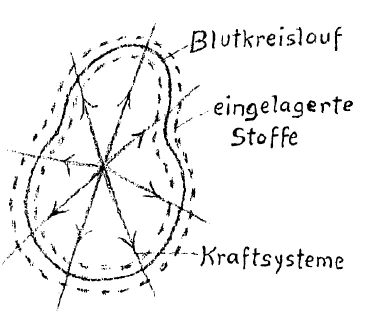
[ 8 ] Das bedeutet, daß der Blutkreislauf in seiner Gestaltung, in der ganzen Art seiner Regsamkeit, bedingt ist durch die Ich-Wesenheit des Menschen. Denken wir uns den Blutkreislauf in dieser ovalen Linie völlig schematisch angedeutet (siehe Zeichnung), so müssen wir sagen, es muß ja der Blutkreislauf von dem übrigen Organismus aufgenommen werden, das heißt, alle Organsysteme müssen so angeordnet sein, daß der Blutkreislauf sich eingliedern kann. Wir könnten das ganze Gewebe unserer Blutgefäße — sei es am Kopfe oder an einem anderen Teil unseres Organismus — nicht so haben, wie es ist, wenn nicht überall dahin, wo das Blut kreisen soll, die entsprechenden Dinge geleitet werden, die da sein müssen. Das heißt, die Kraftsysteme müssen im menschlichen Organismus, vom Ernährungssystem angefangen, so wirken, daß sie an die betreffenden Orte das notwendige Ernährungsmaterial hintragen und es zugleich so gestalten, so vorbilden, daß an diesen Orten das Blut genau die Form seines Verlaufs einhalten kann, deren es bedarf, um ein Ausdruck des Ich werden zu können. Es muß daher in alle Impulse unseres Ernährungsapparates, also des untersten Systems unseres Organismus, schon dasjenige hineingelegt sein, was den Menschen zu einem IchWesen macht. Die ganze Form, die der Mensch zuletzt in seiner physischen Vollendung zeigt, muß schon hineingegliedert sein in die Organsysteme bis in das hinein, was die verschiedenen Ernährungsprozesse des Menschen sind. Da sehen wir von dem Blute hinunter in die den Blutkreislauf vorbereitenden Organsysteme zu den Prozessen, die weitab von unserem Ich im Dunkel unseres Organismus sich abspielen. Während das Blut der Ausdruck unserer Ich-Tätigkeit ist, also Ausdruck des Bewußtesten ist, was wir haben, sind wir nicht fähig, hinunterzusehen in die unbekannten Tiefen des physischen Leibes. Wir wissen nicht, wie die Stoffe hingeleitet, hingetragen werden zu den einzelnen Orten unseres Organismus, wo sie verwendet werden müssen, um ihn aufzubauen und zu formen, damit er Werkzeug unseres Ich sein kann. Das zeigt uns, daß schon von Anfang an bei der Ernährung alle Gesetze im Organismus des Menschen liegen, die zuletzt zur Gestaltung des Blutkreislaufes führen.
[ 8 ] This means that the circulatory system, in its structure and in the very nature of its activity, is determined by the human ego. If we imagine the blood circulation schematically represented by this oval line (see drawing), we must conclude that the blood circulation must be integrated into the rest of the organism; that is to say, all organ systems must be arranged in such a way that the blood circulation can be incorporated. We could not have the entire network of our blood vessels—whether in the head or in any other part of our organism—as it is, unless the necessary elements are directed to every place where the blood is to circulate. This means that the energy systems in the human organism, beginning with the digestive system, must function in such a way that they carry the necessary nutrients to the relevant locations and at the same time shape and form them so that the blood can maintain precisely the course it needs in these places to become an expression of the I. Therefore, what makes a human being an “I” must already be embedded in all the impulses of our digestive system—that is, the lowest system of our organism. The entire form that the human being ultimately exhibits in their physical perfection must already be integrated into the organ systems, right down to the various digestive processes of the human being. There we look down from the blood into the organ systems that prepare the blood circulation, to the processes that take place far removed from our ego in the darkness of our organism. While the blood is the expression of our ego activity—that is, the expression of the most conscious aspect of what we possess—we are not able to look down into the unknown depths of the physical body. We do not know how the substances are directed and carried to the individual parts of our organism where they must be utilized to build and shape it so that it can be an instrument of our ego. This shows us that, from the very beginning of nutrition, all the laws that ultimately lead to the formation of the blood circulation are already present in the human organism.
[ 9 ] Das Blut als solches stellt sich uns nun dar als das beweglichste, als das regsamste aller unserer Systeme. Und wir wissen ja, wenn wir auch nur in geringem Maße irgendwie eingreifen in die Blutbahn, so nimmt das Blut sogleich andere Wege. Wir brauchen uns nur an irgendeiner Stelle zu stechen, so nimmt das Blut gleich einen anderen Weg als sonst. Das ist unendlich wichtig zu berücksichtigen, denn daraus können wir ersehen, daß das Blut das bestimmbarste Element im menschlichen Leibe ist. Es hat seine gute Unterlage an den anderen Örgansystemen, aber es ist zugleich das aller bestimmbarste, das die wenigste innere Stetigkeit hat. Das Blut kann ungeheuer bestimmt werden durch die Erlebnisse des bewußten Ich. Ich will dabei nicht eingehen auf die phantastischen Theorien, die von seiten der äußeren Wissenschaft über das Erröten oder Erbleichen bei Scham- oder Angstgefühlen aufgestellt werden, ich will nur hinweisen auf die rein äußere Tatsache, daß solchen Erlebnissen wie Furcht oder Angst und Schamgefühl Ich-Erlebnisse zugrunde liegen, die in ihrer Wirkung auf das Blut erkennbar sind. Beim Furcht- und Angstgefühl ist es so, daß wir uns gleichsam schützen wollen vor irgend etwas, von dem wir glauben, daß es gegen uns wirkt; wir zucken da gleichsam mit unserem Ich zurück. Beim Schamgefühl ist es so, daß wir uns am liebsten verstecken möchten, uns sozusagen hinter das Blut zurückziehen, unser Ich auslöschen möchten. Beide Male - ich will dabei nur auf die äußeren Tatsachen eingehen — folgt das Blut materiell, als äußeres materielles Werkzeug dem, was das Ich in sich erlebt. Beim Furchtund Angstgefühl, wo der Mensch sich so stark in sich zurückziehen möchte vor etwas, von dem er sich bedroht fühlt, da wird er bleich; das Blut zieht sich zurück von der Oberfläche zum Zentrum, nach innen. Wenn sich der Mensch beim Schamgefühl verstecken möchte, sich auslöschen möchte, wenn er am liebsten nicht wäre und irgendwo hineinschlüpfen möchte, da drängt sich das Blut unter dem Eindrucke dessen, was das Ich erlebt, bis zur Peripherie des Organismus, und der Mensch wird rot. So sehen wir, daß das Blut das am leichtesten bestimmbare System im menschlichen Organismus ist und den Erlebnissen des Ich am schnellsten folgen kann.
[ 9 ] Blood, as such, now appears to us as the most mobile, the most active of all our systems. And we know that if we interfere with the bloodstream even in the slightest way, the blood immediately takes a different path. We need only prick ourselves in any spot, and the blood immediately takes a different path than usual. It is infinitely important to bear this in mind, for from it we can see that blood is the most malleable element in the human body. It has a solid foundation in the other organ systems, but at the same time it is the most malleable of all, possessing the least internal constancy. Blood can be immensely influenced by the experiences of the conscious self. I do not wish to delve into the fanciful theories put forward by conventional science regarding blushing or paleness in response to feelings of shame or fear; I merely wish to point out the purely external fact that experiences such as fear, anxiety, and shame are rooted in ego experiences whose effects on the blood are discernible. With feelings of fear and anxiety, it is as though we want to protect ourselves from something we believe is working against us; we recoil, as it were, with our ego. With feelings of shame, it is as though we would prefer to hide, to withdraw, so to speak, behind the blood, to erase our ego. In both cases—I wish to address only the external facts here—the blood follows, materially, as an external material instrument, what the ego experiences within itself. In the case of fear and anxiety, where the person wishes so strongly to withdraw into themselves from something they feel threatened by, they turn pale; the blood withdraws from the surface toward the center, inward. When a person feels shame and wants to hide, to erase themselves, when they would rather not exist and want to slip away somewhere, the blood, under the impression of what the ego is experiencing, surges to the periphery of the organism, and the person turns red. Thus we see that the blood is the most easily identifiable system in the human organism and can follow the experiences of the ego most rapidly.
[ 10 ] Je weiter wir hinunterrücken in unseren Organsystemen, desto weniger folgen die Anordnungen der Systeme unserem Ich, desto weniger sind sie geneigt, sich den Erlebnissen des Ich anzupassen. Was das Nervensystem anbelangt, so wissen wir, daß es angeordnet ist in bestimmten Nervenbahnen und daß diese in ihrem Verlauf etwas verhältnismäßig Festes darstellen. Während das Blut regsam ist und je nach den inneren Erlebnissen des Ich von einem Körperteil zum anderen bis in die Peripherie geführt werden kann, ist es bei den Nerven so, daß den Nervenbahnen entlang diejenigen Kräfte verlaufen, welche wir als «Bewußtseinskräfte» zusammenfassen können, und daß diese nicht die Nervenmaterie von einem Orte zum anderen tragen können, wie das mit dem Blut in seinen Bahnen möglich ist. Das Nervensystem ist also schon weniger bestimmbar als das Blut; und noch weniger bestimmbar ist das Drüsensystem, das uns die Drüsen zeigt für ganz bestimmte Verrichtungen an ganz bestimmten Orten des Organismus. Wenn eine Drüse durch irgend etwas tätig gemacht werden soll zu einem bestimmten Zwecke, so kann sie nicht erregt werden durch einen Strang ähnlich dem Nervenstrang, sonmuß diese Drüse an dem Orte, wo sie eben ist, erregt werden. Es ist also das Drüsensystem noch weniger bestimmbar, wir müssen die Drüsen da erregen, wo sie sind. Während wir die Nerventätigkeit den Nervensträngen entlang leiten können — wir haben da noch Verbindungsfasern, welche die einzelnen Nervenknoten miteinander verbinden -, kann die Drüse nur an dem Ort zu einer Tätigkeit erregt werden, wo sie ist. Noch mehr aber ist dieser gleichsam Verfestigungsprozeß, dieser Prozeß des inneren Bestimmtseins, des NichtBestimmbarseins ausgesprochen in alle dem, was zum Ernährungssystem gehört, durch das der Mensch sich direkt die Stoffe eingliedert, um ein physisch-sinnliches Wesen zu sein. Dennoch muß in der Eigenart dieser Stoffeingliederung eine völlige Vorbereitung für das Werkzeug des Ich gegeben sein.
[ 10 ] The further down we go into our organ systems, the less the structures of those systems follow our ego, and the less inclined they are to adapt to the ego’s experiences. As for the nervous system, we know that it is organized into specific nerve pathways and that these pathways are relatively fixed in their course. While the blood is active and can be directed from one part of the body to another, all the way to the periphery, depending on the inner experiences of the ego, the situation with the nerves is such that the forces we can summarize as “forces of consciousness” run along the nerve pathways, and that these cannot carry nerve matter from one place to another, as is possible with the blood in its pathways. The nervous system is thus already less controllable than the blood; and even less controllable is the glandular system, which shows us that glands perform very specific functions at very specific locations within the organism. If a gland is to be activated by something for a specific purpose, it cannot be stimulated by a nerve-like strand; rather, this gland must be stimulated at the very location where it is situated. The glandular system is thus even less determinable; we must stimulate the glands where they are. While we can conduct nervous activity along the nerve tracts—we still have connecting fibers there that link the individual nerve nodes together—the gland can only be stimulated into activity at the location where it is situated. But even more pronounced is this process of consolidation, so to speak—this process of inner determination, of indeterminability—in everything that belongs to the nutritional system, through which the human being directly incorporates substances in order to be a physical-sensual being. Nevertheless, the nature of this incorporation of substances must provide a complete preparation for the instrument of the ego.
[ 11 ] Betrachten wir nun einmal den menschlichen Organismus in bezug auf sein unterstes System, das Ernährungssystem im umfassendsten Sinne, durch das die Stoffe nach allen Gliedern des Organismus transportiert werden, so muß die Anordnung dieser Stoffe so geschehen, daß die Formung, der äußere Aufbau des Menschen so vor sich gehen kann, daß zuletzt der Ausdruck des Ich im menschlichen Organismus möglich ist. Dazu ist vieles notwendig. Nicht nur, daß die Ernährungsstoffe in der verschiedensten Weise transportiert und an die verschiedensten Orte des Organismus gelagert werden, sondern auch, daß alle möglichen Vorkehrungen getroffen werden, um die äußere Form des menschlichen Organismus zu bedingen.
[ 11 ] If we now consider the human organism in terms of its most fundamental system—the nutritional system in the broadest sense, through which substances are transported to all parts of the organism—the arrangement of these substances must be such that the formation and external structure of the human being can proceed in a way that ultimately makes the expression of the “I” in the human organism possible. Much is required for this. Not only must the nutrients be transported in a variety of ways and stored in various parts of the organism, but all possible measures must also be taken to determine the external form of the human organism.
[ 12 ] Nun ist es wichtig, daß wir uns folgendes klarmachen. In dem, was wir die Haut genannt haben, sind zwar alle Systeme des menschlichen Organismus vertreten, bis zum untersten System, dem Ernährungssystem, und wir konnten sagen: In die Haut wird alles ergossen, was im eminentesten Sinne zum physischen System des Menschen gehört. Aber Sie können sich leicht denken, daß diese Haut — trotzdem sie alle diese Systeme in sich hat — für sich einen großen Fehler hat, so paradox das auch klingt. Sie hat zwar so wie sie am Menschen ist, die Form des menschlichen Organismus, diese Form würde sie aber durch sich selber nicht haben; durch sich selber würde sie nicht in der Lage sein, dem Menschen seine charakteristische Formbegrenzung zu geben. Ohne Unterstützung würde die Haut in sich selber zusammensinken; da würde der Mensch sich nicht aufrecht halten können. Daraus sehen wir, daß nicht bloß diejenigen Ernährungsprozesse stattfinden müssen, welche die Haut erhalten, sondern es müssen auch die mannigfaltigsten anderen Prozesse stattfinden und zusammenwirken, welche die Gesamtform des Menschenorganismus bilden. Da wird es uns nicht schwer sein zu begreifen, daß wir auch als solche umgewandelten Ernährungsprozesse diejenigen Prozesse anzusehen haben, die vor sich gehen in den Knorpeln und in den Knochen. Was sind das für Prozesse?
[ 12 ] Now it is important that we realize the following. In what we have called the skin, all the systems of the human organism are indeed represented, down to the lowest system, the digestive system, and we could say: Everything that belongs to the human physical system in the most fundamental sense is poured into the skin. But you can easily imagine that this skin—even though it contains all these systems—has a major flaw of its own, as paradoxical as that may sound. Although it takes the form of the human organism as it exists in the human being, it would not possess this form of its own accord; on its own, it would not be able to give the human being its characteristic form and boundaries. Without support, the skin would collapse in on itself; the human being would not be able to hold himself upright. From this we see that not only must those nutritional processes take place that sustain the skin, but the most manifold other processes must also take place and interact to form the overall shape of the human organism. It will not be difficult for us to understand that we must also regard as such transformed nutritional processes those processes that take place in the cartilage and in the bones. What are these processes?
[ 13 ] Wenn das Material unserer Nahrungsstoffe bis zu einem Knorpel oder Knochen geleitet wird, so ist im Grunde genommen auch nur physisches Material dahin transportiert. Was wir zuletzt im Knorpel oder Knochen finden, ist ja nichts anderes als die umgewandelten Nahrungsstoffe; aber sie sind in anderer Art umgewandelt als zum Beispiel in der Haut. Daher können wir sagen: Wir haben in der Haut zwar die umgewandelten Nahrungsstoffe zu sehen, die sich in der äußersten Formumgrenzung unseres Leibes ablagern. In der Art aber, wie im Knochen das Ernährungsmaterial abgelagert wird, haben wir einen solchen Ernährungsprozeß zu sehen, wo das Material sich rundet zur menschlichen Form. Es ist also ein umgekehrter Ernährungsprozeß wie derjenige in der menschlichen Haut. Nun wird es uns gar nicht mehr schwierig sein, gleichsam nach dem Muster der Betrachtungen, die wir für das Nervensystem angestellt haben, uns auch diesen gesamten Ernährungsprozeß, das Transportierungssystem der Nahrungsmittel zu denken.
[ 13 ] When the material from our food is transported to cartilage or bone, essentially only physical material is being transported there. What we ultimately find in cartilage or bone is, after all, nothing other than the transformed nutrients; but they are transformed in a different way than, for example, in the skin. Therefore, we can say: In the skin, we do indeed see the transformed nutrients deposited within the outermost boundary of our body. However, in the way the nutritional material is deposited in the bone, we see a nutritional process in which the material takes on the human form. It is thus a nutritional process that is the reverse of that in human skin. Now it will no longer be difficult for us to conceive of this entire nutritional process—the transport system of nutrients—following, as it were, the pattern of the observations we made regarding the nervous system.
[ 14 ] Wenn wir die Haut anschauen und auf die Ernährungsstoffe sehen, welche sie zustande bringen, diesen äußeren Abschluß, der dem Menschen die Oberfläche gibt, aber niemals selber die menschliche Form hervorbringen könnte, so wird es uns klar sein, daß die Hauternährung die jüngste Art der Ernährung ist im Menschenorganismus; und wir erkennen, daß wir in der Art, wie die Knochen ernährt werden, einen analogen Prozeß zu sehen haben, der in einem ähnlichen Verhältnis zur Hauternährung steht, wie wir den Prozeß der Gehirnbildung in ein Verhältnis setzen konnten zum Prozeß der Rückenmarksbildung. Wir werden dasselbe Recht haben zu sagen: Dasjenige, was wir zunächst äußerlich im Hauternährungsprozeß auftreten sehen, können wir auf einer späteren, das heißt hier höheren Stufe umgewandelt sehen in der festen Form der Knochenbildung. - Es weist uns eine solche Betrachtung des menschlichen Organismus darauf hin, daß unser Knochensystem früher als weiche Substanz bestanden hat und sich erst im Laufe der Entwickelung verfestigt hat. Das kann auch durch die äußere Wissenschaft nachgewiesen werden, die uns lehren kann, wie gewisse Gebilde, die später deutlich Knochen sind, im kindlichen Alter noch weich, knorpelhaft auftreten und daß erst nach und nach aus einer weicheren, knorpelmäßigen Masse durch Einlagerung von Ernährungsmaterial sich die Knochenmasse bildet. Da haben wir ein Hinüberführen von einer weichen in eine festere Substanz, wie es auch beim einzelnen Menschen sich vollzieht. Wir haben also im Knorpel eine Vorstufe des Knochens zu sehen und können sagen, daß uns die ganze Einlagerung des Knochensystems in den Organismus als etwas erscheint, was sozusagen ein letztes Resultat derjenigen Prozesse darstellt, die uns in der Hauternährung vor Augen treten. Es werden also zuerst in einfachster Weise die Ernährungsstoffe umgewandelt zu einer weichen, biegsamen Substanz, und dann, wenn dies vorbereitet ist, kann der Ernährungsprozeß sich abspielen, durch den gewisse Teile sich erst verhärten zu Knochenmaterie, damit zuletzt die Form des menschlichen Gesamtorganismus zum Vorschein kommt. Die Art, wie uns die Knochen entgegentreten, gibt uns Anlaß zu sagen: Über die Knochenbildung hinaus haben wir eigentlich dann kein weiteres Fortschreiten der Ernährungsprozesse zur Verfestigung, soweit der Mensch der gegenwärtigen Entwickelungsstufe in Betracht kommt. Während wir auf der einen Seite im Blut die bestimmbarste, wandlungsfähigste Substanz im Menschen haben, können wir andererseits in der Knochensubstanz dasjenige erblicken, was völlig unbestimmbar ist, was bis zu einem letzten Punkte sich verhärtet, verfestigt hat, über den hinaus es keine weitere Umwandlung mehr gibt; sie hat es bis zur starrsten Form gebracht. Wenn wir nun die früheren Betrachtungen fortsetzen, dann müssen wir sagen: Das Blut ist das bestimmbarste Werkzeug des Ich im Menschen, die Nerven sind es schon weniger, die Drüsen noch weniger, und im Knochensystem haben wir das, was am letzten Punkte seiner Evolution angelangt ist, was ein letztes Umwandlungsprodukt darstellt in bezug auf die Bestimmbarkeit durch das Ich. Deshalb geschieht alles, was zur Formung des Knochensystems gehört, in der Weise, daß zuletzt die Knochen Träger und Stütze eines weicheren Organismus sein können, in welchem Lebens- und Ernährungsvorgänge so ablaufen, daß das Blut in seinen Bahnen in der rechten Weise verlaufen kann, damit das menschliche Ich in ihm ein Werkzeug haben kann.
[ 14 ] When we look at the skin and consider the nutrients that give rise to it—this outer covering that provides the human body with its surface but could never itself produce the human form—it becomes clear to us that skin nutrition is the most recent form of nutrition in the human organism; and we recognize that in the way the bones are nourished, we see an analogous process that stands in a similar relationship to skin nutrition as we could place the process of brain formation in relation to the process of spinal cord formation. We will be equally justified in saying: What we initially observe externally in the process of skin nutrition, we can see transformed at a later, that is, higher stage into the solid form of bone formation. — Such an observation of the human organism indicates to us that our skeletal system once existed as a soft substance and only solidified in the course of development. This can also be demonstrated by external science, which can teach us how certain structures that later clearly become bones appear soft and cartilaginous in childhood, and that only gradually does bone mass form from a softer, cartilaginous mass through the deposition of nutritive material. Here we have a transition from a soft to a firmer substance, just as it occurs in the individual human being. We must therefore regard cartilage as a precursor to bone and can say that the entire incorporation of the skeletal system into the organism appears to us as something that represents, so to speak, the final result of those processes that we observe in skin nutrition. Thus, the nutritive substances are first transformed in the simplest way into a soft, pliable substance, and then, once this is prepared, the nutritive process can take place through which certain parts first harden into bone matter, so that ultimately the form of the entire human organism comes into being. The way in which bones present themselves to us gives us reason to say: Beyond bone formation, we actually have no further progression of the nutritional processes toward solidification, as far as the human being at the present stage of development is concerned. While on the one hand we have in the blood the most malleable, most changeable substance in the human being, on the other hand we can see in the bone substance that which is completely unchangeable, which has hardened and solidified to a final point beyond which there is no further transformation; it has brought it to the most rigid form. If we now continue our earlier considerations, we must say: Blood is the most malleable instrument of the ego in the human being; the nerves are less so, the glands even less so, and in the skeletal system we have that which has reached the final point of its evolution, which represents a final product of transformation in terms of its malleability by the ego. Therefore, everything involved in the formation of the skeletal system occurs in such a way that, ultimately, the bones can serve as the bearers and supports of a softer organism in which life and nutritional processes proceed in such a way that the blood can flow through its channels in the proper manner, so that the human ego may have an instrument within it.
[ 15 ] Ich möchte wissen, wer nicht mit höchster Bewunderung und Ehrfurcht erfüllt würde, wenn er hiineinblickt in den menschlichen Organismus und sich vorzustellen versucht: Im Knochensystem habe ich dasjenige vor mir, was die meisten Verwandlungen, die meisten Stufen durchgemacht haben muß, was von den untersten Stufen aufgestiegen ist durch viele, viele Epochen hindurch bis zum heutigen Knochensystem; es ist zuletzt so gestaltet worden, daß es der feste Träger, die feste Stütze des Ich sein kann. Wenn man gewahr wird, wie bis in die Bildungen der einzelnen Knochen hinein die Tendenz des Ich wirkt, wer könnte da nicht mit tiefster Bewunderung erfüllt werden gegenüber diesem Bau des menschlichen Organismus.
[ 15 ] I would like to know who would not be filled with the utmost admiration and awe upon looking into the human organism and trying to imagine: In the skeletal system, I have before me that which must have undergone the most transformations, the most stages, that which has risen from the lowest levels through many, many epochs to the present-day skeletal system; it has ultimately been shaped so that it can be the firm bearer, the firm support of the I. When one becomes aware of how the tendency of the ego works right down into the formation of the individual bones, who could fail to be filled with the deepest admiration for this structure of the human organism?
[ 16 ] Sehen wir diesen Menschen an, so haben wir zwei Pole des physischen Daseins gegeben, einmal im Blutsystem, das das bestimmbarste Werkzeug des Ich ist, und dann im Knochensystem, das in äußerer Form und innerer Struktur am meisten fest ist, am unbestimmbarsten, am wenigsten wandlungsfähig, das in der Unbestimmbarkeit am weitesten vorgeschritten ist. Wir dürfen daher sagen: Im Knochensystem hat die physische Organisation des Menschen vorläufig ihren letzten Ausdruck, ihren Abschluß gefunden, während sie in dem Blutsystem in einem gewissen Sinne einen neuen Anfang genommen hat. Schauen wir auf unser Knochensystem hin, so können wir sagen: Wir verehren in diesem Knochensystem einen letzten Abschluß der menschlichen physischen Organisation. — Und schauen wir auf unser Blutsystem, so können wir sagen: Wir sehen in ihm einen Anfang, etwas, das erst anfangen konnte, nachdem alle anderen Systeme vorangegangen sind. -— Vom Knochensystem können wir sagen: Eine gewisse erste Anlage, die ersten Kräfte zur Bildung des Knochensystems mußten schon vorhanden gewesen sein, bevor Drüsen- und Nervensystem im Organismus zur Entwickelung kamen, denn diese mußten durch das Knochensystem ihre entsprechenden Orte angewiesen erhalten. Das älteste der Kraftsysteme des menschlichen Organismus haben wir im Knochensystem in uns.
[ 16 ] When we look at this human being, we see two poles of physical existence: on the one hand, the blood system, which is the most malleable instrument of the ego; and on the other, the skeletal system, which is the most rigid in external form and internal structure, the least malleable, the least capable of change, and the most advanced in terms of its immutability. We may therefore say: In the skeletal system, the physical organization of the human being has, for the time being, found its final expression, its conclusion, while in the circulatory system it has, in a certain sense, taken a new beginning. If we look at our skeletal system, we can say: We see in this skeletal system a final conclusion of the human physical organization. — And if we look at our circulatory system, we can say: We see in it a beginning, something that could only begin after all other systems had preceded it. -— Regarding the skeletal system, we can say: A certain initial predisposition, the first forces for the formation of the skeletal system, must already have been present before the glandular and nervous systems developed in the organism, for these had to be assigned their respective locations by the skeletal system. The oldest of the force systems of the human organism is found within us in the skeletal system.
[ 17 ] Wenn wir nun das Blutsystem und das Knochensystem als zwei Pole bezeichnet haben, so wollten wir damit bildlich ausdrücken, daß in ihnen gleichsam die beiden äußersten Enden der menschlichen Organisation zu sehen sind. Im Blutsystem haben wir das beweglichste Element vor uns, das so regsam ist, daß es jeder Regung unseres Ich folgt. Und im Knochensystem haben wir dasjenige, was fast ganz dem Einfluß unseres Ich entzogen ist, wo wir nicht mehr hinunterreichen mit unserem Ich; dennoch aber liegt in seiner Form schon die ganze Organisation des Ich darinnen. Es stehen damit schon rein äußerlich betrachtet Blutsystem und Knochensystem im Menschen wie ein Anfang und ein Abschluß einander gegenüber. Und wenn wir so unser Blutsystem anschauen, das fortwährend allen Regungen des Ich folgt, so sagen wir uns: Im regsamen Blut drückt sich uns so recht das menschliche Leben aus. - Wenn wir auf unser Knochensystem schauen, sagen wir uns: Es symbolisiert alles das, was sich unserem Leben entzieht und dem Organismus nur als Stütze dient. — Unser pulsierendes Blut ist unser Leben; unser Knochensystem ist dasjenige, was sich dem unmittelbaren Leben schon entzogen hat - weil es ein so alter Herr ist -, was sich schon ausgeschaltet hat und nur noch als Stütze dienen will, nur noch Form geben will. Während wir in unserem Blute am meisten organisch leben, sind wir im Grunde genommen in unserem Knochensystem schon gestorben. Und ich bitte Sie, diesen Ausspruch wie ein Leitmotiv für die folgenden Vorträge zu betrachten, denn es werden sich wichtige physiologische Dinge daraus ergeben. Während wir in unserem Blute leben, sind wir in unserem Knochensystem eigentlich schon gestorben. Unser Knochensystem ist wie ein Gerüst, es ist das am wenigsten Lebendige, es ist nur das uns stützende Gerüst in uns.
[ 17 ] When we have referred to the circulatory system and the skeletal system as two poles, we have sought to express figuratively that they represent, as it were, the two extreme ends of the human organism. In the circulatory system we have before us the most mobile element, one so active that it follows every impulse of our ego. And in the skeletal system we have that which is almost entirely beyond the influence of our ego, where our ego no longer reaches; yet the entire organization of the ego is already present in its form. Thus, viewed purely from the outside, the circulatory system and the skeletal system stand opposite one another in the human being as a beginning and an end. And when we look at our blood system in this way, which constantly follows all the movements of the ego, we say to ourselves: Human life is truly expressed to us in the active blood. — When we look at our skeletal system, we say to ourselves: It symbolizes everything that is withdrawn from our life and serves the organism only as a support. — Our pulsating blood is our life; our skeletal system is that which has already withdrawn from immediate life—because it is such an old gentleman—which has already stepped aside and now wishes only to serve as a support, to give form. While we live most organically in our blood, we have, in a sense, already died in our skeletal system. And I ask you to regard this statement as a leitmotif for the following lectures, for important physiological insights will emerge from it. While we live in our blood, we have actually already died in our skeletal system. Our skeletal system is like a scaffold; it is the least alive part of us; it is merely the supporting framework within us.
[ 18 ] Wir haben schon am Anfang dieser Vortragsreihe im Menschen eine Zweiheit gesehen; jetzt tritt uns diese Zweiheit noch einmal in einer anderen Weise entgegen. Auf der einen Seite das Regsamste, Lebendigste im Blut, auf der anderen Seite etwas wie ein sich der organischen Regsamkeit am meisten Entziehendes, den Tod eigentlich schon in sich Tragendes im Knochensystem. Unser Knochensystem hat einen gewissen Abschluß schon erhalten - in seiner Ausformung wenigstens, wenn es auch nachher noch wächst - bis zu der Lebenszeit des Menschen, wo die Ich-Erlebnisse beginnen regsam zu werden. Bis zum Zahnwechsel im siebten Lebensjahr hat das Knochensystem sich im wesentlichen seine Form gegeben. Gerade in der Zeit also findet die Hauptentwickelung unseres Knochensystems statt, wo wir selber noch der Regsamkeit unseres Ich in hohem Maße entzogen sind. In dieser Zeit, wo das Knochensystem sich aufbaut aus den dunklen Untergründen und Kräften unseres Organismus heraus, können auch die meisten Fehler in der Ernährung gemacht werden. Gerade in diesen ersten sieben Lebensjahren können in der Ernährung des Kindes besonders folgenschwere Fehler gemacht werden, die sich auf das Knochensystem übel auswirken, zum Beispiel in rachitischen Erkrankungen, die namentlich davon herrühren, daß die Ernährungsprozesse in diesen Jahren nicht in der richtigen Weise geleitet werden, zum Beispiel wenn man der Naschhaftigkeit der Kinder nachgibt und ihnen alles mögliche gibt, wonach sie Verlangen tragen. So sehen wir das, was dem Ich entzogen ist, in unser Knochensystem hineinwirken.
[ 18 ] We already observed a duality within the human being at the beginning of this lecture series; now this duality presents itself to us once again in a different way. On the one hand, the most active, most vital aspect is found in the blood; on the other hand, there is something in the skeletal system that seems to withdraw most from this organic activity, something that actually already carries death within itself. Our skeletal system has already reached a certain point of completion—at least in its formation, even if it continues to grow afterward—by the time in a person’s life when ego experiences begin to become active. By the time of the change of teeth at the age of seven, the skeletal system has essentially taken its form. It is precisely during this period, therefore, that the main development of our skeletal system takes place, when we ourselves are still largely removed from the activity of our ego. During this time, when the skeletal system is building itself up from the dark depths and forces of our organism, the most serious mistakes in nutrition can also be made. It is precisely during these first seven years of life that particularly serious errors can be made in a child’s diet, which have a detrimental effect on the skeletal system—for example, in cases of rickets, which stem specifically from the fact that nutritional processes during these years are not properly guided, such as when one indulges children’s sweet tooth and gives them everything they crave. Thus we see that what is withheld from the ego works its way into our skeletal system.
[ 19 ] Ganz anders ist es beim Blutsystem, welches regsam folgt unserem einzelmenschlichen Leben und mehr als alles andere abhängig ist von den Prozessen unseres inneren Erlebens. Es ist nur eine Art von Kurzsichtigkeit seitens der äußeren Wissenschaft, zu glauben, daß von den inneren Erlebnissen das Nervensystem mehr abhängig wäre als das Blutsystem. Ich will nur darauf hinweisen, daß wir die ein fachste Art der Beeinflussung des Blutsystems durch die Ich-Erlebnisse in der Scham und in der Furcht haben, wo eine Umlagerung des Blutes stattfindet, die deutlich ausdrückt die Ich-Erlebnisse in dem Werkzeuge des Ich, dem Blut. Sie können sich also denken, wenn sich schon vorübergehende Prozesse so ausdrücken, wie sich dann dauernde oder gewohnheitsmäßige Erlebnisse des Ich ausdrücken müssen in dem erregsamen Elemente des Blutes. Es gibt keine Leidenschaft, keinen Trieb oder Affekt, ob wir sie gewohnheitsmäßig haben oder ob sie explosionsartig zum Ausdruck kommen, die nicht als innere Erlebnisse übertragen werden auf das Blut als Instrument des Ich. Alle ungesunden Elemente des Ich-Erlebens kommen im Blutsystem zum Ausdruck.
[ 19 ] The situation is quite different with the circulatory system, which closely follows the course of our individual lives and is, more than anything else, dependent on the processes of our inner experiences. It is merely a form of short-sightedness on the part of external science to believe that the nervous system is more dependent on inner experiences than the circulatory system. I merely wish to point out that the simplest form of influence exerted by ego experiences on the circulatory system is found in shame and fear, where a redistribution of blood takes place that clearly expresses the ego experiences through the instrument of the ego, the blood. You can therefore imagine that if even transient processes express themselves in this way, how much more must lasting or habitual ego experiences express themselves in the excitable element of the blood. There is no passion, no impulse, or no emotion—whether we experience them habitually or whether they erupt explosively—that is not transmitted as an inner experience to the blood as the instrument of the ego. All unhealthy elements of ego experience find expression in the blood system.
[ 20 ] Und überall, wo wir irgend etwas verstehen wollen, was im Blutsystem vorgeht, da ist es wichtig, nicht bloß zu fragen nach dem Ernährungsprozeß, sondern vielmehr nach den seelischen Prozessen zu suchen, insofern sie Ich-Erlebnisse sind, wie Stimmungen, dauernde Leidenschaften, Affekte und so weiter. Nur eine matenialistische Gesinnung wird bei Störungen im Blutsystem das Hauptaugenmerk auf die Ernährung lenken; denn die Bluternährung baut sich auf auf die Ernährung des physischen $ystems, des Drüsensystems, des Nervensystems und so weiter, und im Grunde genommen sind die Nahrungsstoffe schon sehr filtriert, wenn sie an das Blut herankommen. Wenn daher das Blut von dieser Seite her beeinträchtigt werden soll, muß schon eine ganz wesentliche Erkrankung des Organismus aufgetreten sein; dagegen wirken alle seelischen, alle Ich-Prozesse in unmittelbarer Weise auf das Blut zurück.
[ 20 ] And wherever we wish to understand anything that is happening in the blood system, it is important not merely to inquire into the nutritional process, but rather to look for the psychological processes insofar as they are experiences of the “I,” such as moods, enduring passions, emotions, and so on. Only a materialistic mindset will focus primarily on nutrition when there are disturbances in the blood system; for the blood’s nourishment is based on the nourishment of the physical system, the glandular system, the nervous system, and so on, and, in essence, the nutrients are already highly filtered by the time they reach the blood. Therefore, if the blood is to be affected from this side, a very significant disease of the organism must already have occurred; in contrast, all mental processes, all ego processes, have a direct effect on the blood.
[ 21 ] So entzieht sich unser Knochensystem am meisten den Vorgängen unseres Ich, und so fügt sich unser Blutsystem am allermeisten den Vorgängen unseres Ich. Ja, dieses Knochensystem ist am allerwenigsten veranlagt, dem Ich zu folgen, man möchte sagen, es ist ganz unabhängig vom Ich, aber doch ist es für das Ich organisiert.
[ 21 ] Thus, our skeletal system is the least subject to the processes of our ego, and our circulatory system is the most subject to them. Indeed, the skeletal system is the least inclined to follow the ego; one might say it is entirely independent of the ego, yet it is organized for the ego.
[ 22 ] Nur ein kleiner Teil des Knochensystems macht von der Unbestimmbarkeit durch das Ich eine Ausnahme und zeigt eine individuelle Prägung, nämlich die Schädelknochen, besonders der obere Teil des Schädels. Diese Tatsache hat zu verschiedenem Unfug Veranlassung gegeben.
[ 22 ] Only a small part of the skeletal system is an exception to the principle that it cannot be identified by the ego and exhibits individual characteristics, namely the bones of the skull, particularly the upper part of the skull. This fact has given rise to various forms of nonsense.
[ 23 ] Sie wissen, daß es eine Phrenologie, eine Schädelknochenuntersuchung, gibt. Diese hat nach und nach, trotzdem sie von materialistischer Seite als Aberglaube angesehen wird, nach den allgemeinen Gepflogenheiten unserer Zeit eine materialistische Nuance angenommen. Wenn wir grob charakterisieren wollen, können wir sagen: Im allgemeinen wird Phrenologie so beschrieben, daß in den Formen unserer Schädelbildung der Ausdruck gesucht wird für die innere Beschaffenheit unseres Ich, indem gleichsam allgemeine Gesichtspunkte aufgestellt werden und erklärt wird, der eine Höcker bedeute dies, der andere das und so weiter. Da will man die menschlichen Eigenschaften auffinden an den verschiedenen Höckern, die sich an unserem Schädel zeigen. In dem Knochensystem des Schädels wird also von der Phrenologie gesucht eine Art plastischer Ausdruck für unser Ich. Nun ist das aber, wenn es so getrieben wird, auch wenn scheinbar geistige Ausdrücke im Bau der einzelnen Knochen gesucht werden, doch ein Unfug. Denn wer wirklich ein feiner Beobachter ist, der weiß, daß kein einziger menschlicher Schädel dem anderen gleicht und daß man niemals Erhöhungen oder Vertiefungen angeben könnte, die für diese oder jene Eigenschaft allgemein typisch sind, sondern daß ein jeder Schädel sich unterscheidet von dem anderen, so daß wir bei jedem Menschenschädel andere Formen vor uns haben.
[ 23 ] You know that there is such a thing as phrenology, the study of the skull. Although it is regarded as superstition by materialists, it has gradually taken on a materialistic tone in accordance with the general customs of our time. If we wish to characterize it roughly, we can say: In general, phrenology is described as seeking, in the forms of our skull structure, an expression of the inner nature of our ego, by establishing, as it were, general principles and explaining that one bump signifies this, another that, and so on. The aim is to identify human characteristics in the various bumps that appear on our skull. Phrenology thus seeks a kind of plastic expression of our ego in the bony structure of the skull. But when pursued in this way—even if one appears to be seeking spiritual expressions in the structure of the individual bones—it is, in fact, nonsense. For anyone who is truly a keen observer knows that no two human skulls are alike and that one could never point to elevations or depressions that are generally typical of this or that trait, but rather that every skull differs from the next, so that we are faced with different forms in every human skull.
[ 24 ] Nun haben wir gesagt, daß sich unserem Ich, dem das Blut in seiner Regsamkeit am meisten folgt, der Knochenbau entzieht, ihm am wenigsten folgt. Es ist merkwürdig, daß uns dennoch die Bildung des Schädels und der Gesichtsknochen dem Ich entsprechend gestaltet erscheinen, während der Knochenbau mehr allgemein typisch erscheint. Wer den Schädelbau betrachtet, der weiß: So wahr der Mensch selber individuell ist, so wahr ist auch sein Schädelbau individuell.
[ 24 ] We have said that the skeletal structure eludes our sense of self—which the blood follows most closely in its activity—and follows it the least. It is curious that the formation of the skull and facial bones nevertheless appears to us to be shaped in accordance with the sense of self, while the skeletal structure appears more generally typical. Anyone who observes the structure of the skull knows: just as the human being is an individual, so too is the structure of his or her skull an individual one.
[ 25 ] Wie kommt es, daß diese wunderbare Konfiguration des Schädels von Anfang an der einzelnen menschlichen Individualität entsprechend angelegt ist, wenn doch das Ich keinen Einfluß auf den Knochenbau hat? Woher kommt es, daß der Schädel, der sich so entwikkeln muß, wie die anderen Knochen auch, anders ist bei jedem Menschen? Woher kommt das? Das kommt einfach aus demselben Grunde, aus dem die individuellen Eigenschaften des Menschen sich überhaupt entwickeln, nämlich daher, daß das individuelle menschliche Gesamtleben nicht nur verläuft von der Geburt bis zum Tode, sondern verläuft in vielen Inkarnationen. Während unser Ich also in der gegenwärtigen Inkarnation keinen Einfluß hat auf den Schädelbau, hat es durch die Erlebnisse seiner vorangegangenen Inkarnation die Kräfte entwickelt, die in der Zeit zwischen dem Tode und der nächsten Geburt die Konfiguration des Schädelbaues, die Schädelform, in dieser Inkarnation bestimmen. Wie das Ich in der vorherigen Inkarnation war, das bestimmt die Schädelform in der jetzigen Inkarnation, so daß wir in dem Bau unseres Schädels einen äußeren plastischen Ausdruck haben für die Art und Weise, wie wir, jeder einzelne, als Individualität, in der vorhergehenden Inkarnation gelebt und gewirkt haben. Während alle anderen Knochen bei uns etwas Allgemein-Menschliches ausdrücken, drückt der Schädel in seiner äußeren Form das aus, was wir waren und was wir getan haben in der vorigen Inkarnation.
[ 25 ] How is it that this marvelous configuration of the skull is shaped from the very beginning to correspond to the individual human personality, even though the ego has no influence on bone structure? How is it that the skull, which must develop just like the other bones, is different in every human being? Where does this come from? It comes simply from the same reason that the individual characteristics of human beings develop in the first place, namely, that the individual human life as a whole does not merely extend from birth to death, but unfolds over many incarnations. So while our ego has no influence on the structure of the skull in the present incarnation, through the experiences of its previous incarnation it has developed the forces that, in the time between death and the next birth, determine the configuration of the skull structure—the shape of the skull—in this incarnation. The nature of the ego in the previous incarnation determines the shape of the skull in the present incarnation, so that in the structure of our skull we have an outward, plastic expression of the way in which we, each and every one of us as an individual, lived and acted in the previous incarnation. While all our other bones express something generally human, the skull, in its external form, expresses what we were and what we did in the previous incarnation.
[ 26 ] Das äußerst regsame Element des Blutes kann also bestimmt werden vom Ich in dieser Inkarnation. Unsere Knochen aber haben sich in dieser Inkarnation dem Einfluß des Ich schon ganz entzogen, bis auf den letzten Rest, den Schädelknochen, der aber dem Ich auch nicht mehr in dieser Inkarnation folgen kann. Der Schädelknochen, der aus der Weiche der Keimessubstanz heraus sich entwickelt hat, wo das Ich noch gestaltend einwirken konnte, gibt einen Ausdruck dafür, wie wir in der vorherigen Inkarnation waren. Eine allgemeine Phrenologie gibt es nicht. Wenn wir Phrenologie überhaupt in Betracht ziehen wollen, so darf sie keine schematisierende Wissenschaft sein, sondern sie sollte auf eine künstlerische Art und Weise die plastischen Eigentümlichkeiten des Schädelbaues betrachten. Wir müssen unseren Schädelbau beurteilen wie ein Kunstwerk. Wir müssen allerdings in dem Schädelbau etwas Individuelles sehen, aber etwas Individuelles, das ein Ausdruck der Geschichte des Ich ist in einer vorhergehenden Inkarnation. So sehen wir, daß selbst diese Form des Knochenbaus, wie sie uns im Schädelbau entgegenrritt, dem Ich soweit entzogen ist, daß es in der gegenwärtigen Inkarnation darauf keinen Einfluß mehr hat. Aber es hat noch Einfluß darauf beim Durchgang zwischen Tod und neuer Geburt, wo es in gewissem Sinne die Kräfte wieder aufnimmt, die sich ihm im vergangenen Leben schon entzogen hatten und welche unter seinem Einfluß für das nächste Leben das Knochensystem und besonders den Schädel aufbauen.
[ 26 ] The extremely active element of blood can thus be controlled by the ego in this incarnation. Our bones, however, have already completely withdrawn from the influence of the I in this incarnation, down to the very last remnant, the skull bone, which, however, can no longer follow the I in this incarnation either. The skull bone, which developed from the soft tissue of the embryonic substance where the I could still exert a formative influence, expresses how we were in the previous incarnation. There is no such thing as general phrenology. If we are to consider phrenology at all, it must not be a schematizing science, but should instead consider the plastic characteristics of the skull structure in an artistic manner. We must assess our skull structure as a work of art. We must, however, see something individual in the skull structure, but something individual that is an expression of the history of the ego in a previous incarnation. Thus we see that even this form of bone structure, as it presents itself to us in the skull, is so far removed from the ego that it no longer has any influence on it in the present incarnation. But it still exerts an influence on it during the transition between death and new birth, where, in a certain sense, it reassumes the forces that had already withdrawn from it in the past life and which, under its influence, build up the skeletal system and especially the skull for the next life.
[ 27 ] Wenn daher von der Wiederverkörperungsidee gesprochen und gesagt wird, das sei eine Sache, die sich im allgemeinen der Beurteilung durch unsere Vernunft entziehe, da müsse man eben das glauben, was der Geistesforscher sagt -, so ist das nicht richtig. Man kann darauf erwidern: Ihr könnt euch handgreiflich davon überzeugen, daß das menschliche Ich in einer vorhergehenden Inkarnation dagewesen sein muß; im menschlichen Schädel hat man handgreiflich den Beweis vor sich, wie der Mensch in der vorhergehenden Inkarnation war. Wer das nicht zugibt, wer darin etwas Paradoxes sieht, daß man aus der Art, wie etwas äußerlich geformt ist, schließen muß auf etwas früher Lebendiges, das aus seinem früheren Leben heraus das Äußere geformt hat, der hat auch kein Recht, sonstwie auf ein früher Lebendiges zu schließen, wenn ihm irgendwo eine plastische Gestalt entgegentritt. Wer nicht den Schluß zugibt als einen streng logischen, daß in der individuellen Schädelform, die wir haben, sich die Konfiguration des Ich aus früheren Inkarnationen ausdrückt, der hat auch kein Recht, wenn er zum Beispiel irgendwo auf der Erde eine leere Muschel findet, aus der äußeren Form dieser Muschel schließen zu wollen, daß da einmal ein Lebewesen drin war. Wer aus der toten Muschel schließen will auf ein Lebewesen, das einmal da drinnen war und die Muschel geformt hat, der darf den logisch ganz gleichwertigen Schluß nicht abweisen, daß in der individuellen Ausgestaltung unseres Schädels der unmittelbare Beweis gegeben ist für das Hereinwirken eines früheren Lebens in dieses Leben.
[ 27 ] Therefore, when people speak of the idea of reincarnation and say that it is a matter that generally eludes the judgment of our reason—and that one must simply believe what the spiritual researcher says—this is not correct. One can reply: You can convince yourselves tangibly that the human ego must have existed in a previous incarnation; in the human skull, you have tangible proof before you of what the human being was like in the previous incarnation. Anyone who does not admit this, anyone who sees something paradoxical in the fact that one must infer from the way something is outwardly formed that there was something living earlier that shaped the exterior from its previous life, has no right to infer the existence of a previous life in any other way when confronted with a sculptural form. Anyone who does not accept the conclusion—as a strictly logical one—that the configuration of the “I” from previous incarnations is expressed in the individual shape of the skull we possess, has no right either, for example, if they find an empty shell somewhere on Earth, to infer from the external form of that shell that a living being was once inside it. Anyone who wishes to infer from the dead shell the existence of a living being that was once inside it and shaped the shell must not reject the logically equivalent conclusion that the individual configuration of our skull provides direct proof of the influence of a previous life on this one.
[ 28 ] So sehen Sie, daß wir hier eines der Tore haben, durch die wir physiologisch hineinleuchten können in die Reinkarnationsidee. Solche Tore gibt es viele; man muß sich nur Zeit lassen. Wenn man geduldig ist und wartet, dann wird man die Stellen finden, wo die Beweise erbracht werden können und wie sie zu erbringen sind. Und wer leugnen wollte, daß in dem, was jetzt gesagt worden ist, Logik liegt, der müßte auch die gesamte Paläontologie leugnen, denn sie beruht auf denselben Schlußfolgerungen. So sehen wir, wie wir durch Eindringen in die Formen des menschlichen Organismus diesen auf seine geistigen Grundlagen zurückführen können.
[ 28 ] So you see that here we have one of the gateways through which we can shed light, from a physiological perspective, on the idea of reincarnation. There are many such gateways; one simply has to take one’s time. If one is patient and waits, one will find the points where evidence can be provided and how it should be provided. And anyone who would deny that there is logic in what has just been said would also have to deny the entire field of paleontology, for it is based on the same conclusions. Thus we see how, by delving into the forms of the human organism, we can trace it back to its spiritual foundations.