

An Occult Physiology
GA 128
26 March 1911, Prague
Translated by Steiner Online Library
Sixth Lecture
[ 1 ] From the previous lectures, we have seen that the human being, as a physical organism, is, so to speak, bounded on the outside by the skin. If we understand the human organism entirely in the sense that our previous discussions require, then we must acknowledge that: It is the human organism itself, with its various systems of forces, that defines a specific boundary to the outside world through the skin. In other words: We must realize that within the human organism there is a comprehensive system of forces which, through their interaction, define themselves in such a way that they give rise to precisely the outline that appears through the skin as the outer boundary of the human form. Thus, we must actually say that an interesting fact regarding the human life process is that the outer form boundary provides us with a pictorial expression, as it were, of the entire activity of the force systems within the organism. If such an expression of the organism is to be found in the skin itself, we must assume that, in a certain sense, the whole human being must somehow be present within the skin. For if the human being, as he is, is to be formed in such a way that the outer skin, as a boundary of form, expresses what he is, then everything that belongs to the human being’s overall organization must be found within the skin. And indeed, when we examine what belongs to the human being’s overall organization, we can see how much of what is inherent in the force systems of the entire organism is actually present within the skin.
[ 2 ] We have seen, first of all, that the whole human being, as he appears to us as an earthly human being, has the instrument of his ego within his blood system, so that the human being is human precisely because he harbors an ego within himself, and this ego is able to create an expression, an instrument, in the blood, extending down to the physical system. If our body’s surface, the boundary of our form, is an essential link in our entire organism, then we must say: This entire organism must act through the blood all the way into the skin, so that an expression of the whole human being—insofar as it is physical—can be present in the skin. If we consider the skin, as it stretches over the entire surface of the body, consisting of several layers, we find that fine blood vessels do indeed penetrate this skin. Through these fine blood vessels, the “I” can send its forces and create an expression of the human being right down into the skin. We also know that the nervous system is the physical instrument for everything we call consciousness. If the boundary of the body’s surface is an expression of the human being’s entire organization, then the nerves must also extend into the skin so that human consciousness can reach into this organ. We therefore see, alongside the fine blood vessels within the layers of the skin, the most diverse nerve endings running through them, which are usually—though not entirely correctly—called tactile corpuscles, because it is assumed that the human being perceives the external world through the sense of touch with the help of these tactile corpuscles, just as he perceives light and sound through the eyes and ears. But that is not actually the case. On closer inspection, this sense of touch is the expression of various sensory activities, such as the sense of warmth and others. We shall see how things stand. We thus find in the skin that which is the expression or physical organ of the human ego: the blood. But we also see that which is the expression of human consciousness: the nervous system, which extends its branches all the way into the skin.
[ 3 ] Now we must look for an expression of what we can consider to be the essential instrument of the life process. We already drew attention to this instrument of the life process in the last lecture when discussing excretion. In excretion, in which, as we have seen, a kind of obstacle arises, so to speak, we must see the expression of the life process insofar as a living being that wishes to exist in the world necessarily has to seal itself off from the outside. This can only happen by the being experiencing a barrier within itself. This experience of a barrier within itself is mediated by secretory organs, which can be broadly described as glands. Glands are secretory organs, and the barrier arises because they oppose the nutrients pressing against them with, so to speak, an inner resistance. We must therefore assume that such secretory organs, just as we find them distributed throughout the organism, also belong to the skin. And they do belong to the skin; for we also find secretory organs in the skin—glands of the most varied kinds, sweat glands, sebaceous glands—which carry out this secretory activity—that is, a life process—within the skin.
[ 4 ] And when we finally ask what lies beneath the life process, we will find there what we might call the pure material process—the transfer of substances from one organ to another. I would now like to ask you to make a clear distinction between such a secretion process—which creates an internal barrier and is part of the life processes—and those processes that bring about purely material redistributions, that is, the mere transport of substances from one place to another. For these are not the same thing. From a materialistic perspective, it might appear that way, but for a living understanding of reality, it is not so. In the human organism, we are not dealing merely with the simple transport of substances. Admittedly, the conveyance of substances—of nutrients—to the individual organs takes place everywhere. But the moment the nutrients are taken in, we are dealing with a life process, with processes of secretion that simultaneously create internal barriers. It is necessary to distinguish this from the process of mere material redistribution. We descend from the life process to the processes of the physical realm proper when we say that it appears as if the ingested nutrients were being transported to the various parts of the physical body. But it is a living activity, as it were, a self-awareness of the organism within itself, in which internal barriers are created by the excretory organs.
[ 5 ] As metabolic processes occur, substances are transported throughout the body, and this happens in the skin just as it does in other parts of the organism. Waste products from food are excreted through the skin, secreted, and carried to the outside through the process of perspiration, so that here, too, there is a purely physical transport of substances.
[ 6 ] We have thus essentially characterized the fact that the outer organ of the skin contains both the circulatory system, as an expression of the ego, and the nervous system, as an expression of consciousness. I would now like to gradually lead up to the conclusion that we are justified in summarizing all phenomena of consciousness under the term “astral body”; that we can thus describe the nervous system as an expression of the astral body, the glandular system as an expression of the etheric or life body, and that we can describe the actual process of nutrient redistribution as an expression of the physical body. In this respect, all the individual components of the human organism are indeed present in the skin system, through which the human being is enclosed from the outside. Now, however, we must take into account that all the components of the human organism—the blood system, the nervous system, the digestive system, and so on—form a whole in their mutual relationships, and that, as it were, by considering these four systems of the human organism and visualizing them in relation to the physical body, we have the human organism before us from two sides. We indeed have it from two sides, and initially in such a way that we can say: The human organism has only one purpose within earthly existence if, as a total organism, it is the instrument of our I. But it can only be this if the next instrument that the human I can make use of—the blood system—is present within it. Now, however, the blood system is only possible if the other systems precede it in their formation. Blood is not only, in the sense of the poet’s words, “a very special sap,” but it is easy to see that, as it is, it cannot exist at all without being embedded in the rest of the human organism; it is necessary that its existence be prepared by the rest of the human organism. Blood, as humans possess it, cannot occur anywhere other than in the human organism. We must by no means simply transfer what has been said about human blood to any other living being on Earth. I may have the opportunity later to speak about the relationship between human blood and animal blood. This will be a very important consideration, because conventional science pays little attention to this difference. Today we wish only to point out that blood is an expression of the human ego. Only once the entire rest of the human organism has been developed is the human being capable of carrying blood, of establishing the blood circulation within itself; only then can it possess within itself the instrument that serves as a tool for our ego. For this, however, the entire human organism must first be developed.
[ 7 ] You know that there are other beings on Earth besides humans who appear to be related to humans in a certain way, but who are not capable of expressing a human “I.” In these beings, what resembles the corresponding systems of the human constitution is apparently structured differently than in humans. In all these systems that precede the blood system, the capacity to accommodate the blood must already be predisposed. This means that we must first have a nervous system capable of accommodating a blood system in the sense of the human blood system; we must have a glandular system and likewise a digestive system that must be preformed to accommodate a human blood system. This means, for example, that on the side of the human organism that we have designated as the actual expression of the human physical body—specifically in the circulatory system—the I must already be predisposed. The process of the formation of the circulatory system by the organism must, as it were, be directed and guided in such a way that ultimately the blood can flow through the proper channels. What does this mean?
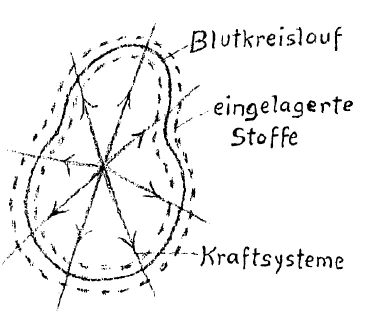
[ 8 ] This means that the circulatory system, in its structure and in the very nature of its activity, is determined by the human ego. If we imagine the blood circulation schematically represented by this oval line (see drawing), we must conclude that the blood circulation must be integrated into the rest of the organism; that is to say, all organ systems must be arranged in such a way that the blood circulation can be incorporated. We could not have the entire network of our blood vessels—whether in the head or in any other part of our organism—as it is, unless the necessary elements are directed to every place where the blood is to circulate. This means that the energy systems in the human organism, beginning with the digestive system, must function in such a way that they carry the necessary nutrients to the relevant locations and at the same time shape and form them so that the blood can maintain precisely the course it needs in these places to become an expression of the I. Therefore, what makes a human being an “I” must already be embedded in all the impulses of our digestive system—that is, the lowest system of our organism. The entire form that the human being ultimately exhibits in their physical perfection must already be integrated into the organ systems, right down to the various digestive processes of the human being. There we look down from the blood into the organ systems that prepare the blood circulation, to the processes that take place far removed from our ego in the darkness of our organism. While the blood is the expression of our ego activity—that is, the expression of the most conscious aspect of what we possess—we are not able to look down into the unknown depths of the physical body. We do not know how the substances are directed and carried to the individual parts of our organism where they must be utilized to build and shape it so that it can be an instrument of our ego. This shows us that, from the very beginning of nutrition, all the laws that ultimately lead to the formation of the blood circulation are already present in the human organism.
[ 9 ] Blood, as such, now appears to us as the most mobile, the most active of all our systems. And we know that if we interfere with the bloodstream even in the slightest way, the blood immediately takes a different path. We need only prick ourselves in any spot, and the blood immediately takes a different path than usual. It is infinitely important to bear this in mind, for from it we can see that blood is the most malleable element in the human body. It has a solid foundation in the other organ systems, but at the same time it is the most malleable of all, possessing the least internal constancy. Blood can be immensely influenced by the experiences of the conscious self. I do not wish to delve into the fanciful theories put forward by conventional science regarding blushing or paleness in response to feelings of shame or fear; I merely wish to point out the purely external fact that experiences such as fear, anxiety, and shame are rooted in ego experiences whose effects on the blood are discernible. With feelings of fear and anxiety, it is as though we want to protect ourselves from something we believe is working against us; we recoil, as it were, with our ego. With feelings of shame, it is as though we would prefer to hide, to withdraw, so to speak, behind the blood, to erase our ego. In both cases—I wish to address only the external facts here—the blood follows, materially, as an external material instrument, what the ego experiences within itself. In the case of fear and anxiety, where the person wishes so strongly to withdraw into themselves from something they feel threatened by, they turn pale; the blood withdraws from the surface toward the center, inward. When a person feels shame and wants to hide, to erase themselves, when they would rather not exist and want to slip away somewhere, the blood, under the impression of what the ego is experiencing, surges to the periphery of the organism, and the person turns red. Thus we see that the blood is the most easily identifiable system in the human organism and can follow the experiences of the ego most rapidly.
[ 10 ] The further down we go into our organ systems, the less the structures of those systems follow our ego, and the less inclined they are to adapt to the ego’s experiences. As for the nervous system, we know that it is organized into specific nerve pathways and that these pathways are relatively fixed in their course. While the blood is active and can be directed from one part of the body to another, all the way to the periphery, depending on the inner experiences of the ego, the situation with the nerves is such that the forces we can summarize as “forces of consciousness” run along the nerve pathways, and that these cannot carry nerve matter from one place to another, as is possible with the blood in its pathways. The nervous system is thus already less controllable than the blood; and even less controllable is the glandular system, which shows us that glands perform very specific functions at very specific locations within the organism. If a gland is to be activated by something for a specific purpose, it cannot be stimulated by a nerve-like strand; rather, this gland must be stimulated at the very location where it is situated. The glandular system is thus even less determinable; we must stimulate the glands where they are. While we can conduct nervous activity along the nerve tracts—we still have connecting fibers there that link the individual nerve nodes together—the gland can only be stimulated into activity at the location where it is situated. But even more pronounced is this process of consolidation, so to speak—this process of inner determination, of indeterminability—in everything that belongs to the nutritional system, through which the human being directly incorporates substances in order to be a physical-sensual being. Nevertheless, the nature of this incorporation of substances must provide a complete preparation for the instrument of the ego.
[ 11 ] If we now consider the human organism in terms of its most fundamental system—the nutritional system in the broadest sense, through which substances are transported to all parts of the organism—the arrangement of these substances must be such that the formation and external structure of the human being can proceed in a way that ultimately makes the expression of the “I” in the human organism possible. Much is required for this. Not only must the nutrients be transported in a variety of ways and stored in various parts of the organism, but all possible measures must also be taken to determine the external form of the human organism.
[ 12 ] Now it is important that we realize the following. In what we have called the skin, all the systems of the human organism are indeed represented, down to the lowest system, the digestive system, and we could say: Everything that belongs to the human physical system in the most fundamental sense is poured into the skin. But you can easily imagine that this skin—even though it contains all these systems—has a major flaw of its own, as paradoxical as that may sound. Although it takes the form of the human organism as it exists in the human being, it would not possess this form of its own accord; on its own, it would not be able to give the human being its characteristic form and boundaries. Without support, the skin would collapse in on itself; the human being would not be able to hold himself upright. From this we see that not only must those nutritional processes take place that sustain the skin, but the most manifold other processes must also take place and interact to form the overall shape of the human organism. It will not be difficult for us to understand that we must also regard as such transformed nutritional processes those processes that take place in the cartilage and in the bones. What are these processes?
[ 13 ] When the material from our food is transported to cartilage or bone, essentially only physical material is being transported there. What we ultimately find in cartilage or bone is, after all, nothing other than the transformed nutrients; but they are transformed in a different way than, for example, in the skin. Therefore, we can say: In the skin, we do indeed see the transformed nutrients deposited within the outermost boundary of our body. However, in the way the nutritional material is deposited in the bone, we see a nutritional process in which the material takes on the human form. It is thus a nutritional process that is the reverse of that in human skin. Now it will no longer be difficult for us to conceive of this entire nutritional process—the transport system of nutrients—following, as it were, the pattern of the observations we made regarding the nervous system.
[ 14 ] When we look at the skin and consider the nutrients that give rise to it—this outer covering that provides the human body with its surface but could never itself produce the human form—it becomes clear to us that skin nutrition is the most recent form of nutrition in the human organism; and we recognize that in the way the bones are nourished, we see an analogous process that stands in a similar relationship to skin nutrition as we could place the process of brain formation in relation to the process of spinal cord formation. We will be equally justified in saying: What we initially observe externally in the process of skin nutrition, we can see transformed at a later, that is, higher stage into the solid form of bone formation. — Such an observation of the human organism indicates to us that our skeletal system once existed as a soft substance and only solidified in the course of development. This can also be demonstrated by external science, which can teach us how certain structures that later clearly become bones appear soft and cartilaginous in childhood, and that only gradually does bone mass form from a softer, cartilaginous mass through the deposition of nutritive material. Here we have a transition from a soft to a firmer substance, just as it occurs in the individual human being. We must therefore regard cartilage as a precursor to bone and can say that the entire incorporation of the skeletal system into the organism appears to us as something that represents, so to speak, the final result of those processes that we observe in skin nutrition. Thus, the nutritive substances are first transformed in the simplest way into a soft, pliable substance, and then, once this is prepared, the nutritive process can take place through which certain parts first harden into bone matter, so that ultimately the form of the entire human organism comes into being. The way in which bones present themselves to us gives us reason to say: Beyond bone formation, we actually have no further progression of the nutritional processes toward solidification, as far as the human being at the present stage of development is concerned. While on the one hand we have in the blood the most malleable, most changeable substance in the human being, on the other hand we can see in the bone substance that which is completely unchangeable, which has hardened and solidified to a final point beyond which there is no further transformation; it has brought it to the most rigid form. If we now continue our earlier considerations, we must say: Blood is the most malleable instrument of the ego in the human being; the nerves are less so, the glands even less so, and in the skeletal system we have that which has reached the final point of its evolution, which represents a final product of transformation in terms of its malleability by the ego. Therefore, everything involved in the formation of the skeletal system occurs in such a way that, ultimately, the bones can serve as the bearers and supports of a softer organism in which life and nutritional processes proceed in such a way that the blood can flow through its channels in the proper manner, so that the human ego may have an instrument within it.
[ 15 ] I would like to know who would not be filled with the utmost admiration and awe upon looking into the human organism and trying to imagine: In the skeletal system, I have before me that which must have undergone the most transformations, the most stages, that which has risen from the lowest levels through many, many epochs to the present-day skeletal system; it has ultimately been shaped so that it can be the firm bearer, the firm support of the I. When one becomes aware of how the tendency of the ego works right down into the formation of the individual bones, who could fail to be filled with the deepest admiration for this structure of the human organism?
[ 16 ] When we look at this human being, we see two poles of physical existence: on the one hand, the blood system, which is the most malleable instrument of the ego; and on the other, the skeletal system, which is the most rigid in external form and internal structure, the least malleable, the least capable of change, and the most advanced in terms of its immutability. We may therefore say: In the skeletal system, the physical organization of the human being has, for the time being, found its final expression, its conclusion, while in the circulatory system it has, in a certain sense, taken a new beginning. If we look at our skeletal system, we can say: We see in this skeletal system a final conclusion of the human physical organization. — And if we look at our circulatory system, we can say: We see in it a beginning, something that could only begin after all other systems had preceded it. -— Regarding the skeletal system, we can say: A certain initial predisposition, the first forces for the formation of the skeletal system, must already have been present before the glandular and nervous systems developed in the organism, for these had to be assigned their respective locations by the skeletal system. The oldest of the force systems of the human organism is found within us in the skeletal system.
[ 17 ] When we have referred to the circulatory system and the skeletal system as two poles, we have sought to express figuratively that they represent, as it were, the two extreme ends of the human organism. In the circulatory system we have before us the most mobile element, one so active that it follows every impulse of our ego. And in the skeletal system we have that which is almost entirely beyond the influence of our ego, where our ego no longer reaches; yet the entire organization of the ego is already present in its form. Thus, viewed purely from the outside, the circulatory system and the skeletal system stand opposite one another in the human being as a beginning and an end. And when we look at our blood system in this way, which constantly follows all the movements of the ego, we say to ourselves: Human life is truly expressed to us in the active blood. — When we look at our skeletal system, we say to ourselves: It symbolizes everything that is withdrawn from our life and serves the organism only as a support. — Our pulsating blood is our life; our skeletal system is that which has already withdrawn from immediate life—because it is such an old gentleman—which has already stepped aside and now wishes only to serve as a support, to give form. While we live most organically in our blood, we have, in a sense, already died in our skeletal system. And I ask you to regard this statement as a leitmotif for the following lectures, for important physiological insights will emerge from it. While we live in our blood, we have actually already died in our skeletal system. Our skeletal system is like a scaffold; it is the least alive part of us; it is merely the supporting framework within us.
[ 18 ] We already observed a duality within the human being at the beginning of this lecture series; now this duality presents itself to us once again in a different way. On the one hand, the most active, most vital aspect is found in the blood; on the other hand, there is something in the skeletal system that seems to withdraw most from this organic activity, something that actually already carries death within itself. Our skeletal system has already reached a certain point of completion—at least in its formation, even if it continues to grow afterward—by the time in a person’s life when ego experiences begin to become active. By the time of the change of teeth at the age of seven, the skeletal system has essentially taken its form. It is precisely during this period, therefore, that the main development of our skeletal system takes place, when we ourselves are still largely removed from the activity of our ego. During this time, when the skeletal system is building itself up from the dark depths and forces of our organism, the most serious mistakes in nutrition can also be made. It is precisely during these first seven years of life that particularly serious errors can be made in a child’s diet, which have a detrimental effect on the skeletal system—for example, in cases of rickets, which stem specifically from the fact that nutritional processes during these years are not properly guided, such as when one indulges children’s sweet tooth and gives them everything they crave. Thus we see that what is withheld from the ego works its way into our skeletal system.
[ 19 ] The situation is quite different with the circulatory system, which closely follows the course of our individual lives and is, more than anything else, dependent on the processes of our inner experiences. It is merely a form of short-sightedness on the part of external science to believe that the nervous system is more dependent on inner experiences than the circulatory system. I merely wish to point out that the simplest form of influence exerted by ego experiences on the circulatory system is found in shame and fear, where a redistribution of blood takes place that clearly expresses the ego experiences through the instrument of the ego, the blood. You can therefore imagine that if even transient processes express themselves in this way, how much more must lasting or habitual ego experiences express themselves in the excitable element of the blood. There is no passion, no impulse, or no emotion—whether we experience them habitually or whether they erupt explosively—that is not transmitted as an inner experience to the blood as the instrument of the ego. All unhealthy elements of ego experience find expression in the blood system.
[ 20 ] And wherever we wish to understand anything that is happening in the blood system, it is important not merely to inquire into the nutritional process, but rather to look for the psychological processes insofar as they are experiences of the “I,” such as moods, enduring passions, emotions, and so on. Only a materialistic mindset will focus primarily on nutrition when there are disturbances in the blood system; for the blood’s nourishment is based on the nourishment of the physical system, the glandular system, the nervous system, and so on, and, in essence, the nutrients are already highly filtered by the time they reach the blood. Therefore, if the blood is to be affected from this side, a very significant disease of the organism must already have occurred; in contrast, all mental processes, all ego processes, have a direct effect on the blood.
[ 21 ] Thus, our skeletal system is the least subject to the processes of our ego, and our circulatory system is the most subject to them. Indeed, the skeletal system is the least inclined to follow the ego; one might say it is entirely independent of the ego, yet it is organized for the ego.
[ 22 ] Only a small part of the skeletal system is an exception to the principle that it cannot be identified by the ego and exhibits individual characteristics, namely the bones of the skull, particularly the upper part of the skull. This fact has given rise to various forms of nonsense.
[ 23 ] You know that there is such a thing as phrenology, the study of the skull. Although it is regarded as superstition by materialists, it has gradually taken on a materialistic tone in accordance with the general customs of our time. If we wish to characterize it roughly, we can say: In general, phrenology is described as seeking, in the forms of our skull structure, an expression of the inner nature of our ego, by establishing, as it were, general principles and explaining that one bump signifies this, another that, and so on. The aim is to identify human characteristics in the various bumps that appear on our skull. Phrenology thus seeks a kind of plastic expression of our ego in the bony structure of the skull. But when pursued in this way—even if one appears to be seeking spiritual expressions in the structure of the individual bones—it is, in fact, nonsense. For anyone who is truly a keen observer knows that no two human skulls are alike and that one could never point to elevations or depressions that are generally typical of this or that trait, but rather that every skull differs from the next, so that we are faced with different forms in every human skull.
[ 24 ] We have said that the skeletal structure eludes our sense of self—which the blood follows most closely in its activity—and follows it the least. It is curious that the formation of the skull and facial bones nevertheless appears to us to be shaped in accordance with the sense of self, while the skeletal structure appears more generally typical. Anyone who observes the structure of the skull knows: just as the human being is an individual, so too is the structure of his or her skull an individual one.
[ 25 ] How is it that this marvelous configuration of the skull is shaped from the very beginning to correspond to the individual human personality, even though the ego has no influence on bone structure? How is it that the skull, which must develop just like the other bones, is different in every human being? Where does this come from? It comes simply from the same reason that the individual characteristics of human beings develop in the first place, namely, that the individual human life as a whole does not merely extend from birth to death, but unfolds over many incarnations. So while our ego has no influence on the structure of the skull in the present incarnation, through the experiences of its previous incarnation it has developed the forces that, in the time between death and the next birth, determine the configuration of the skull structure—the shape of the skull—in this incarnation. The nature of the ego in the previous incarnation determines the shape of the skull in the present incarnation, so that in the structure of our skull we have an outward, plastic expression of the way in which we, each and every one of us as an individual, lived and acted in the previous incarnation. While all our other bones express something generally human, the skull, in its external form, expresses what we were and what we did in the previous incarnation.
[ 26 ] The extremely active element of blood can thus be controlled by the ego in this incarnation. Our bones, however, have already completely withdrawn from the influence of the I in this incarnation, down to the very last remnant, the skull bone, which, however, can no longer follow the I in this incarnation either. The skull bone, which developed from the soft tissue of the embryonic substance where the I could still exert a formative influence, expresses how we were in the previous incarnation. There is no such thing as general phrenology. If we are to consider phrenology at all, it must not be a schematizing science, but should instead consider the plastic characteristics of the skull structure in an artistic manner. We must assess our skull structure as a work of art. We must, however, see something individual in the skull structure, but something individual that is an expression of the history of the ego in a previous incarnation. Thus we see that even this form of bone structure, as it presents itself to us in the skull, is so far removed from the ego that it no longer has any influence on it in the present incarnation. But it still exerts an influence on it during the transition between death and new birth, where, in a certain sense, it reassumes the forces that had already withdrawn from it in the past life and which, under its influence, build up the skeletal system and especially the skull for the next life.
[ 27 ] Therefore, when people speak of the idea of reincarnation and say that it is a matter that generally eludes the judgment of our reason—and that one must simply believe what the spiritual researcher says—this is not correct. One can reply: You can convince yourselves tangibly that the human ego must have existed in a previous incarnation; in the human skull, you have tangible proof before you of what the human being was like in the previous incarnation. Anyone who does not admit this, anyone who sees something paradoxical in the fact that one must infer from the way something is outwardly formed that there was something living earlier that shaped the exterior from its previous life, has no right to infer the existence of a previous life in any other way when confronted with a sculptural form. Anyone who does not accept the conclusion—as a strictly logical one—that the configuration of the “I” from previous incarnations is expressed in the individual shape of the skull we possess, has no right either, for example, if they find an empty shell somewhere on Earth, to infer from the external form of that shell that a living being was once inside it. Anyone who wishes to infer from the dead shell the existence of a living being that was once inside it and shaped the shell must not reject the logically equivalent conclusion that the individual configuration of our skull provides direct proof of the influence of a previous life on this one.
[ 28 ] So you see that here we have one of the gateways through which we can shed light, from a physiological perspective, on the idea of reincarnation. There are many such gateways; one simply has to take one’s time. If one is patient and waits, one will find the points where evidence can be provided and how it should be provided. And anyone who would deny that there is logic in what has just been said would also have to deny the entire field of paleontology, for it is based on the same conclusions. Thus we see how, by delving into the forms of the human organism, we can trace it back to its spiritual foundations.