

An Occult Physiology
GA 128
24 March 1911, Prague
Translated by Steiner Online Library
Fifth Lecture
[ 1 ] Before we proceed with our reflections, my task today will be to introduce a few concepts that we will need as we continue our discussion. It will be particularly important that we agree on the meaning of what we, in the spiritual-scientific, anthroposophical sense, call a physical organ—or rather, the physical expression of an organ. For you have already seen that we can speak of the spleen, for example, in such a way that the physical spleen can even be physically removed or rendered inoperative without what we call the “spleen” in the anthroposophical sense being deprived of its activity. Nevertheless, when we have rendered such a physical organ inactive or removed it, the activity, the inner vitality that was exercised by the organ, still remains within the organism. From this we see—and I ask you very much to adopt such a concept for what follows—that we can mentally set aside everything that is physically visible, everything that is physically perceptible in such an organ—of course, this cannot be said of every organ—and yet the organ’s intended function remains; and what then remains, what continues the function, we must count among the supersensible aspects of the human organism.
[ 2 ] However, when we speak in the context of our spiritual science of organs such as the spleen, liver, gallbladder, kidneys, lungs, and so on—by uttering these names—we are not initially referring to what can be physically seen, but rather we are designating the systems of forces active within these organs, which are of a supersensible nature. Therefore, when we speak of these organs from a spiritual scientific perspective—and this is particularly true of the spleen—we must first conceive of a system of forces that is not physically visible from the outside. So let us imagine, in what I am drawing here, a system of forces that is not physically visible, but which could only become visible to a supersensible gaze.
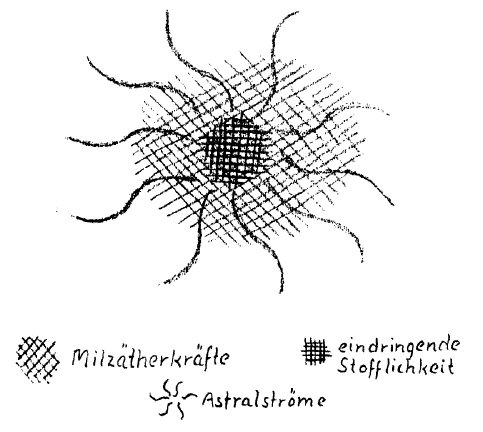
[ 3 ] Such a system would therefore be visible, for example, in the area of our spleen only as a supersensible force system. If we now consider that, in the actual human organism before us, this supersensible system of forces is filled with sensible matter, we must ask ourselves: How are we to conceive of the relationship between this supersensible system of forces and what constitutes sensible matter?
[ 4 ] I believe you will have no difficulty in conceiving that forces can travel through space that are not immediately perceptible to the senses. One need only recall the following: For example, anyone who has never heard of the reality of air in a bottle emptied of water will believe that the bottle is completely empty. Such a person, unfamiliar with physics, will be somewhat astonished to see that when we place an empty water bottle on the table, fit a tight-fitting, narrow-necked funnel onto it, and quickly pour water into the funnel, the water remains in the funnel and cannot flow into the bottle because the counterpressure of the air prevents it from entering the bottle. Such a person will then realize that there is indeed something inside the bottle that is invisible to them, which is holding the water back. If you expand this concept a little, it will not be difficult to imagine that space can be permeated by systems of forces that are initially of a supersensible nature, so that we cannot cut through them with a knife and they cannot be affected even if a physical organ—which is their material expression—such as the spleen, were to become diseased. We must conceive that a supersensible force system stands in such a relationship to what we see as a physical-sensory organ that physical matter becomes embedded in this force system, drawn by the force points and force lines, and thereby becomes a physical organ. We can say: The reason why, for example, a physical-sensory organ is visible at the site of the spleen is that there, in a very specific way, force systems fill the space, drawing matter to itself in such a way that it becomes embedded in the manner we observe in the external organ of the spleen when we examine it anatomically.
[ 5 ] You can think of the various organs in the human organism in this way. They are initially of a supersensible nature and are then filled with physical matter under the influence of the most diverse supersensible force systems. Therefore, we must first see in these systems of forces a supersensible organism that is differentiated within itself, that incorporates physical matter in the most diverse ways, and whose complexity the physical organ incorporated into it can only follow incompletely. In doing so, we have not only gained an understanding of the relationship between the supersensible force systems and the embedded physical-material organs, but also another concept: that of the nourishment of the entire organism. What, then, does this nourishment of the entire organism consist of? It consists of nothing other than the fact that the ingested nutrients are prepared in such a way that it is possible to direct them to the various organs, which then incorporate the substances. In the following lectures we shall see how this general concept of nutrition, which manifests as an attractive force of the various organ systems toward the nutrients, relates to the development of the individual human being, to the embryonic history of the individual human being that lies prior to birth. The most comprehensive concept of nutrition is therefore that through supersensible force systems, through a supersensible organism, the individual nutrients are drawn in and incorporated into the physical organism in the most diverse ways.
[ 6 ] Now we must be clear that the human etheric body, which is the next supersensible member of the human organism after the physical body, that this etheric body—even though it is the coarsest of the supersensible members—lies at the foundation of the entire organism like a supersensible archetype, that it is internally structured, and contains the most diverse systems of forces for assimilating the substances taken in through nutrition. But following this etheric body, which we can regard as the archetype of the human organism, we have, as the next higher member of the human being, the so-called astral body. The next lectures will show us how these two are united. The astral body is that which can only integrate itself once both the physical organism and the etheric organism are already prepared in their structure; it presupposes the other two organisms. Furthermore, we have what we call the human ego, so that the entire human being is composed of these four members. We can now imagine that there are already certain force systems within the etheric body itself that draw in the nutrients and then shape them in the physical organism in a very specific way. But we can also imagine that such a force system is determined not only by the etheric body but also by the astral body, and that the astral body sends its forces into it, so that if we were to mentally remove the physical organ, we would first have the etheric force system, then the astral force system, which permeates the etheric force system in a very specific way, and we can imagine that rays from the ego also penetrate into it.
[ 7 ] There may be organs that are integrated into the organism in such a way that their very essence rests on the fact that the etheric currents have had very little defining influence in their own right; so that, if we were to investigate the space in which a particular organ is located through occult means, we would find that the etheric part of this organ is quite undifferentiated in itself, contains only a small amount of these force systems, but that, in contrast, this part of the etheric body is influenced by strong astral forces. Then, when physical matter incorporates itself into such an organ, the etheric body exerts only a slight attractive force on the substances to be incorporated; the main attractive force is then exerted by the astral body on the organ in question, and indeed in such a way as if the substances in question were being drawn directly from the astral body into the organ in question. From this you can see that the organs of the human being are of quite different significance. There are organs of which one must say that they are primarily determined by the force systems of the etheric body, others that are more determined by currents or forces of the astral body, while still others are more determined by currents of the I. From the explanations given in the lectures, you can already see that the organ system that carries our blood, in particular, depends essentially on the radiations emanating from our ego; that is to say, human blood is essentially connected with the currents and radiations of the human ego. The other organ systems and their contents are determined, in varying degrees, by the supersensible members of human nature.
[ 8 ] But the opposite can also occur, namely when we consider the physical body in and of itself, which—setting aside its higher components—also constitutes a system of forces. It represents, first of all, what one can conceive of as a composite of substances from the external world, which also have their own inner laws, but which, having been transformed, are incorporated into the physical body. The physical body is thus also a system of forces. So that you can also imagine the case where the physical organism in turn exerts a counter-effect on the etheric or even the astral system of forces, or even into the ego system. We must realize that the etheric force system is not merely captured by the astral or ego system, but that there are also organs in which the etheric forces are so engaged from the side of the physical force system that the physical force system predominates. Such organs, in which the physical body predominates—that is, which are influenced only to a lesser extent by the higher members of the human organism—are mainly those organs that can be described in the broadest sense as secretory organs: all glandular organs, all secretory organs in general. All secretory organs, all organs that directly secrete substances, are prompted to these secretions—that is, to a process that has its essential significance within the purely physical world—mainly by the forces of the physical organism. Wherever such organs are found in the human organism, if they are primarily intended for the secretion of material substances, we must be clear that such organs, which are mainly instruments of the physical systems of force, inevitably lead the organism to decay through disease, through becoming useless, or through their removal, so that it can then no longer develop in the appropriate manner and ultimately can no longer live. You can see in an organ such as the spleen, which we spoke of yesterday, that its disease, its becoming otherwise unusable, or its surgical removal disturbs the physical body’s functions far less than is the case with other organs, because it is influenced in a particularly strong way by the supersensible parts of human nature, by the etheric body, but especially by the astral body. The situation is different with organs where the physical energy system predominates. A disease of the thyroid gland, for example, which in certain conditions sometimes enlarges to form what is known as a goiter, can have a very harmful effect on the entire organism. However, it must not be rendered completely useless or completely removed, and this is because it must express its effects in such a way that what it brings about as a physical process is quite essential to the overall balance of the human organism.
[ 9 ] There may be organs that are highly dependent on the supersensible force systems of the human organism, yet are integrated into the physical organism and are prompted by its forces to secrete material substances. One such organ is, for example, the liver, as are the kidneys. These are organs that, just like the spleen, depend on the supersensible members of the human organism—the etheric body and the astral body—but are, so to speak, captured by the forces of the physical organism, their effects drawn down to the level of the physical forces. Therefore, it is far more important for them, as physical organs, to be in a healthy state than, for example, for the spleen, where the physical aspect plays a very minor role and is far outweighed by what comes from the supersensible members of the human organism. We can say of the spleen that it is a very spiritual organ, for the physical part of this organ constitutes the least part of its significance. For this reason, the spleen has always been regarded and described in occult literature—which has sprung from circles where one truly knew something about these matters—as a particularly spiritual organ.
[ 10 ] Thus, we have now, so to speak, arrived at the concept of the total organism, whose individual organs can be regarded as a supersensible system of forces into which, as it were, physical matter is incorporated through the entire process of nutrition. Another concept we must grasp is this: What does the process of taking in—whether of a physical substance or of something spiritual, brought about by our soul activity, for example in perception—actually mean for human beings? And what does the excretion, the release of a substance, mean?
[ 11 ] Let us first consider the excretory process in its broadest sense. We know, of course, that a large portion of the material from the food we consume is already excreted by the digestive tract. We also know that carbon dioxide is excreted from the human organism through the lungs. Then there is a process of excretion through the kidneys, and another process of excretion occurs through the skin. In this latter process, which initially takes the form of perspiration but also encompasses everything that, in the broadest sense, can be considered a process of excretion through the skin, we must recognize—and I ask you to pay close attention to this—that this excretion occurs in humans at the outermost extent, at the very periphery of the body. Now let us first ask ourselves: What does a secretion process actually mean for human beings?
[ 12 ] We can only grasp the significance of a process of differentiation in the following way. You will see that without the concepts we have developed today, we cannot make any progress at all in our consideration of the human organism. To gradually guide our thoughts toward the essential nature of a process of separation, I would first like to introduce another concept, one that bears only a distant resemblance to the process of separation but can lead us there: the concept of becoming aware of our self. Consider for a moment how you can essentially say that it is a kind of becoming aware of your own self when you walk into a room and carelessly bump into a hard object. This bumping is, in essence, a becoming aware of one’s own self. It is a becoming aware of one’s own self in such a way that the sensation caused by the bump has become an inner event. For what is the collision with a foreign object to you? It is the cause of a sting, of pain. The process of pain takes place entirely within you. Thus, an inner process is triggered by your coming into contact with a foreign object that lies in your path as an obstacle. The awareness of this obstacle is what triggers the inner process that manifests as pain when you bump into it. Basically, you can easily imagine that you need to know nothing else at all to experience the awareness of your own self other than the internal pain caused by bumping into an external object. Imagine that you bump into an object in the dark, of which you have no idea what it is, and suppose you bump into it so hard that you cannot even infer what the object might be like, but you only feel the effect of the bump as pain. You have perceived the bump in its effect in such a way that you experienced the process within yourself. You experience nothing other than an inner process, and that is the essential point. However, if you also say, “I bumped into an external object,” this is more or less an unconscious inference from an inner experience to an external obstacle.
[ 13 ] From this you can see that a person becomes aware of their inner self by encountering resistance. We must grasp this concept: the becoming aware of the self, the experience of the inner self, the being filled with real inner experiences through the encounter with resistance. This is a concept that I have, I might say, developed in the crudest terms in order to be able to make the transition from it to another concept, that of secretions in the human organism. Let us imagine for a moment that the human organism takes into itself, into some organ system— the stomach, for example, and that this organ system is arranged in such a way that, through its activity, it separates something from this substance that has been taken in—separates it, as it were, from the total substance—so that through this activity of the organ, the total substance breaks down into a finer, as it were filtered, part and a coarser part that is excreted. Thus, a differentiation of the substance takes place into one that is converted into a substance that can be further utilized and absorbed by other organs, and into one that is first separated and then excreted.
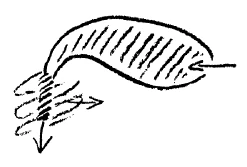
[ 14 ] Here, at this point, where the unusable parts of matter are separated from the usable substances, you have, in a modified form, something like a collision with an external object, as I just described. The stream of absorbed matter, as it approaches an organ, encounters a kind of resistance, so to speak; it cannot remain as it is, it must change. The organ tells it, as it were: You cannot remain as you are, you must change. — Thus, a resistance is set against the substance; it must be further processed as a different substance, and it must shed certain parts. Within us, the organ opposes the flow of substance just as the external object opposes us when we collide with it. Such resistances are found within the entire organism in the most diverse organs. And it is only through the fact that secretion occurs in our organism at all, only through the fact that we have secretory organs, that the possibility arises for our organism to be a self-contained, self-experiencing entity. For an entity can only experience itself by encountering resistance. Thus, in the processes of excretion, we have important processes of human life, namely those processes through which the living organism closes in on itself. Human beings would not be self-contained beings if such excretory processes did not exist.
[ 15 ] Imagine for a moment that the flow of food or oxygen passed smoothly through the human organism as if through a tube, and that there was no resistance from the organs. The consequence of this would be that the human organism could not experience itself as a separate entity, but would experience itself only as part of the entire wider world. We could, of course, also imagine that within the human organism the coarsest form of this resistance would occur, that the flow of matter would strike a solid wall, be reflected, and return. But that would not affect the inner experience of the human organism, for whether the flow of nourishment or the flow of oxygen passed through the human organism as through a tube—in on one side, out on the other—or whether it were reflected, it would make no difference to the inner experience. You can already infer that this is the case from the fact that—as we have already said—when we cause an image to return to itself within our nervous system, we thereby effectively lift our nervous system out of the experience of the inner organism. It therefore makes no difference whether there is complete reflection or merely a passing through of the currents entering from the outside through the human organism. What makes the human organism experienceable in itself are the secretions.
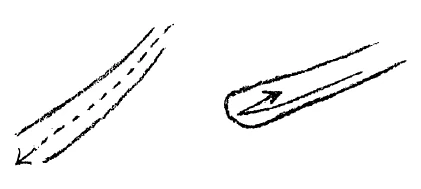
[ 16 ] If you consider the organ that we must regard as the central organ of the human organism—the circulatory system—and if you observe how, on the one hand, the blood is constantly renewed by taking in oxygen, and if, on the other hand, you regard the circulatory system as the instrument of the human ego, then we can say: If the blood were to pass through the human organism unchanged, it could not be the organ of the human ego, which is, in the most eminent sense, the organ that makes the human being experienceable inwardly. Only because the blood undergoes changes within itself and returns as something different—that is, because secretions of altered blood occur—only through this is it possible for the human being not only to have an ego but also to experience it with the aid of its sensory-physical instrument, the blood.
[ 17 ] This has led us to the concept of excretion. And now we must ask ourselves: What about that excretion which we previously described as belonging to the outermost periphery of the human organism? — It will not be difficult for us to imagine how the entire human organism must function in order for this secretion to take place at the periphery. For this, it is necessary that an organ be set in opposition to the entire flow of the human organism, an organ that is connected precisely with this most extensive secretion process. And this organ, which, as you can easily imagine, is the skin, with everything that belongs to it in the most comprehensive sense, is at the same time that which presents itself to the immediate external gaze as the essence of the human figure, the human form. If we therefore imagine that the human organism, which is able to experience itself at its outer periphery, can do so only by setting the organ of the skin in opposition to its entire flow of forces, then we must see in the unique formation of the skin one of the expressions of the innermost forces of the human organism.
[ 18 ] We must now ask ourselves: How are we to conceive of this organ of the skin? How are we to conceive of the skin with all that belongs to it? We will see in detail what belongs to it, but today we want only to characterize it in broad terms. We must first be clear that what belongs to our conscious experience—that which we can come to know through some form of self-observation—does not include the form that is expressed in the shaping of our skin. Even if we are to some limited extent co-active in the shaping of our outer bodily surface, it is nevertheless something that eludes direct volition in the most complete sense. Only with regard to the mobility of our skin—in terms of facial expressions, gestures, and so on—do we have an influence that still comes close to what we might call conscious activity; but we no longer have any influence over the shape, the form of our body’s surface. It must, of course, be admitted that between birth and death, a person has a certain influence on the external form of their body within narrow limits. Anyone who has known a person at a certain age and perhaps sees them again after ten or twenty years can see this for themselves, especially if that person has undergone profound inner experiences during those years—namely, experiences of insight that are not the subject of external science, but rather those that “cost blood,” which are connected to the whole course of our lives. Then, however, we see within narrow limits how physiognomy changes, how, within these limits, the human being has an influence on the shaping of their body. But they have it only to a small degree, and everyone will have to admit this; for the most essential aspect of the human form is by no means subject to our will and is not determined by our consciousness. Nevertheless, we must say: The entire human form is adapted to the human being; and anyone who considers these matters will never be able to imagine that what we call the full scope of human abilities could develop in a being of a form other than the present-day human form. All the abilities present in human beings are connected to this human form. Just imagine for a moment that the frontal bone were in any other position relative to the entire organism than it is; this change in form would require entirely different abilities and powers in human beings. Studies could indeed be conducted on this by clarifying what other abilities would be present in people with different external forms of the head, skull structure, and so on. Thus, we must form a concept of the adaptation of the human form to the entire inner human being, indeed, of a complete correspondence between the outer form and the inner being of the human being. What lies in the forces of this adaptation has nothing to do with what belongs to the human being’s own activity, which is encompassed by consciousness. But since the human form is connected to human spiritual activity and also to human soul life, you can easily imagine that within the forces that bring about the human physical form lie forces that, as it were, meet from another side those forces that the human being develops within themselves. Intellectual powers, emotional powers, powers of the soul, and so on—a human being can only develop these in the physical world on the condition of having a specific form. This form must be given to them. He must therefore receive this form prepared for his capacities—if I may put it this way—by forces of a kind similar to those that build up this form from the other side, so that it can then be used for the purpose for which it is intended. It is not difficult to grasp this concept, for one need only consider that a machine we wish to use for a particular task must be intelligently and appropriately designed for that task. For such a machine to come into being, it is necessary first to perform tasks similar to those the machine is then to carry out, and thereafter to manufacture and assemble the parts of the machine that give it its form. When we have a finished machine before us, it can be explained to us entirely mechanically if we see and understand its operation. As thinking observers, however, we will ask ourselves: Who is it that built it? — For its composition points to a purposeful mental activity that produced this machine for a specific purpose. This mental activity need not be present if we wish to explain the machine mechanically, but it stands behind the machine; it is what brought it into being in the first place.
[ 19 ] Similarly, we can say: All the structural systems inherent in the design of our organism are given to us, first and foremost, so that we may develop our abilities and powers as human beings. But behind this human form there must be formative, shaping forces that we find just as little in the finished form as we find the machine builder in the machine.
[ 20 ] With this idea, something else will also become perfectly clear to you. A materialist might say: Why do we need to assume the existence of intelligent forces and consciously creative beings behind our physical world? After all, we can explain the physical world from within itself, based on its own laws. A clock, a machine, can be explained by its own laws. — Here we have reached a point where the gravest errors are being made on both sides, both among those who hold a spiritual worldview and among the materialists. If, for example, a spiritual-scientific worldview were to deny that the human organism, as it exists in its present form, could be explained purely mechanically or mechanistically through its own laws, that would of course go too far and be entirely unjustified. The human organism is entirely explainable by its own laws, just as a clock is. But the fact that the clock is explainable by its own laws does not imply that behind the clock there was not the clock’s inventor, the clockmaker, and his spiritual activity. This objection, which can be raised from a materialist perspective, is thereby resolved. But the spiritual researcher must also admit that the human organism, as it stands before us, can be explained by its own laws. But if we truly think in terms of spiritual science, we must look behind the overall structure of the human organism for the formative beings—that is, for what underlies the entire form of the human being. If we now wish to form a concept of how the human form comes into being at all, we must imagine that it is brought about, on the one hand, by the unfolding of the formative forces and that they build up the human being by closing in upon themselves at the boundaries of the human form. In the formation of the skin, we have the purest example of what the spatial self-conclusion of the formative forces in the human being means. If we draw this schematically, we can imagine that the formative forces flow out toward the periphery and conclude themselves there in the outer form, which is to be indicated only by the line A-B.
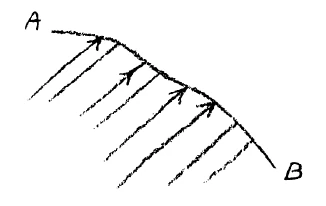
[ 21 ] We will now see how we need this concept again in order to understand everything that happens beneath the skin. Furthermore, however, we must realize that such boundaries are not found merely in human skin, but that we also find such boundaries within the human organism itself, where external activity and essence are confined. You need only reflect on what has been said so far, and you will realize that we also have such self-contained activities within the human being, in which we are just as uninvolved as we are in the structure of our outer surface; and these are precisely the activities that take place in the organs of the liver, gallbladder, spleen, and so on. There, what flows into the organism through the forces contained in food is held back; something is pushed against it, resistance is offered—that is, the external, inherent activity of the substances is transformed within these organs. So while with the formative forces the situation is such that we must conceive of these formative forces as active up to the skin and beyond the skin there are no longer any formative forces, we must imagine that with those forces that enter our interior with the flow of food or air, there is not a complete sealing off of what penetrates from the outside as currents, but rather a transformation takes place there. We must conceive of these organs not as closing off, as the skin does, so that there is nothing outside, but rather in such a way that the activity of the substances is transformed by them to such an extent that the stream of nourishment, which is taken in from the side of these organs (see drawing, a), is conveyed onward in a different way (b) after resistance has been opposed to it. Here, then, we are dealing with a transformation, and this concerns above all those organs that we have designated as the human inner world system. They transform the external activity of the substances. These are forces that, in contrast to the formative forces that constitute the entire organism, we can call forces of movement. In our inner world system, these forces, which transform the inner activity of the nutrients, then become movement, so that we can speak here of forces of movement in the organs.
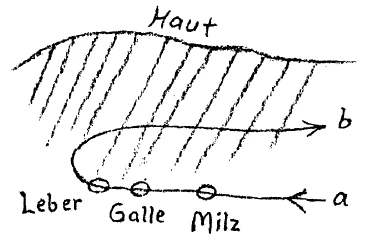
[ 22 ] We have now progressed so far in our examination of the human organism that we can say: Forces act upon the human organism from the outside, the activity of which we do not perceive with our consciousness. Everything we do there takes place below the horizon of our consciousness; no one can observe the activity of their liver, gallbladder, spleen, and so on in normal consciousness. Now the question arises: What prevents us from knowing anything about the forces of form and movement at work within our internal organs, since our soul life is integrated into the organism? After all, tremendous activities are taking place within us. Why is it that we know nothing of this?
[ 23 ] Now, just as our brain-spinal cord-nervous system is designed to convey the external impressions we receive through our senses all the way to the blood—that is, to take in the impressions of external events into our blood, into the instrument of the ego—just as the brain-spinal cord-nervous system is designed to serve the ego in normal consciousness, in exactly the same way, the sympathetic nervous system—which, with its nodes and branches, is situated, as it were, in front of the inner world system—is designed not to allow the processes taking place within the organism to reach the blood, the instrument of the ego, but rather to keep them from the blood.
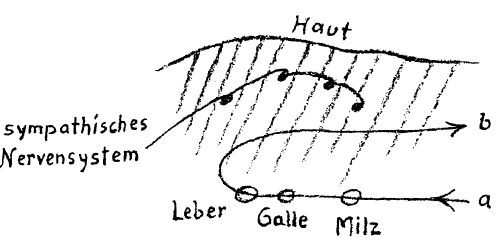
[ 24 ] As you can see, the sympathetic nervous system has a function opposite to that of the central nervous system, and this explains the difference in the structure and nature of these two systems. While the brain-spinal cord nervous system must strive to transmit external impressions to the blood as effectively as possible, the oppositely acting sympathetic nervous system must continually hold back—from the blood, as the instrument of the ego—the intrinsic activity of the absorbed substances. If we consider the digestive process, we first have the intake of external nutrients, then the suppression of the intrinsic activity of the nutrients, and then the transformation of these activities by the human being’s inner world system. So that we do not constantly perceive, as we stand in the world, everything that is taking place within our internal organs, the entire flow of processes must be held back by the sympathetic nervous system from the blood, just as the brain-spinal cord nervous system carries to the blood what is taken in from the outside. Therein lies the task of the sympathetic nervous system: to keep our inner processes within us, not allowing them to rise up to the blood—the instrument of the ego—in order to prevent these inner processes from entering ego-consciousness.
[ 25 ] I already pointed out yesterday that a person’s outer life and inner life, as it is lived out in the etheric body, stand in opposition to one another, and that this opposition between outer and inner life is expressed in tensions which, as we have seen, become strongest in the organs of the brain that we call the pineal gland and the epiphysis.
[ 26 ] If you now consider today’s and yesterday’s explanations together, you will easily be able to see that everything flowing in from the outside, in order to come into the closest possible contact with the blood circulation, strives to unite with its opposite—that which comes from within and is held back by the sympathetic nervous system. In the pineal gland, we have the place where what is brought to the blood from the outside via the brain-spinal cord-nervous system seeks to unite with what comes from the other side, and the pineal gland is, as it were, the final outpost preventing what constitutes human inner life from reaching the blood. At this point in the brain, two important organs face each other. The entire inner experience remains below our consciousness; after all, it would disturb us terribly if we were to consciously participate in all our digestive processes; this is held back by the sympathetic nervous system. Only when this reciprocal relationship between the two nervous systems—as expressed in the tension between the pineal gland and the pituitary gland—is out of balance does what we might call a “shimmering” of one side into the other occur, a disturbance of one side by the other. This occurs, for example, when irregular activity in our digestive organs brings uncomfortable sensations to our consciousness. Here we have a—albeit still very vague—radiation of the otherwise unconscious human inner life into consciousness, which has, however, been significantly transformed in the process, so that it does not appear in consciousness as it actually occurred. Or, in particular emotions—anger, rage, terror, and the like—that have their origin in consciousness, we have a particularly strong influx from the inner human organism; in which case we have the situation where emotions—particular inner stirrings of the soul—can influence digestion, the respiratory system, and thereby also blood circulation and everything that lies below the level of consciousness in a particularly harmful way. Thus, these two aspects of human nature can nevertheless interact with one another.
[ 27 ] Thus, as human beings, we truly stand in the world as a duality, and we have seen this duality today: on the one hand, the conscious experience of the external world through the brain-spinal cord-nervous system, which transmits external impressions all the way to the blood, the instrument of the ego; on the other hand, the unconscious experience of the inner world—unconscious because it is held back from the blood by the sympathetic nervous system. These two opposites stand in direct opposition to one another across the board. But we find their particular expression in the tension between these two organs we have spoken of: the pineal gland and the pituitary gland.
[ 28 ] We will continue our discussion from this point next time.