

An Occult Physiology
GA 128
23 March 1911, Prague
Translated by Steiner Online Library
Fourth Lecture
[ 1 ] Today we will continue yesterday’s discussion of the significance of one of the organs that, so to speak, represent a human’s internal world system. We will then move on to describing the functions of other human organs and organ systems.
[ 2 ] Following what was said here yesterday about the spleen, I was told that an apparent contradiction might arise with regard to the important role attributed yesterday to the spleen within the human organism as a whole. This contradiction could arise when one considers that it is indeed possible to remove the spleen from the body—that is, to excise it—without rendering the person incapable of life as a result of this removal of the spleen.
[ 3 ] Such an objection is, of course, one of those that are entirely justified from our current contemporary standpoint and that present certain difficulties precisely for those who approach the spiritual-scientific worldview with a truly honest and inquiring spirit. Only in general terms could it be pointed out in the first public lecture how our contemporaries today—especially those with a conscience trained by scientific methods—have difficulties to overcome when they set out to understand what is presented from the occult depths of the world’s being. Now, in the course of the lectures, we will in principle see for ourselves how such an objection can be resolved. But I would like to point out already today, by way of a preliminary remark, that the removal of the spleen from the human organism is entirely compatible with what was discussed yesterday. If you truly wish to ascend to the truths of spiritual science, you must gradually come to terms with the fact that what we call the human organism—what we perceive through our external senses, what we see as substantial and material in this human organism—is not the whole human being, but that underlying the physical organism—as we shall have to elaborate further—are higher, super-sensory organizations: the etheric body or life body, the astral body, and the I; and that in the physical organism we have only the outer, physical expression of the corresponding form and processes of the etheric body, the astral body, and the I. When we refer to an organ such as the spleen, we mean this in the spiritual-scientific sense: that, fundamentally speaking, something is taking place not only in the outer physical spleen, but that what occurs in the physical spleen is merely the physical expression of corresponding processes in the etheric body or the astral body. And one could say: The more an organ is the immediate physical expression of a spiritual reality, the less the physical form of the organ—that is, what we have physically and materially before us—is actually the decisive factor. When we look at a pendulum, the pendulum’s movement is merely the physical expression of gravity. Similarly, a physical organ is merely the physical expression of supersensible forces and formative influences. Now, however, there is a difference between the effects of gravity, which manifest in the pendulum’s motion, and the effects arising from the actions of the etheric and astral bodies on the spleen. If one removes the pendulum, there is no longer an object on which the rhythm caused by gravity can manifest. This is the case with inanimate, inorganic nature; with the living organism, it is different. Unless there are reasons—which we will discuss later—the spiritual effects of the higher organisms do not necessarily cease with the removal of the physical organ.
[ 4 ] So when we consider the human being in relation to the spleen, we are first dealing with the physical spleen, and then with a system of forces that find their physical expression in the spleen. If the spleen is removed, these forces—which were once integrated into the human organism—are still present; they do not cease. Under certain circumstances, the presence of a diseased physical organ may even pose a far greater obstacle to the continuation of spiritual effects than the removal of the organ in question. This can be the case, for example, with a severe disease of the spleen. If, in the case of a severe disease of an organ, it is possible to remove the organ, then under certain circumstances the absence of this organ may be a lesser obstacle to the unfolding of spiritual effects than the presence of the diseased organ, which is a constant source of disturbance for the development of spiritual forces. Therefore, an objection such as the one cited belongs to those that are certainly raised when one has not yet penetrated more deeply into the very essence of spiritual scientific knowledge. It is a quite understandable objection, but at the same time one of those that disappear of their own accord if one takes the time and has the patience to delve deeper into the matter. You will find this to be the case: When one approaches the study of spiritual science with a certain body of knowledge drawn from the views of today’s materialistic science, contradiction upon contradiction can arise, so that one cannot make head or tail of it. And if one is quick to judge, one will indeed come to no other conclusion than that spiritual science is some kind of nonsense that does not in the least correspond to the findings of external science. - But if one engages with the subject with patience and time, one will see that there is no contradiction, not even the slightest, between what comes from spiritual science and what results from external scientific research. The difficulty here is that the entire field of anthroposophical or spiritual scientific knowledge is so vast that one can only ever present parts of it. And when people approach these parts, they can easily perceive contradictions such as the one described here.
[ 5 ] But this must not deter us; otherwise, we would not even be able to begin the necessary task of integrating the anthroposophical worldview into the overall education and body of knowledge of our time.
[ 6 ] Yesterday I tried to explain to you the rhythmic restructuring brought about by the spleen in contrast to the external, non-rhythmic nourishment of the human being. I started with this because, of all the functions the spleen performs, it is the easiest to understand. But although it is the easiest to understand, it is not the most important, nor is it the one that constitutes the main point. For one could say: Well, if people made an effort to recognize the proper rhythm for their diet, then in this respect the activity of the spleen would gradually become unnecessary. — From this alone, one can see that this function, which we spoke of yesterday, is the least significant. Far more important is the fact that in our diet we encounter foodstuffs as external substances, in the manner of their composition, as they are found in our environment. As long as one holds the view, of course, that these foods are dead substances or, at most, imbued with the life one assumes exists in plants—as long as one assumes this—it might indeed seem as though the external substance taken into the organism as food is processed by what is called, in the broadest sense, digestion. Certainly, many people also imagine the matter in such a way that we are dealing with an undifferentiated substance that we take in as our food, a substance that is completely indifferent to us and that, once we have taken it in, is merely waiting for us to process it. But that is not the case. Nutrients are not like bricks that must simply accept being used in any way as building blocks for a structure that is to be erected. The bricks allow themselves to be incorporated into a building in any way according to the architect’s plan because they represent an unformed, lifeless mass, at least in relation to the building. But this is not the case with foodstuffs in relation to human beings. For every substantial substance we have in our environment possesses certain inner forces, has an inner lawfulness. And this is the essence of a substance: that it possesses inner laws and inner vitality. So when we introduce external foodstuffs into our organism—when we seek, so to speak, to integrate them into our own inner vitality—they do not simply accept this; rather, they initially strive to retain their own laws, their own rhythms, and their own inner forms of movement. And if the human organism wishes to use them for its own purposes, it must first destroy the substances’ own activity; it must neutralize it. It must not merely process an inert material, but must work against the substances’ own laws. That these substances possess an inherent lawfulness is something a person can soon sense, for example, when they ingest a strong poison. He will soon see that the poison’s inherent laws assert themselves and take control of him. But just as a poison has an inner law through which it attacks the organism, so it is with every food substance we consume. It is not something inert, but asserts itself through its own nature, its own essence; it has its own rhythm. And this rhythm must be counteracted by the human being, so that not only are inert building materials to be processed within the human organism, but the very nature of these building materials must first be overcome.
[ 7 ] Thus we can say that in the organs where our foodstuffs first encounter the human body, we have the tools to counteract what constitutes the independent life of the foodstuffs—“life” now understood in the broadest sense. Not only what we ourselves bring about through irregular rhythms in our diet, but also the inherent rhythm of the foodstuffs themselves—which contradicts the human rhythm—must be re-rhythmized. Of the organs that accomplish this, the spleen is the outermost organ. But the other organs mentioned play an essential role in this re-rhythmization, this restructuring and defense, so that in the spleen, liver, and gallbladder we have a cooperating organ system that is essentially designed to push back, during the intake of food into the organism, that which is the inherent nature of these foods. All activity that unfolds in the stomach, or even before the food reaches the stomach, as well as what is then brought about by the secretion of bile, and what subsequently occurs through the activity of the liver and spleen—all of this constitutes precisely this repulsion of the inherent nature of external foodstuffs. Therefore, our food is only adapted to the inner rhythm of the human organism once it has been met by the actions of these organs. And only then, when we have subjected the food we have taken in to the actions of these organs and transformed it, do we have within us that which is capable of being absorbed into that organ system which is the carrier, the instrument of our ego—into the blood. Before any external nutrient can be absorbed into our blood, so that this blood acquires the ability to serve as an instrument for our ego, all the inherent laws of the external world must be shed, and the blood must receive the nutrients in a form that corresponds to the nature of the human organism. Therefore, we can say: In the spleen, liver, and gallbladder—and in their influence on the stomach—we have the organs that adapt the laws of the external world, from which we derive our nourishment, to the inner organization and inner rhythm of the human being.
[ 8 ] However, this human nature, as it functions as a whole with all its components, does not merely face the inner world; rather, this inner human nature must be in constant correspondence, in a constant, living interaction with the outer world. This living interaction with the external world is cut off precisely because the three organ systems—the liver, gallbladder, and spleen—are set in opposition to the laws of the external world, insofar as we come into contact with it through foodstuffs. Through these, the external laws are removed from within. And if the human organism were exposed only to these organ systems, it would completely shut itself off from the external world; it would be a being completely isolated within itself. Therefore, another aspect is equally necessary. Just as the human being, on the one hand, needs such organ systems through which the external world is transformed so that it conforms to his inner world, so must he, on the other hand, also be able to confront the external world directly with the instrument of his ego—that is, to bring his organism, which would otherwise be an entity isolated within itself, into direct relation with the external world. While on the one hand the blood relates to the external world only in such a way that it receives from this external world only that which has been stripped of all its own laws, on the other hand it relates to the external world in such a way that it can approach it directly. This happens when the blood flows through the lungs and comes into contact with the external air. There it is refreshed by the oxygen of the external air and shaped in such a way that nothing now stands in the way of this shaping to weaken it, so that in fact the oxygen of the air approaches the instrument of the human ego in a manner that corresponds to its very nature and essence. Thus we see that most remarkable fact come before our eyes: that the noblest instrument man possesses, the blood—the instrument of his ego—stands as a being that carefully filters and receives all nourishment through the organ systems previously described. Through this, the blood is enabled to become a complete expression of the inner organization of the human being, of the human being’s inner rhythm. But because the blood comes into direct contact with those substances from the external world that may be absorbed into its inner laws and vitality without needing to be directly combated, this human organization is not something self-contained, but is in full contact with the external world.
[ 9 ] From this perspective, too, the human blood system presents us with something truly marvelous. In it we have a genuine, authentic means of expression for the human “I,” which is indeed turned toward the external world on the one hand, and toward one’s own inner life on the other. Just as we have seen that the human being is turned toward the impressions of the external world through the nervous system—that is, takes in the external world, so to speak, indirectly through the nerves—so too does the human being come into direct contact with the external world through the blood, as the blood takes in the oxygen from the air via the lungs. We can therefore say: In what is given to us on the one hand in the spleen-liver-gallbladder system and on the other hand in the lung system, we have two opposing systems that, as it were, touch one another in the blood. The external and internal worlds come into direct contact through the blood in the human organism, as the blood comes into contact on one side with the external air and on the other side with the foodstuffs, which have been stripped of their own nature. One might say, then, that like positive and negative electricity, two worldly forces collide here within the human being. And we can very easily imagine where the organ system is located that is designated and suited to allow the collision of these two systems of world forces to act upon it. Up to the heart, insofar as the blood flows through the heart, the transformed food juices are at work. Up to the heart, insofar as it is traversed by the blood, the oxygen of the air—which enters our blood directly from the outside world—exerts its effect, so that in the heart we have the organ in which these two systems meet, into which the human being is woven, and to which he is connected on two sides. It is the case with this human heart that we could say: on the one hand, the entire human internal organism depends on it, and on the other hand, through the heart, the human being is directly connected to the rhythm and activity of the external world.
[ 10 ] If two such systems were to come into contact, it is quite possible that their interaction would result in immediate harmony. We could imagine that these two systems—the system of the greater world, which acts upon us through the oxygen we inhale or the air in general, and the system of the smaller world, our own inner organism, which transforms our food—that these systems create a harmonious balance in the blood as it flows through the heart. If this were the case, then human beings would be caught between two worlds that, so to speak, create their inner balance. Now, in the course of these lectures, we will see that this is not how the relationship between the world and the human being works. Rather, the world behaves, so to speak, entirely passively; it merely sends out its forces and leaves it to the human being to create, through their own inner activity, a balance between the two systems whose effects we are caught up in. We will come to recognize more and more as the essential truth that, in the end, a remnant always remains for the human being’s inner activity, that it is left to him—right down to his organs—to create the balance, the inner equilibrium, himself. Thus we must also seek within the human organism itself the balance, the harmonization of these two world systems. We must tell ourselves from the outset: The harmonization of the two systems is not automatically achieved through the laws of the external world, which enter directly into the human being, and through the human being’s own inner laws, into which he transforms the laws of the external world that he absorbs through food. The harmonization must first take place through a special organ system of his own. Human beings must bring about this harmonization within themselves. This does not occur through conscious processes, but through processes that take place entirely unconsciously within the human organism. This balance between these two systems is brought about by the fact that between the spleen-liver-gallbladder system on the one hand and the lung system on the other—which face each other in the blood flowing through the heart—there is interposed what we call the kidney system, which is also intimately connected with the blood circulation.
[ 11 ] In the renal system, we have what, so to speak, harmonizes those external effects arising from the direct contact of the blood with the air with the effects emanating from those internal organs of the human body through which the nutrients must first be processed so that their inherent nature is stripped away. In the renal system, therefore, we have such a balancing system through which the organism is enabled to eliminate the excess that would result from a disharmonious interaction of the other two systems.
[ 12 ] We have thus contrasted the entire internal system—the organs of the digestive system, including those we must count among them, such as the liver, gallbladder, and spleen—with that for which these organs initially developed their preparatory functions: the circulatory system. And on the other hand, we have contrasted this blood system with those organs through which the one-sided isolation is counteracted, thereby creating a balance between the aforementioned internal system and what comes from the outside. So if we—and we shall yet see how justified this is—imagine the blood system, with its center, the heart, situated in the very center of the organism, then we have, connected to this blood-heart system, on the one hand the liver-gallbladder-spleen system, and on the other hand—and connected to the heart in a different way—the lung system. The kidney system is situated between them. We will see later just how incredibly interesting the connection is between the lung system and the kidney system. For now, however, we will not go into this in detail, but rather consider the whole in its context. If we simply draw the systems side by side in a very schematic way (drawing on page 78, left), we can already see from this schematic representation how the human internal organization is connected in a certain way, and we have depicted this connection in such a way that we see the most important element in the heart with its associated blood system.
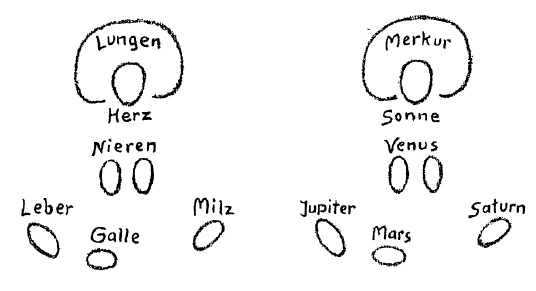
[ 13 ] I have already pointed out—and we will see in more detail later to what extent such a naming is justified—that in occultism, the action of the spleen is described as a Saturnian influence, that of the liver as a Jovian influence, and that of the gallbladder as a Martian influence. For the same reason, occult knowledge regards the heart and its associated circulatory system as deserving the name “Sun” within the human organism just as much as the Sun outside within the planetary system. Following the same principle, the occultist designates the pulmonary system as “Mercury” and the renal system as “Venus.” Thus, even in the naming of these systems of the human organism—though we are not now going into a justification of these names—we have already hinted at something like an inner world system, which we have further supplemented by placing ourselves in a position to also consider the connection between the two organ systems related to the blood system. Only when we consider these connections in this sense does what we might call the actual inner human world present itself to us in its entirety. In the following lectures, I will also have to show you that the occultist indeed has reasons to conceive of the relationship between the Sun, Mercury, and Venus in a similar way to how the relationship between the heart, lungs, and kidneys must be conceived within the human organism.
[ 14 ] We see from this that in the instrument of our ego—our circulatory system, which expresses its rhythm in the heart—there is something that is, so to speak, determined in its entire structure, in its inner nature and essence, by the inner world system of the human being, and that it must be embedded in such a [macrocosmic] overall system so that it can live as it does. In this human blood system—as I have often mentioned—we must see the physical instrument of our ego. We know, of course, that our ego, as we possess it, is only possible because this ego is built upon the foundation of a physical body, an etheric body, and an astral body. A human ego flying freely about in the world is inconceivable within the world that is our world. A human I presupposes as its foundation an astral body, an etheric body, and a physical body. Just as this I presupposes, in a spiritual sense, the three aforementioned members of the human being, so its physical organ, the blood system, also presupposes, physically, such reflections of the astral and etheric bodies. The blood system can therefore only develop on the basis of something else. While the plant simply develops on the basis of the inorganic nature surrounding it, growing out of it, as it were, we must say that for the human blood organism, external nature alone is not immediately sufficient as a foundation; rather, this external nature must first undergo a transformation. Just as the human physical body must first have an etheric body and an astral body, so too must the nutrients that flow in be transformed first so that they can serve the human ego as an instrument.
[ 15 ] While we can say that this physical instrument of the human ego—the blood—is influenced from the outside by the lungs, the lungs themselves are an organ of the physical body; that is to say, it is not this organ itself, but rather the air inhaled through it, that makes it possible to influence the blood with an external rhythm. We must distinguish between what approaches the human being from the outside in the form of the air that is inhaled—which enables the human being to directly permeate their blood system with an external rhythm— and that which does not approach the living instrument of the ego in the organism—the blood—directly, but rather approaches—in the manner already described—indirectly through the soul; that which the human being thus takes in by receiving impressions of the external world through the senses, and these senses then convey their impressions all the way to the blood. Therefore, we can say: The human being does not merely come into direct material contact with the external world through the air breathed in, in that this contact affects the blood, but through the sense organs the human being also comes into contact with the external world in such a way that this contact is a non-material one, as it takes place in the process of perception that the soul unfolds when it relates to the environment. Here we have something that adds itself as a higher process to the breathing process; we have something like a spiritualized breathing process. While we take in the external world in a material sense through the breathing process, in the process of perception—and by “perception” I now mean everything that a human being processes in terms of external impressions—we take something into our organism through a spiritualized breathing process. And the question now arises: How do these two processes interact? For in the human organism, everything must interact with one another.
[ 16 ] Let us examine this question more closely—for much will depend on our examining it precisely—so that we may bring the answer, which for now must remain hypothetical, before our souls. We must become clear about how an interaction, a mutual influence, can take place between all that acts through the blood and what it has become as a result of all these internal organ processes having taken place, and what the blood becomes as we carry out external perceptual processes. We must see that an interaction can take place here. The blood, despite being so thoroughly and so diversely filtered, despite so much having been done to ensure that it is such a wonderfully organized substance capable of serving as the instrument of our ego, the blood is nevertheless a physical substance and, as such, belongs to the physical body. Therefore, we can say: At first glance, there appears to be a vast, vast distance between the physical processes at work in human blood and what we know as our perceptual processes, which the soul carries out. This is an undeniable reality; for one would have to be strangely incapable of thinking to deny that perceptions, concepts, ideas, feelings, and impulses of the will are just as real as blood substance, nerve substance, liver substance, bile substance, and so on. Worldviews may dispute how these things are connected; they may dispute whether thoughts are merely effects, say, of nervous substance or the like. This is where a dispute among worldviews might begin. But there can be no dispute about this, because it is self-evident that our inner spiritual life, our life of thought, our life of feeling—everything that is built upon external perceptions and impressions—constitutes a reality in itself. Mind you, I am not saying: a separate reality—but rather: a reality in itself, for nothing in the world is separate. By “reality in itself” I merely mean to indicate what can be observed as real, and this includes thoughts, feelings, and so on just as much as the stomach, liver, gallbladder, and spleen.
[ 17 ] But something else may strike us when we compare these two realities side by side: On the one hand, everything that is material and physical, however heavily filtered, such as blood; and on the other hand, that which at first glance seems to have nothing at all to do with the physical—namely, the contents of the soul: feelings, thoughts, and so on. In fact, the sight of these two kinds of realities presents such difficulties for human beings that the most diverse answers from a wide variety of worldviews have become associated with this sight. There are worldviews that assume a direct influence of the soul, of thought, and of feeling upon physical substance, as if thought could act directly upon physical substance. Opposed to these are the materialistic ones, which assume that thoughts, feelings, and so on are simply produced out of the processes of the physical-substantial. The conflict between these two worldviews has, of course, played a major role in the outer world—not for the occultist, for whom this conflict is a conflict of empty words—throughout long periods of time. And when people finally could no longer make sense of it, something else emerged in more recent times, bearing the peculiar name “psychophysical parallelism.” Because people no longer knew how to resolve which of the two ideas was correct—whether the spirit acts upon the physical processes, or the physical processes act upon the spirit—they simply said that these were two processes occurring in parallel. People said to themselves: While a person thinks, feels, and so on, very specific processes take place in parallel within their physical organ systems. — The perception “I see red” would thus correspond to some material process within the nervous system. What we perceive in a red impression, what we feel in terms of joy or pain in connection with it, corresponds to a material process. But one goes no further than to say that it simply “corresponds.” This theory effectively eliminates all the difficulties by simply explaining them away. Well, all the disputes that have arisen on this ground, as well as the helplessness of psychophysical parallelism, stem from the fact that one seeks to resolve these questions on a ground where they cannot be resolved at all. We are dealing with non-material processes when we consider the activities of our inner mental life, and we are dealing with material processes when we direct our observations even to something as finely organized as blood. If one simply sets these two things against each other—physical activity and mental activity—and now attempts through reflection to determine how these two interact, such reflection yields absolutely nothing. Through reflection, one can arrive at any arbitrary solution or non-solution. Only by truly acquiring a higher form of knowledge—one that does not stop at the physical observation of the external world nor at thinking bound to the mere physical external world—will we be able to reach a decision on these questions. We must find a form of knowledge that rises to that which leads beyond the physical into the supraphysical world. On the one hand, we must ascend from the material to the supramaterial, to the supraphysical; but on the other hand, we must also ascend from the soul life that unfolds in the physical world to that which underlies our soul life in the supraphysical world, for with our soul life, with all our feelings and so on, we also live in the physical world. We must therefore ascend from two sides to a supraphysical world.
[ 18 ] In order to ascend from the material realm into the supersensible world, we need those spiritual exercises that enable us to look beyond the outer sensory world, beyond the veil I have spoken of, into which our sensory impressions are woven. We are confronted with such sensory impressions even when we observe the outer human organism; even in the most finely organized part of the human organism, the blood, we are dealing with something physical-sensory. Spiritual exercises are necessary to lead the human being into the supersensible world. First, they must descend one level deeper than where they were when they could take in the soul impressions within themselves, below the plane of the physical. In the depths of the physical-sensory world, the etheric body meets them as the supersensible aspect of the human organism. This etheric body—we will discuss it in greater detail later, particularly from an occult-physiological standpoint—is a supersensible organization that we may initially conceive simply as the supersensible fundamental substance from which the human sensory organism emerges and of which it is an image, an imprint. The blood, of course, is also an imprint of this etheric body. So now, having stepped one level beyond the physical-sensory organism, we have found a supersensible element in the human etheric body. And the question now arises: Can we now also approach this supersensible aspect, this etheric body, from the other side, from the side of the soul, from our sensations, thoughts, and feelings, which we build up from impressions of the external world?
[ 19 ] It turns out, however, that no matter how immediate our inner life may be, we cannot immediately access the etheric organism. But—and let me conclude today’s reflection with this—when we work within our soul, it happens in such a way that we first receive external impressions; the external world acts upon the senses, and then we process these external impressions in our soul; but we do even more: we store these received impressions within ourselves, as it were. Just think for a moment about the simple phenomenon of memory. When you recall something about which you gained impressions years ago based on external perceptions, formed mental images that you now bring up from the depths of your soul, and the memory comes to you—let’s say of something very simple, a tree or a scent—then you must say that you have stored something in your soul that has remained with you from the external impression. Now, however, a view of the life of the soul itself—which can only be gained through exercises of the soul—shows us that at the moment when our soul life has developed to the point where we can recall stored impressions as memories, our soul experiences do not act solely within our ego. At first, we do this by facing the external world with our ego, taking in impressions from it, and processing them in the astral body. But if we did only that, we would forget everything immediately. When we draw conclusions, we work in the astral body. But when we fix the impressions within us so firmly that we can recall them after some time—or even after just a few minutes—then we imprint the impressions that we have gained through our ego and processed through our astral body into our etheric body; so that we have, through the ego, imprinted into the etheric body in our memory images that which we have gained as soul activity in contact with the external world. If we now have the ability to press our memory images from our soul into the etheric body, and if we recognize the etheric body, on the other hand, as the next supersensible expression of our organism, the question then arises: How does this pressing in take place? How does it happen that the human being actually brings what has been processed by the astral body into the etheric body? How can he transfer it into the etheric body? This transfer takes place in a very remarkable way. If we first consider, quite schematically, the course of the blood through the entire human body and regard this blood as the outer physical expression of the human ego, then we see—if we now view this as though we were standing inside the etheric body—how the ego works in correspondence with the external world, how it receives impressions and condenses them into ideas, and we see how, in the process, our blood is not only active, but how our blood, throughout its entire course—namely upward, less so downward—stimulates the etheric body everywhere, so that we see currents developing throughout the etheric body that take a very specific course. They appear as if they were connecting with the blood, flowing from the heart to the head, and gathering in the head. They gather in much the same way—if I may now use an external comparison—as streams of electricity flow toward one point, which is opposed by another point, and thus strive toward the equalization of positive and negative electricity.
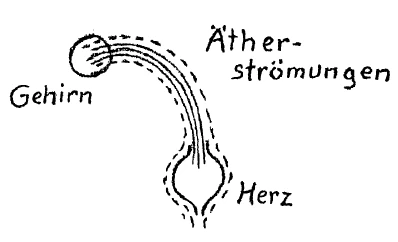
[ 20 ] If we observe this process from an occult perspective with a suitably trained soul, we see how, at a single point, those etheric forces—brought about by the impressions that are now seeking to become specific mental images, memories that wish to imprint themselves on the etheric body—converge under immense tension. One can see from the etheric forces that they are striving to become memory forces. I wish to depict the final extensions of these etheric currents as they rise toward the brain and the gathering of forces as it would appear in reality. We see there a powerful tension gathering in one place and, as it were, saying: I want to enter the etheric body! — We now see how other currents meet this etheric current of the head, currents emanating specifically from the lymphatic vessels and gathering in such a way that they oppose the first current. Thus, in the brain, when a memory image is about to form, we have two etheric currents facing each other, concentrating with the greatest possible force, much like positive and negative electricity concentrate at their poles with the greatest tension and strive for equilibrium. An equilibrium between the two etheric currents does indeed occur, and when it is achieved, a mental image has become a memory and has been incorporated into the etheric body.
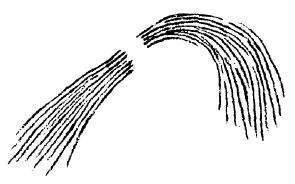
[ 21 ] Such supersensible realities, such supersensible currents within the human organism, express themselves by creating a physical-sensory organ, which we must regard as a materialization of these currents. Thus we have an organ located in the middle brain that is the physical-sensory expression of what seeks to form as a memory image. Opposite this is another organ in the brain, which is the expression of those currents in the etheric body that come from the lower organs. These two organs in the human brain are the physical-sensory expression of these two currents in the human etheric body; they are, as it were, the final signs that such currents are taking place in the etheric body. These currents, as it were, condense so strongly that they take hold of the human bodily substance and condense into these organs, so that we indeed have the impression that bright streams of light radiate from one organ and overflow into the other. The physical organ that seeks to form the memory image is the pineal gland; the receiving part is the pituitary gland.
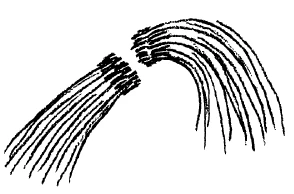
[ 22 ] Here, at a very specific point in the physical organism, you have the external physical manifestation of the interaction between the soul and the body!
[ 23 ] This is intended, for now, merely as a general overview, with which we wish to conclude today’s discussion; we plan to continue this discussion tomorrow and to follow it up with more specific and verifiable details. It is important that we firmly hold on to the idea that we can investigate the supersensible, and then ask ourselves whether the expected physical expression of the supersensible actually exists. We have seen here that this is the case. However, since this concerns the gateway from the sensory to the supersensory, you will understand that these organs are highly questionable for physical science, and that external science can provide only extremely inadequate and insufficient information about them.