

The World of the Senses
and
The World of the Spirit
GA 134
1 January 1912, Hannover
Translate the original German text into any language:
Versions Available:
The World of the Senses and the World of the Spirit, tr. SOL
Sechster Vortrag
Sixth Lecture
[ 1 ] Sie werden vielleicht gerade aus diesen Vorträgen haben entnehmen können, ein wie kompliziertes Wesen der Mensch eigentlich ist und von wie vielerlei Seiten man den Menschen betrachten muß, wenn man seinem Wesen beikommen will. Es soll in diesem Augenblicke nur noch auf eine Tatsache hingewiesen werden, die sich gewissermaßen als eine der bedeutendsten Entwickelungstatsachen ergibt, wenn man an der Hand hellseherischer Forschung des Menschen Werdegang von sehr alten Zeiten bis heute und seine Aussichten in die Zukunft des Menschengeschlechtes hinein betrachtet. Ich habe Sie ja im Verlaufe der Vorträge darauf aufmerksam gemacht, daß, wenn man sein Erkenntnisvermögen, seinen Erkenntnistrieb so erzieht, daß die menschliche Seele, während sie die Erkenntnis anstrebt, aufnimmt die Zustände, die wir bezeichnen können als Staunen, Verehrung, weisheitsvollen Einklang mit den Weltereignissen und Ergebenheit gegenüber allem Weltgeschehen, dann die Erkenntnis sich allmählich dazu aufschwingen kann, überall in dem, was uns umgibt, zu unterscheiden: Hier habe ich es mit einem Werdenden zu tun, mit einem, das erst in der Zukunft seine Vollkommenheit erlangen wird, und auf der anderen Seite habe ich es mit einem allmählich Ersterbenden, Hinschwindenden zu tun. In der Region des Entstehens und Vergehens nehmen wir ja solche Dinge wahr. Und es ist insbesondere darauf hingewiesen worden, wie der menschliche Kehlkopf eigentlich ein Zukunftsorgan ist, wie er dazu berufen ist, in der Zukunft etwas ganz und gar anderes zu sein, als er heute ist. Heute teilt er nur unsere inneren Zustände durch das Wort der Außenwelt mit, während er in der Zukunft mitteilen wird alles das, was wir selbst sind, das heißt, was zur Hervorbringung des ganzen Menschen dienen wird. Er wird das zukünftige Reproduktionsorgan sein. Der Mensch wird in der Zukunft nicht nur die Verfassung seines Gemütes durch das Wort zum Ausdruck bringen mit Hilfe des Kehlkopfes, sondern er wird sich selbst in die Welt hinein durch den Kehlkopf zur Darstellung bringen; das heißt, die Vermehrung des Menschen wird an das Organ des Kehlkopfes gebunden sein.
[ 1 ] You may have gathered from these lectures just how complex human nature actually is, and from how many different angles one must view human beings if one wishes to understand their nature. At this moment, I would like to point out just one fact that emerges, so to speak, as one of the most significant developmental facts when we examine the course of human development from very ancient times to the present day—and the prospects for the future of the human race—through the lens of clairvoyant research. I have, in the course of these lectures, drawn your attention to the fact that if one trains one’s capacity for knowledge and one’s drive for knowledge in such a way that the human soul, while striving for knowledge, absorbs states that we can describe as wonder, reverence, a wise harmony with world events, and a sense of surrender to all worldly occurrences—then knowledge can gradually rise to the point of discerning everywhere in what surrounds us: Here I am dealing with something in the process of becoming, with something that will only attain its perfection in the future, and on the other hand I am dealing with something that is gradually dying out, fading away. In the realm of becoming and passing away, we do indeed perceive such things. And it has been pointed out in particular how the human larynx is actually an organ of the future, how it is destined to be something entirely different in the future than it is today. Today it merely communicates our inner states to the outer world through speech, whereas in the future it will communicate all that we ourselves are—that is, what will serve to bring forth the whole human being. It will be the future organ of reproduction. In the future, human beings will not only express the state of their minds through speech with the help of the larynx, but they will also present themselves to the world through the larynx; that is to say, the procreation of human beings will be bound to the organ of the larynx.
[ 2 ] Nun gibt es in diesem komplizierten Mikrokosmos, in dieser komplizierten kleinen Welt, die wir als den Menschen bezeichnen, für ein jegliches Organ, das in dieser Weise gleichsam in seinem Samenzustande ist und in der Zukunft dann einen höheren Vollkommenheitsgrad erreichen wird, ein anderes Organ, welches dafür — sagen wir — in allmählicher Abnahme, im Hinsterben ist. Für den menschlichen Kehlkopf ist nun das entsprechende hinschwindende Organ der Gehörapparat. Und in demselben Maße, in dem der Gehörapparat für den Menschen immer mehr dahinschwinden wird, immer mehr abnehmen wird, in demselben Maße wird der Kehlkopf immer vollkommener und vollkommener werden, ein immer bedeutungsvolleres Organ werden. Die ganze Größe dieser Tatsache können wir nur dann ermessen, wenn wir sozusagen mit Hilfe der AkashaChronik in eine weite Vergangenheit des Menschen zurückblicken und dann aus dem, was wir da erforschen können, uns eine Vorstellung zu bilden in der Lage sind, was denn der Gehörapparat, das Ohr, einmal eigentlich war. Ungeheuer aufschließend für die Erkenntnis des menschlichen Wesens ist es, gerade das Ohr zurückzuverfolgen. Denn in seinem jetzigen Zustand ist dieser Gehörapparat des Menschen eigentlich, man möchte sagen, wirklich nur noch ein Schatten dessen, was er war. Dieser menschliche Gehörapparat hört heute nur die Töne oder die in Tönen sich ausdrückenden Worte des physischen Planes. Das ist gewissermaßen ein letzter Rest dessen, was durch das Gehör in den Menschen eingeflossen ist, ein letzter Rest davon; denn es flossen einstmals durch diesen Apparat ein die gewaltigen Bewegungen des ganzen Universums. Und wie wir heute nur irdische Musik durch das Ohr hören, so floß in den Menschen herein in alten Zeiten Weltenmusik, Sphärenmusik. Und wie wir heute die Worte in die Töne kleiden, so kleidete sich einstmals in die Sphärenmusik das göttliche Weltenwort, dasjenige, wovon das Johannes-Evangelium als dem göttlichen Weltenworte, dem Logos, kündet. Aus der geistigen Welt floß ein in alles, was im alten Sinn als Gehör bezeichnet werden kann, wie jetzt nur das menschliche Wort und die irdische Musik, so einst die himmlische, die Sphärenmusik, und innerhalb der Sphärenmusik das, was die göttlichen Geister sprachen. Und wie heute der Mensch durch sein Wort und durch seinen Gesang, durch seinen Ton die Luft in Formen zwingt, in Formen bringt, so brachten die göttlichen Worte und die göttliche Musik Formen hervor.
[ 2 ] Now, within this complex microcosm, within this complex little world that we call the human being, for every organ that is, as it were, in its embryonic state in this way and will in the future attain a higher degree of perfection, there is another organ that is—let us say—in gradual decline, in the process of dying out. For the human larynx, the corresponding organ that is fading away is the auditory apparatus. And to the same extent that the auditory apparatus will increasingly fade away for human beings, will increasingly diminish, to that same extent the larynx will become more and more perfect, will become an ever more significant organ. We can only grasp the full magnitude of this fact if we look back, so to speak, into humanity’s distant past with the help of the Akashic Records and are then able to form a mental image, based on what we can investigate there, of what the auditory apparatus—the ear—actually once was. It is immensely illuminating for the understanding of the human being to trace the ear back in time. For in its present state, this human hearing apparatus is, one might say, really nothing more than a shadow of what it once was. Today, this human hearing apparatus hears only the sounds or the words expressed in sounds of the physical plane. This is, in a sense, a last remnant of what once flowed into human beings through hearing, a last remnant of it; for once upon a time, the mighty movements of the entire universe flowed through this apparatus. And just as we today hear only earthly music through the ear, so in ancient times the music of the worlds, the music of the spheres, flowed into human beings. And just as we today clothe words in sound, so once the divine Word of the world—that of which the Gospel of John speaks as the divine Word of the world, the Logos—was clothed in the music of the spheres. From the spiritual world flowed into everything that in the ancient sense can be called hearing—just as now only the human word and earthly music, so once the heavenly, the music of the spheres, and within the music of the spheres, that which the divine spirits spoke. And just as today human beings, through their speech and their singing, through their sound, compel the air into forms, bring it into forms, so the divine words and the divine music brought forth forms.
[ 3 ] Und die kostbarste dieser Formen, die kann uns in der folgenden Weise vor die Seele treten. Betrachten Sie einmal, wenn Sie heute irgendein Wort, meinetwillen auch nur einen Vokal aussprechen, zum Beispiel das A, wie dann durch dieses A in die Luft eindringt die Möglichkeit, in dieser Luft eine Form zu bilden. So drang heraus aus dem Weltenwort in die Welt herein die Form, und die kostbarste dieser Formen ist der Mensch selber. Der Mensch selber in seinem Urzustande wurde erzeugt dadurch, daß er aus dem göttlichen Worte ausgesprochen wurde. Die Götter sprachen — und wie heute die Luft in Formen kommt durch des Menschen Wort, so kam unsere Welt in ihre Form hinein durch das Wort der Götter. Und der Mensch ist die kostbarste dieser Formen. Da war allerdings das Gehörorgan ein viel, viel komplizierteres noch. Jetzt ist es zusammengeschrumpft. Denn das, was Sie heute als äußeres Gehörorgan haben, was nur bis zu einer gewissen Tiefe in das Gehirn eindringt, das breitete sich von außen nach innen aus über die ganze menschliche Wesenheit. Und überall im Innern der menschlichen Wesenheit breiteten sich aus die Wellengänge, die den Menschen aus dem Gotteswort heraus in die Welt hineinsprachen. So ist der Mensch, als er noch spirituell erzeugt wurde, erzeugt worden durch das Gehörorgan, und so wird in der Zukunft der Mensch, wenn er wieder aufgestiegen sein wird, ein ganz rudimentäres, ein ganz zusammengeschrumpftes Ohr haben. Der Sinn des Ohres, er wird ganz und gar vergangen sein. Das Ohr ist in absteigender Bewegung; dafür aber wird zu höherem Glanze und höherer Vollkommenheit sich entwickelt haben das, was heute erst im Samenzustande ist, der Kehlkopf. Und in seiner Vollkommenheit wird es hinaussprechen das, was der Mensch für die Welt als die Wiederholung seines Wesens hervorbringen kann, wie die Götter den Menschen als ihr Geschöpf auf die Erde hereingesprochen haben. So kehrt sich der Weltengang in einer gewissen Weise um. Dieser ganze Mensch, wie wir ihn haben betrachten können, er ist so, eben wie er vor uns steht, das Produkt einer absteigenden Entwickelung, und wenn wir ein solches Organ wie das Ohr betrachten, so müssen wir uns überall sagen: Dieses Ohr, das es schon bis zu der inneren Verdichtung des Knochigen in den Gehörknöchelchen gebracht hat, dieses Ohr ist sozusagen im letzten Stadium absteigender Entwickelung. Der Sinn als solcher schwindet hin, der Mensch aber entwickelt sich in die Welt der Geistigkeit hinein, und seine aufsteigenden Organe sind die Brücken, die ihn hinaufleiten in die Geistigkeit. So verhält sich die Welt der Sinne zu der Welt des Geistes, indem die Welt der Sinne uns angezeigt wird durch lauter absterbende Organe, die Welt des Geistes durch aufsteigende Organe.
[ 3 ] And the most precious of these forms can present itself to our soul in the following way. Consider this: when you utter any word today—even just a vowel, for example the letter A—the possibility of forming a shape in the air enters the air through that A. Thus the form emerged from the world-word and entered into the world, and the most precious of these forms is the human being itself. The human being itself, in its primordial state, was brought into being by being spoken forth from the divine Word. The gods spoke—and just as today the air takes on forms through the human word, so our world came into its form through the word of the gods. And the human being is the most precious of these forms. At that time, however, the organ of hearing was much, much more complex. Now it has shrunk. For what you have today as the external organ of hearing, which penetrates only to a certain depth into the brain, once spread from the outside inwards over the entire human being. And throughout the inner being of the human being, the wave currents spread out, speaking to humanity from the Word of God into the world. Thus, when humanity was still spiritually formed, it was formed through the organ of hearing; and so in the future, when humanity has ascended once more, it will have a very rudimentary, a very shrunken ear. The function of the ear will have passed away entirely. The ear is in a state of decline; in its place, however, what is today only in a seed-like state—the larynx—will have developed to greater splendor and perfection. And in its perfection, it will speak forth what humanity can bring forth for the world as the repetition of its being, just as the gods spoke humanity into the world as their creation. Thus the course of the world is, in a certain sense, reversed. This whole human being, as we have been able to observe him, is, just as he stands before us, the product of a descending development; and when we consider an organ such as the ear, we must say to ourselves everywhere: This ear, which has already reached the inner densification of the bony structure in the ossicles, this ear is, so to speak, in the final stage of descending development. The sense as such is fading away, but the human being is developing into the world of the spiritual, and his ascending organs are the bridges that lead him upward into the spiritual. This is the relationship between the world of the senses and the world of the spirit: the world of the senses is revealed to us through organs that are all dying off, while the world of the spirit is revealed through ascending organs.
[ 4 ] Und so ist es in aller Welt, insofern uns diese Welt gegeben ist. In aller Welt können wir verfolgen in einer gewissen Weise Werden und Vergehen. Und lehrreich ist es, anzuwenden die Idee, die uns über Werden und Vergehen gegeben wird, wichtig ist es, bedeutungsvoll, sie anzuwenden auf die übrige Welt. So ist uns zum Beispiel in der Welt des Mineralischen etwas gegeben, das auch in einer gewissen Weise in einer aufsteigenden Entwickelung ist, das jetzt in einer Art von Samenzustand ist. Und das ist das Quecksilber. Das Quecksilber ist ein Metall, das Verwandlungen durchmachen wird, aber Verwandlungen zum Vollkommenen. Das Quecksilber hat als Metall noch nicht alle diejenigen Kräfte pulverisiert, die ein jeder Stoff im Geistigen hat, bevor er Stoff wird. Es wird in der Zukunft noch Wesentliches aus seiner Spiritualität heraussetzen können und wird noch andere Formen annehmen können, so daß in der Welt des Mineralischen in gewisser Weise das Quecksilber dem menschlichen Kehlkopfe entspricht und auch in einer gewissen Weise dem Organ, dessen Anhangsorgan der Kehlkopf ist, der Lunge. Andere Metalle, sagen wir zum Beispiel das Kupfer, das ist dafür in einer Art absteigender Entwickelung. Das wird in der Zukunft so sich zeigen: Es hat nicht mehr innere spirituelle Kräfte, die es heraussetzen kann, sondern es muß immer mehr und mehr sich bloß zersplittern, bloß zerfallen, bloß zum Weltenstaube werden. Solche Zusammenhänge, wie sie jetzt eben angeführt worden sind mehr beispielsweise, die werden immer mehr und mehr von unserer jetzigen Zeit ab studiert werden. Man wird immer mehr die Verwandtschaft im Entstehen und Vergehen in den einzelnen Reichen der Natur studieren, wird darauf kommen, wie zum Beispiel nicht bloß durch Probieren, sondern durch die imaginative Erkenntnis eine gewisse Verwandtschaft metallischer Stoffe zu gewissen Organen des menschlichen Leibes gefunden werden kann, woraus sich dann ergeben wird, daß man diese Stoffe, deren Wirksamkeit ja aus der äußeren Erfahrung zum Teil bekannt ist, aus der Imagination heraus gerade in ihrer Heilkraft, in ihrer reproduktiven und restituierenden Kraft auch für den menschlichen Leib wird erkennen lernen. Überhaupt Verwandtschaften der einzelnen Wesenheiten werden sich in der mannigfaltigsten Art ergeben.
[ 4 ] And so it is throughout the world, insofar as this world is given to us. Throughout the world, we can observe, in a certain sense, becoming and passing away. And it is instructive to apply the idea that is given to us regarding becoming and passing away; it is important, indeed meaningful, to apply it to the rest of the world. For example, in the mineral world, we are given something that is also, in a certain sense, in a state of ascending development, something that is now in a kind of seed state. And that is mercury. Mercury is a metal that will undergo transformations, but transformations toward perfection. As a metal, mercury has not yet pulverized all those forces that every substance possesses in the spiritual realm before it becomes matter. In the future, it will still be able to release essential elements from its spirituality and will still be able to assume other forms, so that in the mineral world, mercury corresponds in a certain way to the human larynx and also, in a certain way, to the organ of which the larynx is an accessory organ: the lung. Other metals, let us say for example copper, are in a sort of descending development. This will become apparent in the future: it no longer possesses inner spiritual forces that it can release, but must instead increasingly merely shatter, merely disintegrate, merely become the dust of the world. Such connections, as have just been mentioned and others like them, will be studied more and more in our present time. People will increasingly study the kinship in the arising and passing away within the individual kingdoms of nature, and will come to realize how, for example, not merely through experimentation but through imaginative insight, a certain kinship between metallic substances and certain organs of the human body can be discovered, from which it will then follow that one will learn to recognize these substances—whose effects are, after all, partly known from external experience—through imagination precisely in their healing power, in their reproductive and restorative power, also for the human body. In general, affinities between individual entities will reveal themselves in the most manifold ways.
[ 5 ] So wird man erkennen, daß an der Pflanze alles das, was im Samen ruht, was in der Samenkraft darinnen ist, in anderer Weise mit dem Menschen verwandt ist als das, was zum Beispiel in der Wurzel der Pflanze enthalten ist. Alles das, was in der Wurzel der Pflanze enthalten ist, das entspricht in einer gewissen Weise dem menschlichen Gehirn und dem sich anschließenden Nervensystem (siehe die Übersicht auf Seite 108). Und das geht so weit, daß in der Tat auch der Genuß von all dem, was in den Pflanzenwurzeln enthalten ist, eine gewisse Verwandtschaft hat mit den Prozessen, die sich in Gehirn und Nervensystem abspielen. So daß in einer gewissen Weise der Mensch, wenn er will, daß sein Gehirn und Nervensystem als physische Werkzeuge des Geisteslebens physisch beeinflußt werden sollen, dann dasjenige, was als Kräfte in den Wurzeln ist, mit den Nahrungsmitteln zu sich nimmt. Er läßt dann dasjenige, was er in sich aufnimmt, in einer gewissen Weise in sich denken, in sich geistige Arbeit verrichten, während er, wenn er weniger dazu neigt, sagen wir das wurzelhafte Wesen aufzunehmen, es dann mehr selber sein wird, seine Geistigkeit, welche das Gehirn und Nervensystem benutzt. Daraus ersehen Sie, daß viel Wurzel-Genuß den Menschen in bezug auf sein seelisch-geistiges Erleben unselbständig macht, weil das Objektive, das Äußere, durch ihn arbeitet, weil sozusagen das Gehirn und Nervensystem verselbständigt werden. Wenn der Mensch also in einem höheren Maße es selbst sein will, was in ihm arbeitet, dann muß er sich beschränken in bezug auf den Wurzel-Genuß. Meine lieben Freunde, das sind keine Anweisungen zu irgendeiner Diät, sondern nur Mitteilungen über die Tatsachen der Natur. Denn ich ermahne Sie ausdrücklich, sich nicht ohne weiteres an solche Regeln zu halten. Nicht jeder Mensch ist so weit, daß er nicht nötig hat, sich die Kraft des Denkens von dem Objektiven abnehmen zu lassen, und es kann sehr leicht geschehen, daß der Mensch, der noch nicht reif ist, sich die Kraft des Denkens und Empfindens von dem objektiven Seelenleben abnehmen zu lassen, dann, wenn er den Genuß von Wurzeln aus dem Pflanzenreich vermeidet, in eine Art schlafmützigen Zustand kommt, weil sein Spirituell-Psychisches noch nicht stark genug ist, um in sich die Kräfte aus dem Geistigen heraus zu entwickeln, die sonst eben objektiv, ohne Zutun des SpirituellPsychischen im Menschen entwickelt werden. So liegt die Sache. Alle Diät ist ganz individuell und ganz und gar abhängig von der Art und Weise, wie der Mensch in dieser oder jener Weise entwickelt ist.
[ 5 ] Thus, one will recognize that everything in the plant that lies dormant in the seed—that is, the seed force contained within it—is related to the human being in a different way than, for example, what is contained in the plant’s root. Everything contained in the root of the plant corresponds in a certain way to the human brain and the associated nervous system (see the overview on page 108). And this goes so far that, in fact, the consumption of everything contained in plant roots also has a certain kinship with the processes taking place in the brain and nervous system. So that in a certain way, if a person wishes for their brain and nervous system—as the physical instruments of spiritual life—to be physically influenced, they consume, through their food, the forces present in the roots. They then allow what they take in to, in a certain sense, think within them, to perform spiritual work within them, whereas if they are less inclined to, let us say, take in the root-like essence, it will then be more their own spirit that uses the brain and nervous system. From this you can see that excessive consumption of root vegetables makes a person dependent in terms of their soul-spiritual experience, because the objective, the external, works through them, because, so to speak, the brain and nervous system become independent. So if a person wants to be, to a greater extent, the very thing that works within them, then they must limit themselves with regard to root-food consumption. My dear friends, these are not instructions for any kind of diet, but merely statements about the facts of nature. For I expressly urge you not to adhere to such rules without further thought. Not every person is at a stage where they do not need to have their power of thought taken away from the objective world, and it can very easily happen that a person who is not yet mature enough to have their power of thought and feeling taken away from the objective life of the soul when he avoids the consumption of roots from the plant kingdom, may fall into a sort of drowsy state, because his spiritual-psychic nature is not yet strong enough to develop within himself the forces from the spiritual realm that are otherwise developed objectively, without the intervention of the spiritual-psychic in the human being. That is how it is. Every diet is entirely individual and depends entirely on the way a person is developed in this or that respect.
[ 6 ] Dasjenige, was zum Beispiel in den Blättern der Pflanze ist, das steht in einer ähnlichen Weise in einem Zusammenhange mit dem, was wir als Lunge ansehen können, und all dem, was zum Lungensystem gehört. Hier haben wir schon etwas, das uns darauf hinweist, wie eine Art Bilanz geschaffen werden kann in einem Menschen, von dem zum Beispiel gesagt werden kann, daß sein Atmungssystem durch seine vererbten Anlagen oder durch sonstige Verhältnisse im Übermaß von innen her erhalten ist. Bei dem wäre es gut, ihm abzuraten, in seiner Nahrung vorzugsweise das zu genießen, was die Blätter der Pflanze liefern. Demjenigen aber, dem: wir nachhelfen wollen in bezug auf sein Atmungssystem, sein Lungensystem, dem tun wir gut, anzuraten, möglichst viel Blättriges zu genießen. Diese Dinge hängen dann wieder zusammen mit den Heilkräften, die in der Welt in den einzelnen Reichen draußen sind, denn diejenigen Teile der einzelnen Pflanze, welche eine bestimmte Verwandtschaft zu solchen Organen haben, diese Teile der Pflanze sind es vorzugsweise, welche auch für diese Sphären, für diese Gebiete des menschlichen Organismus die Heilkräfte enthalten. So daß also Wurzeln von Pflanzen viele Heilkräfte enthalten in bezug auf das Nervensystem, Blätter viele Heilkräfte enthalten in bezug auf das Lungensystem. Blüten der Pflanzen enthalten viele Heilkräfte in bezug auf das Nierensystem zum Beispiel, und Samen der Pflanzen enthalten in einer gewissen Weise Heilkräfte in bezug auf das Herz, aber nur so in bezug auf das Herz, daß heilkräftig die Samenkräfte sind, wenn sozusagen das Herz sich der Blutzirkulation zu stark widersetzt. Wenn es der Blutzirkulation zu stark nachgibt, dann sind mehr die Kräfte, die in den Früchten sind, in dem ausgereiften Samen also, in Betracht zu ziehen.
[ 6 ] What is found, for example, in the leaves of a plant is related in a similar way to what we might regard as the lungs and everything that belongs to the respiratory system. Here we already have something that points to how a kind of balance can be established in a person of whom it can be said, for example, that their respiratory system is maintained in excess from within due to their inherited predispositions or other circumstances. In such a case, it would be advisable to discourage them from consuming, in their diet, primarily what the plant’s leaves provide. But for those whom we wish to support with regard to their respiratory system, their lung system, we do them a favor by advising them to consume as many leafy parts as possible. These things are in turn connected to the healing powers found in the world within the various kingdoms outside, for those parts of the individual plant that have a specific affinity with such organs—it is these parts of the plant in particular that also contain the healing powers for these spheres, for these areas of the human organism. So, for example, plant roots contain many healing powers related to the nervous system, and leaves contain many healing powers related to the respiratory system. Plant flowers contain many healing powers in relation to the renal system, for example, and plant seeds contain, in a certain sense, healing powers in relation to the heart—but only insofar as the heart resists blood circulation too strongly. If it yields too much to blood circulation, then the powers found in the fruits—that is, in the mature seeds—are more significant to consider.
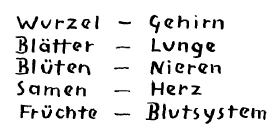
[ 7 ] Dies, sehen Sie, sind einzelne Andeutungen, die sich dann ergeben, wenn wir Rücksicht darauf nehmen, daß in dem Augenblick, wo wir vom Menschen hinausdringen in die uns umgebende Natur, dasjenige, was in dieser uns umgebenden Natur den Sinnen erscheint, was zur Sinneswelt gehört, eigentlich nur die Oberfläche ist. An den Pflanzen ist also das, was zur Sinneswelt gehört, nur das Oberflächliche; hinter dem, was dem Auge, dem Geschmacke, dem Geruche an der Pflanze erscheint, sind erst die geistig-seelischen Kräfte der Pflanze. Aber diese geistig-seelischen Kräfte der Pflanze sind nicht so in der Pflanze enthalten, daß wir etwa davon sprechen könnten, jede einzelne Pflanze wäre beseelt, wie jeder einzelne Mensch etwa beseelt ist. Das ist nicht der Fall. Derjenige, der glauben würde, jede einzelne Pflanze sei beseelt, der würde sich demselben Irrtum hingeben wie der, welcher glauben würde, jedes einzelne Haar oder das Ohrläppchen oder die Nase oder ein Zahn im Menschen sei beseelt. Der ganze Mensch ist beseelt, und wir erlangen einen Einblick in das Seelische des Menschen erst dann, wenn wir von seinen Teilen zum Ganzen gehen. Das müssen wir aber bei jeglichem Wesen tun. Wir müssen spirituell bei jeglichem Wesen sorgfältig darauf kommen, ob es Teil oder ob es in einer gewissen Weise Ganzes ist. Die sämtlichen Pflanzen der Erde sind nun keineswegs für sich ein Ganzes, sondern sie sind Teile, Glieder, und eigentlich sprechen wir von einem Wirklichen nur, wenn wir von dem sprechen, zu dem die Pflanzen als Teile, als Glieder gehören. Beim Menschen sehen wir das auch physisch, wozu seine Zähne, wozu sein Ohrläppchen, wozu seine Finger gehören, wir sehen es physisch als den Gesamtorganismus. Bei den Pflanzen sehen wir das, wozu die einzelnen Pflanzen gehören, nicht mit dem physischen Auge, nehmen es nicht wahr mit einem physischen Organ, sondern da gelangen wir gleich vom Teil zum Ganzen, da kommen wir gleich ins Geistige hinein. Und im wesentlichen müssen wir sagen: Das Seelische der Pflanzenwelt ist ein solches, welches in den Pflanzen nur seine einzelnen Organe hat. Und eigentlich sind es nur wenige Wesen in unserem Erdenganzen, die gleichsam zusammengestopft in der Erde sind und die als ihre einzelnen Teile die Pflanzen haben, wie der Mensch seine Haare an sich trägt.
[ 7 ] These, you see, are individual insights that arise when we take into account that, the moment we step out from the human being into the nature that surrounds us, what appears to the senses in this surrounding nature—what belongs to the sensory world—is actually only the surface. In plants, therefore, what belongs to the sensory world is only the superficial; behind what appears to the eye, the taste, and the smell in the plant lie the plant’s spiritual-soul forces. But these spiritual-soul forces of the plant are not contained in the plant in such a way that we could speak of every single plant as being animated, just as every single human being is animated. That is not the case. Anyone who were to believe that every single plant is animated would be committing the same error as one who believes that every single hair, or the earlobe, or the nose, or a tooth in a human being is animated. The whole human being is animated, and we gain insight into the soul of the human being only when we move from its parts to the whole. But we must do this with every being. Spiritually, we must carefully determine with every being whether it is a part or, in a certain sense, a whole. The totality of the plants on Earth is by no means a whole in and of itself, but rather they are parts, members, and in fact we speak of a reality only when we speak of that to which the plants belong as parts, as members. In the case of human beings, we also see this physically: to what his teeth, his earlobe, and his fingers belong—we perceive this physically as the whole organism. In the case of plants, we do not see with the physical eye to what the individual plants belong, nor do we perceive it with a physical organ; rather, we move directly from the part to the whole, and we enter immediately into the spiritual realm. And essentially we must say: The soul of the plant world is one that has only its individual organs in the plants. And actually, there are only a few beings in our entire Earth who are, as it were, crammed together in the Earth and who have the plants as their individual parts, just as the human being bears his hair upon himself.
[ 8 ] Wir können, wenn wir wollen, davon sprechen, daß, wenn wir über die Pflanze, insofern sie unseren Sinnen erscheint, hinausgehen, wir dann zu den Gruppenseelen der Pflanzen kommen, die sich zur Pflanze so verhalten wie das Ganze zum Teil. Im großen und ganzen gibt es sieben Gruppenseelen, die als Pflanzenseelen zur Erde gehören und alle im Erdmittelpunkt in einer gewissen Weise den Mittelpunkt ihres eigenen Wesens haben. So daß wir uns die Erde nicht nur als diesen physischen Ball vorstellen können, sondern diese Erde ist durchdrungen von sieben solchen mehr oder weniger großen oder kleinen Sphären, die alle im Mittelpunkt der Erde etwas haben wie einen eigenen geistigen Mittelpunkt. Und dann treiben diese geistigen Wesen die Pflanzen heraus aus der Erde. Die Wurzel wächst dem Mittelpunkt der Erde zu, weil sie eigentlich dahin will und nur durch die übrige Erdenmaterie abgehalten wird, bis zum Mittelpunkt vorzudringen. Jede Pflanzenwurzel hat das Bestreben, bis zum Mittelpunkte der Erde vorzudringen, wo der Mittelpunkt des geistigen Wesens ist, zu dem die Pflanze gehört. |
[ 8 ] If we wish, we can say that when we go beyond the plant as it appears to our senses, we then come to the group souls of the plants, which relate to the plant in the same way that the whole relates to the part. Broadly speaking, there are seven group souls that belong to the Earth as plant souls, and all of them have, in a certain sense, the center of their own being at the Earth’s center. So that we cannot merely imagine the Earth as this physical sphere, but rather this Earth is permeated by seven such spheres—some larger, some smaller—all of which have something like their own spiritual center at the Earth’s center. And then these spiritual beings drive the plants out of the Earth. The root grows toward the center of the Earth because it actually wants to go there and is only prevented by the rest of the Earth’s matter from reaching the center. Every plant root strives to reach the center of the Earth, where the center of the spiritual being to which the plant belongs is located. |
[ 9 ] So sehen wir also, daß wir etwas außerordentlich Wichtiges haben in dem Grundsatz, daß wir immer zu dem Ganzen gehen müssen, daß wir bei einem jeden Wesen darauf sehen müssen, ob es 'Teil oder Ganzes ist. In der neueren Zeit sehen einige Naturforscher die Pflanzen wohl als beseelt an, aber sie sehen die einzelnen Pflanzen als beseelt an. Das ist nicht geistreicher, als wenn man einen Zahn einen Menschen nennen würde; das steht auf derselben geistigen Höhe. Und alles das, wovon gerade heute viele sagen: Das ist schon ganz Anthroposophie, denn die sehen die Pflanzen als beseelt an — das ist für die Zukunft nichts weiter als wissenschaftliche Makulatur. Denn in den Pflanzen einzelne individuelle Seelen suchen, das würde eben heißen: Ich reiße einem Menschen einen Zahn aus und suche darin die Menschenseele. Die Pflanzenseele haben wir nicht zu suchen in der einzelnen Pflanze, sondern so, daß sogar ihr Wichtigstes im Mittelpunkte der Erde ist, nach welchem die Wurzel als die nach dem geistigsten Teile des Pflanzendaseins strebende Kraft hinzielt.
[ 9 ] So we see that we have something extraordinarily important in the principle that we must always look at the whole, that we must examine every being to see whether it is a ‘part or a whole.’ In recent times, some natural scientists do indeed regard plants as animated, but they regard individual plants as animated. That is no more intelligent than calling a tooth a human being; it is on the same intellectual level. And all that which many people say today: “That is already quite anthroposophical, for they regard plants as animated”—that will be nothing more than scientific rubbish in the future. For to seek individual souls in plants would be precisely like pulling a tooth from a human being and seeking the human soul within it. We are not to seek the plant soul in the individual plant, but rather in such a way that even its most essential part lies at the center of the Earth, toward which the root, as the force striving toward the most spiritual part of the plant’s existence, is directed.
[ 10 ] Wenn Sie nun ein solches Reich ins Auge fassen, dann wird Ihnen vom Standpunkte der heutigen Naturanschauung allerdings schon etwas entgegentreten, was uns in einer gewissen Weise so weit an die Pforte der Wahrheit bringen kann, wie Mephistopheles den Faust ins Reich der Mütter bringt, nämlich just bis zum alleräußersten Tor, nicht hinein in das Reich der Mütter. Denn ebensowenig, wie Mephistopheles mit dem Faust in das Reich der Mütter herunter kann, ebensowenig kann die heutige Naturwissenschaft in das Geistige hinein. Aber wie in gewisser Weise der Mephistopheles den Schlüssel gibt, gibt die Naturwissenschaft schon auch den Schlüssel. Sie will nur nicht selber hinein, wie Mephistopheles selber auch nicht hinein will in das Reich der Mütter. Also in gewisser Weise gibt uns Naturwissenschaft heute Anhaltspunkte, die dann, wenn Sie das so erkennen, wie wir es charakterisiert haben in diesen Vorträgen, dieses Erkennen oftmals an die Pforte des Wahren bringen können.
[ 10 ] If you now contemplate such a realm, then from the standpoint of today’s view of nature, something will indeed confront you that can, in a certain way, bring us as close to the gate of truth as Mephistopheles brings Faust to the realm of the Mothers—namely, right up to the very outermost gate, but not into the realm of the Mothers itself. For just as Mephistopheles cannot descend with Faust into the realm of the Mothers, so too can modern science not enter into the spiritual realm. But just as Mephistopheles, in a certain sense, provides the key, so too does modern science provide the key. It simply does not wish to enter itself, just as Mephistopheles himself does not wish to enter the realm of the Mothers. So in a certain sense, modern science gives us points of reference today which, if you recognize them as we have characterized them in these lectures, can often bring this recognition to the very threshold of the True.
[ 11 ] So spricht die Naturwissenschaft der Gegenwart, indem sie sich von Darwin hat anregen lassen, bloß aus der Welt der Sinne einen wichtigen naturwissenschaftlichen Grundsatz abzuleiten, von dem sogenannten Kampf ums Dasein. Wer wollte diesen Kampf ums Dasein nicht überall bemerken, wenn er nur das, was zunächst die äußere Sinneswelt darbietet, ins Auge faßt? Oh, dieser Kampf ums Dasein tritt uns ja überall entgegen! Wir brauchen nur zu beachten, wie, sagen wir, unzählige Keime von Meerestieren in das Meer oder an den Strand abgelegt werden, wie viele da zugrunde gehen und wie wenige zu wirklichen Tieren sich auswachsen, wie wenig Keime also wiederum Tiere werden und wie die anderen alle zugrunde gehen. Da schon beginnt sozusagen ein scheinbar furchtbarer Kampf ums Dasein, und man könnte nun anfangen zu lamentieren, wenn man bloß auf die Welt der Sinne hörte, und sagen: Von den Millionen und Abermillionen Keimen gehen im Kampf ums Dasein so viele zugrunde und nur wenige kommen fort. — Aber dies ist nur die eine Seite eines Gedankens. Denn fassen wir diesen Gedanken einmal an einem anderen Ende an. Gleichsam um Ihr Denken in eine gewisse Richtung zu bringen, möchte ich Sie ermahnen, den Gedanken am anderen Ende anzufassen. Sie können auch in der folgenden Weise lamentieren über den Kampf ums Dasein: Sie können Ihren Blick richten auf ein Getreidefeld, wo so und so viele Ähren mit so und so vielen Körnern stehen, und können sich jetzt fragen: Wieviel geht von diesen Körnern, die in den Getreideähren sind, in irgendeiner Weise für sein eigentliches Ziel verloren, und wie wenig davon wird wiederum in die Erde gesenkt, um Neues zu werden in demselben Sinne, wie es das Alte war? — Wir senden also unseren Blick über ein Ährenfeld hin, das in üppiger Fruchtbarkeit sproßt und sprießt, und sagen uns: Wieviel von dem, was da sproßt und sprießt, wird vergehen, ohne seinen Zweck erreicht zu haben, und nur weniges wird in die Erde gesenkt, so daß neue Pflanzen der gleichen Art entstehen. Es ist da also auch so, nur ein wenig auf einem anderen Gebiete, wie bei den Meerestieren, wo auch nur wenig Keime zur Entfaltung kommen.
[ 11 ] This is how modern science, inspired by Darwin, derives an important scientific principle—the so-called struggle for existence—solely from the sensory world. Who would not notice this struggle for existence everywhere, if only they were to take in what the external sensory world initially presents? Oh, this struggle for existence confronts us everywhere! We need only observe how, say, countless marine animal eggs are deposited in the sea or on the beach, how many perish there, and how few grow into actual animals—how few eggs, in other words, become animals, while all the others perish. There, so to speak, a seemingly terrible struggle for existence begins, and one might now start to lament, if one listened only to the world of the senses, and say: Of the millions and millions of embryos, so many perish in the struggle for existence and only a few survive. — But this is only one side of the story. For let us approach this thought from the other end. As it were, to steer your thinking in a certain direction, I would urge you to approach the thought from the other end. You can also lament the struggle for existence in the following way: You can turn your gaze to a grain field where there are so many ears of grain with so many kernels, and you can now ask yourself: How many of these grains in the ears of grain are lost in some way to their actual purpose, and how few of them are in turn sown into the earth to become something new in the same sense as the old was? — So we cast our gaze over a field of ears of grain that sprouts and grows in lush fertility, and say to ourselves: How much of what is sprouting and growing there will perish without having achieved its purpose, and only a little will be sown into the earth so that new plants of the same kind may arise. It is thus the same there, only in a slightly different realm, as with marine animals, where too only a few embryos come to fruition.
[ 12 ] Aber jetzt möchte ich Sie einmal fragen, was mit den Menschen, die etwas essen müssen, werden sollte, wenn alle Getreidekörner wiederum in die Erde gesenkt würden? Nehmen wir an, es könnte sein — theoretisch kann man ja alles annehmen —, daß so viel wächst, daß alle Getreidekörner wieder aufgehen könnten. Aber denken wir dann, was mit denjenigen Wesen geschehen würde, welche sich vom Getreide ernähren müssen! Hier, sehen Sie, kommen wir an etwas sehr Merkwürdiges; hier kommen wir zu einer Erschütterung in bezug auf einen Glauben, der uns berechtigt erscheinen könnte, wenn wir die Welt der Sinne anschauen. Es könnte uns berechtigt erscheinen, wenn wir, sagen wir in bezug auf rein sinnliches Dasein ein Ährenfeld anschauen, daß ein jegliches Korn wieder eine ganze Pflanze werde. Aber der Gesichtspunkt ist vielleicht falsch. Vielleicht ist es im Gesamtzusammenhange der Welt gar nicht so, daß wir richtig denken, wenn wir einem jeglichen Samenkorn den Zweck zuschreiben, wiederum eine ganze Pflanze zu werden, sondern vielleicht ist es so, daß uns nichts berechtigt zu sagen, daß irgendwie diejenigen Körner ihren Weltenzweck verfehlt haben, welche anderen Wesen zur Nahrung dienen, ebensowenig, wie uns irgend etwas zwingt zu sagen, daß die Samen der Meeresfische ihren Zweck verfehlt haben, die nicht wiederum zu Fischen geworden sind. Es ist nämlich wirklich nur ein menschliches Vorurteil, daß ein jeglicher Same wiederum zu demselben Wesen werden solle. Denn die Aufgaben der Einzelwesen können wir nur ermessen, wenn wir wiederum den Blick auf das Ganze richten. Und wenn das, was alljährlich in millionenfacher Weise an Samen im Meere zugrunde geht, auch nicht zu Fischen wird, so dient es dafür anderen Wesenheiten, die der Mensch jetzt nur nicht überschaut, zur Nahrung, gibt sich anderen Wesenheiten hin. Und wahrhaftig, diejenigen geistigen Substanzen, die sich ins Dasein ringen in den scheinbar zugrunde gehenden Meeressamen, die lamentieren nicht, daß sie ihr Ziel nicht erreichen — um Nahrung zu sein für andere Wesen, aufgenommen zu werden von diesen anderen Wesen. Der Mensch, der ja mit seinem Verstande außen steht, der glaubt, daß nur alles das eine Bedeutung habe, was sozusagen zu dem Ziele hinstrebt, das er durch seine Sinne als das letzte Ziel ansehen muß. Ein vorurteilslos auf die Natur gerichteter Blick sieht in jedem Stadium eines jeden Wesens etwas Vollkommenes, und solche Vollkommenheit ruht nicht erst in dem, zu dem ein Wesen wird, sondern in dem, was es ist.
[ 12 ] But now I would like to ask you: what would become of the people who need to eat if all the grains of wheat were to be sown back into the earth? Let us suppose—theoretically, anything is possible—that enough would grow so that all the grains of wheat could sprout again. But then let us consider what would happen to those beings who must feed on grain! Here, you see, we come to something very strange; here we encounter a shock regarding a belief that might seem justified to us when we look at the world of the senses. It might seem justified to us, when we look at a field of grain—say, in terms of purely sensory existence—that every single grain will become a whole plant again. But this perspective may be mistaken. Perhaps, in the overall context of the world, it is not at all the case that we are thinking correctly when we ascribe to every single seed the purpose of becoming a whole plant again; rather, perhaps it is the case that nothing justifies us in saying that those grains which serve as food for other beings have somehow failed in their purpose in the world, any more than anything compels us to say that the seeds of sea fish have failed in their purpose because they have not become fish again. For it is really only a human prejudice that every seed should become the same being again. For we can only gauge the tasks of individual beings when we turn our gaze back to the whole. And even if the millions of seeds that perish in the sea every year do not become fish, they serve as food for other beings—beings that humans cannot yet perceive—and give themselves up to other beings. And truly, those spiritual substances that struggle into existence within the seemingly perishing seeds of the sea do not lament that they do not reach their goal—to be food for other beings, to be taken in by these other beings. Human beings, who stand outside of this with their intellect, believe that only that which strives, so to speak, toward the goal they must regard as the ultimate goal through their senses has any meaning. A view of nature free of prejudice sees something perfect in every stage of every being, and such perfection does not lie only in what a being becomes, but in what it is.
[ 13 ] Das sind solche aus dem Okkultismus heraus gewonnene Gedanken, die in Ihnen angeschlagen werden müssen. Und wenn Sie jetzt von der Außenwelt zurückblicken auf die eigene Seele, dann werden Sie wahrnehmen, daß in dieser eigenen Seele eine Fülle von Gedanken ist, die fortwährend in diese Seele hereinströmen, fortwährend in dieser Seele aufleben, und wenige von diesen Gedanken nur werden klar gefaßt, wenige nur werden ein bewußter Teil der menschlichen Seele. Machen Sie irgendeinen Weg durch die Stadt und denken Sie daran, wie vieles da durch Ihre Sinne hereinfällt in Ihre Seele und wie wenig Sie es so beachten, daß es dann ein bleibender Bestandteil Ihres Seelenlebens wird. Sie nehmen fortwährend Eindrücke auf, und die Masse dieser Eindrücke, die Sie aufnehmen, verhält sich zu dem, was dann ein bleibender bewußter Besitz Ihrer Seele wird, geradeso, wie die große Menge der jährlich entstehenden Fischkeime im Meere sich zu dem verhält, was wirkliche, ausgewachsene Fische wird. Auch in Ihrem inneren Seelenleben müssen Sie auf dem Grund und Boden eines weiten Gebietes fortwährend die Prozedur ausführen, weniges nur zur Entfaltung kommen zu lassen. Und wenn der Mensch nur ein klein wenig dahinter kommt, aus welchem Flutenmeere von Phantasiegebilden und Vorstellungsgebilden er auftaucht, wenn er aus dem Schlafe auftaucht, wenn manchem Menschen noch der Traum eine letzte Spur zeigt von diesem ungeheuer reichen Leben, das der Mensch im Schlafzustande führt, dann kann er auch darauf kommen, daß es eine Bedeutung hat, wenn er so vieles in sich aufnimmt, was nicht zum deutlichen Bewußtsein kommt. Denn was zu einem deutlichen Bewußtsein kommt, das ist für die innere Arbeit des Menschen verloren, das arbeitet nicht mehr an dem System der Sinnesorgane, an dem System der Drüsenorgane, an dem System der Verdauung, an dem Nerven-, Muskel-, Knochensystem usw. Das, was in der Seele bewußt wird, was der heutige Mensch als bewußten inneren Seelengehalt in sich trägt, das arbeitet nicht mehr, das ist gerade dadurch charakterisiert, daß es losgerissen ist von dem Mutterboden des Gesamtmenschen und dadurch dem Menschen zum Bewußtsein kommt. Das, was sich verhält zu diesen bewußten Vorstellungen wie die vielen Samen zu den wenigen, die Fische werden, was da hereinkommt an ungeheuer vielen äußeren Eindrücken, aber nicht ins Bewußtsein hereinkommt, das arbeitet an dem Gesamtmenschen.
[ 13 ] These are ideas derived from the occult that must be instilled in you. And when you now look back from the outside world upon your own soul, you will perceive that within this soul there is a wealth of thoughts that continually flow into it, continually arise within it, and only a few of these thoughts are clearly grasped; only a few become a conscious part of the human soul. Take any walk through the city and think of how much enters your soul through your senses and how little you pay attention to it in such a way that it then becomes a lasting part of your soul life. You are constantly taking in impressions, and the mass of these impressions you take in bears to what then becomes a lasting, conscious possession of your soul in exactly the same way that the vast number of fish eggs produced annually in the sea bears to what becomes actual, fully grown fish. In your inner spiritual life, too, you must continually carry out the process of allowing only a little to unfold, against the backdrop of a vast expanse. And if a person can only begin to grasp from which vast ocean of imaginative and mental constructs they emerge—when they emerge from sleep, when for some people a dream still reveals a final trace of this immensely rich life that a person leads in the state of sleep— then they may also come to realize that it has significance when they take in so much within themselves that does not reach clear consciousness. For what reaches clear consciousness is lost to the inner workings of the human being; it no longer works on the system of the sense organs, on the system of the glandular organs, on the digestive system, on the nervous, muscular, and skeletal systems, etc. That which becomes conscious in the soul, that which modern human beings carry within themselves as conscious inner soul content, no longer works; it is characterized precisely by the fact that it has been torn away from the fertile soil of the whole human being and thereby comes to human consciousness. That which stands in relation to these conscious mental images as the many seeds do to the few that become fish—that which comes in as an immense multitude of external impressions but does not enter into consciousness—that works upon the whole human being.
[ 14 ] Es arbeitet also fortwährend an dem Gesamtmenschen dasjenige, was in seiner Umgebung ist. Sehen Sie, der Traum kann Sie manchmal auch darüber belehren, wie in der T’at nicht nur das in die Seele hereinzieht, was dann als bewußte Vorstellung fortlebt, sondern wie auch andere Eindrücke in die Seele hereinziehen. Sie brauchen nur zu achten auf solche Dinge, die sich tausendfach im Leben finden. Sie träumen irgendeine Situation: Sie stehen einem Menschen gegenüber, der mit einem anderen Menschen spricht. Sie stehen als Dritter da. Sie träumen ganz genau das Antlitz des betreffenden Menschen und so weiter. Sie sagen sich: Woher dieser Traum? Er macht so den Eindruck, als ob er sich mit Personen befaßte, die ich kenne im physischen Leben, er geht also auf den physischen Plan hinaus in seiner Anregung. Woher aber der Traum? Ich habe das nicht gehört, nicht gesehen. Und nun forschen Sie nach, und wenn Sie genau forschen, so können Sie finden, daß Sie vor ein paar Tagen doch den Menschen gegenübergestanden sind in einem Eisenbahnwagen, nur ist es damals unbewußt an Ihnen vorbeigegangen. Aber es lebt sich doch ein. Nur Ungenauigkeit in der Beobachtung macht es, daß die Menschen so etwas nicht wissen.
[ 14 ] Thus, everything in a person’s surroundings is constantly working on the whole person. You see, a dream can sometimes also teach you how, in reality, not only does that which then lives on as a conscious mental image enter the soul, but how other impressions also enter the soul. You need only pay attention to such things, which are found a thousandfold in life. You dream of some situation: you are standing opposite a person who is speaking with another person. You stand there as a third party. You dream the exact features of the person in question, and so on. You ask yourself: Where did this dream come from? It gives the impression of dealing with people I know in physical life; its inspiration thus extends to the physical plane. But where did the dream come from? I didn’t hear or see that. And now you investigate, and if you investigate closely, you may find that a few days ago you did indeed stand facing that person in a train car, only it passed you by unconsciously at the time. But it does come back to you. It is only a lack of precision in observation that causes people not to know such things.
[ 15 ] Nun sind allerdings solche Vorstellungen, die in dieser Weise der Traum uns vor Augen bringt, nicht die allerwichtigsten, die als Eindrücke auf die Seele wirken, sondern ganz andere. Denken Sie einmal daran, daß das, was Ihnen gestern vorgeführt worden ist, ja fortwährend geschehen ist in der Menschheitsentwickelung. Durch sein Knochensystem hat der Mensch fortwährend Imaginationen hervorgebracht, durch sein Muskelsystem fortwährend Inspirationen in die Welt geschickt, durch sein Nervensystem fortwährend Intuitionen. Das alles ist in der Welt. Das, was böse ist, muß der Mensch wiederum zurücknehmen und durch sein Schicksal abtragen. Aber das andere baut draußen auf und gestaltet, ist fortwährend in der Umgebung des Menschen da. Tatsächlich ist auch alles das, was, sagen wir, nur seit der atlantischen Katastrophe der Mensch an Imaginationen, an Inspirationen und Intuitionen in die Erdenwelt hinausgegeben hat, vorhanden und gehört zu unserer Umgebung. Das alles, insofern es ein Gutes war, was da die Menschen hervorgebracht haben, das brauchen die einzelnen Menschen nicht wieder in ihrem Karmaverlauf zurückzunehmen. Aber was sie so durch Jahrhunderte und Aberjahrhunderte in den aufeinanderfolgenden Epochen gleichsam hinausgesendet haben in die geistige Erdenatmosphäre, das ist wahrhaft für die Menschen, die jetzt weiterleben, ebenso vorhanden, wie die Luft für den physischen Menschen vorhanden ist. Wie der Mensch die physische Luft atmet, wie die Luft von seiner Umgebung in sein physisches Inneres dringt, so dringen in den Menschen herein die Dinge, die sich da entwickelt haben als Imaginationen, Inspirationen und Intuitionen, und der Mensch nimmt mit seinem SeelischGeistigen teil an alledem. Und nun ist das Wichtige, daß der Mensch nicht wesenlos dem gegenüberstehe, was er also in den früheren Epochen seines Erdendaseins der Erde selber mitgeteilt hat, daß er nicht unverwandt dem gegenüberstehen soll. Verwandt aber kann der Mensch nur werden dem, was er also als geistigen Inhalt der Erde einverleibt hat, wenn er sich allmählich die Fähigkeit erwirbt, in seine Seele diese Dinge hereinzunehmen.
[ 15 ] However, the mental images that dreams present to us in this way are not the most important ones that leave an impression on the soul; rather, it is quite different ones. Consider that what was shown to you yesterday has, in fact, been happening continuously throughout human evolution. Through his skeletal system, man has continually produced imaginations; through his muscular system, he has continually sent inspirations out into the world; through his nervous system, he has continually sent out intuitions. All of this is in the world. That which is evil, man must take back and work off through his destiny. But the other builds up and shapes the world outside; it is constantly present in man’s surroundings. In fact, everything that humanity has, so to speak, sent out into the earthly world in the form of imaginations, inspirations, and intuitions—even since the Atlantean catastrophe—is present and belongs to our environment. All of this, insofar as it was good what people have produced, individual human beings do not need to take back again in the course of their karma. But what they have, as it were, sent out into the spiritual atmosphere of the Earth over centuries and centuries in successive epochs is truly just as present for the people who now live on as the air is present for the physical human being. Just as a human being breathes the physical air, just as the air from their surroundings penetrates into their physical being, so do the things that have developed there as imaginations, inspirations, and intuitions penetrate into the human being, and the human being participates in all of this with their soul-spiritual being. And now the important thing is that the human being should not stand before what he has thus imparted to the Earth itself in the earlier epochs of his earthly existence in a disembodied way; that he should not stand before it without having become related to it. But the human being can only become attuned to what he has thus incorporated into the Earth as spiritual content if he gradually acquires the ability to take these things into his soul.
[ 16 ] Wie aber wird das gemacht? Sehen Sie, wenn man in den geistigen Sinn der Erdenentwickelung eindringt, dann zeigt sich, daß in den Zeiten, in denen die Menschen der nachatlantischen Zeit noch etwas von altem Hellsehen hatten, Imaginationen, Inspirationen und Intuitionen in einem ganz umfassenden Sinne der geistigen Erdatmosphäre mitgeteilt worden sind. Da war vorzugsweise die Zeit der Ausgabe von solchen spirituellen Substanzen. Seit der vierten nachatlantischen Periode, insbesondere aber von unserer Gegenwart an, kommen wir immer mehr und mehr dazu, weniger auszusenden, aber mehr darauf angewiesen zu sein, das Alte als ein uns Verwandtes aufzunehmen, das, was hinausgesendet worden ist, wiederum in uns hereinzunehmen. Das heißt, der Mensch ist angewiesen darauf, gleichsam einem früheren geistigen Ausatmungsprozeß einen geistigen Einatmungsprozeß entgegenzusetzen. Der Mensch muß immer empfindlicher und empfänglicher werden für das Geistige, das in der Welt vorhanden ist. |
[ 16 ] But how is this done? You see, when one penetrates into the spiritual sense of Earth’s development, it becomes apparent that in the times when the people of the post-Atlantean era still possessed some of the old clairvoyance, imaginations, inspirations, and intuitions were communicated in a very comprehensive sense through the spiritual atmosphere of the Earth. That was primarily the time of the outpouring of such spiritual substances. Since the fourth post-Atlantean period, but especially from our present time onward, we are increasingly coming to emit less, yet to be more dependent on receiving the old as something akin to us—taking back into ourselves what has been sent out. This means that human beings must, as it were, counter a former spiritual exhalation process with a spiritual inhalation process. Human beings must become ever more sensitive and receptive to the spiritual that exists in the world. |
[ 17 ] Die alten Zeiten hatten das noch nicht so notwendig, weil sie Geistiges aus ihrem Innern heraussetzen konnten, sie hatten einen Reservefonds. Der ist aber seit der vierten nachatlantischen Kulturepoche so weit erschöpft, daß in der Zukunft nur immer das in gewisser Weise herausgesetzt werden kann, was zuerst eingeatmet, eingesogen wurde. Daß der Mensch in diese neue Mission seines Erdendaseins sich verständnisvoll hineinfinden könne, dazu ist ja gerade Anthroposophie oder Geisteswissenschaft da, welche den Menschen, die heute schon einen Zug zu ihr hin haben, wahrhaftig nicht aus dem Grunde gefällt, weil unter anderen Marotten eben auch diese geisteswissenschaftliche Marotte einmal in die Welt gekommen ist; sondern Geisteswissenschaft oder Anthroposophie hängt im Innersten zusammen mit der ganzen Erdenentwickelung, hängt damit zusammen, daß der Mensch darauf angewiesen ist, nach und nach Verständnis für das Geistige um sich herum zu entwickeln. Denn die Menschen, die von unserer jetzigen Zeit ab kein Verständnis entwickeln werden für den Geist hinter den Sinnen, für die geistige Welt hinter der Sinneswelt, sie werden denen gleichen, welche im physischen Leibe ihr Atmungssystem so verdorben haben, daß sie keine Luft bekommen können zum Atmen, daß sie an Atemnot leiden. Heute ist es’ noch so, weil ein gewisses Erbgut uralter menschlicher Weisheit in Begriffen geblieben ist, daß die Menschen von diesen alten Begriffen zehren. Wer aber mit geistigen Augen die Entwickelung der Menschheit in der letzten Zeit betrachtet, der wird wahrnehmen: Wieviel auch im äußeren Materiellen die Erfindungen und Entdeckungen sich häufen, geistiger Inhalt ist in einer gewissen Weise merkwürdig der Erschöpfung entgegengegangen. Neue Begriffe, neue Ideen, sie sprießen der Menschheit immer weniger. Nur diejenigen, welche die alten Ideen nicht kennen und immer das Alte gerade für sich wiederum entdecken, das heißt, die in gewisser Weise ihr ganzes Leben lang etwas unreif bleiben, nur die können glauben, daß jetzt neue Ideen als solche reifen können. Nein, die Welt der abstrakten Ideen, die Welt der Verstandesideen, sie hat sich erschöpft. Neue Ideen sprießen nicht mehr.
[ 17 ] In earlier times, this was not so necessary because people could express spiritual content from within; they had a reserve fund. However, since the fourth post-Atlantean cultural epoch, this reserve has been so depleted that in the future, only what has first been inhaled and absorbed can be expressed in a certain way. Anthroposophy, or Spiritual Science, exists precisely to help human beings find their way into this new mission of their earthly existence with understanding. It truly appeals to those who already feel drawn to it not simply because, among other fads, this particular spiritual-scientific fad has come into the world; but Spiritual Science or anthroposophy is intrinsically connected with the entire development of the Earth; it is connected with the fact that human beings are dependent on gradually developing an understanding of the spiritual world around them. For those who, from our present time onward, will not develop an understanding of the spirit behind the senses, of the spiritual world behind the sensory world, will be like those who have so corrupted their respiratory system in the physical body that they cannot get air to breathe, that they suffer from shortness of breath. Today this is still the case because a certain legacy of ancient human wisdom has remained in concepts, so that people draw upon these old concepts. But anyone who observes the development of humanity in recent times with spiritual eyes will perceive: however much inventions and discoveries may accumulate in the outer material world, spiritual content has, in a certain sense, strangely moved toward exhaustion. New concepts, new ideas—they spring up ever less frequently for humanity. Only those who do not know the old ideas and are constantly rediscovering the old anew for themselves—that is, those who, in a certain sense, remain somewhat immature throughout their lives—only they can believe that new ideas as such can now mature. No, the world of abstract ideas, the world of intellectual concepts, has exhausted itself. New ideas no longer spring forth.
[ 18 ] Bei Thales begann ein gewisses Entstehen der Verstandesideen für das abendländische Denken. Jetzt sind wir in gewisser Weise am Ende, und Philosophie ist als solche, als Ideenwissenschaft, am Ende. Der Mensch muß sich erheben lernen zu dem, was jenseits der Ideen und Gedanken, die ja auch nur dem physischen Plane angehören, was jenseits dieser Welt der Ideen liegt. Zunächst wird er sich erheben zu den Imaginationen. Die werden wiederum etwas Reales für ihn werden. Dann wird eine neue Befruchtung eintreten für das Geistige der Menschheit. Daher erfließen uns in der Geisteswissenschaft Imaginationen für wichtige Weltenvorgänge. Sehen Sie sich an, wie sich die Beschreibung von Saturn, Sonne und Mond von anderen Dingen unterscheidet, wie sich diese verhält zu den abstrakten Begriffen der anderen Wissenschaft. Bildhaft muß man alles geben, so daß es in der äußeren sinnlichen Welt nicht unmittelbar realisierbar ist. Von dem alten Saturn sagen wir, daß er einen bloßen Wärmezustand hat. Das ist Unsinn für die heutige Welt der Sinne, denn eine bloße Wärmesubstanz gibt es nirgends für die Welt der Sinne. Was aber Unsinn ist für die Welt der Sinne, ist Wahrheit für die Welt des Geistes, und hinein sich zu leben in die Welt des Geistes ist das, was dem Menschen unmittelbar obliegt in die nächste Zukunft hinein. Denn diejenigen, die sich nicht entschließen werden, die Luft des Geistes zu atmen, für welche die Menschenseele. durch Geisteswissenschaft, durch eine Wissenschaft, die über die der bloßen Sinne hinausgeht, empfänglich gemacht werden soll, diejenigen, die sich nicht empfänglich machen wollen für die geistige Wissenschaft, sie werden wirklich einem Zustande entgegengehen, den man in gewisser Weise für viele heute schon herankommen sieht: einer geistigen Atemnot und damit einer geistigen Erschöpfung, die dann weiterführt zu einer geistigen Auszehrung, zu einer geistigen Schwindsucht.
[ 18 ] With Thales, a certain emergence of intellectual ideas began for Western thought. Now, in a certain sense, we have reached the end, and philosophy as such—as the science of ideas—has come to an end. Humanity must learn to rise to that which lies beyond ideas and thoughts—which, after all, belong only to the physical plane—to that which lies beyond this world of ideas. First, humanity will rise to the level of imaginations. These, in turn, will become something real for humanity. Then a new inspiration will arise for the spiritual life of humanity. Thus, in Spiritual Science, imaginations flow to us regarding important world processes. Look at how the description of Saturn, the Sun, and the Moon differs from other things, how it relates to the abstract concepts of other sciences. Everything must be presented pictorially, so that it is not immediately realizable in the outer sensory world. Of the ancient Saturn we say that it has a mere state of warmth. This is nonsense to today’s sensory world, for a mere substance of warmth does not exist anywhere in the sensory world. But what is nonsense to the sensory world is truth to the spiritual world, and to live oneself into the spiritual world is what immediately falls to human beings in the near future. For those who will not resolve to breathe the air of the spirit—for which the human soul is to be made receptive through Spiritual Science, through a science that goes beyond that of the mere senses—those who do not wish to make themselves receptive to Spiritual Science, will truly be heading toward a state that, in a certain sense, is already becoming apparent to many today: a spiritual shortness of breath and thus a spiritual exhaustion, which then leads on to spiritual emaciation, to spiritual consumption.
[ 19 ] Das würde das Los der Menschen auf Erden sein, die nur bei der Sinneswelt verbleiben wollten, daß sie an geistiger Schwindsucht zugrunde gehen würden. So wird sich in der Zukunft die Kultur entwickeln, daß es Menschen geben wird voller Empfänglichkeit und Seelenhaftigkeit und Herz für die geistige Welt, für das, was zunächst als Geisteswissenschaft gegeben wird, für das, was dann ganz von selbst in den menschlichen Seelen entspringen wird als die Welt der Imagination, Inspiration und Intuition. So wird es sein mit dem einen Teil der Menschheit, daß er ein Verständnis und eine Hingabe haben wird für diese Welt des Geistes. Das werden diejenigen Menschen sein, welche die Aufgabe, die der Erde zunächst gesetzt ist, erfüllen werden. Andere Menschen werden vielleicht bleiben bei der Welt der Sinne, nicht vorrücken wollen über die Welt der Sinne und über das bloße Schattenbild der Sinneswelt, das in den philosophischen Begriffen, das in der äußeren Wissenschaft gegeben werden kann. Diese gehen entgegen geistiger Atemnot, geistiger Auszehrung, geistigem Siechtum, die vertrocknen innerhalb des Erdendaseins und erreichen nicht das, was der Erdenentwickelung als Ziel gestellt ist. Es muß aber die Entwickelung so geschehen, daß ein jeglicher die eigene Seele fragen muß: Welchen Weg wählst du? Gleichsam zur Linken und zur Rechten werden die Menschen stehen in der Zukunft — diejenigen, für die allein die Welt der Sinne Wahrheit sein wird, und diejenigen, für welche die Welt des Geistigen, des Spirituellen Wahrheit sein wird.
[ 19 ] That would be the fate of people on Earth who wished to remain solely within the sensory world: they would perish from spiritual consumption. Thus will culture develop in the future, so that there will be people full of receptivity and soulfulness and a heart for the spiritual world, for what is first given as Spiritual Science, for what will then spring up quite of its own accord in human souls as the world of imagination, inspiration, and intuition. Thus it will be with one part of humanity that it will have an understanding and a devotion to this world of the spirit. These will be the people who will fulfill the task initially set for the Earth. Other people may remain in the world of the senses, unwilling to move beyond the world of the senses and beyond the mere shadow of the sensory world that can be presented in philosophical concepts or in external science. These are heading toward spiritual suffocation, spiritual emaciation, spiritual wasting away; they wither away within earthly existence and do not attain what has been set as the goal of Earth’s development. But development must take place in such a way that each person must ask their own soul: Which path do you choose? In the future, people will stand, as it were, on the left and on the right—those for whom the world of the senses alone will be truth, and those for whom the world of the spiritual will be truth.
[ 20 ] Da aber die Sinne, wie das Ohr des Menschen, dahinschwinden, da dem Menschen am Erdenende alle Erdensinne hingeschwunden sein werden, so können Sie jetzt eine Vorstellung davon bekommen, wie real jene Schwindsucht und Auszehrung zu verstehen ist. Verlassen wir uns auf die Welt der Sinne, so verlassen wir uns auf etwas, was den Menschen verläßt in der Zukunft der Erdenentwickelung. Dringen wir zur Welt des Geistes vor, so entwickeln wir uns zu dem, was immer mehr und mehr an den Menschen herankommen will in der Zukunft der Erdenentwickelung. Wenn wir ein Symbolum gebrauchen wollen, so können wir sagen: Der Mensch kann einmal dastehen am Ende der Erdenentwickelung und sprechen wie Faust, nachdem Faust äußerlich erblindet ist — denn er wird nicht nur dastehen, der Mensch, äußerlich erblindet, sondern äußerlich taub, äußerlich ohne Geschmack, äußerlich ohne Geruch — :: doch im Innern leuchtet helles Licht, doch im Innern tönt herrlichstes Menschentönen und Menschenwort. So wird der Mensch sagen können, der sich der Welt des Geistes zuwendet. Aber der andere, der bei der Welt der Sinne stehen bleiben wollte, wäre ein solcher Faust, der, nachdem er äußerlich erblindet ist, sich sagen müßte: Blind bist du im Äußeren geworden, doch im Innern leuchtet kein geistiges Licht, Finsternis nimmt dich allein auf. Zwischen diesen zwei Faustnaturen hat die Menschheit in bezug auf die Erdenzukunft zu wählen. Denn der erste Faust hätte sich zugewendet der Welt des Geistes, der andere Faust aber hätte sich zugewendet der Welt der Sinne und wäre damit verwandt geworden, verwandt mit dem, was der Mensch empfinden muß als das Wesenlose, das ihm all sein Wesen raubt. So nimmt sich das, was wir aus okkulten Höhen herunterholen wollen, für das unmittelbare Leben des Menschen aus. Und ich denke, man kann sich ersparen, in Worte zu fassen, was an moralischen Grundsätzen, was an Willensantrieben aus einem wirklichen Verständnis der okkulten Wissenschaft für die Menschen der Gegenwart erwachsen kann. Denn aus der richtig verstandenen Weisheit wird die richtig verstandene Tugend in dem Menschenherzen schon geboren werden. Streben wir nach wirklichem Verständnis der Weltentwickelung, suchen wir nach Weisheit, und es wird nicht fehlen, daß das Kind der Weisheit die Liebe sein wird. Das sollte in diesen Vorträgen auseinandergesetzt werden.
[ 20 ] But since the senses, like the human ear, are fading away—since by the end of the Earth’s existence all earthly senses will have faded away for humanity—you can now begin to form a mental image of how real that wasting away and emaciation truly is. If we rely on the world of the senses, we rely on something that will leave humanity in the future of Earth’s development. If we penetrate into the world of the spirit, we develop toward that which will increasingly draw near to humanity in the future of Earth’s development. If we wish to use a symbol, we can say: Humanity may one day stand at the end of Earth’s evolution and speak like Faust after Faust has become outwardly blind—for humanity will not only stand there, outwardly blind, but outwardly deaf, outwardly without taste, outwardly without smell—:: yet within, a bright light shines; yet within, the most magnificent human sounds and human speech resound. Thus will the human being be able to say who turns toward the world of the spirit. But the other, who wished to remain with the world of the senses, would be such a Faust who, after becoming outwardly blind, would have to say to himself: You have become blind on the outside, yet within no spiritual light shines; darkness alone enfolds you. Between these two Faust-like natures, humanity must choose with regard to the future of the earth. For the first Faust would have turned toward the world of the spirit, while the other Faust would have turned toward the world of the senses and would thereby have become related to it—related to that which man must perceive as the insubstantial, which robs him of all his being. Thus does what we seek to bring down from occult heights appear for the immediate life of human beings. And I think one can spare oneself the trouble of putting into words what moral principles, what impulses of the will, can arise for the people of the present from a true understanding of occult science. For from wisdom rightly understood, virtue rightly understood will already be born in the human heart. Let us strive for a true understanding of world development, let us seek wisdom, and it will not fail to be the case that the child of wisdom will be love. This is what should be explored in these lectures.