

The World of the Senses
and
The World of the Spirit
GA 134
31 January 1912, Hanover
Translated by Steiner Online Library
Sixth Lecture
[ 1 ] You may have gathered from these lectures just how complex human nature actually is, and from how many different angles one must view human beings if one wishes to understand their nature. At this moment, I would like to point out just one fact that emerges, so to speak, as one of the most significant developmental facts when we examine the course of human development from very ancient times to the present day—and the prospects for the future of the human race—through the lens of clairvoyant research. I have, in the course of these lectures, drawn your attention to the fact that if one trains one’s capacity for knowledge and one’s drive for knowledge in such a way that the human soul, while striving for knowledge, absorbs states that we can describe as wonder, reverence, a wise harmony with world events, and a sense of surrender to all worldly occurrences—then knowledge can gradually rise to the point of discerning everywhere in what surrounds us: Here I am dealing with something in the process of becoming, with something that will only attain its perfection in the future, and on the other hand I am dealing with something that is gradually dying out, fading away. In the realm of becoming and passing away, we do indeed perceive such things. And it has been pointed out in particular how the human larynx is actually an organ of the future, how it is destined to be something entirely different in the future than it is today. Today it merely communicates our inner states to the outer world through speech, whereas in the future it will communicate all that we ourselves are—that is, what will serve to bring forth the whole human being. It will be the future organ of reproduction. In the future, human beings will not only express the state of their minds through speech with the help of the larynx, but they will also present themselves to the world through the larynx; that is to say, the procreation of human beings will be bound to the organ of the larynx.
[ 2 ] Now, within this complex microcosm, within this complex little world that we call the human being, for every organ that is, as it were, in its embryonic state in this way and will in the future attain a higher degree of perfection, there is another organ that is—let us say—in gradual decline, in the process of dying out. For the human larynx, the corresponding organ that is fading away is the auditory apparatus. And to the same extent that the auditory apparatus will increasingly fade away for human beings, will increasingly diminish, to that same extent the larynx will become more and more perfect, will become an ever more significant organ. We can only grasp the full magnitude of this fact if we look back, so to speak, into humanity’s distant past with the help of the Akashic Records and are then able to form a mental image, based on what we can investigate there, of what the auditory apparatus—the ear—actually once was. It is immensely illuminating for the understanding of the human being to trace the ear back in time. For in its present state, this human hearing apparatus is, one might say, really nothing more than a shadow of what it once was. Today, this human hearing apparatus hears only the sounds or the words expressed in sounds of the physical plane. This is, in a sense, a last remnant of what once flowed into human beings through hearing, a last remnant of it; for once upon a time, the mighty movements of the entire universe flowed through this apparatus. And just as we today hear only earthly music through the ear, so in ancient times the music of the worlds, the music of the spheres, flowed into human beings. And just as we today clothe words in sound, so once the divine Word of the world—that of which the Gospel of John speaks as the divine Word of the world, the Logos—was clothed in the music of the spheres. From the spiritual world flowed into everything that in the ancient sense can be called hearing—just as now only the human word and earthly music, so once the heavenly, the music of the spheres, and within the music of the spheres, that which the divine spirits spoke. And just as today human beings, through their speech and their singing, through their sound, compel the air into forms, bring it into forms, so the divine words and the divine music brought forth forms.
[ 3 ] And the most precious of these forms can present itself to our soul in the following way. Consider this: when you utter any word today—even just a vowel, for example the letter A—the possibility of forming a shape in the air enters the air through that A. Thus the form emerged from the world-word and entered into the world, and the most precious of these forms is the human being itself. The human being itself, in its primordial state, was brought into being by being spoken forth from the divine Word. The gods spoke—and just as today the air takes on forms through the human word, so our world came into its form through the word of the gods. And the human being is the most precious of these forms. At that time, however, the organ of hearing was much, much more complex. Now it has shrunk. For what you have today as the external organ of hearing, which penetrates only to a certain depth into the brain, once spread from the outside inwards over the entire human being. And throughout the inner being of the human being, the wave currents spread out, speaking to humanity from the Word of God into the world. Thus, when humanity was still spiritually formed, it was formed through the organ of hearing; and so in the future, when humanity has ascended once more, it will have a very rudimentary, a very shrunken ear. The function of the ear will have passed away entirely. The ear is in a state of decline; in its place, however, what is today only in a seed-like state—the larynx—will have developed to greater splendor and perfection. And in its perfection, it will speak forth what humanity can bring forth for the world as the repetition of its being, just as the gods spoke humanity into the world as their creation. Thus the course of the world is, in a certain sense, reversed. This whole human being, as we have been able to observe him, is, just as he stands before us, the product of a descending development; and when we consider an organ such as the ear, we must say to ourselves everywhere: This ear, which has already reached the inner densification of the bony structure in the ossicles, this ear is, so to speak, in the final stage of descending development. The sense as such is fading away, but the human being is developing into the world of the spiritual, and his ascending organs are the bridges that lead him upward into the spiritual. This is the relationship between the world of the senses and the world of the spirit: the world of the senses is revealed to us through organs that are all dying off, while the world of the spirit is revealed through ascending organs.
[ 4 ] And so it is throughout the world, insofar as this world is given to us. Throughout the world, we can observe, in a certain sense, becoming and passing away. And it is instructive to apply the idea that is given to us regarding becoming and passing away; it is important, indeed meaningful, to apply it to the rest of the world. For example, in the mineral world, we are given something that is also, in a certain sense, in a state of ascending development, something that is now in a kind of seed state. And that is mercury. Mercury is a metal that will undergo transformations, but transformations toward perfection. As a metal, mercury has not yet pulverized all those forces that every substance possesses in the spiritual realm before it becomes matter. In the future, it will still be able to release essential elements from its spirituality and will still be able to assume other forms, so that in the mineral world, mercury corresponds in a certain way to the human larynx and also, in a certain way, to the organ of which the larynx is an accessory organ: the lung. Other metals, let us say for example copper, are in a sort of descending development. This will become apparent in the future: it no longer possesses inner spiritual forces that it can release, but must instead increasingly merely shatter, merely disintegrate, merely become the dust of the world. Such connections, as have just been mentioned and others like them, will be studied more and more in our present time. People will increasingly study the kinship in the arising and passing away within the individual kingdoms of nature, and will come to realize how, for example, not merely through experimentation but through imaginative insight, a certain kinship between metallic substances and certain organs of the human body can be discovered, from which it will then follow that one will learn to recognize these substances—whose effects are, after all, partly known from external experience—through imagination precisely in their healing power, in their reproductive and restorative power, also for the human body. In general, affinities between individual entities will reveal themselves in the most manifold ways.
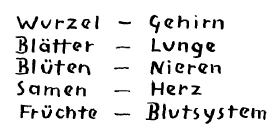
[ 5 ] Thus, one will recognize that everything in the plant that lies dormant in the seed—that is, the seed force contained within it—is related to the human being in a different way than, for example, what is contained in the plant’s root. Everything contained in the root of the plant corresponds in a certain way to the human brain and the associated nervous system (see the overview on page 108). And this goes so far that, in fact, the consumption of everything contained in plant roots also has a certain kinship with the processes taking place in the brain and nervous system. So that in a certain way, if a person wishes for their brain and nervous system—as the physical instruments of spiritual life—to be physically influenced, they consume, through their food, the forces present in the roots. They then allow what they take in to, in a certain sense, think within them, to perform spiritual work within them, whereas if they are less inclined to, let us say, take in the root-like essence, it will then be more their own spirit that uses the brain and nervous system. From this you can see that excessive consumption of root vegetables makes a person dependent in terms of their soul-spiritual experience, because the objective, the external, works through them, because, so to speak, the brain and nervous system become independent. So if a person wants to be, to a greater extent, the very thing that works within them, then they must limit themselves with regard to root-food consumption. My dear friends, these are not instructions for any kind of diet, but merely statements about the facts of nature. For I expressly urge you not to adhere to such rules without further thought. Not every person is at a stage where they do not need to have their power of thought taken away from the objective world, and it can very easily happen that a person who is not yet mature enough to have their power of thought and feeling taken away from the objective life of the soul when he avoids the consumption of roots from the plant kingdom, may fall into a sort of drowsy state, because his spiritual-psychic nature is not yet strong enough to develop within himself the forces from the spiritual realm that are otherwise developed objectively, without the intervention of the spiritual-psychic in the human being. That is how it is. Every diet is entirely individual and depends entirely on the way a person is developed in this or that respect.
[ 6 ] What is found, for example, in the leaves of a plant is related in a similar way to what we might regard as the lungs and everything that belongs to the respiratory system. Here we already have something that points to how a kind of balance can be established in a person of whom it can be said, for example, that their respiratory system is maintained in excess from within due to their inherited predispositions or other circumstances. In such a case, it would be advisable to discourage them from consuming, in their diet, primarily what the plant’s leaves provide. But for those whom we wish to support with regard to their respiratory system, their lung system, we do them a favor by advising them to consume as many leafy parts as possible. These things are in turn connected to the healing powers found in the world within the various kingdoms outside, for those parts of the individual plant that have a specific affinity with such organs—it is these parts of the plant in particular that also contain the healing powers for these spheres, for these areas of the human organism. So, for example, plant roots contain many healing powers related to the nervous system, and leaves contain many healing powers related to the respiratory system. Plant flowers contain many healing powers in relation to the renal system, for example, and plant seeds contain, in a certain sense, healing powers in relation to the heart—but only insofar as the heart resists blood circulation too strongly. If it yields too much to blood circulation, then the powers found in the fruits—that is, in the mature seeds—are more significant to consider.
[ 7 ] These, you see, are individual insights that arise when we take into account that, the moment we step out from the human being into the nature that surrounds us, what appears to the senses in this surrounding nature—what belongs to the sensory world—is actually only the surface. In plants, therefore, what belongs to the sensory world is only the superficial; behind what appears to the eye, the taste, and the smell in the plant lie the plant’s spiritual-soul forces. But these spiritual-soul forces of the plant are not contained in the plant in such a way that we could speak of every single plant as being animated, just as every single human being is animated. That is not the case. Anyone who were to believe that every single plant is animated would be committing the same error as one who believes that every single hair, or the earlobe, or the nose, or a tooth in a human being is animated. The whole human being is animated, and we gain insight into the soul of the human being only when we move from its parts to the whole. But we must do this with every being. Spiritually, we must carefully determine with every being whether it is a part or, in a certain sense, a whole. The totality of the plants on Earth is by no means a whole in and of itself, but rather they are parts, members, and in fact we speak of a reality only when we speak of that to which the plants belong as parts, as members. In the case of human beings, we also see this physically: to what his teeth, his earlobe, and his fingers belong—we perceive this physically as the whole organism. In the case of plants, we do not see with the physical eye to what the individual plants belong, nor do we perceive it with a physical organ; rather, we move directly from the part to the whole, and we enter immediately into the spiritual realm. And essentially we must say: The soul of the plant world is one that has only its individual organs in the plants. And actually, there are only a few beings in our entire Earth who are, as it were, crammed together in the Earth and who have the plants as their individual parts, just as the human being bears his hair upon himself.
[ 8 ] If we wish, we can say that when we go beyond the plant as it appears to our senses, we then come to the group souls of the plants, which relate to the plant in the same way that the whole relates to the part. Broadly speaking, there are seven group souls that belong to the Earth as plant souls, and all of them have, in a certain sense, the center of their own being at the Earth’s center. So that we cannot merely imagine the Earth as this physical sphere, but rather this Earth is permeated by seven such spheres—some larger, some smaller—all of which have something like their own spiritual center at the Earth’s center. And then these spiritual beings drive the plants out of the Earth. The root grows toward the center of the Earth because it actually wants to go there and is only prevented by the rest of the Earth’s matter from reaching the center. Every plant root strives to reach the center of the Earth, where the center of the spiritual being to which the plant belongs is located. |
[ 9 ] So we see that we have something extraordinarily important in the principle that we must always look at the whole, that we must examine every being to see whether it is a ‘part or a whole.’ In recent times, some natural scientists do indeed regard plants as animated, but they regard individual plants as animated. That is no more intelligent than calling a tooth a human being; it is on the same intellectual level. And all that which many people say today: “That is already quite anthroposophical, for they regard plants as animated”—that will be nothing more than scientific rubbish in the future. For to seek individual souls in plants would be precisely like pulling a tooth from a human being and seeking the human soul within it. We are not to seek the plant soul in the individual plant, but rather in such a way that even its most essential part lies at the center of the Earth, toward which the root, as the force striving toward the most spiritual part of the plant’s existence, is directed.
[ 10 ] If you now contemplate such a realm, then from the standpoint of today’s view of nature, something will indeed confront you that can, in a certain way, bring us as close to the gate of truth as Mephistopheles brings Faust to the realm of the Mothers—namely, right up to the very outermost gate, but not into the realm of the Mothers itself. For just as Mephistopheles cannot descend with Faust into the realm of the Mothers, so too can modern science not enter into the spiritual realm. But just as Mephistopheles, in a certain sense, provides the key, so too does modern science provide the key. It simply does not wish to enter itself, just as Mephistopheles himself does not wish to enter the realm of the Mothers. So in a certain sense, modern science gives us points of reference today which, if you recognize them as we have characterized them in these lectures, can often bring this recognition to the very threshold of the True.
[ 11 ] This is how modern science, inspired by Darwin, derives an important scientific principle—the so-called struggle for existence—solely from the sensory world. Who would not notice this struggle for existence everywhere, if only they were to take in what the external sensory world initially presents? Oh, this struggle for existence confronts us everywhere! We need only observe how, say, countless marine animal eggs are deposited in the sea or on the beach, how many perish there, and how few grow into actual animals—how few eggs, in other words, become animals, while all the others perish. There, so to speak, a seemingly terrible struggle for existence begins, and one might now start to lament, if one listened only to the world of the senses, and say: Of the millions and millions of embryos, so many perish in the struggle for existence and only a few survive. — But this is only one side of the story. For let us approach this thought from the other end. As it were, to steer your thinking in a certain direction, I would urge you to approach the thought from the other end. You can also lament the struggle for existence in the following way: You can turn your gaze to a grain field where there are so many ears of grain with so many kernels, and you can now ask yourself: How many of these grains in the ears of grain are lost in some way to their actual purpose, and how few of them are in turn sown into the earth to become something new in the same sense as the old was? — So we cast our gaze over a field of ears of grain that sprouts and grows in lush fertility, and say to ourselves: How much of what is sprouting and growing there will perish without having achieved its purpose, and only a little will be sown into the earth so that new plants of the same kind may arise. It is thus the same there, only in a slightly different realm, as with marine animals, where too only a few embryos come to fruition.
[ 12 ] But now I would like to ask you: what would become of the people who need to eat if all the grains of wheat were to be sown back into the earth? Let us suppose—theoretically, anything is possible—that enough would grow so that all the grains of wheat could sprout again. But then let us consider what would happen to those beings who must feed on grain! Here, you see, we come to something very strange; here we encounter a shock regarding a belief that might seem justified to us when we look at the world of the senses. It might seem justified to us, when we look at a field of grain—say, in terms of purely sensory existence—that every single grain will become a whole plant again. But this perspective may be mistaken. Perhaps, in the overall context of the world, it is not at all the case that we are thinking correctly when we ascribe to every single seed the purpose of becoming a whole plant again; rather, perhaps it is the case that nothing justifies us in saying that those grains which serve as food for other beings have somehow failed in their purpose in the world, any more than anything compels us to say that the seeds of sea fish have failed in their purpose because they have not become fish again. For it is really only a human prejudice that every seed should become the same being again. For we can only gauge the tasks of individual beings when we turn our gaze back to the whole. And even if the millions of seeds that perish in the sea every year do not become fish, they serve as food for other beings—beings that humans cannot yet perceive—and give themselves up to other beings. And truly, those spiritual substances that struggle into existence within the seemingly perishing seeds of the sea do not lament that they do not reach their goal—to be food for other beings, to be taken in by these other beings. Human beings, who stand outside of this with their intellect, believe that only that which strives, so to speak, toward the goal they must regard as the ultimate goal through their senses has any meaning. A view of nature free of prejudice sees something perfect in every stage of every being, and such perfection does not lie only in what a being becomes, but in what it is.
[ 13 ] These are ideas derived from the occult that must be instilled in you. And when you now look back from the outside world upon your own soul, you will perceive that within this soul there is a wealth of thoughts that continually flow into it, continually arise within it, and only a few of these thoughts are clearly grasped; only a few become a conscious part of the human soul. Take any walk through the city and think of how much enters your soul through your senses and how little you pay attention to it in such a way that it then becomes a lasting part of your soul life. You are constantly taking in impressions, and the mass of these impressions you take in bears to what then becomes a lasting, conscious possession of your soul in exactly the same way that the vast number of fish eggs produced annually in the sea bears to what becomes actual, fully grown fish. In your inner spiritual life, too, you must continually carry out the process of allowing only a little to unfold, against the backdrop of a vast expanse. And if a person can only begin to grasp from which vast ocean of imaginative and mental constructs they emerge—when they emerge from sleep, when for some people a dream still reveals a final trace of this immensely rich life that a person leads in the state of sleep— then they may also come to realize that it has significance when they take in so much within themselves that does not reach clear consciousness. For what reaches clear consciousness is lost to the inner workings of the human being; it no longer works on the system of the sense organs, on the system of the glandular organs, on the digestive system, on the nervous, muscular, and skeletal systems, etc. That which becomes conscious in the soul, that which modern human beings carry within themselves as conscious inner soul content, no longer works; it is characterized precisely by the fact that it has been torn away from the fertile soil of the whole human being and thereby comes to human consciousness. That which stands in relation to these conscious mental images as the many seeds do to the few that become fish—that which comes in as an immense multitude of external impressions but does not enter into consciousness—that works upon the whole human being.
[ 14 ] Thus, everything in a person’s surroundings is constantly working on the whole person. You see, a dream can sometimes also teach you how, in reality, not only does that which then lives on as a conscious mental image enter the soul, but how other impressions also enter the soul. You need only pay attention to such things, which are found a thousandfold in life. You dream of some situation: you are standing opposite a person who is speaking with another person. You stand there as a third party. You dream the exact features of the person in question, and so on. You ask yourself: Where did this dream come from? It gives the impression of dealing with people I know in physical life; its inspiration thus extends to the physical plane. But where did the dream come from? I didn’t hear or see that. And now you investigate, and if you investigate closely, you may find that a few days ago you did indeed stand facing that person in a train car, only it passed you by unconsciously at the time. But it does come back to you. It is only a lack of precision in observation that causes people not to know such things.
[ 15 ] However, the mental images that dreams present to us in this way are not the most important ones that leave an impression on the soul; rather, it is quite different ones. Consider that what was shown to you yesterday has, in fact, been happening continuously throughout human evolution. Through his skeletal system, man has continually produced imaginations; through his muscular system, he has continually sent inspirations out into the world; through his nervous system, he has continually sent out intuitions. All of this is in the world. That which is evil, man must take back and work off through his destiny. But the other builds up and shapes the world outside; it is constantly present in man’s surroundings. In fact, everything that humanity has, so to speak, sent out into the earthly world in the form of imaginations, inspirations, and intuitions—even since the Atlantean catastrophe—is present and belongs to our environment. All of this, insofar as it was good what people have produced, individual human beings do not need to take back again in the course of their karma. But what they have, as it were, sent out into the spiritual atmosphere of the Earth over centuries and centuries in successive epochs is truly just as present for the people who now live on as the air is present for the physical human being. Just as a human being breathes the physical air, just as the air from their surroundings penetrates into their physical being, so do the things that have developed there as imaginations, inspirations, and intuitions penetrate into the human being, and the human being participates in all of this with their soul-spiritual being. And now the important thing is that the human being should not stand before what he has thus imparted to the Earth itself in the earlier epochs of his earthly existence in a disembodied way; that he should not stand before it without having become related to it. But the human being can only become attuned to what he has thus incorporated into the Earth as spiritual content if he gradually acquires the ability to take these things into his soul.
[ 16 ] But how is this done? You see, when one penetrates into the spiritual sense of Earth’s development, it becomes apparent that in the times when the people of the post-Atlantean era still possessed some of the old clairvoyance, imaginations, inspirations, and intuitions were communicated in a very comprehensive sense through the spiritual atmosphere of the Earth. That was primarily the time of the outpouring of such spiritual substances. Since the fourth post-Atlantean period, but especially from our present time onward, we are increasingly coming to emit less, yet to be more dependent on receiving the old as something akin to us—taking back into ourselves what has been sent out. This means that human beings must, as it were, counter a former spiritual exhalation process with a spiritual inhalation process. Human beings must become ever more sensitive and receptive to the spiritual that exists in the world. |
[ 17 ] In earlier times, this was not so necessary because people could express spiritual content from within; they had a reserve fund. However, since the fourth post-Atlantean cultural epoch, this reserve has been so depleted that in the future, only what has first been inhaled and absorbed can be expressed in a certain way. Anthroposophy, or Spiritual Science, exists precisely to help human beings find their way into this new mission of their earthly existence with understanding. It truly appeals to those who already feel drawn to it not simply because, among other fads, this particular spiritual-scientific fad has come into the world; but Spiritual Science or anthroposophy is intrinsically connected with the entire development of the Earth; it is connected with the fact that human beings are dependent on gradually developing an understanding of the spiritual world around them. For those who, from our present time onward, will not develop an understanding of the spirit behind the senses, of the spiritual world behind the sensory world, will be like those who have so corrupted their respiratory system in the physical body that they cannot get air to breathe, that they suffer from shortness of breath. Today this is still the case because a certain legacy of ancient human wisdom has remained in concepts, so that people draw upon these old concepts. But anyone who observes the development of humanity in recent times with spiritual eyes will perceive: however much inventions and discoveries may accumulate in the outer material world, spiritual content has, in a certain sense, strangely moved toward exhaustion. New concepts, new ideas—they spring up ever less frequently for humanity. Only those who do not know the old ideas and are constantly rediscovering the old anew for themselves—that is, those who, in a certain sense, remain somewhat immature throughout their lives—only they can believe that new ideas as such can now mature. No, the world of abstract ideas, the world of intellectual concepts, has exhausted itself. New ideas no longer spring forth.
[ 18 ] With Thales, a certain emergence of intellectual ideas began for Western thought. Now, in a certain sense, we have reached the end, and philosophy as such—as the science of ideas—has come to an end. Humanity must learn to rise to that which lies beyond ideas and thoughts—which, after all, belong only to the physical plane—to that which lies beyond this world of ideas. First, humanity will rise to the level of imaginations. These, in turn, will become something real for humanity. Then a new inspiration will arise for the spiritual life of humanity. Thus, in Spiritual Science, imaginations flow to us regarding important world processes. Look at how the description of Saturn, the Sun, and the Moon differs from other things, how it relates to the abstract concepts of other sciences. Everything must be presented pictorially, so that it is not immediately realizable in the outer sensory world. Of the ancient Saturn we say that it has a mere state of warmth. This is nonsense to today’s sensory world, for a mere substance of warmth does not exist anywhere in the sensory world. But what is nonsense to the sensory world is truth to the spiritual world, and to live oneself into the spiritual world is what immediately falls to human beings in the near future. For those who will not resolve to breathe the air of the spirit—for which the human soul is to be made receptive through Spiritual Science, through a science that goes beyond that of the mere senses—those who do not wish to make themselves receptive to Spiritual Science, will truly be heading toward a state that, in a certain sense, is already becoming apparent to many today: a spiritual shortness of breath and thus a spiritual exhaustion, which then leads on to spiritual emaciation, to spiritual consumption.
[ 19 ] That would be the fate of people on Earth who wished to remain solely within the sensory world: they would perish from spiritual consumption. Thus will culture develop in the future, so that there will be people full of receptivity and soulfulness and a heart for the spiritual world, for what is first given as Spiritual Science, for what will then spring up quite of its own accord in human souls as the world of imagination, inspiration, and intuition. Thus it will be with one part of humanity that it will have an understanding and a devotion to this world of the spirit. These will be the people who will fulfill the task initially set for the Earth. Other people may remain in the world of the senses, unwilling to move beyond the world of the senses and beyond the mere shadow of the sensory world that can be presented in philosophical concepts or in external science. These are heading toward spiritual suffocation, spiritual emaciation, spiritual wasting away; they wither away within earthly existence and do not attain what has been set as the goal of Earth’s development. But development must take place in such a way that each person must ask their own soul: Which path do you choose? In the future, people will stand, as it were, on the left and on the right—those for whom the world of the senses alone will be truth, and those for whom the world of the spiritual will be truth.
[ 20 ] But since the senses, like the human ear, are fading away—since by the end of the Earth’s existence all earthly senses will have faded away for humanity—you can now begin to form a mental image of how real that wasting away and emaciation truly is. If we rely on the world of the senses, we rely on something that will leave humanity in the future of Earth’s development. If we penetrate into the world of the spirit, we develop toward that which will increasingly draw near to humanity in the future of Earth’s development. If we wish to use a symbol, we can say: Humanity may one day stand at the end of Earth’s evolution and speak like Faust after Faust has become outwardly blind—for humanity will not only stand there, outwardly blind, but outwardly deaf, outwardly without taste, outwardly without smell—:: yet within, a bright light shines; yet within, the most magnificent human sounds and human speech resound. Thus will the human being be able to say who turns toward the world of the spirit. But the other, who wished to remain with the world of the senses, would be such a Faust who, after becoming outwardly blind, would have to say to himself: You have become blind on the outside, yet within no spiritual light shines; darkness alone enfolds you. Between these two Faust-like natures, humanity must choose with regard to the future of the earth. For the first Faust would have turned toward the world of the spirit, while the other Faust would have turned toward the world of the senses and would thereby have become related to it—related to that which man must perceive as the insubstantial, which robs him of all his being. Thus does what we seek to bring down from occult heights appear for the immediate life of human beings. And I think one can spare oneself the trouble of putting into words what moral principles, what impulses of the will, can arise for the people of the present from a true understanding of occult science. For from wisdom rightly understood, virtue rightly understood will already be born in the human heart. Let us strive for a true understanding of world development, let us seek wisdom, and it will not fail to be the case that the child of wisdom will be love. This is what should be explored in these lectures.