

The World of the Senses
and
The World of the Spirit
GA 134
28 December 1911, Hanover
Translated by Steiner Online Library
Second Lecture
[ 1 ] Yesterday we arrived at the consideration of that state of mind which we called resignation and which appeared to us as the highest, for the time being, of the states of mind that must be attained if thinking—if what is commonly called knowledge—is to enter into reality, if it is to have anything to do with reality, with what is truly real. In other words: a thinking that has risen to those states of the soul where we first acquired wonder, then what we call reverent devotion to the world of the real, and then what we call knowing oneself to be in wise harmony with the phenomena of the world. A mode of thinking that could not then also rise to that region characterized by the state of soul known as surrender—such a mode of thinking could not reach the real. Now, this surrender can actually be attained only by vigorously striving to bring the inadequacy of mere thinking before one’s eyes again and again, and by further striving to make ever more lively and vigorous a mood that ceaselessly tells us: You should not expect your thinking to provide you with insights into the true, but you should initially expect nothing more from your thinking than that it educates you. It is extraordinarily important that we develop this attitude within ourselves, that our thinking educates us. You see, if you truly put this principle into practice, then you will transcend many things in a completely different way than is commonly believed to be necessary.
[ 2 ] I readily believe that not many of you have thoroughly studied the philosopher Kant. Nor is that necessary. For now, it suffices to say that in Kant’s most significant and groundbreaking work, the Critique of Pure Reason, you will always find arguments presented on one side in favor and on the other side against. Let’s take a statement, for example: the world once had a beginning in time; then, on the other side of the same page, Kant might write the statement: the world has always existed from eternity. And for these two statements—which, as one can easily see, express the exact opposite of one another—he provides valid proofs for both. That is to say: he proves in the same manner that the world had a beginning, and then that it had no beginning. Kant calls these antinomies and thereby seeks to demonstrate the limitations of human cognitive capacity, to show that human beings must necessarily arrive at such mutually contradictory lines of reasoning. Indeed, as long as one holds the view that one is supposed to arrive at the truth—that is, at agreement with some objective reality—through thinking or processing concepts, or, let us say, through the thoughtful processing of experiences, as long as one adheres to this view, it is indeed a rather dire situation when one is shown how one can prove one thing and also prove its exact opposite. For how is one to arrive at reality through the proofs! But if one has trained oneself to recognize that thinking, precisely where the decisive matters come into play, decides nothing about reality; if one has vigorously trained oneself to regard thinking merely as a means to become wiser, as a means to take one’s self-education toward wisdom into one’s own hands, then it does not matter that one thing can be proven one way and another thing another way. For then one realizes very soon that precisely because reality cannot actually affect one at all in the processing of concepts, one can work and educate oneself in the freest manner within concepts and ideas. If one were constantly being corrected by reality, then one would have no free means of self-education in the processing of concepts. Bear this in mind: we have an effective, free means of self-education in the processing of our concepts only because we are never disturbed by reality in the free processing of concepts.
[ 3 ] What does that mean: we are not disturbed? Indeed, what would such a disturbance by reality actually entail in the free processing of concepts? We can bring such a disturbance somewhat to mind if we first—purely hypothetically—contrast divine thinking with human thinking; we will see later that this need not remain hypothetical for us. We can say: Regarding divine thinking—of which we cannot initially form the concept that it has nothing to do with reality—but regarding divine thinking—let us assume this for now only hypothetically—we can only form the concept that it does indeed intervene in reality. Now, however, nothing less than this follows from that: If a person makes a mistake in their thinking, it is a mistake; it is not a serious matter, for it is merely a mistake, so to speak, a logical error. And if a person later realizes that they have made a mistake, they can correct it and have thereby contributed to their self-knowledge; they have made themselves wiser. But let us consider divine thinking: Yes, when divine thinking thinks correctly, something happens, and when it thinks incorrectly, something is destroyed, something is annihilated. So if we were to have divine thinking, then with every false concept we form, we would immediately bring about a process of destruction, first in our astral body, then in our etheric body, and from there also in our physical body, and the consequence of a false concept would be — if we had an effective divine thinking, if our thinking had anything to do with reality — that we would, so to speak, bring about something within us like a small process of withering in some part of our body, a process of ossification. Now, we truly must make very few mistakes here, for a person would very soon have made so many mistakes that they would have withered their body, so that it would completely disintegrate; they would have worn it down very quickly if they had translated into reality what were errors in their thinking. We actually sustain ourselves in reality only by the fact that our thinking does not intervene in this reality, that we are protected from the intervention of our thinking in reality. And so we can make mistake after mistake in our thinking: if we correct these mistakes later, we have educated ourselves, we have become wiser, but we have not immediately caused devastating effects with our mistakes. If we allow ourselves to be increasingly permeated by the moral power of such a thought, then we arrive at that resignation which finally leads us to no longer apply our thinking at the decisive moments of life in order to learn anything about external things.
[ 4 ] That sounds strange, doesn’t it, and at first it seems as if it would be impossible to carry out such a thing at all. And yet: while we cannot carry it out absolutely, we can carry it out in a certain sense. Given our nature as human beings, we cannot entirely stop ourselves from judging things in the world; we must judge—we will see why in these lectures—that is to say, we must do something in life, in the practice of living, that does not actually penetrate to the depths of reality. So we must judge, but we should, through wise self-discipline, cultivate caution in accepting as true whatever we judge. We should constantly strive, so to speak, to look over our own shoulders and realize that wherever we apply our discernment, we are essentially groping in the dark, liable to err everywhere. This strikes a hard blow against the security-seekers of life, who believe they can no longer make any real progress if they must doubt that what they attach as their judgment to every event, to every occurrence, is to be decisive for them. Let us just observe the lives of many people for a moment, to see whether they do not actually regard as the most important thing to say everywhere, whenever this or that occurs: “But I believe this,” “But I believe that,” or when they see something: “I don’t like that,” “I like that,” and so on. These are the things one must break oneself of—if one does not wish to belong to the complacent of life—one must break oneself of them when one is heading toward reality with one’s inner life. So it is a matter of developing a mindset that can be characterized by the following words: Well, I simply have to live, and therefore I must judge; hence I will make use of judgment insofar as the practice of life makes it necessary, but not insofar as I wish to recognize truth. Insofar as I wish to recognize truth, I will always look carefully over my shoulder and always regard every judgment I make with a certain degree of doubt.
[ 5 ] Yes, how are we to arrive at any conception of the truth at all if we are not to judge? Well, this was already hinted at yesterday in a certain sense: we should let things speak for themselves, adopt an increasingly passive attitude toward them, and allow them to reveal their secrets. Much would indeed be avoided if people did not judge, but instead let things speak their secrets. One can learn this art of letting the secrets of things speak in a wonderful way from Goethe, who, precisely where he seeks the truth, forbids himself from judging and instead wants to let things speak their secrets themselves. Let us suppose that one person judges, while another allows things to speak their secrets for themselves. We can illustrate this with a concrete example: One person judges—let us say he sees a wolf—and now he describes the wolf. He finds that there are other animals that also look like this wolf, and in this way arrives at the general concept of the wolf. And now such a person might arrive at the following judgment. He might say: Yes, in reality there are only individual wolves. The general concept of the wolf, I form in my mind; the wolf as such does not exist; there are only individual wolves in the world. — Such a person will easily conclude that we are dealing only with individual beings, and that what we have in the general concept, in the idea—this general image of the wolf—is not something real. In the most eminent sense, this would be a merely judging person who forms such mental images. But a person who lets reality speak—how will such a person think about that invisible aspect of the wolf that is found in every wolf, that characterizes all wolves at once? Well, they would say something like this: I will compare a lamb to a wolf, or a number of lambs to a wolf. I do not wish to judge at all, but merely let the facts speak for themselves. Yes, let us suppose that the fact unfolded quite vividly before this person: the wolf eats the lambs. That would be quite vivid. Then the person in question would say: “Yes, now that which used to leap about as a lamb is in the wolf and has been absorbed into the wolf.”
[ 6 ] But it is very strange that this very way of looking at things shows just how real “wolf nature” is. For, isn’t it true that what one might observe externally could lead to the conclusion: If the wolf is now cut off from all other food and eats nothing but lambs little by little, then—because of what this entails for its metabolism—the wolf must gradually come to consist entirely of the substance of lambs. In fact, however, it never becomes a lamb; it remains a wolf. This shows quite clearly, if we judge correctly, that the material is not merely captured in the wolf by an unreal concept. If we allow ourselves to be instructed by what the external world of facts presents to us, it shows us that, apart from what we have before us as the material substance of the wolf, this wolf is, beyond this material substance, something entirely real; that is, what one does not see there is something most real. For that which does not dissolve into the material is precisely what ensures that the wolf, even when it devours nothing but lambs, does not become a lamb, but remains a wolf. The purely sensuous has passed over from the lambs into the wolf.
[ 7 ] It is difficult to fully grasp the difference between making judgments and allowing oneself to be instructed by reality; but once one has grasped this, and then uses judgment only for the purposes of practical life, and uses being instructed by things to approach reality, one gradually enters into the state of mind that tells us what surrender is. Surrender is precisely that state of mind that does not seek the truth on its own, but expects all truth from the revelation that flows from things, and can wait until it is ready to receive this or that revelation. Judgment seeks to arrive at the truth at every stage. Resignation does not strive to force its way into this or that truth, but works upon itself, upon self-education, and waits calmly until, at a certain stage of maturity, the truth flows in through the revelations from things, permeating us completely. Working with patience, which seeks to carry us further and further through wise self-education—that is the spirit of resignation.
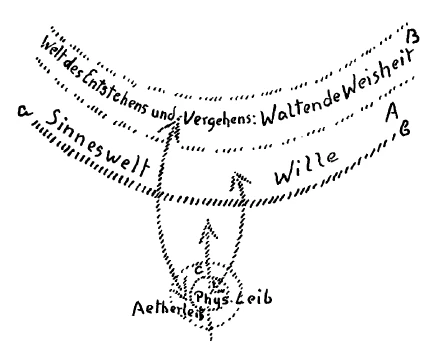
[ 8 ] The point now is that we bring the fruits of this surrender before our souls. What do we gain by having progressed in our thinking from wonder through reverence, through feeling ourselves in wise harmony with reality, into the soul state of surrender—what do we gain by this? Through this, we ultimately gain the following: When we now go out to observe the plant world in its greenness and in its changing blossoms and other features, to observe the firmament in its blueness, to observe the stars in their golden radiance, without judging from within, allowing things to reveal themselves to us as they are—when we have reached this state of surrender, then all things become something entirely different for us than they were before within the sensory world, then something is revealed to us in the sensory world for which there is no other word than one drawn from our own soul life. All things reveal themselves, and I would like to characterize the sensory world as it appears before us precisely through this level line (a—b, see drawing on page 41). Suppose you are standing here (c) before the sensory world; you are looking at this sensory world, which spreads out before you like a veil. So what is to be characterized by this line here (a—b)—let that be the sounds of the sensory world that act upon our ears, the colors and forms that act upon our eyes, the smells and tastes that act upon our other organs, let that be hardness and softness, etc.; in short, let all of that be characterized by this line. Let this line be the world of the senses. So in ordinary life, just as we stand in this sensory world, we apply our power of judgment. And how do the external sciences arise? By the sciences approaching this sensory world, by their exploring, so to speak, through various methods, what laws prevail in the things of this sensory world and the like. We have seen from the whole spirit of our previous discussions that this does not lead us into the world of reality, because judgment is no guide at all, but that only through the training of thought—through wonder, reverence, and so on—can we penetrate the world of the real. Then what is the sensory world changes; then this sensory world becomes something entirely new. It is important that we approach this newness if we are to recognize the very essence of the sensory world at all.
[ 9 ] Let us suppose that a person who has developed, to a certain high degree, this feeling, this state of mind of resignation, comes face to face with, say, the fresh, lush green of a meadow. It first reveals itself to him because no individual plant colors stand out above the general green; it reveals itself in the general fresh green. Such a person, who has truly developed the state of mind of resignation to a higher degree, will be unable to do anything other than, upon looking at this meadow, feel something that touches them in an inner mood of a certain balance—but a lively balance, like the gentle, harmonious, even rippling of water. They will be unable to do anything other than conjure this image before their soul. And so, let us say, such a person will be unable to do anything other than feel, in response to every taste, every smell, something like an inner liveliness within their soul. There is no color, no sound, that says nothing; rather, everything says something, and everything says something such that the person feels the necessity to respond to what is said with inner liveliness—not to respond with a judgment, but with inner liveliness. In short, the person comes to realize that the entire sensory world reveals itself to him as something he can describe as nothing other than will. Everything is flowing, reigning will, insofar as we encounter the sensory world. I ask you to grasp this very well: that the person who has acquired resignation to a higher degree discovers reigning will everywhere in the sensory world. Hence you understand that for a person who has developed this surrender within themselves even to a small degree, it is so distressing, let us say, when they see some impertinent fashion color coming toward them on the street, because they cannot help but feel this inwardly and actively in relation to everything that is out there. They are always connected to the whole world through a will that they perceive in everything, that they feel in everything. In this way, they draw near to reality, for they are connected through the will to everything that constitutes the sensory world. And so the sensory world becomes like an ocean of will differentiated in the most manifold ways. But through this, that which we otherwise only feel as spread out takes on a certain thickness. We see, as it were, behind the surface of things, hear behind them, and hear will flowing everywhere. For those who have read Schopenhauer, I note that Schopenhauer, in a one-sided manner, sensed this ruling will only in the world of sound; hence he describes music in general as, so to speak, differentiated effects of the will. But in truth, for the devoted person, everything in the sensory world is ruling will.
[ 10 ] Once a person has learned to sense the will that reigns throughout the sensory world, they can then go further. They can, as it were, penetrate through the sensory world into the mysteries lying beyond it, which are otherwise initially hidden from them.
[ 11 ] To understand what is about to follow, we must first ask ourselves: How do we know anything at all about the sensory world? Well, the answer is simple: through our senses; through the ear we perceive the world of sound, through the eye we perceive the world of colors and forms, and so on. We know about the sensory world through our sense organs. The person who initially approaches this sensory world in the everyday way allows it to affect them and then judges it. The surrendered person first allows the sensory world to act upon the senses. But then they feel how a ruling will flows over to them from the things, how they swim, as it were, with the things in a shared sea of ruling will. When a person feels this ruling will in relation to things, their development, so to speak, propels them of its own accord to the next higher stage. For having passed through the preliminary stages we have mentioned—feeling in harmony with the wisdom of the world, reverence, wonder—up to this state of surrender, then, through the influence of these states within the state of surrender most recently attained, he learns the possibility of now also growing together with things, as it were, with his etheric body—that which stands as the etheric body behind the physical body. In the ruling will, the human being first grows together with things through their sense organs, that is, through the physical body. When we see, hear, smell, etc., this has the effect that, as surrendered human beings, we feel the ruling will flowing into us as if through our eye, through our ear, and feel ourselves in correspondence with things. But behind the physical eye lies the etheric body of the eye, and behind the physical ear lies the etheric body of the ear. We are completely permeated by our etheric body. Just as the physical body grows together with the things of the sensory world through the ruling will, so too can the etheric body grow together with things. But as the etheric body grows together with things, a completely new kind of perception comes over the human being. The world is then transformed to a far greater extent than it is by our advancing from sensory appearance to the ruling will. When we, so to speak, grow together with things through our etheric body, the things in the world, as they stand, make an impression on us such that we cannot leave them in our mental images and concepts as they are, but they change for us as we enter into relationships with them.
[ 12 ] Take, for example, a person who has gone through the spiritual state of surrender. He looks at, say, a green, succulent plant leaf, and he now turns his spiritual gaze upon this leaf. Then they cannot simply leave it at that—this green, succulent plant leaf—but in the very moment they look at it, they feel that it is growing beyond itself. They feel that this green, succulent plant leaf has the potential within it to become something entirely different. If you take the green plant leaf, you know that as it gradually grows upward, it becomes a colorful flower petal. The entire plant is actually a transformed leaf. You can already bring this to mind from Goethe’s studies of nature. In short, the person who looks at a leaf sees in the leaf that it is not yet finished, that it wants to transcend itself, and he sees more than the green leaf gives him. He is so moved by the green leaf that he feels something like sprouting life within himself. Thus he grows together with the green plant leaf and feels sprouting life. But let us suppose he looks at dry tree bark; then he cannot grow together with the dry tree bark except by being overcome by something like a mood of death. He sees less in the withered tree bark than it actually represents. The one who looks at the bark merely according to its outward appearance may admire it; it may please him; in any case, he does not see the withering, the something that pierces the soul, as it were, that fills the soul with thoughts of death when faced with the dead tree bark.
[ 13 ] There is nothing in the world that, in the face of such a fusion of the etheric body with things, would not evoke feelings of growth, becoming, and sprouting—or, conversely, feelings of decay and decomposition. This is how one looks into things. Let us suppose, for example, that as such a devoted person, who then continues to educate themselves, one directs one’s attention in some way to the human larynx; then the human larynx appears to one, in a strange way, as an organ that is quite at the beginning of becoming, that has a great future ahead of it, and one perceives it directly through what the larynx itself expresses as its truth: that it is like a seed, not like a fruit or something withering, but like a seed. And there must one day—one knows this immediately through what the larynx expresses—come a time in human development when the larynx is completely transformed, when it will be such that, whereas the human being now produces only the word through the larynx, it will one day give birth to the human being. It is the future organ of birth, the organ of bringing forth. Just as the human being now produces the word through the larynx, so the larynx is the predisposition, the seed organ, which will in the future unfold to bring forth the human being, the whole human being, when it is spiritualized. This is what the larynx immediately expresses when one allows it to tell us what it is. Other organs of the human body appear in such a way that we see they have long since passed beyond their height; that we see they will no longer be found in the human organism in the future.
[ 14 ] When we look at things in this way, something immediately presents itself to us: a sense of becoming in the future and of dying away into the future. Sprouting life and decay, dying away—these are the two things that intertwine in relation to everything else when we come to this connection of our etheric body with the world of reality. This is something that, when a person progresses a little further, represents a very, very difficult trial. For every being reveals itself to him in such a way that, in relation to certain aspects of the being, he always has the feeling of becoming, of sprouting, of budding; in relation to other aspects of this being, he has the feeling of dying away. And from these two fundamental forces, everything that we see beyond the sensory world reveals itself. In occultism, what one looks upon there is called the world of becoming and passing away. Thus, in contrast to the sensory world, one looks into the world of becoming and passing away, and what lies behind it is the ruling wisdom.
[ 15 ] Behind the ruling will lies the ruling wisdom! I say “ruling wisdom” explicitly, for the simple reason that the wisdom which man brings into his concepts is usually not a ruling wisdom, but a conceived wisdom. The wisdom that man acquires by looking behind the ruling will is connected with things, and in the realm of things, where wisdom reigns, there reigns the ruling wisdom that truly manifests its effects, that is truly there. Where it withdraws, so to speak, from reality, there arises dying; where it flows in, there arises becoming, there is emergence, sprouting, budding life. You see, the world we are looking at here, which we can characterize, so to speak, as the second, we can delimit it and say: We look first at the sensory world as world A and at that of the ruling wisdom as B, which lies behind the sensory world. From this is taken the substance of our own etheric body. For what we see out there as ruling wisdom, we perceive in our own etheric body. And in our own physical body we perceive not merely what is sensory appearance, but also ruling will, because we see ruling will everywhere in our sensory world.
[ 16 ] Yes, that is the peculiar thing: when we, as devoted human beings, stand before another person and look at them, their skin color—whether it happens to be reddish, yellowish, or greenish—does not appear to us merely reddish, yellowish, or greenish, but in such a way that we then, for example, grow together, as it were, with their rosy cheeks, grow together with reality, and have the ruling will within us—that is to say, we see everything that lives and weaves within them as if shooting toward us through their rosy cheeks. People who are themselves currently attuned to bestowing rosy cheeks will say: A red-cheeked person is simply the only healthy one. So one approaches the person in such a way that one sees this ruling will within them, and one can now say: Our physical body, if we first schematically indicate it here through this circle, is taken from world A; from the world of the ruling will—the physical body! In contrast, our etheric body, which I wish to indicate here with the second circle, is taken from the world of ruling wisdom, from world B. Here, then, you have characterized the connection between the world of ruling wisdom, which extends outward, and our own etheric body—and the world of ruling will, which extends outward, and our own physical body.
[ 17 ] Now, in ordinary life, human beings are unable to truly grasp the connection between one thing and another. You see: as I have described here, there is a direct connection between the external sensory world and our physical body, and between the world of governing wisdom and our etheric body. There are connections. But this connection is beyond human reach; we cannot influence it. Why can we not influence it? Well, there is, in fact, a situation where our thoughts and our entire life—as we develop it in the soul as a life of judgment—are not, I might say, as harmless to our own reality as they are in everyday life.
[ 18 ] In everyday life, while we are awake, benevolent gods have ensured that our thoughts do not have too devastating an effect on our own reality; they have stripped us of the power our thoughts might otherwise exert over our physical body and our etheric body, for otherwise the world would truly be in a very bad state. If thoughts—I emphasize this again—were to truly mean in the human world what they actually mean as divine thoughts in truth, then with every error a person would trigger a small process of withering within themselves, and they would soon wither away. And a lie, of all things! If a person had to burn the corresponding part of the brain with every lie, as would be the case if they were to intervene in the world in truth, then they would soon see how long their brain would last. Good gods have, so to speak, deprived our soul of power over our etheric and physical bodies. But this cannot always be the case. For if we were to exert absolutely no influence whatsoever from our soul upon our physical and etheric bodies, we would very soon exhaust the forces contained within our physical and etheric bodies, and we would have a very short lifespan; for in our soul, as we shall see in the course of these lectures, are those forces that must in turn flow into the physical and etheric bodies—the forces we need in the latter bodies. Therefore, at certain times, streams of energy must flow from our soul into the etheric and physical bodies. This happens at night, when we sleep. There, the currents we need to dispel fatigue flow from the universe via a detour through the I and the astral body. There is indeed this living connection between the world of the will and the world of wisdom and our physical and etheric bodies. For it is into these worlds that the astral body and the I disappear during sleep. They go there, and there they form centers of attraction for the substances that must now flow in from the world of wisdom into the etheric body and from the world of the ruling will into the physical body. This must happen at night. For if a person were truly conscious of it, you would see how this inflow takes place! If human beings were generally conscious of this process—with their errors and vices, with all the evil and so on that they commit in the world—then that would be a strange trap for the forces that are meant to flow in. Horrible destruction would have to be wrought in the etheric body and physical body by what the human being would send into them from his ego and astral body—into the physical and etheric bodies—from the world of ruling wisdom and the world of ruling will.
[ 19 ] That is why the good gods have once again ensured that we cannot be conscious of the process when the proper force must flow into our physical and etheric bodies during the night. For this very reason, they have dimmed human consciousness during sleep so that one cannot, through one’s thoughts—which would then be active—corrupt what one would undoubtedly corrupt. This is also what causes us the most pain when ascending into the higher worlds on the path of knowledge, if we set to work thoroughly. You will find described in the text “How Does One Attain Knowledge of the Higher Worlds?” how, so to speak, the night life, the sleeping life, is in a certain way utilized to ascend from the world of outer reality into the higher worlds. There, when a person begins to examine their sleep consciousness from the world of the imagination—using knowledge, experiences, and insights—they must truly see how to escape, so that they can properly eliminate from their consciousness all sources of destruction for their physical and etheric bodies. This is what makes it necessary, in this ascent into the higher worlds, to truly know oneself very precisely. When one knows oneself very precisely, one usually stops loving oneself. Self-love usually ceases when one begins to know oneself, and this self-love—which is always present in the person who has not attained self-knowledge—for it is an illusion when someone believes that they do not love themselves; they love themselves more than anything else in the world—this self-love must be overcome in order to be able to eliminate oneself. In this ascent, one must actually reach the point where one can say to oneself: As you are, you must set yourself aside. Much has already been accomplished toward this by becoming a submissive person. But one need not love oneself at all. One must therefore always have the capacity to feel: You must step aside. For if you cannot set aside what you otherwise love about yourself—your errors, pettiness, prejudices, sympathies, antipathies, and so on—then the ascent will proceed in such a way that, through your errors, pettiness, and prejudices, forces will mingle with what must flow in so that you can become clairvoyant. These flow into your physical and etheric bodies; there are then as many errors as there are destructive processes. As long as we have no consciousness in sleep, as long as we are unable to ascend into the worlds of clairvoyance, as long as that is the case, good gods protect us from these forces flowing into our physical and etheric bodies from the world of the ruling Will and the world of the ruling Wisdom. But then, when we carry our consciousness up into the world of clairvoyance, then no gods protect us anymore—for the protection they give us consists precisely in their taking our consciousness away from us—then we must ourselves remove everything that constitutes prejudices, sympathies, antipathies, and so on. We must set all of this aside; for if we still harbor any self-love, any desires that cling to us as personal, if we are in a position to pass this or that judgment from a personal standpoint, then all these things are reasons why we damage our health—namely, our physical and etheric bodies—as we develop upward into the higher worlds.
[ 20 ] It is of the utmost importance that we take this to heart. Therefore, we can come to realize just how significant it is that, in ordinary daily life, human beings are deprived of any influence over their physical and etheric bodies, since our thoughts, as we conceive them when we are within the physical and etheric bodies, have nothing to do with reality, are ineffective, and therefore cannot bring about any decision regarding the real. At night, however, they can bring about a decision. Every false thought would destroy the physical and etheric bodies. Then everything that has just been described would appear before our eyes. Then the sensory world would appear to us as a sea of ruling will, and behind it would appear, how effectively through this will and whipped up and down by this will, the wisdom that constructs the world—but in such a way that with its surging waves it continually brings about the processes of coming into being and passing away, of birth and death. This is the world of truth into which we are looking, the world of the ruling will and the world of the ruling wisdom; the latter, however, is the world of becoming and passing away, of ceaseless births and ceaseless deaths. This is, after all, the world that is ours and which it is immensely important to recognize. For once one recognizes it, one begins to actually find an important means to ever higher and higher resignation, because one feels interwoven with ceaseless births and ceaseless deaths and because one knows: In everything one does, one stands in some aspect of arising and passing away. And what is good then becomes for the human being not merely something of which one says: This is good, this fills me with sympathy. No, now the human being begins to know: The good is something in the universe that is creative, that signifies the world of becoming everywhere. And of evil, one feels everywhere that it is spreading decay. This is an important transition to a new worldview, in which one will no longer be able to feel evil as anything other than the strangling angel of death striding through the world, and in which one will no longer be able to feel the good as anything other than the creator of ceaseless world births, both great and small. And through Spiritual Science, as one grasps what can be said in this way, a sense should dawn upon humanity of how deeply one can, through this Spiritual Science, through this spiritual worldview, deepen one’s worldview altogether, as it flows directly into the feeling: The world of good and the world of evil are not merely what they appear to us in the outer maya, where we stand before good and evil with our power of judgment and find nothing other than that one is sympathetic and the other antipathetic. No, the world of good is the world of the creative, and evil is the angel of death who walks through the world with his scythe. And with every evil act, we become the angel of death’s helpers; we take up his scythe ourselves and participate in the processes of death and decay. The concepts we absorb from a spiritual foundation have a strengthening effect on our entire worldview. This is the strength that humanity must take up from the present into the cultural development of the future, for this is what people will need. Until now, benevolent gods have watched over humanity, but now the time has come in our fifth post-Atlantean cultural epoch when human beings are more or less left to their own destinies, when good and evil are once again placed in their hands. For this, it is necessary that people come to know what good means as a creative principle, and what evil means as a death-bringing principle.