

Life Between Death and Rebirth
in Relation to Cosmic Realities
GA 141
10 December 1912, Berlin
Translated by Steiner Online Library
Fourth Lecture
[ 1 ] In our previous reflections on life between death and rebirth, we have seen that the part of the human being which, upon passing through the gate of death, leaves the physical body and, to a large extent, the etheric body—that is, the imperishable part of the human being—undergoes a life that draws its strength from the starry world, and we have pointed out how this human being draws its forces from the stellar realms between death and the new birth. We have pointed out how the human being becomes more or less capable of drawing its forces from the stellar world in the right way, depending on whether it has developed certain moral or religious dispositions here in earthly life. Thus we were able to point out how, for example, a human being draws his proper forces from the region that radiates its powers from what is called Mercury in occult terms, through a correspondingly developed moral disposition during the life preceding death; how, through an appropriate religious experience before death, he can draw the corresponding forces from the Venus region—forces necessary for his further life including for his further life on Earth, through a corresponding religious experience before death. If we summarize these various thoughts that we have been able to bring before our soul so far, then we can say: Just as the human being, as long as he makes use of his senses, as long as he allows himself to be guided and directed by the intellect bound to the brain as its instrument—in other words, just as the human being here during his earthly existence is connected to the forces of this very Earth of ours—so, in the life between death and new birth, he is connected to the forces radiating from the starry worlds. However, there is a certain difference for the human being of today in the relationship of his being to the forces of the Earth during physical life and in his relationship to the forces of the stars between death and new birth. The forces that human beings take into their consciousness during their earthly life—that is, the forces they consciously experience during their earthly life—do not contribute significantly to all that human beings need for the building up and enlivening of their own being. These are processes of breakdown. That this is the case, we can simply see from the fact that a human being does not develop consciousness during sleep. Why not? He simply does not develop consciousness for the reason that he is not meant to be a witness to what happens to him during sleep. For during sleep, the forces expended in waking life are restored. Human beings are not meant to witness this restoration of their expended forces during sleep. This entire process, which is the opposite of the waking process, is, so to speak, veiled from human consciousness. The Bible has a significant, profound expression for this fact. This is one of those sayings in the Bible which, like all the occult foundations of religious texts, is very little understood. Where it is stated in reference to life in Paradise: The divine Spirit decreed that man, after having acquired this or that—for example, the ability to judge good and evil—should not also be granted insight into the forces of life. — This is the passage where the Bible points out that man is not to witness the reanimation of his being during sleep, nor is he to witness the reanimation of his being at all during his physical earthly existence. He is not to be a witness to this. And when man awakens, the entire life process is actually a process of destruction, a process of wear and tear. Nothing is actually created within the human being there. Where there is still an actual animation, a creation—namely in the very earliest childhood—there the consciousness is also still dull, and the entire process of creation is later veiled from the human being, in that they no longer recall the times of their earliest childhood. So we can say: For conscious earthly life, what can be called processes of vitalization and creation remain veiled from the human being. It is processes of perception and cognition that fill the human consciousness, but not actual processes of vitalization.
[ 2 ] This changes in the life between death and the new birth. This entire life between death and the new birth is, after all, intended to bring into the human being the forces that can serve to build up the next life—to draw these forces, so to speak, into the human being from the entire starry world. But in this process, it is not as it is on Earth, where one, so to speak, does not know oneself as a human being at all. For on Earth, one does not know oneself. What does a human being know of the processes taking place within their own organism? One knows nothing of this through direct perception; and what is gained through anatomy, biology, and so on is, after all, not true knowledge of the human being, but something quite different. But in the life between death and new birth, the human being observes how the forces from the starry world act upon him, upon his being, how they gradually rebuild him. From this you can see how different perception is between death and new birth than it is here on Earth. Here, a person stands at a point on Earth, directs their senses outward, and then their seeing or hearing extends into the vastness. They thus look out from the center in which they find themselves into the vastness. It is exactly the opposite in life after death. There, the human being feels as if their entire being were spread out, and what they look at is actually the center. They look toward a single point. There comes a time for the human being between death and the new birth when they describe a circle that traverses the entire zodiac. There they look, as it were, from every point of the zodiac—that is, from various perspectives—toward their own being, and then feel as if they were drawing from the individual parts of the zodiac the forces they pour into their being so that it may have what it needs for the next incarnation. One thus looks from the circumference toward a center. It is as if you could duplicate yourself here on Earth, step out of yourself, and leave yourself standing in the center, walk around yourself, and continuously absorb the forces of the universe, the life-giving Soma, which, however, because it takes on a different character from the various sides, pours itself in different ways into the being you have left standing in the center. Translated into the spiritual realm, this is indeed how it is in the life between death and the new birth. If we now wish to bring to mind the difference that exists between a state that is actually quite close to the experience between death and the new birth—namely, between the state of sleep and this life between death and the new birth—we can actually characterize this difference very simply, although those unaccustomed to such mental images may not be able to imagine much of it. But it can be characterized in a simple way as follows. When a person sleeps during their earthly existence—that is, when they have left their physical and etheric bodies and live in their I and astral body, which are then in the starry world—they are also out there in the entire starry realm. And it is indeed the case that our state in sleep is objectively much more similar to the state between death and new birth than is commonly believed. Objectively, these two states are quite similar to one another. They differ only in that, in sleep during normal life, a person has no awareness of the world in which they are during sleep, whereas between death and rebirth they do have awareness; there they know what is happening to them. That is the essential difference. If a person were to simply wake up in their I and astral body—when these are outside the physical body and the etheric body during sleep—they would be in the same stage as they are between death and rebirth. The difference is, in fact, merely a state of consciousness. And this circumstance is very significant for the reason already mentioned. It is significant because, as long as a person remains on Earth—and thus also during the state of sleep—they are bound to their physical body; they are not free from the physical body in the state of sleep. He can only become free from the physical body when this physical body passes into a lifeless state, when it undergoes a transformation, as happens when a person passes through the gate of death. As long as the physical body is viable, a connection is maintained between the actual spiritual human being—the I and the astral body—and between the physical body and the etheric body.
[ 3 ] People usually imagine the state of sleep to be too simple. This is quite understandable, because when it comes to the complex matters at hand the moment one enters the higher worlds, one can, so to speak, only ever characterize things from a certain perspective. One gains a complete picture of the true circumstances only when one patiently advances step by step in Spiritual Science and comes to know things from all sides. One characterizes—and rightly so—the human state of sleep by saying: The physical body and the etheric body remain in bed; what we call the “I” and the astral body move out and unite with the stellar forces. Now, however, this characterization, as correct as it is from one perspective, is given only from one perspective. And one can, so to speak, form a mental image of how this characterization is given only from one side when one considers a person’s sleep from the standpoint of Spiritual Science, provided this sleep takes place, so to speak, at a reasonably normal time. For in truth, objectively speaking, an afternoon nap is something quite different from a proper night’s sleep. What I have just mentioned is significant not so much for a person’s state of health or for other aspects of the person themselves, but for the whole relationship of the human being to the world. And so we do not wish to consider an afternoon nap, but rather a sleep that overtakes a person around midnight. So the sleep of a healthy person around midnight, and this state of sleep, viewed from the standpoint of clairvoyant consciousness, is what we wish to consider.
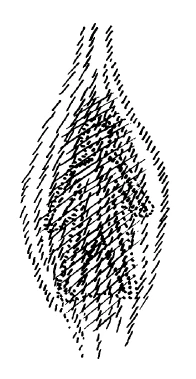
[ 4 ] When we are in our daily waking state, we can say that within the human being there exists, in a certain ordered connection, what we call the four members of human nature: the physical body, the etheric body, the astral body, and the I. We can best grasp what constitutes the proper connection between the four members of human nature by drawing it roughly as the clairvoyant consciousness perceives the so-called aura of the human being. What I can draw for you here is, of course, only a very rough sketch.
[ 5 ] If we consider the ordinary waking state of a human being, we would depict the human aura in roughly the following way: the physical body as the sharper line; the etheric body within the dotted line; the denser hatched area is the astral body; and the ego aura could be depicted as permeating the entire human being, but I draw it as rays that surround him, without actual boundaries, radiating upward and downward.
[ 6 ] Next, I will draw the difference in the auric composition during the sleeping state of a person who would be sleeping around midnight, or rather the auric image of that person (see drawing): the physical body and etheric body are as in the first drawing; the darkly hatched area would be the astral body; whose indefinite downward extension would stand out, yet remain in a vertical position. I would then have to draw the ego-aura in a radiating form, as can be seen here. In the neck region, the ego-aura is interrupted and begins again only in the head region, but in such a way that it radiates outward and extends upward into the indefinite when the person is in a horizontal position, yet is directed upward, from the head and upward. So that essentially the appearance of the aura of the sleeping person would be such that the astral body is significantly denser and darker—in the area darkly hatched in the drawing—while in the upper parts it is thinner than during the day. In the neck region, the ego-aura is interrupted; below, it is again radiating outward and then extends into the indefinite.
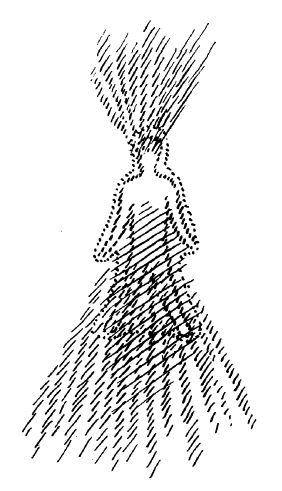
[ 7 ] The essential point is that, during such a state of sleep, what might be called the auric image of the ego actually splits into two parts. During the waking state, the ego aura hangs together like an oval; during such a state of sleep, it splits apart in the middle and consists of two parts during sleep, one of which is turned downward by a kind of heaviness and spreads downward, so that one is dealing not with a closing ego aura but with one that spreads downward. To the clairvoyant consciousness, this part of the ego-aura appears as a substantially very dark portion of the aura, containing dark threads but tinged with strong, for example, dark-reddish hues. What separates from this and extends upward again runs narrowly from the head region, but then spreads out into the indefinite, so to speak, spreading upward into the world of the stars. The astral aura is not divided in the same way in the middle, so that one cannot speak of a real division of it, whereas the ego aura, at least to the eye, is divided.
[ 8 ] Thus, in this occult vision, we also have a kind of pictorial expression of the fact that the human being, together with that which permeates him as ego forces during the waking state, goes out into the space of the worlds in order to connect with the world of the stars, to draw in the forces from the world of the stars, so to speak.
[ 9 ] Now, the part of the ego aura that constricts downward and becomes dark appears more or less opaque, while the part extending upward is brightly luminous and shining, radiant in bright light; at the same time, it is the part most exposed to the influence of the Ahrimanic forces. The adjacent part of the astral aura is most exposed to the Luciferic forces. We can therefore say: The characterization, which is rightly given from a certain point of view, that the ego and the astral body leave the human being, is absolutely true for the upper parts of the ego and astral auras. For those parts of the ego and astral auras that correspond more to the lower parts, especially the lower parts of the torso of the human form, it is not actually correct; but for these parts it is even the case that during sleep the aura of the ego and the astral body are more inward, more connected with the physical body and the etheric body than is the case in the waking state, that they are denser and more compact toward the lower regions. For one also sees how, upon waking, what I have drawn so strongly below again emerges from the lower parts of the human being. Just as the upper part emerges when falling asleep, so the lower part of the ego and astral auras emerges in a certain way upon waking, and only a kind of fragment of these two auras remains inside, as I have drawn in the first figure.
[ 10 ] Now it is of the utmost importance to know that through the evolution of our Earth, through all the forces that have played a part in it—which you can see in *Outlines of Esoteric Science*—arrangements have been made so that the human being does not participate in this more active work of the lower aura during sleep; that is, does not participate in this work as a witness. For it is from these parts of the lower ego-aura and the lower astral aura that the revitalizing forces are stimulated which the human being needs so that what has been worn down during the waking state can be repaired. The restorative forces must emanate from these parts of the aura. Whether they act upward and restore the whole human being depends on the upward-projecting part of the aura developing forces of attraction that it draws in from the world of the stars, thereby enabling it to attract the forces coming from below so that they have a regenerative effect on the human being. This is the objective process.
[ 11 ] Now, understanding this fact also gives us, in a sense, the best understanding of certain messages that a person receives when studying the various occult texts or those based on occultism. You have, as I just said, always heard the characterization—which is entirely justified from a certain point of view—that sleep consists of a person leaving their physical and etheric bodies in bed and going out with their astral body and ego; which is, in a certain sense, entirely correct for the upper parts of the ego and astral auras, particularly for the ego aura. But if you study Eastern writings, you will not find this characterization, but rather the exact opposite. There you will find it described that during the state of sleep, that which otherwise lives in human consciousness draws itself deeper into the body. So there you find the opposite characterization of sleep. And particularly in certain Vedanta texts, you will find the matter characterized in such a way that what we say withdraws from the physical and etheric bodies sinks deeper into the physical and etheric bodies during sleep, that what otherwise causes vision withdraws into deeper parts of the eye, so that vision can no longer take place. Why is this described in this way in Eastern writings? It is because the Eastern thinker stands on a different point of view. Through his kind of clairvoyance, he perceives more of what is taking place within the human being, what is unfolding there internally. He pays less attention to the process of the upper aura withdrawing and more to the fact of being permeated by the lower aura during sleep. Therefore, from his point of view, he is naturally correct.
[ 12 ] One might say: The processes that take place within human beings as they evolve are very complex, and as evolution progresses, it will become increasingly possible for human beings to grasp, so to speak, the full scope of those processes. But development consisted in the fact that people gradually came to know individual aspects through their observations. Hence the individual statements made in the various epochs. Even if they do not seem to say the same thing, they are not therefore false, but rather they always refer to the one-sided aspect, which is, after all, always taking place. But the entire process of development only becomes clear when one summarizes all the processes together. That is what matters.
[ 13 ] We have now reached a point where we can gain a fairly clear overview of a certain phase of evolution. There is truly a very significant difference in the entire state of mind, the mood of the human soul, when we survey the development of the human soul, for example, in those incarnations that took place during the Egyptian-Chaldean period, then again during the Greco-Roman period, and then again in our own time. Even outwardly, we can quite clearly trace what the soul experiences. I believe that even here in this enlightened circle there will be a large number of people who, when faced with a star-studded sky, do not know exactly where the individual constellations are today and how the individual constellations change their positions in the heavens during the night. On the whole, we can say: People who are still properly knowledgeable about the starry sky are becoming rarer and rarer. — There will even be people, for example among the urban population, whom one might ask in vain: Is it a full moon or a new moon now? — This is by no means a criticism; it is part of the natural course of development. But what applies to the soul today would have been a complete impossibility in the Egyptian-Chaldean era, especially in the earlier Egyptian-Chaldean era. Back then, people actually knew their way around the sky. The present day, after all, has another advantage over those people of the Egyptian-Chaldean era: logical thinking—as people today might think if they made the effort—was something the people of the Egyptian-Chaldean era had not even considered. They lived from day to day, and whatever they did in their daily tasks, they did more instinctively. One would be completely mistaken to believe that back then a building or an aqueduct was constructed by engineers first sitting down in their offices and carrying out the entire project using the methods by which plans and the like are drawn up today. The engineers of that time did no more of that than a beaver today draws up a plan of its dam, which it builds with perfect artistry and precision.
[ 14 ] So there was no logical, scientific thinking as we know it today; rather, whatever people did while awake, they did instinctively. They possessed the knowledge they had—and we know, of course, that a vast body of knowledge from the Egyptian-Chaldean era has been preserved—which they had acquired in a completely different way. They knew the starry sky, the night sky; they were familiar with the heavens, but they did not have the kind of astronomy that people have today. They exposed themselves to the sight of the starry sky; they had the successive images in the successive hours of the night, and what affected them was not merely what made an impression on the senses, not merely these sensory images, but the whole of the astral forces spread out in space. They lived through that. Thus, for example, the path of the Great Bear, the Seven Stars, was an experience for them; an experience that continued even while they slept, for they were receptive, sensitive to what moved spiritually across the sky with the Great Bear. They took all of this in. Along with the sensory sight, they took in what lives as the spiritual in the space of the universe. Something else penetrated their consciousness that the present-day consciousness is entirely unsuited to receive, for today people take in only the sensory image of the starry sky. And since they are very clever, they take the star map—where people have drawn all the animal forms—and say: People used to draw symbols there; they grouped the stars together in that way; but now humanity has progressed to the point of seeing reality as it is. — Yet people today do not realize that the ancients actually saw what they drew; that these were real forms they sketched based on the direct vision that presented itself to them. One could draw better, another worse, but they traced reality. That is what they saw. But they did not see as one sees in the life of the senses. Rather, when they experienced, for example, the Great Bear as it swept across the night sky, they saw the physical stars only as embedded in a mighty spiritual being that they truly perceived. But it was not the case that they saw an animal sweeping across the sky in that place, as one sees a physical animal on Earth—that would be a childish mental image—but rather this experience of the Big Dipper rushing by was intimately connected with their own nature. People felt how it affected their astral bodies and brought about changes there.
[ 15 ] You can get a mental image of what that might have been like if you imagine the following: Here is a rose. You would not look at it, but simply grasp it, and by grasping it, you are actually always experiencing your own touch with the rose. So you would not look at the rose, but only grasp it and experience your own contact with it, and in this way form a mental image of the rose. In this way, these people “touched,” as it were, with their astral bodies what they could experience in the Great Bear, “felt” the astral, and experienced their own contact with it. But this brought about changes within them, changes that are still brought about today, though they are no longer perceived.
[ 16 ] In a sense, this is how evolution has led us into our modern, scientific age—our age of reason—namely, that the direct experience of spiritual processes has ceased, leaving behind only the sensory world and the intellect bound to the brain. Therefore, when in the Egyptian-Chaldean era people spoke of spiritual beings in space and such beings were also depicted, and when the physical stars were drawn into this as points of reference, this corresponded to reality as it was directly experienced. So that in the Egyptian-Chaldean era, human perception existed that was much more akin to life between death and new birth than our present physical life in consciousness is akin to life between death and new birth. For when one actually perceives how the astral body and the I experience the events in the heavens, then one also knows the following: Just as you live there with the starry sky, so do you live outside your physical body and etheric body, and there is not the slightest reason to believe that, once the physical body and etheric body are no longer with you, you do not live just as much with the starry sky. — Thus there was a direct knowledge of the experience of the celestial events in the life between death and new birth. Anyone who lived in the Egyptian-Chaldean era, for example, would have found it ridiculous if one tried to prove the immortality of the soul to him; for he would have said: There is no need to prove that! — They would not even have understood, in our sense, what a proof is, because logical thinking did not exist. But if they had learned in an occult school what a proof is—as it will be understood in the future—they would have said: There is no need to prove the immortality of the soul, for when one experiences the starry night sky, one experiences that which is independent of physicality. — So for him, immortality was an immediate experience, and these people knew much of what we describe today regarding perception in the disembodied state. They knew it directly. For when we look from these more distant starry worlds up at our planetary stars, Saturn, for example, was something these people perceived spiritually. That is to say, they perceived what is connected to Saturn as a spiritual world. They thus actually perceived—and this applies particularly to the earlier times of the Egyptian-Chaldean epoch—what lives on Saturn within the human being between death and new birth. It would indeed have seemed quite curious to a person of that time if one had tried to tell them that one would strive for such a “Mars correspondence” as is often imagined today, for to them a connection with these worlds was very much a reality in their consciousness. But if one knows Saturn or Mars or any other planetary state and can observe how it manifests itself within our planetary system today, this also leads one to an understanding of those states—such as the Saturn, Sun, and Moon states described in *Outlines of Esoteric Science*—which are pre-earthly. This was, in fact, experienced back then. It would not have been necessary to present it in a lecture, but rather one would simply have had to bring it before human consciousness in such a way that people who could no longer perceive such things directly would be brought into states in which they could perceive them. It would not have been possible otherwise.
[ 17 ] Things were already different by the Greco-Roman period. By then, people had lost their sensitivity to everything I have just described, and all that remained was the memory of it. So in the Greco-Roman era, among the leading peoples—for example, those of southern Europe—the ability to perceive the spiritual beings of the starry sky no longer existed to the same degree, but the memory of it remained. A soul born within the Greco-Roman culture therefore no longer had the ability to look out into the starry worlds to perceive the spiritual; one no longer saw, to the same extent as in the Egyptian-Chaldean era, the spiritual beings belonging to the starry worlds. But just as a person today remembers what they experienced yesterday, so the souls still remembered what they had experienced about the universe in earlier incarnations. This radiated into the people; they knew that it lived within their souls. Plato interprets it as memory. But people do not always interpret it as memory. And therein lies the progress in evolution: that this direct perception was subdued, and in its place, during the Greco-Roman era, judgment and the conceptual world developed—which, after all, only emerged at that time. Consequently, the other had to recede and could only live on in memory. This is most beautifully seen in Aristotle, who lived in the 4th century B.C. and is, of course, the founder of logic, the art of judgment; he himself could no longer perceive anything of what exists as spiritual in the starry worlds out there, but in his writings he revives all the old theories, so that he does not speak of what we today know as physical celestial bodies, but rather of the “sphere spirits,” of spiritual beings. And a large part of Aristotle’s discourse is devoted to the enumeration of the individual planetary spirits, the fixed-star spirits, and so on, up to the unified God of the worlds. The sphere spirits still play a major role in Aristotle’s work.
[ 18 ] But even the memory of the spiritual beings of the world from the Greco-Roman era was gradually lost to humanity. And it is interesting to see how, so to speak, bits and pieces of this ancient knowledge have been lost over time. Those of a more spiritually inclined nature still drew from their memories the awareness that spiritual beings are connected to everything that is physically scattered throughout space as celestial bodies, just as we describe it again today in anthroposophical science. Thus, one finds much in this regard—one might even say, presented in a manner that was grandiose for its time—in Kepler. And the closer we move toward modern times, the more this ability to recall what the soul experienced when gazing at the starry sky in the Egyptian-Chaldean era also fades away. The memory that was still present in the Greco-Roman era is also fading, and the age of Copernicanism is drawing ever closer, in which one sees only the physical celestial spheres rushing through space. Only sometimes, as I said, does a possibility still glimmer in the minds of newer spirits, as something enters their consciousness, allowing them to trace something of the spiritual connections and spiritual processes from the constellations of the starry world—as Kepler, for example, took it upon himself to independently calculate the time of Jesus of Nazareth’s birth from the starry world. That was a calculation that still stemmed from Kepler’s spiritual imbuedness; just as Kepler was also aware that a certain star constellation in the year 1604 again led to the suppression of the old memory. And the more we move into more recent times, the more humanity has come to rely on the external senses and on the intellect bound to the brain, because what the souls had experienced in ancient times has sunk down into deeper layers of consciousness. What the souls experienced when they were able to perceive this living spiritual life in the realms of the cosmos was once present in all your souls. It is present everywhere in the depths of your souls. But today there is no possibility of guiding the souls during the night and directing their gaze, for example, toward the Great Bear, nor of making visible the forces emanating from the Great Bear—which are thus spiritual forces. This is not immediately possible because the powers of vision, the powers of perception, lie deep within the soul. In the state of night sleep, the human being experiences this through the part of the aura that extends upward, but their consciousness is not present there. That is why the scientific retrieval of the forgotten impressions of ancient times is the right approach for the souls of the present. And how does this retrieval take place? Just as we do it in anthroposophy! Nothing new is brought to the souls; rather, what is brought up is what the souls experienced in earlier times, what they could no longer perceive in the Greco-Roman era but had not yet completely forgotten, what is now completely forgotten but can be brought up again. So that anthroposophy is nothing other than the stimulation to bring up the powers of knowledge lying deep within the souls. All human beings who have participated in evolution up to the Western era possess, deep within their souls, the mental images that are to be stimulated by anthroposophy, and the anthroposophical methods are the means of stimulation to bring these mental images, resting in the depths of the soul, to the surface. |
[ 19 ] Let us now draw attention to the difference that now exists, due to these two ways of relating to the world, between a human soul that was incarnated in the Greco-Roman era and a soul that is incarnated today.
[ 20 ] We have seen that during the Greco-Roman period, the soul retained a certain connection—a capacity to perceive—even during its earthly life to what it had experienced between death and rebirth. At that time, this had not yet been drawn into the deeper layers of the soul. Therefore, the difference in consciousness on Earth and between death and rebirth was not as great in those ancient times as it is today. But because the Greeks could only remember what they had experienced, the difference was already immense. Today, the situation has progressed to the point where a human being can still develop consciousness between death and new birth through a moral or religious state of mind, even ascending into the sphere of Venus. But when they reach the solar sphere, and especially beyond the solar sphere, they lack the ability to kindle their consciousness unless they take care here on Earth to bring the mental images resting in the depths of the soul up into their waking consciousness. Here in earthly life, anthroposophy appears as a theory, as a worldview that one takes up because it interests one. After death, it is a torch that illuminates the spiritual world for one from a certain point onward between death and the new birth. And if one disregards it here in the world, one lacks this torch: then a dimming of consciousness occurs between death and new birth. To engage in spiritual science is not merely a theoretical matter, but something living. Spiritual science is, so to speak, a torch of life. The content of spiritual teaching here consists of concepts and ideas; after death, they are living forces! But this actually applies only to our consciousness. For from what I said at the beginning of today’s reflection, it will be clear to you that even in earthly life, the spiritual ideas we take in are life-giving forces. It is just that the human being is not a witness to these life-giving forces, because the knowledge of these life-giving powers is closed off to him. After death, he beholds them, he is a witness to them. Here, anthroposophy is, so to speak, a kind of theory, and what is spiritually life-giving—though objectively present—eludes the human being’s consciousness in the waking state. After death, the human being is a direct witness to how the forces he absorbs through spiritual teachings during his life on Earth actually have an organizing effect, an animating and strengthening effect on that part of his being which can then be present when he prepares for a new incarnation on Earth.
[ 21 ] Thus, humanity’s evolution absorbs what constitutes spiritual teaching. But if this spiritual teaching were not absorbed—at present it is sufficient for a few to absorb it, but more and more people must absorb it as we look toward the future—then gradually, when people return to earthly incarnations, they would not have the sufficient vitalizing forces they would then need. A decline, an atrophy, would set in during later incarnations. People would soon wither, develop wrinkles early, and so on. A decline, a withering of physical humanity would set in if the spiritual forces were not absorbed. For the forces that people once absorbed from the starry worlds must be brought up again from the depths of the soul and used for the evolution of all humanity.
[ 22 ] Once you grasp this, you will truly be able to let the idea sink in that being on Earth has such great, such immense significance. For it had to happen that, so to speak, the human being would internalize his connection with the starry worlds to such an extent that the very same force he had otherwise always drawn in from the starry worlds would become the innermost force of his soul and be drawn up again from his soul. But this can only happen on Earth. One might say: In primeval times, the life-juice rained down from the heavenly realms into the individual souls, was preserved there, and must now flow out again from the individual souls. In this way, we gain a very special mental image of the mission of the Earth. And now that we have introduced this mental image today, we will examine life between death and the next birth even more closely.