

What Significance does
Occult Development have for Man's Sheaths:
The physical, etheric, and astral bodies, and the Self?
GA 145
23 March 1913, The Hague
Translated by Steiner Online Library
5. The Nuanced Experience of the Ethereal
[ 1 ] The more the human etheric body changes under the influence of esoteric development, the more the human being acquires what one might call a sense of time. This sense of time should be understood as a feeling for experiencing the succession of facts and events in time. Usually, in their outer life, people lack this distinct sense of time. I have already hinted a little at how this sense of time arises even through changes in the physical body, in that through esoteric development one becomes more sensitive to—let us say—summer and winter. But through the transformation of the etheric body, the experience of the external changes in events becomes even more vivid, much more sensitive. And anyone who has tried for a time, in all seriousness, to advance their soul will first of all perceive a distinct difference between the various seasons, indeed even between parts of the seasons; they will gradually learn to experience a great difference inwardly between summer and winter, between spring, summer, and autumn, but even much smaller periods of time in the course of the year will be sensed. Time, in a sense, becomes something alive in its progression. One gradually notices that, in the course of time, one perceives a differentiated life. Just as in the physical body the individual organs show themselves to be differentiated, becoming more alive and independent of one another internally, so the parts of the continuous sequence of time become, in a sense, more independent of one another, more autonomous. And this is connected to the fact that, with the development of one’s own etheric body, one experiences life in the outer ether, which surrounds us everywhere. It is not only the air that surrounds us; the ether surrounds us everywhere; but this ether lives a real life in time.
[ 2 ] The ether that surrounds us is, in a sense, a kind of living being; it lives, and lives in different ways as time goes on, just as human beings live differently in the various stages of their lives. And one learns to experience the unfolding life of the outer ether. In this way, one gains an ever-increasing sense of what the life of the life-ether is like out there: when spring arrives, when it approaches summer, when summer has reached its peak, when summer is drawing to a close, when autumn approaches, and when it is finally here. One learns to experience this outer progression; one comes to recognize a distinct difference between this summer-spring, summer-autumn life and the actual winter life.
[ 3 ] This difference is becoming increasingly apparent, so that one can truly conclude: the Earth, together with its ether, leads an independent life, and as we live in step with the times, we are literally immersed in this ever-changing life of the ether. When midsummer arrives, one feels most clearly how, with one’s etheric body, one is, so to speak, dependent on oneself, how one participates in a unique life with the Earth in such a way that the Earth then touches one little inwardly; one is, as I said, dependent on oneself, so to speak, and one then gradually comes to understand what the occultist says: During the summer, the Earth is in its actual sleeping period. We arrive at a fact that is completely misjudged because of the outer maya, by which human beings are constantly surrounded. In the outer life directed by maya, people like to compare spring with morning, summer with noon, and autumn with evening. They are mistaken in this comparison, for in reality things are not so. In reality, if we are to compare the Earth’s outer cycle with something within us, we must compare spring, summer, and autumn—in that sequence—with the Earth’s time of sleep; and autumn, winter, and spring—in that sequence—with the Earth’s time of waking. And when we speak of a spirit of the Earth, we must create a mental image in which we imagine that for the hemisphere where it is summer, the spirit of the Earth is, so to speak, in the same state during that summer as we humans are during our sleep. It is, of course, different with the Earth. Human beings alternate completely between waking and sleeping; with the Earth, it is such that waking and sleeping, as it were, move from one hemisphere to the other; that, in essence, the spirit of the Earth never truly sleeps, but that when it allows its waking activity for one hemisphere to be relieved by sleep, it then shifts its waking activity to the other hemisphere. But we need not pay much attention to that.
[ 4 ] Let us consider the human experience of the Earth: in this context, only one hemisphere of the Earth is actually relevant. We must create a mental image of the situation in which the spirit of the Earth in a certain sense separates itself from its physical body—which is now the Earth itself—and that in relation to its physical earthly body, this spirit of the Earth lives the same life in summer that a human being lives in relation to their physical body during sleep.
[ 5 ] During sleep, the physical and etheric bodies lie in bed; they lead a purely vegetative life. To the occult eye, it becomes apparent that within the sleeping human body something unfolds like a delicate vegetation, like a sprouting and blossoming of purely vegetative life, and the forces expended during waking hours are in turn replenished by this vegetative life, so that during sleep the human being actually experiences a kind of summertime. And if, when outside the physical body with his astral body and his ego, he were to look upon the life of the sleeping physical body, he would perceive this sleeping life of the physical body just as one perceives plant life sprouting and budding on the earth in spring and summer. Thus, one would observe a vegetative, sprouting, and budding summer life in one’s physical body during sleep.
[ 6 ] However, because the part of the Earth we inhabit is in its dormant state during the summer, human beings are, so to speak, dependent on their own etheric bodies, and the consequence of this is that, in the course of esoteric development, during this summer season—provided they have already acquired the ability to perceive such things—human beings perceive their own etheric bodies more clearly and distinctly than during the winter season. They perceive, so to speak, the independence of their etheric body—and in our present cycle of time, specifically the independence of the etheric part of the head, the etheric part that underlies the brain. It is a very peculiar process of learning to feel when, by living through the life of the Earth ether in summer, one gradually begins to acquire a kind of inner feeling for this particular part of the human etheric body that underlies the head; and one then feels this inner experience differently in spring, differently in summer, and differently as autumn approaches. One feels the differences in this inner experience so clearly that one can now truly speak, just as with the physical body, of a differentiation of the limbs, of different lives one goes through in the course of the summer season, of lives that are clearly differentiated from one another. The life that unfolds inwardly in spring is different, the life that unfolds inwardly in summer is different, and the one in autumn is different. When speaking of the etheric body, one must actually make a distinction, which we will do today: to separate, so to speak, a specific part of the ether that underlies the head.
[ 7 ] That is what I would like to sketch out for you in a few strokes, my dear friends. If we create a mental image of the human being in a sketchy way, we can imagine that this etheric body, of which I have just spoken, is perceived in such a way—and indeed is perceived less and less as we move upward, but rather fades into the indefinite—that it moves along with time. And one gradually learns to feel quite clearly that beings have been creatively at work on this part of our etheric body, beings who, so to speak, take turns in the various seasons we experience from spring to autumn; one notices that the seasons have worked on the brain part of our etheric body, so that our etheric brain is, in a certain sense, a complex organ.
[ 8 ] It has, as it were, been woven together by various spiritual beings who unfold their abilities in successive eras. One now begins to grasp a very significant teaching—and gradually comes to perceive the truth of this teaching—the teaching that was particularly cultivated in the Zoroastrian schools. This teaching stated that the etheric body of the human brain was gradually created out of the spiritual cosmos by spiritual beings called Amshaspands. And these Amshaspands act in such a way that they, as it were, hold sway during the summer season, and indeed still hold sway today in such a way that they succeed one another, the first, so to speak, in early spring, the second in spring, and so on up to the sixth and seventh. Seven, or rather six, of such spiritual beings take turns over time; and they are the creative spirits who—by taking turns, so that when one has completed its activity, the other intervenes—bring about such a complex being as the etheric body, especially that of the human brain. Thus, six to seven spiritual entities, succeeding one another, play a role in our brain, and one will only truly understand the human physical brain when one says to oneself: there is a spirit at work that can be sensed especially in early spring—it radiates its forces, which are primarily etheric forces; then, in late spring, a second spirit comes, which in turn radiates its forces.
[ 9 ] Thus, the etheric forces of this second spirit radiate into the same space. The third spirit, in turn, radiates its etheric forces into it, and in this way this etheric part of the human brain is formed, as spirits that succeed one another send their etheric forces into the same space at successive moments.
[ 10 ] Now we must be clear that we can only sense certain connections between what is in our brains and these spirits, which today unfold their etheric forces outside of us. For occultism teaches us that what I have just described already took place during the ancient Lunar Age; so that we must not believe that these spirits, who, as we might say, govern the summer, still exert an influence today and are, so to speak, formative forces. The predispositions that were truly radiated into us during the ancient Lunar Age by these spirits, humanity has already carried over into its earthly existence; but because he carries them within himself in his own etheric body, he still feels today—even though these spiritual beings no longer have a direct influence on our inner etheric body in the brain—he still feels a kinship with them, and that is what one feels in summer. In early spring one feels the first of these spirits, which today has a different task out there in the ether; but one feels that what one carries within, what one absorbed in the old Moon, originates from it; one feels a kinship with it at that time. This is that momentous discovery that a person can make in the course of their esoteric development: that over time they experience within themselves something like an image of spiritually active beings who, even today, have a completely different task than in the past, and who in the past were co-creative spirits in our own being. During the formation of the Earth, the physical brain then arose, as it were, as an imprint, a reflection of what had already developed during the old Moon era as a kind of etheric archetype through these spiritual-cosmic influences. I have drawn this part of our etheric body open at the top because it is truly perceived in this way (see drawing on page 80). It is perceived in such a way that, as soon as one perceives it in oneself, one actually gets the feeling: Here you are opening yourself out into spiritual worlds; here you stand in connection with spiritual worlds that are always above you. There is another sensation that one gradually develops in the esoteric life in relation to this part of the etheric body. It is generally not at all easy to communicate about these things; but I hope that if I make an effort to express these things clearly, we will still be able to understand one another.
[ 11 ] It is as if, when one begins to feel the etheric body, one feels as though one is swimming in the stream of time. But for this etheric part of the head, it is as if one felt, so to speak, as though one were carrying time along with oneself—that is, one is not merely swimming along, but carrying the flowing time with oneself. In fact, one carries much from earlier times in this etheric part of the head: one carries the old Lunar Age within it; for the essential being that arose there came into being during the old Lunar Age, and one carries the current of the old Lunar Age within the etheric part of the brain. And when one now begins to feel this way, it is like a memory of the old Lunar Age. Anyone who gains an understanding of the inner experiences described yesterday as temperamental experiences can also understand why it is said that the occultist who learns to feel the inner etheric body of his head in this way, when he concentrates particularly on this etheric part of the head, then always feels this concentration on the etheric part of his head connected with a melancholic mood that overcomes him; one feels, so to speak, as if a melancholic mood were being poured into one’s head in the course of esoteric development. And out of this melancholic mood, an understanding of such things gradually develops in the inner experience, as they were described to our friends in the occult description of the ancient Moon.
[ 12 ] Esoteric development must, of course, go much further if one truly wishes to describe the individual conditions on the Moon; but you can see how the things that lead to such a description are beginning to take shape. You see that something arises within the human being himself that one might call the melancholy of his mind, within which mood a vision gradually emerges—like a vision of remembrance—into a distant past, into the ancient lunar era. And it would be desirable, my dear friends, that from such descriptions as those just given, you might gauge how esoteric development actually proceeds, how one starts from a particular experience, how one first learns to recognize this experience —in this case, for example, as a memory of a distant past, from which one has brought the stream of time into the present—and, as it were, learns to unroll again that which was once lived through. Gauge from this that the occultist is truly not speaking of daydreams when he presents that construction of the universe which goes back to the ancient Moon, Sun, and Saturn eras, but that, if one only perseveres patiently, one can gain a concept—through the process of discovering how these things are found—of the gradual immersion into those vast, grand cosmic tableaux, which indeed belong to a distant past but are evoked once more from present-day life. We need only come to experience within ourselves, for example, phenomena of bygone times that lie within us as if entangled or wrapped up, and then bring them to unfold.
[ 13 ] The etheric body is experienced differently—specifically, the part of the etheric body that belongs to the middle region of the human being. Outwardly, the sensation fades; inwardly, it is perceived in such a way that one can say: This, which is depicted here in the middle as a sort of egg-shaped form, is felt as separate from the rest. If one isolates this middle part of the etheric body in this way as a distinct experience, one must say: The person who, through esoteric development, comes to experience within themselves the differentiated life of this middle part of the human being as well, has the feeling that in this part of the etheric body they are, in a sense, essentially flowing along with the current of time. And in this part of the etheric body, one indeed still clearly perceives the shared experience of the Earth’s etheric life as it differentiates itself in the succession of time.
[ 14 ] Those who make progress on the esoteric path feel, especially in this phase, just as in early spring other spirits, so to speak, influence them differently than in midsummer or autumn. It is a kind of shared experience, or more precisely, a kind of going with the flow. This is also what sets this part apart from the others, and if we are able to delve into such matters, we have a feeling for this middle part of the etheric body that fluctuates between a phlegmatic and a sanguine mood. It takes on the most varied nuances between a phlegmatic and a sanguine mood. In the springtime, for example, it is more a kind of going along with the current of time in the etheric body—in the physical body this expresses itself quite differently—while toward autumn it is more a resisting, a repelling of the current of time.
[ 15 ] A third part of the etheric body is then perceived in such a way that we feel it extending downward into the unknown, disappearing into the earth, yet spreading out. These are three parts of the etheric body that can be perceived separately from one another.
[ 16 ] Now, however, this would represent the inner sensation, the inner experience of the etheric body; for example, this is not how it would appear to a clairvoyant when observing another person’s etheric body, but rather it is the inner experience of the etheric body. This experience is significantly modified by the presence of a fourth member of the etheric body, clearly defined like a sort of egg-shape, which actually encloses the human being within itself. From the various sensations one has toward these parts of the etheric body, one gradually acquires such sensations that one gains the feeling of having an inner impression of the etheric body as of an outer form.
[ 17 ] And then the etheric body takes on a hue; it becomes colored, and one gets the impression of being here in this part of the etheric body as if in a kind of bluish or bluish-violet aura. This part, which corresponds to the head, is also bluish or, depending on the person’s nature, bluish-violet, but gradually transitions downward into a greenish hue. The middle part has a distinctly yellowish-reddish color—if one perceives the color—and the lower part has a distinctly reddish to deep red color, which, however, radiates outward and often extends far beyond.
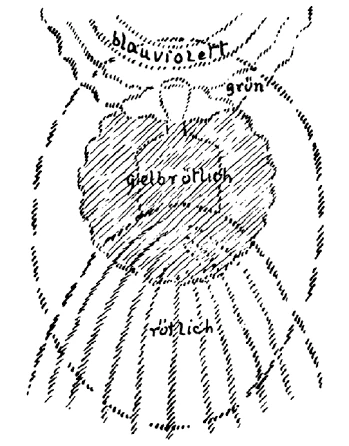
[ 18 ] However, the forces at work in these four parts are differentiated, so that what one experiences as inner sensations does not come through clearly; but when one observes it clairvoyantly from the outside, the forces within this outermost aura act to compress the upper part, and one then gets the impression, when looking from the outside, as if—only slightly larger—the etheric part of the head were entirely in keeping with the shape of the head. The middle part is the same. The further down one goes, the less this is the case. But because the forces interact with one another, when viewed from the outside, one gets the impression that the etheric body is a kind of basic form of the physical body, yet protrudes beyond the physical body to a certain extent. Toward the lower regions, the sense of harmony between the physical body and the etheric body gradually fades.
[ 19 ] So you must bear in mind that the inner experience of the etheric body is different from the form that the etheric body reveals to the clairvoyant in vision. This must be kept very clearly in mind.
[ 20 ] If you are still learning to pay attention to mood in your esoteric development—specifically those fundamental moods that are inherent in the etheric body and were described yesterday—you will find that the mood associated with the lowest part of the etheric body is perceived as choleric. Thus, the individual temperaments do indeed differ for the various parts of our etheric body. The upper part of the etheric body is of a melancholic disposition, the middle part is, in alternating states, of a phlegmatic-sanguine disposition, and the lower part is choleric. And I ask you to take great care to note that this description applies to the etheric body. Anyone who does not take this into careful consideration will, for example, very easily fall into error if they take things at face value. But anyone who does take this into careful consideration will be struck to the highest degree by the correspondence between what has been described and certain phenomena of life. Just try, for example, to study choleric people—it is extremely interesting.
[ 21 ] According to what has been said, the lower part of the etheric body would be particularly well-developed in a choleric person; it would stand out from the other parts, and this is what makes a person choleric. The other parts are, of course, also developed, but the lower part would stand out particularly. Now, if the lower part of the etheric body is particularly well-developed as an etheric body, possessing strong forces within it, then something else always occurs: namely, that the physical body is somewhat deficient in these areas, that the physical body may exhibit certain underdeveloped features in the direction corresponding to this part of the etheric body. It would therefore follow that in pronounced choleric individuals, who manifest as such in life, the anatomical findings for certain organs corresponding to this part of the etheric body would show a kind of underdevelopment. Please read the anatomical findings regarding Napoleon, and you will be struck by the evidence that will present itself to you. When one begins to study these hidden aspects of human nature, only then will one truly come to understand this.
[ 22 ] You may now ask: How does what was said yesterday correspond to what is being said today? It corresponds perfectly. Yesterday we spoke of the four temperaments. They are determined by the forces of the etheric body. And indeed: the life of the etheric body relates to the temporal just as its structure and differentiation relate to the spatial. The physical body becomes more alive within itself in the spatial realm, differentiating, as it were, into its individual members; the etheric body becomes more alive as its members differentiate temporally, that is, as temporal life is experienced in the succession of independent parts and members.
[ 23 ] The underlying reality for the melancholic is that he constantly carries within himself an experience from the past, something he has lived through in time. Anyone who is able to attune to the etheric body of the melancholic will find that this etheric body still resonates with what it has experienced in times past. I am not referring here to what has been mentioned regarding the human brain, which relates to ancient times, but rather to what is commonly called melancholy. Above all, the etheric life of the head is stimulated at a certain time—let us say in youth; and then what has been stimulated is so strongly influenced that in later stages of life, as a melancholic, one still carries within the vibrations in the etheric body that were imprinted in youth, whereas in the non-melancholic these vibrations have simply vibrated themselves out. In the phlegmatic and the sanguine, we have a kind of going with the flow of time; only that in the phlegmatic there is, as it were, a complete, even going with the flow of time, while the sanguine alternates between, so to speak, a faster inner experience and a slower experience in relation to the outwardly flowing stream of time. The choleric type, on the other hand—and this is what is peculiar—resists the approaching time, which flows toward us, as it were, from the future. The choleric person thus, in a certain sense, rejects time, and quickly dispenses with the vibrations that time evokes in his etheric body. Therefore, the melancholic person carries within himself the most of the after-vibrations of what was experienced in the past; the choleric person carries within himself the least of the after-vibrations of what he has experienced in the past. Take the somewhat grotesque comparison of the ball filled with air, which was likened to the etheric body of the choleric person; you can apply this comparison here as well. The ball is hard to impress by successive events; it repels the events, and thus does not allow the events, as they act in the stream of time, to resonate strongly within it. Therefore, it does not carry this within itself for long. The melancholic, who allows events to affect his etheric body deeply, deeply, has to bear for a long time the vibrations that he carries with him from a past course of time into the future.
[ 24 ] It is helpful, when seeking to understand the etheric and physical bodies, to adopt a mental image that the physical body is primarily a spatial entity, while the etheric body is primarily a temporal entity. One cannot understand the etheric body at all if one regards it merely as a spatial entity. And a drawing such as the one made here is actually only a kind of spatial representation of the life of the etheric body, which flows along in time and engages with time. Because the life of the etheric body itself unfolds as if in time—it is a life of time—we therefore also experience time with our etheric body, that is, the external flow of events in time.
[ 25 ] When a person undergoes occult development, they also experience yet another stream of events in time. In ordinary life, this stream of events is scarcely perceived, but it is perceived precisely during the higher development of the soul: this is the course of the day. For in a certain sense, the spirits of the annual cycle also influence the course of the day, albeit with lesser forces. It is, after all, the same sun that determines both the annual and the daily cycle! Those who have undergone an esoteric development will soon find that such a relationship exists between their etheric body and what is happening in the outer ether that they will, so to speak, relate differently to the spirits of the morning than to those of midday and those of the evening. The spirits of the morning stimulate us in such a way that we feel, so to speak, more stimulated in our etheric body toward an activity that leans more toward the intellect, toward reason, that is better able to reflect on what has been experienced, that is better able to process what has been observed in memory through judgment. As noon approaches, these powers of judgment gradually diminish; the human being feels the impulses of the will working within. Even if, as noon approaches, the human being begins, so to speak, to be less productive in terms of external work than in the morning: internally, the powers of the will are working more. And as evening approaches, the productive forces emerge—those more closely connected with the imagination. Thus, the spiritual beings who send their forces into the life-etheric conditions of the Earth also differ in terms of their duties.
[ 26 ] One can be certain that one will gradually come to understand more and more—the more one has overcome the entirely materialistic mindset of our time—the need to take into account the adaptation of the human etheric body to the passage of time. A time will come when people will find it strange to tackle a school subject in the morning that makes special demands on the imagination. People will find this just as strange in the future as they would find it strange today if someone were to put on a fur coat in August and a thin garment in the middle of winter. Certainly, we are still somewhat far removed from these things today; but they will draw near sooner than people actually believe. A time will come when, in general—there will still be a distinction between summer and winter time—but a time will come when people will realize that it is absurd to organize school hours any other way than by scheduling a few hours in the morning, then leaving the midday free for a long stretch of time, and then scheduling a few more hours in the evening. Perhaps this seems impractical according to today’s division of time; one day it will be found practical in relation to the demands of human nature. And one will schedule mathematics lessons for the morning, and the reading of poets for the evening hours. Today we are in a time when understanding of these things is completely buried by the materialistic mindset that is now a deluge; so that today it will happen that what must appear to be the most reasonable, when one considers the entire nature of the human being, appears to be the most foolish.
[ 27 ] Another result will be that, during the winter season, through esoteric development, one will increasingly feel that one is, so to speak, not as self-contained within one’s inner etheric body as during the summer season, but rather that one comes into closer connection with the immediate spirit of the Earth. The difference will be felt in such a way that during the summer one says to oneself: You live there with the spirits who have worked on you since time immemorial, whose work you help to carry forward, while the direct Life-Spirit of the Earth is now more distant from you in summer. — In winter, the inner vibrations that one has carried within oneself since ancient times, particularly in the head, will be more silent; one will feel connected to the spirit of the Earth; one will come to understand that the spirit of the Earth is awake in winter. Just as it sleeps in summer, so it is awake in winter. During the summer, the spirit of the Earth sees the sprouting and budding plant life coming just as the sleeping human sees the vegetative forces surging upward within their own body. During winter, they recede, just as these vegetative forces recede in the human body during waking hours. In winter, the spirit of the Earth is awake; the Earth is, as it were, united with the waking spirit, just as the human being is united with their waking spirit during waking hours. The result is that, through an esoteric life, one develops a sense of this: one learns to feel that in summer one must think, one must work out one’s thoughts. Not inspirations; those come from what is within, in the independent etheric body. In winter, however, one is more easily inspired by thoughts than in summer, so that human thinking in winter acts more like an inspiration than in summer. Thus, human thinking in the specific sense proceeds so easily in winter that it comes, as it were, of its own accord in a certain respect. Of course, these conditions combine. These conditions also arise quite individually in each person. So that if a person is more inclined, so to speak, to nurture thoughts that turn toward the supersensible, this can lead to a conflict. Because during the summer season it is easier to generate these thoughts directed toward the supersensible, the exact opposite can occur. But what I have just said applies to the experience of the etheric body.
[ 28 ] It is precisely this shared experience with the outer etheric realm that becomes increasingly acute the further a person advances in their esoteric development. And if a person wishes to develop their etheric body in the proper way, they must—just as they must first suppress sensory perception—gradually shut down their thinking as well; they must, in particular, shut down abstract thinking and gradually transition to concrete, pictorial thinking; they must move from thinking to thoughts and then also let go of those thoughts. But then, when a person establishes his empty consciousness, when he lets go of his thoughts—as you will find described in the second part of my *Secret Science*—then he feels how the thinking that lives within him fades away, how, as it were, that which he has hitherto produced as his thinking through his own efforts melts away; instead, however, he then feels strangely enlivened by thoughts that flow into him as if from unknown worlds, that are there for him.
[ 29 ] There is a transition in the life of the human soul that can be characterized, roughly speaking—and I ask you not to misunderstand the expression—by saying: a person ceases to be clever and begins to become wise. This is something with which a very specific concept is associated. Cleverness, which one acquires inwardly through power of judgment, and cleverness, which is an earthly asset, fade away. In particular, one enters an inner state in which one does not value them particularly highly; for one gradually feels the wisdom bestowed by the gods dawning within oneself! I ask that you by no means misunderstand the expression; for the experience itself leads to the point where the expression can be used without any immodesty, where it can be used quite humbly and modestly. In the face of the wisdom bestowed by the gods, human beings become ever more humble; one is actually proud and arrogant only regarding self-acquired cleverness and so-called intelligence.
[ 30 ] And then, when one goes through this experience, one gradually feels as if this wisdom—this God-given wisdom—is flowing into one, flowing into the etheric body, filling the etheric body. This is a very significant experience one has; for one has this experience in a peculiar way. One has it in such a way that one feels life flowing away or drifting along with the stream of time. And the stream of wisdom is something that comes toward one, something that, as one drifts along with time, pours into one like a counter-flow; and one actually feels this pouring in such a way that—to put it figuratively—one feels it as streams, but streams flowing through time, which enter through the head and pour into the body and are received by the body.
[ 31 ] Little by little, what I have just said becomes a very specific experience. One no longer feels oneself to be in space; for one learns to feel the etheric body, which is a being of time, one learns to move through time, but one continually learns, so to speak, to encounter the spiritual beings who come toward one as if from the other side of the world, who come toward one from the future and bestow wisdom upon one. Then the feeling of receiving this wisdom can only be attained if one has organized one’s esoteric or occult development in such a way that one has cultivated within oneself a feeling that, in a peculiar way, positions the soul in relation to all future events: when one has cultivated serenity toward what the future brings us—that is, toward what the ongoing experience brings us. If we still approach our experience with strong sympathy and antipathy, if we have not yet learned to take karma seriously—that is, to accept what befalls us with serene endurance of karma—then we cannot yet have that peculiar sensation of wisdom flowing toward us; for it is only from an experience felt with serenity that the streams of wisdom flowing luminously into our being emerge. The sensation just described characterizes a very specific point in esoteric experience—that point at which we arrive and which we can truly experience only when we allow every experience to approach us with devoted gratitude and serenity. We are enabled to do this by the transformation of our etheric body, which takes place during proper esoteric development and which, among other developmental requirements, also demands this: that we acquire serenity, that we acquire a true understanding of our karma, so that we do not attract what is to come through sympathy and antipathy, nor rebel against what befalls us, but rather learn to bear our karma in the steady flow of experience. This learning to bear karma is part of esoteric development, and it is what enables us to transform our etheric body so that it gradually learns to perceive more and more of the outer etheric life surrounding it.