

What Significance does
Occult Development have for Man's Sheaths:
The physical, etheric, and astral bodies, and the Self?
GA 145
27 March 1913, The Hague
Translated by Steiner Online Library
9. The Guardian of the Threshold: Cain and Abel
[ 1 ] When one approaches the processes occurring in the astral body and in the human self—insofar as they are experienced through occult development—the description becomes increasingly difficult. For in experiencing these aspects of human nature, one moves very far away from what one is accustomed to experiencing in everyday life. In ordinary soul life, it is indeed the case that one perceives as one’s inner life the life in the astral body in the ebbing and flowing passions, emotions, drives, desires, and so on; that one also perceives as one’s inner life that which finds its expression in the synthesis within the “I.” However, what one experiences in this way is nothing other than the reflection, the mirroring of the Self and the astral body upon the etheric body and the physical body; it is not a conscious participation in the experience of the astral body and the Self. And through what one has in ordinary soul life, one cannot gain any real mental image of the actual experience within the higher worlds in the astral body and in the Self. Therefore, when describing these things, one must resort to a mode of representation that is natural to these higher worlds; one must resort to imaginations; and these imaginations are, after all, experienced in reality. But you must not imagine, my dear friends, that the act of looking at—or, as it were, staring at—the clairvoyant imaginations is the only thing one experiences; in a sense, it is not even the main thing; the main thing is what one undergoes inwardly in the process, what the soul goes through in terms of events and inner trials when it faces these imaginations.
[ 2 ] And this is especially true when it comes to such significant, powerful visions as the one described in the “Paradise” vision. Whoever truly experiences this Paradise Imagination—that is, whoever can hold it before them as an achievement of higher experience—feels themselves standing right in the midst of an inner surge of the soul; they feel seized by an inner surge of the soul and sense how they can, so to speak, stray off in the two directions described yesterday. Just as one is drawn, vividly drawn, by all the passions and emotions that continue to exert their influence from the personal life one leads on the physical plane—for just as hundreds upon hundreds of magnetic forces of attraction, the personal interests one has gradually drawn to oneself on the physical plane, act ever more strongly—on the other hand, however, one feels something else as well. The closer one gets, the more clearly this vision of paradise can be seen, the more strength these forces gain that pull one down toward personal interests, and what they do to one is this: they increasingly erase this vision of paradise, or rather, they do not allow it to truly arise at all; one becomes as if numbed. The personal interests, affections, feelings, and sensations one carries along with them are just as many hundreds and hundreds of magnetic forces as they are, on the other hand, numbing agents. And then, when one tries to advance one’s self-education to the point where one views the astral body, so to speak, more and more in truth—for when one has this image of paradise, one is outside one’s physical and etheric bodies, that is, one is in one’s astral body and I—when one has grasped the nature and character of the astral body, then one knows: that is the egoist. And this is only justified at this stage, which one has attained through self-education, if one does not make the personal aspect of one’s being—which then comes with a hundred and a hundredfold of forces—the center of one’s egoistic interests, but rather if one can increasingly make the very general interests of humanity and the world one’s own. For one feels, at this stage of occult development, a counterbalance to the egoism of the astral body—another force that rises more and more the more, so to speak, the egoistic forces stir within the now-liberated astral body. One feels ever greater loneliness, icy loneliness. This icy loneliness is also part of what one experiences in the inner surging. And this icy loneliness is what cures one of allowing egoism to gain the upper hand, and one has truly educated oneself if, at this point in occult development, one can feel side by side the impulse to be everything through oneself and for oneself, but also feel the frosty loneliness drawing near.
[ 3 ] It is just as important to have this feeling as it is to gradually draw closer to the vision of paradise. And when these two forces—egoism expanding into a concern for the world, and icy solitude—work together, one draws ever closer to the vision of paradise. And when this has emerged with the appropriate vitality, when it is truly present, then the moment has also come when one experiences the encounter with the Guardian of the Threshold in just the right way. It is difficult to characterize this Guardian of the Threshold all at once—I have, after all, done so at various points in our reflections. Today, the focus should be less on characterizing this Keeper of the Threshold than on the inner experience of the human sheaths and the human self. So when one comes close to the Paradise Imagination—that is, as it becomes ever more and more alive—and then encounters the Keeper of the Threshold, one feels the described magnetic forces all the more strongly; and as one stands before the Keeper of the Threshold, one feels—and this is a terribly shattering sensation—as if bound, as if spellbound. For all these magnetic forces that pull one down into the personal are now exerting their strongest influence; and only when one has come this far, when the frosty solitude has become one’s teacher to such an extent that one is able to make real worldly interests one’s own, only then does one pass by the Keeper of the Threshold. And then one can feel what might be called: one unites with the Imagination of Paradise, one becomes one with it. One then feels oneself inside it. This experience of feeling oneself inside is like a sense of being justified in the interests of the world, so that one may admit to oneself: Yes, you may assert your own interests, for they are now the interests of the world. — But if one cannot get past it, if one has not yet gained enough of the general interests, then one’s personal interests pull one back, and then what is called in occultism occurs: one cannot get past the Guardian of the Threshold. Then these personal interests obscure the vision of paradise; one gains, so to speak, individual fragments of it, receives vague impressions, but not complete ones, and one is, as it were, pulled back into personal life. But it may then happen that one has, to a certain degree, gained the ability to have clairvoyant experiences. These clairvoyant experiences are then all the more experiences of Maya; they can be entirely mistaken, for they are permeated and clouded throughout by personal interests.
[ 4 ] It is only through such an experience that one fully comes to understand—that one truly grasps, so to speak—how personal interests must have given way to universal interests if one is to truly see what is right in the spiritual world. It is indeed the case that one cannot really believe it beforehand, since personal interests speak against this belief; but at the point described, one already begins to realize it.
[ 5 ] We find ourselves here, so to speak, my dear friends, at a rather daring point in the description of occult conditions. Nevertheless, an attempt should be made to describe the next steps in a manner that arises from the occultist’s experience and as they must be presented if we are to expect the listeners to try to make these things, in a certain sense, their own, to process them further. For these things cannot be conveyed in dry, abstract terms; one must attempt to trace what emerges from clairvoyant perception. Now, this clairvoyant vision is not to be understood as something that can be depicted, so to speak, with rigid, schematic necessity; but what I am about to describe is, in turn, a typical experience like the experience of paradise, and one must actually have this experience in order to subsequently make it clear what knowledge actually is and what occult vision actually is. Before that, one cannot have a proper concept—I mean, no experiential concept—of occult vision. However, once such things have been described to one, one can still understand them oneself by applying common sense. But it must first be described as it can be described from the perspective of vision.
[ 6 ] Let us hypothetically assume that a person has passed the Guardian of the Threshold, has celebrated his union with the Imagination of Paradise, and feels within it as if this Imagination of Paradise had now become his own, expanded astral body. In such a way that, while he still perceives his astral body clearly—knowing that it is connected to his self—this astral body simultaneously extends his interests to encompass all things and beings of the Paradise Imagination. Once a person has celebrated this union with the Paradise Imagination, he may have an impression something like the following: He will perceive his own astral body as belonging to him, and if he has sufficiently felt what has just been described as frosty solitude, then this feeling will be a power within him, and this feeling of frosty solitude will prevent him from looking only at himself once he has celebrated the union with the Paradise Imagination. Through this, he will, as it were, create the organ to perceive other beings. His occult gaze will first fall upon another being, upon a being who will make a special impression on him by appearing to him much as he himself is. He himself feels himself in his self and his astral body; the other being will at first also appear to him with a self and an astral body. This is because the qualities and powers that the human being brings with him for such a moment enable him to perceive precisely such a being, which presents itself as if in a self and an astral body. — Now the human being will feel the following, and this feeling is brought about by the frosty solitude he has learned to endure.
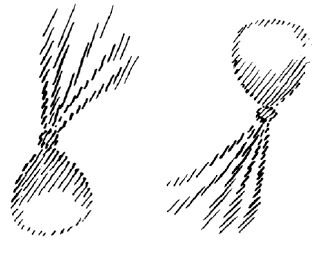
[ 7 ] The effects of his astral body will manifest as if it were striving to rise upward. If I were to depict this schematically, I would have to draw it like this—but as I said, I am only making a very schematic drawing—: I draw the Self like a comet’s nucleus and the astral body like a comet’s tail extending upward. But this is schematic; for one looks at a being, one looks at oneself as a being—and this act of looking is much more complicated than looking at one’s own being as a physical human being. The other being one looks toward is also seen in its self—as I said, this is a typical experience; it is meant that one’s gaze simply falls first upon such a being—but one feels: This being does not stand in such a sphere of frosty solitude as oneself, and thereby it reveals the astral body as directed downward. — It is highly significant to experience this: feeling oneself as if in an astral body that opens upward, unfolds its forces upward, and seeks to flow upward, and seeing the other, the other being, as a self whose astral body unfolds its forces downward.
[ 8 ] Now, in contrast to this typical experience, something arises in one’s self-awareness along the lines of: You are at a disadvantage; you are worth less than this other being. What is valuable about the other being is that it can open its astral body downward, pouring out its forces downward, as it were; that is what is valuable about this being. And one gets the impression that one has indeed left the physical world; the forces that flow downward from the other’s astral body go to the physical world and act there as forces of blessing. In short, one has the impression that one is facing a being who is able to send down to Earth, like a shower of blessing, that which it has attained in the spiritual world; and one cannot direct one’s own astral body downward—it wants to go upward. One gets the feeling that one is thereby of lesser worth, because one cannot direct the astral body downward. And one further gets the feeling: This consciousness that has risen within you must lead you to a spiritual act. A spiritual resolution matures. The spiritual resolution that matures is that one carries one’s loneliness toward this second being and allows one’s frost to be warmed by the warmth of the other being, that one unites with this other being. For a moment one has the impression that consciousness is now being extinguished, as if one had brought about a kind of death of one’s own being, a kind of burning of one’s own being. Then what one might call inspiration breaks into the self-consciousness that already felt as if it were extinguished—something one is only now getting to know. One feels inspired. It is like a conversation, like a typical conversation now being held with a being whom one is getting to know only because it allows its inspiration to be bestowed upon one. If one is capable of truly understanding what this being sends in as its inspiring voice, then one could translate what this inspiring being says into words such as: Because you have found the way to the other and have united yourself with his shower of sacrifice, you may return with him, in him, to the earth, and I will appoint you on earth as his guardian. And one has the feeling that, through this, one has taken something infinitely significant into one’s soul, that one has been allowed to hear these words, the words through inspiration. There is a being in the spiritual realm who is more valuable than oneself, who is permitted to pour out his astral nature downward in blessing. That one may unite with it and that, once one has arrived below, one may be its guardian—through this impression one first learns to understand how one, as a physical human being walking upon the earth, truly relates with one’s physical and etheric sheath to that which is imbued into one’s self and astral body as higher forces. With one’s physical and etheric bodies, one is the guardian of that which is to develop ever further and further toward higher spheres. And in inner experience, one actually gains a true, genuine understanding of the relationship between the outer bodies and the inner being of the human being only when one feels the outer being as the guardian of the inner being.
[ 9 ] But now, once one has passed the Guardian of the Threshold, the experience I have described here does not stand alone; it is followed by another. First, I have described to you the purely clairvoyant and inspired experience one can have when, in addition to the physical and etheric bodies, one has succeeded in uniting with the Paradise Imagination, and has then received that inspiration which actually gives one a first conception of the relationship of the sheaths to the Self. But once one has passed this Guardian of the Threshold, a second impression joins the first; the gaze opens, as it were, past the Guardian of the Threshold and down into the physical world. I draw this line as the boundary between the higher spiritual worlds and the physical world, so that up above would be the realm of the spiritual worlds and down below that of the physical world.
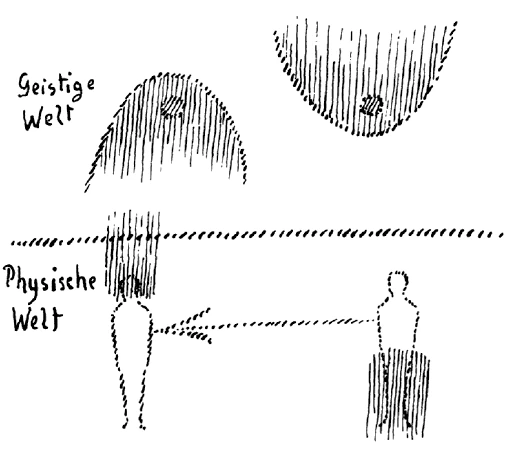
[ 10 ] Now one looks down, as it were, into the physical world, and there a different image appears: the image of oneself standing here below as a human being. One perceives one’s own astral body; but this astral body, which now appears as if in a mirror image, is directed downward; it does not wish to unfold the power to flow toward the spiritual world; it remains, as it were, stuck and clinging to the physical plane; it does not rise upward. One also sees the mirror image of the other being; its astral body is flowing upward. One has the feeling: this astral body is flowing into the spiritual world. One sees oneself, one sees the other, one has the feeling: You are standing down there once more; in the place of the other being, there stands a truly different person down there; it is a person who is better than you; his astral body strives upward, rises like smoke. Your astral body strives toward the earth, rising downward like smoke. You get a sense of the Self that lives within you as you look down there, and you get the terrible impression: a decision is dawning within you, a terrible decision—the decision to kill the other, whom you feel is better than you. One knows: this decision does not come entirely from the Self; for the Self is up there. It is another being that speaks from within one down there; but this one instills the decision to kill the other. And now one hears again the voice that previously inspired the inspiration, but now like a terrible, avenging voice: “Where is your brother?” And from this self, a counter-voice struggles free against the earlier one. Before, the inspiration was this: By uniting yourself with the blessing powers of the other being, you will pour out these blessing powers downward, and I will make you the guardian of the other being. Now the word breaks forth from this being, whom one recognizes as oneself: “I do not want to be my brother’s keeper.” First the decision to kill the other, then the protest against the voice that was thus inspiring: I appoint you, because you have sought to unite your coldness with that warmth, to be the keeper of the other—the protest: I do not want to be the keeper.
[ 11 ] Once you have had this imaginative experience, my dear friends, you will know what a human soul is capable of, and above all, you will know one thing: that when the noblest things of the spiritual worlds are turned into their opposites, they can become the most terrible things of the physical world. One knows that at the depths of the human soul, the reversal of the noblest willingness to sacrifice can give rise to the desire to kill one’s fellow human beings. From this moment on, one knows what is meant by the story of Cain and Abel in the Bible; but only from this moment on, for the story of Cain and Abel is nothing other than the retelling of an occult experience, namely the one just described. Had the writer of the story of Cain and Abel been able—for reasons other than those that existed in the course of human development—to describe what happened to humanity before the time of the Paradise story, he would have described the first (in the drawing), the upper experience. Thus he begins with the Paradise story and describes the reflection; for this is how Cain felt toward Abel before the point in Earth’s development indicated by the Paradise story had arrived—this is how Cain felt toward Abel, as has been indicated here above. And after the temptation and after the loss of that vision, which is regained in occult vision through the Paradise Imagination, Cain’s willingness to sacrifice had turned into what occurs down here. And the soul’s desire to kill the other had in reality been transformed. And the cry conveyed to us in the Bible: “Am I my brother’s keeper?” is the mirror image of the other inspiration: “I will appoint you here on earth as the keeper of the other.”
[ 12 ] It is precisely from this description that you will realize that such typical experiences are certainly meaningful; for they establish a certain connection between what we can be today and the most universal interests of humanity. But at the same time, they show us quite clearly that in what we experience in them—in the ebb and flow of our inner life— the main thing is to feel how human development has made this colossal leap from what I have described to you as the first, so to speak, pre-earthly imagination, to what is presented in the Cain-Abel story as a human event following the expulsion from Paradise, following that expulsion through which the Guardian of the Threshold has become invisible to human beings. It is only through becoming acquainted with this leap in the development of humanity that we truly come to understand what this earthly human being is; for when one fully feels what has now been recounted, one gradually comes to realize how this earthly human being, as he stands here on earth, is, as it were, the reversal of what he once was. And one certainly knows what one would have become had nothing else occurred. If one had simply unfolded within this earthly evolution without anything else, then one would have known what this is a reflection of on Earth. At first, one was not allowed to know this.
[ 13 ] In essence, it is only in our time that people have been given the opportunity to understand what the story of Cain and Abel reflects: that it reflects a great sacrifice. Everything that was above, that was pre-paradisiacal, was veiled when the Guardian himself concealed it—in other words, when human beings were driven out of Paradise. And this could only happen because the human physical and etheric bodies were now so permeated with forces that the human being does not carry out what results as a reflection; for the human being would certainly carry it out if he felt everything that is in the astral body. The physical body and the etheric body numb the human being to such an extent that the desire within him to kill another does not become a reality. Consider what is said in this simple sentence: Because the good, progressive divine-spiritual powers have given the human being his physical and etheric bodies in such a way that he cannot look back, a kind of numbing is simultaneously poured out over the desire for war of all against all. This desire does not stir in the soul because the human being’s physical and etheric bodies have been prepared in such a way that this desire is numbed. The human being cannot see his astral body; therefore, this desire also remains unknown to him, and he does not act upon it.
[ 14 ] You see, if one truly wishes to describe the astral body in relation to the Self, one must describe things that are not only actually hidden from human nature, but that must remain hidden. But what has happened as a result of this desire and similar desires—which are directed toward the annihilation and destruction of human and other forms of coexistence operating on the physical plane—being suppressed? They have been weakened; the human soul perceives them only in a weakened form, perceives them, so to speak, only faintly. And this faint perception of those desires, which would be something so terrible if human beings were to act upon them as they actually are—that is the true human understanding of the Earth.
[ 15 ] I hereby begin by defining what human knowledge of the earth is. This human knowledge of the Earth consists of the blunted destructive impulses: Shiva in his most terrible form, blunted to such an extent that he does not act out his nature, but has been rendered, as it were, insubstantial, squeezed down to the level of the human imagination—this is the maya of the inner world; this is human knowledge. Thus, knowledge had to be weakened, or rather, the drives and inner forces had to be weakened, so that the originally terrible force in which Ahriman reigns—for originally it is Ahriman who stirs up this desire here—so that Ahriman’s power might be weakened to such an extent that human beings would not act out Ahriman and thereby constantly make themselves servants of Shiva. To this extent, that which is the sum of these forces had to be weakened, so that they might reign within the human being only to the extent that he can, through his concepts and ideas, put himself in the place of other beings. When one attempts to penetrate another being with a concept, when one seeks to immerse one’s mental image into the being of another, this mental image immersed into the being of another is the blunted weapon of Cain that was thrust into Abel. And the fact that this weapon was thus blunted made it possible for that which had been abruptly turned into its opposite to evolve. And so, through a slow evolution and the ever-increasing strengthening of his insights, man comes to the point where he gradually develops—first in objective knowledge, then in imaginative knowledge, which already penetrates more deeply into the essence of the other, in inspirational knowledge, which penetrates even closer into the essence of the other, and in intuitive knowledge, which penetrates even further into the essence of the other—that which he was not allowed to live out in the physical world because there it had become a destructive impulse. — first in concrete cognition, then in imaginative cognition, which already penetrates more deeply into the essence of the other, in inspirational cognition, which penetrates even more deeply into the essence of the other, in intuitive cognition, which penetrates completely but lives on spiritually with the other within the other being. Thus we gradually struggle to grasp what this Self actually is. The astral body, viewed in terms of its innermost nature, is the great egoist; the Self is more than the great egoist—it does not merely want itself, it wants itself within the other, it wants to pass over into the other. And the insight, as it is attained on Earth, is this dulled craving to step over into the other, to extend everything that one is, not only within oneself, but further beyond oneself into the other. It is an ascent of egoism beyond itself.
[ 16 ] If you first consider this source of knowledge, you will understand how the possibility of misusing this knowledge exists everywhere; for the moment this knowledge strays, it immediately becomes a misuse, if this knowledge is true knowledge within the self. Only by progressing, by making this penetration into the other ever more spiritual, and by moving from the astral body—which has expanded to encompass worldly interests—to the point of renouncing any penetration into the other, by leaving this other completely untouched within one’s own being, by placing the other’s interests above one’s own, only in this way does one become ready to ascend in knowledge. Otherwise, one cannot recognize a being from the hierarchy of the Angeloi anyway, unless one has reached the point where one is more interested in the inner life of the Angeloi than in one’s own. As long as one is more interested in one’s own being than in the being of the Angeloi, one cannot recognize the Angeloi. One must therefore first train oneself in worldly interests and then in interests that go even further, so that others can become more meaningful and important to one than oneself. The moment one attempts to advance one’s own self through occult experiences, yet one’s own self remains more valuable than the other beings one seeks to recognize—at that very moment, the deviation occurs. And here, if you follow this line of thought, you actually arrive at a true mental image of what black magic is; for black magic begins where occult activity is brought into the world without one being able to first expand one’s interests to include the world, without being able to value other interests more than one’s own interests.
[ 17 ] Such things can really only be conveyed by providing the inspiration for the mental images, for they are too profound to allow for anything more than a suggestion. I wanted to show how one can gradually come to recognize what lives within us as the astral body and the Self in its true form, not in maya; for just as a person experiences their astral body inwardly, so it is not the real astral body, but rather the astral body as it is reflected in the etheric body. And what a person calls their Self is not the real I; it is the I as it is reflected in the physical body. A person experiences only mirror images of their inner self. And if, while still immature, they were to experience the forms of this own inner astral body and I, destructive impulses would arise within them; they would become an aggressive being; the desire to harm would arise within them. And these things, after all, underlie all black magic. Even though the paths taken by black magic are very different, the effect they achieve always has something of an alliance with Ahriman or with Shiva. And one learns to recognize the astral body and the “I” in their true form only by knowing: One may only learn to recognize them if one simultaneously affirms the necessity that they must develop and make themselves worthy and capable of being what they are meant to be. The innermost nature of the astral body is egoism; but the ideal must be to be allowed to be egoistic, because the interests of the world become one’s own interests. The ideal must be to be allowed to immerse oneself in the other being, because the will exists not to seek oneself in the other being with one’s own interests, but to find the other being more meaningful than one finds oneself. Self-education must go so far as to feel this higher image in its full occult-moral significance, this image: to gradually transform what one is into such a state that one’s own emotions, one’s own drives, desires, and passions can no longer warm one, but that, by living oneself into the astral body, one lives oneself into frosty solitude and thereby opens oneself to warmth; that is, to the warm interest that radiates from the other worlds and seeks to unite with the blessing forces emanating from this other being. This simultaneously provides us with the starting point for a gradual ascent to the higher hierarchies in their true form. Otherwise, we cannot ascend to the beings of the higher hierarchies if we are not able to face this imagination and inspiration, as described, with dignity and endure its counter-image—that is, the possibilities in the depths of human nature as it was cast down from the spiritual worlds into the physical world. If one refuses to see the dual image of Cain and Abel—oneself below and the representative of one’s higher self, who is the mediator between oneself and the higher hierarchies—one cannot ascend. But when one is able to cultivate within oneself the feeling indicated here, then one experiences one’s Self and, from this, gains access to the hierarchies of the higher orders.