

Spiritual Hierarchies
and their Reflection in the Physical World
GA 110
18 April 1909 a.m., Düsseldorf
Translated by Steiner Online Library
Ninth Lecture
[ 1 ] It is only natural that, in the face of a discussion such as yesterday’s, questions should pile up, and that, when hearing such a comprehensive exposition of truths relating to the cosmos for the first time, some things may remain incomprehensible. Now, as I emphasized yesterday—and I ask that you always bear this in mind—the characterization here is not based on mere speculation or a preconceived framework, but on the actual facts known as the facts of the Akashic Records; and therefore, these facts can only coalesce into a kind of systematic whole in retrospect. One of the questions, however, that might arise for some, should be addressed here today: What is the situation with the finished planet? Yesterday, in a certain sense, we traced the planet’s development up to its completion, up to the point where it exists, so to speak, as a single visible planet. And now someone might say: Yes, but the planets we now see in the sky did not all come into being before the point in time described yesterday; surely they are not in the process of coming into being?
[ 2 ] That is not the case either. We must be clear that a new epoch actually begins for the planet once the point I spoke of yesterday has been reached. Suppose we wanted to trace the formation of the planets, not as it occurred with ancient Saturn—where, after all, only that ancient Saturn existed—but as it occurred during the formation of the Earth. There, too, the ancient Saturn first reformed as a repetition, so that after the course of Saturn’s development, the Sun’s development, and the moons’ development, at the beginning of Earth’s development a mighty body of heat or fire first took shape again, and everything I told you regarding Saturn’s development came into being there. Then came the moment when, at a single point within this mighty fireball moving around itself, under the influences of the zodiacal region of Leo, this individual Saturn—what we call Saturn today—branched off, reaching, so to speak, its zenith in this branching. Now the individual planet had come into being.
[ 3 ] But you must not imagine that, at this point, the calming effect of the Lion is to be understood as if Saturn were now being held back; rather, the situation is this: Saturn has thus come into being, and the movements that were there before have come to rest. In itself, Saturn has become a being that has absorbed and united within itself everything that was previously distributed throughout its expanse. All of this has come about through what we might call the “Lion’s influence.” But the great sphere from which Saturn has separated is now contracting; it now exists within as a smaller sphere. Because this entire structure is withdrawing inward, Saturn retains, in a certain sense, the movement it originally received, even after this influence has taken place and its inner movements have come to rest. Previously, it needed its own impulse of movement, for it was, so to speak, compelled to continue moving within this sphere, as if swimming. Once this sphere had withdrawn from it, it then moved of its own accord, even though the internal movement had ceased. And this self-propelled movement, after the initial impulse had occurred, is Saturn’s current motion, its current rotation.
[ 4 ] The same is true of Jupiter. For when the Earth began to form, what has just been described took place; then differentiation set in within the sphere, which had withdrawn inward. Under the constellation of Scorpio, the individual spheres were destroyed; they were absorbed into one another, but in return, their own inner life now began. After Jupiter, so to speak, had been destroyed as a great living being, the life of the individual beings living upon it began, and as the entire sphere contracted once more, it continued to move, having thus found the impulse within itself. What we observe today as the movement of Saturn, Jupiter, and so on, is a consequence that arose only after the formative process I described yesterday had been completed.
[ 5 ] Another difficulty seems to have arisen from the fact that I spoke of the second planet that broke away as our present-day Jupiter, and the third as our present-day Mars, whereas in terms of chronological sequence it is said that first came the Saturn phase, then the Sun phase, and then the Moon phase. This is entirely justified, for, as I said, with the present planets we are dealing with what occurred as a repetition in the fourth stage, during the Earth’s development. Back then, when Saturn first formed, there was truly only Saturn. When the solar development took place, the conditions in this second body that had formed were such that we must speak of a sun. But when, following the Saturn evolution, the Sun evolution took place, the entire process was completed with the Sun evolution. So that when we look back on these first planetary evolutions of our Earth, we must be aware that they, too, were now complete.
[ 6 ] When we speak of the Earth’s evolution, this is not the case. First Saturn arises, then the Sun as a repetition; but this moves further inward; it is not complete; Jupiter is left behind as the remnant of the Sun’s evolutionary repetition. This is what we must take into account. Then the lunar evolution is repeated by the Earth. Looking back at the entire evolution, this had, in fact, been completed at that time. In the Earth’s evolution, the lunar period is not a conclusion; it continues inward; what remains behind in the repetition is Mars.
[ 7 ] Thus we see that the present planets, which are visible to us in the sky, must certainly be understood as having come into being during the period we refer to in our Akashic Records system as the fourth, the period of Earth’s evolution. These are the things we must take into account—it is not possible to speak of the entire world and mention everything. Only one thing will have struck you: that there is, in fact, a kind of sphere present from the very beginning. I spoke, for example, of Saturn as a ball of fire or a kind of large fiery egg, and then we actually spoke of rotation.
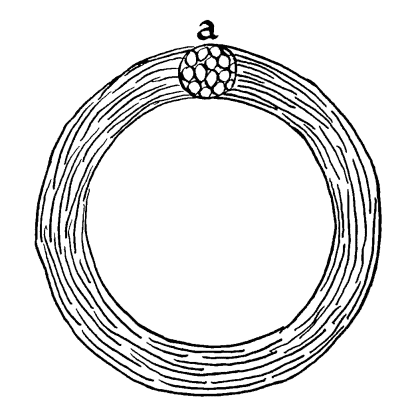
[ 8 ] This is indeed the case; we can initially imagine a kind of egg or sphere. As this sphere, which corresponds to the most primordial Saturn state, begins to rotate, the following gradually takes shape. A sort of belt separates itself, which does not encircle the entire egg, but is merely like a broad band. And within this belt, the individual forms that have formed all around gather, so to speak. This formation of a belt is a very general cosmic law. Among other things, you can see the law that everything is actually based on an accumulation along a kind of equator or belt, formed in the cosmos as far as you can see it, for the Milky Way owes its existence to this law. When you see this Milky Way as an outermost belt encircling the heavens, with stars sparsely scattered in between, this stems from the law that, as soon as rotation begins, things gather into a belt. Our solar system, as we have it, actually already has a sort of lens-like shape because of this. It is not formed directly into a sphere, as is commonly assumed, but rather into a lens shape, and the belt is gathered at the wide equator. You must also imagine such a belt when a planet is forming. So, to put it simply, if you were to take an egg and wanted to schematically draw the various states on it, you would first have to take the whole egg, then you would have to paint such a belt on the egg, with red paint, for example. You should not color the whole egg red, but only a belt. Along this belt, the bodies destined to form the single celestial body gather. At one point, one would have to mark the spot where everything gathers (drawing as on page 129). Thus we see that the configuration, the distribution of the stars as it exists in the space around us, is a result of the spiritual beings or hierarchies. For when we speak of the contraction of the great mass, we must realize that this contraction does not occur of its own accord, but through the action of those beings whom we have described as the beings of the higher hierarchies. And if we summarize what we have described, we must say: While the ancient Saturn was forming—that is, while that immense mass of fire, from which, in essence, our entire solar system sprang, was structuring itself into the ancient Saturn—the spirits of personality lived out their human existence; during the formation of the Sun, the archangels or fire spirits lived out their human existence; then, during the development of the Moon, the angels did so; and on Earth, the human being undergoes his human existence. Yet it is the case that this human being has had a connection with everything that happened before. What we today call the physical body received its first rudiments during the very earliest formation of Saturn. At that time, this physical body was not yet permeated by an etheric body, nor by an astral body, but it was already predisposed in such a way that, following the transformations it later underwent, it could become the vehicle of our present spiritual Earth human. Very slowly and gradually, this human physical body was formed during the ancient Saturnic development, and as ancient Saturn itself formed and revolved through the individual signs of the zodiac, the structure of the human body emerged limb by limb. Just as, during the time when Saturn was in the sign of Leo, the foundation for the heart was formed, so too was the foundation for the chest formed while Saturn was in the sign of Cancer. The foundation for the symmetrical formation of the human being—that is, that he is shaped identically on both sides—this foundation was formed while Saturn was in the constellation of Gemini. And so we could trace the human body part by part. When we look up at the zodiac, where Aries stands, we can say: The foundation for the upper part of our head was formed and first incorporated into us when ancient Saturn was in the sign of Aries. The structure of our speech organ was incorporated into us when Saturn was in the sign of Taurus. And if you now imagine the human being divided in this way, you can see in the zodiac outside the creative forces for all the human limbs.
[ 9 ] This was depicted figuratively in the ancient mysteries in such a way that the zodiac was drawn in a manner similar to how it appears here on the ceiling of the hall. We happen to be—as they say—in a hall decorated above with the zodiac. In the past, the zodiac was not depicted by breaking it down into its corresponding animal forms, but rather by adding the individual human limbs to the respective regions: the head to Aries; then the area of the larynx to Taurus; what expresses this most significantly is the symmetry of the two arms, to Gemini; the breastplate to Cancer; the heart to Leo; and so on, until the lower parts of the legs were drawn for Aquarius and the feet for Pisces. So imagine such a zodiac as a human being drawn into the cosmos, and you have what, from the cosmos—that is, from the corresponding forces of the hierarchies of Thrones, Seraphim, and Cherubim—created the original blueprints for the human physical body. This is the great cosmic human being, the human being who runs through all world sagas and world myths, from whom the individual human being on Earth is formed in the most manifold forms. Think of the giant Ymir, who is spread out in the great cosmos, for the microcosmic human being is formed from the giant. You find him everywhere, the great macrocosmic human being, who is the Creator, who contains externally what the human being contains within. For there lies a deep truth underlying such depictions, a truth that comes to light more or less clearly depending on the clairvoyant capacity of the peoples. And it also shines upon you through that wisdom which has found its outward expression in the Old Testament. It shines through in the wisdom that, as ancient Hebrew esoteric teaching, goes back to the esoteric teaching underlying the Old Testament: the Adam Kadmon of Kabbalah. The macrocosmic human being is none other than the human being we have now drawn into the cosmos. We must only form the right conception of it.
[ 10 ] What I have now outlined for you, culminating in the teaching of the macrocosmic human being, is a teaching that truly contains the deepest mysteries of the world—a teaching that will gradually find its way into the general education of humanity. People today are still far from understanding this teaching, for if anyone who is merely a scholar had listened to these lectures, he would probably have regarded this auditorium as something other than a gathering of intelligent people. People today are very far from understanding these things. But we stand at the threshold of an era in which the facts that contradict the fanciful theories of modern science will compel people to seek the path to these great truths of primordial wisdom. And one will never penetrate the mystery of, for example, the so-called process of fertilization—about which people today speculate so childishly—until one is able to apply the teaching of the macrocosmic human being to the process of fertilization. Precisely that which unfolds as a real mystery and, as a real mystery, eludes instruments and tools the most—precisely that will be illuminated as, so to speak, the smallest point of research. For how small is the cell within which fertilization takes place in relation to the cosmos! But only the mysteries of the great cosmos will unravel what takes place within the smallest cell. Nothing else can unravel the mysteries of the processes within the cell. In the face of the problem of fertilization, the research of external science is not useless; it has its certain merits, but it is all child’s play compared to the great mystery that lies before us and that can only be solved when one comes to understand how the answer to the events lies in the point, how this answer lies in the circle, in the circumference. That is why the ancient mystery teacher said: If you wish to understand the point, then explore the circumference, for it contains the solution. — That is what matters: that one can only understand the point once one has understood the circumference.
[ 11 ] If you now recall that the individual celestial bodies continue their motion after they have, so to speak, reached their conclusion in and of themselves—after they are complete in and of themselves—then you will also understand what must be called the karma of these celestial bodies. From the moment the planet has reached its conclusion in itself, the beings belonging to it must once again reckon with its dissolution, with its disappearance from the cosmic context. So, for example, when we trace the ancient development of Saturn, we must say to ourselves: Until the entire heat sphere has coalesced, the process of Saturn’s development is an ascending one, or, if you will, a descending one, for it is a process of condensation. At the moment when Saturn continues to rotate—but now in the context of the first Saturn development—the Saturn sphere is established; the elements in question are present. When the spirits are involved in this, they must reckon with what has been assembled up to the point of formation during the dissolution, and that is karma. One cannot escape this; things must be dissolved in the same way they were assembled. Thus, the karma of the first half of evolution is fulfilled in the second half. What was assembled in the first half is gradually broken down in the second half of evolution. The creation of the world is the generation of karma; the passing of the world in the broadest sense of the word is nothing other than suffering under karma and, in turn, the eradication of that karma. This is true on a grand scale, but also on a small scale for every planet. For every planet faithfully reflects the conditions on a grand scale. You can observe the same process in a people as well. Imagine a people, aspiring in their youthful development, full of drive, full of energy; imagine this people giving birth, era after era, to the most diverse elements of education and culture: All of this must reach a climax, but as all of this accumulates, the karma of the people also accumulates. Just as karma accumulates during Saturn’s development, in that one must reckon with what has arisen, so too does karma accumulate within a people as culture is built up. This karma is present at its highest point, in its strongest measure, precisely where the people have, so to speak, given birth to the original, elemental forces from within themselves.
[ 12 ] We have now seen that guiding beings are present everywhere. We have seen, in the case of the Earth, how higher spiritual beings—angels, archangels, and primordial forces—descend, and how, where humanity cannot yet help itself to progress, they guide humanity and lead it to a certain level. These are the spiritual beings of the hierarchies who attained their perfection and maturity in earlier times. But once this level has been reached—once, so to speak, the spirits who descend from heavenly heights to guide the peoples have achieved their goal—then other spiritual beings must step forward to become the leaders and guides of the respective peoples. If the peoples are to rise beyond their zenith in a certain way, then leading personalities must voluntarily offer themselves to be bearers of higher spiritual beings; only then is it possible to carry forward what was in the original plan, so to speak, by transcending certain stages. But one thing must happen in this case: those who descend into beings who are to be the leaders of the peoples, who are to carry culture forward beyond a certain point, must, because karma has accumulated, take this karma upon themselves. This is the significant law of taking upon oneself the karma of peoples and races. From a certain point onward, the leading personalities must carry the karma of the people or race within themselves, taking it upon themselves in a certain sense. This is the essential point: that such individuals, such as Hermes was one, had to take upon themselves what lay in the karma of their people, which had accumulated to a certain degree up to that point. These things are, on the individual planet, reflections of the great cosmic processes.
[ 13 ] But we find such reflections even further on. We have seen, after all, that the Thrones became Thrones only by coming to the point where they could transform from creatures into creators, moving from a state of taking to a state of giving. We have said: The Thrones also once underwent their development in other world systems; they progressed to the point where they could radiate their substance. This is a higher stage of development—being able to give, to make sacrifices, rather than merely reaping for oneself what exists in the cosmos. This, in turn, occurs as a mirror image in human beings. What, then, is this human development? Look back in spirit through the Atlantean era, through the Lemurian era, and look forward. Human beings acquire a physical body, an etheric body, an astral body, and an ego; and then, in turn, there is the process of the ego working back into the other members—the transformation of the astral body, the transformation of the etheric body, and that of the physical body—into Manas, Budhi, Atma, into the spiritual self, the life spirit, and the spiritual human being. Thus, the primordial wisdom has taught throughout all ages that the human being transforms their astral body in such a way that this astral body initially consists partly of the old astral nature and partly of Manas, but that it is gradually transformed entirely, becoming completely permeated by the I and its work. Take a human being who has not yet reached that stage of development where his astral body is already completely permeated by the work of the ego. In this case, essentially all human beings are still in this state, with very few exceptions. That which the human being has already transformed goes with them through all eternities; that which they have not yet transformed—so that the ego has not yet taken part in it—must, once the human being has passed through Kamaloka, be shed like a kind of astral shell, which dissolves in the astral world, though not without causing considerable mischief if, as an astral body, it consisted of base desires and passions. Thus we can say that human development consists in leaving less and less of oneself behind in the astral world.
[ 14 ] Let us follow the process. A person dies; soon after death, the etheric body detaches itself, leaving behind an extract. The person passes through Kamaloka, where the unprocessed shell detaches itself; that which has been processed continues through the I into all eternity and is brought back to the new incarnation. The more perfect the human being is, the fewer these remnants will be that they leave behind in the astral world, until they are finally at a stage where nothing of their astral body remains in Kamaloka, until they are at a stage where they can, so to speak, cause no harm to anyone on Earth through the remnants they leave behind in Kamaloka. Such a person then also has the ability to look into the spiritual worlds. For it is not possible to attain this state without having reached a certain degree of clairvoyance in the astral. The entire astral body is then spiritualized, has become the spiritual self; the entire astral body is taken along. Previously, what was bad had to be left behind; now the entire astral body can be taken along into the entire future. And at the moment when the astral body is ready, having been fully transformed, the entire new form of the astral body—the spiritual self—imprints itself into the etheric body, so that the etheric body then becomes an imprint of this transformed astral body. It does not yet need to be fully transformed itself, but what could be worked into the astral body is imprinted into the etheric body. In short, as you can see, we have described a particularly high being who has advanced to the highest degree by developing the entire spiritual self. This being is now called Nirmanakaya in Eastern science, for its astral body, its astral kaya, has reached the stage where it leaves no residue behind. That is a Nirmanakaya.
[ 15 ] Let us now move on. Human beings can continue working further and further; eventually, they transform their etheric body and their physical body. What happens when the etheric body and the physical body are transformed to the point that they come under the control of the human being? When the etheric body is transformed—that is, when the human being not only has his spiritual self in the astral body but gradually develops the buddhi or life spirit within his etheric body—and when this life spirit or buddhi then imprints itself upon the physical body, then a higher stage of development is reached, a kind of intermediate stage. Through this intermediate stage, the human being reaches a point where he need not leave anything behind of his etheric body, where he retains this etheric body in the same form for all time as he has developed it as life spirit or budhi.
[ 16 ] Through such influences, the human being will thus increasingly be able to gain mastery over his astral body and his etheric body. This mastery then enables the human being, in a certain sense, to direct these astral and etheric bodies as well. Those who have not yet brought the astral body under the control of the ego must, of course, wait until they have reached that stage. But those who already have control over the astral and etheric bodies can now dispose of them freely. They can say to themselves: Because I have gone through all the incarnations with my ego that have taught me to transform my astral body and my etheric body to this extent, I have thereby become capable, when I am to return to Earth, of forming a new astral body and etheric body out of etheric substance and astral substance that are just as perfect. - And through this, he is able to, as it were, sacrifice his own astral and etheric bodies, to transfer them to others. You can thus see that there are individualities who, by having become masters of their astral and etheric bodies, also become capable of sacrificing these astral and etheric bodies, because they have learned to build them up. If they wish to return to Earth, they will build an astral body and an etheric body anew from the available material. But what they have attained in perfection, they pass on to other personalities who have certain tasks to accomplish in the world. Thus, such astral and etheric bodies from personalities of the past are woven into and incorporated into later personalities. When this happens, you see that the personality of the past does not merely work where it stands, but that it continues to work into the future with what is within it. Thus, for example, Zarathustra, who was able to control his astral body and who later transferred it into Hermes, could say to himself: I live, but I will not only act as I myself now act as an outer personality, but I will also interweave the astral body of the Egyptian Hermes, the one with whom the Egyptian cultural epoch begins. — Such a personality has a body, a kaya, which not only works where it is, but which works into the future, which sets forth the law for future development. Law extending into the future is called dharma. Such a body is called the dharmakaya. These are certain terms that frequently recur in Eastern science. Here you have the true explanation, as it has always been given in the wisdom of the ancient world. And now let us look at the whole diversity of what has passed before us in these days. A question may well weigh heavily on our souls: What, after all, have we actually called “human” up to now? — We have called “human” a certain stage of development. We have found that the spirits of personality were human beings on ancient Saturn; we have found that even the Thrones must once have been human beings; we have found that the human being continues to develop, that he ascends into higher beings; we have even come to know the first stages of this ascent in the angels and archangels; in these beings we have come to know beings who make sacrifices. We have seen the beginning of sacrifice, which is present in the highest sense among the Thrones. We see the first glimmer of creative activity in those who are the leaders of peoples and races, who knew how to work on their own bodies so that they could radiate something. Just as the Thrones radiated their essence, so too did the Nirmanakayas, to a different degree, radiate their own bodies into the future for later individualities who would not reach that point in their development unless they received what the preceding beings had radiated.
[ 17 ] Thus the concept of evolution unfolds before us, from the point where one receives to the point where, having poured forth, one creates. We see the concept of the Creator arise before our inner eye, and then we say to ourselves: Thus every being evolves from creature to Creator. But now, Archangels, you developed into human beings on the ancient Sun, spirits of personality on the ancient Saturn, angels on the ancient Moon, we humans on Earth, and so it will continue; beings will always, always develop into human beings. Does all this go on endlessly? Is this really just an eternal succession of cycles, through which, for example, what was already present on Saturn is repeated on the Sun, only that a number of beings come to it later? For the fire spirits come one stage later than the spirits of personality. Is it really all like this, that beings always develop upward from the helpless creatures of the beginning into those who can sacrifice themselves? That is not the case, that is by no means the case! The great question arises: Is the humanity on Saturn, which the spirits of personality led, the humanity of the archangels on the Sun, that of the angels on Mars—is that the same humanity as the one we lead here on Earth? When we consider the nature of the angels, for example, do we see in them only the image of our own next epoch, the Jupiter epoch? Do we see in the fire spirits only the image of those beings we will become on Venus? Is there really cause to say to ourselves: Here we stand on our Earth; we will reach higher stages in world evolution; we ourselves will ascend in the hierarchy, but the beings we can become are all already there, and our own stage has, after all, been trodden by other beings before! Is that so? That is the great question of consequence that must actually arise in the soul of everyone who has allowed the lectures to take their effect on them without prejudice.
[ 18 ] If we are dealing merely with a process of becoming human that repeats itself eternally, then we are like the spirits of personality on ancient Saturn, like the archangels on the ancient Sun, like the angels on Mars. This may be important to us, but for the higher gods it would merely be an increase in their creatures, and they would have achieved nothing special in terms of progress. But there is another question: Might human beings, precisely by becoming human on Earth, one day develop into beings capable of something that the angels cannot do, something that even the archangels and the spirits of personality cannot do? Has all of creation learned something by bringing forth human beings after the archangels and angels? Has creation made progress? By deigning to descend deeper, does humanity perhaps thereby earn the right to ascend even higher? Let us pose this question as a kind of consequential inquiry. The remainder of our reflections must be devoted to this: the full significance of the human being in the cosmos and the human being’s relationship to the higher hierarchies—what does the human being become within the sequence of the hierarchies?