

Anthroposophy, Psychosophy
and Pneumatosophy
GA 115
2 November 1910, Berlin
Translated by Steiner Online Library
Psychosophy II
[ 1 ] Yesterday we concluded our psychosophical discussion by pointing out, on the one hand, how this ebbing and flowing of human soul life can essentially be traced back, as it were, to two elements: judgments and the inner experiences of love and hate. We also pointed out that, however, the sensations conveyed to us through our senses then emerge in our soul life, and that our soul life is essentially filled with these sensations, so that, so to speak, these sensations are constantly ebbing and flowing within our soul life. We have also pointed out that within this emotional ebb and flow, something then arises that differs radically from everything else we experience in our daily life in the external world. We experience our sensations while we live, so to speak, with the external world, and they are transformed within us in such a way that they then continue to live on within us. When we survey this ebb and flow of experiences, which is stimulated by the influences of our senses, a perception arises within it that is of a completely different kind from all other perceptions. All other perceptions that we initially have in ordinary life are triggered by external sensory stimuli and are then further processed within us. They have become sensations from perceptions and then live on in what the sensations leave behind within us. Quite different, however, is what lives within us as a perception of the self. This arises amidst the tumult of other experiences caused by the external world; it is, so to speak, present everywhere in our inner life and differs from all other experiences of the soul precisely in that it cannot be caused from without. Thus there is, as it were, a kind of contrast in our inner life: the sense of self and all other inner experiences. What secrets lie hidden behind this contrast will, of course, only become apparent in the course of these lectures. But we should acquire a sense of it from the very beginning of these lectures by allowing this contrast to truly come before our souls.
[ 2 ] We are, as it were, dependent on the external world and all other experiences, and we project our sense of self into all other experiences. We can already begin to grasp—through this, I might say, quite abstract contrast—that what surges and ebbs within us enters our soul from two directions. And it is important that we bring this human soul life—and this is what matters first and foremost, for we will only be able to cast a brief light on other forms of soul life starting from the human being—before our eyes in the small, in the abstract, and in the concrete, in the large, bringing it before our eyes with true feeling at first. This human soul life is truly, from the outset, not a unity, but rather something like a dramatic battlefield on which opposites are constantly playing out. And the person who listens to this life of the human soul, the human psyche, with a somewhat finer sensibility and a deeper feeling, will truly be unable to fail to recognize the dramatic character of this human soul life. Faced with the opposing forces in the human soul, a person actually feels something like a lack of mastery over it, a surrender to this opposition. To this surrender to the opposites of soul life—to, we might say, these two natures within our soul life—the humblest person is bound, as is the greatest genius. And to evoke in you a sense of what surges as opposites within the human soul, even in the greatest genius, I placed a poem by Goethe at the beginning of yesterday’s lecture.
[ 3 ] If any of you, for example, picked up your copy of Goethe between yesterday and today and reread this poem, you will have arrived at a peculiar feeling—a feeling that would be good to have as the foundation for our entire lecture series. I would like to clarify this feeling for you a little; for we do not wish to describe the life of the soul in the abstract, but rather we want to try, so to speak, to breathe life into it and enter into the vitality of this life of the soul.
[ 4 ] If you have read the poem “The Eternal Jew” that was recited yesterday, you must have thought to yourself: That’s written quite differently in the text! What was read aloud was different from what appears in Goethe’s works! — For something has been done for the sake of the recitation that, in the eyes of what is called philological scholarship, may be a brutality, a monstrous barbarity: this poem of the “Eternal Jew” has been specially adapted and was not read as it appears in Goethe’s works. Certain things have been changed, others have been omitted, and what was presented has evoked a completely different picture. Of course, one must not do this in front of philologists. But one may do it when one has a very specific intention, when the aim is to open up a deeper perspective on the drama of the human soul. For “The Eternal Jew” is a poem by Goethe that he wrote in his very earliest youth. And what was read to you yesterday is, in this poem, that which, in terms of its content, could certainly have been presented to the mature Goethean soul in his very old age, and he would have said: Yes, this is something I myself wish to uphold. — On the other hand, he would have turned away from what was omitted or altered yesterday and perhaps said that he was a little ashamed to have written those things. Anyone who regards Goethe with such deep, boundless admiration as I do myself may perhaps also speak of Goethe in the way I am compelled to speak today when I speak of the poem “The Eternal Jew.” This poem was written in Goethe’s earliest youth. And his youth is expressed in it to the extent that it is only natural for the time in which he wrote it, when he was still a real good-for-nothing, someone from whom one certainly cannot learn anything. Or is it perhaps not permissible to say that, with regard to certain things, one cannot learn anything from Goethe? One can say frankly and freely that back then he could not even spell correctly without making mistakes. So why should one not say that certain things in the poem “The Eternal Jew” are worthless? One cannot, however, go along with that wretched contemporary taste that seeks to bring to light all the works of every great artist, if possible, in their earliest form. To do so is merely to reveal one’s own weakness. Yes, there is something in Goethe’s youthful poem that was not himself. Things and ideas rumbled in Goethe’s youthful soul that stemmed entirely from his milieu. They are none of our business; they concern only him. Something comes together there that one might call a marriage between the temporal in Goethe’s soul and the eternal-divine in the Goethean soul. And what emerged there is something eternal for all of humanity. This has value for us, and it has value for all people who will follow us. These two things—one of which concerns only Goethe himself, the other of which concerns us and all posterity—were separated. These two Goethes in the young Goethe, these two souls in his nature, were separated by a cut, and what was already present in the young Goethe of that which reigned within him until the end of his life was separated from what was only in the young Goethe—what had died in the old Goethe—and was retained.
[ 5 ] This shows us how the genius is shaped by the forces he will only come to master in the future, as well as by those forces that arise from his immediate surroundings. And when we look at Goethe’s soul in his youth, it truly appears to us as a battlefield where the struggle takes place between the hero Goethe—who accompanies him throughout his entire life and is the true bearer of his genius—and something else that he had to overcome within his soul. And had this struggle not existed, Goethe would not have become Goethe. Here we have something tangible before us that works within the soul: this polarity. The soul cannot be a uniform entity, for otherwise it would stand still, would be unable to progress. It is important that we acquire from the outset a sense of polarity, of the opposition within the life of the soul. If we do not have this sense, we will not be able to properly appreciate everything that must be said specifically in relation to the life of the soul. And precisely when we have a soul life as typical as Goethe’s, we regard such a soul life as a drama and seek to approach it with timid reverence, because within a single incarnation, in this struggle that unfolds as soul life, we perceive what is the true content, the real destiny of the individual soul life.
[ 6 ] And there is another aspect of this psychological drama that we should point out. Let us once again consider the contradictions within Goethe’s soul, as they come to mind precisely through yesterday’s recitation and the explanation I provided. What conclusions can we draw from this?
[ 7 ] When we survey Goethe’s inner life, we can see how, in his later years, he followed only that which we had, in yesterday’s recitation, drawn out of him—the ideas, feelings, and inner contents—and how he then, through the power of his own soul, cast them out of himself, as it were. Goethe was devoted to these two forces throughout his entire life, as a soul being, without any effort on his part. Thus, every human being, insofar as they are a soul, is a being who is not merely master of themselves, but is also devoted to something inner that has power over them, something that cannot be comprehended by their knowledge from the outset. For if, at the time he wrote “The Eternal Jew,” Goethe had encompassed in his soul everything that could possibly be encompassed, this poem would have become more artistic and something like what we read aloud yesterday; in any case, however, it would not have had the content as it appears in Goethe’s works.
[ 8 ] Human beings are devoted to their inner life. There is something at work here that, in essence, constitutes an external world for their inner life just as much as anything else in the external world. Just as we have no power, when faced with a red rose, to imagine it as not red—but rather, just as the rose compels us to keep the red color alive in our conception of the red rose—so there exists something that, in a certain way, imposes upon us the necessity of living out the drama of the soul in a very specific manner. The external world is our master in all our sensory perceptions. We must also acknowledge such a master in our inner soul life when we face the opposites of this soul life and view it in such a way that we set it before us as it unfolds in time from day to day, from year to year, from epoch of life to epoch of life, driven forward by an inner force and becoming ever richer and richer.
[ 9 ] Even from these simple, concrete examples—in which we have remained entirely on the physical plane—you can see that, through our sensory perceptions, we must acknowledge an external force, a master in relation to external life, and an inner master within us. Wherever we stand, at whatever point in space, the external world is master of our sensory perceptions. And we would fall into fantasy if we did not acknowledge this master in relation to our sensory perceptions. As we now proceed inward within ourselves, we must look toward the dramatic contrast in our inner life, and there we must recognize that, just as in the external world, we have an equally dominant force within us that, for example, causes us to have a different inner life at the age of seven than at twenty or thirty or later. Let this be said for now by way of illustration for many things that will come before our eyes.
[ 10 ] This drama of the soul, which we have so concretely set before us using Goethe as an example, is ultimately composed only of the two elements of the life of the soul: judgments and the phenomena of love and hate. Now, it was said yesterday: Judgments lead to ideas; love and hatred arise from desire. You might now easily see in what has been said a contradiction to the immediate facts, to the immediate experience of the external world, for you might say: If you claim that judgment leads to concepts, then you are contradicting the very simple fact that concepts arise through sensory perceptions, through the fact that these impose themselves from the external world. When we stand before a rose and have the impression “red,” the concept “red” arises without any judgment underlying it. — And you might go on to say: So it is not judgment that leads to concepts, but rather the opposite; first the concept must be there, and then the person must judge on the basis of the concept! — Let us note this apparent contradiction. For it is not at all easy to penetrate; it is not so easy to see through in its nature. We will have to gather various insights from what we can gain through the observation of the life of the soul, so that we may obtain a key to overcoming this apparent contradiction.
[ 11 ] Above all, you must focus your attention on the fact that ideas are something that actually lead a life of their own within the human soul. Please do not take this statement lightly, but rather in all its gravity: ideas are something that, like parasites, like inner living beings, lead a life of their own within the soul. And on the other hand, desire also leads a life of its own in the life of the soul. Our soul life indeed stands in such a relationship to ideas and desires or cravings that both appear as independent entities to which we, as soul beings, are devoted. You can easily convince yourself that ideas are something that lead a life of their own within our soul: You need only consider that you do not possess the power within your own soul life to readily recall a concept you have absorbed. A concept we may have formed only yesterday sometimes resists quite strongly returning to our soul life. In everyday life, we then say: We have forgotten what it is about. It does not want to come up; it refuses at first. A struggle is taking place between what indisputably exists within us as a soul force—which seeks to draw the image forth—and something else that is present in our soul. This is a struggle within our soul with the image. Yet nothing need happen in the external world, and we can still recall the image. So it was within us, but it refused to surrender itself to us immediately in its existence. You also know, however, that among the most diverse human individualities this struggle is a very different one, fought within the human soul between one’s own soul forces and the ideas to be brought back up, which, though they live in the soul, present themselves, so to speak, as opponents of the immediate soul forces. And the difference between these two is so great that we even find their extreme opposites to be quite alarmingly far apart. At one end you find those human individuals who, in essence, are never at a loss to bring to mind whatever has ever lived in their soul when they need it, who always easily recall their entire store of ideas and knowledge. And on the other hand, we have people who suffer from such great forgetfulness that they are completely powerless in the face of the ideas that live within them, unable to truly bring these back up into conscious life. For the true connoisseur of the soul, it is now something extraordinarily important [to observe] how quickly a person remembers, how quickly the ideas a person has experienced yield to the forces that seek to bring them back up. For a connoisseur of the soul, this is a measure of something much deeper in the human being. It points out to him that this detachment from one’s own ideas is an expression of inner health or illness. And since health and illness merge into one another in their nuances at the extremes, one can say: Even in these intimate details, we have provided the soul-reader with a profound indication, extending into the physical realm, regarding a person’s constitution. From the way a soul struggles with its ideas in order to recall them, the soul-reader will even be able to infer where, so to speak, the person in question is lacking. We look, as it were, through the soul onto something that is still something other than the soul itself when we recognize this soul experience of the struggle with one’s own world of ideas.
[ 12 ] But there is another way you can get a sense of how ideas actually lead a life of their own within our souls. The ideas we hold at any stage of life are, taken as a whole, something over which we do not have complete control, something to which we are devoted. And certain experiences can convince us that this is indeed the case. Whether, for example, we understand a person speaking to us or not depends on us, on our inner life. You will understand me when I speak to you in my various lectures. But if you were to bring someone who knows nothing of this—no matter how well-educated they might be in today’s sense of education—into these lectures, they might not understand a thing. Why is that? Because you have, perhaps over the course of years, acquired other ideas! What corresponds to the ideas flowing from today’s talk are those ideas you have acquired over the years. So it is your concepts in the soul that correspond to the new concepts. Here you even have an example of the fact that human beings have extremely little power over the arbitrariness of their soul life. It does no good at all to want to understand something if you do not possess within yourself the mass of concepts that makes this understanding possible. Concept meets concept. And if you listen in on your inner life, you will even be able to notice that your ego plays an extremely minor role in this. For at the very moment when you are listening to something that captivates you, you have the best opportunity to forget your ego, and the more you listen, the more opportunity you have to forget your ego. Just try once to look back on such a moment, when you were so completely absorbed in what you understood, and you will have to admit to yourself: There was something within me where my ego did not do much, where my ego completely forgot itself. — One was as if absorbed, as if lost in the moment — one says then. And a person is always as if lost in the moment when they understand something particularly well. There you even switch off your ego and set the mass of ideas you have within yourself against the other mass of ideas that is to enter your soul. And there is something like a battle, namely ideas against ideas, and you yourself provide the stage for this battle between ideas that are already there and ideas that do not yet exist but wish to enter anew.
[ 13 ] Now, in the life of the soul, something quite significant depends on whether we possess the concepts necessary to understand something, or whether we do not. Imagine we are listening to something without having the concepts necessary to understand it. We listen, as they say in everyday life, unprepared. Then something very strange happens. At the very moment when we listen unprepared and cannot understand due to the nature of our inner life, as I have just described it, something approaches us as if from behind, approaches us like a demon. What is this? It is the ego living within the soul. It reveals itself in such a way that it, as it were, overtakes us from behind. As long as we can be absorbed, lost in ourselves, it does not make itself known. But it makes itself known the moment we cannot understand, cannot keep up. And how does it make itself known then?
[ 14 ] Anyone who listens to the inner life of the soul will soon notice that what is at play there is something that will cause them unease. Their own soul becomes filled with something that makes them feel uneasy. If we keep this in mind, we can say: This unease shows us, after all, that our inner life is such that the ideas we already have affect new ideas that seek to penetrate us; yet these new ideas do not act indifferently, but rather in such a way that they bring our own inner life, as it were, into a state of contentment, into an inner self-satisfaction—or else into a state of unease. Here we see once again how human beings are devoted to their ideas. And for the connoisseur of the soul, there is again something extraordinarily important here, even if it does not immediately manifest itself brutally in life. This unease that forms in the soul in the face of the incomprehensible is now a force that continues to work in the soul’s life in such a way that it goes beyond the soul itself and seizes hold of something that lies even deeper in human nature. What arises in this way from incomprehension, from unease, can have a damaging effect even down into the physical body. And it would be of great importance, particularly in the case of subtle nuances of health or illness that affect a person’s inner life, to take into account whether they are frequently forced in their life to confront things they do not understand, or whether they live their inner life in such a way that they can follow everything with understanding. These are things that are far more important than they are usually regarded in everyday life. But let us move on.
[ 15 ] It has been said that the ideas within us have a life of their own; they are like beings within us. You can see this for yourself if you hold something else before your soul. Recall those moments in your inner life when the external world was such that, even though you wanted to receive stimuli from it or wanted some kind of impression in order to have an experience, the external world gave you nothing. It simply gave you nothing. It passed you by without your receiving any impressions from it. There you experience something in the soul again, namely what is usually called boredom. With boredom, the situation in the life of the soul is that the soul develops a desire, craves impressions, and is devoted to this desire. But this desire is not fulfilled; it remains unsatisfied. Where, then, does boredom come from?
[ 16 ] If you are a truly keen observer of nature, you will be able to make an observation that is often overlooked but nonetheless obvious: namely, that, fundamentally speaking, only humans can get bored. Animals never get bored. And anyone who believes that animals get bored is a poor observer. You can even perceive something curious in the way humans get bored. If you observe people with a simple, primitive inner life, they are actually much less likely to get bored than people with a more complicated inner life in the more educated classes and social strata. Anyone who goes about the world and knows how to make observations will see how much less one gets bored in the countryside than in the city. That is to say, you must of course not look at how city dwellers get bored in the countryside, but rather how country people get bored in the countryside. You would have to look there at the inner life as it is conditioned by the more complex nature of education. So even among people there is a difference with regard to getting bored or not getting bored.
[ 17 ] Boredom is not something that simply arises from our inner life. What causes us to be bored? The life of our own ideas! What yearns for new impressions are our old ideas. They want to be revitalized; they want new impressions. That is why people have so little control over boredom: it is the ideas we have absorbed in our past lives—ideas that have developed a life of their own within the soul—that crave new stimuli. They give rise to desires. And if these desires are not satisfied, then the unsatisfied desire—that is, a quality we must study within our own soul life—expresses itself in the soul life as boredom. That is why the dull-witted person, who has few ideas, also has fewer desirous ideas, and the less he can develop desires for new impressions, the less he is bored. But you must not conclude from this that it is a sign of a highly developed person if they are perpetually bored. People who are perpetually yawning are also not those who have attained the highest development of their inner life, although they have attained a higher level than those who cannot get bored at all because they have few ideas within themselves. For there is, in fact, a kind of cure for boredom, and as the soul’s development progresses, boredom once again becomes impossible.
[ 18 ] Why doesn’t the animal get bored? When it has opened the gates of its senses to the environment, it constantly receives impressions from the outside world. And now imagine these impressions: the inner life of the soul flows along and receives stimuli. What flows externally as a continuous world process and what flows within the animal actually flows simultaneously; it maintains the same temporal rhythm. The animal is done with one impression when a new one arrives, and now it is again absorbed in that one. There is a uniformity here. This is the advantage humans have over animals: that they can introduce a different temporal rhythm within themselves. In the succession of images of his soul life, he can have a different measure of time than what is taking place outside in the world process. Therefore, it can be the case with human beings that they have before them something that has often made an impression on them, something they have often passed by; but then they close themselves off from the impression. They shut out, as it were, the external course of events, the course of time; they do not follow it. Yet time also passes within him. But because it now lacks external impressions, it remains unfilled. As long as a person holds the images of past life within himself, these images continue to influence the time he leaves empty, and thus continue to work within the soul for the time being. And so the following may now occur.
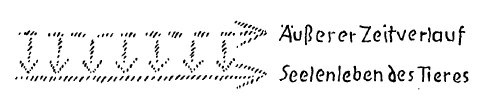
[ 19 ] Consider once more the inner experience of the animal, which runs parallel to the external passage of time [it is depicted]. The animal’s inner life unfolds in such a way that it is attuned to the external passage of time or to the sensations of its own body. For even when animals are digesting, for example, the images that rise from within provide an inner stimulus. And that is something extraordinarily interesting for the animal. In the animal, the external passage of time acts in such a way that it offers a continuous stimulus to the inner life. One could say: For the animal, every moment in its life is interesting. — Not so with human beings. External objects may cease to be of interest to him; things no longer interest him. But the external passage of time continues nonetheless! So imagine the inner life of the human soul and, alongside it, the external passage of time: external impressions reach the human soul; the human being has experienced these countless times, and therefore they no longer interest him. Then the inner life of the soul ceases, and since time also flows on with the life of the soul, time remains empty and the human being becomes bored. It is because of this unfilled time, then, that the human being can become bored. But what is it that acts upon this unfilled time? The earlier ideas, which now have a desire but receive nothing. So while we have constant stimuli in one direction in animals, in humans we have a desire for impressions in the temporal direction from the past into the future, because the ideas themselves demand new content, new enrichment. This is the advantage of humans over animals: that their past ideas live on and develop a life of their own into the future. I will point out things that might be misleading in this regard.
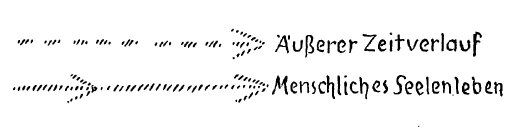
[ 20 ] There is, however, a remedy for boredom, which consists roughly of the following. In the images that flow by, there is not only a desire but also a content, so that they live on in the soul not only as desires but also as a content. Therefore, we ourselves can carry images from the past into the future. And this, in turn, is the higher development of the soul, when the images themselves carry something from the past into our lives. And there is a great difference between whether a person has something in their images that can interest them and fill their future spiritual life, or whether they have nothing within themselves. Thus, from a certain stage onward, a person can become bored. But if they fill themselves with meaningful ideas, these can in turn have an effect on the future. This is what distinguishes those who are capable of curing their own boredom from those who are not. This points to an independent life of our ideas within us, a life over which, as has become clear, we have no control, but to which we are surrendered. If we do not ensure that our ideas are meaningful, we are bound to be bored. Only through meaningful ideas can we protect ourselves from boredom.
[ 21 ] This is once again something of extraordinary significance for the connoisseur of the soul. For normal human life requires that a certain balance be maintained between the fulfillment of the inner life and external life in general. And a soul devoid of content that nevertheless continues to live on in time—for time does not wait—that is, a bored soul, is in a certain sense a poison for the physical body as well. Experiencing a great deal of boredom in life is a genuine cause of illness. It is, in fact, not an inaccurate description to speak of “deadly” boredom, even if one does not die from it immediately. But boredom is something that actually acts as a psychological poison. And its effects extend far beyond the realm of the soul’s life.
[ 22 ] So today you have already had to take in all sorts of things, and you may feel that these were still almost pedantic explanations. But through them we will nevertheless delve ever deeper into the true life of the soul. Subtle distinctions are necessary if we are to get to know this wonderful drama within the soul, with the hero at its center—the “I.” For hidden within all of us is a Someone who is, in essence, wiser than we ourselves usually are in life. And if this Someone were not wiser than we ourselves are in our inner life, then human life would actually be a terrible thing.
[ 23 ] As for how the individual lives his life, it is indeed the case that he indulges in the most curious notions about what the soul is, what the spirit is, what the body is, and so on. These things are jumbled together in the most haphazard way. And the following is particularly interesting. Whereas in ancient times, when even external science was based more on clairvoyance, a clear distinction was made regarding the extent to which the human being is situated within a physical, a soul, and a spiritual life, a church council in relatively early times felt compelled to abolish the spirit, and thus the dogma was established once and for all: Human beings consist of body and soul. — Yes, the spirit has truly been abolished. And if you were to familiarize yourself with the dogmatics of the Christian Church, you would gain insight into what has transpired as a result of the abolition of the spirit. Of course, some people realized that there must be something to which one must refer as “spirit.” But these were the most formidable heretics. Where one felt that body and soul were insufficient and introduced the spirit as a third element, one was deemed a formidable heretic. This stems solely from an uncertainty regarding the absolute legitimacy of speaking of body, soul, and spirit. And the moment one stops speaking of body, soul, and spirit, one throws everything into confusion. But people are such that they throw everything into confusion. And when one no longer really knows what spirit is and what soul is, then something else can disappear behind it. Thus, in fact, a clear view of spiritual life has disappeared.
[ 24 ] But even though people repeatedly fall into the trap of failing to distinguish properly, we can still say that something like a benevolent spirit watches over humanity, and that people do have a very vague sense of the truth. Human beings can have such a vague sense of the truth because something like the spirit of language is at work in their environment. Language is truly wiser than human beings. People do ruin much of language, but not everything can be ruined. Language is more correct and more reasonable than the individual human being. That is why language, in the stimuli and impressions it exerts on the human soul, sometimes acts quite correctly, whereas human beings, when they come along with their judgments, make mistakes. And now I would like to show you, by way of an example, how human beings, when they are devoted to language, nevertheless feel and sense what is right.
[ 25 ] Imagine that you are facing, first, a tree; second, a bell; and third, a human being. And based on what the external world tells you—that is, on your immediate sensory impressions—you now begin to judge; in other words, you set your inner life in motion. Judging is something that takes place in the soul. So you judge the tree, then the bell, and then the person. Look at the tree: it is green. You express the judgment that arises from this, in accordance with the genius of language, by saying: The tree is green. — Let’s assume that now you want to express something about the bell that follows from your sensory impressions, namely that the bell rings, that it produces a sound. At the very moment the bell rings, you will express your perception with the linguistic judgment: “The bell rings.” — Thus you have expressed the greenness of the tree by saying: The tree is green —, and what you experience with the bell, you express by saying: The bell is ringing. — Now let us turn to the human being: the human being speaks. You express this by putting your external perception into words: The human being speaks. — Now let us consider the three judgments that have been made, and what has arisen in these three ways: The tree is green — The bell rings — The person speaks. — In all three cases, you are dealing, if I may say so, with sensory impressions. But you will feel that in all three cases, when I compare the sensory impressions with the linguistic judgment, they turn out to be something quite different. There, however, when you consider the first judgment: The tree is green — you must consider: what am I actually expressing with this? Essentially, I am expressing something that, by virtue of the form of the judgment, must relate to space. When I say: The tree is green — I am expressing something that must relate to space, something that is this way now, will be this way again in three hours, in six hours, and so on. It is something enduring. Take the other judgment: “The bell is ringing.”—Are you also expressing something that is situated in space? No. There you are expressing something that is not situated in space at all, but rather something that unfolds in time, something that is a becoming, something that is in flux. Therefore—because the genius of language is very clever—you can never speak in the same way about something that is situated in space as you do about something that unfolds in time. For what pertains to the judgment, insofar as the tree is situated in space, language does not allow you to use a proper verb directly. You must resort to an auxiliary verb, something that helps you live linguistically in time, and must say: The tree is green. — But you may use a verb perhaps for a very similar fact; for if you have something else in mind, you can perhaps say something like: The tree is turning green. — But I ask you to consider whether you are not appealing precisely to time here? Where the genius of language permits you to move into time, you must move into that which unfolds in time, into that which is becoming, into the emergence of greenness. There is indeed a genius at work in language, a wondrous genius. Although much in it has been corrupted by humans, the fact remains that language does not permit us to apply a verb directly to that which is situated in space.
[ 26 ] And in the second judgment, where we are referring to a process, a becoming, we cannot possibly use “is” to express something that is becoming. At most, you could rephrase it: The bell is ringing —, thereby turning the verb itself into something that completely reverses the meaning. If you paraphrase in this way, you corrupt the language.
[ 27 ] Now for the third judgment: The man speaks. — Here you express sensory perception using the verb “speaks.” But consider for a moment what a difference there is when you utter the judgment: The bell rings, and: The man speaks. — In the first sentence, this conveys something that matters, because the sound is what matters. But when I say: “The man speaks”—this conveys something that doesn’t matter at all; rather, what matters is what is not expressed at all in the “speaking,” namely, what he says. It is not the sensory stimulus that matters—what is expressed in the verb—but rather the content, what is expressed by the verb. Here you stop with language before the content! Why do you not stop in the first instance with the judgment: “The bell rings”—and why do you stop with language before the content in the second instance? Why do you, as it were, stop short of what really matters? Because in the latter case you want to confront the living soul directly! You do not address the content with the word that the genius of language allows you; that is, you characterize what stands before you as an external phenomenon. You bring the inner nature of the bell into the word; there you have the metallic interior in the word “ring.” But when you stand before the living human being with his or her spiritual inner life, you already guard against bringing that inner life into the word through language itself.
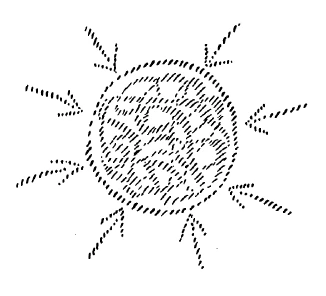
[ 28 ] Here, in the genius of language, you can clearly see the difference between what relates to place, to space, and what relates to a process, to becoming, and between what relates to the inner life of the soul. When we describe this from the outside, we pause in language, as if in reverent awe, before the inner world, before what really matters. We thus acknowledge, through our speech, the inner life of the soul. And we shall now see, in the course of the subsequent lectures, that it is indeed important to rise once more to a certain sensibility, to perceive the soul as something that delimits itself all around, as something that surges outward from within to its very limits and bursts forth at those limits. And when we describe it from the outside, we are compelled by the genius of language to pause, in a certain sense, before the inner life itself. It is important that you, one might say, learn to recognize the soul in its true essence as a kind of inner structure, as an inner formation, and realize that what must come from the outside strikes upon something that defends itself within. Therefore, we must imagine the soul as a circle, approached from all sides by sensory experiences, while the inner life of the soul surges and swells within. But this has become clear to us today: that this inner life is not internally independent, but that it experiences within itself the life of its own ideas, of the masses of ideas. The ideas drawn into the inner life exist within time.
[ 29 ] In the coming days, it will become clear how this life of ideas—which is set apart in the soul from the external world—is the source of our greatest bliss and our deepest pain, insofar as these have their origin in the soul. And we will see how the spirit is the great healer for the pain and suffering that ideas cause in our soul. But we may also say: Just as it is in the outer physical life that hunger must be satisfied, and just as the satisfaction of hunger is healing, so it is also in the inner life of the soul: ideas, in a certain sense, require inner nourishment through other ideas. — But if we overload ourselves, if we eat beyond our hunger, this leads to the undermining of health. And thus the fate of the soul unfolds in such a way that newly arising ideas can have a healing effect and also a sickening one. And we shall see how the spirit can not only have a healing effect on the hunger for ideas, but can also act as the healer in the face of an overload of ideas.