

Experiences of the Supernatural
The Three Paths of the Soul to Christ
GA 143
27 February 1912, Munich
Translated by Steiner Online Library
6. The Hidden Powers of the Soul
[ 1 ] We have spoken at length in recent days about the existence of hidden depths of the soul, and it is certainly beneficial, especially in relation to this topic, for us to consider various matters that may be useful for the student of Spiritual Science to know. On the whole, it must be said that a full understanding of these matters is actually only possible if one can work them out from what is initially provided in Spiritual Science.
[ 2 ] We have now examined what might be called the structure of the human being from a wide variety of perspectives. It will therefore be easy for everyone to relate what appears from a different perspective—when we wish to point a little toward the hidden depths of the soul—to the correct understanding of the structure of the human being, as we know it from the more or less elementary presentation of the spiritual worldview.
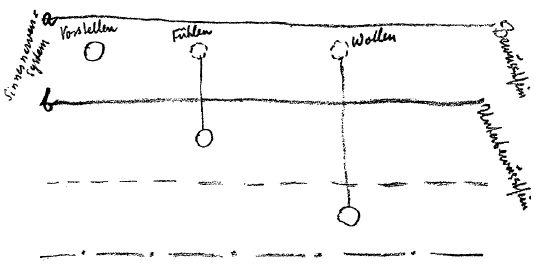
[ 3 ] It has been said repeatedly in recent days that everything encompassing our mental images, our perceptions, our impulses of will, our feelings, and our sensations—in short, everything that takes place in our soul in the normal state of consciousness from waking to falling asleep—can be called the activities, the characteristics, and the powers of ordinary consciousness. Now let us represent everything that falls within this ordinary human consciousness—that is, everything a person knows, feels, and wills from waking to falling asleep—by enclosing it within these two parallel lines (a; b) (see diagram on p. 100).
[ 4 ] Isn't it true that both our mental image and every form of perception belong within this region defined by the two parallel lines? So when we enter into correspondence with the external world through our senses and thereby form a picture of the external world from all manner of sensory impressions—while still in connection with, in contact with, the external world—that, too, belongs to our ordinary consciousness. But it also includes all our feelings and volitional impulses—in short, everything that our ordinary consciousness encompasses. One might say that everything about which normal mental life in everyday life is able to provide information belongs to this sphere, which is represented here by these parallel lines.
[ 5 ] The point is that we know very well that this so-called normal mental life depends on making use of the instruments of the physical body—that is, all the instruments comprising the senses and the nervous system. If we contrast these two parallel lines with two others, we can say: In our physical organism, the sense organs and the nervous system correspond to what we might call the instruments of this consciousness—primarily the sense organs, but also, to a certain extent, the nervous system.
[ 6 ] Beneath the threshold of this ordinary consciousness lies everything we might call the hidden aspects of the soul’s life, or the subconscious. We will gain a good understanding of everything that is, so to speak, embedded in this subconscious if we remember that through spiritual training, human beings acquire imagination, inspiration, and intuition. So just as we bring mental images, feelings, and impulses of will into ordinary consciousness, we must bring imagination, inspiration, and intuition into the subconscious. But we also know that the workings of the subconscious do not occur only when such spiritual training is present, but that they can also occur as an ancient legacy of an original, a primitive state of human consciousness, like an atavism. This is where those things occur that we call visions; and visions in what we might call “naive consciousness,” in primitive consciousness, correspond to imaginations developed through proper training. Premonitions arise; these would be primitive inspirations. We can immediately cite a significant example to illustrate the difference between inspiration and a premonition.
[ 7 ] We have, after all, mentioned on several occasions that, in the course of the 20th century, something will occur within human evolution that can be called a kind of spiritual return of the Christ, and that there will be a number of people who will experience the Christ’s descent into our world from the astral plane in an etheric form. One can gain an understanding of this fact by recognizing, through proper training, the course of evolution, and by coming to realize, so to speak, through proper training, that this must take place in the 20th century. However, as is indeed frequently the case in our present time, there may well be individuals here and there endowed with a natural, primitive clairvoyance who will have, so to speak, a kind of dim inspiration—what we call a premonition—regarding the approach of the Christ. Perhaps such individuals would not know exactly what is at stake; but even such an important inspiration can certainly arise in the form of a premonition. — For the primitive consciousness, something may now arise that does not remain at the level of a premonition or a vision. A vision is the projection of some image representing a spiritual process. If, for example, someone has lost a loved one, so that the person’s ego has passed through the gate of death and now dwells in the spiritual world, and a kind of connection is established between this person and the one living in this world, then perhaps the one living in this world may not know exactly what the deceased wants from them and may have a false mental image of what the deceased is experiencing in their soul. But the fact that such a connection exists at all presents itself in a vision that may be false as an image, yet grounded in the true fact that the deceased wishes to establish a connection with the living. This manifests as an intuition. So that the one who has intuitions knows, so to speak, certain things—whether concerning the past or the future—that are inaccessible in the normal state of consciousness. But when something presents itself to the human soul in a clear perception—not merely as a vision, which under certain circumstances may also be false, but as a clear perception—be it some process in the sensory world here or in a realm where one cannot see the matter with ordinary senses, be it a process of the supersensible world— then in occultism such a phenomenon is designated by a specific term: one speaks of deuteroscopy or the second sight. But with this I have merely described to you what—whether as something attainable through proper training or occurring as a natural clairvoyance—takes place in consciousness, or rather in the subconscious, but precisely within the human soul itself.
[ 8 ] However, everything that takes place within the human soul itself—when we speak of the subconscious in contrast to ordinary consciousness—differs quite significantly from all the processes of ordinary consciousness. The processes of ordinary consciousness, in relation to all that to which they actually refer, are truly such that one can—I would say, to put it mildly and as gently as one can in a public lecture—speak of the powerlessness of ordinary consciousness. The eye sees a rose; but this eye, which in itself behaves in such a way that a mental image of the rose arises within us, is, for ordinary consciousness with all its perception and the mental image of the rose, utterly powerless in the face of the rose’s growth, coming into being, and passing away. The rose grows and withers through its natural forces, but the eye is powerless, as long as only ordinary consciousness is at work, to grasp the immediate present; only this is accessible to its perception. This is not the case with the facts of the subconscious. And this is what we must first establish, for it is extraordinarily important. When we perceive anything through our eyes in normal vision—color images or anything else—not only can we not change the objective reality through the act of perception itself, but something else even occurs when vision is normal: If nothing else occurs before the eye besides mere seeing, then the eye remains unchanged even through the act of seeing. Only when we cross the boundary from normal light to blinding light do we harm the eye. So that we can say: In the facts of normal consciousness, we do not even affect ourselves when we remain within them. Our organism is simply constructed in such a way that the facts of ordinary consciousness do not usually bring about changes within us either.
[ 9 ] The situation is different with what occurs in the subconscious. Let us suppose that we form an image in our mind, or that we have a vision. Now let us assume that this image or vision corresponds to a good being. This good being is then not in the physical-sensory world, but in the supersensory world, and we now want to place the world in which the beings we perceive through an image or vision reside between these two parallel lines (see diagram on pp. 100). In this world that we have placed here, let us seek out everything that can become an object, a perception, or a subject for the subconscious. We shall not yet write anything into this space. But if we create a mental image of anything that is in this world—such as an evil, demonic being—it is not the case that we are initially as powerless in relation to this being itself as the eye is powerless in relation to the rose. When, in an imagination or vision of an evil being, we develop the feeling that it should depart from us—and we do this with a completely clear, visionary, imaginative mental image—then the being that exists in this world must actually feel as if it were being pushed away from us by a force. The same is true when we have a corresponding imagination or vision of a good being. Here, too, it is the case that when we develop a feeling of sympathy, this being actually feels within itself the power to approach us, to connect with us. All beings that dwell in this world in any way feel our forces of attraction or repulsion when we develop visions of them. So that we are, with our subconscious, in a situation similar to that of the eye, which could not only see a rose but, through the simple act of seeing, could develop the desire for that rose to approach it and draw the rose toward itself; or if the eye sees something repulsive, it could not only arrive at the judgment: this is repulsive—but could remove this repulsive thing through mere antipathy. The subconscious is thus in contact with a world upon which the sympathy and antipathy taking root in the human soul can act. It is necessary that we bring this fully before our minds. Now, however, sympathy and antipathy—indeed, the impulses that reside in the subconscious—do not merely act upon this world in the manner indicated, but they act upon what is above all within ourselves and what we must now think of as part of the human etheric body—but not merely as part of the human etheric body, but even as certain forces of the physical body — that we must conceive as enclosed within these two parallel lines: Within these two parallel lines, we must conceive of what lives in the human being, first as the force that pulses through the human blood—that is, the warmth of the blood—and then another force that lies in our healthy or diseased breathing, which is more or less determined by our entire organism; that is, the more or less healthy breath force—we might say: the condition of the breath force. Furthermore, a large part of what is called the human etheric body belongs to all that upon which the subconscious within us acts. Within ourselves, then, our subconscious mind—or the hidden forces of the soul life—is at work; within ourselves, they act in such a way that our blood temperature is influenced, and since the entire pulsation, the liveliness or sluggishness of our blood circulation, depends on our blood temperature, you can see that our entire blood circulation must be connected in a certain way to our subconscious mind. Whether a person has faster or slower blood circulation depends essentially on the forces of their subconscious mind.
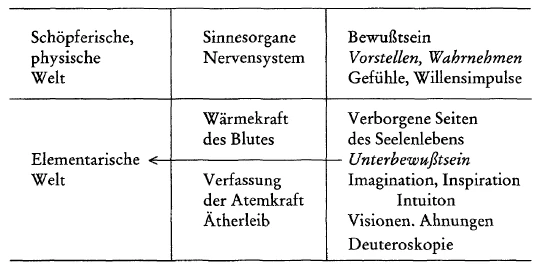
[ 10 ] If the effect on everything out there in the world—whether demonic or benevolent beings—occurs only when a person has visions, imaginings, or other perceptions in the subconscious with a certain clarity, if certain forces become magically effective in this world merely through sympathy or antipathy, then this clear -stepping-before-the-soul in the subconscious is not necessary for the effect on the inner workings of our own organism, which consists of what has been written down here. Whether or not a person knows which imaginations would correspond to this or that sympathy within them: this sympathy acts upon their blood circulation, upon their respiratory system, upon their etheric body. Let us suppose, then, that a person were inclined, for a certain period of time, to experience only feelings of revulsion: if he were a visionary or an imaginative perceiver, he would have before him certain visions or imaginations—as described the day before yesterday—as perceptions of his own being. These would indeed be projected out into space, but they would still belong only to his own world. Such visions and imaginations would represent what lives within him as the forces of feelings of revulsion. But even if a person cannot practice self-knowledge in this way, but simply has such feelings of revulsion, when they live within him, they affect him. They affect him in such a way that they actually influence the warmth of his blood and also his breathing. So that it is indeed the case—if we now turn to another matter—that a person has more or less healthy breathing, depending on whether they experience this or that feeling in their subconscious, that they have more or less healthy blood circulation, depending on whether they experience this or that in their subconscious. And in particular, the activity of the etheric body, all the processes within it, depend on the emotional world that lives within a person.
[ 11 ] But now—and this becomes evident when the facts of the subconscious are truly experienced by the soul—not only does this connection exist, but because this connection exists, a continuous effect is exerted on the entire constitution of the human being, so that there are certain feelings, certain sensations that flow down into the subconscious, and by evoking certain forms of the blood’s thermal energy, certain states of the breath force and the etheric body, they either have a stimulating effect on the organism or inhibit the entire life process, so that through what flows down into the subconscious, something is always arising or passing away within the human being. A person either draws upon life forces or adds to them through what they send down from their conscious state into the subconscious states. And if a person takes pleasure in or even merely tolerates a lie they commit—not feeling revulsion, which is the normal reaction to a lie, but instead being casual about lying or even taking pleasure in it—then the emotional response to the lie is sent down into the subconscious. That which enters the subconscious here impairs blood circulation, respiratory function, and the powers of the etheric body; and the consequence of this is that, with regard to all that remains to the person when they pass through the gate of death, they have, through what has just been described, impoverished themselves, become weaker in strength, and allowed something within them to die that would have come alive had the person felt revulsion, a sense of revulsion toward the lie, for this is the normal feeling toward it. For if the feelings of revulsion toward the lie had been brought to the fore, this would have transferred itself to the forces described here, and the human being would have sent something life-sustaining, something of the creative forces, into his organism.
[ 12 ] We can thus see how, in fact, human beings—through the constant flow of things and forces from their higher consciousness, from their ordinary consciousness, into their subconscious—work, starting from this subconscious, on their own coming into being and passing away. However, as he is today, the human being is not yet powerful enough to corrupt, so to speak, other parts of his organism from the soul—beyond merely the blood circulation, the respiratory system, and the etheric body; he cannot also corrupt the coarser and more solid parts of his physical organism in this way. The human being is, so to speak, only capable of corrupting himself in relation to a part of his entire organism. What is corrupted, however, becomes particularly evident when what remains of the etheric body—for the etheric body is in constant connection with the heat energy of the blood and the respiratory system—has been influenced in this way: then it withers away due to negative emotions. But it receives within itself fertilizing, strengthening, and promoting forces through good, normal, genuine feelings. We can therefore say that through what takes place in his subconscious, the human being works directly on the arising and passing away—that is, on the actual events, on the reality of his organism—that he descends from the region of the powerlessness of ordinary consciousness into that region where something arises and passes away in his own soul and thereby in the entire organization of the human being.
[ 13 ] We have now seen how, as the subconscious becomes more or less accessible to our soul—that is, as we come to know something of it—it also exerts an influence on a world which, to use a term that was employed throughout the Middle Ages to describe this realm, can be called the elemental world. Now, human beings cannot enter into any direct relationship with this elemental world, but only indirectly, by first having these experiences within themselves, which arise in the organism as effects of the subconscious. But once a person has come to know themselves well enough to realize: when you feel this, and send this or that aspect of your behavior down into your subconscious, you destroy certain things and cause them to wither away; if you experience other things and send down certain co-experiences of them, then you nurture yourself; when a person experiences this interplay of destructive and nurturing forces within themselves for a time, then they become ever more mature in self-knowledge. That is actually true self-knowledge. It can really only be compared to an image that one might gain in the following way. For in this way one gains a self-knowledge that is truly as if, through a lie and through an incorrect perception of a lie when it rises in our instincts, we were to immediately bring about a scorpion biting off one of our toes. One can be convinced that, upon perceiving such a real effect, people would lie less than they do now. If, then, a mutilation of our physical organism were to be brought about directly in the physical world, such a thing would be comparable to what actually happens with regard to what is usually not perceived—through what is sent down into the subconscious from these daily experiences. What is sent down from a casual perception of a lie is such that it chips away at us, takes something away from us that we then no longer have, causing us to wither, which we must then reacquire in future karma. And when we send a true sensation down into the subconscious—there is, of course, a thousandfold scale of sensations to consider that can thus sink down—then we grow within ourselves, building new life forces into our organism. This observing of its arising and passing away is what first occurs in a person in the process of true self-knowledge.
[ 14 ] Now, I have been told that it was not well understood the day before yesterday how one can distinguish a true vision or imagination—which belongs to the objective—from that which merely projects itself into space and belongs to our subjective realm. Yes, one cannot say: Write down this or that rule, and then you will be able to distinguish—such rules do not exist; rather, one learns this gradually through development. And one can only truly distinguish between what belongs solely to ourselves and what, as an external vision, belongs to a real entity once one has gone through the experience of being constantly gnawed at by deadly subconscious processes. Then one is endowed with a certain degree of certainty. But then this also happens: one can always bring about a situation where one confronts a vision or imagination and asks oneself: Can you see through it by the power of your spiritual vision? — If the vision remains when one develops the active power of looking, it corresponds to an objective fact; if the active power of looking extinguishes the vision, then it belongs only to ourselves.
[ 15 ] Thus, a person who is not careful in this regard may, for my sake, have a thousand and a thousand images from the Akashic Records before them; if they do not test whether these images are erased or not upon absolutely active observation, then the Akashic images—no matter how much they may recount facts—are valid only insofar as we can regard them as images of our own inner self. And it could happen—I say, it could happen—that someone sees nothing but their own inner self, and that this projects itself in highly dramatic images, which they, for my sake, imagine extending throughout the entire Atlantean world, through generations of human development. Under certain circumstances, this need not be anything other than a projection of one’s own inner self, even if it appears with the greatest possible objectivity.
[ 16 ] Now, once a person has passed through the gate of death, what inevitably occurs within them is that the obstacles through which the subjective life within them becomes objective vision or imagination are no longer present. In ordinary present-day human life, what a person experiences inwardly, subconsciously—what they send down into their subconscious—does not always become vision and imagination. It becomes imagination through proper training, and vision through atavistic clairvoyance. When a person has passed through the gate of death, the entire inner world immediately becomes an objective world; it is simply there. And Kamaloka is essentially nothing other than a world built up around us from what is experienced in our own soul; only in Devachan does the situation become virtually reversed. Thus we can easily see that what I have said regarding the effectiveness of the sympathy and antipathy present in visions, imaginations, inspirations, and intuitions acts under all circumstances upon the objective elemental world. I have said: In the case of the human being embodied in the physical world, only that which he brings to the level of vision and imagination affects this elemental world. In the case of the dead, the forces that were present in the subconscious—and which are then carried along when the human being has passed through the gate of death—always affect the elemental world. — So that everything a person experiences plays a role in the elemental world after death. With the same certainty with which you create ripples in a river when you splash it, the experiences of the deceased propagate themselves in the elemental world; with the same certainty with which the ripples propagate around the point where you splash in a body of water. Or they propagate into the elemental world with the same certainty with which an air current propagates. Therefore, the elemental world is constantly filled with what is stirred up in this elemental world by what people carry with them from their subconscious when they pass through the gate of death. It is therefore always simply a matter of our being able to create the conditions to see and perceive things in the elemental world. The clairvoyant is such that one need not be at all surprised when he correctly recognizes the things that occur in the elemental world as the effects of the dead. But, as you will see, one can trace these effects of the experiences of the dead—which initially play out in the elemental world—all the way into the physical world, albeit under certain conditions. For when the clairvoyant has personally undergone everything I have described in the elemental world, he eventually comes to have remarkable experiences. Let us assume that a clairvoyant goes through the following process: First, he can, say, look at a rose. He looks at this rose with his physical eye. When the clairvoyant looks at it in this way, he receives a sensory impression. Let us further assume that the clairvoyant has trained himself to feel a very specific emotion when faced with the color red. This is necessary; otherwise, the process cannot proceed. Without experiencing very specific emotional nuances in response to colors and tones, this clairvoyance—which is directed toward external objects—cannot proceed. Let us assume he sets the rose aside. Then, if he were not a clairvoyant, the feeling would have sunk into the subconscious and would be working there on his health or illness. But if he is a clairvoyant, he will now perceive how the image of the rose works in his subconscious; that is, he will have an image of the rose. At the same time, he will perceive how this has a destructive or beneficial effect on his etheric body or physical body. Once he has this mental image, he will thereby be able to exert a force of attraction upon the entity we might call the group soul of the rose. He will thus see the group soul of the rose, insofar as it lives as such within the elemental world. But if the clairvoyant now goes even further—that is, has moved beyond the sight of the rose, has let go of the rose, and has followed the inner process of devotion to the rose and the effects arising from it, and has come to see something of the rose in the elemental world— then he sees, at the spot where the rose appeared to him, a kind of wonderfully luminous image that belongs to the elemental world. But then, once one has followed the process this far, something occurs. One can look away from what is before one; one can command oneself: Do not see with your inner vision what you have as a living etheric being going out into the world! Then the peculiar thing occurs that the clairvoyant sees something passing through his eye and showing him how the forces act that build up the eye from the human etheric body. He sees those forces that belong to the building forces of his own physical body. He literally sees his physical eye just as he would otherwise see an external object. This is indeed something that can occur. One can make the journey from the external object to the point where, in an otherwise absolutely dark space—one must not allow any other sensory perception to enter—one perceives how the eye appears in a spiritual image. One sees one’s own inner organ. For one has then come into this region, and this region is what is truly the creative force in the physical world. The creative physical world is first perceived by perceiving one’s own physical organization. One thus makes the journey back to oneself. What, then, has sent such forces into our eye that we literally see our eye as if rays of light were emanating from it, which actually correspond to the very essence of seeing? — Then we see the eye bounded by a kind of yellow glow; we see the eye enclosed within ourselves. This is the result of the entire course of forces that have finally brought humanity this far.
[ 17 ] The same process now applies to forces that may emanate from a deceased person. The deceased takes the contents of their subconscious into the world they experience after passing through the gate of death. Just as we enter our own physical eye, so the forces that the deceased sends out return from the elemental world into the physical world. The deceased may experience a particular longing for someone they have left behind. This particular longing is initially in the subconscious. It immediately becomes a living vision, through which they influence the elemental world. In the elemental world, what is here merely a living vision simultaneously becomes a force. This force takes the path indicated by the longing for the living, and if the opportunity arises, it rumbles in the physical world, near the living: they hear rumbling sounds or the like, which they perceive just as they would perceive any physical object. It is precisely these things, which arise from such a connection, that far more people in the world would perceive at all than is usually the case, if only people would pay attention to the times that are most favorable for such influences. The most favorable times for this are when falling asleep and waking up. And actually, people simply do not pay attention to it, but there cannot really be any people who have never perceived manifestations from the supersensible world during the transitions between falling asleep and waking up, such as rumbling sounds or even words.
[ 18 ] I wanted to point this out to you today because I wanted to show, in concrete reality, what the connection is between the human being and the world. What the human being perceives as an objective sensory world in ordinary consciousness is powerless and seems to have no real connection to this sensory world itself. But as soon as what a person experiences sinks into the subconscious, a connection with reality is immediately established. The powerlessness of the previous consciousness gives way to a subtle magic. And when a person has passed through the gate of death, freed from the physical body, their experiences are such that they play a role in an elemental world and, under favorable conditions, exert an influence even into the physical world, where they can also be perceived by ordinary consciousness.
[ 19 ] I have given you the simplest case that can occur, because one must start with the simplest case. Of course, over time—just as we have always taken our time to gradually work out what we need to know—we will also move on to more complicated matters that can lead us, so to speak, into the more intimate connections between the world and human beings.